Michael Denis Crossey 'Irishman Wornout'
- Caught in the Troubles -
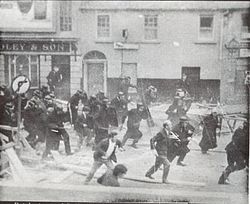
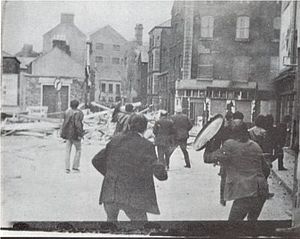
The Derry City riots, August 1969 (Wikipedia)
How ever in less that a decade, areas across the North would be rocked by sporadic violence during and after the civil rights marches against religious discrimination on Irish Catholics. The attacks were carried out by both the Royal Ulster Constabulary (RUC) and Protestant loyalists.
As Irish Republican volunteers in the 1950s and 60s saw it, it was not a war of religion, but against the armed occupiers, namely, the British Army. In those early days, the average joe public on the streets in the North were not overly interested in waging war against the British. They say the struggle waged by the IRA as something from south of the border being imposed on the people in the North. Public opinion north and south of the border was against war in any shape or form.
In November 1961 the Justice Minister Charles Haughey introduced military courts that handed down lengthy sentences to captured IRA volunteers. The IRA leaders knew that they would have to step down or be destroyed. By February 1962 the IRA council gave orders to dump arms, and stand down until further notice. In short, this period of unrest led to the Irish civil rights movement and paved the way for the Provisional IRA and the brutal conflict that followed.
One view about the streets I still recall from my childhood days in Catholic west Belfast was that we were descendants of those displaced natives. And, if that was a not enough, we believed that the Protestants who lived in the houses across the new M1 Motorway were the descendants of those who displaced the native Irish.
In my early adult years I studied in America, where I majoried in American History I learned that squatting on land was a trend that many of the Ulster Scotch-Irish took with them to the New World. Consequently, historical arguments can be presented to show that much truth runs in such beliefs, but things are really much more complicated. Regardless of religion, there is much information to show that most, if not all, of the people currently living in the Ulster are decedents of those who have intermarried since the Plantation times, a trend that still continues today. So who are the Irish?
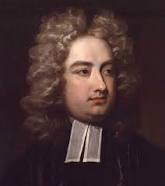
Jonathan Swift (1687-1745) (Wikipedia)
If we take a look at past and present the leaders throughout Ireland it is a similar story. Intermarriage! There was not a child on our street and the neighboring streets who had not heard of Jonathan Swift’s ‘Guliver’s Travels’. Swift had written extensively on Ireland’s plight in the early 1700s. But how many of us knew, or even cared that this great thinker had an Irish mother and English father. The notable Irish nationalist leader, Charles Stewart Parnell (1946-1891) who was born in Avondale in County Wicklow during the Great Famine to an American mother. One of Ireland’s more recent and long lasting of leaders, Eamon De Valera was born in Brooklyn, New York in 1882 to an Irish mother and a Spanish father.
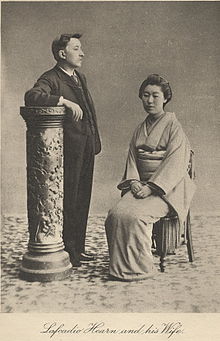
Lafcadio Hearn with his wife, Koizumi Setsu (Wikipedia)
The writer Patrick Lafcadio Hearn (1850-1904) was the son of a Greek mother and an Irish father. He was also known by his Japanese name, Koizumi Yakumo, where he lived, taught, married, and needless to say, wrote books about Japan. Hearn was naturalized a Japanese citizen in 1896 after accepting a teaching position in Tokyo. Hearn died and was buried at Zoshigaya Cemetery in Toshima in Tokyo. The grave is not marked by a cross, for he turned away from Catholicism in his early school years, which confirmed his conviction that Christian education was a load of "conventional dreariness and ugliness and dirty austerities and long faces and Jesuitry and infamous distortion of children's brains.” Similar to my own views, Hearn was anti-religious for much of his life before finally becoming a Buddhist.
Even the beloved term, ‘emerald isle’ that many still use to describe the island of Ireland was first coined in a poem (‘When Erin first rose’) by the noted and respected Ulster Presbyterian, William Drennan, religious hatred remains. Drennan was not only a fine poet, but a physician, not to mention a political radical, too. As a political radical he was one of the founding fathers of the Society of United Irishmen who launched the Irish Rebellion of 1798 with the aim of ending British monarchical rule over Ireland and establishing a republic.
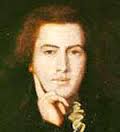
William Drennan (1754-1820) (Wikipedia)
“On the whole the Anglo-Irish wisely avoided any attempt to deal in racial terms; indeed they felt no compulsion to do so. Their patriotism was one of place, not of race.” (Boyce p.105).
Already by the late-1960, many Ulster Protestants spoke more openly of Catholics with extraordinary hatred and contemptuous scorn, and Catholics spoke of them more or less in the same light. Roman Catholicism was often referred to as "Popery" by some who had a some bone to pick with the Catholics. One name that comes to mind was the Reverent Ian Richard Kyle Paisley (1926-2014), who was making a name for himself in these early years. Of course, the religious antagonism was by no means the only issue that separated people in the north of the country, but also the different views on history, politics, economy, and social issues. In those early days, however, religion (Catholic and Protestant) pulled the strings in just about every part of a person's life throughout Ulster, and Paisley was no different.
Paisley was a loyalist politician and Protestant religious leader from Northern Ireland. He was ordained a Protestant evangelical minister in 1946 and continued so for the rest of his life. Paisley was involved in Ulster Unionist-Loyalist politics in the late 1950s, and soon became a firebrand for their causes. In the latter half of the 1960s, for example, he led and instigated loyalist opposition against the Catholic Civil Rights Movement in Northern Ireland, who challenged inequality and discrimination in the North with displays of solidarity amongst the masses of similar mind.
This opposition led to the outbreak of the Troubles (Na Trioblóidí) in the late 1960s, a conflict that would engulf much of Ulster, not to mention its affect on the British economy, for the next thirty years. (The conflict ended with the signing of the Belfast Good Friday Agreement in April 1998). War was a dirty, stupid, crazy, and deadly business that destroys everyone and everything in its path. The Troubles marked another sorrowful period in Irish history that culminated in widening divisions further, not to mention in the loss of more than 3,500 lives, with countless others seeking new lives abroad. Many people moved away for fear of their future and their families future, rather than because of any immediate concerns.
In April, 1966 the fundamentalist preacher Reverent Ian Paisley founded the Ulster Constitution Defense Committee (UCDC), which in turn formed its paramilitary wing called the Ulster Protestant Volunteers (UPV). This was in opposition to the mostly Catholic Civil Right Movement. Then a month later in late-May, a loyalist group going by the name of the Ulster Volunteer Force (UVF) declared war on the Irish Republican Army (IRA). Although the IRA were not engaged in any armed activities at this time, they feared that a revival was imminent. Whilst many Irish nationalists were busy preparing to mark the 50th anniversary of the Easter Rising of 1916.
The months of May and June saw three planned attacks on Catholics in Belfast by UVF members. This included the killing of a Protestant woman by mistake. An UVF team had attempted to firebomb a Catholic-owned public-house that was situated next to the home of the Protestant woman. Soon afterwards, a Catholic man was shot dead on his way home. Then, the UVF opened fire three Catholic men as they left a pub, wounding two, and killing one. The dead man was from the Republic of Ireland.
In petty terms, the worry of something bigger happening could be said to have worn all opposing sides down. However, in world terms, any triumph could be said to be the nationalists. Baring that normal taste for mischief, the mass destruction of life and material that war can bring about, was something that the youth had not yet experienced. Despite our shyness, sullenness, playfulness, loudness, we were identifiably normal, we were powerless kids longing to grow up and live a normal life.
In fact, the civil rights movement in the North dates to the early 1960s to challenge inequality and discrimination. The Troubles that erupted out of it all was also a dissident campaign involving republican and loyalist paramilitaries, and British security forces. Some historians date the Troubles from the riots of 1968 through to the Good Friday Agreement of 1998.
1968
Beginning in late-August, 1968, the Civil Rights Movement had organized a series of marches. In turn, loyalists groups organized counter-demonstrations to have the marches banned. One example of this was on 5 October when a civil rights march was set to take place in the city of Derry. The Apprentice Boys Association planned to hold its own march at the same time, in the same place, which caused the government at Stormont to ban the civil rights activists from marching. With the support of a number of Members of Parliament, the ban was defied by the civil rights activists.
Clearly some in the government felt there was potential in the air for a great calamity to occur if the civil rights march went ahead. What they did not see was a lack of discipline among RUC officers who surrounded the marchers. With the presence of teams of RUC, some of whom hastily broke forward only indicated that something more than a repulse of the march was about to happen. The police, who had been engaged in the area all day long, advanced in mass through the now broken lines of marchers beating them indiscriminately. Many of the marchers did there best to preserve an unwavering and undaunted front as they advanced into the chaos beyond them. By the end of the day there were more than 100 casualties among the marchers, which included some MPs. The unprovoked action sparked a further two days of heavy rioting in Derry between Catholics and the RUC.
On 9 October, around 2,000 Queen’s University, Belfast students formed its own organization called, People’s Democracy, and attempted to march under this banner to Belfast City Hall to protest against the police brutality in Derry. In turn. the student march was blocked by loyalists led by the Reverent Ian Paisley.
In January, 1969 a People’s Democracy march from Belfast to Derry found itself under repeated attack by groups of loyalist supporters. Then at the town of Burntollet the march was again attacked by a large group of loyalists with bottles, bricks, iron all sorts of deadly paraphernalia. Some of the loyalists were known to be off-duty police (RUC). According the marchers, the police who were on duty did little to stop the attacks. If that was not enough, when they did finally reach Derry the RUC went into action to break up the march by force. This again led to heavy rioting between Irish nationalists and the police. Later, loyalists, including some police went on a rampage in the Bogside area of Derry, which was home to mostly Catholic families. In turn, the residents built barricades to stop the attacks, giving birth to what became known as ‘Free Derry’.
Then in March, just two months after these attacks, a series of bombs planted by the UPV and the UVF damaged water and electricity installations in the North, which they blamed on elements within the civil rights movement, as well as on the IRA who still remain inactive at this time. The loyalists aim was to bring down the Stormont government led by Prime Minister of Northern Ireland, Terence O’Neill who wanted to make concessions to the civil rights movement. As a result, British soldiers were deployed in the North to guard the installations. In the meantime, Unionist support for O’Neal began to wane, and which would soon lead to his resignation in late-April. On 17 April, the QUB student and People's Democracy activist Bernadette Devlin became the youngest woman ever to be elected to Westminster, in London.
Many people hold to the view that the Troubles was a fight for a United Ireland, which could not be further from the truth. It is true, the Troubles irrupted from a civil rights movement that got madly out of control, and that the war was fought for better living and working conditions for the Catholics. Further, the population in the North was so closely divided that even if a one-Ireland vote moved minds closer to that goal, the others would have fought nail and tooth to prevent it from happening. I think this was well understood by republicans in their armed struggle to improve conditions for all on a more equal footing.
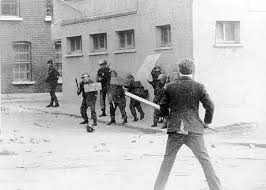
Throughout the months of April and July more attacks were unleashed on Catholic by loyalist and RUC members resulting in the death of some Catholics. This included Francis McCloskey, a 67 year old who is believed by many to be the first civilian to die in the Troubles. On the 5 August, the RTE Television Center in Dublin was damaged by a bomb planted by the UVF. Then on 12 July, heavy rioting broke out in Derry between Irish nationalists and loyalist, and police during the annual Apprentice Boys march. The rioting continued continuously for two days and became known as the Battle of the Bogside. the RUC used armored cars to force their way into the nationalist Bogside area of the city. CS gas, water cannon, and on occasion, firearms were used.
On 14 August, Irish nationalists held three days of protests in response to the events in Derry City. In a number of instances riots erupted throughout the North. In Armagh, Belfast, Coalisland, Crossmagien, Dungannon, and Dungiven loyalists rampaged in nationalist areas. As a result, six Catholics and two Protestants were shot dead, whilst at least 133 were hospitalized for gunshot wounds. Also, thousands of Catholic and Protestant people were forced to flee, or were burnt out of their homes. Many businesses, too, suffered, most of which were run by Catholics. As a result, some refugee camps were set up in the south of the Border to accommodate some of those who lost their homes.
The British Army duties were now widened as many soldiers were now deployed on the city streets. This marked the beginning of what was known as, Operation Banner, which may seem an appropriate title since the carrying of banners was a big thing in the North, particularly at festivals and celebrations. The By mid-August 1969, the decision was made to reinforce the RUC with army personnel. General Ian Freeland was placed in command of the British troops during a relatively peaceful time in the early part of the Troubles with only 1,000 soldiers at his disposal. Then in late-August he became the overall Director of Operations in security matters for the North. Soon with the escalation of rioting troop levels were increased to more than 6,000. The deployment of the British Army and its campaign in the North attracted some political criticism.
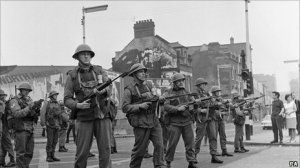
The British Army, deployed to restore order in Belfast in 1969 (Wikipedia)
On the 11 October, loyalists took to the streets in protest against the Hunt Report — disarming of the RUC, and the disbandment of the Ulster Special Constabulary, usual called the B-Specials. The B-Specials were a quasi-military reserve police force established in the North a little after the partition of Ireland in late-1920. They received military-like training, where therefore armed, and only to be used in times of emergency or unrest. Initially, the unionist and loyalists saw General Freeland on their side, a view that soon changed when he sought the abolition of the B-Speicals. Now with the British Army on the streets, there seemed little need of them.
However, it came of no surprise when violence erupted on that same day of the B-Specials demise, which left three people dead. One of the dead was a Victor Arbuckle, who became the first RUC officer to be killed in the Troubles. He had been gunned down by the Protestant UVF. Even before the rioting, the British Army presence had its critics, with many in the republican stronghold areas of major towns and cities being the most persistent, with the rebirth of the IRA the most fierce critic of all. On the political front, Gerry Adams, the leader of Sinn Fein (the Irish Gaelic expression for ‘We Ourselves’’, and oldest political party in Ireland), was perhaps the most eminent pamphleteer against the deployment of British soldiers on the streets. Needless to say, there were countless other noted figures steadfastly opposed to the presence of the soldiers, which was like turning back the clock. Undaunted by the criticism, the British government was unable to envisage what was about to unfold.
Through October and December the UVF continued their activities in the South by exploding a bomb close to the Garda Siochana, or the Central Detactive Bureau in Dublin. This was followed by a second explosion that damaged a power station in the town of Ballyshannn. Also, the memorials to the leaders, Wolfe Tone and Daniel O’Connell in Bodenstown and Dublin, respectively, were damaged by devices left by the UVF. At this time, the (Official) IRA remained dormant, which caused a splint among its members that led to the establishment of the Provisional IRA.
In the case of recruitment to the republican organizations, it was not that the young men and women had nothing to lose and no where to go, or workless, homeless, hopeless, and unconnected. Far from it! They were often of strong, loving family backgrounds. Many were the quite educated types, far from the noisy kind you might hear in the pubs on a weekend, for such people only drew attention to themselves. The republican soldiers were well aware of the fact that the course they set out on could lead to paying the ultimate price, and which many of them would certainly pay. Many others chose not to get involved and simply packed up and moved across the Irish Sea to make their lives in England. From there others moved on to secondary migration across that impenetrable barrier, the Atlantic Ocean to America.
Then there was the added strangeness of being away from their native place. The new environment and surroundings seemed foreign, for the different dialects, backgrounds, and customs. Of course, it helped that many of them were familiar with urban life, and many again would come to make a happy life for themselves and their families far away from what they had left behind. The decreasing opportunities for employment at home, or the consequences of unemployment, or the increasing demands of living through the Troubles, saw places like London as their goal for hope and security. And why not? London in particular was one of the most cosmopolitan cities of the civilized world, and home to the comers and goers of all kinds of strong, willing, and able people from all parts of the British Isles, and beyond to seek out a meaningful livelihood. The increasing movement, mainly young people to industrial urban centers like London, Birmingham, Manchester, and Liverpool, and so forth, became particularly enormous at the hight of the Troubles.
Most would travel in search of employment and opportunities to different parts of Britain, though some with a skill or trade under their belt. For others, a lack of success in search of a good full-time job meant a life of irregular work. Many Irish people have travelled the highways and by-ways of Britain. Today, people with strong Irish connections can be found in almost every county and major industrial town throughout the United Kingdom. Migration was nothing recent, rather since time immemorial. Just as birds of a feather flock together, whole districts of London, such as in Kilburn and in Camden Town, would become lodging house ghettoes filled with Irish people. This helped with blending into the familiarities of life and the members and customs they brought with them. Many of whom would leave their mark in the construction industry. For example, I read in the Irish Times in June of 2015 that a new international project was set up by the Irish Architecture Foundation called 'We Built This City’. London! The project also planed to show where the Irish contributed in the creation of some of the most famous cities in the world.
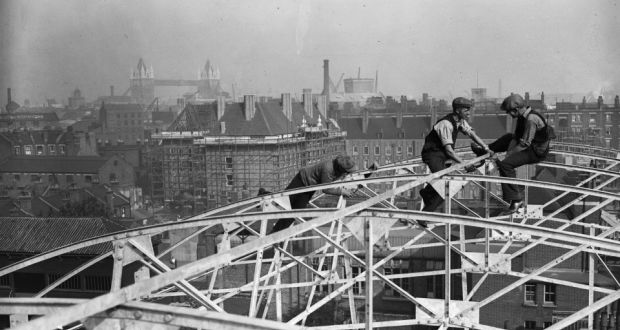
Construction workers high over London with London Bridge in the background. (Photograph: Getty Images)
Those who stayed to fight and those who chose to leave for whatever their reason or religion, were products of an Irish heritage, and almost without exception they shared a common ancestry. This includes the social and economic conditions from which they came. The living conditions prior to leaving Ireland, or getting caught up in the Troubles -- standards of housing, hygiene and diet, expectations of life and employment, and so on. This Irish heritage differing only according to their parentage, their place of birth, their trade or skills (if any), their occupation, and their place of residence.
1970
By late-March, 1970, heavy rioting again erupted following an Orange Order march along the Springfield Road in Belfast. The Springfield Road is a residential area adjacent to the equally Irish nationalist and republican Falls Road in West Belfast. It also crosses into the Protestant and loyalist areas of the Greater Shankill Road area of Belfast. The rioting was to last for three days in which the British Army used CS gas for the first time in the city. By the end of the riots, closed to 40 British soldiers were injured, along with many civilians.
On 3 April, General Freeland announced that anyone seen to be throwing petrol bombs, a weapon that had become common during the rioting, would be shot dead. Just across the Irish Sea, Edward Heath replaced Harold Wilson as Prime Minister in a landslide election on 19 June. On 24 June I would be 14 years old, my first birthday in London were I now attended school!
Two days of riots erupted on 27 June in both Belfast and Derry after the arrest of the young nationalist leader, Bernadette Devlin. Then Orange Order marches across nationalist Catholic areas led to more violence that culminated in guns being fired between republicans and loyalists that left seven people dead. By 3 July, heavy rioting again erupted between residents and soldiers during an army raid along the Irish nationalist Falls Road area of Belfast. Large quantities of CS gas was used, and gun battles developed between British soldiers and the Official IRA (OIRA). As a result, the entire area was sealed, and a 36-hour curfew was imposed, which became known as the ‘Falls Curfew’. Hundreds of homes were raided and more that 300 arrests were likewise made. At the end of it all, three residents were killed, and a British journalist who was shot by British soldiers. 63 people received hospital testament for their wounds. Last but not least, fifteen British soldiers were shot by the OIRA.
By 2 August, rubber bullets were used for the first time on the streets to curb the demonstrations and riots. On the political front, the nationalist Social Democratic and Labour Party (SDLP) was formed. Under the leadership of Gerry Fitt, the SDLP would in a short while withdrew from any parliamentary involvement at Stormont as they felt it to be ‘un-reformable’. They would in the coming years become the second largest political party in the North and the largest one that represented the Irish nationalist people there.
1971
The 3 February, 1971 pressure on the army from the Stormont government saw the start of a series of house raids in nationalist areas of Belfast. This in turn led to three days of violence that saw further deaths by both sides in the space of a week. This included the British solider, Robert Curtis, the first on-duty solider to die in the Troubles since 1921. Private Curtis was believed to have been shot by the Provisional Irish Republican Army (PIRA). This caused the then PM of Northern Ireland, James Dawson Chichester-Clark (1923-2002) to declare that the North “is now at war with the Irish Republican Army Provisionals”. Incidentally, Chichester-Clark, the penultimate PM of Northern Ireland, quit being an MP after the Stormont Government was suspended, then abolished altogether. Direct Rule in the North now came from Westminster in London.
Following Chichester-Clark’s declaration, the killings continued! On 9 March, three off-duty Scottish soldiers were shot dead by the PIRA. This saw more than 4,000 Harland and Wolff shipyard workers (whose ancestors helped to build SS Titanic, among other famous ships) down their tools and hit the streets of Belfast in an effort to pressure the government for the mass arrest and internment of Irish republicans.
By 23 March, 1971, Arthur Brain Deane Faulkner (1921-1977) became the PM of Northern Ireland. Brain Faulkner, as he was better known, would be the last to hold the office of Prime Minster. Two months after Brain Faulkner took up his role as PM the IRA bombed a joint army-police base in Belfast killing an army sergeant and wounding numerous others, including 18 civilians. Things quieted down for a spell, but street disturbances on 8 July led to the shooting death of two Catholic men in Free Derry. They had been shot by British soldiers. Riots in Irish national areas erupted and the national representative party SDLP walked out of Stormont in protest.
Then by August, 1971, the Harland and Wolff shipyard workers who demonstrated nearly six months earlier to demand internment of Irish nationalists seemed to have got their wish. Operation Demetrius was introduced, whereby British soldiers launched a series of early morning raids across the North. More than 340 people suspected of involvement in IRA activities were picked up. According to research, most of those detained were Catholic and had no links whatsoever to any paramilitary organizations.
Four days of violence followed which left 20 civilians, two PIRA members, and two British soldiers dead. Also, 14 of the dead civilians, which included a Catholic priest, Father Hugh Mullan, were killed by British soldiers. Among those to die in that dark month of August 1971, was a 22 year old man called Winston Donnell. Shot by the PIRA, Mr. Donnell became the first Ulster Defense Regiment (UDR) solder to die in the Troubles.
Once again, thousands of people were forced out of their homes, mostly Catholics. In short, the introduction of internment failed miserably to solve the problems of violence, and if anything only contributed to a long-term increase in it. How could things get so miserably out of hand? Like many countries in Europe, the experiences from the Second World War saw a dramatic shift in the sorts of attitudes that forced people and governments to lean more towards human rights. A host of atrocities stirred peoples minds! The revelations like what happened in the Nazi concentration camps was one of the main reasons for turning heads and minds away from pursuing destructive ways. The times were ripe for the emergence of organized human rights campaigns. Of course, the nonviolent protests similar to those that Gandhi and Martin Luther King had engaged in were by no means the rule of the day in the North, but plans were in the air.
The United Nations Charter of 1945, spoke of “universal respect for, and observance of, human rights,” and called on the other member states to promote human rights. Human rights became a legitimate concern of the United Nation members, not an internal thing. From this, political imprisonment became a violation in the eyes of the other states. Also, a hose of so-called ‘freedoms’ were declared: “freedom of thought, conscience and religion,” “freedom of peaceful assembly and association”, “freedom of opinion and expression.” The European Convention of Human Rights was agreed and adopted in 1950, whilst Amnesty International was founded in 1961. That said, the issue of human rights did not become a major focus in many places in the world until the 1970s, particularly in the North during the hight of the Troubles.
To a great extent, political imprisonment has become out of date, it was costly, difficult to maintain, and came with many repercussions, or no end of discomfort for the governments both at home and abroad. After all, this was the age of international human rights, which hastened the demise of the Argentine military government regime and the Communist governments Poland and in other Eastern European countries. All of this was indirectly responsible for the disintegration of the old Soviet Union in 1991. Furthermore, it was through negotiation and effort that helped end political imprisonment in South Africa, also in 1991; not to mention the effort Nelson Mandela, himself a long-term political prisoner, in the talks.
Disappearances as a mood of repression against anyone who crossed the government was a lot less costly or problematic than the phenomenon of political imprisonment. It was in Latin America that disappearances of people occurred on a grand scale. There tens of thousands of people vanished as a result of the Guatemalan army’s counterinsurgency campaign in the early-1980s. In a military led Argentina, too, many thousands more disappeared from early-1976 and late-1983 when the government was pushed aside. Close to 10,000 were also imprisoned during those years, many of whom were tortured. Of course, such occurrences can happen at anytime for any reason in anyplace.
During the 1970s and much of the 1980s, a host of other countries in the world placed countless people in prison for their political views. In Asia, for example, untold numbers of political prisoners were held by Soviet-backed governments in Vietnam and in Afghanistan. In Vietnam in particular many thousands of people where held for ‘reeducation’ after the US-backed South Vietnam government was pushed aside. Even today in US-backed South Korea many hundreds are held since the war of the early-1950s for their political views, which makes them the longest held political prisoners anywhere in the world. In Myanmar (previously Burma), which was ruled by a military government since 1962 extensively used political imprisonment against its decanters right up until the 1990s. Best known among them was Aung San Suu Kyi, who won the Nobel Peace Prize in 1991, which also reflected the regimes inability to silence her, she spent some 15 years under house arrest.
Even if political imprisonment continues to be used by some governments as a mode of repression, the numbers have fallen greatly since the middle-decades of the twentieth-century when being locked up for political views had reached an apogee. All the same, ’repression’ remains, through other violent, and less violent modes are used, since they are less susceptible to human rights campaigns, also less susceptible to international denunciations and economic sanctions imposed from other governments. I learnt from reading through The Oxford History of the Prison recently that even from the early days, confinement came in many forms, and that prison is where one finds it, real and imaginary. In some instances governments suppressed dissent in their countries by controlling or monitoring work and employment, also through travel restrictions, and on education. Denying people certain jobs, or preventing young people a right to attend university, or withholding passports to prevent travel, or even through the control of information and ideas, lend themselves much less readily to international human rights campaigns than say, political imprisonment would.
*
This bombing was followed by what became known as the Balmoral Furniture Company bombing on 11 December, 1971, also in Belfast. It left four people dead, two of whom were babies who died when a wall fell on to the pram they were in. The bomb was believed to have been planted by members of the PIRA in retaliation for the McGurk bombing, and exploded without warning. According to one journalist (Peter Taylor) the devastation was "reminiscent of the London Blitz" during World War Two. As it turned out, both bombings also provoked such anger in the tight-knit nationalist and loyalist communities that they proved to be the catalysts for young men (and women) to join one paramilitary organization or another. The 1970s would mark the bloodiest decade of the Troubles 30 year duration. It was a decade of not only tit-for-tat shootings and bombings, but some outright vicious crimes and killings.
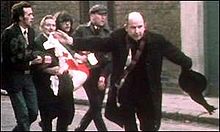
Father Edward Daly waving a blood-stained handkerchief
while escorting the mortally wounded Jackie Duddy to safety (Wikipedia)
1972
The first month of the New Year had not quite ended when the world would open its ears to the atrocities going on in the Northern Ireland. On 30 January, 1972 the British Army opened fire on a large demonstration in Derry City against internment.In the course of events, 26 unarmed demonstrators would be picked up off the streets and taken to hospitals in the city; 13 of whom were already dead. One would later die of his wounds. The demonstrators had been fired on by the British in their efforts to breakup the march. This was to mark the largest death toll from a single atrocity of its kind during the Troubles. This day would forever be known in the minds of most Irish people as ‘Bloody Sunday’, or as the Bogside Massacre in the minds of others.
Two days later, some 30,000 people marched past the British Embassy in Dublin in a mark of respect for those killed on Bloody Sunday by the British Army. Among the marchers were 13 replica coffins and black flags. During the course of events, the Embassy was repeatedly attacked with stones, bottles, and petrol bombs, and eventually was burnt to the ground.
Then on 22 February, about three weeks after Bloody Sunday, a car bomb exploded at Aldershot Army Barracks in England killing seven people. The bombing had been planned by the OIRA and believed to have been in retaliation for the Bloody Sunday incident. As things turned out, non of the dead were soldiers, one of who was a Roman Catholic British Army chaplain. This also showed that the OIRA were still active and more than prepared to take their operations to England.
This was followed on 4 March by a large bomb that exploded at the crowded Abercom Restaurant and Bar in the center of Belfast killing two young women, and injuring more than 130 others, some of whom were to lose limbs and eyes as a result. Although the PIRA were believed to have planted the bomb, no paramilitary organization officially admitted it. Then almost three weeks later on 20 March a car bomb went off killing seven people — four civilians, two RUC officers, and one UDR soldier. Another 148 people were injured. The Donegall Street , Belfast bombing, as it is known, was the first time a car bomb was used by the PIRA.
On the political front, the Stormont Paralament and Government in Northern Ireland were dissolved. On 30 March, Direct Rule from Westminster in London was introduced. On 14 April, the PIRA were responsible for no less than 24 bombs going off in different towns and cities throughout the North causing panic and mayhem. Likewise, 14 shootouts with security forces were also reported. Ten days later on 22 April, an 11 year old schoolboy in Belfast was killed when he was hit on the head by a rubber bullet fired by a British Army soldier. Apparently, the boy was simply walking through the infamous Divis Flats complex near the Falls Road when he was hit by the projectile. He would die in hospital two day later. This was the first fatality caused from being hit by a rubber bullet.
This incident was followed on 13 May by a loyalist car bombing at a Catholic-owned public-house in the Irish nationalist area of Ballymurphy in west Belfast. The incident became known as the Battle of Springmartin and involved clashes between the PIRA, the Protestant UVF, and the British Army. When it ended a day later seven people would be dead — five civilians, one British soldier, and a Catholic boy who was a member of Fianna Eireann, the youth wing of the PIRA.
Two weeks later in Belfast, four PIRA members died when the bomb they were getting ready exploded prematurely. Four civilians were also killed by the blast. On the 29 May, The OIRA announced a ceasefire of their military campaign, and vowed not to launch attacks, except only in self-defense. This also marked an end of Irish nationalist support for the OIRA. Things were far from looking better in the North. On 9 July, British snipers shooting from a timber yard in the Springhill, Ballymurphy area of Belfast, killed five Catholics — two civilians, two Fianna Eireann members, and one Roman Catholic priest. This incident became known as the Springhill Massacre. By then the Troubles was into its third year and hundreds of people on both sides of the divide had been killed.
Paramilitary groups had already been at one another throats all day long. In fact, the five dead at Stringhill were part of ten people killed that day. By the 13 July, there was still no letup in the unrest in the North. A series of gun-battles and shootings throughout Belfast, for example, left three British soldiers dead, two civilians, and one PIRA volunteer. The next day saw three more British soldiers being killed when they were shot by the PIRA. One PIRA volunteer and one OIRA volunteer were also killed in shootouts with British soldiers, whilst a Protestant civilian was killed by crossfire.
In Belfast on 21 July, 24 bombs exploded in less than an hour and a half killing nine people — five civilians, two British Army soldiers, and one UDA member. Another 130 people were injured. The PIRA climbed responsibility for the bombs.
As it was, many areas in the cities in the North were entirely nationalist or loyalist/unionist. One reason for the barricades that were built in the different neighbors by residents and paramilitaries was against incursions from anyone who meant harm. So called “no-go areas”, such as ‘Free Derry’ in the Bogside area of Derry City. On 31 July, the British Army put into motion, what was called, ‘Operation Motorman’ to bulldoze and remove the barricades, or to be able have some control over the no-go areas once more. No less that 12,000 British Army soldiers, backed with tanks and bulldozers, were deployed to carryout this task.
On the same day of Operation Motorman, three large bombs exploded in the town of Claudy in County Londonderry killing nice civilians — five Catholics and four Protestants. No one ever claimed responsibility for the bombing, however, a Roman Catholic priest called Father James Chesney was later implicated for his part in it. The priest, it was later learned, had been in charge of operations for the South Derry OIRA Brigade.
Years later (in 2002) the Police Ombudsman for Northern Ireland released a long awaited report into the Claudy bombings that effectively confirmed what many had believed for 38 years. A Catholic priest was indeed played a central role in carrying out this atrocity. Furthermore, the British government, the RUC and the Catholic Church all conspired to cover up the activities of the priest. Fr Chesney was soon moved to another parish in County Donegal in 1973. He died in 1980.
Then, just five days before Christmas, five Catholics, and one Protestant were shot dead as they drank at the Top of the Hill Bar on the Strabane Old Road in Derry. The killing was thought to have been carried out by members of the UDA, the largest of the Ulster loyalist paramilitary organizations.
1973
The New Year arrived with little change! On 4 February, British Army snipers shot and killed four men at the junction of Edington Street and New lodge Road in Belfast. Four of the dead men were civilians, the other was a PIRA volunteer. A few days later on 7 February, the United Loyalist Council held a one-day strike in the hope of re-establishing its control over the affairs of the province. In turn, loyalist paramilitaries made efforts to stop people from going to work and to prevent businesses from operating. In the course of the day, there were eight bombings and thirty-five arsons. Three loyalist paramilitaries, and one civilian died in the unrest.
By 1973, sectarianism was at a high! Recruitment into the different paramilitary organizations and the security forces were at a high. Rioting, gun battles, sniper attacks, bombings, not to mention punishment beatings were now part of everyday life in the North. Besides the OIRA car bomb incident at Aldershot Army Barracks, which killed seven people, a year earlier, for the most part, Great Britain remained relatively untouched right up until 1973. All the same, security services were on their toes, and it was believed that something would happen at sometime. The PIRA Army Council had made plans to widen its campaign to England period in the not too distant future.
On 8 March in London, two car bombs went off in London. One outside the Old Bailey Courthouse, a second at the Ministry of Agriculture, whilst two other bombs were discovered and defused. This was also the date for when the the Northern Ireland sovereignty referendum, or Border Poll was set to begin on whether or not Northern Ireland should join with the Republic of Ireland uniting the island. The referendum was also the first time that a major vote was held in any region of the United Kingdom at that time. The Old Bailey bombing in London, also marked the first of a series of operations that would be carried out by the PIRA in England.
Then on 17 May, five British Army soldiers were killed by a PIRA booby-trap bomb place outside the Knock-na-Moe Castle Hotel in Omagh in County Tyrone. On 12 June, six Protestant pensioners were killed and another 33 other were wounded by a PIRA car bomb that had been parked on Railway Road in Coleraine in County Londonderry. The IRA was noted for giving a warning to where the bombs had been planted and when they were timed to explode. However, sometimes things did not work according to plans. For example, the warning given before the Coleraine bombing had been inadequate.
On the political front, 31 October was the day when Assembly elections were taking place in Northern Ireland. It was also then day of the Mountjoy Prison escape in Dublin. A hijacked helicopter was used to help three PIRA volunteers to getaway. A lot of famous faces and things had passed thought the gates or happened there over the years. In 1954, Michael Manning was the last man to be executed in the Republic of Ireland. Mr. Manning was hung on this date at Mountjoy, for the murder of a nurse.
Regardless, newspapers around the world published stories of the escape, and a song was written by the Irish band, The Wolfe Tones, celebrating the escape. The Helicopter Song topped the Irish popular music charts, regardless of it being banned by the Irish government. The prison escape happened at a time when the Irish coalition government, led by Liam Cosgrave, were bending over backwards to improve relations with the British Conservative government, led by Harold Heath.
The doomed Sunningdale Agreement was finally signed on 9 December, 1973 at Sunningdale Park in Barkshire, England. The Agreement was an attempt to establish a power-sharing Northern Ireland Executive along with a cross-border Council of Ireland. The Agreement would last less than six months.
1974
The year 1974 was to become one of the deadliest years in the PIRA’s bombing campaign in England. In someways the same was true for the Protestant loyalist UVF. On 4 February of that year, a high explosive bomb exploded on a coach traveling along the M62 Motorway in West Yorkshire in England killing nine soldiers and three civilians, and wounding more than 50 others. The blast was heard several miles away, and leaving the coach a "tangle of twisted metal”. There was a railway strike at the time, so the coach had been commissioned to carry British Army and Royal Air Force personal, and their families to and from their bases. The bomb had been placed in a luggage locker on the coach by a PIRA operative. One person, Judith Ward, was convicted for it later that year for planting the bomb. However, after serving 18 years in prison, the case was finally ruled an error of justice, and so she was released.
Exactly two months later on 4 March, the Labour Party leader Harold Wilson defeated the Conservative Leader in the 1974 general election to become the Prime Minister. This was Wilson’s second time to hold office in ten years. Needless to say, the killings did not let up, even for a while. On 20 April, amid a spate of killings and shootings over the past couple of days, the Troubles claimed its 1,000th victim when the body of a Mr. James Murphy, a Catholic owner of a petrol station in County Fermanagh, was found dumped at the roadside by a passing motorist. It is believed that the killing was the work of the UVF, who had been escalating their campaign against Catholics and Catholic owned businesses.
On 2 May, six Catholic civilians were killed and eighteen wounded when the UVF operatives exploded a bomb at the Rose & Crown Bar on the Ormeau Road in south Belfast. The 15 May marked the beginning of the Ulster Workers' Council strike. This was a general strike called by the unionists and was to last for close to two weeks. The strike was against the Sunningdale Agreement signed in December 1973, which sought the sharing of powers in the North with the Republic of Ireland. On 17 May, the UVF exploded fours bombs in Dublin and one in monaghan in the Republic of Ireland. In total, 33 civilians were killed ad some 300 others were wounded making it the largest number of casualties in a single incident of it kind during the Troubles. This was again thought to be the work of the UVF. However, the UVF did not admit responsibility of the bombing until mid-July, 1993. Furthermore, it was alleged that members of the British security forces were also involved in it.
The bombings, and a lack of information from the British government, resulted in the collapse of the Northern Ireland Executive, to be replaced once more by Direct Rule from Westminster in London on 28 May, 1974. In response, the PIRA bombed the British Houses of Parliament in London on 17 June causing mayhem and extensive damage, with 11 people injured. According to the media of the time, the explosion was believed to have fractured a gas main causing a fierce fire to spread quickly through the centuries-old hall. This must have been seen as quite a feat for the PIRA since the Houses of Parliament is still one of Britain's most tightly guarded buildings. It was also feared at the time that the bombing may herald the start of a new summer offensive by the by the PIRA on government buildings.
On 5 October, four British soldiers were killed by PIRA bombs at two pubs in Guildford in England. An unfortunate event that became know in textbooks as the 1974 Guildford Pub Bombing. By this time my father was also running public-houses in London, so there was some fear in the air about that time as we were from Belfast. This was followed by the Birmingham pub bombings on 21 November, which claimed the lives of 21 civilians when bombs exploded in two pubs in the Birmingham City center. This was believed to be the work of the PIRA, for which six suspected members would be tried and convicted for their part in it. They would forever become known as the ‘Birmingham Six’. However, many years later new evidence showing police fabrication, and their suppression of relevant evidence led to the convictions being quashed and their release.
If the emergence of the Provisional IRA in December 1969 after splitting from the Official IRA was not headache enough for the Stormont and Westminster governments at the time, certainly the forming of a new paramilitary organization, the Irish National Liberation Army would be. At first they were known as the People's Liberation Army, or the People's Republican Army, but soon became the Irish National Liberation Army (INLA). The INLA, with its political wing, the Irish Republican Socialist Party (IRSP), came into being following a secret meeting held at the Spa Hotel in the small scenic town of Lucan on 10 December.
Like the PIRA, the INLA was made up of former members of the dormant OIRA who objected to the ceasefire. Also like the PIRA, the INLA targeted the British Army and members of the police force, the RUC in the North; which they , like their counterparts, saw as political and economic targets. However, the INLA forever remained a much smaller organization and their military campaign was less active in the Irish Republic, or across the Irish Sea in Great Britain. This may have been the result of internal feuds. One goal these organizations shared was to force the British government to negotiate a withdrawal from the North. Similar to their predecessors decades earlier, the PIRA and the INLA used guerrilla tactics to great effect in rural and in urban areas through the course of the Troubles.
By late-December, 1974, the PIRA announced a ceasefire for the Christmas holiday period. Before that, however, they had a surprise in mind when a bomb planted at the London residence of the Conservative Party leader and former Prime Minister, Edward Heath exploded. Fortunately, Mr. Heath arrived back at his home soon after the bomb detonated and that no one was injured. A lover of classical music, Mr. Heath had been conducting a carol service at his hometown of Broadstairs, Kent , a coastal town some 130 kilometers from London. He was reported to have said that the attack on would not deter him from traveling to Ulster the next day as planned. I learnt from research that the Prime Minister Harold Wilson had sent Mr. Heath a message which was "very much appreciated”. Mr Wilson wrote: "This attack will only strengthen our united resolve to bring these things to justice.” Once again, no one admitted responsibility for the bombing, even though the PIRA were suspected.
1975
By 10 February, 1975 a truce-cum ceasefire was agreed to with the British government, the Northern Ireland Office, and PIRA. Incident centers were also setup in nationalist areas to oversee the ceasefire and the security forces patrolling the streets. By this time, hopes on all sides for a favorable outcome to the Troubles were quickly beginning to recede. As a result, The British Secretary of State for Northern Ireland took the unprecedented step to hold secret meetings with PIRA leaders, and was able to secure a ceasefire. (Years later an internal British Army document released under the Freedom of Information Act 2000 in 2007 offered an expert opinion that the British Army had been far from successful in defeating the IRA through military force, but also claimed to have "shown the IRA that it could not achieve its ends through violence”).
The February 1975 truce and negotiation between the PIRA and the British government did not stop the conflict or killings. The PIRA had agreed to stop making attacks on the security forces, who intern stopped its raids and searches on homes in Irish nationalist areas. There were dissenters across the divide who resented the truce at large. British officers felt it was wrong to stop fighting just at a time they believed when the PIRA were being defeated. After all the PIRA had already been thoroughly infiltrated by the British security forces for information.
During the truce, there was an increase in sectarian killings (which lasted until early 1976). Loyalist paramilitaries, for example, feared that they would soon be kicked aside by Westminster to allow the North to unite with the Irish Republic. The coming months saw an increase in Protestant sectarian loyalist attacks against Catholics. By the end of 1975, no less than 120 Catholics, most of whom were civilians, were killed. The loyalists also hoped that nationalist paramilitary groups would retaliate, thus .hastening an end to the flagging truce. The PIRA high command had given strong orders to its members not to engage the security forces. Some of its units, however, concentrated on tackling the loyalists where they could. The INLA were keen to act, as were some current or former OIRA members who engaged in tit-for-tat killings.
That said, the British continued to drag their feet and the gradual withdrawal of troops, among other things crucial to keeping the peace, did not materialize. By 20 February, internal feuding and bickering developed among the PIRA, OIRA, and INLA leadership, which led to sectarian killings and assassinates of one anther’s volunteers. A host of other internal problems, particularly the lack of finance and weapons influenced the outcome of the ceasefire. The British had also infiltrated the IRA rank and file. (The feuding only ended in June, 1975. I was eighteen years old and working as part of a permanent way gang at South Kensington in London on the nightshirt at London Transport).
In March of that year a feud also broke out between the Ulster Defense Association (UDA) and the Ulster Volunteer Force (UVF), which led to the assassinations of volunteers. Likewise, the feud between the OIRA and the INLA continued, as did the loss of life on both sides. The attacking of civilians and public-houses remained an easy target. On 12 April, 1975, the UVF attacked the Strand Bar in Belfast with repeated gunfire before throwing a grenade killing six Catholic civilians.
On 22 June, the UVF made and attempt to bomb the railway lines at a place called Straffan in County Kildare in the Irish Republic. Members of the OIRA were believed to have been board the train on their way to attend a commemoration at Bodenstown. The town is the gravesite of the 18th-century Irish revolutionary and leader of the Society of the United Irishmen, Theobald Wolfe Tone. Commemorations have been held at this spot every June by various parties of the Irish Republican tradition since the late nineteenth century. The attempt to derail the train was hindered by a civilian, Mr. Christopher Phelan, whose actions allowed the train to pass safely and undoubtedly may prevented the loss of life. However, Mr. Phelan died from stab wounds he received for his efforts.
On 17 July, four British soldiers were killed by a PIRA remote-controlled bomb device planted near Forkill in County Armagh, and was the first major breach of the February truce. Then on the last day of July, group of UVF volunteers and UDR soldiers shot dead three musicians belonging to the Irish music band called, Miami Showband, near the town of Buskhill between Banbridge and Newry in County Down. One of the dead band members was a Protestant from the North. Apparently, the gunmen had staged a bogus military checkpoint along the country road in the early morning of 31 July, 1975. They ordered the musicians out from the minibus they were traveling in, in the pretense to search it. Their aim was to secretly plant a time bomb on the minibus. However, the bomb exploded prematurely killing the two UDR soldiers handling it. In the mayhem that followed, the remaining gunmen opened fire on the three musicians killing them. Later, three UDR soldiers would be convicted for their part in what became known as, ‘The Miami Showband Massacre’ in which five innocent people were murdered in cold blood. They received life sentences, but were released in 1998.
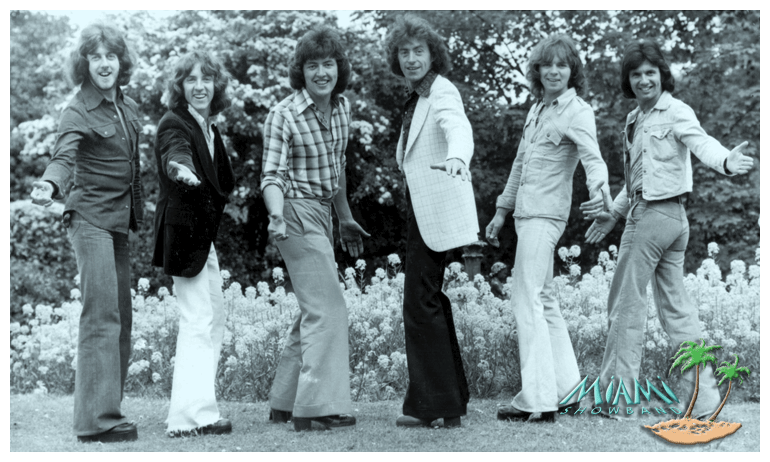
This is one of the last photographs taken of the band before the massacre on 31st July 1975 (Wikipedia)
Then on 13 August, PIRA volunteers carried out a gun and grenade attack on the Bayardo Bar in Belfast that was frequented by UVF leaders. The attack left five Protestants dead — four civilians and one UVF member. On 1 September, five Protestant civilians were shot and killed and seven wounded after an attack on the Tullyvallen Orange Hall near Newtownhamilton, County Armagh. One of those present was an off-duty RUC officer, who returned fire. The attack was claimed by the South Armagh Republican Action Force (SARAF) who claimed it was in retaliation for the killings of fellow Catholics in Belfast.
The SARAF are believed to have been a shadowy republican paramilitary faction active for a short period starting in the mid-1970s. Some thinkers believe they were part of the PIRA’s South Armagh Brigade, whilst others hold that they were once members of INLA. As many as 24 deaths, all of whom were civilians, are believed to be linked to the SARAF during the 1970s. What was known for sure at this time, all sides were responsible for series of tir-for-tat killings, in which innocent people suffered.
On 2 October, the UVF killed seven civilians in a series of attacks throughout the North. Six of them were Catholics and one was a Protestant. Four UVF volunteers also died when the bomb they were transporting prematurely event off as they drove along a road in Farrenlester, County Londonderry, not far from Coleraine. Then on 22 November, three British Army soldiers were killed and one was wounded when the PIRA attacked an army observation post (OP) in Drummuckavall, Crossmaglen in South Armagh at the border on the Irish Republic. This incident became known as Drummuckavall Ambush. (An AR-15 rifle used in this attack was used by the SARAF in an attack on the Tullyvallen Orange Hall almost two months earlier that killed five civilians).
Being the most violent decade during the Troubles, the British army manned several part-time OPs in the hope they could reduce, if not prevent, any sectarian attacks coming from south of the border. Throughout their duration, the OPs remained highly vulnerable to attack. An earlier example of which was the 1974 bomb attack on the same OP that took the lives of two British Royal marines.
On 25 November, 1975 a notorious gang of men nicknamed the ‘Shankill Buthcers’ carried out the first of their gruesome chain of murders of innocent Catholics living in Belfast. They would kidnap and torture their victim’s before cutting the throat and dumping the bodies. In fact, this group of killers had created a new level of paramilitary violence in the North, home to a people already hardened by death and destruction on their doorsteps.
The infamous Shankill Butchers were already serving members of the UVF, and which was mainly active in Belfast from the mid-1970s until 1982. It also got its nickname from the place in was based in — the loyalist Shankill area of west Belfast. Among this gangs weapons of choice was butchers knifes and hatchets
By the time this gang was brought to justice, it is believed to have murdered close to 25 people, mostly in sectarian attacks. For this most of them would be given the longest combined prison sentences in United Kingdom legal history. The judge said during the 1979 trial that the Shankill Butcher’s crimes were "a lasting monument to blind sectarian bigotry”. Ironically, the leader of the Shankill Butchers, Hugh Leonard Thompson Murphy (an Irish surname) and two of his lieutenants would not be convicted for their crimes. Perhaps becouse Murphy had already spent lengthy periods behind bars from 1972 to 1982. What was known by those who know him, Murphy had a pathological hatred of Catholics, and would later (on November 1982) receive justice in the form of bullets from PIRA guns. It was believed that loyalist paramilitary groups assisted the PIRA in the killing.
If the end of internment on 5 December, 1975 was not enough to see out the year, then two other instances certainly did. The first happen on 6 December when four PIRA members held two residents captive at their apartment in Marylebone in London. The Balcombe Street Siege, as it was called, involved a stand off with the police, which ended after six days with the surrender of the PIRA men and the release of the two hostages unharmed. The event had been televised and watched by millions of viewers round the world.
The Special Powers Act that recognized republican prisoners as POWs had been on the table since 1971, however it was denied those picked up from the beginning of 1976. Since 1971, just about every adult was picked up for questioning at least once. By 1978, more than 3,000 men and women were in prison in the North and in England for republican contacts, most of whom were held at Long Kesh near Belfast. If the end of internment on 5 December, 1975 was not enough to see out the year, then two other instances certainly did. The first happened on 6 December when four PIRA members held two residents captive at their apartment in Marylebone in London. The Balcombe Street Siege, as it was called, involved a stand off with the police, which ended after six days with the disarming and surrender of the PIRA men and the release of their two hostages. The event had been televised and watched by millions of viewers round the world.
Already from 1974 to 1975 London was hit by a 14-month PIRA campaign of bomb and gun attacks, which killed 35 people and injured countless more. One such attacked was the assassination of the co-founder of the Guinness Book of Records, Ross McWhirter. Mr. McWhirter had previously offered a £50,000 pound reward to anyone willing to provide information on PIRA activity to the security forces.
The second incident happened in the town of Dundalk in County Louth, when a loyalist paramilitary faction, the Red Hand Commandos, detonated a car bomb outside a pub without warning killing two civilians and wounding some 20 others. There was alleged collusion by the Royal Ulster Constabulary (RUC) in the bombing. The Dundalk explosion was also the third bomb attack in the Republic of Ireland, since the Dublin and Monaghan bombings of 17 May 1974. Shortly afterwards, the same group was responsible for launching a gun and grenade attack over the border in the town of Sliverbridge that killed three civilians — two brothers and a Englishman visiting there. Six others were wounded.