Part Two
One thing I will say is that I still recall how gentle and kind Mr. Mount was to me and the other boys I saw about the playground. My only encounters with Mr Mount mostly in the mornings when the boys used to pass through the front gate and down a little flight of steps that led to the main school building, (now demolished). I found Mr Mount a gentleman, who never failed to bend down to chat to the boys. I still remember our little discussion about our eye-glasses and how he once told me that he placed them on a bedside table before going to sleep each night. I do remember his also asking me where I put my glasses at night, but sadly, I do not remember how I answered him.
In our class, these checks were usually done in a hurry and our teacher, Miss Moss, failed to notice that some of the boys were actually showing the tail-ends of their shirts, which the boys produced through a hole in their pockets. However, I think the school gave up punishing us on the later, since most of the boys did not seem to have a handkerchief to our name. In comparison, what percentage of young students today bother their arses about carrying a handkerchief in their pockets? Then again, by the end of the day, our shirtsleeves or pullover sleeves always proved to be a topic of discussion when we returned home for our dinner.
Needless to say, it was the same fate should we fail to do our homework assignments, which always had something to do with religion, such as, remembering our prayers, memorizing the Ten Commandments, or one passage or another from the Bible, more than anything academic. Was it any wonder that some of us looked upon going to school hardheadedly as a necessary evil rather than an opportunity for enlightenment. For all that I learned at Saint Kevin's Primary School, I might as well have been enrolled at a hedge school somewhere under the tutelage of a volunteer itinerant schoolmaster.
The hedge schools were once a reaction against the Penal Laws during the 1800s, which excluded the Catholic Irish from attending schools or receiving an education. Even during those youthful days I knew something was wrong, that I was attending school and was not receiving an education of any shape, size, or worth. For the life of me, I would swore that there was nothing even mentioned regarding Belfast, nor Ulster, nor Ireland. In the words of the nationalist leader Thomas Francis Meagher (1823–1867): “Ireland was the last nation we were taught to think of, to respect, to love and remember."
When I look back I guess I was just in the wrong place and the wrong time. Not that I cared very much about it one way or another. The only thing we wanted was for the school bell to ring to announce lunchtime or the end of classes so as we could get outside to play. Come to think of it, attracting or holding onto good teachers was not exactly a never-ending concern like it might be with schools today, for good or bad, they seemed to stay in the same jobs forever.
In those days we labored under an acute shortage of textbooks, let alone standard reading and writing materials. What books and textbooks I do recall placed in front of us on our desks had more than likely been used by our elder brothers and their elder brothers. The textbooks with their black and white pictures were in such a poor state that they were barely held together, but by the goodwill of God, if anything it was a wonder they did not fall apart in our hands.
Each time we finished using the grubby textbooks they were then re-stacked on top of the well polished wooden shelfs that were as thick as our thighs. On the whole, the classrooms were so spotlessly clean that we could almost see your faces in the floors. The corridors, too, were waxed shiny that some of us would run and slide along when the teachers were not around.
For what I came away with or learned during my early days, I cannot help but feel it was a nearly total waste of time going to school. By the time we did leave school I could barely read, let alone add and subtract numbers with confidence. Some of my friends told me in later years of their major reading deficiencies, and left school with a only rudimentary English ability. There was method to the madness, I guess, for a good number of the kids strived through their subjects, and seemed to love their time at school. My best friend John McGoran being one of them, had an above average reading ability, which I still recall envying him for. Still, there were many other poignant disparities.
The only thing I ever got really into reading in those days was half of an ‘Oor Wullie’ hardcopy comic book that I found on our street one day when walking home from school. Even thought the front half of the book’s pages was missing, I well recall the joy I got from it. Of course, I cannot recall any of the stories in that comic book, other than there was not so much to read from the comic strips, still, I was fixated.
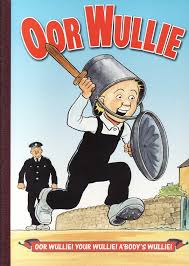
It was not until I scrolled through Wikipedia recently that I learned that early Wullie comics books had little dialogue, for much depended on the artistic drawings that created the storylines. This Scottish comic strip was a first crated and published on 8 March, 1936, by the editor R. D. Low and the cartoonist Dudley D. Watkins, both of whom worked at the British publishings company DC Thomson. This publishing company had produced many notable newspapers, journals, the comic strips, including ‘The Beano' and ‘The Dandy’, which I also loved to read if I was fortunate enough to get my paws on one, which was not very often when I was a wee lad. I knew that when I picked it up off the wet street, it was the kind of book, that relatives give to children for birthday or Christmas presents, so I was happy to have it. There had been some rain a little while earlier, which was reason enough, I think, that no one else picked it up.
In the case of my friend John, he was not excessively tall, but grew up to become a well-muscled, and rather sweet-natured fellow, who could stand up for himself amongst the most aggressive of boys on the school playground. Like many young people in the area after leaving school, John entered into the building trade. And like many others before and after him growing up in west Belfast, he was definitely an Irish nationalist, a belief for which he would pay dearly for in later years in more ways than one.
The only bullies I can recall were the teachers. The sole mission of the teachers back then was to cut us down to size, to knock the spirit out of us, which I am happy to report they failed miserably to achieve. Our teachers spread a monastic-like aura of quietness, or gloomy silence in the classrooms. Just like the proverb stated, ‘children should be seen and not heard’ for fear of a good thrashing if you spoke out of turn. In those days we were expected to merely do as we were told without question, so was it any wonder we could not wait for the school bell to ring. (Incidentally, this proverb was first recorded to have been said by an Augustin clergyman in 1450, and was meant for the ears of young unmarried woman).
The rate of discipline or physical punishment at our Catholic primary school was considered neither exceptional nor a blot on the system. Discipline was intended to enforce compliance and meekness. So like they did during Victorian times, our teachers would use a cane or leather strap to discipline us if we spoke out of turn, talked back or for whatever other infraction the disgruntled teachers deemed worthy to administer.
To me it all seemed so rather Dickensian, and I used to wonder how the students in previous times felt as I did. A wealth of writers and playwrights spend some or all of their school life at schools in the north of the country. The rhythms and rhymes, the ballads of the poet Louis MacNeice (1907-63) spring from his early days at school in Northern Ireland. Christian intellectual , C S Lewis (1998-1963), writer of the still popular children's stories was born in East Belfast. Both Oscar Wilde (1954-1900) and Samuel Beckett (1906-1989) attended school in Enniskillen, not overly far from Belfast. Others to grace the classrooms and playgrounds of Ulster schools were the poet of Belfast birth John Hewitt (1907-1987), not to forget one of my favorites writers, William Carleton (1794-1869), as did Patrick Bronte (1777-1861), the father of the famous novelist sisters. Last, but not least, the gifted story-teller and poet, not to mention Nobel Laureate, Seamus Heaney, (1939-2013) spent much of his life in Belfast as a teacher and writer.
My time growing up in Belfast would see me enrolling at two other schools, namely, Sacred Heart Primary School and St. Patrick’s Secondary School, and where the cane and strap seemed to follow me. My elder brother’s John and Paul would also be enrolled at ‘Bearnageeha’, the subtitle that St. Patrick’s inherited since its founding in 1955. The name ‘Bearnageeha’ is phonetically from the Gaelic phrase "bearna gaoithe", which means "the windy gap”. Back then, our headmaster at Bearnageeha was Mr. Billy Steele, and who held the post from 1960 to his retirement in 1980. Later, or after I had long vacated the school gates, it became the first secondary school in Belfast to offer A-Levels.
At both Sacred Heart Primary School and Bearnageeha, discipline was equally intended to enforce compliance, and so forth, by equally disgruntled teachers. One advantage the harsh discipline did achieve was to force me to question my faith in the Roman Catholic doctrine. Of course, it was more than that that finally caused me to become the proud Atheist I now am.
We were not bad or raucous kids, though it was often true we were more interested in running, rolling, crawling, climbing, and jumping about like cowboys and Indians even in the Belfast wintertime, than having to go to school most days in our lives. School punishment may have had its rehabilitative aspects, but we tended to be more obedient and more orderly to kindness; because of this we got a long well with some of our teachers.
Schoollife had its good points, too, which was just as well since leaving school without something between your ears in those days would have been another threat to the social fabric. Unfortunately, some of my friends from those early days, I later learned, would not come into manhood exactly lawless. Not that the trouble they found themselves in had anything to do with being completely idle or a lack of brains.
One teacher in particular I recall well enough, though sadly I have forgotten is name, used to teach history better than anyone before and since. An austere speaker, he told us great and detailed stories of various historical events, while at the same time drawing splendid pictures with colored chalk on the blackboard. For example, he drew pictures of Roman centurions in battle, raising their shields and striking with their swords. There were pictures of the Great Wall of China being attacked by nomadic worriers, and so many other pictures that enlivened our minds. Of course, I never imagined for a moment back then that I would major in Modern History at Queen's University, Belfast years later. A subject now dear to my heart, and thanks to that teacher at Saint Kevin's Primary School all those years ago, I became a teacher.
Our barony of sorts, the bog meadows was intersected by the new M1 Motorway, which now runs to the east of our street. The longest motorway in Ulster, then under construction, it was planned to run from Belfast to Dungannon. When the workmen packed up and left in the early evenings, the site became our battlefield, where we played at wars and crawled about like the soldiers we saw in the films on the telly and on the big screen if we were lucky. The youthful imagination, too, was easily fired up with the endless repertoire of stories that we seemed to have about ghosts, banshees, fairies, and leprechauns, or superstitions that were part and parcel to our Irish identity.
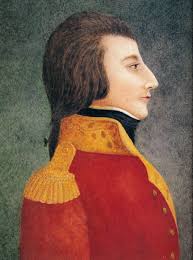
Wolfe Tone
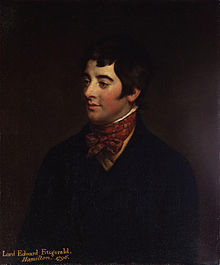
Portrait of Edward FitzGerald by Hugh Douglas Hamilton, 1796
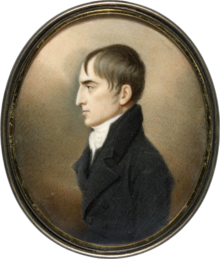
A watercolor miniature made of Emmet during his trial.
Almost soon after birth we somehow learned about and venerated the very names of Irish martyrs from the 1798 struggles onwards. Notable names such as, Lord Edward Fitzgerald, who died of wounds he received during his capture. And, Wolfe Tone, who took his own life in prison, thus, depriving the British Crown of justice; and Robert Emmet, the leader of a failed Christmas uprising, who in turn would be hanged and beheaded for his efforts. A lot of these early notable figures in Irish history were themselves Protestants, who in turn supported Catholic Emancipation on grounds of equity.
Then there was the Gaelic hero and High King, Brain Boru, who in the tenth-century led his army across Ireland to defeat their Danish (and Irish) opponents at the Battle of Clontarf. These we learned not in our classrooms, but from stories handed down and spread amongst ourselves, if not somewhat expanded upon, too, for added bite.
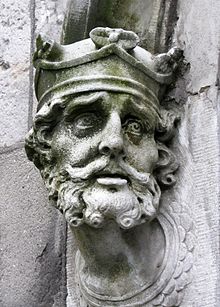
Brian Boru sculpture outside Chapel Royal, Dublin Castle
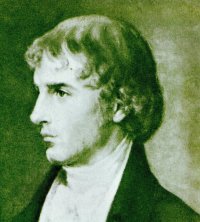
Perhaps one of the most interesting figures for me in Irish history was Henry Joy McCracken, not because he was born in Belfast, as I was, nor because he was a founding member of the Society of United Irishmen. Even though McCracken was offered clemency if he testified against his compatriots, which he refused to do. For this, McCracken was hanged on 17 July, 1798 on land that had been donated to Belfast Town by his grandfather years earlier. Even as many of these notable figures in Irish history were Protestant, their names remain lustrous through song and legend to most Catholic Irish, if not all. Only too soon other names, Catholics and Protestants, would sadly be added to the already lengthy list.
The lack of disposable money, getting about on foot was what seemed to be the way it was back then. It was an endurable life! The bicycle was a very good way to to get around, if one was lucky enough to have a bike. Unlike people today, who could fork our thousands of pounds for a bike, some people I knew collected the parts and put their own together. Of course, few of my friends had bicycles, and there was only one car parked on the entire street, which barely moved as I recalled.
Last, but not least, there was the edible seaweed, dried dulse, that my grandma used to come by from time to time, and which I just loved to eat like chewing gum. In fact, many of the elderly woman on our street used to sit by the front doors on a nice sunny day chewing contentedly on dulse like there was no tomorrow.
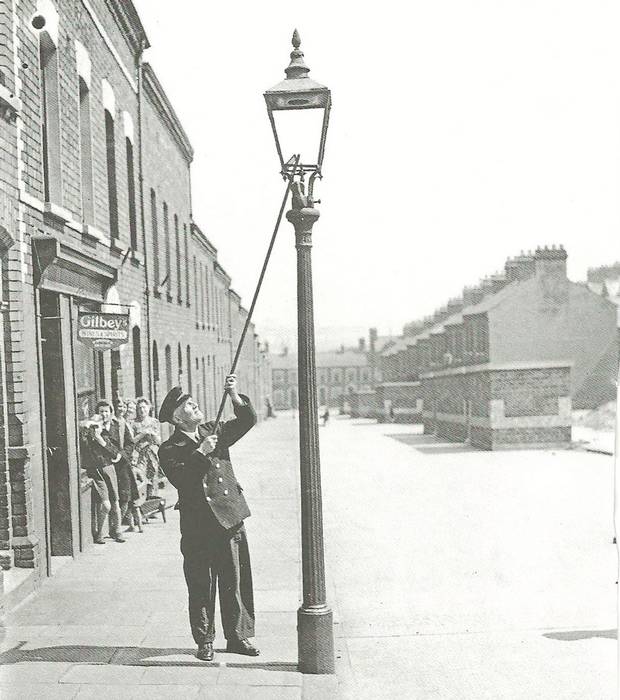
Lamplighter, Belfast 1957
Little by little modernity had taken hold. Examples of this are the gas lit street lamps that we used to swing on ropes around, were soon replaced by electric ones. Belfast was once home to no less than 10,000 gas lamps. Looking back, there was nothing romantic or compelling about the electric lamps that replaced the old and elegant gas lit ones. If I can recall correctly, the gas lamps on our street had a softness or gentleness about them, which drew people together, or us kids anyway. It is somewhat intriguing how gas is back in vogue in many homes for heating and cooking, and so forth. Though I somehow cannot imagine them ever gracing the streets of Belfast again (or anywhere) in any meaningful nor practical way, and probably never will.
Then a year or two later the house opposite us got the first telephone on the street installed. This was another mistake, of sorts, since almost everybody on the street suddenly knew someone they wanted to call. And the innumerable times the unfortunate owners of this device had to knock on someone's door to tell them that they had a phone call. Being kids, we were never allowed to go near such luxuries. So for us, life meant playing outdoors, like hide-and-seek among the bulrushes that grew in abundance along the edges of bog meadows behind our street. It was on the bog meadows that the migratory birds rested for a spell, before they made the long flights to their tropical breeding grounds. Notwithstanding, this outdoor existence, of sorts, also involved running to school as fast as our legs could carry us, during those seemingly endless weekdays, for fear of the fatal consequences of being late. Therefore, for us life remained fairly unchanged.
Then the house next door to ours got the first colored television in our street put in. Though, looking back I felt sure the occupants of the house, the Ogle family, were sorry they had new TV, for just about everybody on the street continuously popped in to look at it. Even still, most of the programs were still aired in black and white. One thing I still recall watching on our old black and white telly was the news on the assignation of JFK in November 1963, and how a general consternation had seized just about everyone. "How could this be?" people asked themselves. "He had just visited Ireland a wee while ago!"
There was talk of the Soviets having something to do with it. But what did we know? It had been a few years since Soviet Premier Nikita Khrushchev’s goodwill tour of the United States that began on September 15, 1959. The big Christmas song among the children in the early 1960s, which was a play on Rudolph the Red-Nosed-Reindeer, had something to do with Khrushchev’s baldy head, not his nose.
Kruschev the baldy Russian
Had a very shiny head.
And if you ever saw it,
You’d even say it's red.
All of the other Russians,
Used to laugh and call him names.
They never let poor Kruschev
Join in any Russian games.
Then one foggy launching night,
The Russians came to say:
“Kruschev with your head so bright,
Won't you guide our sa-tel-lite?”
Then how the Russians loved him,
And they shouted out with glee,
"Kruschev the baldy Russian,
You'll go down in history!"
We sang this song on our way to Saint Kevin’s Primary or when we played about the street every time the mood hit us.
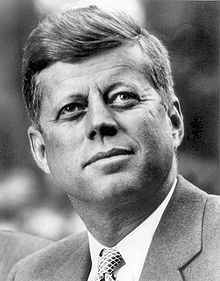
Everyone on the street appeared to be in complete shock at the sad news, and many shed tears! Then the reality of the almost stoic acceptance of JFK's death set in, and the anguish and sorriness set aside. This was followed by a strange kind of quietism about the street that enabled some to take stock of their own lives, and to endure their own suffering without protest. But for the shedding of tears, the surrounding streets, too, seemed appropriately voiceless. The sad news of JFK's demise had indeed brought an element of solace and an hypnotic tedium to the streets.
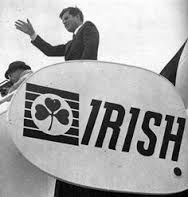
JFK's visit to Ireland in June 1963
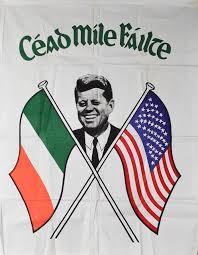
Even as a child I used to think all Americans were attractive, which was greatly nurtured by the American programs and Holywood films that we watched on the telly. This was a feeling soon dashed following a close scrutinization of Lyndon Baines Johnson's face. When I saw JFK on the telly giving a speech I was too young to care about what was being said or what everyone was eagerly listening to. My mind was more in awe at how attractive JFK was. Everything about him seemed to be handsomely fitted in its right place, his eyes, his ears, his nose, and his mouth, from which came words that motivated everyone on our street.
To me JFK appeared so perfect, with such certainty and sense of command! His tall, strong, manly, well-dressed figure was the sort of man I wanted to watch fighting against the outlaws and Indians on the Saturday morning matinees that we sometimes went to when the money was available. Furthermore, I was not the only one among my friends who felt this way about Kennedy. What awe this young, handsome, educated, self-confident leader of the most powerful, if not greatest nation in the world, inspired in the Irish as a whole. It was true, America had the biggest and most of just about everything, not to forget having a leader with Catholic Irish roots, too.
JFK was proud of his Irish roots, and in turn, the Irish were proud of him. While in Ireland, he paid a visit to his ancestral home in Dunganstown, County Wexford. His great-grandfather, Thomas Fitzgerald Kennedy, had left Ireland for America in the middle of the Great Famine of 1848, and where he settled in Boston.
One of the two bonfires that I do recall fairly well burned in all its glory just a few months before Kennedy’s assignation. Right up to the day it was set to be lit some diehard youths were still out and about collecting fuel for it. I remember them coming to our house to see if there was any unwanted thing they might carry away with them for the bonfire. I was standing next to granddad at the front door with my ears wide open. The short conversation went something like this: “What sort a stuff ur ya luckin fur, son?” granddad asked one of the older boys. Whom we all knew fairly well, for he lived just a few doors away from our house, though sadly his name still escapes me. “Mister McAleese, anythin ya don’t want wud do. We’ll tak-it right off yur hands nay!” “Well son, there isn’t even a roll of toilet paper in tha entire house.” A truer statement could not have been made! “Awe well! All right Mister McAleese, thanks anyway.” “Gud luk boys!” granddad called after them, as he turned away leaving me at the door.
From the doorstep I watched them as they went on their way slowly down the street dragging after them the bits and pieces of what they had already picked up for the bonfire. Some stopped at a few other doors to see what they could lay their hands on. Then they turned the corner at the end of the street. The site of the bonfire was set beside the M1 Motorway, then under construction. I wanted to go with them, but it was already past six o’clock when we had to be home for dinner. Besides, I had been out looking for junk earlier this morning, so I did not feel too bad. And if we behaved we would be allowed to play on the street for an hours or so with some of the other children before going up the stairs to bed at nine o’clock.
That night was when it all happened! My sister and I lay in bed fretting, a usual thing at that time of the year. Like the previous years, we could not understand why we were not apart of the crowds around the blazing bonfire. “It’s just at da en of da street.” we used to say. Our pleas feel on deaf ears, for the answer was always the same. “Yur too young ta be out aftur nine!” “Especially among an aimless crowd like that lot!” We all knew that a lot of the older youths smoked, drank, and swore as the fancy took them. “Tha only thin they’re good fur was begging cigarettes and pouring stout down their gullets.”
From the bedroom window, which looked out over the backyard and dark alleyway, we could only but listen to the laughter of the crowds. We could not see the bonfire, but we could see its orangey glow across the rooftops and walls of the houses nearer to the wasteland at the end of the street. After a while, and after praying to God to help us attend the next burning of the massive bonfire next year, we climbed back into bed. Soon Anna was fast asleep, but I could not sleep as I was still fretting at being in bed when the whole world outside the window seemed to be having the time of their lives!
Soon, however, I felt my eyes becoming heavy and must have fallen asleep, too. The clock had gone midnight and I knew that our grandparents were asleep in their bedroom that overlooked the street. Much of the laughter around the bonfire had died down, but I could still hear the sound of people talking and some of them laughing. Just then I heard the sound of breaking wood nearby. This was followed by the sound or running feet and muffled laughter. I woke Anna, and we got out off bed, and opened the window to look outside. Apart for the glow of the bonfire on some faces of people walking about on the tiny part of wasteland we could see, there was not much of anything interesting to keep us up. We closed the window, climbed back into bed, and soon we both were fast asleep.
Early the next morning we were awakened by the sound of granddad’s voice from below. Looking down from the bedroom window we saw him standing in the tiny neglected back-garden, with his hands on his hips and his head shaking from side to side. “Wud ya believe it, the animals hav’ tuck ma fence.” We could not see grandma, but we could hear her voice: “Oh no! Ya just putt the thing up a wee while ago!” Granddad had not yet retired because of a bad heart that would cause him to do so in a couple more years, but work was scarce and so he had time on his hands to do odd jobs about the house and the street in those days. Replacing the old rotten fence was one of those jobs.
Granddad was furious! “Why wud anybody tak’ it?” grandma asked, and which made granddad even more angry. “Fur God’s sack woman, where da ya think? It’s in ashes by now!” Just then Anna put her head out of the window to ask what was the matter, but noticing most of the the fence was missing, said nothing. “Did yup childur hair anythin’ las night?” To which Anna replied that she had heard nothing, but that I had. I remembered looking down at granddad from the window again, one hand on the window cill for support, while pushing Anna , away from me with the other. “Ai only hurd people laughin’ over there.” I told him, as I pointed in the direction of waste ground.
Later I would learn from grandma that the young lads he had spoken to at the front door yesterday were more than likely acting as a decoy, whilst others were focusing on removing most of the fence. I still have no idea why the culprits left the little gate standing in place. Perhaps it had something to do with the mischievous fun of it all. For the rest of granddad’s life, I never owned up to what I heard that night, the sound of the wood breaking, the sound of the muffled laughter, and the sound feet running in the direction of the waste ground.
Later I would learn from grandma that granddad thought the young lads he had spoken to at the front door yesterday had something to do with stealing our fence. He felt that they were more than likely acting as a decoy, whilst others were focusing on removing most of the fence. Besides, they did not knock on too many doors on the street after leaving us, which was something I had mentioned over dinner yesterday. Whoever was involved in the theft, I still had no idea why the culprits left the little gate still standing in place. “Mmm!” Perhaps it had something to do with the mischievous fun of it all. For the rest of granddad’s life, I never owned up to what I heard that night, the sound of the wood breaking, the sound of the muffled laughter, and the sound feet running in the direction of the waste ground.
Of course I cannot remember what we ate at the breakfast table that morning, or any particular morning, or afternoon, nor evening. But I do recall that nothing more was said about the missing fence, for granddad was that kind of person. It fact, that was the first and only time I had ever seem him so angry, or take the Lord’s name in vain.
After breakfast I remember running down the road to look at the smoldering remains of the bonfire and to listen to the stories of that night from my friends, who were fortunate enough to have been allowed by their parents to attend the event. “Mmm!” How I envied them then! They told me everything about the bonfire, and how near they stood to it, and what they saw, and who the saw, and what I had missed.
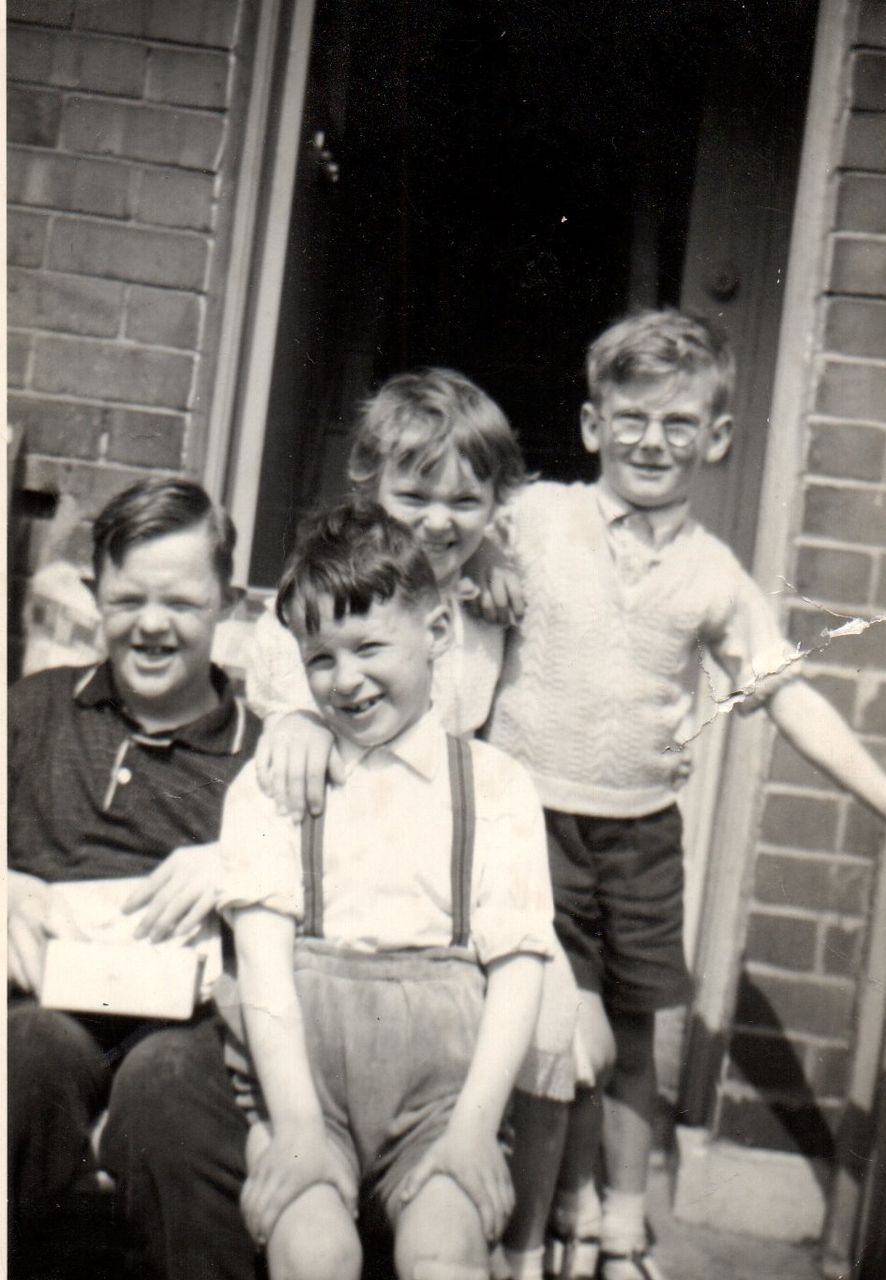
Michael is the one wearing a new pair of glasses, summer 1961
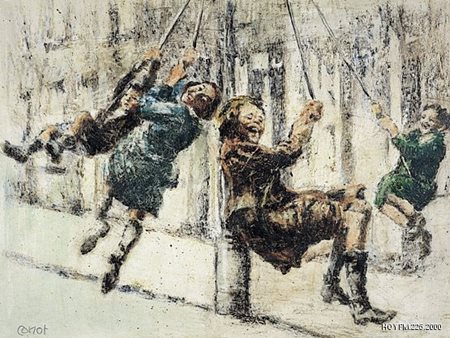
It boggles the mind why we bother to look back to a time that is truly gone forever. Or bother wondering if anyone ever really cared for the bullrushes and the bog meadows that bordered our street, and where our energetic, robust young bodies used to play for hours on end? Or if the beautiful swans, and geese, and ducks, and so forth, still made it their refuge or place of rest before flying off to somewhere else? In fact, it was back in 1951 when a man called Hugh Beaver (1890-1967), the managing director of the Guinness Breweries, was visiting Ireland on a hunting trip that he wondered after a shot, what was the fastest bird in Europe? This led to his publishing a book listing the fastest, biggest, and most outstanding of things in nature.
By August, 1954 the Guinness Book of Records was born. So there was a book with the answers in it, or that made people feel cleaver! The only problem was that none of us had the money nor inclination to buy a copy. It was not until I entered university that I saw my first copy of this successful reference book in the library. Who could have guessed that the oldest tree in the world today is a 4,700 years old pine tree growing in California? Or that the largest animal in the world was the blue whale, which grew to around 30 meters long? Most of us probably already felt that the largest land animal was the elephant, but I do not think anyone knew the difference between an African elephant and one from Indian. Or the fastest animal was the cheetah which could kick up dust at a speed close to 110 kilometers per hour. Or that the Culiver’s beaked whale can dive to a depth of 1,900 meters and hold its breath beyond an hour. By god, even when swimming in the sea I still hated putting my head under water.
Even now I longed to lose myself among those bullrushes that grew around the bog meadows, our pastoral headquarters from home. As kids we did not really see the beauty or importance of places or things like grown people like Mr. Beaver might have done. It is with much delight I can well recall the predominant colors of the bog meadows of greenish, grayish, brownish shades, baring the distinctive seasons, and how it changed little by any subtleties of weather. Only in the wintertime, beginning in late-December to mid-January did the ground crackle underfoot from the frosty morning air. Soon the high winter winds would arrive and the fresh snow would fall changing the landscape completely, a never ending novelty even for us children. The winter scenery was altogether magnificent, baring being too preoccupied with keeping warm. Or with our youthful minds full of things importance only to ourselves to really notice or care about nature. It was not until the summer months with the soft warm breezes, the pleasant air under a sky unrelentingly blue, could we reclaim our old hiding places from this unapologetically wetlands at the back of our street. School was out for summer and our world was our oyster.