2017年03月

Irishman Walking (Stage 9 Chapter 3) Winter 2012-13

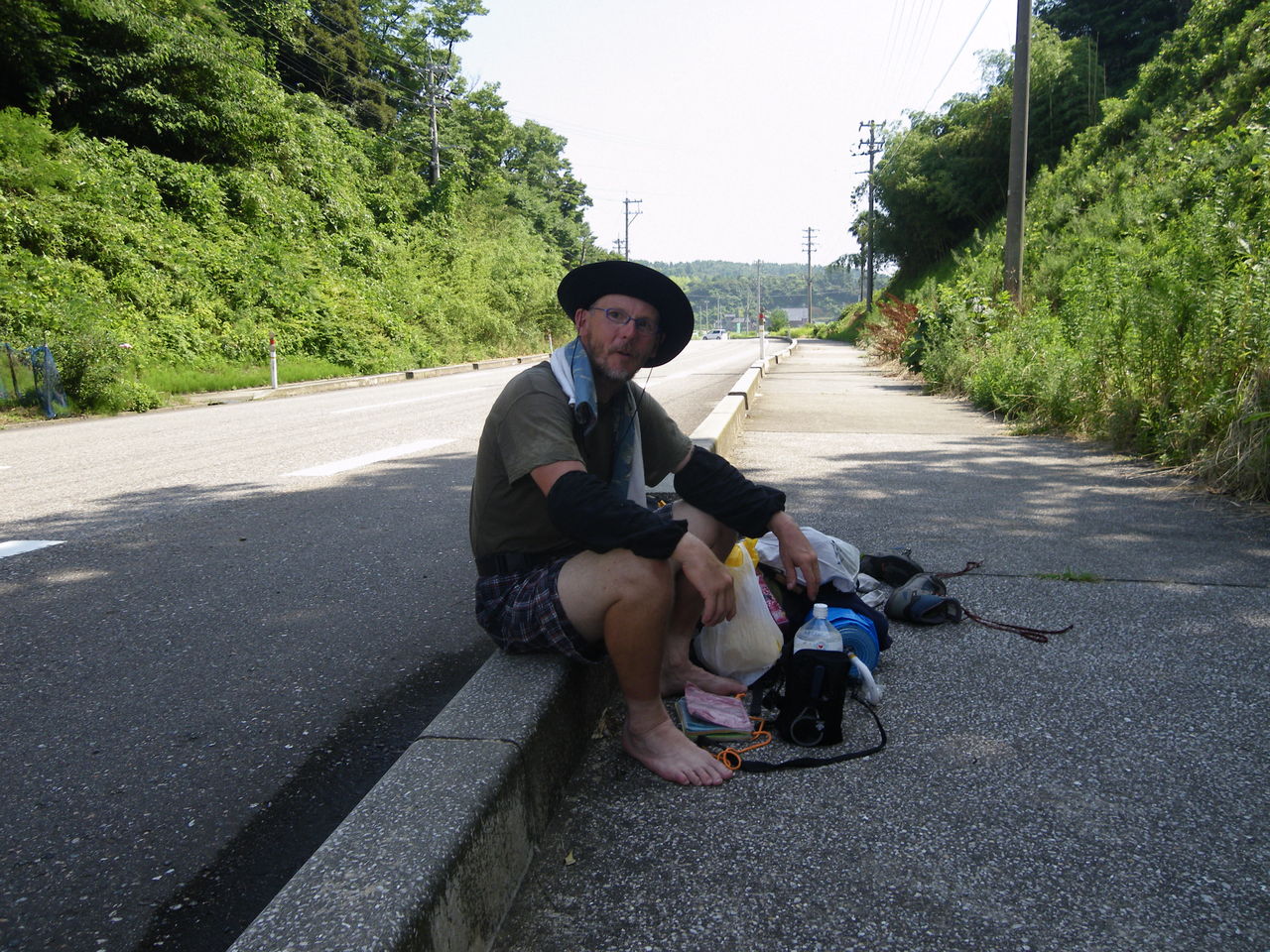
IMGP1620

Irishman Walking (Stage 9 Chapter 3) is about my walking the main and coastal roads of Japan. Winter 2012-13.


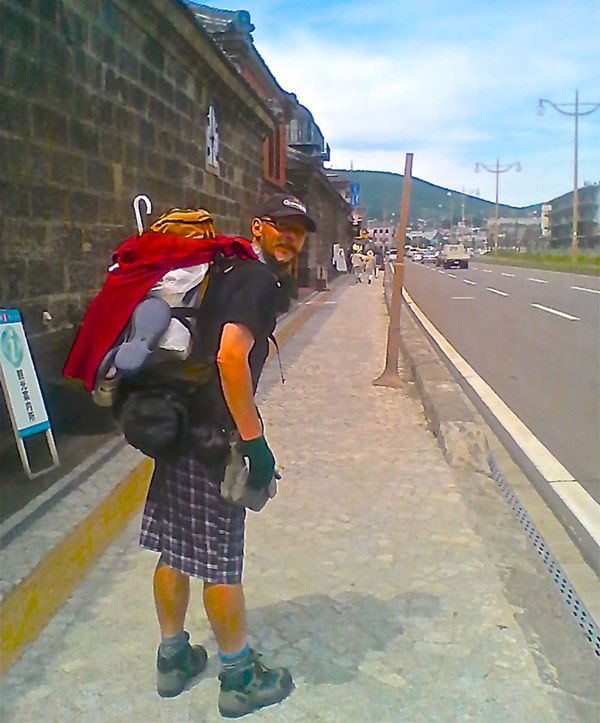
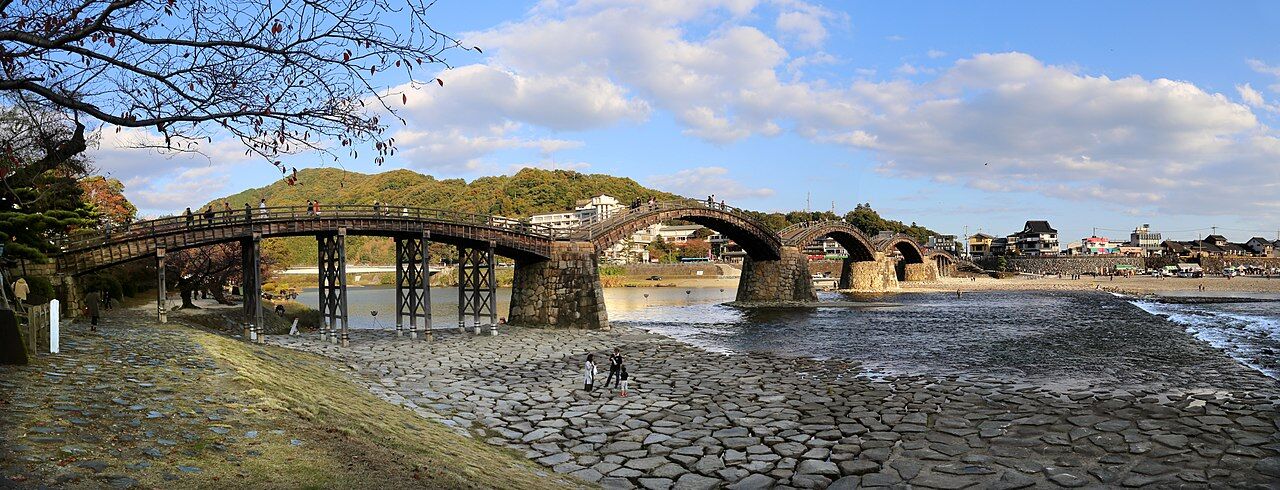
2 Jan, 2013: By morning, the road looked like someone had come in the night when I was sleeping and polished it. “Mmm!” It was good that I camped where I did, I thought to myself, as the rain began to fall again. Still, not everything was honky-dory, for a lot of condensation coated the tent interior. The outer lining of the sleeping bag was damp. Above, through the light covering of clouds, the sun was doing its best to make an appearance. This told me that the rain would not last long. My feelings were right! In just 10-minutes the rain stopped and the clouds began to show signs of dispersing. It would not belong before the sun began to mark long enough for me to dry the stuff and air the sleeping bag. Once every thing was spread out for the sun to work its magic, I set about getting everything else in order for hitting the road. In a way, getting thing ready for the road included myself. Soon the water was heated enough to soup up a cloth and give my body a little rubdown. More water was boiled for a cup of tea, and hopefully set my mind right for the long road ahead. My main concern when I did start on the road again were my knees. The rest had worked wonders, but experience told me that the pain was certain to return. Not very long ago I would have boasted to anyone willing to listen of walking on average five to six-kilometers per hour, and often hour after hour without letting up. Now I would not bet on that, nor on what I was capable of notching up now! How I hated thinking about the state of my knees, or about how well they would hold out. It was difficult not to, but I needed to remain positive. There was no getting away from it, the end was near, even if it was not quite near enough! The day was slow and uneventful! There were moments when the sky looked so heavy that it would amaze me if it did not rain. Strange how the weather plays on ones mind. When the sky did finally clear and the sun finally came out to rule things up there, if not down here, too, I could no longer feel the pain in my knees. In the early evening, while the sun showed signs of going down on the western horizon,  I began to search for a place to make camp. Often finding a good place to pitch the tent was far from easy and this was one of those nights. I knew from an a road sign a ways back that I was now about 10 and 50-kilometers from Iwakuni and Hiroshima, respectively. Considering how both my knees held out, I should not complain about anything. At last, camp was made on a disused segment of Route 2, a few meters from the old Nippara tunnel. One elderly fellow I stopped to ask if he could tell me exactly where I was, could only vaguely tell me that it was Iwakuni-Shi (City). I could not quite believe that I had reached the city so soon, and a study of my maps a little later on showed me that he must have meant that I was camped somewhere on the outskirts of Iwakuni. Earlier still, another road sign had told me that Iwakuni was 13-kilometers further along. With an estimated population   of 137,128 people, I knew Iwakuni was a city of considerable size, but I was damned if I could see any city lights, even with the help of my binoculars. I still felt confused about where I made camp!


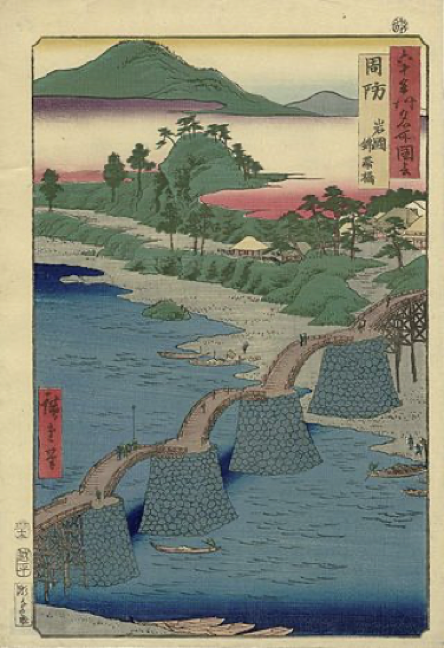
3 Jan, 2013: For once everything about was nice and dry whenever I pulled my well rested body from the tent. Again, there was condensation on the outer side of the sleeping bag, but that would dry up soon. A cool dry wind blew in from the river some meters below where I spent the night. Then, rattling the sides of the tent, it continued under the passover and out towards the waiting sea. “Mmm!” It was good weather for tramping the road. If my knees continued to hold out, I thought, as I set about rolling the stuff up. Not two-kilometers down the road when I passed a road sign pointing towards Shin Iwakuni Station, which gave me a better idea of where I made camp last night, marked with a pen on the map! Fortunately, I came to a Popular convenience store, where I popped into to use the john. Then I focused my attention to the thermos flask to get hot water for the coffee I always carried at the ready. My supplies were also running low, and I was not sure if I had enough tea and coffee for more than two-days. Among what I did have, the bags, or a Japanese ocha, or green tea, collected at the business hotels. Many foreigners quite liked the stuff, but for me it looked and tasted like piss. No doubt, some of my readers might be wondering how I knew that ocha tasted like urine. The color was easy enough to touch on — a pale yellowy color that clearly looked like urine. As to the taste, being on outdoorsman, very much in tune with survival tactics, drinking urine could easily become a matter of life or death. It was no secret that life would be cut drastically short, without water. Anyway, the least said about drinking urine, the better! In time, the road divided into two, the minor Route 112 pointed in the direction of Kentaikyo Bridge, the other seemed to pass through Iwakuni Tunnel for 360-meters, which needless to say, had no footpaths to its name. Much of my way along  the road was flanked on the right by the beautiful Nishikigawa River, which I was pleased to be near. The river, I felt, was in less hurry than myself to reach the mighty Pacific. The weather was also ideal, or just dandy for much of my time on the road. At times, the large white puffy clouds that floated high overhead, offered tiny sprinklings of snow, which did not come settle much. “Mmm!” It was strange how little occurrences, such as sprinklings of snow, caused the old brain to focus other things. Like, Yukio Mashima’s Spring Snow (1969), the first Japanese novel I ever read. Actually, the novel, “the first in his Sea of Fertility tetralogy”. appeared serially, in Shinchō from 1965-7, before it was published, a couple of years later. My introduction to Mashima’s works was back in 1979 when I first settled in Tokyo for a while. I can still recall how the young Kiyoaki, the main character in the plot found himself caught up in the tensions between tradition and modernity, a story of passion told from the sidelines by his  good friend Shigekuni Honda, a law student. ‘Spring Snow’ was the first in Mashima’s Sea of fertility tetralogy, and Honda, a law student in the first novel appears as the main supporting character throughout, when he eventually ends up as a wealthy retired judge in the last book. Of course, once I read one, I could not stop until I got through the others as well — ‘Runaway Horses’ (1969), ‘The Temple of Dawn’ (1970), and finally, ‘The Decay of an Angle’ (1971). My pace along the road was slow for the knee problem, and the stops here and there to rest them a while always left me feeling in no great hurry to hit the road again, which just was not the normal me. 


At the same time, there was another feeling that I was so near to the end that nothing could stop me from finishing, or go wrong. Everything was beyond fate, and as good as in the bag! The only danger I faced so far were the damn tunnels. “Mmm!” How could any right-minded person, I thought, plan them without proper footpaths? It must have had something to do with cost cutting. When they were built, everyone in Japan was wanting to buy cars and fewer people were walking. Baring the odd fellow who would undertake such a massive venture to tramp thought much of the country and come face to face with all the tunnels that came in the way. “Mmm!” God forbid, that would be ‘fate’ for a close relative or friend of the architect to get walloped by a speeding car, as he or she walked through one of these dim-lighted pavement-less jobs. It was easy to think all kinds of stuff tramping the road, or stopping to rest. All that I wanted to tell myself now was I had stopped long enough and needed to get off my sore arse and back on my way. On the road, I began to think about the tunnels again. They were not recent jobs, with the last one I tramped through being opened in Showa 41, that was in 1966 if my mind was not mistaking, and when the Vietnam War entered into its eleventh year. On the whole, it was one hell of a slow and lazy day, with some tension placed on my knees, not to mention my head being filled with all sorts of useless thoughts. It was not yet 3:30 P.M., she I stopped a moment to glance across the road at an advertisement hinging high up on the wall of the Kamenori Hotel. ¥4,800 Yen for a single room! “Mmm! What the fuck!” I thought, for I really needed to soak in a nice hot bath to ease the pain that I was now feeling all over my body. It had been a slow day, not because I wanted it that way, but I could not do anything other than opened, which I kind of liked for the cleanliness that might imply. When I did enter  Room 901, I was dismayed to note an oily palm print on the top sheet on the bed. Then, a clear hand print on the mirror on the wall, as well as a good layer of dust on the television set, did not help sooth my feelings any. Some of the people I know would have stormed down to the front desk to complain. Then again, I was not them, and they had not tamped the road all day long, or suffered the pain in my body that was occupying my mind now. Strange as it may appear, I hated the psychology behind informants and informing, which I guess complaining about the state of the room was. It was my mistake, I chose to stop the night when I could have continued on. Knowing that the hot bath was the main factor for my stopping, I began to feel better. Soon the bathtub was filled with hot water and me relaxing in it. It was a relatively big hotel, and therefore one might expect the building to have solid walls. Even with the television set turned on for the seven o’clock news, the sound of snoring  from the next room could be heard. The noise did not bother me so much, but I did think  of the powerful earthquake, and the tsunami that followed in Tohoku region, was still fresh in the minds of many. Off coast of not, the 2011 Took Earthquake had a magnitude of about 9, followed by a god almighty tsunami that caused the deaths of almost 16,000 people, more than 2,500 missing, and over 6,000 injured. Not to forget, the permanent relocation of many thousands more.


4 Jan, 2013: The alarm clock rang at 8:00 sharp, but I was already up a good 30-minutes before that sitting in the hot bath to ease the pain in my knees a final time. Down to the restaurant for breakfast was my next step, and where most of the tables and chairs were empty. The buffet breakfast was second to none, and consisted of several appetizingly prepared dishes from which I was free to help myself. “Mmm!” With such professionally prepared dishes, I thought, how could the I was in be so wanting? Surely it was a once off on the part of the staff, for everything else about the hotel appeared so professional. While I set eating breakfast and jotting some stuff into my notebook, a good number of other guests came and went. Clearly, the hotel was busier than I at first thought. The window where I sat at looked out over the hotel carpark and onto Route 2, and which I would shortly find myself on once again. And how I hoped with gusto, too! The carpark was more full than previously that I wondered if the guests were actual guests or merely stopping off for something to eat on their way to work. Apart from my views on the state of my room, there were no other depressing drawbacks about checking into the hotel last night. For example, I was able to relax and watch an English Premier League game between Southhampton and Arsenal on the television. Not an overly interesting football game, I guess, especially on the part of the visitors, Arsenal, as the 1-1 draw might imply. Even still, the unexpected game kind of added to the value of my stay. The main reason for this stopover was the pain in my knees, and the numerous soaks in the hot bathtub worked wonders. More than anybody, I really needed my knees to holdout for the remaining segment of this stage of my epic mission. God forbid, how could anything go wrong on me now? As I was about to close the room door to leave and hit the road again, I noticed a tiny sign near the bed, which read: ‘Please refrain from smoking in bed’. It felt a little strange that this sign was in the room at all. Then again, nothing surprised me anymore, and the Japanese in particular never failed to amaze me in countless little ways. There were a good number of joggers who passed me, most of them male of various ages. On the road itself, a good few large motorbikes of different models also shot by. None of them were loaded up with camping gear like I saw on the many Harley’s up in Hokkaido during that summer of 2009 when I started out on my mission. Then, not far from Hatsukaichi, a city with around 120,00 residents, I came to one hell of a long traffic jam, where the vehicles moved at walking pace. When I finally left the city another traffic jam began to form heading into it. “Mmm!” Had I missed something? I wondered. What did they want to see or visit. Did the city of Hatsukaichi have something going on? It was too early (or too late) for the market there that was held since the Kamakura period (1192-1333) on the twentieth-day of each month, and from which the city got its name. A relatively new city that continued to expand in size and grow economically. On an added note, Hatsukaichi was said to be the birthplace of the traditional Japanese toy, ‘kendama'.


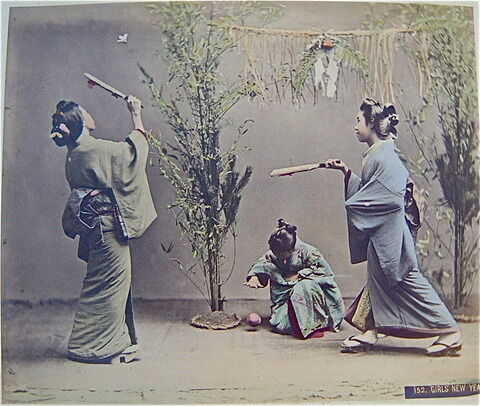
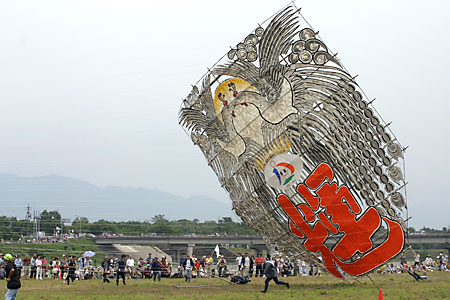
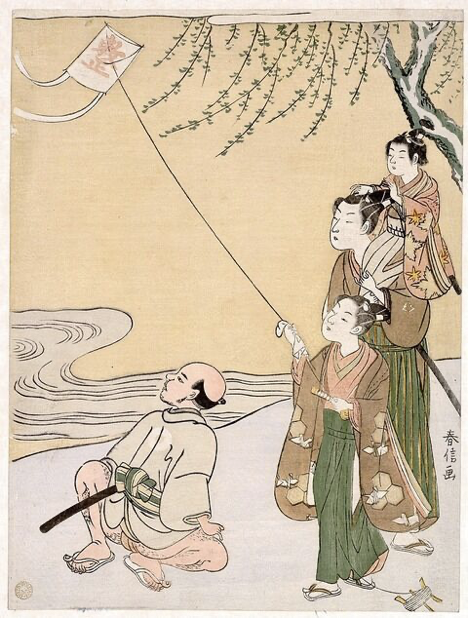
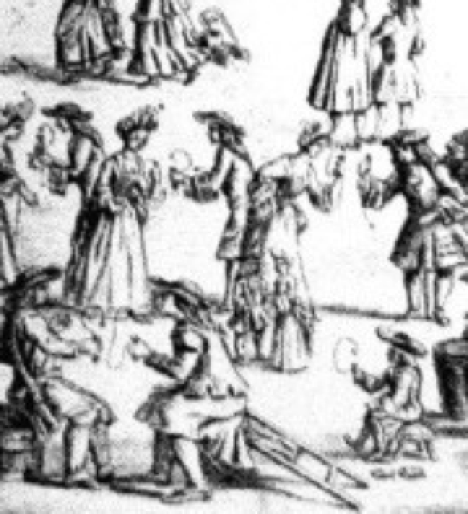
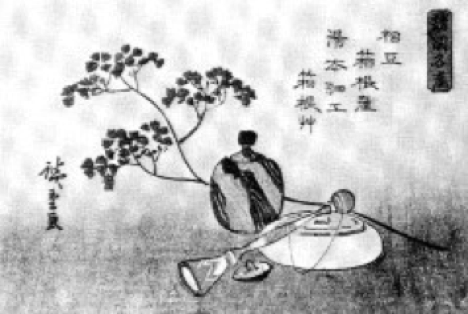
Kendama was a game that required great concentration and skill, of which its name refers. Actually, this game has no one single origin, for similar games have been recorded in a number of countries, like, France in the sixteenth-century. In France it was called, ‘bilboquet’ and was played by nobles and children for fun, just like adults and children in Japan still do today. Also, the Ainu in Hokkaido had their own version of kendama, but it is unclear if it was a game or a tool to teaching hunting skills. It is known that the early Inuit people (of Canada) used it as a tool to train their youth in hunting skills. Either way, kendama, is believed to have arrived in Japan  in 1777 from Europe, via Nagasaki, which was the only city open to the outside world during the Tokugawa era. the game also appeared in the writings of Kita Muranobu in 1830, in which it was called ‘sukuitamaken’ (spoon-kendama). Soon such games became very popular drinking hunts during the Edo period, when the loser after a certain amount of tries was encouraged to drink more or quickly. It was not until the Meiji period (1868-1912) that the interest in kendama as a fun-game spread, especially among female gender. The game appeared in a book for girls in 1876, where it was referred to as, sakazukioyobidama, which means sake-cup and ball. Over the following years kendama has continued to give full to all kinds of people, regardless of class, age or gender, even if I did not quite get into it myself. My going along the hard asphalt was much better than I had expected, and soon a road sign told me that Hiroshima City was an insignificant 12-kilometers further along.  “Mmm!” I began to feel confident! It was probably around 2 to 3-kilometers after the road sign, felt fortunate enough to find a good place to make camp for the evening. Most everywhere else was so congested with buildings and traffic, and prying eyes. The tent was finally erected on a step hill in a public park, and would offer me an excellent view of the city with its lights fanned out across the distant plain, that evening. Tomorrow I would be Hiroshima, once a castle town ruled by the Mori Clan in the late-1500s. It has been said that Hiroshima Castle was built on one of five islands that was formed by the buildup of soil washed down into the shallow bay by the fast flowing Otagawa River. Hiroshima was a strategically important economic and military post for the shogunate appointed lords during the Kamakura period. From this, a bustling castle town grew and flourished, with a number of important roads, canals, bridges, and a harbor, built.The Honkawa and the Motoyasu Bridges remain. The canals had long been filled in and currently used as roads. The Mori Clan was replaced by the Fukushima Clan who would rule for only 20-years. However, during that period Hiroshima continued to develop rapidly. Then the Asano Clan took up the mantle in 1699 after the Fukushimas’ were pressured to step aside by the Tokugawa Feudal Government, and would rule there for the next 250-years until the Meiji period. The Hiroshima area continued to grow and prosper under the Asanos’. This included land reclamation around the Ujina Bay area, joining a number of islands to the mainland.

Unknown-18


French nobles playing bilbuquet, 17th century

Unknown-19


Japanese Suikuitamaken


This was among the major projects ad events at that time, not an easy task to achieve even by todays standards! It would not be until the next 200-years or so, when the Meiji Government would appropriate vast sums of money for the re-development of Ujina Bay and Harbor. The total cost of the new harbor, when it was finally opened in late-1889, came to ¥300,000 Yen, much more than the original estimate.  When the feudal clan system was abolished by the new Meiji Government, Hiroshima fief became Hiroshima Prefecture in mid-1871, soon Hiroshima became one of the most important cities in this new Japan. Needless to say, a series of farmer riots over the uncertainty and dissatisfaction of the new government policy broke out across Hiroshima, its leaders were later arrested and hung. Hiroshima , with a population of more than 83,000 was granted city status in April 1889. This was part of the Meiji Government’s new system of municipalities that was sweeping the country at the time. With the reclaimed land and the newly redeveloped Ujima Bay and Harbor, Hiroshima now became an important commercial port, ensuring prosperity and importance for the future. The major building projects and development of Hiroshima included the extension of the railway system, and opening of Hiroshima Station by June and July 1894. The train station and harbor became very important to the military during the Shin-Japanese War (1894–1895). Though the war lasted for less that a year, it was the first time China’s regional dominance in the Far East would shift to Japan. It was in the following years that Hiroshima would not only become an economic and cultural city, but a military one, too. The cities strategic location, newly developed infrastructure, and good harbor made it ideal for the building of modern military installations. This included imposing military control over the castle and the surrounding area, too. During the Sino-Japanese War and then the Russo-Japanese War (1904-1905) that followed, Ujima Bay and Harbor became very active with ships loaded up with soldiers and military supplies coming and going. In September 1894, Emperor Meiji relocated the Imperial Headquarters to the castle, and where the provisional Diet would hold meetings for the next eight months, before being moved back to Tokyo. Clearly, both of these wars helped the rapid progress of the area, making Hiroshima on of the most prosperous, influential, and important military cites attracting tradespeople and craftsmen from all over Japan. During these years the growing city also saw the opening of banks, large industries, a stock exchange, and schools and educational facilities, giving it a new image,  a modern city. Schools around the world taught children about how things were during and after the Pacific War, and which included atrocities the Imperial Japanese Army were accused of committing in Manchuria and in Shanghai in China, and other places. From 1942, the headquarters of the Imperial Navy, under the command of Lt. General Fumio Saeki, was located next to Ujina Bay. Some children may even have read about how the Imperial Army and Navy victoriously stormed through the Malay Peninsula towards Singapore. 


Many children have certainly learned about the dropping of the Atomic bombs on Hiroshima, and on Nagasaki in Kyushu, literally turning both cities to waste and piles of rubble. Just about every public and private facility and organization was destroyed in seconds of the blast. The roads, railways,  buildings, and bridges, everything of shape and size, were gone or beyond use. The situation of the Pacific War changed against Japan two-years earlier with its defeat at Guadalcanal, when the mainland came under threat from American bombers. To counter the possibility of invasion, the Japanese government split the military into two parts; one with its GHQ located in Tokyo, the other with its GHQ located in Hiroshima. When Saipan finally fell in 1944, the threat of invasion became more imminent with its cities being attacked relentlessly by incendiary bombes from the air. On August 6, 1945, the atom was dropped on Hiroshima, killing some 140,000 people, the first atomic bomb in history. The castle was reconstructed after the original was destroyed by an atomic bomb. It goes without saying, since its devastation, the City at large has achieved such a remarkable recovery. To visit Hiroshima now, you would hardly know that an atomic bomb had been dropped. Then again, more than a million people visit the Hiroshima Peace Memorial Museum every year, to look around and to pray and place flowers at the Cenotaph for the A-bomb Victims, and to pay a little visit to the many other peace monuments in Peace Memorial Park. The Atomic Bomb Dome was registered as a UNESCO World Heritage Site in 1996. A visit to Hiroshima reminds its many visitors of the preciousness of world peace. No sooner was the tent up and the odds and ends and stuff tossed into it for later sorting out, the cellphone rang. It was from my friend Meg in Fukuoka City. She sounded like she was crying! When she finally calmed down, I learnt that her husband told he wanted a separation. I tried to console Meg the best I could on the phone and at such a distance between us. We spoke for the best part of an hour, in which we planned a meeting in Tokyo in the very near future. I liked Megumi-san, and found her beautiful smiling face very captivating, but I was not sure how I could really help her. The call left me feeling even more tired! The kilometers that I tramped on the road had already worn me out. It was not easy to sleep in the night for thinking about Meg and her seven cats that were a big part of her life. The marriage itself, or so she told me, was loveless, but financially convenient. In Japan, the husband often hands over most of his salary to his wife to take care of the children and run the household, which kind of frees him of having much to do with such things. Conversely, many women in Japan consider money to be more important than love or even sex. Clearly my friend Meg was worried about the future life. It was not as if she could simply loose herself in her work and move one with things. Being self-employed, she told me at our recent meeting, in Fukuoka, that her interior design office was not doing well at all. Megumi-san also told me that she was currently toying with the idea of wrapping her office up. 


Then, I found myself wondering why people bothered getting married at all? My own father had been married three times, and my sister twice. Just about everyone else I was close to or knew, family and friends, were now divorced, and some of them, as far as I knew, were currently living happily with their girlfriends. That said, it was usually unheard of in Japan for parents living under the same roof  to be ‘unmarried’. Such an arrangement would most certainly lead to a good number of legal problems, rights over children, family status, and so forth. Many Japanese women put off getting married for particular reasons! For example, they may have high personal and financial expectations of their ideal man, also, a keen sense of independence afforded them by their education and employment aims, and which no doubt may cause difficulty in balancing both work and family. In Japan, marriage is not to be entered into easily! Legally and socially it is at the center of the household. Marriages are valid even without the necessity of an expensive ceremony, provided the change of status in the family registration has been sorted out. Throughout history, Japanese marital systems, as in many countries, has gone through lots of changes and conditions. Unlike in the West, many Japanese have a pragmatic, non romantic view of marriage, and love for that matter. Compared with other countries, the divorce rate is relatively low in Japan. In 95-percent of divorce cases, in Japan, the wife had the exclusive right to getting the children. This would not apply to my friend, Megumi-san, since there were no children involved. Many marriages in Japan were still arranged, which was called ‘o-miai.  Arranged marriages were preferred by many people, and according to recent statistics, seldom ended in divorce. In a way, such marriages were also seen as a kind of purely practical business arrangement. The wife voluntarily gave up her job, to run the household and, and raised their children. Conversely, such husbands willingly stepped into the shoes of the bread winner. They earned the money to pay the bills. However, none of this, I felt, had anything to do with my friend Meg. The truth was, I really knew so little of anything about my friend, or her life for that matter. For a good while along the road, I could not stop myself thinking about her, or problems she was going through at the moment. What could I do? I felt so helpless! Why did she have to tell me? Surely she did not think that I was some knight in shinning armor. Did such a person exist? The only knights in shinning armor that I knew of, were the sort of idealized, or chivalrous characters one read about in books, or saw up on the big screen. The kind of guy who rescued women from one impossible situation or another. Just like superman used to do in the comics, only they rode horses instead. Was there such a thing as a mister perfect? Was Mahatma Gandi perfect? Or how about Martin Luther King, or  Martin Mandela? Even they had a few cobwebs in their closets. Like just about any Tom, Dick, or Harry, out there, I had my own fair share of flaws, and no doubt there was room for a few more, through the course of my life.


5 Jan, 2013: Surprisingly this time sleep came quick, and how welcoming it was, too. Last night there had been a number of phone calls, including two quick ones from my troubled friend, Meg. And not counting the one made by me to Meg at her home back in Fukuoka after we were cut off abruptly. In the end, the old cellphone stayed open even though the battery was just about worn down for need of recharging. The morning came with a heavy sky!  The sun shown through thin layers in the clouds here and there, which warmed things up a bit. There was no hurry to go anywhere, for just 10-kilometers separated me from the hot bath at the hotel in the center of the city. Then again, it was not as easy as that, for checkin time being at 3:00 P.M. Therefore, this was going to be a slow tramp in that direction. By the time I did finally hit the road, my cellphone told me it was close to 11:30. My walk along the Miyajima kaido in the western part of Hiroshima, then across the Yahatagowa-River-Bridge-East, was greatly aided by the warm breeze under a cloud dispersing sky. There was a short pause in the middle of the bridge to take a few quick snaps of the distant magnificent view of the mountains on both sides. Hiroshima was also called the City of Water, for the six beautiful rivers that flow through it. Then it was on across the main roads and past Nishihiroshima JR Station. Up ahead of me the great Ota River flowed to the sea. Near by the cars and trams passed by in both directions along the Heiwa dori Avenue. The weather continued to suit my purpose with each and every slow step that I took, as well as ease the pain in my knees. Soon the Tenna River came into view, and where I stopped a while to look over my city map to see the best way towards the train station, my goal. There appeared a good few ways to get there, including the road I was on. But like the saying tells us,"If it ain't broke, don't fix it.", so I continued along the Heiwa awhile longer. The Nishi-Heiwa Obashi Bridge had not long been passed when I stopped to take some quick snaps of my first monument, which depicted a woman holding a child playing a tiny trumped. The name of this is, the Statue for a Prayer for Peace. According to its sculptor, Katsuzo Entsuba, its meaning was , “From parent to child, not yesterday but tomorrow.” Regardless, I felt that yesterdays victims of that horrible day, and which countless words have been written about, cannot be forgotten. The unveiling ceremony for the statue was on 2 August, 1977, which was around the time I was preparing to fly to NewYork, where I would like for nearly a year. Then it was across the Heiwa River and then the busy Rijo dori and past the tall ANA Crown Plaza Building on my left, just one of so many tall buildings that have been constructed since my last visit donkeys years earlier. Hiroshima was much more attractive city to live in or visit now than ever, but void of my early recollections. Now what remained were the signs of the Christmas and New Year holiday period, for many colorful lights and other decorations were being dismantled as I walked along. “Mmm!” The only thing I really thought about now was how far it was to the station. 


Street maps were only good if you knew exactly where you were! At one point a long the way I stopped to ask a postman, if I was headed in the right direction for Hiroshima JR Station, since the hotel I was booked into was near there. When I stopped the postman, he was just about to ride off on the little red and white colored Honda Cubs that were commonly used by the post offices in Japan. There was a myth that Japanese found it hard to say, ‘No’, This included: ’Sorry, I don’t know!’ Or something to that effect. Actually, the Japanese could say no directly when they needed to, even if they had to use body language, or indirect language to do so. In fact, no one spoke more indirectly better than the Japanese. This poor fellow, however, not only appeared tired, or overworked, but mentally lost. It soon became clear to me that he was unable to confirm if I was going in the right direction, or   going the wrong way, for that matter. At first, he stared at my map without saying anything! Then he told me that the station was not less that 10-kilometers, perhaps 30-kilometers. It was hard not to feel even more confused after I left him. His face became rather perplexed when I turned to walk away. It was no secret that so many people in public, and private, jobs were overworked. The same with many of the teachers I knew in the schools I worked at over the years. They worked long hours from morning to night for little pay or benefits! Many teachers took one kind of drug or another, to help calm their nerves or reduce stress, or for some other work related condition or another. Like some teachers, especially foreign teachers who worked in Japan, many postmen and women were employed on a part-time basis. Employment that tied them to kind  of, ‘like it or lump it’ yearly contracts. Many people had no choice but to accept these jobs, for bills had to be paid and family cared for. Whatever his problem was, if there was a problem, it remained on my mind for a good while for the remainder of the day. All I wanted was a coherent reply to my question. Wasn’t the location of Hiroshima JR Station something that someone posting letters would know? As things turned out, and with the encouragement of some others I stopped to ask, I was indeed on the right road, even if my route seemed to go on for ever, and with bends and turns one after the other, not to forget the rivers and bridges to cross. Whenever I did finally arrive at the train station, my problem now was to find the hotel I was supposed to stop at for a couple of days. This has got to be the first time that I have needed to stop and ask so many people directions or to make sure I was headed in the right direction. Strange, since I never was one for asking people for anything, and tended to do or find things on my own steam. Often this rule of thumb was applied even  to tourist information office. There is nothing wrong with calling into the tourist information places if there was one at hand, and if they were not crowded with people waiting seeking answers to their questions. As it turned out, there was a tourist at the station, which luckily for me, was empty of tourists, so I went inside for directions to my hotel and to see what useful little bits of information I might be able to pickup about the city. 


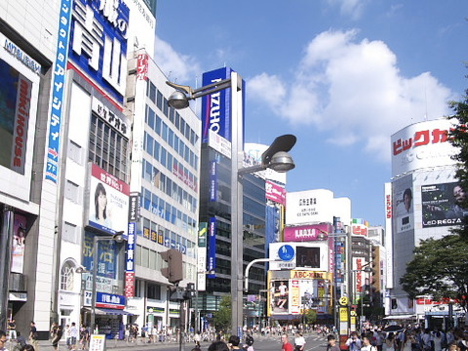
Although the tourist information office was empty, it was manned by two neatly clad women and one man siting behind a long counter. Everyone looked up and smiled as I entered! The man, who seemed to have some authority, was round faced and rather fat. The two rather attractive female staff were seated close by, on either side of him. As my eyes focused on the man first, I walked over to where he was seated to ask  him for directions to the hotel. To my surprise, the man spoke very loudly in a close to shouting pitch, that I could not help feeling I had made a bad choice. “Mmm!” Then I thought that perhaps it was me who saw bad in everyone and everything — tired and in no mood for dealing with anyone or anything. That said, this fat guy give me the impression that he was not exactly happy I picked him to ask directions from. Then I thought how could such a rude and unfriendly fellow be in such a job? By now, the guy was on his feet gesturing at me with both of his hands, like a school bully. His behavior was something like I had seen Mussolini do in the documentaries I sometimes watched on YouTube. Surely the fat guy was in the wrong job, or had a screw missing. "Mmm!" The same could undoubtedly have been said about the fascist leader. The woman to the left of us looked uneasy at the guys antics, if not sympathetic to me, so I approached her instead. As their chairs were rather close, the fat guy could not stop himself from butting in from time to time. At last, I was able to get the information I required from her, and with a new road map and as much touristy information on Hiroshima I could get, I headed out the door that much the wiser. That unwanted encounter of sorts, remained on my mind for a good while afterwards. It was not easy to turn a deaf ear to such lowly attitudes or behavior and in such a public place as a tourist information office, that I wondered if I should not have done something about it, like, write or phone someone of importance to complain about it. In the end, I chose to do neither! The improvements to the city’s infrastructure included the filling in of the moat around Hiroshima Castle and laying tracks for the new electric train, which replaced the old horse drawn buses. The Hiroshima JR Station that stood today was nothing like the one I slept outside three decades earlier (August 1980). The current station building was one complex hell of a place, similarly busy as Shinjuku JR Station in Tokyo, only worse. When I did finally reach the station after crossing over busy roads, there were no clear or easy to find sign posts for the North Exit, which I needed to go to in order to get to my hotel to drop off my stuff, nor for any exit for that matter. Once again I found myself needing to stop someone to ask for directions. This again proved not easy, for some people I motioned to for help simple ignored me without stopping. Such was the sort of behavior, or thing, that I knew well about back in Tokyo. Then again, Centre Hiroshima was quite on par with any one of the downtown shopping and entertainment areas in busy Tokyo, so I guess I was not overly surprised. The improvements included the filling in of the moat around Hiroshima Castle and track laying for the new electric train that replaced the old horse drawn buses. 


A series of lines and stations soon followed. In fact, by 1912, the changes to the city were so transforming that they dramatically altered the surrounding landscape. Even as I stood in the hotel lobby I was about to discover that my problems were far from over. “No! We can’t seem to find your reservation. Was it done over the Internet?” The attractive young hotel clerk asked me. “Mmm!” How could this be, I  wondered, racking my brain to think. A trusted friend of mine back in Tokyo had been kind enough to reserve a room for me, and had done so on a number of other occasions, which I hurriedly told her. “What is the name of your friend? She asked, while pressing away at the keyboard like there was no tomorrow. “Perhaps I can see if that name will popup!” No doubt my facial expression by now told her that I was not a happy chap. Either way, she appeared keen to sort my predicament out the best she could. Of course, I did my best to keep my composure, if not to act like a gentleman, too. It was not easy! For I had just finished tramping 15-kilometers, longer than what I had previously though from my maps earlier that morning. Now I wondered if my friend had somehow totally fucked up! “Mmm!” I began to think about the coach ticket back to Tokyo, too. No! There was no fuckup there! The ticket was paid for, the numbers had been emailed me, I had them somewhere written down. Then I dialed the friend’s cellphone number, but no answer! “Why the fuck doesn’t she answer it? I mumbled under my breath. The clerk was still searching for the reservation! This was not looking good! Now I had dialed both her cellphone and house numbers, but to no avail. This sometimes happened, but not at such a predicament as this. In recent times my friend was not the easiest of people to get in touch with, and no doubt I was the same. Especially after the injury she had sustained when she fell from a tree in her garden. Since that time, she was prone to have accidents, so I felt more concerned that annoyed. “Well, sorry, but we don’t seem to be able to find your name, nor your friend’s name!” “Well!” I replied, and I made my way nearer to the counter. “As far as I was led to believe, I had a reservation for two-days, at ¥4,300 Yen for a single room”. “Perhaps you would care to make a new reservation? It's quite simple!” she suggested, giving a faint smile as she pointed towards the computers on a long shelf by the main windows at the entrance. “How much is a single?” The young clerk picked up a tiny calculator, pressed a few keys on it to show me. “What! ¥6,900 Yen?” There was nothing else to do, but to walk to the computers for guests to use, and see if I could get something better than that. One good thing about the Internet hotel reservation companies was that they often had good deals or prices, or usually better than when you walked in off the street. I sensed the young hotel clerk could see that I was no computer buff, and sensed my predicament, for she came over to lend a hand. In no time at all, she was able to find a site that showed a more favorable cost for a single at this hotel, ¥4,890. At last, everything was filled in and completed, and was now heading up in the elevator to my room and the hot bath that I so longed for.


6 Jan, 2013: What else was there to do but to look about the city? This, of course, meant a visit to the Peace Park and the museum there. I was still kicking myself for walking past the Miyaji Itsukushima, one of the truly famous marvels that drew countless visitors to it all year round. “Fucking hell! How could I not have noticed it?” I wanted to shoutout! “Mmm!” That was what that very long traffic jam was all about, I thought to myself, as I sipped on the coffee I stopped to make. The Miyaji Itsukushima Shrine was an example of shinden-zukuri architecture of the Heian period when it was built. To paraphrase from a touristy map I picked up, each time the tide came in, the shrine pavilions connected by corridors appeared to gracefully float upon the sea. “Yes! How on earth could I have missed it?” Being tired was not an excuse! Besides, missing such a thing has no excuses, beyond stupidity. Then I recalled later that there were so many tourists and souvenir shops everywhere. Therefore, my distain for crowded places caused me to up the pace and get my butt to hell away, without stopping to think why there were so many visitors there. Just at that point, I decided to take the lest busy of the roads, which took be a little inland for some distance. Needless to say, the road also took me away from seeing the Miyaji Itsukushima Shrine. And it was not until an hour or so later that I realized my mistake, by which time I was in no mood for going back. “Fuck it!” I knew that I wold be returning to Hiroshima in the coming summer to continue on the next stage (Stage 10) of my mission around Japan. “Mmm!” Perhaps I could make amends then. I really hoped so! This very evening at around nine-fifty, I was scheduled to board a coach bound for Shinjuku, in Tokyo. Before that, however, I had hoped to visit Hiroshima Castle. Many years ago I had visited there. Unfortunately, I can hardly recall a thing about that time, other than sleeping rough one evening on a narrow strip of grass the stretched from the old train station towards the main road. I often woke up in the night and the early hours to check on my bicycle, which lent against one of the thin trees that graced the narrow patch of ground. I also recall when I finally opened my eyes that morning and seeing the place crowded with people going to work. Way back then I was just a young foolish man, with little interest in anyone or anything but myself and what was mine. I did not care much about people looking at me, and took my time packing up things before cycling off again. I was heading in the direction of Kyushu, and, like now, looked forward to getting away from the hustle and bustle of city life. In those days, I was cycling around Japan, and at times would notch up 150-kilometers to 200-kilometers on a daily basis, almost without breaking in to a sweat or feeling tired at the end of the day. Hiroshima was a castle town to begin with. That was because a certain daimyō called Terumoto Mori ordered the building of the original castle on the shores of the bay. A couple of magistrates had been appointed to start work on its foundations in 1589 and were ordered to carry our the work in great haste. Gradually the town around the castle began to take shape, including the construction of the mote around the castle. 


As the town grew, so did the trade and business, with regular and flourishing markets that sold such things as, fruits and vegetables, fishes, tatami matting, baskets, and all kinds of bamboo items of the day. With this rapid growth and progress came economic strength and many merchants became unprecedentedly busy and prosperous. In addition, castle towns were built to support the samurai lifestyle, and similar to Apartheid in South Africa, they were segregated from the ordinary people who lived and around the castle towns. Mori himself resided in the castle for only 10-years until his defeat at the battle of Sekigahara, when he was forced to relocate at Bocho, in todays Yamaguchi prefecture. Like I mentioned earlier, Hiroshima was built on a series of islands, with the castle built on the largest of them. This is seen from the kanji that makes up the city’s name: ‘Hiro’ in Japanese means ‘large’, whilst ‘shima’ means ‘island’. Then again, there are no historical records to show that this was how the name ‘Hiroshima’ about. The castle even had a nickname, ‘Ryo’, which in English means ‘Castle of the carp.’ This was because the island on which the castle had been built was also known for its abundance of koi, or the freshwater fish called, carp that are native to Asia and Europe. The walk to the castle was a pleasant one that took me across the Sakae-bashi Bridge and past the Noboricho Junior High School. It was at this school that was where the young Sadako Sasaki attended as a first year student. Sadly, she would not live to graduate. While suffering from leukemia in the Hiroshima Red Cross, Sadako folded more than 1,000 paper cranes in the hope it would bring her good luck in combating her disease, caused by the radiation from the atomic bomb. Sadly, the youthful Sadako passed away on the 25 October, 1955, about eight months before my own birth. In addition to leukemia, so many atomic bomb victims who survived the blast,  suffered such things as nausea, vomiting, diarrhea, inflammation of the mouth and throat, fever, and rapid emaciation, and death. The real numbers of those how died of the atomic bombs  effects will never be fully known. However, the most recent and conservative estimate of killed and wounded in Hiroshima and in Nagasaki stand at, 150,000 and 75,000, respectively. As things ultimately turned out, the death toll was higher in Hiroshima than it was in Nagasaki. A main reason for this was the location of the two cities. For example, Nagasaki was enclosed by the Nagasaki-Urakami, a line of mountain ridges that helped to shield the city from much of the atomic blast and the aftermath. Conversely, Hiroshima was located a vast flat delta of land. Then it was past the Shukkeien Garden keeping straight on Kami-halchobori which led to the castle grounds. Being a lover of history, I still regret not stopping to look at the garden, for in the Edo period it had once been a villa where the feudal lord, Asano Nagaokira of  the Hiroshima domain, resided. With the new system of municipalities taking shape during the Meiji period, and with a population of more than 83,000, it was on 1 April, 1889 when Hiroshima was officially granted city status. 


Like with many cities in the world, if not all, it had its own mayor, Akira Miki, appointed to office, too. As with on previous days, the weather could not have been more perfect for a stroll in a park. When I think about it, a visit to that Japanese garden might have been an ideal way to have rounded off my venture. There seemed no better place to take note of the changing contrast of the seasons, than in an old  Japanese garden. Even my knees showed signs of changing, or getting better. The sunniest months were usually in December and January, in Japan. Others might argue that the best months were in autumn, whilst others would say, in spring. Japan had its fair share of writers, and these were times in the year, when many Japanese put pen to paper to express their feelings through poetic verse. These were the times when the colors of the leaves on the trees changed from red to gold, or to whatever color it seemed to the poetic mind. There was no real or fair comparison between Nagasaki and Hiroshima, beyond the  dropping of the atomic bombs, which changed more than the cities colors. The was of course a shared hast towards the redevelopment afterwards. Come to think of it, there was something about the telling number of memorial statues erected on behalf of one sad story or another, by one notable group, or organization, in both of the cities. The most important, if not the most famous, was surely the Peace Parks, and the museums, in both cities. Today, Nagasaki and Hiroshima were no longer ordinary Japanese cities, per  say. They were recognized worldwide as Meccas to world peace. In a strange sort of way, there were a number of monuments on our street in Belfast, too, that drew crowds to look at. That was during my childhood days. One involved the house next door to ours, when our neighbors, the Ogals, got the first colored television in our street. Though, looking back I felt sure our neighbors must have been sorry that they bothered. Just about everybody on the street, and the surrounding streets, stopped by to take a wee peek at it. Mr. Ogal was the coal-man in the area, and so his family, unlike most others, had some spare money to spend. Back in those days, almost all of the programs were aired in black and white, and I recalled that only a few of the programs aired at the time, were in color. The television proved a disappointment. I could not recall if the shock of the Kennedy assassination reports, or his funeral, was aired in color. It would not be for another five-years after Kennedy's death, when the first true color television (Triniton KV-1210), was introduced by Sony, in 1968. That was about the time that another Kennedy would meet a similar end. Then, a year after the Ogal family acquired their color telly, the house opposite us had the very first telephone, on the street, installed. This proved to be another big mistake, of sorts. Almost everybody on the street quickly heard about it, and soon everybody wanted to call somebody. Not to mention the countless times the unfortunate owners of the device had to knock on someones door to tell them that they had a phone call. Those were the days when houses still used the three-round-pinned plugs. The swinging 60s, was the period was called, was a time that swung in more ways than one. 


The Beatles drifted onto the scene and into people's lives.  Across the sea in England, people found themselves with disposable incomes. People could splash out on new trends and fashions -- minimalist radios, the Dansette Bermuda record players. The latest kitchen appliances -- Kenwood Chef mixers, Hoover Dial-A-Matic vacuum cleaners! Remington targeted men, with the world's first cordless and rechargeable shaver, in 1960. There was the new Black & Decker U-100 electric drills, which allowed the man about the house to get some handy work done, on weekends, or until their wives told them. Many young girls had their Mattel's Barbie dolls, which also made an appearance, about the same time, here and there. A few lucky kids got things like Etch-a-Sketch, a popular drawing toy of the 1960s, probably for Christmas. The swinging 60s really had swung in more ways than one, but not everywhere. Back across the sea, again, in Belfast, any thing new always seemed to take its time to arrive, as did the money to purchase it. Being kids growing up in Belfast, in those days, we hardly saw any sort of luxury, let alone even touch it. The first time I caught the rich aroma of coffee, was back in the early-1960s, but I was damned if I could taste it. The first cup of coffee I ever had was at a little coffee shop in the Kamiyacho area of Tokyo, in the mid-1980s. Most children on our street did not have two pennies to rub together. Work was scarce for adults as it was, and even more so if you were a Catholic. For many people, it was a period of belt-tightening. Today, most families had smartphones, flatscreen television sets, and computers, and a host of other electrical devices. It almost seems strange that a third of the people in the world still did not have access to the Internet. Another thing the I well recall from the 1960s, was how people held the view that things  'made in Japan' were of poor quality. I remembered the wee inexpensive plastic toy soldiers I used to play with, and various other sorts of toys I had as a young child, that were made in Japan. Of course, I could not remember if I broke the toys, or what happened to them. Then again, all children broke stuff. Who foresaw how things would turn out? Japan was a country no one in my neck of the woods took very seriously. It was so far away, that I could not even imagine that I would one day find myself walking around it. I for one could not imagine that it would grow and develop to lead the world in a host of commercial enterprises, and would for many years have the second largest economy in the world. Along the road, there was no shortage of progress. High-tech things were everywhere. Everybody had the latest of something. The latest gadgets were everywhere you looked. The days of pen and paper were numbered. Money, too, for that matter, was fast becoming a thing of the past. It was only a matter of time, when credits cards would follow. One day in the not too distant future, the madness of the traffic that sped along the roads, would be replaced by driverless vehicles. It was only a matter of time. Nothing lasted forever, everything ran its course.
Who is Michael Denis Crossey ‘Irishman Walking’?

IMGP1620

Michael Denis Crossey 'Irishman Wornout'

For most of my adult life, or from my penniless childhood days to the present, I have been interested in walking.  For the kids of many Catholic and Protestant families in the Belfast I knew before and during the 1960s there was no other way to get about than to walk. Or to run as was the case for us who found it hard to sit still even for a minute. It was a little before my tenth birthday when my grandmother took me on a trolley bus that headed into the city centre. That was my first time on wheels. For most of my adult life, or from my penniless childhood days to the present, I have been interested in walking.  For the kids of many Catholic and Protestant families in the Belfast I knew before and to the early-1970s there was no other way to get about than to walk. Or to run as was the case for us who found it hard to sit still even for a minute. It was a little before my tenth birthday when my grandmother took me on a trolley bus that headed into the city centre.

 
For much of the following years of life in Belfast, I was totally ignorant about the people who lived in the North, or in the rest of Ireland for that matter. We were not taught about our history, political or whatnot, at our schools. Even when our classes ended for the day and we ran laughing and playing, and fooling about on the way to our homes for tea and toast we never thought nor cared about anything academic.  Much later, when I was much older, did I turn to my own background and culture with great interest. Only by hard work, research, and extensive reading, not to mention close communication with my family, friends and colleagues was I able to acquire something about what I was looking for. After all, I did not realize until those later years how important it was for me to know in some depth about my own people, history and culture.  Only by doing so, could I find out more about my own background, or what made me the person I am.


We all grew out of a somewhat precarious existence from the time we were born. This was in an environment of few pretensions and where people accommodated themselves to their humble situations. Of course, most people did not live in grim poverty, nor ragged and destitute with emancipated faces, like many Catholic Irish did in earlier years. Still, living conditions were woefully inadequate as it was, with shortages of all sorts of daily household items and necessities, including proper toilet paper. To this day I still never found out how granddad came by the newspapers that he cut up and hung with a string on the toilet door, for few people could afford to read them. It was only a few steps to the outdoor toilet located in the far corner of the yard. During the cold winter months in the freezing sweeps of Irish rain, those daily visits were not for the faint hearted. Even as children, we could not help feel that our outhouses seemed somewhat out of place. Therefore, since my youthful days to the present, I had always held a cherished place in my heart for a good, clean, private place to relieve myself.


The Japanese have a long history of sanitation, from the Shoguns to the present times. In today's Japan (where my mission on foot currently lies), a country of  both modern and traditional values, not to mention, superstitions, is also a country where everything has its place. In the homes having to slip into a pair of 'toilet slippers' before entering the toilet never failed to be a topic for discussion among many new arrivals to the country. Perhaps one thing many foreigner visitors failed to notice was that most toilets in Japanese homes were installed in the part of the house that faced north. It is from the North where the bitter cold winds make Japanese winters close to unbearable. Adding credence to the superstition, many sick people were placed in rooms that faced north. Regardless of the reasons, it was (and still is) believed that a toilet located in the wrong part of a house could be considered dangerous, or lead to misfortune.


Circumstances in Belfast of the 1950 to 60s, or lack of them, caused people to borrow a half cup of this, or a half cup of that just to make ends meet, or tie things over until their husbands got paid. Catholics in particular were greatly disadvantaged by the uncertainty of employment, if not their legal position in a Protestant dominated government, and many families lived in distressing circumstances. Somehow people just about got by in a climate when just about everything on the store shelves could be deemed as too expensive. Sadly, sharing their food with others was an old Irish custom that I surmise has run its course in more recent times. However, even during the early days, I still recall the evenings we sometimes went to bed hungry. And we were by no means the only family on the street to do so either. Regardless of these circumstances, people on our street still treated one another with an equal share or civility, respect, and affection. Nothing undermined the strong communal spirit of the people on our street. What was not scarce was the natural vivacity and lightheartedness among the people in those days.


At school we never learned about the meanings of words like, 'segregation', which was how it was in the cities in the north of the country. It was somehow drilled into us in our earliest of years that there were two kinds of people, those who were Protestant and those who were Catholic, or Papists as we were referred to by those on the other side of the divide. Many Protestants spoke of Catholics with extraordinary hatred and contemptuous scorn, and Catholics spoke of them more or less in the same light. Of course, the religious antagonism was by no means the only issue that separated people in the north of the country, but also the different views on history, politics, economy, and social issues that laid to what was commonly called, ‘the Troubles’ (Na Trioblóidí). The conflict broke out in October 1968, and ended with the signing of the Belfast Good Friday Agreement in April 1998. It marked a sorrowful period in Irish history that culminated in the loss of more that 3500 lives, forcing countless more to seek new lives abroad.


For the most part, people still continued to hope for better days to come, since they had been through bad times before the Troubles. For the most part, family atmosphere was hearty and cheerful. If it had not been for the ebullient wit and humor of the people to soften their misfortunes, I could not imagine how  my life might have turned out. On the other hand, people did not bother much about a future over which they had little control. Even the short-term future! It was a time when next week, or next month, was not what mattered, nor the week or the month after that, but the present. Pocket money was something we never heard of, and most of us did not have two pennies to rub together. Therefore, getting about on foot was what seemed to be the way it was back then. Few of us had bicycles, and there was only one car parked on the entire street, as I recalled. On the other hand, people did not bother much about a future over which they had little control. Even the short-term future! It was a time when next week, or next month, was not what mattered, nor the week or the month after that, but the present. Pocket money was something we never heard of, and most of us did not have two pennies to rub together. Therefore, getting about on foot was what seemed to be the way it was back then. Few of us had bicycles, and there was only one car parked on the entire street, which barely moved as I recalled.


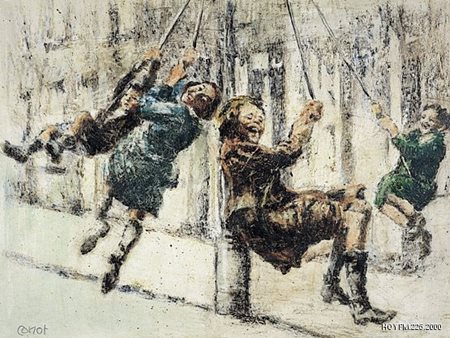
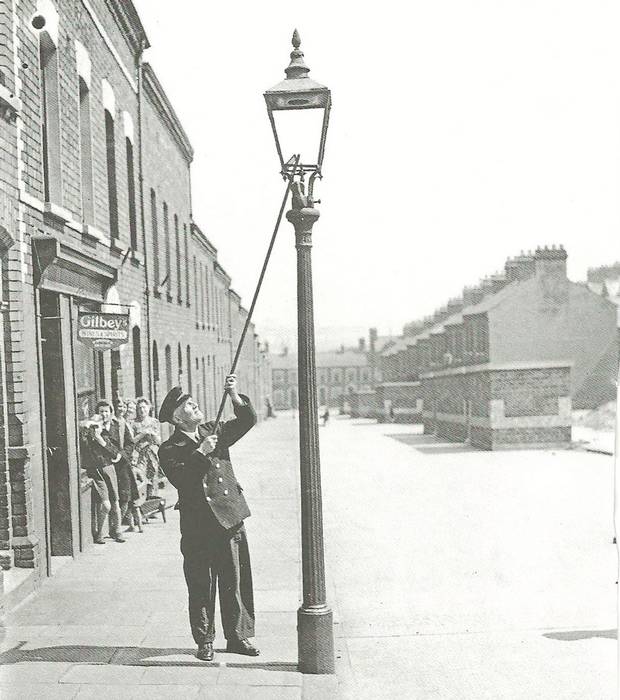
Little by little modernity had taken hold. Examples of this are the gas lit street lamps that we used to swing on ropes around, were soon replaced by electric ones. Belfast was once home to no less than 10,000 gas lamps. Looking back, there was nothing romantic or compelling about the electric lamps that replaced the old and elegant gas lit ones. If I can recall correctly, the gas lamps on our street had a softness or gentleness about them, which drew people together, or us kids anyway. It is somewhat intriguing how gas is back in vogue in many homes for heating and cooking, and so forth. Though I somehow cannot imagine them ever gracing the streets of Belfast again (or anywhere) in any meaningful nor practical way, and probably never will.


lamplighter


Little by little modernity had taken hold. Examples of this are the gas lit street lamps that we used to swing on ropes around, were soon replaced by electric ones. Belfast was once home to no less than 10,000 gas lamps. Looking back, there was nothing romantic or compelling about the electric lamps that replaced the old and elegant gas lit ones. If I can recall correctly, the gas lamps on our street had a softness or gentleness about them, which drew people together, or us kids anyway. It is somewhat intriguing how gas is back in vogue in many homes for heating and cooking, and so forth. Though I somehow cannot imagine them ever gracing the streets of Belfast again (or anywhere) in any meaningful nor practical way, and probably never will.
 

jpg

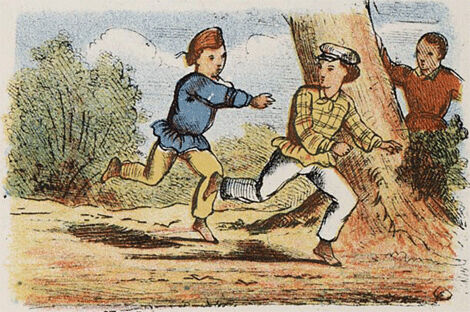
Then the house next door to ours got the first colored television in our street put in. Though, looking back I felt sure the occupants of the house were sorry they did, as everybody on the street continuously popped in to look at it. Even still, most of the programs were still aired in black and white. Then a year or two later the house opposite us got the first telephone on the street installed. This was another mistake, of sorts, since almost everybody on the street suddenly knew  someone they wanted to call. And the countless times the unfortunate owners of this device had to knock on someones door to tell them that they had a phone call. Being kids, of course, we were never allowed to go near such luxuries, so our lives of playing outdoors, or playing hide and seek on the bog meadows behind our street, or running to and from school during the seeming endless weekdays, went unchanged.

Here and now, I am a somewhat disorganized yet, coherent, tidy, clean, healthy and happy Irishman with few regrets. I have lived my life somewhat backwards (e.g. travelled, worked, educated, born, and reborn, etc, etc, etc). In general, my views and outlooks on life are quite open minded and liberal. I have a very good sense of humor and love the company of similar minded people. I am also a lover of hiking, long distance cycling, camping and large (American style) motorbikes, to name a few of my interests. These are all the more worthwhile when done with someone you are comfortable with. Right? When I have free time I just love getting away from Tokyo (on my bicycle or on my motorbike) to some relaxing and interesting place.

If that is not possible, then I love to talk to friends. I honestly don't know what friends say about me. I am sure they say so much, or at least they think about me, I hope so as I think about them. Ha! Or like Oscar Wilde once said: "The only thing worse in the world than being talked about is not being talked about". So true! On the whole, I think better of those people who talk directly to my face than behind my back.

What makes me happy is a sense of achievement in all things I set out to accomplish. I wonder if this also includes that thing we call 'love'? What makes me Upset or Frustrated? Stupid people -- racists, bigots, and warmongers, or even the blood and gore in war films. What is the point of such films, has the world not had enough of wars, real or fiction? On the other hand, I have so many favorite films, or two that come to mind: 'Love is a Many Splendored Thing' (1955), staring Jennifer Jones and William Holden; and 'Roman Holiday' (1953), with the fabulous Audrey Hepburn, not to forget the reliable Gregory Peck. Why I like these films so much is the overcoming of prejudice and such difficulties regardless of the consequences. That said, it was somewhat unfortunate that the leading character in the first of these films had to die in the Korea War to aid the storyline’s powerful ending. Of course, I think, why one likes a film so much is really in the eyes of the beholder. 

My favorite music? I like many kinds of music. Perhaps classical is foremost among my favorites as it can be very relaxing and thought provoking. Quite recently I to have ambient sounds playing in the background when I read or write. For many years have been into theme music from lots of films, which really brings memories flowing back to me -- eventful times in my life, and people I once knew, or places that I had been to, and so forth. Oh how I long for those yesterdays again! As to my favorite animals, I like all animals, especially dogs. It is said that a man's best friend is his dog, right?

Recent years had brought an enormous burst of energy and ideas out of me to see Japan proper.  My stay in Japan stimulated inspiration enough to do something big. To many people this might have meant making pot loads of money. For me, however, I hated that necessary evil, money. Nothing was free in Japan, and everything had its price. Books, which I love to read, were not exactly cheap and can be a nuance when they piled up. Then again, if they were truly enlightening then I guess it was money well spent. Books were what had initially sparked my interest in Japan, especially ones on history, which was another of my loves. 

Also, it is thanks to books that an appreciation for nature and the outdoors has also added to my growing intellectual curiosity on this country, hence, my mission of walking around it. I like to think that books had served me well in my scholarly inquisitive quest for that thing called,  ‘self-improvement in whatever form that might be’. Of course, ‘self-improvement’ is an ambiguous term, for it means so many different things to so many different people. Therefore, I guess what one truly gets from reading is so personal, that it cannot be explained so easily here, nor perhaps should it be.

It has long been said that doing things that require much use of the brain can help keep us  younger than we might be otherwise. Some of these things might include playing board games, like, chess or shoji, or painting pictures,  or learning a foreign language such as Japanese, or just plain old reading. This might be true! Consequently, for myself one other thing has, unexpectedly  come to the fore -- reading has also made me realize just how old I am, regardless of how fit I feel or how healthy I might look for my age.

This is especially true, when it comes to my love of reading modern history books, for often I am brought face-to-face with dates of events and things that are still no less distinguished or spectacular on the stage of human drama. Recently I read in a book that the Tower Bridge was opened to shipping and the public over the mighty Thames on 30 June, 1894. “Good God!”, I remembered thinking to myself, that was just 62 years before I was born. Similarly,  each time I read a book about the SS Titanic on its maiden voyage, I cannot help thank that it sunk just 44 years before I was born. The Titanic remains the most famous of liners ever to sail the ocean. Or when I read something on the Pacific War with Japan, which ended just 11 years before I was born.

It is said that, ‘Father Time’ stops for no one, but I sometimes wonder if it sometimes does. “Mmm!” Wishful thinking! Nevertheless, the importance of  great achievements or tragic events has not been relegated by time, rather, many are still the subject of classroom debates, seen by the eyes of painters and photographers, still written about on the pages by writers, and acted out in drama and on film.

On top of my love of books, or rather what I got from them, my travels around the world served to reinforce my confidence in life and in people, and of course in myself, too. How did it come to pass that despite my initial experience and general enthusiasm for travel, I had become aware of and very interested in the size, shape, and ways of other cultures more than my own? Whenever I visited Belfast in particular or Ireland at large, I always felt like an outsider looking in. Sad! Whatever the reasons, the sights and sounds, and experiences gained on my travels confirmed in me a dedication to put what I could down on paper as a profession

Some people might have seen my writing as a mere compilation of daily articles. Perhaps there was some truth here, however, I have tried to extend my hand to my readers to have them experience life on the roads with me through my words. The pages in this journal that follow described my time on the road in the context of nature, people, attitude, traditions, and institutions, etc. ‘Irishman Walking’ is about my walking the main and coastal roads of Japan through a series of spring, summer, autumn, and winter stages. Stage 1 began in Cape Soya in Hokkaido in the summer of 2009, and ended in Noshiro City in Akita Prefecture seven weeks later. Then in the summer of 2012, Stage 8 started at Shibushi Port in Kagoshima Prefecture on the southern island of Kyushu, and ended in the city of Fukuoka six weeks later. Stage 19 started at Sapporo and ended at Mombetsu Airport on the island of Hokkaido. The stage lasted for six weeks. Stage 20 will start from Mombetsu Airport and end at Cape Soya were it all began. This final stage is expected  to last for three weeks.

To date, I have walked around the islands of Kyushu, Shikoku, Honshu, and most recently most of Hokkaido, not to mention some of the smaller islands, too. This coming summer, 2017, I will start at Mombetsu in Hokkaido to walk the final stretch of road towards Cape Soya where my mission on foot around Japan began. The conclusion of each stage left me with good reason for optimism, and one-step closer to completing my mission and the last pages of my notebook.


irishman_walking_interview_1b
This is the beginning of the end...

Irishman Walking (Stage 9 Chapter 2) Winter 2012-13

IMGP1620

Irishman Walking (Stage 9 Chapter 2) is about my walking the main and coastal roads of Japan. Winter 2012-13.
 

27 Dec, 2012: Last night turned out to be colder than usual, even with two sleeping bags wrapped around me. It would have frozen the balls of a brass monkey. Much of the tent and ground around was a gray-white color for the frost and ice. The sun  was rising fast over a cluster of trees to the rear. “Mmm!” All would soon be wet, I told myself, pulling the selling bags for the tent to hang over a fence that belonged to the convenience store. Hopefully, the morning breeze would soon do a job on the condensation. Soon everything that was wet, was hung-out to dry, before hitting the road. In no great hurry at that time, I set about boiling water, for a cup of tea. One good thing about camping near to a convenience store was the easy use of the hot water from the two liter thermos, of which there were usually two at the ready. Just as I set down outside to drink the tea and bit into a piece of sweetbread that I bought, my cellphone rang. It was from my friend in Tokyo, who was kindly searching for transportation prices for returning to Tokyo when this stage of my mission ended. “I’m all ears!” I said, grateful for the help, as I searched about for a pencil to jot down the name of the airline company and related information. Already I knew that the main carriers out off Hiroshima Airport were JAL and ANA, and so I asked what other ones there were. “Well! It’s not exactly an airline!” My friend replied. “It’s a long distance bus! You know, a coach!”  Of course, I was not too picky, since I had to be back in Tokyo on time. I then asked where the bus would start, knowing that Hiroshima would factor in somewhere. “If you were able to wrap this stage of your walk up, in Hiroshima, then you might get the bus from city back to Shinjuku, in Tokyo.” That sounded good, since I was living in Shinjuku at the time, or just 30-minutes from the bus terminal. Shinjuku was one hell of a busy place to live, with stores, restaurant, and clubs housed in some of the ugliest buildings ever built. There were a good number of quiet side-streets, like the one on which I currently resided. All the same, my days in this busy area were numbered, like, I had overstayed my stay, or so a certain restless about my character, told me. For now, the problem of packing up and moving could be thought about later, when I returned. In fact, I could say something of the same about Tokyo. Most of my time in Japan had been spent in this metropolis of metropolises. Tokyo was the largest city in the world, with a population of more than 37-million people. For a wildlife and nature lover, like myself, to live for such a long time, in a place like Tokyo, seemed somewhat on the ironic side. My friend went on to tell me that she could reserve a seat on a bus, and that a one-way fare would come to ¥4,900 Yen, which sounded good enough to me. We both knew that I needed to be back in Tokyo soon, by 8 January, 2013, at the latest. I felt confident that I could still reach my goal a few days early, which should give me enough time to look about the city. I especially wanted to visit the Peace Museum there. So it was decided to try and reserve a seat on the Tokyo bound bus for the 7 January. Hiroshima City was as good a place as any to wrap things up in. 


It should be easy to return to, to start the following stage, Stage 10. In away, it felt good to have friends in the right places, and felt truly blessed for their help. It did not take long for the camping stuff to dry. In no time at all I was back on my way along the road again. My chief concern now was how further the turning was to get off Route 2 and nearer to the sea. As luck had it, a signpost came into view, which pointed in the direction of Sanyoonoda, just six-kilometers away. “Mmm!” Things were now looking up, I told myself, turning my back on Route 2 and onto the minor Route 29 that led to the sea. Unlike the previous two-days when I covered more than 70-kilometers, this was going to be my slow day. It was just as well I was in the mood for taking my time, for it was taking forever to find Route 190 that ran for a good stretch along the coastline. Some staff at another 7-Eleven convenience store I stopped by at, assured me that I was indeed heading in the right direction, which made me feel good. According to my often confusing maps, a few more kilometers beyond Use City, should bring me to the coastline, The sea so near at hand always felt good. Today the weather turned out to be good for tramping the road, at any pace, quick or slow. It made me think about spring, even and winter was far from over. The main thing for the day was to get onto the proper road as soon as possible, which should take me to the city of Hofu. Another study of my maps told me that I might need to make a couple of detours if I was to get closer to the mighty Pacific. Nothing worked better on the mind that being walking next to water, river, lake, sea, or ocean. Even then, I feared that the side roads may not be near enough. Unlike many Japanese writers of bye-gone-years, I do not think my writing could ever truly represent Japan, even in the tiniest of ways. For one thing, I am not Japanese, and therefore lack loyalty, if not love. Also, my writing was not done from a warm and comfortable room, or in a nice house in some sprawling urban area. No! Not at all! Rather, my road-notes were a collection of thoughts, visions, with humble experiences and feelings from the roads I tramped along, or at times from the warmth of my sleeping bag and tent to protect me from the cold night air. Although I saw, touched and rested in just about every village and town I came to, I did not stop long enough in any of them to acquire a sense of belonging. Many of the more conservative minds, including those who benefited economically from the good old days in Japan, kept to the view that this was where the problem lies. It would appear that these rural areas had little to offer an interested visitor, things to do or visit. This did not seem right! To get to know a country one needed to visit those out of the way places, and stay long enough in them to establish some sort of depth and understanding. True, there had been a genuine growth in tourism in many rural places, in recent years. Many people wanted to learn more about the past. After all, many of the more rural locations were less transformed by the postwar boom that swept over the country changing everything in its path. If such progress was for the better, then I definitely the wrong person to ask.


28 Dec, 2012: By the time  fell asleep, the moon and countless stars ruled the sky. In the early hours, however, I awoke to the sound of gentle raindrops hitting the side of the tent. This told me that when morning proper did come, there would be no quick start on the road. Having to roll up and pack things away when inside a small tent kind of took the fun out of camping. What else was there to do? That was how it was! Soon the rain was falling in a steady pour. After a while, I called my friend in Tokyo, and inquired about the weather forecast for the day, and who answered in the negative. “Rain all day long!” Then I asked about tomorrow, feeling a bit depressed. “I’ll call you back later about that.”I then thanked my friend, and after a few more words, our chat ended. Since leaving Tokyo, this has got to be the most mentally trying of starts on the road proper. Even not things seem so miserable! All day the rain continued to fall with gusto nonstop. Last night at around 6:30, just when I decided to make camp under the long Hoshinogawa Bridge close to the meandering river of the same name, the rain stopped. By the time the tent was erected and the gear placed inside it, the clouds broke apart to reveal the moon and stars. In a little while the night sky became no less beautiful than the previous evening, or before the heavens emptied its bladder on top of me. That was when a good day was seen in terms of distance covered, and as this was winter I would consider myself lucky if I could cover only 20-kilometers by the end of the day. Then again, it also had something to do with getting lost and continuing along the same direction until the mistake could be noticed. Then there was the scrambling about to see if there was a connecting road in the hope I would not have to backtrack. Needless to say, what joy I felt when I did find a road! One of the mistakes I made on the road saw me tramping along the hard shoulder of San'yō-Jidoshado Expressway for a good three-kilometers, or so, before finally clambering over a fence and down onto narrow a side road, which thankfully ran parallel to the expressway. The complete length of the  San'yō-Jidoshado Expressway opened, in 1997. The expressway ran for some 447-kilometers, from Kobe in Okayama to Iwakuni in Yamaguchi. It passed through Hiroshima along the Inland Sea, were I was fast approaching, on foot. Just as I reached the side road a police car sped past in the opposite direction on the expressway above. There was the sound of the siren, and its lights flashing like mad. It was no good counting myself lucky to have left the expressway just in time, for I had the funny feeling the Japanese police were not going to give up so easily. Clearly I had been spotted by an overhead camera and to police were notified. That police car was looking for me! Low and behold, after just 10-minutes a tiny police car emerged slowly from another side road and stopped. Two policemen got out and walked towards me. One was a young fellow, a white rain cold covered his uniform. The other policeman, clearly of some higher rank, was closer to my own age. Both policemen were polite, which I was happy to note. The elder of the two did most of the talking.


The younger scribbled down what was said into a little notebook, the size of the tiny calendar-books that I usually carried in my pocket, or bag, in Tokyo. “You were spotted by a camera on the expressway. Why were you there?” He asked in Japanese, while pointing in that direction in the hope I understood why I was being stopped! There was nothing like the truth, and to which I replied that I simply became lost. The odd remark was also made about the poor roadsigns and before I knew it, I found myself walking along the hard shoulder of what turned out to be the expressway. In fact, the segment of the expressway that I found myself on, did not even look like an expressway. I also told the police that as soon as I realized where I was, I began searching for a place to get off, which I was able to do just a little ways back, before they showed up. The police turned out to be rather understanding, and rather impressed when I told them a little about my mission, on foot around their country. Of course, it did not take me long either to produce one of the photocopies of a newspaper articles, I carried with me, to prove the point. “Where were you planning to sleep?” The younger one asked me. I replied that business hotels were good for the comfort and hot bath, etc, but more often than not, my tent served me just as well in just about any worthwhile place. Last night, I told them, was spent under a bridge, some distance back. “It's very cold! You look soaked through.” The older policeman said! I told them that, that was how life on the road often was. There was nothing I could do about the weather, but to keep as warm as possible, and remain positive. "Junan-ni taiou-suru! Umaku kiri-nukeruI!”. “You know! Roll with the waves and dodge the punches, regardless.” I said, to which we all laughed. Before they left me to my own devices, they had no objections to having their photos taken, beside the police car. Soon we were all headed in our different directions, and to our very different ways in life. No doubt, for them both, the warmth of a police station awaited. As for myself, an eye open for a suitable spot to set up camp for the night. Along the road, I thought about the little encounter with the police. It was said that there were two things one was sure to experience in life -- death and taxes. "Mmm!" And wondered if running into the police could be added to the small list? There were roughly more than 296, 000 police personal, in Japan, a number that I thought to be rather high. With regards to a wee bit of research I did recently, I learnt that Japan was well up the list of the number of police, compared to in other countries. Even if the list in question seemed not quite up to date, there were a good number of countries with a lot of  police. It did not surprise me to discover that China (2-million), India (1,926,000), Russia (756,859), and American (686,665), had the largest police personal on their books. Japan (296.000), lagged a fair way behind, and Ireland (13,000) far down the list. The police had a wide range of functions -- enforce the law, investigate crime, crowd and traffic control, public order and safety, and so forth. "Mmm!" An old friend of mine back in Belfast, once referred to the police as "a necessary evil".


29 Dec, 2012: One could not wish for a better morning to wake up to, especially when just about all my gear and everything in my backpack was drying out from yesterday. Soon all the clean and dirty clothes and nick-necks, were now hanging over whatever was nearby, to dry. For once, I felt I could wait for everything to dry, for I felt in no hurry. Even with those wrong turnings or mishaps on the road, my mind was made up. If all goes well, Hofu City in Yamaguchi, should be my next stopping place. All the same, I was not sure what to expect, or if it was worth while stopping in the city. Already I found myself thinking of a nice hot bath and a good scrub down. The early morning sun rose above the roofs on the houses away to my left, like it wanted to reassure me. “Don’t  worry Mick, I’ve not abandoned you!” Now it did not seem to matter that this was the same sun that burnt me to a crisp during the summer stages. How heart lifting it was to see it now. Even when you were in no hurry, problems still arose. The narrow road that passed over the Hoshinogawa Bridge was now busy with rush-hour traffic and pedestrians, many slowing down to give me the once-over. On the road, an attractive young woman riding her bike did not even return my smile, or seem happy. Perhaps she, too, was on her way to work, a job that she did not like. My main problem was that I was desperate to take a dump, but where in the view of all those people? At last the task was completely! Then my mind became occupied with wondering if this was something I needed to share with my readers. Earlier this morning I took a dander up to the bridge, notebook and pen in hand, so as to make sure I had the name of the bridge and the river it spanned currently jotted down. There were, in fact, three large bridges constructed side-by-side, the middle one solely for trains. The Japanese had a habit of doing this kind of thing, which I might add, stole what beauty their was, and which I found somewhat sad. Sad for a progressive country like Japan, with such a long rich history, where only a few old bridges remained. The wooden Kintaikyo in Yamaguchi had stood for more than 300-years, and was said to be best visited at cherry blossom time. The view must surely be enhanced by the added beauty of the old bridge, and its surroundings, in the background. Then there was the beautiful Shokaikyo over the Chicago-gawa, in Kyushu. At 143-kilometer in length, the Chicago River flowed through Saga, Ōita, and Kumamoto prefectures. The river was important to agriculture, forestry, and irrigation to the vast rice fields. The Chikugogawa Onsen Fireworks display, the largest in Kyushu, took place on the river, on 28 July, each year. The fireworks display was first held on the riverbank, in Kurome in Fukuoka, in 1650. The Shokaikyo Bridge opened up to allow the tall ships to pass. Then there is the Akashi Kaikyo Ohashi, currently the longest suspension bridge in the world, connecting Kobe to Awaji Island. There are other examples of truly specular and gorgeous bridges, so it is a shame that many are built so closely together because of necessity. The tramp to Hofu was about 20-kilometers, or that was how it looked to me on the map.


 800px-The_Famous_Scenes_of_the_Sixty_States_60_Chikugo


Chicago-gawa, by the Japanese ukiyo-e artist, Utagawa Hiroshige (Wikipedia)

  Unknown-15


Kintai Bridge, by the Japanese ukiyo-e artist, Utagawa Hiroshige (Wikipedia)


 1280px-Iwakuni,_ponte_kintai-kyo,_03,0


Kintai Bridge, over the Nishiki River (Wikipedia)

As I had written in my notebook sometime back, a bad workman blamed his mistakes on her tools. For once again I seemed to have gotten lost. The roads and roadsigns were so unclear at times, and my maps just as bad. It was so unbelievably easy to think you were on a certain road, only to discover some time and distance later that you were not. Trying hard to be careful not to take a wrong turning, or end up on an expressway, like I did yesterday, was not an easy thing at times. After all, the mind often daydreamed or wandered into another world — thoughts of previous times, places and people, and so forth. Even about yourself, like, the things you did and did not do, or should have done, etc. As it turned out, the mistake cost me a good hour lost, or five-kilometers I could have done without. In addition, I could feel my blood rising in anger with myself. I was never one for returning to previous places I visited, for life was short and therefore, one should always want to experience something new. So I needed to backtrack to correct my mistake, and the heavy backpack did not improve my feelings neither. Before I realized that I had gone past my turning, I remembered stopping to look at a road sign, which showed that I still had 13-kilometers to cover before reaching Hofu City. “Mmm!” I then thought of the two-kilometers from where I had camped to where I saw that road sign, added up to the five-kilometers that I lost. That made seven-kilometers in a little more than an hour, which would have been excellent if it was all in the right direction. One thought about all sorts of useless stuff on the road. Then with a wee momentary stop to look over my map, I could not help but notice that there were more than 20 public toilets printed on it. “Mmm!” Then I wondered if the people living there drank a lot, or pissed a lot, or both? It was nearly six o’clock when I reached the Route Inn where I was to stop the night. Thank God the weather had been spring-like, otherwise I would most certainly have been one miserable sod for the rest of the evening. All I wanted to do now was to soak in the hot bath. A look about the city can wait until tomorrow!As cities go, Hofu was small with a population of a little more than 110,000 inhabitants, some of whom most certainly worked at the large Mazda automobile factory there. The kanji that made up its name meant the capital of Suo Province, now part of Yamagata Prefecture. Hofu was granted city status in late-1936, and was located in the eastern part of Yamagata. Surfing through the Internet, I learnt that the animated film, ‘Mai Mai Miracle’, which debuted in 2009, was based around the autobiography of its author, Nobuko Tsuruta, who lived in Hofu. Tsuruta wrote under her pen name, Nobuko Takagi. Her animated film gave viewers a little insight into how Hōfu  had developed into a city over the years. One fellow I became very interested in, was the Japanese poet, Santōka Taneda (1882-1940). My interest in him was for the similarities that I felt we shared, rather that for his writings. Santōka, wrote under the pen-name, Taneda Shōichi, and lived for some time in Kumamoto, part of the Fukuoka-Kitakyushu metropolitan area. Later, he moved to Yamaguchi, where he lived in a cottage he called 'Gochūan'. The name was taken from a verse in the Lotus 'Sūtra, one of the most influential genre of Buddhist scriptures. 


After nearly six-years, he moved again to Matsuyama in Ehime prefecture, in 1938, where he spent the final years of his life. Santōka was keen on the outdoors, and was a long distance walker. Among many of his lengthy outdoor ventures, included the 88-temple pilgrimage on Shikoku Island, which he completed in 1929. He was also believed to have retraced the route of the famous haiku poet, Matsuo Bashō, in 1936. For a while, Santōka practiced the ways of a Buddhist monk, clad in a robe, and with a large hat to shade him from the sun, he spent many months on the road, with a bowl in his hand, to beg for his keep. This was called, ‘takuhatsu’, in Japanese, and was an important part of practicing to become a monk. His road-diary, however, showed that he had loathed this part of his training. 28 March, 1933: "Even if it means nothing to eat, I don’t want to do any more of that hateful begging! People who have never done any begging seem to have difficulty understanding how I feel about this." About 20-months later (26 November, 1934) he wrote: "Loving sake, savoring sake, enjoying sake is not so bad. But drowning in sake, rioting in sake—that won’t do! Running around drinking in this messy way—utterly stupid!" In much of Santōka's life, he fought with the problems of alcoholism, and was himself at times suicidal. His mother, and later a brother, died as a result of suicide. On 4 November, 1939, Santōka wrote: "The rain began coming down in earnest and the wind was blowing hard… It blew my hat off, and my glasses went flying too—what a mess! But a grade-school student passing by retrieved them for me—many, many thanks! Rain kept getting worse, wind blowing stronger all the time—nothing to do but stop for the night at Okutomo—but none of the inns would have me. Let it be is all I say and, looking like a drowned rat, I walk on, Finally can't go on any longer and take shelter in the lee of a roadside warehouse. I wring out my clothes, each lunch, stay there for two hours. Deluge!—No other word for it—violent wind lashing it around, sheets of rain streaming sideways like a loose blind. I felt as though I had been bashed flat by heaven—a rather splendid feeling in fact. With evening I was able to make it as far as Shishikui, but again nobody would take me in. Finally I got to Kannoura, where I found an inn that would give me lodging, much to my relief." Today, a statue stood outside Hofu Station. “Mmm!” It was a monument to a most interesting fellow, I should add. The similarities that I shared with the poet amazed me no ends. In addition to the hardships he experienced on the road, in all kinds of weather conditions, it also included his being stopped by the police for questioning. Santōka did not exactly belong to a monastery, and while on the road begging, many people regarded him with disdain. On some occasions he was stopped and "questioned by the police". This was an unwanted occurrence that had become very much part and parcel of my own mission, of tramping around Japan on foot. Then again, my own encounters with the police, in a way, proved food for my thoughts, if not arsenal for my road-notes (Wikipedia).


Unknown-16


30 Dec, 2012: The TV news warned about a rain front that would blanket the whole country. Often it was the rain that forced me to stop at a hotel, which was not always easy. Sitting by the window looking out as I ate my hotel breakfast, the heavy sky told me that it would be wise for me to stop another night. The rain began to fall! A study of my maps told me also that I would most likely reach Hiroshima in the New Year by 5 January at the earliest. “Mmm!” I smiled at the thought! How many times during my entire mission had I got lost or ended up on the wrong roads? Then I thought about all the  unnecessary kilometers that I had tramped and hours I had lost putting things right. It was decided, I would hit the road again tomorrow. This was going to be a lazy day of complete and utter rest, with another good long soak in the hot bathtub. Stopping any length of time in a bath was rather uncharacteristic for me. Not only did l loath bathing as such, considered it a complete waste of time. Another glance out the window told me the rain had stopped. Still, I was in no mood to reconsider my plans, besides, the cost for a second night had already been paid. The sky remained overcast, and I knew that if the worst had yet to come, then I really hoped sooner the better. At around noon the rain stopped, although a glance at the sky told me that there was more to come. A little ways from the hotel stood a Mister Donut where I wandered cross to thinking about lunch. Soon I decided to have the shop’s version of chahan, or fried rice, costing ¥399 Yen. When it did arrive, turned out to be anything but delicious. Good or not, it did lesson the hunger pings for a spell. The place was rather busy with people, who I surmised were passing through Hofu on their way to visit their families for Oshogatsu, the New Year. The Japanese did that sort of thing more than any other people I know. In some respects I even envied them for their strong cultural family ties. Those strong bonds so inherent in continuing of the family institution or name. Then again, I wondered why so many Japanese family members were so rude to each other. Nor can I believe that was because they bent over backwards being so polite and friendly to just about everyone else. In Japan, the family structure and relationships within them had changed considerably over the years.  Before the Pacific War, for example, the family was structured more along traditional, conservative lines. The traditional Japanese family was called an “ie” and consisted mostly of close relatives from the oldest to the youngest. Similarly with my own country, Ireland, the family structure in Japan in the pre-war-years was one of hierarchy, usually the father then eldest son, (or able-bodied male), made all the important decisions concerning the family line. Drastic and more liberal changes came about in the post-war-years,  which was greatly influenced by western culture. Things moved away from the traditional and more towards the nuclear family structure. Adult women, for example, now had more liberty and freedoms to make their own decisions about their own futures. To some extent, the sky was the limit for them in education, and employment opportunities. 


Arranged marriages, known as Omiyai was very common in Japan prior to World War II. However, it has become less, whilst now women free to search for their own lifelong partners. Research had shown that many middle-class families continued to encourage Omiyai, because they were concerned for the security of their household or family name, over love marriages, which are less reliable. In contemporary Japan, nuclear families consisting of a mother, a father and one or two children are common. The post-war changes did not create a more individualistic society,  rather families became even more dependent on one another.  For example, fathers were expected to work long hours, or often late into the evenings. It is considered quite usual for them to devote at least six-days a week to the company, with Sunday off.  For the most part, fathers are the main financial breadwinners for the family. Because of this, though not always, fathers are usually treated with great respect, like guests, by their wives, with everything taken care of, laid out, and made ready for them. The fathers were therefore dependent on their wives to take care of just about everything important to running the household and overseeing the upbringing of the children. In Japan, the mothers were the ultimate authority in overseeing their children's  education and academic needs. The nurturing and well being of children is highly valued among Japanese society. Each year family vacations together remain short. To return to my views on walking shoes or boots once more, before leaving Tokyo to board the flight for Fukuoka, I bought a new pair walking shoes at a shop in Kitasenju in Tokyo for only ¥980 Yen. On a shelf at the shop the shoes in question looked sturdy enough even at the low cost, and when I tried them on, they were exceptionally comfortable. As things turned out, the shoes comfortably cushioned my tired feet from Fukuoka to a couple of days before I reached Hofu City, when I decided to make a stop and check my gear. Both shoes developed holes in the soles, and tiny tears on the uppers. They might even have lasted all the way to Hiroshima and I gave that possibility much consideration. At least until the heavy downpour yesterday, and again today, which caused me to stopover an extra day in Hofu, I decided it was time to replace them. A new pair of walking shoes needed to be of a better quality, or if I managed not let the cost influence me any. This was soon done an hour ago at the Aeon shopping complex located in a square across from the hotel I was stopping at. The shop was called ‘Shoe Green Box’, and this time the shoes I settled on cost ¥2,900 Yen. To make matters worse, my trusty old backpack that I bought a fair number of years back on a visit to the then newly opened and soon to become popular shopping and entertainment complex called Odaiba. It was a surprisingly rememberable trip with my old Philippine friend Cesar B. That was around the mid-1990s on the manmade island in Tokyo Bay that is connected to Greater Tokyo by the massive Rainbow Bridge. During the late-Edo period (1603-1868), a series of tiny manmade islands were built as forts in the governments efforts to protect Edo from any possible attacks from the sea. 


Not that the forts prevented the gunboat diplomacy of Commodore Perry and the black-ships that sailed into the Bay at that time. Incidentally, word ‘odaiba' meant ‘fort’ in English. Odaiba, an extravagant development project of the 1980s, was almost sunk when the ‘Bubble Economy’ burst in the early-1990s. Fortunately or not, this futuristic-looking, residential and business district gradually came into being by the mid-1990s. Around the time that my friend and I visited it, the place was full of young people, walking, looking, shopping, and eating. Today it is one of Tokyo’s most popular tourist attractions, if not dating spots. When we got to Odaiba, on that lovely a sunny day, one of the first things we did was to treat ourselves to a delicious American-style hamburger lunch. Clearly, the area was also home to some of Tokyo's boldest architectural creations, such as the Fuji TV Building, or the Diver City Tokyo Plaza, among others.We found many of the new buildings to be s imply ‘ugly', for want of a better word. And like the first Disney park to be built outside America, which opened some 10-years earlier, it was not my kind of place. (*In 2013, Tokyo Disneyland surpassed previous years when it hosted 17.2 million visitors. This made it the world's second-most visited theme park, behind its Magic Kingdom, in Florida). Within a few years of the opening of Odaiba, it became home to several hotels and shopping malls, and countless visitors. This was greatly helped by its own elevated train line that made it easy for commuters to visit. As with a lot of modern city planning, Odaiba had its own green space areas, and elevated walkways and carefully planned roads, for pedestrians, and motorized traffic, respectively. What could not be hidden was the fact that it all appeared so artificial.  Then again, what the hell did I know about city planning, other than it was built on an artificial island, in Tokyo Bay. On an added note, the cost of the backpack that I bought at a store in Odaiba, came to ¥13,000 Yen. That was a hefty price for an item that I was not to use, until I set off on Stage 1 of my mission, more than five-years later, in July, 2009. It was only when I started drawing up plans for my tramp around Japan when it appeared useful. For some reason, I never used that backpack for sometime, even though I was not short of the chances to do so. It was not until when I stepped out of my bed early one morning unable to sleep for a bout of depression I was having at the time. An hour after that had not passed when I decided then and there to embark on my long mission of walking around Japan. To cut to the chase, the old backpack was so battered and worn-out now, for being with me from the very start of Stage 1 at Soyamisaki. Now, I was in Hofu City, which also meant that I was now more than halfway through Stage 9. It was never easy to part company from someone, or something, one had become attached to. In a way, I treated the backpack like a friend, a thing that I had grown used to. Of course it had served me well on the road, and in all weather conditions. This was a sad day for me, or all the more so, since I knew I could not give it a proper burial ceremony of sorts, like I had done with my good old walking boots a number of stages back.


Tokyo Bay was also home to the majestic 798-meter long 'Rainbow Bridge', that towered a good 126-meters from the water service to the tips of its towers. The bridge was officially given a rather lengthy name, 'Shuto Expressway No, 11 Daiba Route - Port of Tokyo Connector Bridge'. Prior to its opening, in late-August, 1993, however, a more fitting name was left for the public to come up with. The existence of Odaiba was not exactly a modern or futuristic idea, where many people would flock. The area was once used for its strategic defensive possibilities, in the 1850s, to keep invaders out. Later, a shipyard and port was built at Odaiba, in 1860. Much of the Odaiba offshore area was developed, with land reclaimed, through much of the twentieth-century, especially in the 1990s. Today, Odaiba had grown to become a major commercial, residential, and leisure district; this included artificial sandy beaches on the waterfront, and with swimming at Sea Park. On the downside, however, the area was still underpopulated, with many vacant lots. The collapse the Japanese Bubble Economy the late-1980s through the 1990s, did not help any, and if anything it hindered commercial development in the area. Because of its location, the area proved inconvenient for business. Already since Odaiba opened, many companies on the island had gone bankrupt. It was also said that the Rainbow Bridge and the Yurikamome rapid transit line, proved inconvenient to and from central Tokyo. Like lights at the end of a tunnel, and area was far from dead. By the late 1990s, the focus shifted to tourism, with the development of a large leisure zone, big hotels, spacious shopping malls, and convention centers for international expositions. A number of international events, like, the DI Grand Prix, had taken place at Odaiba, since 2004. It was also set to host some of the venues for the 2020 Summer Olympics. Last, but not least, several large companies also established their HQs on the island, as well as, newly improved transportation links implemented. As I had penned above, the name ‘Odaiba’ was said to have come from the word, ’daiba’, which referred to a number of small offshore islands that were manned by forts with batteries. The forts were only particularly completed, by 1853. The reason for them, was in anticipation of threats from Commodore Perry’s black ships. Work was resumed on the offshore forts, which were finally completed, in 1862, a time when the American Civil War (1861-65), raged away like there was no tomorrow. Most of the Civil War battles fought in that year were Unionist victories. Decades later,  an area of land was set aside on the grounds of the Metropolitan Daiba Park, to display one of the batteries from the forts, to the public, in 1928. Japan was involved in a number of important events in that year. Japanese athletes leave to compete in the first real winter games, the Winter Olympics in St. Moritz in Switzerland, in 1928. The country was going through a general election that saw gains for the socialist and parties. This caused the Prime Minister at that time, Giichi Tanaka, to issue orders for the arrest of all communists and their sympathizers, across the country. In other news, Emperor Hirohito infant child died, in January, 1928.


8d9a5dce


Replica Statue of Liberty in Odaiba, with the Rainbow Bridge in the background behind it (Wikipedia) 


31 Dec, 2012: A beautiful clear, or almost cloudless sky, with a hint of red off on the horizon. All just perfect for hitting the road! I felt good! Target for today was to get a good start towards Hiroshima City, and this was my last hotel until I got there, and which if all turned out well should be on 5 January, 2013. As with hotels, it had been easy to its rooms, or not so difficult as I had felt, for this was holiday time. Then again, it might all have something to do with location, if not timing. Then again, Hofu City was not overly attractive. That was if you did not take in to account the beautiful mountain range that circled much of the city’s background. “Mmm!” The mountain range caused me to think about the road ahead, and how it would lead me up and over a mountain pass. I also wondered about my new walking shoes and backpack, and if they would hold up well on the roads. Time and distance will tell! Now I only wanted to think about the New Year, and wondering if I might not be better off somewhere else. Heading  away from Hofu City could not have gone, for once, more smoothly. The old Route 2 that ran parallel with the railroad tracks off to my right came to a T-junction. The road sign told me that this was Route 58, with Shimonosaki in Kitakyushu to the left and Shunan City to the right. A little ways along the road to the right, I stopped at a 7-Eleven convenience store to use the toilet and to make some tea. One good thing about convenience stores was the hot water thermos flack always at the ready, often near the entrance. Soon outside again, a man walked over to chat with me. Many foreign tourists have spoken of how shy they found the Japanese to be, which I felt could not be further from the truth. The Japanese could be very to the point when they wanted or needed to be. They loved stripping off their clothes and climbing into public baths, with complete strangers sitting in them. They loved singing at karaoke places, even if this meant doing so in front of strangers. If you inadvertently or slightly touched their spotlessly clean cars, the shit could well hit the fan. No! The Japanese were not shy at all! By the time he left me I had answered most of his questions, which was quite a bit about my private life, married, divorced, a daughter who was a doctor, where I slept last night, how much money I spent per day, etc. Whether or not the man felt obligated to stop and ask me such questions, or had something to do with that cultural thing, known in Japanese as  ‘giri’, he went away feeling pleased with himself. He presented me with a little gift of chocolate and cheese before he left me siting alone with my own thoughts. The weather, too, could not have been better, sunny and not so hot for the cool breeze blowing in from the coast. Almost ideal for tramping the road! Soon I arrived at my first tunnel of the day, as well as sighting of my old friend the sea. The Chausuyama Zuido Tunnel, in Hofu City in Yamaguchi prefecture, ran for just 318-meters, This was about the length that all long tunnels should be, and not a meter longer. A"Mmm!" This was more wishful thinking than not, I thought, as I stopped a moment to jot down some stuff into my notebook. With the notebook safely put away, I turned to the road and the long distance that lay in front of me.

Only when I entered the tunnel did I realize that it was really too long, for the absence of a pavement to its name. Not long after emerging from the tunnel that another pavement-less  one showed its dark face. This was not good, for like the last one, the dangers were there! The cars really sped past missing me by inches. On emerging from the second tunnel, the road now sloped downwards towards the town of Tonomi, and where the local trains stopped. Another road sign told me that Hiroshima was 116-kilometers away. Now I knew that it was a certainly that I would reach there by Saturday, the 5th day of January in the Gregorian calendar of 2013. The pressure was gone, for only 20-kilometers a day was a piece of cake in any weather conditions. It always felt good knowing that the successful completion of a stage was close at hand. Each stage of my mission was one step nearer to the complete end of it all, or at Cape Soya where it all began. Now I could only hope that the weather stayed like it had been today, sunny, but not baking hot. The weather played a big part in making my time on the roads enjoyable, if not memorable. Arriving at most any large city with lots to offer visitors over the weekend was not advisable. Hotels were usually fully booked out, and more times than not, I found myself camping under a bridge or behind a tree in a large park. This time  I already had a room booked for me in Hiroshima, where I will stop for two-days. A bus ticket back to Tokyo was also paid for, so I had little else to worry about than the tramping a head of me. On top of everything else that might pop up, the new walking shoes were performing perfectly. The new backpack, too, felt more comfortable on my back than the old one that had served me well enough — a sad loss all the same. Night came quickly, as usual! By six in the evening I was erecting my tent in the grounds of a large and beautifully kept public park called, Eginzan Park. Also in the evening, or so it felt, the temperature had already dipped close to zero, if not lower. There were a number of trip outside the warmth of my sleeping bag and tent to discharge the beer I had consumed on the rest stops. A few large clouds had formed in the sky, still, the moon and stars were clearly visible. “Mmm!” Then I thought to myself, if it would only remain that way, how lovely it might be to watch the first rising sun of the year. This was a very auspicious day in Japan, is best welcomed in by watching first sunrise, or hatsu-hinode as it is called here. Traditionally, it was supposed to be a day of joy, free of stress and anger, and when everything has to be clean and in order. It was also a day when no work should be done. The New Year would not be for an hour or so, and I worried about falling asleep again! A glance at the already opened bottle of red wine that I picked up at the convenience store earlier on would play some part in my welcoming it in. The cell phone in a corner of the tent made me think about people I knew and what they were up to just now. Surely no one will call to wish me a happy New Year, for they were probably too wrapped up in their own celebrations. It did not matter, for I would place a few calls to some in the morning to wish them something along similar lines.

I guess for a foreigner to visit Japan during the New Year's holidays might prove both rewarding and frustrating. Then why was I feeling so bored? I wondered. During the minutes prior to the New Year, or Oshogatsu as it is called in Japan, the sound of a bell ringing in the distance could be heard. I knew that was caused by a great log suspended by ropes or chains being pushed against a large cast iron bell that are common at Shinto shrines everywhere. It had that slow long lasting bong, bong, bong sound. Millions of Japanese people flocked to the famous shrines, like the Meiji Jingu in Harajuku in Tokyo, and the not so famous local shrines at this time of the year where the bells are rung until midnight. Oshogatsu is the most important of the holidays in Japan. For once, families have time to spend together. Most of the companies or businesses are closed at the beginning of January for three or four-days. For the Japanese, if not everybody else, New Year meant a fresh start, or an end to the worries and problems of the past. The old years were usually seen out with attending many year end parties, called, bonenkai. Many, if not most Japanese cleaned the homes towards the end of the year, and decorated the entrances of their homes with ornaments made from bamboo, pine, and plum trees. On New Year, just about everyone eats toshikoshi soba, or buckwheat noodles, which to them symbolizes longevity. There are various other kinds of special oshogatsu traditional dishes, called osechi ryori. For example, otoso, a sweetened rice wine and ozoni, a soup containing mochi or rice cake. This tradition can be traced back to the Heian Period (794-1185). In addition, the Japanese love at this time of the year to play traditional games at New Year time, though sadly even these have decreased somewhat in recent times. For example, hanetsuki, a game played with wooden paddles and a colored shuttlecock. A kind of Japanese version of badminton played without a net. Then there is tako-aga, or kite flying, was one of the most traditional of activities still popular in Japan at the beginning of the January. Up until recent times, it was believed to have been a children’s favorite activity at this time of the year. Today, many young people were well known for the hours spent in their rooms playing games on their smartphones, iPads, laptops, and computers, with little interest in traditional games and activities. Fewer people at large bothered with kite flying these days. All the same, ahead of the peak period, many convenience stores and toy shops sold kites from mid-December. During the Tokugawa era (1603-1868), kite flying was permitted only during the New Year’s period. The reason for this was that the activity had become so extremely popular among ordinary people that it hindered the movement of the aristocrats and trade along the roads. Museums, like the Metropolitan Museum of Art in Ueno in Tokyo, gave visitors a fair insight of the history of the world. The most visited museum in the world, the National Air and Space Museum located in Washington, which displayed the history of flight, included kites. Museums, like the Smithsonian Institution, also in Washington, D. C.,  was the largest museum in the world.


  961a12f9-s


Hanetsuki, a game played with wooden paddles and a colored shuttlecock


f50b48ba


Yokaichi Giant Festival was held every May in Higashiomi in Shiga (Wikipedia)


Unknown-17


Kite Flying by Suzuki Harunobu, 1766 (Metropolitan Museum of Art) (Wikipedia)

The National Air and Space Museum located in Washington, had something for everyone, so it would not have surprised me any if they had something there about kites, too. Kite flying was thought to have been brought to Japan from China by Buddhist missionaries during the Nara era (649-794) or Heian era (794-1185). In Japan, kites had long been used in religious ceremonies, whilst in China they were seen more for military purposes. At the time, however, flying kites soon became an activity enjoyed only by Japanese aristocrats. Kite flying was particularly popular in Hamamatsu in Shizuoka prefecture, where I hoped to pass though in the future. Huge kites soared far into the sky to battle during the day while parades dominate the night. A hugely popular holiday festival in Hamamatsu, during late-spring each year, featured over 100 kites, flown in the skies over the sand dunes. The holiday period was known as Golden Week, and drew more than 1.5 million visitors each year. Conversely, the parade in the evenings was very different in style from the daytime festivities. Each of the battle kites were decorated by town name kanji characters, as well as, names of baby boys. The tradition was echoed around the country by Children's Day on May 5, when carp flags were flown. The origins of Hamamatsu Festival dated back to the sixteenth-century, when the birth of an heir to the domain was celebrated with a display of kite flying. Over the three-days, more than 100 large kites take to the skies. The highlight of the festival was a battle that involved around 100 kites. The aim is to cut the opponent's string through friction and skill alone. Therefore, only kite flying experts could participate in the battle. In the evening, a parade of more than 80 elaborately carved and decorated floats, accompanied by traditional music, could be seen along the streets. The festival floats were referred to as ‘palaces’. Other notable attractions over the festival period involved dancing, drums, and bell performances. I once asked a young American guy, who taught English at a public high school in Tokyo I used to work at, why he was always looking at his smartphone or doing something on it? He told me that that was what people of his generation did. I did not feel old or behind the times at his reply, but I did feel a little sad. Whatever happened to those days when people read newspapers or wrote letters on paper to one another? For years I held to the view that you had to write a letter to receive one in reply. Then again, this did not justify my reputation or of reading and writing, when about five-years or so ago I set down to put pen to paper. There was a good bit of my heart in that long letter I posted to a favorite cousin in Birmingham in England, and it took close to two and a half hours to compose. The short sharp reply came a week later in the form of an email thanking me for the letter, and hoping that all was well on the eastern front. That was the last letter I ever wrote! “Mmm!” Somehow I can never imagine people like the American and my cousin taking time away to fly kites. Last but not least, karuta a sort of card matching game played in Japan. The name itself had Portuguese origins, ’carta’, or ‘card’.

Jongensspelen_10


A  Dutch cartoon of children playing tag, 1860s (Wikipedia) 


The National Air and Space Museum located in Washington, had something for everyone, so it would not have surprised me any if they had something there about kites, too. Kite flying was thought to have been brought to Japan from China by Buddhist missionaries during the Nara era (649-794) or Heian era (794-1185). In Japan, kites had long been used in religious ceremonies, whilst in China they were seen more for military purposes. At the time, however, flying kites soon became an activity enjoyed only by Japanese aristocrats. Kite flying was particularly popular in Hamamatsu in Shizuoka prefecture, where I hoped to pass though in the future. Huge kites soared far into the sky to battle during the day while parades dominate the night. A hugely popular holiday festival in Hamamatsu, during late-spring each year, featured over 100 kites, flown in the skies over the sand dunes. The holiday period was known as Golden Week, and drew more than 1.5 million visitors each year. Conversely, the parade in the evenings was very different in style from the daytime festivities. Each of the battle kites were decorated by town name kanji characters, as well as, names of baby boys. The tradition was echoed around the country by Children's Day on May 5, when carp flags were flown. The origins of Hamamatsu Festival dated back to the sixteenth-century, when the birth of an heir to the domain was celebrated with a display of kite flying. Over the three-days, more than 100 large kites take to the skies. The highlight of the festival was a battle that involved around 100 kites. The aim is to cut the opponent's string through friction and skill alone. Therefore, only kite flying experts could participate in the battle. In the evening, a parade of more than 80 elaborately carved and decorated floats, accompanied by traditional music, could be seen along the streets. The festival floats were referred to as ‘palaces’. Other notable attractions over the festival period involved dancing, drums, and bell performances. I once asked a young American guy, who taught English at a public high school in Tokyo I used to work at, why he was always looking at his smartphone or doing something on it? He told me that that was what people of his generation did. I did not feel old or behind the times at his reply, but I did feel a little sad. Whatever happened to those days when people read newspapers or wrote letters on paper to one another? For years I held to the view that you had to write a letter to receive one in reply. Then again, this did not justify my reputation or of reading and writing, when about five-years or so ago I set down to put pen to paper. There was a good bit of my heart in that long letter I posted to a favorite cousin in Birmingham in England, and it took close to two and a half hours to compose. The short sharp reply came a week later in the form of an email thanking me for the letter, and hoping that all was well on the eastern front. That was the last letter I ever wrote! “Mmm!” Somehow I can never imagine people like the American and my cousin taking time away to fly kites. Last but not least, karuta a sort of card matching game played in Japan. The name itself had Portuguese origins, ’carta’, or ‘card’.


pastedGraphic.png


A  Dutch cartoon of children playing tag, 1860s (Wikipedia) 


Card games were introduced into Japan by the Portuguese traders in the mid-sixteenth-century. Today, there was a long list of traditional Japanese games, played by people of all ages.Perhaps the first traditional game that I ever saw being played was popular card game was called 'karuta'. The idea of the game was to quickly see and pick up matching cards, before the opposing players could do it. Thus, the player with the most sets of cards, was the winner. Karuta was especially enjoyed among young children at many schools today. Of course, I did not care much about such games now that I was an adult. In away, a good number of the games, with their different variants resembled music, in that they were played far and wide, and very international. Another similarity with games was that some of them seemed to be more gender related, than others. When I was a child, for example, me and my mates loved playing games, such as, 'tag', and 'hide-and-seek', which were called  'onigokko' and 'kakurenbo', in Japanese, respectively. On the other hand, my sister and her friends preferred such things, like, 'hopscotch' and 'jumprope', also called, 'ken-ken-pa', and 'nawatobi' in Japanese. The last of the cheap Chilean red wine was about to be consumed. As for myself, I was not a fan of Japanese red wine, and found the general sort of stuff, within my price range, or the sort sold in the shops, to be very watery, or little better than a glorified fruit juice. So I felt that the wines available to consumers in the shops in Japan, were not the best of what might otherwise be offered. “Mmm!” Surely they were not among the selections of fine wines the Japanese companies put on the international market, I thought to myself. It surprised me to learn that grapes had been grown in Japan, as long ago as 718 AD. In that year, legend had it, a Buddhist monk, called, Gyoki, received divine inspiration.This caused him to establish a temple, called Daizen-ji, where he cultivated grapes in the surrounding area. The early documents have shown that Christian missionaries, led by St. Francis Xavier, presented wine to the Japanese feudal lords, in Kyushu, during the sixteenth-century. One variety of grape that stood out over all the others, in Japan, was the ‘Koshu’. This was a white wine variety of grape that had been cultivated primarily in the Koshu Valley in Yamanashi, for hundreds of years. It was a variety of grape thought to be of European origin. Koshu, the name of the grape, and the noted valley where was grown, was  also the former name of Yamanashi. An informal name for the area was ‘Kyoutou Wine Resort’, or ’Yamanashi Wine Resort’, in English. Many native varieties of grapes had since been cultivated since ancient times. This was in the Katsunuma region in Yamanashi prefecture, a prominent region for its wineries, in Japan. The first proper winery was set up in Yamanashi, in the nineteenth-century. Today, 80 wineries in the prefecture, produced about 40-percent of the domestic wine produced in Japan. In recent years, Yamanashi had done quite well at the Decanter World Wine Awards, and the industry still continued to grow and develop. The Japanese had a good history in wine making. Winemaking began seriously in Japan during the Meiji period.


This was to satisfy a new-found interest in Western things, which also included tastes. Like the country’s famous sake brands, wine was series business in the Land of the Rising Sun. The hidden vineyards in Yamanashi, was a fertile midland stretch of Japan. The Koshu Valley was an area that taunted visitors to stop awhile to sample the local wine. It certainly worked its magic on me, some 5-years back, on a day-trip I made there.  In fact, I still kept the little steel cup, for sampling the wine, as a fond reminder of that time. Like I said above, more of the wine tasted like fruity water. Only when I asked one of the staff members, he there was anything in the form of ‘full-body wine’, was one produced. In a word, delightful! It was the blood of nature. So I knew that Japan was more than capable of producing good wines, if only it could be marketed to the masses, at a reasonably affordable price. That said, life on the road was no place for playing games, or consuming wine. Back to the present, my mind was already thinking about the road tomorrow, and what lay ahead. Outside, the decreasing traffic could still be heard speeding along the road. The time was fast approaching for me to sleep. I once Googled: 'best medicine for sleep', and a page with sleeping pills popped up. Actually, I had not been thinking of that kind of drug, but other means of helping someone go to sleep, like counting sheep, and so forth. On a second attempt, and another set  of words keyed in to the computer, I got the following ideas: 1. Hit the sack at the same time every night. 2. Cut out naps after 3 o’clock in the afternoon, and not to nap more than 20-minutes. 4. Avoid nicotine. 5. Stay away from caffeine and alcohol, late in the day. 6. Regular exercise was a good idea, but not two to three-hours before hitting the sack. “Mmm!” Food for thought. On the road to the extent I was, kind of proved good enough exercise, and when I did stop to make camp, a few hours would pass before I finally called it a day, and crawled into the sleeping bag. This was usually at around 11 o’clock in the evening. I hated the smell of a person smoking near by, which never failed to cause me to move away. In fact, I never smoked in my life. In wintertime, I did not usually stop much along the road. The summertime was another story, when I was known to take a nap under the shade of a tree somewhere. This was usually for around 30-minutes. When I did stop to rest awhile, I liked to boil water for coffee or tea, but I never bothered much to do this at camp. However, I kind of considered a cup or two of wine an evening treat. A sort of thanks, for a job well done -- distance covered on the road. For the most part, I had little problems when it came to sleep. Already I was snugged up in a warm winter sleeping bag. Sleep deprivation was not for the faint hearted, or for anyone for that matter. Sleep was as important as the water we drunk, and food we ate. What would life be without sleep? Often I was so worn-out, by evening that sleep was not far behind. Soon the last of the wine was gone. My heavy eyes and tired mind, could no longer vision anything. The birds in the trees that chirped away, were now silent! The birds that flew low overhead, were said to be a sign of rain, whilst those that flew way up high, indicated good weather. It was too dark outside in the cold air, to notice anything.


1 Jan, 2013: It was not the rain that followed the clear evening of last night, rather a white carpet of snow. “Mmm!” I just wondered where the snow came from, it was so unexpected, for the fresh morning sky was now blue and ideal for walking. First thing was first, however, and that was to hang the gear over a line I had brought with me for drying purposes. This was then followed with a quick nip into some bushes to do you know what. Not an easy thing to do as quickly and secludedly as I hoped, for the increase of visitors and joggers to the park. Once that was settled, I then needed to make a some calls to family, friends, and acquaintances to wish them well for the year. The first thing I needed to do was to post the postcards that I had written out last night. With the convenience of emails and the Internet, people no longer placed much importance these days, on pen and paper. No doubt this would hurt the art of good skillful penmanship. “Mmm!” I wondered if schools did those classes anymore. Some years ago I used to spent hours writing nice long letters to people. I still recall one letter in particular to a favorite cousin, Roseanne, then living in Birmingham in England. A week or so later, I received  a short email from her thanking me for my letter. So much for my old philosophy: ’What you put in to something, was what you get out.’ Actually, it was a very popular custom for the Japanese to send New Year's cards, which I should add, were specially marked out, so that they would be delivered by New Year’s Day. It was also not uncommon for the people to send out several dozens of cards to family, friends, and acquaintances. It was almost 11:00 when I finally hit the road, Route 2, in the direction of Shunan. The morning air was chilly and, as expected, the road was busy with the New Year traffic. One segment of the road in Shunab-Shi that I passed along, of all things, was called Shinjuku dori. My apartment in Tokyo was located in Shinjuku Ward, and next to a Shinjuku dori that was a very busy shopping and nightlife area. On the way towards Shunan, however, factories up and running appeared to rule the roost. Great chimneys kicked out smoke or combustion gases far up into the sky. Man can make anything, including manmade clouds. “Fuck it! Why not?” This was not my country, I momentarily mumbled to myself. Then I turned my eyes away and looked in the direction of a McDonalds ahead of me. I was hungry and could eat anything! Tramping the roads often made you feel hungry and needing to kill the hunger pings. It was lunchtime when I entered and there were a good number of young children running about having the time of their lives. The cheapest thing on the menu was a regular hamburger at ¥100 Yen, and so I ordered two with their ’S’ portion of french fries. The cost came to ¥410 Yen! “Mmm!” How could the small fries be the same cost of two hamburger? I thought, as I forked over the money and waited for my change. A quick glance at the receipt told me that ¥19 Yen made up the consumption tax, or VAT as it was called when it was introduced during my days in London years ago. The system of VAT was introduced by Lord Barber in 1973 under a Conservative government led by Edward Heath.


Unknown-2


Shinjuku Dori (Wikipedia)


It was also not uncommon for the people to send out several dozens of cards to family, friends, and acquaintances. It was almost 11:00 when I finally hit the road, Route 2, in the direction of Shunan. The morning air was chilly and, as expected, the road was busy with the New Year traffic. One segment of the road in Shunab-Shi that I passed along, of all things, was called Shinjuku dori. My apartment in Tokyo was located in Shinjuku Ward, and next to a Shinjuku dori that was a very busy shopping and nightlife area. On the way towards Shunan, however, factories up and running appeared to rule the roost. Great chimneys kicked out smoke or combustion gases far up into the sky. Man can make anything, including manmade clouds. “Fuck it! Why not?” This was not my country, I momentarily mumbled to myself. Then I turned my eyes away and looked in the direction of a McDonalds ahead of me. I was hungry and could eat anything! Tramping the roads often made you feel hungry and needing to kill the hunger pings. It was lunchtime when I entered and there were a good number of young children running about having the time of their lives. The cheapest thing on the menu was a regular hamburger at ¥100 Yen, and so I ordered two with their ’S’ portion of french fries. The cost came to ¥410 Yen! “Mmm!” How could the small fries be the same cost of two hamburger? I thought, as I forked over the money and waited for my change. A quick glance at the receipt told me that ¥19 Yen made up the consumption tax, or VAT as it was called when it was introduced during my days in London years ago. The system of VAT was introduced by Lord Barber in 1973 under a Conservative government led by Edward Heath. It started at 10-percent tax on most all goods bought from a business. VAT was increased to 20-percent on 4 January 2011. VAT became one of a government's most important sources of tax. I guess, the same was true in Japan! Regardless, I also hoped that this would be my last visit to a junk food place, at least for quite a while. Camp was set up under a high passover on the outskirts of  the small city of Kudamatsu in Yamaguchi prefecture, and home to around 55,000 inhabitants. Soon I found myself feeling depressed. Those un wanted periods of uncertainty did that. Thoughts about the benefit of sticking to Route 2, or whether I should get my arse onto Route 188, which headed in the direction of Yanai and Hikari, two cities that bordered each other. Yanai was a small city in Yamaguchi, and was granted city status in early-1954. It had a population of more than 32,000 inhabitants. Hikari, previously called Shunan, became the larger, and more interesting of the two cities neighboring. Through a series of mergers over the years, Hikari was granted city status no less than three times, 1 April, 1943, 1 July, 1955, and on the 4 October,  2004. About when I had just relocated to my current place in Shinjuku in Tokyo. Hikari had a population of more than 50,000 inhabitants. The kanji that made up the name, 'Hikari', meant, 'light' or 'brilliance', in English. During the Pacific War years, was home to Hikari Naval Dockyard, a military base, constructed in 1942.


That was at a time in the war when Japanese military forces saw victory after victory. Rear Admiral Nagai Mitsuru was the officer in command. At the time, some 600 people worked at the yard, and produced components for torpedos and bombs, and other machine parts deemed necessary for the war effort. In the closing months of the war, training was carried out at the base, for a Special Attack Force, the manned suicide torpedo crafts, called kaiten. It was one of four such like manned torpedo training bases set up at that time. It might be said, that the kaiten plans came too late to influence the  outcome of the war. The dockyard was targeted by American B-29 bombers, on August 14, 1945, just day before Japan's surrender. Up to 738 lives were lost in the attack. On an added note, there were a number of English translations for the kanji that formed the  word, 'kaiten' -- 'Turn the Heavens', 'The Heaven Shaker', and 'Turn of Heaven's Will'. The Kaiten Monument, was erected near the site, in 1996, to pay homage to the young kaiten pilots. Some of the steel frames that were once part of the structure of the Hikari Naval Dockyard (Arsenal), were used in the construction of the Tsukumo Bridge. The road, Route 118, proved a good choice to take, as it followed nicely along the coastline, but something told me that I would soon need to get off it. The reasons were not so obvious! Route 2 would be a shorter distance to the city of Iwakuni. No doubt would lead me on to my final goal, where I planed to wrap up this stage of my mission. Iwakuni was formerly a castle town and home to the famous Kintai Bridge. The bridge was first constructed, in 1673, on the orders of Kikkawa Hiroyoshi, the third daimyō and eldest son of Kikkawa Hiroie. Kikkawa was responsible for the construction of Iwakuni Castle, from 1601 to 1608. However, within only a few years, the castle was dismantled on the orders of the Tokugawa Shogunate, in 1615. In his time, Kikkawa also held the position of retainer of a vassal of the Shōgun, under the Mōri clan, who in turn would become daimyōs under the control of the Tokugawa Shogunate. Today, only a replica of the castle tower stood that overlooked the Kintai Bridge. It was selected by the Japan Castle Foundation, as one of the 100 Great Castles of Japan, in 2006. The Kikko Park was also home to a sanctuary for white snakes. In Japan, white snakes were considered a symbol of good luck. Many people visited Iwakuni to pray to these snakes in the hope that they would become successful in businesses. The Kintai Bridge spanned the 110-kilometer long Nishiki-gawa, which made its way to the Inland Sea. Naturally, the bridge went through a series of rebuilding over the years, and had service earthquakes, typhoons, and floods. In fact the bridge destroyed by  heavy flooding within a year of being built. Of course, it was fortunate for this iconic bridge to have survived the closing stages of the war, in 1945. However, it was washed away by a flood during typhoon ‘Kijia’, in 1950. In early-2006, Iwakuni was merged with a number of other towns to form its current city status. To pass through the Iwakuni region would have been easier, had it not been for the unbearable pain in my knees.

This was what came from tramping along the roads all day long. The repeated stress on my legs, knees, and feet, was not helped any, for the heavy backpack. That said, I was not quite sure why or what caused the pains -- cartilage tears, strained ligaments, or perhaps even tendonitis. Somehow I did not think my sore knees had anything to do with arthritis, or aging. At least, I did not consider myself very old, if I may say so myself. There were a number of ways to ease the pain in my knees — heat, ice, compression, rest, and elevation. For one reason, or another, most of them were not easily available to me on the road. This was partly my own doing. A big part of me wanted to push on, and that things could wait until I made camp, and so forth. It did not good to stop too long when the sun was sinking. The body cooled down too quickly when you stopped moving, and seemed to talk longer to warm up when you got moving again. Therefore, the evening, or at camp, was usually the best time, or place, to try and fix things, before crawling into the sleeping bag to sleep. Along the road,  I found myself stopping more and more, and for longer periods. This was not so much for any need to rest, but more to ease the pain in my feet and legs. In normal circumstances, I would happily take any coastal road, over any inland road, without question. But, now I found myself racking my brains about what to do, as I drew nearer. My mind was torn between ‘what I wanted to do’ and ‘what was best to do’. Even if I took the more scenic road, which was the longer of the two, I could still reach my goal, Hiroshima City, on time. The road that I preferred followed along the coastline, where I needed to get to, by 5 January at the latest. Of course, a hotel room, with a hot bath, awaited me in Hiroshima. Now, here I was, limping along the road like an old man. This was at a pace that had greatly slowed down, too slow for comfort.. All the same, every step that I took, brought me nearer to the point along the road, where I needed to make up my mind which route to take. One did not have to be a mathematician, or famous explorer, to understand where the best route lay, and my mind was already set on the best road to take. The road that give me the best chance to wrap-up this stage of my mission at, with the least pain, was likely the one that had fewer steep inclines, or less mountainous. It was under such a light, and with some sadness, that I decided to follow along the busier inland road, Route 2. All that would have to wait until the morning. All that I wanted to do know was to see if I could get some sleep! The luck of the Irish, of sorts, was still on my side, for I awoke at around 10 o'clock in the evening to the sound of a light rain falling. It was good that I erected the tent under the cover of the passover, for it kept the gear dry. That would help, when morning proper came. The only bad thing about camping here, baring the unpleasant site of the surroundings, was the closeness to the busy. There was the ceaseless sound of the vehicles, as they passed along it. “Mmm!” Unless things somehow improved soon, I thought, the traffic was going to do its best to keep me awake for the remainder of the night, or so the though ran through my head.
 

Irishman Walking (Stage 9 Chapter 1) Winter 2012-13

IMGP1620

.

Irishman Walking (Stage 9 Chapter 1) is about my walking the main and coastal roads of Japan. Winter 2012-13.

*


Dear Friends and Readers:


Irishman Walking was about my walking the main and coastal roads of Japan, in a series of spring, summer, autumn, and winter stages. It took me eight-years to complete my mission. This winter-stage, Stage 9, began on 20 December, 2012, at Fukuoka City, in Fukuoka prefecture, on the northwestern region on the mainland island of Kyushu. It was also where the previous stage officially ended. The Japanese archipelago consisted of 6,852 islands, with 430 of them inhabited. An island was defined as being land with more than 100-meters in circumference. The five main islands, from north to south, were Hokkaido, Honshu, Shikoku, Kyushu, and Okinawa. Honshu was often referred to as the Japanese mainland. After about 17-days on the road, and the trials and tribulations that went with it, the stage was finally concluded on 6 January, 2013, at Hiroshima City, in Hiroshima prefecture, on the southwestern coastline of the main island of Honshu, the largest of Japan’s mainland islands. Today, Hiroshima was a very modern city. As many of us know, much of the city had been destroyed by the atomic bomb in the closing days of the Pacific War, in 1945. Today, the Hiroshima Peace Memorial Park commemorated the event. The park itself was home to the ruins of the Genbaku Dome, one of the few buildings that still stood, near ground zero. Other prominent sites included the Shukkei-en, a formal Japanese garden, and Hiroshima Castle, among other things. The name of the garden in English meant, ‘shrunken-scenery garden’. A perfect title, in that the garden was a carefully cultivated work of art. It mimicked in miniature, a number of natural scenic views — ponds, forests, valleys, and mountains, and so forth — all of which were connected by a single path that weaved around the entire garden. The garden was constructed on the orders of the daimyo, Asano Nagaakira, completed in 1620 during the Tokugawa period, just after the castle was built. For many years, the garden was used as the villa of the Asano family, a kind of second home. The Emperor Meiji had briefly lodged at the villa. The garden was donated to Hiroshima Prefecture, in 1940. Needless to say, the Shukkei-en was extensively damaged by the atomic bomb. It later served as a refuge for victims of the war.  Renovation work was soon carried out on the garden, and it was reopened, in 1951. In the case of the castle, built in 1589, the castle was nicknamed, ‘Carp Castle’, this was because of its location on  a plain surrounded by a moat, rather than on raised ground, such as, a hill. Like in many castles in Japan, a town of Hiroshima grew up around the castle. Although the castle survived the dismantlement policy during the Meiji Restoration, it did not survive the atom bomb. Rebuilding and restoration work had been carried out on the castle, since the 1960s. Much of the reconstruction was done with original building methods and materials.


Be happy, keep smiling! 


Yours sincerely


Michael Denis Crossey

*


From Fukuoka City to Hiroshima City

162875502_122337283185628_8327886716890386145_n


*


20 Dec, 2012: Getting to the airport at Narita was not as difficult as I had thought. There was the brisk march to Ichigaya JR station to get a train that would take me in the direction of Nippori, baring of course a change of trains at Akihabara. The town of Akihabara grew up around the city gates at Edo. This was along a main road that connected Edo to the northwestern regions, of Japan. Because of its location, Akihabara became a home to tradesmen, craftsmen, and low-ranking samurai. The area became a major freight transit point for fruit and vegetables, when the train station opened, in 1890. A number of markets and shops soon followed. Akihabara, or to use its nickname, the famous 'Electric Town' was for many one of the go-to places in Tokyo, if not in Japan. The area gained its nickname during the early years of occupation, after the Pacific War, when it became a major shopping center for electronic goods. In the absence of a strong government and police-force in those years, a lot of the goods were sold on the black-market. The area was a busy place at the slackest of times. Everyone seemed to be looking for the latest of something new, as they scurried about, like they were unaware of each other. This electronic geeks and computer nerds paradise, of sorts, was easy to get to, located in the Taitō area of Chiyoda Ward, in Tokyo. many visitors to the area even saw Akihabara as a 'sacred place', a kind of home away from home. The name itself, was a shortened version of 'Akibagahara'. This in turn, came from the word 'Akiba', the deity of a local Shinto shrine, dedicated to firefighters and the control of fire. During the first year of the new Meiji Restoration, the area was itself flattened by a fire. Hence, the shrine was built, in 1869. That said, Tokyo had a long history of devastating fires. Today, Akihabara had grown to become a main centre of modern popular culture, where countless video and computer games, manga, and anime, and so forth, could be bought. The bursting of the Bubble Economy in the late-1980s, saw many households tighten their belts, this in turn saw a change in appeal from what shoppers wanted towards what they really needed. In turn, the stores and shops in Akihabara also shifted their focus on what they sold. This new specialization saw the latest home computers targeted at new customer base -- anime, manga, and video and computer game nerds, also known as, 'otaku', in Japanese. Akihabara's businesses and the many colorful icon lit buildings that housed them, had been designed and shaped to reflect the current trends. This new found connection between the otaku and Akihabara, not only survived up to the present day, but flourished to the point that Electric Town was known all over the world, if not a symbol of Japan, in the way that geisha and samurai were. In addition, Akihabara had bent over backwards to create a distinctive imagery for visitors to enjoy, if not become part of the world of their anime and manga heroes and interests. This local atmosphere in the area displayed large numbers of cosplayers, see along the sidewalks, not to forget, the many maid cafés that have popped up in many places. After a while, the train pulled in Nippori Station. 


The station seemed rather complex to get about in, and seemingly more so during the rush hour. The Nippori Station was located in the Arakawa area of Tokyo, and  somewhat easy for me to get to. Arakawa Ward was home to Arakawa Nature Park, which was built on reclaimed land, that had once been the Tokyo Mikawashima Wastewater Treatment Plant. The park was selected as one of the 'New Tokyo 100 Views', in 1982. The area was once housed a POW camp during the Pacific War, near the Arakawa River, and had 256 prisoners when it was liberated, when the war ended. Arakawa Ward got its name from the 173-kilometer long river, Arakawa-gawa, which was had a history of flooding, ran through the area. It became also the 'sister river' to the more famous and much longer, Potomac River, in the eastern part of America, in 1996. The Potomac was 652-kilometers long, and formed the borders of four states, Washington DC, Maryland, Virginia, and West Virginia. The station was opened on April Fool’s Day, in 1905, and the number of boarding passengers using it, had steadily increased, since 2000. Fortunately, for once in my life, I managed to tale the correct steps, which led me as far as the gates I wanted, for the Keisei Main Line limited express that serviced the traffic between Tokyo and Narita Airport. The train service was operated by the Keisei Electric Railway, which was a private company. The limited express ride took 80-minutes, but I was in no real hurry anyway, but glad for the money it saved. The ticket was a round ¥1,000 Yen, more than half a cheep as the Skyliner. Most Japanese, I felt, preferred to use the swifter Skyliner, also operated by the same railway company. The Skyliner was also an airport limited express train, but with fewer stops, it was faster. In fact, on an earlier trip, the train sped like mad along the Narita Sky Access Line. The one-way journey from Nippori to the airport, took about 36-minutes, for a cost of ¥2,520 Yen. The seat reservations were mandatory. As I expected, the domestic airport terminal was just as gorgeous as the international section, but with only two places to buy gifts. From the window of the train on my way to catch the flight to Fukuoka Airport, the main airport in Kyushu, the fourth business for passengers, in the country. The train passed a classic looking windmill, the type that existed in Holland, or read about in books. The windmill reminded me of that great work of fiction I once saw on the big screen, namely, ‘The Man from La Mancha’, that depicted the one and only, Don Quixote. Needless to say, the film stared the magnificent actor of actors, Rex Harrison. God forbid, I hoped I would not find myself in a similar frame of mind, that caused me to want to charge at windmills. I had enough hardship ahead of me on the long roads. On the eve of the start of this stage of my mission, Stage 9, I was accompanied by the usual unwanted apprehension about how things would go. Soon the plane turned low over Fukuoka City, then it began to line up with the runway. My worries were now replaced by a sense of relief, if not hope in my heart. “Yes, this was it!” I mumbled to myself. There was only room now for positive thoughts.


21 Dec, 2012: Megumi-san had driven into the Parking lot of a convenience store last summer, or that was when our eyes met. It was not love at first sight, more a fascination, the sort that told me this was a person that I wanted to get to know. It was the final day of Stage 8 of my mission and I was making my way slowly towards the hotel that I had arranged to stop a couple of days at. The morning was beautiful and sun was very hot, and there was no greater reward than to sit down somewhere to enjoy a nice cool can of beer. Megumi-san had just closed the door of her car and walked past me and into the store. Being an attractive woman, who was perhaps in her mid- or late-30s, I turned my head to look on until she disappeared inside. Just as she passed me, she suddenly turned her head and smiled back at me. It was not often that a woman showed an interest in me in any shape or form, let along cast a smile in my direction. At least I had not experienced such a thing in a good while. Come to think about it, I could not even remember someone last did it. The unexpected encounter of sorts, kind of surprised me a little, that a little shiver momentarily ran down my back. The woman in question was not been in the store for very long. Soon she emerged and made her way directly over to where I sat At the time I had been jotting down a few things into my notebook, with a can of beer on the ground next to me. At the time, I was not sure if it was the heat that beat down on top of me, or my sudden encounter with the attractive women. Either way, it was not easy to concentrate, and I was about to put the notebook and pencil back into my backpack, when I glanced up and saw a smiling her face. Later on in the evening, I remembered thinking how strange it seemed how people recalled somethings, but not others. When I looked back I could not remember what we chatted about. What I could recall was that something clicked between us, not that I expected anything to come of it. Before Megumi-san drove off, we exchanged email addresses and phone numbers with one another, and with a promise to keep in touch. That was not all. She gave me a half bottle of red wine that she had just picked up at the convenience store. There seemed no limit to the surprises. In addition to the wine, I was also given a tiny pink rose. At the time I thought it was a romantic thing to do. Later on, I read that receiving a light pink roses from someone, conveyed happiness, and other positive things. Deep pinks, on the other hand, conveyed appreciation, gratitude, recognition, or put more simply --  'thank you'. That said, I was not quite sure of the exact color of the rose I was presented with, other that to say, I felt over the moon when it was given to me. She certainly seemed to me, to have all the nuts and bolts in the right places, or had a good head on her shoulders. When I went through my notebook later on, to reread a few things I had penned, I was that Megumi-san was an interior designer, and ran a small office, located in Fukuoka City. Experience over the years taught me that when a female gave you her email address or phone number, it was often not correct. There was something in Megumi-san’s character that told me we were destined to meet again, in the not too distant future. Time would undoubtedly tell if my feelings were spot on.


22 Dec, 2012: On Route 3 heading out of the city was not as smooth as it appeared on the map. It was so easy to get lost or venture onto another road if you did not keep your wits about you. Needless to say, getting lost was something that I was good at.  Even with close attention I somehow found myself on a road that took me a good 3 km out of my way. When I finally got back onto the road I should have been on all along a series of by-passes had to be dealt with. Rather than try my luck on another side road, I decided to stick to Route 3 even if it meant following it up and across a passover where the cars sped past me like there was no tomorrow. At last I found myself on course, if a little behind on time. Near the outskirts of Fukuoka I stopped by at an outdoor store where I picked up a 500-milliliter canister of gas for my little Captain Stag cooker, and for a record low price of only ¥590 Yen. Why the thing cost that price  had not the foggiest, for the other brands  of gas canisters stacked on the shelf nearby were priced at more than ¥800 Yen. The heavy sky told me that it was going to rain, so I also picked up an umbrella, but as things turned out, the sky cleared and so it remained strapped to my backpack for the rest of the day. The sun had gone down by the time I reached a little south of Munakata City, where  decided to make camp. It was never easy to find a good place to pitch the tent in the dark. In fact, I was having more trouble than usually that I decided to stop by at a little business hotel to see if they had a single room of the night. A desk clerk, with a friendly smile on her face, asked me in perfect English, if I had a booking, and to which I answered, no! Something in his friendly personality told me that my chances for a room where good. The clerk disappeared for a little while and then returned carrying a little calculator with the price already keyed into it. “We can let you have a room for ¥6,900 Yen.” He said, again smiling. “What?” I replied, hardly believing my ears. A sign hanging from the roof outside advertised single rooms at ¥4,000 Yen. Of course, hotel desk clerks were well versed on dealing with all sorts of questions. In short, it took the clerk only a few seconds to tell me that the lower price was the weekday cost for a single room, and that on the calculator  that he held up for me to look at again, was the weekend cost. The difference of the two costs told me that something was not quite right. “Thank you,” I said with a smile, as I pointed at the calculator. “But I don’t want to pay that price.” And with that, I was soon outside again under the cold evening sky, with the headlights from the passing cars to show me my way. I had not gone very far when I decided to leave the main road and investigate a somewhat more peaceful place to make camp. This was soon done under a bridge, but soon after pitching the old army tent and tossing my gear into it, I began to wonder if I had chosen a good place after all. The place had the foulest of smells about it, which brought thoughts of human waste. “Mmm!” Perhaps if I crawled inside the tent and zipped up and tried to get some shuteye, then it might not seem so bad. After all, I was very tired, too tired to up camp and search for somewhere else. Whenever I did wake up a couple of hours later to take a pee, I was not sure if the smell had gone, or if my mind just become accustomed to it.


23 Dec, 2012: The night was spent camped under a bridge, which turned out to be surprisingly comfortable. Even with the traffic roaring nonstop overhead, sleep proved easy enough. The sight of the thick steel beams that formed the roof of the bridge, high above me, helped to keep much of the noise, down to a minimum. No doubt things were helped last night by a cup of the red wine that I brought with me from my stopover in Fukuoka. That was during the time I spent with Megumi-san, or Meg as she preferred to be called. My mind was relaxed enough to read some pages of a thin book that I had with me on the previous stage of my mission, but was unable to finish. The title of the book is, ‘Modern Japan’ by Christopher Goto-Jones, and which I was determined to get through at least before I reached Hiroshima airport, and where I had planned to wrap up this stage, Stage 9, of my mission. Nothing beat being able to hit the sack early to ready the body for tackling the long hard roads the next day. However, I had stayed awake later than I had hoped reading the book and sipping away at the red wine. This meant a later start and the time on the cell phone told me that it was almost 08:30 AM. By the time I did make it back up onto the road, Route 3, a good hour had passed. The going was slow, but steady with the odd stop was made at a convenience store to get hot water to make a cup of tea or coffee. By then the sky became heavy and I felt that rain was in the air. The region enjoy a humid subtropical climate, this meant that the winter temperatures were mild, with little snow, if any. The temperatures rarely dropped below 0-degrees celsius. Rain was another story, and a light rain could fall at any time. When a light drizzle began to fall a couple of hours later I stopped again, this time at a McDonalds, where I ordered a hamburger. I could not remember the last time I called into such a place to sample one of their hamburgers. I could still recall the time when I was a young child, how excited I had felt when my Aunt Lila took me into a Wimpy Bar in Belfast. There we had a hamburger and chips, and I recalled how nice it tasted. For years I used to think that the Wimpy restaurant chain was a British version of the American fast-food joints. It was only in recent times, however, that I learned it was founded in Chicago, in 1934, during the Great Depression years. It was not for two-decades, that its first outlets would popup in the United Kingdom, in 1954. I still felt that the Wimpy hammerers were a notch up for the other large fast-food chains. The restaurant outlet chain was inspired by one of the cartoon characters, 'J. Wellington Wimpy', in the popular, and famous, comic strip series, 'Popeye', created by E. C. Segar, in 1931. "Mmm!" God how I loved watching Popeye on the old black and white box, or so the thought to myself, as my brain began to work overtime. Even when I first arrived in Japan, I remembered that I chanced upon a Wimpy Bar outlet, located in the Kabukicho area of Shinjuku, it 1979. The outlet was on the ground floor, of a large ugly building that housed a cinema, where I had been a couple of times. 


Sadly, however, the Wimpy outlet soon disappeared. It was also a good chance to jot down some things into my notebook. For the rest of the day it threatened to rain, but fortunately it did not happen. There were a few tiny flacks of snow, the first I had seen in Kyushu. Some breaks in the clouds that let the sun shine through did not last long. “Mmm!” Surely it was going to rain soon, I thought. A couple of hears earlier a received a phone call from Meg in Fukuoka to check if all was going well with me. The road was busy with traffic to hear her, so I decided to call back when I found a better place to talk. The jury was still out on how I should feel about Meg, since our planned get together in Fukuoka for a couple of days turned out to be an expensive one. It was dark when I reached Central Kurosaki in Kitakyushu, and I know that I was not going to find a place to pitch my tent anytime soon. Kurosaki Train Station, was a busy little station, opened in 1891 in the Yahata area of the city, it served the Fukuoka Yataka Line, the Kagoshima Main Line, and the Chikuho Electric Railroad Line, including the JR limited express trains that stopped at the station. During the Pacific War, the Yahata area of Kitakyushu was the first part of mainland Japan to be bombed. On 16 June, 1944, some 75 Boeing B-29 Super-fortresses flying out of China, dropped bombs over the city. Furthermore, Kokura was a primary target for the nuclear bomb, ‘Fat Man’, but owning to heavy clouds and other actors, the bomb was ultimately dropped over Nagasaki. Today, Yahata was noted for its walking areas and fine scenery. Kitakyushu itself, was granted city status in early-1963, just one year before the country hosted the summer Olympic Games in Tokyo. Today, Kitakyushu had a population of less than 1,000,000 inhabitants, still it was the fifteenth most populated city in Japan. On economic terms, the city was home to a number of large corporations, such as, the Nippon Steel Corporation, Zenrin Co. Ltd., Toto Ltd., the Yaskawa Electric Corporation, and last, but not least, the airline company, StarFlyer, which had its headquarters at Kitakyushu Airport. As luck had it, a business hotel came into view, which I stopped by at to check the prices for a single room. Of course, I felt glad the clerk did not wave weekend under my nose, and with that I decided to stop the night. The first thing I did when I opened the door of room number 711 at Comfort Hotel Kurosaki was to fill the bathtub, which I soaked myself in for close to an hour. Then after putting on the hotel pajamas, I made my way down in the elevator to the second floor where the washing machines and dryers were located. In the morning after breakfast, my plan was to hit the road with as positive a mindset as possible, and that included having  a set of fresh clean clothes on. It always felt good to feel clean, even if I knew that it would not last long. I recalled that one of Benjamin Franklin's many virtues was cleanliness -- habitation, body, and clothes, etc. Then again, D.H. Lawrence had other ideas about the subject, and who felt it was a good idea not to be too clean, as it impoverished the blood. "Mmm!" I what did the British author mean by that?


24 Dec, 2012: After falling sleep early, I woke up at 11:30 P.M., feeling somewhat refreshed and unable to go to sleep again. There were a couple of bilingual programs on the television that I tuned into for a while, or until the rest of the red wine was gone. Flicking about with the remote control I was pleasantly surprised to discover on one of the channels a game under way between Chelsea and Aston Villa. And being a fan of Liverpool and the English Premier League, I could not  think of anything better to do than watch it. Already the score was 3-0 by half-time with the first goal going to Fernando Torres from  a well placed header. Torres was an exciting player who had recently left Liverpool to join Chelsea for a British record fee of 50-million pound sterling. The game was also especially interesting to me since two of my favorite people in the world of football were involved, the Spaniards Rafa Benitez and Fernando Torres, both of who were previously and successfully involved with Liverpool FC before moving to Chelsea FC. (While acting as interim manager at Chelsea, Benitez would lead them to winning the Europa League a year later. Torres, who scored in that final, would be less endearing than he had at Liverpool in the hearts of the Chelsea fans, netting only 45 goals in 172 appearances). By now I was on my second 500-milIliter can of beer, which I had bought from a vending machine on the second floor, at the right old price of ¥310 Yen a can. As far as the cost of beer at hotels goes, this was not bad at all. The game ended with the remarkable score of 8-0 to Chelsea. At least Benitez appeared to be happy, even if the Chelsea fans did not, for some reason, take to him as their teams caretaker manager kindly. The Liverpool fans were sorry to see Benitez go, for he did a good job there. Under his guidance Liverpool won the UEFA Champions League in 2005, a game I watched  on a large screened in the early hours of the morning in a crowded sports bar in Ebisu in Tokyo. Benitez instilled a sense of belief among the fans when the team went on to win the English FA Cup in 2006, and finish runners-up in the Premier League in the 2008-9 season, their highest place in many years. Also while at the club Benitez was twice named the UEFA Manger of the Year. From the room window at the hotel the first flutters of the snow began to fall. Not just signs in the sky, but also the morning news on the television told me that more was to fall. The buffet breakfast consisted of several dishes, which the guests served themselves. The breakfast was not so bad as business hotel breakfasts went, or rather filling. Of course, the main thing on my mind that morning was the road the lay ahead of me and the 30-kilometers to Shimonoseki. The tunnel ran under the Straight and joined the islands of Kyushu and Honshu. It also meant that I would be saying goodbye to one of my favorite parts of Japan, and mark the completion of my walk around this beautiful southern island. Kyushu would soon be out of my life and left behind me, for I knew in my heart that I had no reason to return. “Mmm!” Still, such thoughts were best left alone for the moment, I told myself, for I needed to keep focused on what lay ahead of me.


Up until recent times, I was quite a frequent visiter to the Starbuck coffee shop, particularly in the Kojimachi area of Tokyo, not very far from my home. The first Starbucks was founded in Seattle, in 1971, and today there were close to 30,000 outlets in almost 70 countries. For some time I suspected the name was taken from one of the main characters in the famous novel, 'Moby Dick'. I bought the book years ago, but for a number of reasons, I never got around to finishing it. Happily, I was able to watch the 1956 film, that stared one of my favorite actors, Gregory Peck. Incidentally, Starbucks was played by the lesser known, but just as talented actor, Leo Genn. According to Gordon Bowker on of the Starbucks founders: "Moby-Dick didn't have anything to do with Starbucks directly; it was only coincidental that the sound seemed to make sense" (Wikipedia). The nearest post office was quite a hike away, so I decided to leave off finding one until tomorrow, when I hit the road again. After all, most towns had at least one. Thankfully, things did not close because it was Christmas Day, like so many places did in Ireland and just about everywhere. The clerk at the hotel front desk also informed me that where no museums, nor even a Starbucks, which kind of disappointed me. The first Starbucks in Japan, was in the Ginza area of Tokyo, opened in August, 1996. There were curently more than 1,500 Starbuck outlets in Japan, but not a single one in Kurosaki. The morning air felt fresh, though not overly cold on my cheeks, as I made my way in the direction of Kurosaki JR station on the bicycle that I borrowed from the hotel. Borrowing the bike turned out not to be such a good idea after all, since there seemed to be no place to park the damn thing. The only places I found, were allocated parking areas, at ¥200 Yen a time. All the same, using the bike to look about the city proved good in one important way, for it took the weight of my feet as much as possible. At the train station I found a busy little Mister Donuts where I popped into for lunch and to make a start on writing out my plain postcards to some family, friends, and acquaintances. Later on, I cycled about the city, which to me seemed to be hovering some where between situations -- recession and ambition. The large arcade looked like it had seen better days, with many shops closed to business. There were a couple of large stores nearer to the train station, this included one that was undergoing renovation. The train station itself was opened in 1891. Around that time, the Kyushu Railway Company (KRC) had already opened a railway line to Hakata and Kumamoto, in 1889 and 1891. Today, there were a good number of main line express trains. This included the attractive Sonic train, a limited-express that traveled at high speed over much of Kyushu. The train was first introduced on the Nichirin limited express services, between Hakata and Ōita, in April, 1995; and was operated by the Kyushu Railway Company. The city was home to the popular Kurosaki Gion festival that countless visitors came to enjoy each year, in July. The festival was especially noted for its highly decorated ‘battle floats’, pulled through the streets.


25 Dec, 2012: Morning came with the gentle sound of rain drops on the window pane, another reminder that I should have pushed on yesterday instead of stopping. Still, the damage has already been done, as the saying goes, and I was a bit better rested all the same. Besides, the clock cannot be turned back, the roads were still there to be walked regardless of the weather conditions. All that I knew was, I needed to do the best I could on the road, especially as I never believed in limited objectives. Rain or no rain, I felt good and ready to make a move, for I had stopped long enough at Kurosaki. The pair of underwear and socks that I washed last night were still not dry. To get dry ones meant digging deep down into the all ready tightly packed backpack. As the luck of the Irish would have it, the rain that had been falling for hours, stopped the moment I left the hotel. The sound of rain falling can be music to the ears, but walking in it can be hell on the mind. After a few hours on the road and some 15-kilometers under my belt, the sun a long last made a guest appearance though a break in the clouds. On such an unpredictable day, the feeling of the sun on my face never failed to cheer me up. And if the sun did not show its face, my progress on the road usually did the same. Even after studying my maps, I was still not decided about whether or not sticking to Route 3 was best idea. Some of the by-passes I sometimes came to, clearly showed signs that prohibited me from walking on them. Still, I needed to take them regardless of any danger, or find an alternative way, which took longer, not to mention troublesome. Each time I did find myself having to use a by-pass, I tried to up my pace and hope that a police patrol car did not show up anytime soon. One reason for my sticking to Route 3, or at least until I left Shimonoseki well behind me, was that I had cycled the length and breath of it 30-years earlier on my venture around Japan. Much had changed since those days. Many old tunnels and sections of the roads that I once cycled along are gone, closed or replaced. One thing I discovered on the road in wintertime was that the people did not seem keen to stop and chat like they did in the summertime. Such was the power that the weather or seasons had on ones behavior, myself included.  Earlier on in the day,  or not so long after setting off, I stopped at a local postoffice to buy a load of ¥50 and ¥70 Yen stamps for all the postcards I had with me. It would save time not needing to pop into one every time I needed to buy a stamp. For a local postoffice  it was quite busy with people coming and going, then again, it was that time of the year. An attractive young woman at the only ATM machine in the place seemed to be having a little trouble. She put her PO book and card into the appropriate slots in the ATM machine and pressed the appropriate keys, but nothing seemed to happen. At last after a few tries she picked up her things and moved away allowing me to use it. After withdrawing ¥20,000 Yen that I hoped would see me right for a few days, I headed back out onto the road to continue my walk. Finally I came to the town of Mojiko, and where I once spent a couple of days with a friend visiting me from Tokyo.


Not much later after leaving Mojiko, I was standing under the long suspension bridge, Kanmon Bridge (and Tunnels)  collected Kyushu to Honshu. One good thing about being alone on the road were the sorts of things that occupied your mind. This great steel bridge, for example, was opened to traffic on 14 November, 1973. A decade after that it was connected to the Kyushu Expressway on 27 March, 1984. Then, after thinking about dates, I then would think about whatever it was I was looking at was made of, too. In this case, steel, cement and concrete. In fact, concrete was used as far back as the ancient Romans. The Colosseum and the Pantheon in Rome in Italy were practically build using unreinforced concrete. The Thames Tunnel that connected Wapping and Rotherhithe in east London is believed to be the world's first underwater tunnel. However, it remained debatable in that the Babylonians were believed to have built the Euphrates Tunnel about 4,000-years prior. According to sources, the Euphrates Tunnel was built during the reign of Queen Semiramis to connect the city of Babylon in early-Mesopotamia, and which the Euphrates River ran through. The tunnel was nearly a kilometer long. Even using the latest tunneling shield technology in its day, the 396-meter long Thames Tunnel took nearly 20-years to built from 1825 to 1843. The tunnel was finally opened to the public on 25 March, 1843. Originally the Thames Tunnel was designed as a foot tunnel for horse-drawn carriages and pedestrians. In order to adequately accommodate wheeled carriages the entrances needed widening, but  because of high costs, nothing was done. The tunnel was used mostly by pedestrians. Today, it part of the London Underground train network. The opening of the Thames Tunnel showed the world that an underwater tunnel was possible, despite early skepticism, including some who felt underground tunnels I had the  to be impracticable. Several underwater tunnels have since been built in the UK and in many other countries. As with all great architectural wonders the world over, the Thames Tunnel became a major tourist attraction, with around two million people visiting it yearly, each paying a penny for the privilege to pass through it. The tunnel also became the subject of popular songs of the period. One visitor in 1851, the Reverent William Allen Drew commented; "No one goes to London without visiting the [Thames] Tunnel” and saw it as the "eighth wonder of the world”. However, when Rev. Drew saw the tunnel for himself, he was "somewhat disappointed in it" To him, the interior looked more like an underground marketplace rather than the transport artery it was supposed to be. Some 50 partitioned arches, ran the whole length of the tunnel, each one was “finished into fancy and toy shops in the richest manner — with polished marble counters, tapestry linings gilded shelves, and mirrors that make everything appear double. Ladies, in fashionable dresses and with smiling faces, wait within and allow no gentleman to pass without giving him an opportunity to purchase some pretty thing to carry home as a remembrancer of the Thames Tunnel.


Unknown-18


Interior of the Thames Tunnel, mid-19th century (Wikipedia)


The Arches are lighted with gas burners, that make it as bright as the sun; and the avenues are always crowded with a moving throng of men, women and children, examining the structure of the Tunnel, or inspecting the fancy wares, toys, &c., displayed by the arch-looking girls of these arches ... It is impossible to pass through without purchasing some curiosity”. Most of the items on sale were labelled, ’Bought in the Thames Tunnel’ or ‘a present from the Thames Tunnel” (Rev. Drew). The American writer, Nathaniel Hawthorne took a darker view then Rev. Drew’s somewhat charitable one, when he visited the tunnel a few years later in 1855. “It consisted of an arched corridor of apparently interminable length, gloomily lighted with jets of gas at regular intervals ... There are people who spend their lives there, seldom or never, I presume, seeing any daylight, except perhaps a little in the morning. All along the extent of this corridor, in little alcoves, there are stalls of shops, kept principally by women, who, as you approach, are seen through the dusk offering for sale ... multifarious trumpery ... So far as any present use is concerned, the tunnel is an entire failure.” It did not take very long for the tunnel to be regarded as the haunt of prostitutes and "tunnel thieves" who lurked under its arches and mugged passers-by (Wikipedia). When I worked for a year on a permanent-way gang on London Transport in 1975-6 we had the opportunity to visit the Thames Tunnel in Wapping. I vaguely recall it being cold, damp and muggy. Whilst, in 1851, “the Tunnel appears to be well ventilated, as the air seemed neither damp nor close” (Rev. Drew). The development of concrete has come along way since then, and it remains the most widely preferred of man-made materials use by the construction industry today. Thanks to the development of technology, steel was stronger, durable, and much  more cheaper to use than wrought iron. Japan was famous the world over for its modern steel making furnaces that provided them tons of the stuff at the blink of an eye. Great structures today would not be possible without steel and concrete. It goes without question, the architects and engineers must have taken ultimate responsibility for making the first Kanmon Tunnel happen. As with all great things, accuracy was essential, so how taxing on the mind it must have been for attention to detail, during the dark shadow of the war looming over them. Because of that, this undersea tunnel must surely go down as the ultimate architectural monument of its time. Where was all the steelwork made for the bridge and tunnels? Who was responsible for exercising quality control over the finished product on them? During the building of the Tower Bridge that still graces the River Thames in London today, weight of each piece of steel was kept at five-tons for easy handling. (Steel and concrete are measured by tonnage). Linking the great chains for that great bridge was said to have been the hardest part of the whole operation.  The most rigorous test was a bridges stability. Just a few days before it was officially opened, “a colossal weight of steam-rollers, traction engines, and trollies loaded with granite refuse was placed at its far extremity”, or in the middle where the great bascules join. 


In addition, the bridge was designed to withstand the high winds that frequently blew across London. “Mmm!” When I read about the history of Tower Bridge, I also wondered what was the ‘hardest’ part in constructing the Kanmon Bridge, and the tunnels, too, for that matter? How they were tested for strength and stability before the official openings? Massive as both the towers on the Tower Bridge, I wonder if any of the masses of people who attended the opening ceremony where aware that the Surry tower was larger than the Middlesex one? Regardless, every inch and space of the neighboring area that led to the tower was packed with people. Similarly, when the Kanmon Bridge and the tunnels were opened to the public, it must have been picturesque and stately events. Masses of waiting spectators, members of the government, and other distinguished and prominent figures, many clad in their uniforms and robes, no doubt visited right were I now stood when the bridge and tunnels were opened. I also wondered if memorial stones and time capsules, similar to the vase containing papers and coins that were led in place during the formal ceremony before the work began on that extravagant structure known as Tower Bridge? According to my reading about Tower Bridge: “on average 432 men were employed during the eight-year building period”, and that possibly ten men died during construction. Naturally, I thought about the number of workers needed on the Kanmon Bridge, as well as on the tunnels? As with the building of Tower Bridge, it can only be surmised that the magnitude and nature of this work also resulted in the loss of life. One case in point was the Tay Bridge that spanned the River Firth in northern England. On December 1879, most of the bridge, including a passenger train fell into the icy waters below. Of course, operating and maintenance costs were probably high, including cleaning and refurbishment, and so forth. Such disasters were beyond excuse. It was generally agreed by the committee that oversaw the investigation of the disaster that Sir Thomas Bouch, the designer of the bridge, shoulder most of the responsibility. Already “the quality of the iron castings, the standard of workmanship, and the slovenly policy of maintenance” had been questioned, as well as, the faults of the design, for which he was found entirely responsible. Sir Bouch was also held partly responsible for the construction and maintenance of the bridge. In Japan, when something goes wrong, the guilty parties say they are sorry, then bow their heads in remorse in front of the television cameras, and no more is heard about whatever it was that they were sorry about. So much for my amateurish observations, for I had other more testing things to think about! “Mmm!” It did not take me very long to realize that it was also a great place to make camp for the night, and besides, the sky would soon be dark so it was better to pitch the tent in the light I had left. Construction on the Kanmon Railway Tunnel started in 1936 and six-years later in 1942 when the Pacific War raged in was opened. During the War, the Americans had made plans to blow up the tunnel, but the surrender of the Japanese made it unnecessary to do so. 


Today, the Sanyo Main Line trains run through the tunnel between the two islands carrying passengers and freight. Passing through the Kanmon Tunnel can wait until tomorrow. Already I was beginning to feel a little depressed about leaving Kyushu. When people asked me where my favorite place in Japan was, I always answered Kyushu, and Fukuoka being my favorite city. This was funny in someways, since I could not really say way, for there were lots of beautiful and interesting places to live in or visit in Japan. One reason Fukuoka remains in my heart is that the first Japanese girlfriend I ever grew close to, came from there. I still freshly recall my visit to Kyushu to see her at her at her parents home in Fukuoka City. Like now, when I reached Kanmon Tunnel it was prohibited to ride my bicycle, and so I had to push it, then mount it again when I left the elevator that took me to the surface again on the Kyushu side. The weather had become sunny and warm then, which I recall made the journey towards Fukuoka all the more enjoyable. Where were you now Arimi-san? How strange I feel at still missing her! It was not good to reawaken the past now! Only tomorrow was what mattered to me now. High overhead, the traffic raced across this massive steel structure. “Mmm!” Why should they be in a hurry? I thought? Perhaps loving wives with the hot baths and cooked dinners awaited them in their warm homes. A look up at this great structure one could not help but marvel at how Japan had developed. The steel industry was the second most profitable in the world behind America. On the narrow Kanmon Strait that divided these two great islands the odd ship horn could be heard from a passing ship. Most of the tankers and cargo ships moved across the water like giant ghosts passing silently in the night. Nearby the sound of people’s footsteps could be heard walking! Some people were out walking their dogs. Others were jogging, for which age seemed no limit. Even by eight o’clock in the evening there was no letup in the visitors to the area, near where I pitched my tent. “Mmm!” For a while I even began to wonder if these little encounters were ever stop, or why most of them felt it necessary to pass so closely to my tent. Normally when I pitched the tent after tramping the roads all day long I would take a nap for an hour or so. Then I would see about rustling up something to eat on my gas burner or campfire, which depended on how I felt at the time. The last thing I would do after doing some writing and reading, would be to wash  away the dirt of the day, then change into some clean clothes. More times than not, washing my body in any form was not always possible, but you kind of got used to such things being outdoors all the time. Sleep came easily at any time! Though, a cup of inexpensive red wine sometimes helped. This was one of those late nights when I was unable to wash, and I noticed also that the wine bottle was just about empty. It was then that I decided to give my old friend in Tokyo a call just to say hello and to let her know that I was camping at the same place we visited in August last year. There was no answer! A few minutes later my cellphone rang, but cut when I picked it up to answer the call. 


A voice message had been left on cellphone, which said: “Merry Christmas!” My friend, Riko-san, in Tokyo was an ardent Catholic and a frequent visiter to the Franciscan Chapel, in the Roppongi part of Tokyo. This was the only English-language Roman Catholic parish, in Japan, and where I once enrolled in Japanese language classes, in the early-1980s. Well, it certainly was Christmas, even as this ex-Roman Catholic Irishman had not a single Christian vein left in his tired body. It was only natural for me to surmise what the people I knew were up to. Undoubtedly, some of them were in the midst of some party somewhere, with drink glasses in hand. Some a bit topsy-turvy. All having a great time. My friend, Riko-san, was that kind of woman. She was the center of attraction, who loved to talk, sing, and dance. The only dancing I had been able to do was wriggling out of my sleeping bag and staggering outside into the freezing evening air to take a piss. A part of me knew that it was not helpful for me to think about others at this time of the year. To do so only heightened the loneliness of life on the road, particularly alone in a tent in the evening. This was Christmas and I really longed for the company of someone. Anyone, even a stranger, someone whom I could just talk to, or enjoy this festive time with. The last of my red wine was finished and there was not a shop insight, to buy even a can of beer at. Fuck it! There were a number of times on the road, when I could literally feel the signs of depression creeping into my mind. This was one of those times. During the early planning stages of my mission, around Japan on foot, everything looked perfect and grand. Even when I finally started off from my place in Tokyo, bound for Cape Soya, everything could not have been more 'honky-dory', as the phrase that I had heard sometimes said in America, put it. What a pure and magnificent thing it was to embark on  such a massive venture, walking around the main and costal roads of a country. Well, great and grand, or not, it was something that I had become completely wrapped up in completing, regardless. As such, I needed to roll with the waves, and dodge the punches, the hardships that life on the road could through at me. A good number of times I wanted to stop everything and just turn around and head back to my, so-called, 'normal lifestyle' again. Then what? In away, it was not that long ago, and for similar reasons, that I had given up the normal pattern of things, so as to take on this venture, my mission. There was no point in quitting now. Stopping, or giving up, also meant turning around with my tail between my legs. Such a thing was not even worth thinking about. How could I live with myself? Short of breaking a leg, this thing was for the long haul. Should things not turn our for some god forbidden reason I was not able to succeed, then it was not for the want of trying. My mind was working overtime, which was not good. I felt tired. If only I could feel the pangs of depression evaporate. I tried to refocus my thoughts on other things, but it was not easy. Now I felt restless as I longed for the morning to come when I could hit the road again and cross through the Kanmon Tunnel once and for all, and get by arse across to Honshu.


 Unknown-19


Kanmon Bridge seen from 'Norfolk Square' 


Unknown-25


Kanmon Tunnel, the borderline


26 Dec, 2012: On Boxing Day I awoke to the sound of hammers being gently tapped somewhere high up on the bridge. Just across from the bench I was now sitting on, a man stood fishing. The fishing rod he held firmly, appeared to be three times the size of him. Besides the people I saw last night walking their dogs, or jogging, fishing too seemed to be a popular thing in these parts. “Mmm!” Compared to life in big cities, these people were really fortunate to live in such a place, I thought. The summertime must really be nice, for I remembered how pleasant it had been strolling along this very wharf with my friend last year. The weather was nice at that time, too!  Then, we had just returned to Mojiko by train after visiting the famous tunnel together. Soon I would experience walking through the tunnel again, alone. Soon I would make my way to the Moji entrance of the tunnel for pedestrians and bicycles and make my way towards the other end. The depression began to return! As those in the National Geographic Society well know that, that narrow piece of water called the Kanmon Strait was particularly famous for the number of times the tidal flow changed in a single day. Four! The National Geographic official magazine has been published since 1888, just six-years before the official opening of Tower Bridge, and almost 40-years before the Kanmon Tunnel, which  I was soon to take under the strait to get to Honshu. To quote from a tourist information notice board: “At its narrowest point, the two coastlines are no more than roughly 700-meters apart, and the swift tides are said to have been the backdrop to many historical dramas. Best viewed from Norfolk Square.” Sadly, the contribution these great architectural wonders had on the progress, development, and influence on the respective countries, have often been ignored, distorted, or glossed over in school textbooks. As to the Kanmon Tunnel, it is Japan’s only pedestrian tunnel that went under the sea. To be precise, the tunnel ran for exactly 780-meters in length, and took any stout-hearted body about 15-minutes to walk through it. In the middle of the tunnel, the prefectural borderline was also there for all to see and photograph. When I visited the tunnel two summers earlier, I fondly recall stopping there momentarily so that my friend could take a snapshot. Today, would also mark my third visit to the part of this interesting country, the first being three decades earlier, as I mentioned earlier. However, this time must also mark the loneliest of the previous ones, and more than likely my last visit here. One thing I did notice on both sides of this body of water was the presence of traffic police stopping speeding motorists. A couple of kilometers after leaving the Kanmon Tunnel on the Honshu side, I passed yet another uniformed chap sitting on a little stool while staring at some kind of meter in held firmly in his hand. Then about 500-meters further along the road I came to two more traffic policemen, who were just about to run out into the middle of the road, with much danger to themselves, to flag down an unfortunate motorist. In the short time I stopped nearby to eat something for breakfast and drink a cup of coffee, four more cars were pulled over by the police. About five-years earlier, I too found myself stopped for speeding. At that time I had gone for a ride on my brand new motorbike just to get used to it. It was a nice warm sunny morning on a main road in the Nishi Nippori area of Tokyo.


The road was not busy at all, so I was moving at 50 in a 40 zone, and for which I got a ticket that put a ¥15,000 dent in my already depleted bank account. Just as I stood up to re-shoulder my backpack to hit the road again, a fifth car was stopped. Besides the police busy stopping the speeding motorists who came off the Kanmon Bridge and the lovely warm weather that was ideal for tramping the roads, it was an uneventful day. A while earlier, I caught sight of the first touring cyclist, his bike loaded up with camping gear. A chap in a car stopped to offer me a lift. He told me that he was headed to Ogori, a fair distance for any hitchhiker, however, I politely declined his kind offer. With a wave of the hand he drove away. Then I came to one very long tunnel, or it seemed long to this tired Irish trooper of the roads. The Takayama Tunnel, which was opened in August of 2003, ran for just 605-meters — not as bad as it first appeared. All that I could think of when I emerged was the appearance of an even longer one somewhere up ahead. Fortunately, there were no more short or long tunnels for the remainder of my time on the road that day. It was already dark when I decided to make camp, which was soon done on a piece of wasteland close to a 7-Eleven convenience store. Not many steps away, set a group of long-distance goods trucks, their engines ticking over, and would continue that was through the rest of the night. Being on the road for hours each day made it easy to sleep in most any place or condition. On the whole, the day could not have been better for long distance tramping, which I was happy to dot down in my notebook. That said, I was not so sure if getting onto Route 2 was the correct choice. When I cycled along Route 2 decades earlier, I can still vaguely recall not being overly impressed with it then either. There was not much really to do beside reading and writing, or going over my maps to check on things. Even then, you were so tired, that even this was not always easy. Thanks to my maps, however, I was able to decide on a route before morning came.  The start of Route 190, according to my maps, was only a few kilometers back from whence I had come. Trying to put a positive spin on things, I tried to tell  myself that all mistakes can be corrected, and that no real damage had been done, and all that good old jolly sort of lighthearted sort of thinking. Then again, it was not always easy to think that way. Especially as I was at times hardheaded, and pushed on without wanting to believe that I was on the wrong road, or there were better ones to use. “What the fuck! Wasn’t that what I should have done in the first place?” I mumbled to myself, as I began to feel the depression creeping in again. There was no getting away from it, as now the thought of having to retrace my steps made my stomach curl. Then another glance over my maps told me all would soon be well again when morning came. Besides, it was not the first time that I had missed a turning, or lost time correcting things. That was all part and parcel of my mission. Again I found myself wanting to call out at the top of my voice; “Did that stop me in my tracks? Was that something to ruin my mission and give up? Fuck no! Never!” That was how things were! On the road you needed somehow to be flexible with plans and schedules, for this went hand-in-hand with success, and that suited me just dandy.

ギャラリー
  • Irishman Walking (Stage 20 Chapter 1) Summer 2017
  • Irishman Walking (Stage 20 Chapter 1) Summer 2017
  • Irishman Walking (Stage 20 Chapter 1) Summer 2017
  • Irishman Walking (Stage 20 Chapter 1) Summer 2017
  • Irishman Walking (Stage 20 Chapter 1) Summer 2017
  • Irishman Walking (Stage 20 Chapter 1) Summer 2017
  • Irishman Walking (Stage 20 Chapter 1) Summer 2017
  • Irishman Walking (Stage 20 Chapter 1) Summer 2017
  • Irishman Walking (Stage 20 Chapter 1) Summer 2017