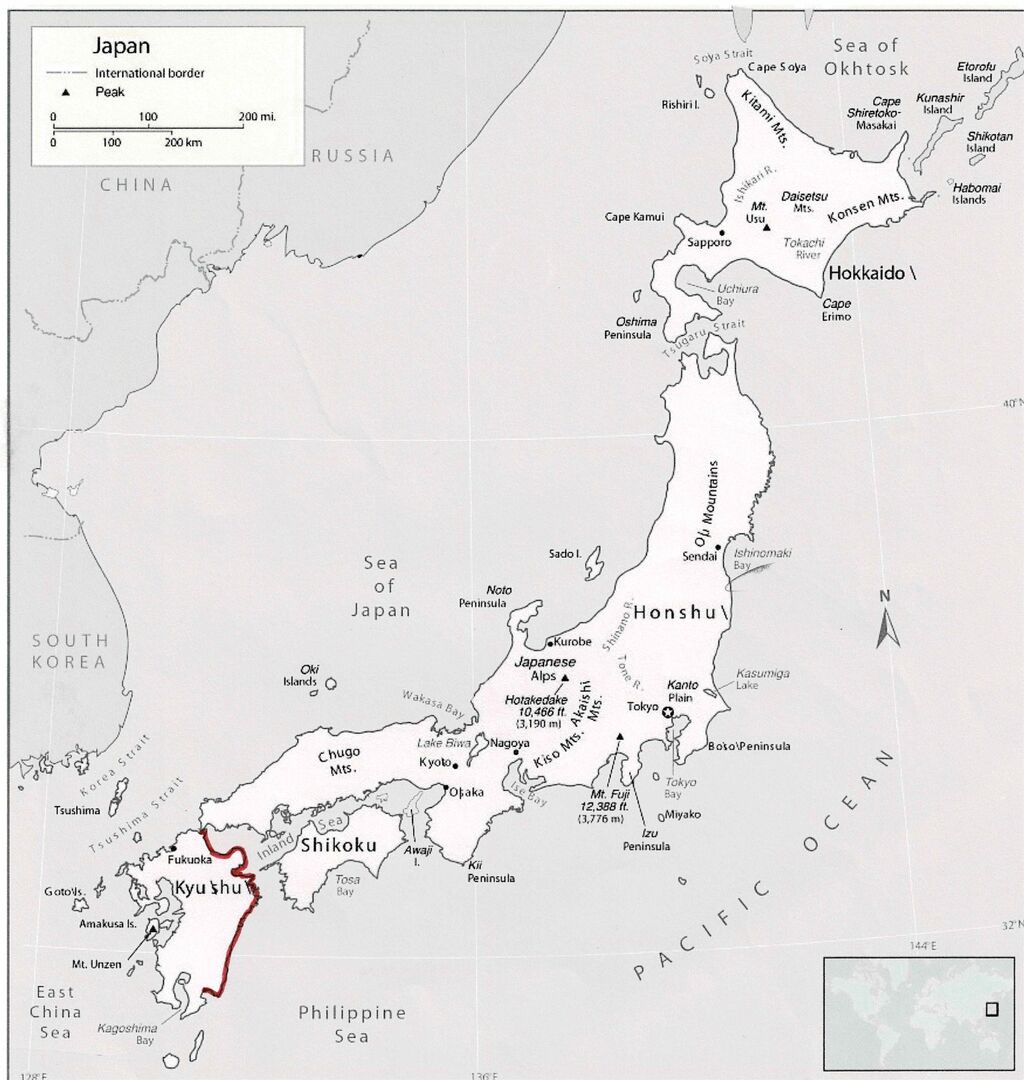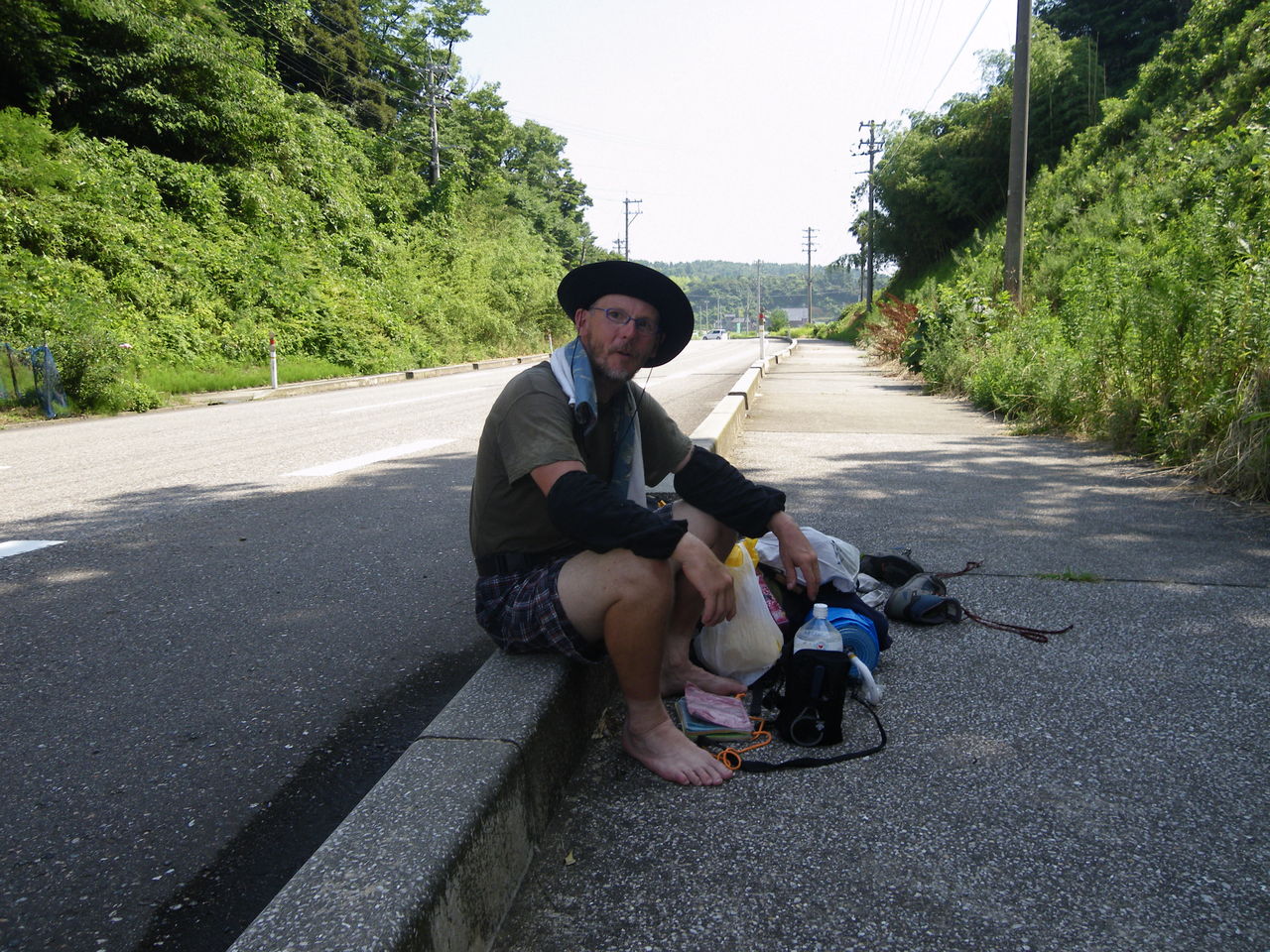
Irishman Walking (Stage 7 Chapter 2) is about my walking the main and coastal roads of Japan. Winter 2011.
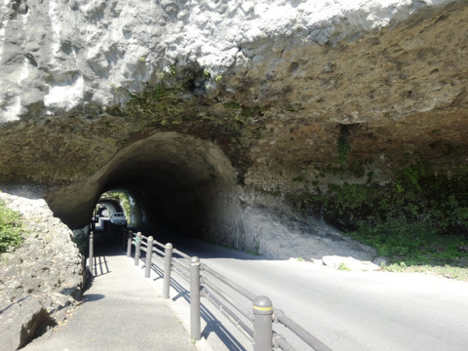
20 Dec, 2011: Camp was set up near a river, across from a school, some four-kilometers from the town of Kunimi, a distance much shorter than had hoped. A restless night! Though why that was so I had not the foggiest, for I had been warm and comfortable. Now the sky was covered by heavy clouds, and again I was surprised me a little at seeing the beautiful rays of the sun fighting to be noticed. Breakfast was a cup of hot black coffee and the remains of a pack of ‘Calorie Mate’ that a friend had given me when I left Tokyo. My humble breakfast was prepared as I got my gear ready and packed away for hitting the road. The town of Kunimi, which I would soon pass through, has a population of around 5,500, and is located in the Higashikunisaki District in Oita Prefecture in Kyushu. For most of the time on the road, or since arriving in Kyushu, I wondered where all the bus stops huts had gone to? On my way towards Kunimi I passed by a few of them, but without going into detail this time their conditioned was most uninviting. Along my way a number of old tunnels, too, came and went, not to mention that long bugger of one that I passed through yesterday evening. In time I pass a sign on my right that points for Kyosendoji Temple, but I have no time nor interest to go there. It was almost 11:00 A.M., when I stopped at a rest area that had public toilets and a restaurant that went by the name, ‘Mihama’.”Mmm!” Things were looking good, I thought as I left the road and turned into the parking lot. Thoughts of having a bit of a wash and then stopping by at the restaurant to see if there was something hot worth having. On the road it was never a good idea to pass up on the chance to replenish the body with energy. It took only a few seconds after sitting down at one of the tables next to one of the large windows that the food on the menu was fish based in one manner or another. On top of this, everything appeared to be cooked! “Mmm!” Not even a single sushi or sashimi dish on offer! Ever since my childhood, how I hated the smell of cooked fish! On a normal occasion, I would simply get up and leave! But this was not a ‘normal’ occasion, besides, I was sitting at the table and my writing things were already opened up on the table before me, and the cellphone battery was being recharged. “What the hell!” I mumbled under my breath, as I pointed to the octopus dish on the menu. Not a lover of cook fish, when the dish was placed on the table in front of me, I must say the slices of taco and octopus, on top of cooked rice with mushrooms looked mouth watering. This was also the first proper hot meal that I had since leaving Tokyo, so I should not complain any. The large windows offered the customers a splendid view of the surroundings. The differing colors on the tree covered slops in the late seasonal change, away out on the horizon I could see the cargo shops headed to somewhere. Most interesting was the clear view I had of Himeshima Island situated just off the north-eastern coast of Kyushu in Oita Prefecture. In fact the island appeared so near like it was just a swimming distance away. In more favorable weather conditions, no doubt. According to visitors to Himeshima, the most breathtaking scenic spot on the island can be seen from the Kannonzaki Peninsula at the north-eastern point of the island.
It is here, at the top of a hill where the Sennin-do sits on a rock that look out over the sea. The view is greatly enhanced by the wind-bent pines that grow from among the rocks and stones around it. On a clear day, the mountains in Kyushu, on Honshu and on Shikoku can also be seen far off in the distance. A magnificent view can also be seen from the lighthouse located on the eastern tip of the island. The kanji characters that form the name of this remote island mean ‘Princess Island’. Not surprisingly, there is a small village located on the Himeshima, accessible to by a ferry from Imi Port on the main island. The island is also referred affectionately to as Hime. Close to 2,000 people live on Hime, with the main occupations being shrimp farming and fishing. The island is said to be noted for its quality tiger prawns, and the kuruma ebi is said to be the island’s most famous product. According to my research, much of the money made from this bustling trade is ploughed back into the local economy and to the upkeep of the many beautiful old buildings, thus keeping the island's old-style image at its best. Like many places in Japan, it has its fair share of hot springs. For a couple of days in mid-August, a Shinto religious ceremony or festival called Kitsune matsuri (Fox Dance Festival) is held every summer with dancers dressed as foxes. Quiet and tranquil much of the year, the matsuri is also a time when the island is filled with visitors from all over Japan and further afield. “Mmm!” Are many foxes also living on the island? One good way of finding out, if not exploring this hilly place once and for all might be a bicycle ride around this seven-kilometers long island, or in my case a good lengthy tramp. Sadly, I had time for doing either! One other thing that Himeshima was noted for were the millions of beautifully colored butterflies that migrated from Okinawa, around June. Therefore, it surprises me a little that there is no festival to mark the occasion. Might not such a thing be good for business? Last but not least, in 2000, Himeshima was used for location for part of the film, ‘Kao’ (The Face) by Junji Sakamoto, thought the less I say about this the better. Along the way once again, the road began to wound upwards for a spell that for a while that I began to think it was going to be one of those hard and tedious days that I had to endure. Alas, it tuned out not to be so steep nor lengthy. The only annoying part of the tramp was the disappearance from sight of my old friend the sea. My view, or from now on as it seemed, was separated from the sea by steep hills covered with trees. There was no point in counting the number of tunnels that I needed to tramp through, though I recall that a good few of them were more than 500-meters in length. Similarly, I no longer found it necessary to stop and take photos of them, or to waste time stopping and jotting down details from iron plates at the entrances. In other words, I did not care anymore! The many bridges and rivers that I crossed no longer had the same meaning as they had when I tramped down through Hokkaido. That said, this segment of my mission has so far been a piece of cake. Or at least compared with the previous Akita to Fukui winter stage when it rained and snowed continuously.
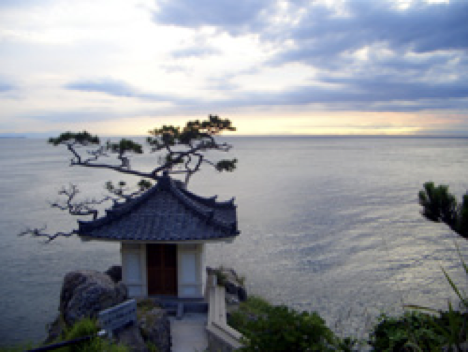
The Sennin-do (Japan Visitor, Johannes Schonherr)
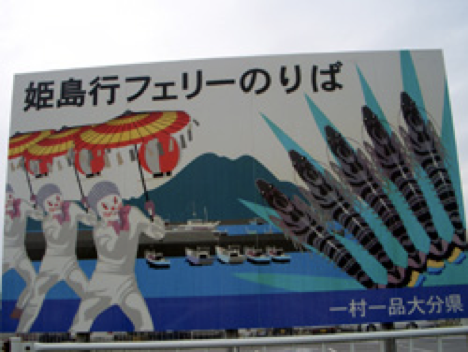
(Wikipedia)
Just a couple of steps after emerging from Kozato Tunnel that I got sight of a sandy beach a good distance below. Route 213 wound downwards to the left. Then near to my right I soon passed a well cared for graveyard, and some of whose occupants once frolicked about on that beach with their sweethearts. Soon the beach was behind me, when a touristy sign came into sight and pointed to the right in the direction of three historic Buddhist temples, Senpukuji, Monjusenji, and Iwatoji, 21, 12, and nine-kilometers, respectively. The temples were located on the Kunisaki Peninsula in a region of Oita that is said to have been created by demons that served powerful gods. Home to several inactive volcanoes are at its center, the 35 to 40-kilometer wide hilly Kunisaki Peninsula is found at the northeastern region of Oita Prefecture. The name Kunisaki is said to mean ‘land’s end’, and standing close to the tip of the peninsula, I guess it was. The highest peak ion the peninsula is Mount Futago, with a height of 721-meters. With a number of small villages dotted along the coastline, Kitsuki is the largest city and is located on the southern region of the peninsula. Oita Airport is found on the southeastern coast. No other place in Japan can boast so many mountainous temples as here. Since ancient times, this area had been a gathering place for mountain worship. Like many temples and places of worship, Senpukuji Temple (also spelt Sempukuji), has a long and flourishing history, but unlike them it was the main temple of the Soto school of Buddhism in Kyushu. It also has large Zen hall where practicers can come together to learn the correct posture and manners. Considering the temple’s importance, according to the Internet, there seemed to be much more information on Monjusenji Temple. Similarly, there is little to be found on the history of Iwatoji Temple, other than it was founded during early-8th century or around 718 by the priest Ninmon. Ninmon is believed to have founded no less than 28 temples on the peninsula as well as creating nearly 70 thousand Buddha statues in his lifetime. Iwatoji was a Buddhist temple located about five-kilometers north-northeast of Mount Futago. At the entrance to the temple stand a pair of Niou statues, one of which has the date "1478" carved on it. Thought to be the year that the statue was made. Nearby, the 3.3-meter high Kunisaki Pagoda also has the date “1283" carved on it, and it is believed to be the oldest Kunisaki Pagoda in Japan. Digging up information about Monjusenji Temple was a different story! However, without going too much into detail, the idol worshipped at Monjusenji is called Monju Bodhisattva, known as the Mother of Wisdom, especially as far as young children were concerned. Many people continue to visit the temple throughout the year so as to prey for their child’s healthy growth, academic success. Hidden within the most inner part of the temple there is a small bronze Buddhist statue of Monju Bodhisattva, just 30-centimeters in hight, which is so treasured it is revealed only once every 12-years, or in the Year of the Rabbit. (The next revealing was in 2023). There is a cave located behind the hall where spring water gushes from. It is said that those who drink the water will receive wisdom, hence its name, ”Chie no Mizu”, the Water of Wisdom.
Monjusenji is perhaps one of the oldest temples in Japan and is believed to have been founded around 648 by the Father of Shugendo. Shugendo is the path of ascetic training, a syncretic form of religion that included aspects of Shintoism, Taoism, esoteric Buddhism, and Japanese shamanism, among other disciplines. A number of the statutes kept within the temple compound date back to this period. Last, but not least, the temple is also home to the largest ancestor prayer pagoda in Japan, and which is said to have been built by as many as 14,000 people and took 10-years to complete. On a good day, Yamaguchi and Ehime across the Seto Inland Sea can be clearly seen. The Monjusenji Temple stands within forest that is recognized as a natural monument of Oita Prefecture. The forest is home to a 1000 year old Zelkova tree, also native to eastern China, Korea, and Taiwan. The Zeikova tree is often grown for ornamental purposes, such as being used in bonsai. Many Cedar trees that exist within the forest are said to date back over 400-years. Not long after stopping a while to ponder a sign post that pointed in the direction of temples, the pain in my left knee became more acute. If though I followed the policy that i decided on the day before of making more stops and rests, my pace had become so depressingly slow. I also knew that if I was to get anywhere, I just had to rest my knees. It would be a mistake to just push on! As Hemingway put it in ‘To Have and Have Not’, “I’ve got to think right all the time. I can’t make a mistake. Not a mistake! Not once!” A glance at the cellphone clock told me it was four o’clock (Weeks earlier I lost my trusty old watch and chain somewhere in Tokyo). The rich sandy beach down below the road, and just a short distance to the left side of where I stood, told me that there was no better place or time to make camp. If only the weather was more inviting, like it usually was in summer, how I would have loved to have splashed about in the salty waters of the mighty Pacific. Picking up my binoculars I could get a good look at the cargo ships of various sizes moving away on the horizon. How those giant monsters now looked so small, like some child’s toys. Would my body have faired any better had I been in a kayak? I wondered, as I made my way slowly down the hill towards the beach. Traveling to some distant place in a kayak was another of my many dreams. As with my love for long distance walking, the seed of kayaking was also planted in me by a book I read. Long before starting out on Stage 1 of my mission on foot around the main and coastal roads of Japan, I read a lot of all kinds of true stories of adventure. In 2005, for example, I read a book called ‘On Celtic Tides’ by an expedition sea kayaker called Chris Duff. Duff’s book gave an interesting account of his journey around my own country, Ireland, in a sea kayak. A trip that took him about three months to complete. It told of how he battled with the freezing Irish waters while the morning sun rose up over the countryside. An adventure that took him to the western horizon is the pinnacle of Skellig Michael, it steep vertical rock rising more than 213-meters out of the roaring waters of the Atlantic. In my younger, if not more vigorous times, I walked and cycled in and around many countries at.
Sadly, I was not one into writing or reading much of anyting, and therefore had left little account of those adventures. Some decades ago I cycled around Japan, which often took me along road, across bridges, and through tunnels that no longer existed. That was around a Japan that has changed considerably, compared to the country that I found myself tramping around now. Hence, the importance I now placed on keeping good road-notes, and photos. Why not? Even Marco Polo, the first European to travel to China, was also the first to leave a detailed chronicle of his venture experiences. His works of literature also inspired Christopher Columbus, among many other great travelers in their time. In part, Marco Polo’s writings were influenced by the introduction of the first world map at that time. This was called 'The Fra Mauro Map', produced around c. 1459, it was the most detailed, and accurate world map, up until that time. Today, the Venice cosmographer, Fra Mauro's map was considered the greatest memorial of medieval cartography. Yamato no Uchūshi, or Japanese Cosmography, was by no means lost in the doldrums, or murky, at least not until the Taisho period. That was when Japanese artist and cartographer, Hatsusaburō Yoshida (1884-1955), came on the scene. The quality and bird's-eye image of his maps, mainly of cities and towns, earned him the title: 'Hiroshige of the Taisho Era'. The Taisho period (1912-1925), was a time of what was called, ‘Taisho democracy’, with its liberal movements, in Japan, it was also a time between a chaotic Meiji and a militaristic Showa years of hardship and uncertainty. The popularity of Yoshida's detailed maps gained in popularity, due to a boom in tourism, and the expansion of the rail transport system, through the Taisho to Showa periods. He had friends in high places, and was praised by the Emperor Showa for his works. In the course of his lifetime, Yoshida produced no less than 3,000 maps. During the Pacific War years, the production of Yoshida's maps were shelved by the the military, who judged them too revealing to the enemy of military secrets - harbors, etc. "After the war Yoshida's first major work was a bird's-eye view of the aftermath of the Hiroshima atomic bombing" (Wikipedia). In Japan, the earliest known term used for maps was the word, ‘kata’, which roughly meant ‘form’ in English, and was believed to have been use up until the eighth-century. This was followed by the words ‘zu’, and ‘ezu’, a term more commonly used, during the Nara period. Translated into English, the word ‘ezu’ toughly meant, ‘picture diagram’. Unlike modern maps, the early picture diagrams were not always geographically accurate depictions of particular physical scenes. They were more like pictorial images of physical geography, or spiritual landscape, such as, the surrounding scenery at a shrine, which offered an impression of nature and of human figures that depicted the local life. It was not until the late-eighteen-century, when a new word became generally accepted and used today. That was in Nagasaki in Kyushu, when translators latched onto the Dutch word for land, ‘kaart’, or ‘chizu’, in Japanese, and ‘map’ in English. Perhaps the most famous maker of maps in Japan was the Japanese cartographer and surveyor, Tadataka Inō (1745-1818), who was born in Kazusa Province along the Pacific coastline, in todays Chiba prefecture, east of Tokyo. In fact, Inō was credited with producing the first detailed map of Japan. The task covered the entire coastline of Japan, and selected parts of the interior of the main islands.
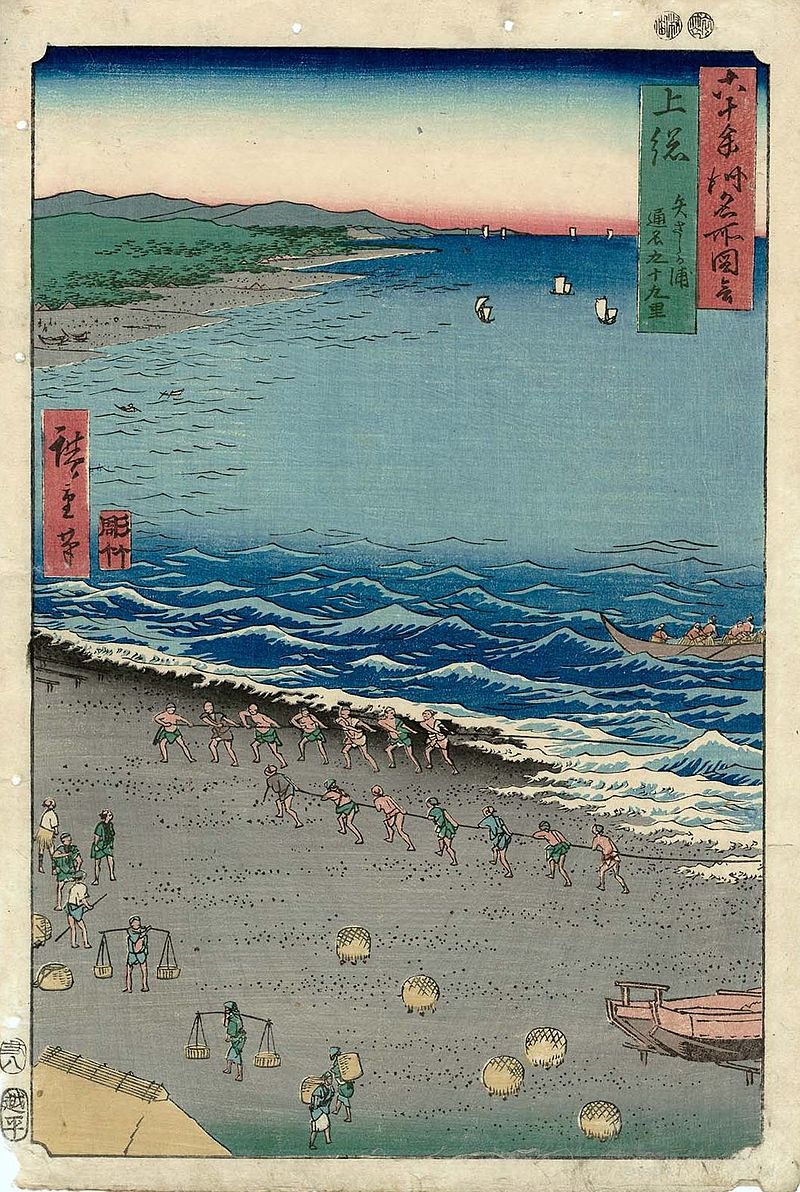
A Utagawa Hiroshige ukiyo-e of ‘Kujūkuri Beach in Kazusa’ from, ‘The Famous Scenes of the Sixty States’ (Wikipedia)
21 Dec, 2011: A restless evening, but by morning I felt ready again to hit the road early. For a little while I paused to enjoy the early morning sun, the first that I had really observed in ages. How majestic the sun seemed, a red-orange-yellow mesh of confusing colors. After a cup of hot tea and the last of my onigini , or rice balls, I set about rolling up and packing away the gear. A little distance down the road, Route 213, I came to a cycling track called ‘Kunisaki Hanto Cycling Road’. Then with a wave and a goodbye to Route 213, I turned onto the cycling path that would take me for a good 12.3-kilometers. For a few moments I stopped to look at the sea. Far off I could see the giant container ships and many kinds of smaller vessels, powering their way though the open waters. Thanks to the warm coastal breeze coming low in over the sea, the ship engines could be clearly heard. “Mmm!” Something told me that this was going to be a good day, or so I felt. Even the pain in my left knee hurt less than this time yesterday. Then again, I knew that I needed to tread lightly, even though a study of the maps last night told me I needed to cover at least 25-kilometers a day. That was how it had to be if I was to reach Shibushi Port on time if I hopped to catch the ferry. Stumbling upon the cycling road proved an unexpected joy! Free from the noise and dirt from the speeding traffic, meant that I could now hear the sound of the rolling waves and the science of the nature about me. This was such an extremely busy stretch of water with shipping traffic moving between the islands and mainland, and beyond. Heading in all direction, ships could be seen far off and further still. From bow to stern, the giant cargo ship centerlines where low in the water, and told me that they were loaded up. “Mmm!” It was hard not to wonder about where the ships were bound for. Each and every one was carrying their loads to somewhere in the world. Somewhere near to Musashi Town, not so far from Funichi Beach. Musashi is a town located in the Higashikunisaki District of Ōita Prefecture. As of 2003, it had an estimated population of nearly 6,000 people. I was when I was thinking about the beach, when my eyes spotted yet another one of the many touristy signs I had passed. This time the sign pointed towards five Buddhist temples, and one Shinto shrine; Maruonoji, Saikoji, Hoonji, and Shoonji temples, not to forget the shrine with its very lengthy name, Tsubaki Hachiman Shrine. The divided spirit of Usa Jingu Shrine was also enshrined at this shrine. Up until the end of the Tokugawa period, Tsubaki Hachiman-jinja was the center of the faith of the feudal lords. The sacred tree, a camphor tree, was relocated along with the shrine to the current location, in 1023. Today, the tree had been designated for special protection by Oita prefecture. Directly translated into English, Tsubaki Hachiman-jinja, meant: ‘camellia eight-million shrine’. Hoonji Temple in particular was first established in 1394, before being moved to its current location, in 1601, and was Japan’s first Zen training center. Noted for its many statues each with different facial expressions on them. It is also said that the statues were made by nine Buddhists from the Kyoto and that it took them some four-years to complete the task in 1731. According to one Internet site I looked at called, ‘Hello Japan’, two of the statues are believed to be of Venetian merchant and explorer, Marco Polo (1254-1324), and Mongolian general and statesman, Kublai Khan (1215-1294).
Why the faces of these men would be on the statues was well beyond me. The Travels of Marco Polo (c. 1300), a book that described his travels to China, and to other Asian cities and countries. Marco Polo had been introduced to Kublai Khan by an uncle and they are known to have travelled together for a time through Asia. Did they pay visit Japan? Soon another road signs me that Kitsuki and Oita Airport are straight on along Route 55, and that Futago and Tomikiyo Mountains are away to the right. Musashi Port was off to the left along Route 543. Nearby I could see a book shop, but I was more interested in finding a convenience store, and after a little while I came to a Family Mart on the righthand side of the road, with a Lawson a little further along on the other side. Rather that cross over the road, I continued along towards the Lawson passing a bookshop called Books Bungo, which I thought was a rather interesting name. Back at my apartment in Tokyo I had a lot of books, a good number of which remained to be read. Now they just gathered dust! On the whole, I could not complain any about my performance on the road, and the early start allowed me to get a good few kilometers more than usual under my belt, which felt good. The number airplanes low in the sky also told me that the airport was not so far away. Not much later I could even see airplanes clearly taking off. If all goes well, then the airport will soon be behind me, and perhaps then I could focus my mind on looking for a place to pitch the tent for the night. Like I said earlier, if all went well and I could keep up the pace until at least five o’clock, excluding the stops to rest, then I should be able to notch up 30-kilometers, or there about. When it came down to it, words were cheap! Beyond a rather attractive red colored girder bridge I caught sight of another sandy beach, and nearby on the opposite side of the road from it stood a supermarket. “Mmm!” What better place to make camp that right there on the beach, I thought, as I loosened the straps on the backpack and continued along the road towards the sea. It did not take very long to reach the beach and soon the tent was pitched on the sand. One good thing about making camp on a beach earlier than usual was that you had more time to enjoy it, or such was the case in the summer. There was nothing better than a plunge about in the sea for easing the muscles, and whatever damage there was on the body. This was not summer! A glance at the cellphone clock told me it was just gone five o’clock, and that a nap might not be a bad idea to begin with. Before that the gear and whatnot else needed to be sorted out, then a quick stop by at the supermarket to see what might be had in the form of food. No sooner had I got back to the tent, when the cellphone rang. It was from my friend in Tokyo, Riko. One of the things we talked about was the distance from the airport to Beppu, as well as to Oita City. Later, I was able to go over my maps and get a better idea of things, to compare distances already covered in terms of times and days. I remember finding it hard to believe that I was just 20-kilometers from Beppu and 30-kilometers to Oita. Or such was how it was related to me, and of course, I trusted my friend for she had the use her computer and the Internet, and Google Map, and so forth. Yet, on my tattered maps things less clear. Nice as it all sounded, I had a funny feeling that the road signs were going to tell me a different story.
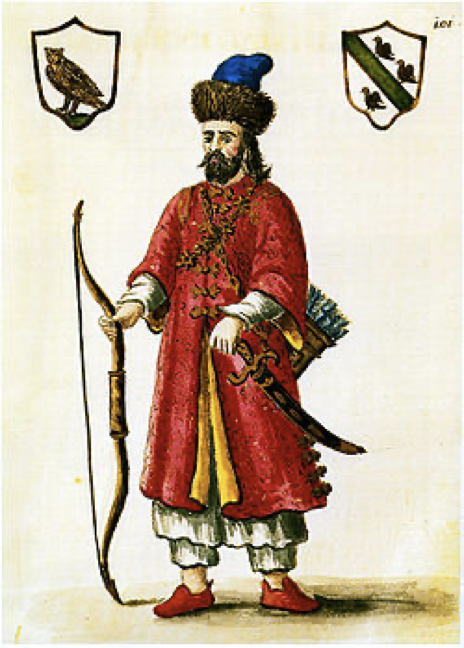
Marco Polo dressed in a Tatar outfit (Date of print unknown) (Wikipedia)
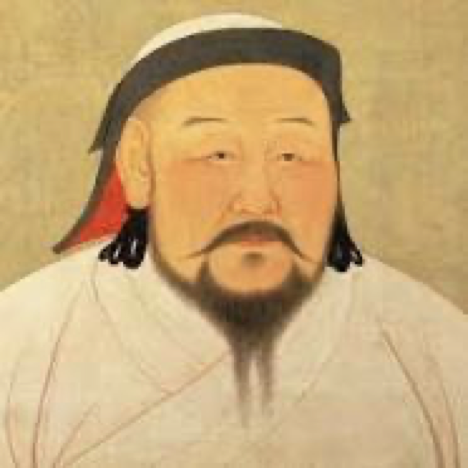
Kublai Khan (1215-1294) (Wikipedia)
22 Dec, 2011: Soon after returning to the warmth or the tent and sleeping bag after taking a piss, the soft pitter-patter sound of the rain on the sides of the tent. The time was not yet 05:00 when I remembered that I still had some dirty clothes hanging outside, where I had left them to air. On the road, it was often not easy to wash clothes in wintertime. So, it was back outside again, I stood barefooted in the sand. “Mmm!” Strange! Or so I thought! For there was no sign or trace of rain, even thought I had distinctly heard it falling just now! Not wanting to have to go outside again, I grabbed my things of the rocks and bushes where I had placed them, and tossed them into the tent. Along my way an elderly woman approached from the opposite direction on her bicycle. The pavement was very narrow, and found myself having to squeeze in to the hedge to make room for her to pass me. She appeared to be speaking to herself, when she drew near, but I could not make head nor tail of the words. Suddenly, the woman dumped off the bike and pointed back in the direction from whence she had come. Now I could understand her words. “There’s a spa a little ways up there.” She said, and motioned with her head and hand to a large white building. “It’s only ¥100 Yen.” “Wow! That’s cheap!” I replied, with a smile. “Why don’t you stop there for a while?” She continued! Actually, I never cared much for public bathhouses of any kind, and loathed the idea of sharing the baths with other naked men. Of course, I did not tell the elderly woman that, but thanked her for the information, as she got back onto her bicycle and peddled away. When I reached the building in question, I could see that it was really a Japanese inn, where glass doors led to the lobby in the center of it. On the righthand side of the building there was a restaurant with large windows. The carpark was full cars, which told me the spa there was very popular. Not feeling hungry nor caring to stop and investigate, I continued my tramp along the pavement. For a while, I thought about the elderly woman on her bicycle and wondered if I should have acted on her suggestion and stopped. Only about two-kilometers after passing the inn I decided to stop for a nap on a piece of ground under an overhanging roof of a disused building. Unable to nod off, or after 30-minutes of tossing and turning, I decided to boil some water to make a cup of coffee. An odd combination of Camembert cheese and what was left of the sweet bread I picked up at a convenience store earlier acted as my lunch. Then, with my body somewhat replenished and vigor restored, it was back onto the road where I hoped to reach Beppu before dark. Since hitting the road this morning, the sky has been a mixture of good and bad, or anything from warm sunshine to heavy rain and snow, and the freezing cold for company. When the sun had its way, the going was good and comfortable, but when it did not, everything was so miserably depressing. The roads, too, remained consistently busy with all sorts of traffic. This included three cyclists, each loaded up with camping gear, who sped past me in the opposite direction a little time earlier, and not even a wave.
Most of the roadsigns that I passed showed only directions to where ever, but non mentioned the distances to the places, which would have been nice to have known. Distance-direction roadsigns gave me a good idea of my own progress on the roads, how far I came and how far I had to go, and so forth. They also gave me a reasonably good idea on the time when I might reach a particular place, town, or city. Talk of the devil! For I just caught sight of the first distance-direction road sign in ages. Now I knew that Beppu was only 13-kilometers away, and that Oita was further at 24-kilometers. Regardless, I could now predict fairly accurately the time when I would arrive at both cities. Actually, both cities were further away than I had thought! I had hoped to tramp into Beppu and perhaps stop the night there. Soon, however, I had sliced four to five-kilometers of both distances, now making Oita my main target for today. The checkin time at Route Inn was at three o’clock, and this was well within my grasp for sure. Only God knew how I looked forward to soaking in a hot bathtub. If I was not mistaking, the Route Inn in Oita also had a public bath, and I hoped to try it out, but I knew that I would have to pick my times carefully Not 10-minutes earlier, I was awakened from a nap by the ringing of the cellphone. It was from my friend in Tokyo wanting to know how things on the road were going or how I was doing? I learned, thanks to my friend, that Beppu was most famous for its hot public baths, or hot springs. Once again, I felt unimpressed! “Surely the place is famous for other things! Right?” I asked, my eyes still feeling a little heavy. Other than being famous for the many Japanese visitors who flock there to enjoy the hot springs and sand baths, my friend was not able to tell me much about the city! Visitors during the winter months are given a seasonal treat when the entire town becomes filled with warm, escaping steam from the frost covered ground. With little of anything to offer, other than it being an important spa resort. It is very famous for its real vintage mineral rich, multicolored, hot sparkling waters. In fact, the city remains among the top three spa locations in the country. Perhaps because of the importance of its hot springs and many visitors to it, Beppu was granted city status on April Fool’s Day in 1924. Actually, there are eight major geothermal hot thermal vents here called, jigoku, or ‘hell’ pools. Hence the nickname: ‘Eight Hells of Beppu’! Besides the natural smell of sulfur, with steam rising from vents, a good portion of the spa water was much hot for meaningful use. With temperatures ranging from 50 degrees celsius to 99.5 degrees celsius, to be of any immediate use. Interestingly, these dangerously hot thermal vents are referred to as “hells”. Umi-Jigoku (Sea Hell), Oniishibozu-Jigoku (Shaven Monk's Head Hell), Yama-Jigoku (Mountain Hell), Kamado-Jigoku (Boiling Hell), Oniyama-Jigoku (Demon Mountain Hell), and last but not least, Shiraike-Jigoku (White Pond Hell). To quote from a book, ‘A Guide to Japanese Hot Springs’ (1986), and which I piked up at a secondhand book shop donkey’s years ago and only recently started to read: “The concept of jigoku was introduced with Buddhism.
Jigoku consisted of six hells, including one of fire and another of boiling, so it was easy to imagine the fear that puffs of steam must have caused those who first stumbled across Beppu many years ago. In the past, animals and birds often perished near Jikoku, usually due to the noxious fumes emitted. Even to day [mid-1980s] threats of banishment to the hell places are not taken lightly, especially by children.” (Anne Hotta/Yoko Ishiguro).As cities go, Beppu was fairly small, with a population of around 123, 000. The city is more lengthy than wide, Beppu is enveloped between a mountain range and waters around Beppu Bay and beyond. And, apart from the amazingly beautiful landscape, Beppu was not the sort of place I cared to remain in for very long. After the call, I then thought about going back to sleep, but the urge to talk another piss proved more pressing. The night view across the bay proved creating taking. The yellowy-orangey lights from the city danced about on top of the black shiny water. In the far distance other lights remained me of my destination, Oita! The evening sky, too, was so uncertain. The last time I left the tent to relieve myself, there was not a star to be see anywhere in the heavens. This time, the clouds opened up before my eyes to reveal a countless array of the stars. So low in the sky that I felt I could just about reach up and touch them. Everything was so unexplainable, for just a short while ago, I could have sworn I heard the sound of rain on the sides of the tent. Nor was this the first time! One thing that did remain constant, however, was the cold evening air. Then again, that was to be expected since I loved to camp as near to the sea as I possible. Of course, on the road one needed to learn and change with the circumstances. There was no dominant or absolute, or right way. You needed to be prepared for any risk. Or to be in tune with the precautions you needed to take when camping outdoors. Although most campers were aware of the dangerous weather conditions, like, typhoons, and so forth, I surmised many forget about the possible dangers of the beaches. Besides the high tides, who among us thought about such stuff as harmful debris or toxic chemicals. Beaches were closed for various reasons, so it was wise to check the websites of the beaches if possible. Warning flags or signs posted on our near the beaches had to be obeyed. Most beaches, I guess, posted warnings, if not closed down, when sharks sighted in the area. Japan waters had sharks, but noting to the extent of other countries, like, Australia, or parts of America. I especially needed to be aware of the dangers of the rip currents, whenever I took a dip in the evenings. A common mistake was to try and swim against a strong current, but rather to swim perpendicular with the shore to get away from the current. All this sort of stuff I knew, and touch wood, had little or no problems to date. That said, my main aim of camping on the beaches was to wind down and relax after a long day on the road. I did not want to think about much of anything, other than to somehow wash my body, put on clean clothes, eat, and steep, usually in that order. And of course, just hope that nothing unexpectedly or unwanted occurrence happened.
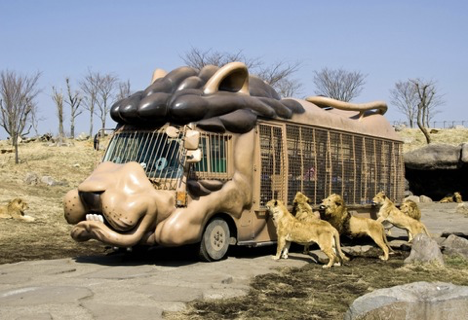
23 Dec, 2011: At last I dragged myself from the tent and stood up straight on the cool sand to take in the fine clear morning, and the pleasant rays from the sun that reflected over the coastal water across the bay. It was a nice morning all right, just perfect for hitting the road. The tide was in and not far off shore a couple of tiny fishing boats with their lone occupants keenly applying their trade. Back on the road at last a road sign informed me it was nine-kilometers to Beppu, and 21 to Oita. The pain in my knee caused some concern, but this had to be done! It was no good grumbling now! Besides, I could stop somewhere along the way and rest a while! “Mmm! What was 20-kilometers anyway?” I mumbled to myself, trying to put a positive spin things. Besides, I had pushed myself twice that on various occasions, and in worse weather conditions, too. Now my mind began to work overtime! Hopefully the pain in my left knee could be walked off! That was what the professional footballers did! Right? Or so I tried to tell myself, more for self encouragement, than not! “Mmm!” I remembered thinking how unfair life was, for the way famous sports people talked of having trainers and fans, and people to push them to their limits. What did I have, other than the hurting knee and a heavy backpack that was digging into my shoulders? Further along the road I came to a touristy sign that pointed in the direction of two places of interest near Beppu in Ōita, in Kyushu; namely, African Safari and Ajimu Family Village, also known Family Travel Village, some 12 and 32-kilometers away, respectively. Since the African Safari opened on 29 May, 1976, people could drive through the safari-style park at their own pace, and observe many exotic animals. If they do not want to use the car, then for a price, the experience can be enjoyed on the jungle-bus. From the cage incased bus, visitors can feed the wild animals, including lions and giraffes, by using long tongs, which are of course provided. In a way, the visitors are able to observe the animals natural habitat, and interact with wildlife close up without having to go all the way to Africa. There were six different kinds of jungle buses designed for the visitors safety. From the buses, visitors were able to touch and feed the animals by hand, as well as, learn about these beautiful creatures. There are also place to eat at the safari park, including a gift shop where they can buy souvenirs on their visit there. The Ajimu Family Village, located in a place in Usa, it was opened to the public in May, 1980, a year after I first arrived in Japan. It was also the first travel village in the country. It took around 40 minute by car from Beppu JR Station. On foot, I shuddered to think how long it would take me. The village consisted of 15 cottages with Japanese and western-style rooms, fitted out for the comfort of both business and leisure guests. There were also facilities for disabled guests, and pets were also welcomed. It was a vast complex leisure facility built within 89 hectares of land , and offered visitors a wide variety of activities. For example, sports, camping, restaurants, including a winery. It was particularly noted for its hot spring spa that was tattoo friendly.
Both places of interest were in the direction of Ajimu and off Route 10 to my right. Much of this segment of the road was well looked after. Rows of tall palm trees flanked the pavement along which I made my way. On the road, many trees lined the center divide, with the traffic speeding past in both directions. In time, I saw a wide assortment of trees along the opposite side of the road. Soon after, I decided to stop at nice park to rest my feet and legs, and to boil some water for a cup of coffee. Dropping the backpack on the ground I made for the public toilet to point Percy and the porcelain. No sooner had I unzipped my shorts, when a young Japanese fellow entered and stood at the urinal next to the one I was using. “Hello!” He said, with a smile on his face! Our shoulders were almost touching! The toilet was empty and I was in no mood for striking up a conversation with a man in a public toilet. Especially as the fellow choose to receive himself at a urinal right next to me. I had noticed him standing near the toilet when I entered the park, but thought nothing of it. Besides, I had more important things on my mind to imagine anything amiss. Even as I washed my hands at one of the sinks in the toilet, the fellow continued to stand at the urinal. Outside again, in the fresh air again I found that I was in no mood for stopping longer to boil water. Therefore, I re-shouldered the backpack, tightened up the straps and headed back out on to the road. Often the physical, personal, or intimate space a person maintains from another person often conveys a message. This ‘space’ is also referred to as ‘bubble area’. The life of most, if not all living things are territorial and diverse. Humans in particular, need their own intimate space. This could be noted on beaches, in waiting rooms, and barring rush-hours, on train station platforms, and so forth. In short, people expect others to respect their territorial rights. Maintaining a comfortable zone or distance from another person was instilled in me at an early age. This may well differ in country to country from culture to culture, but the physical, personal, or intimate space between people, whether they are strangers or not, exists regardless. This actual distance may range from only an arms length to a few meters, often depending on their relationship, or reasons for close communication. There are other related terms used, such as, ‘public distance’ and ‘social distance’, but they have a more formal and businesslike and meaning to them, respectively. Whilst one’s personal space, that invisible sphere of keeping just enough distance apart, is more tied in with the daily life of communication. So important is this invisible sphere to people, that when it is invaded, violated, infringed, or intruded upon, they may express irritation, or feel some level of discomfort because of it. Of course, there are times when this cannot be avoided! This is most noticeable, for example, during rush-hour on public transportation, which in turn can be rather irritating for many people to say the least. Thanks to having two motorbikes and a good road bicycle, I have seldom needed to rely on public transportation. The fellow who followed me into the public toilets had other ideas on his mind, other than merely to take a piss.
The nerve he had for choosing to stand at the urinal next to the one I was using. I felt angry! For me, this was unacceptable, for I felt my personal space was being trampled upon. It goes without saying that looks and actions can be deceiving. Still, I could not help but construe from the fellows actions that he was seeking a sexual encounter with someone. Glancing back momentarily at the park, I could see the fellow was still standing near the toilet entrance, just waiting! Clearly he was out ‘cruising’, to use the specifically sexual meaning of the word, which has a long history of a sexual nature, particularly in the gay world. A direction road sign pointed for Beppu JR train station. Near by, I saw a 7-Eleven convenience store where I decided to stop to enjoy a can of beer. Even in winter, there was nothing like a nice cool can of beer when you build up a sweat. As I set done to enjoy the can of Kirin ‘Classic’ beer, leaning against a fence and my legs stretched our on the tarmac before me, a Caucasian man walked past, and disappeared inside the store. Even though I felt that he noticed me, there was something I could not describe about him that told me he was uninterested in stopping to chat. Perhaps, like me, he had more important things on his mind. My useless thoughts were soon awakened by the sound of some far-rightwing vans went past, in both directions. The different vans churned out their political views in music and in words at great volume. One of them played Kimigayo the Japanese national anthem. Again the volume was turned up so loudly that I was sure even the gods in he heavens must have heard it. “Mmm!” I wondered if the far-rightwing guys knew that the lyrics of Kimigayo that they wee proud of playing in such a manner was among the oldest of national anthems of the world, as well as being one of the shortest, too? The lyrics of Kimigayo are taken from a wake poem of the Heian period (794-1185). Did the far-rightwing guys also know that it was a Scot-Irishman called John William Fenton (1828-1890) who is credited with initiating the process by which Kimigayo became accepted as the country’s national anthem? In 1869, Fenton brought it to the attention of the new Meiji government that a modern nation state needed to have its own national anthem. At this time, Fenton was a musician and military band leader with the British 10th Foot Regiment (later called the Royal Lincolnshire Regiment). The regiment arrived in Japan in 1868 to help protect the foreign community in Yokohama during unrest of the early Meiji period. Fenton’s father, John Fenton (1790-1833), was born in Brechin in Scotland, whilst his mother, Judith Towers, was born in Kindle in County Cork in Ireland in 1828. Kimigayo served as the national anthem of the Empire of Japan from 1888 until the country’s surrender at the end of World War II in 1945. Since the War, Kimigayo had remained as a de facto national anthem. With the passing of the Act on National Flag and Anthem in Japan in 1999, Kimigayo was recognized as the official national anthem. Because of this, Kimigayo has been deemed the world's most controversial national anthem.
Even after things quietened down somewhat, I could not help but wonder to myself about the kind of Japan that the far-rightwing guys dreamt of establishing? Then I thought that such people churned out their political views, because it was that time of the year again, the Emperor’s birthday, when they had noting better to do, other than to belt out their narrow-minded views on one issue, or another. Then again, what did I care about what happened in this country? Even if I did have permanent residency status, I was unable to vote. According to one story, some Japanese naval cadets had overheard Fenton and his brass band rehearsing, and persuaded him to become their instructor. I wondered if the Japanese rightwing groups knew that a foreigner had a hand in the beloved national anthem, Kimigayo? Fenton was also the first to perform it for Emperor Meiji, in 1870? He was not merely the first bandmaster in Japan’ but he was considered to be the father of band music, in the country. All in all, this was quite an undertaking for him, since it had to be completed in just three weeks, including rehearsal. However, this was only the first draft of Kimigayo and a number of changes were to follow before the current modified melody was adopted. Even now, Fenton’s early version is still performed annually at the Myōkōji Shrine in Yokohama, near where he was stationed as a military band leader. Today, the main band of the Japanese Maritime Self-Defense Force still considers this first group of cadet musicians as the earliest of the country’s naval bands. Even when Fenton’s regiment left Japan in 1871, he stayed on for an additional six-years as an instructor of the newly formed Japanese navy and then the band of the imperial court. Kimigayo served as the Empire of Japan’s national anthem, from 1888 until the surrender at the end of the Pacific War, in 1945. Since the War, Kimigayo has remained as a de facto national anthem. With the passing of the Act on National Flag and Anthem in Japan in 1999, Kimigayo was recognized once more as the official national anthem. Because of this, Kimigayo has been deemed the world's most controversial national anthem. The lyrics also made Kimigayo the oldest of the world's national anthems, and at a length of just 32-characters, it was also the shortest. Personally, I thought it to be a rather attractive anthem, at least when compared to a good number of the others being spouted about here and there in the world. On the road one was very much alone, and that was that! This stretch of the road, Route 10, between Beppu and Oita ran for more than 10-kilometers. It was an extremely beautiful stretch, with the sea on one side, the mountains on another, and the abundant foliage every where around me. It was a real paradise for joggers, and cyclists. And yes, even for hikers! There was not one female among the different joggers, and cyclists who passed me by in both directions. All I cared about was fixing my eyes on the outline of Oita, and soon the buildings and factories came into view. “Mmm!” All that I could think about now was that every step I took towards Oita lessoned the time when I would be sitting in a hot bath.
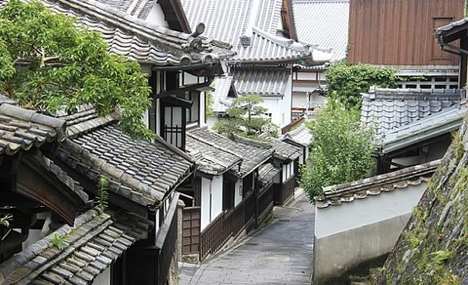
The samurai district in Usuki City Center along the old paved alleyway that dated to the Tokugawa period
24 Dec, 2011: The morning sky seen through the narrow window in the hotel restaurant, where I had just finished a buffet breakfast, looked to be calling me out. The postcard to a friend in America was finished and needed posting. So there was little reason to remain were I was, other than return to the room to get my stuff together for the busy road, Route 10. Then there was a quick stop at the laptops in the lobby for guests to use, so as to check up on emails if any. That would be the last thing to do, before heading out thought the sliding glass doors and the waiting road. Or unless nature called, for I had tanked up on the coffee this morning. Fortunately, Route 10 ran right past the hotel building, so it was just a matter of taking a few steps this way and that way, and shortly I was on my way, headed in the right direction. In a little while I found myself tramping along Route 217, and then across Oita River. The road wound steeply up and up, and then down, and after a while up again. That was before the road finally leveled out for a fair spell. Needless to say, it was not long before my well rested and spotlessly clean body clad in fresh clean clothes became incased in the sweat and dirt of tramping the road. That was the way it was, and there was nothing I could do about it! For once the sun remained prominent in a blue and clouded dotted sky, which of course the stopping to rest all that more pleasant. There was no great haste in my tramp towards the port town of Saganoseki, with Mount Tomiyama further off in the distance. Saganoseki was not the biggest of towns with a population of over 12,000. Together with the town of Notsuharu, Saganoseki was merged with Oita City in 2005. Therefore, I guess there was more there than met the eye! It never did any good getting lost or taking a wrong turning when you were tramping the roads. If one was to find themselves on the wrong road then it could really mess up the rest of the day, like, fuck up the initial plans altogether. The time had gone one o'clock when I realized that Route 217 was taking me further and further away from the coastline. To make matters worse, the road I was on was not even marked on my maps. The road signs pointed in the correct direction, or for Usuki City, but it was in a direction that I did not want to take. To make matter even more annoying, everything seemed so complicated when they should not be, for now I had come to a T-junction. The way to the right led further inland towards Usuki and then on towards Tsukumi on the eastern coast of Oita Prefecture. Usuki City is an old castle town now famous for its Usuki Stone Buddhas, deemed a national treasure, and for its soy sauce. As to the Buddha figures carved out of the rock on the side of a cliffs, known as ‘Magai-butsu’ and ‘Usuki Sekibutsu’, mark the first of this kind of art to be designated as a National Treasure in Japan. The carvings are believed to have be completed during twelfth and fourteenth-centuries, during the late-Heian Period (797-1192) to Kamakura Period (1192-1333). Each year in autumn, a bamboo lantern festival is held in Usuki, and where thousands of Japanese table lamps in a bamboo shade are lit, also, visitors can listen to the faint tone of the koto from the temples in the area.
(Wikipedia)
Castles, festivals, carvings, or what ever, all of this was meaningless to me just now, and I was not even sure if I needed to pas through the city. For the steam was still coming out of my ears for not knowing the best route to take. The road to the left, Route 197, followed along a river for quite a distance, but I was not sure where to or for how far. “Mmm!” Annoying! It turned out to be a long and tiring four-kilometers slog to rejoin Route 197. Once there, I decided to stop a while to give my maps a good going over. This was not a very good idea! Feelings of depression began to be felt! The distance that I had taken me more than two hours to actually cover from Oita City, had not been much. If only I had not somehow made such a blunder. For me, losing time in such an unnecessary manner was plenty bad! The mistake had taken me along a great river and thought the town of Oosai, and where I even stopped outside a convenience store to rest and to enjoy a cool can of lager. In someways, I guess, I was not really got lost, only heading in what turned out to be a longer way. On top of the loss of distance and time, my body and brain was worn out. The blunder had taken its toll on both of my knees, worse that the pain that I had commented on earlier. It had gone five o’clock when I finally hobbled into the outskirts of the old town of Sakanoichi, where I decided to make camp next to a Shinto Shrine called Dokiya. Like many places in Japan, the town of Sikamoichi, and other neighboring towns, was merged with Oita City in 2015. The shrine there is located up on the top of a high piece of ground, a hike which again was felt mostly in the knees. At the shrine grounds an elderly man was hard at work sweeping away the many leaves and tiding up around the shrine. No doubt he was putting things in order for the coming New Year, a time when many visitors will come to pray for a better future for their family members. “Do you mind if I camp the night here?” I asked in Japanese, while pointing across to a dry spot some distance from the main shrine building, and near one of the giant quality trees that graced the compound. “Not at all! Please!” He replied, looking up momentarily from his work, grasping a straw broom that was almost as tall as himself. Such brooms in Japan are said to have originated from Shinto rituals. In early times, the broom were used as a kind of magical tool, such as touching a pregnant woman’s stomach with it, so that she would have a safe and healthy baby. Even today, after 400 years, this Shinto ritual is still customarily performed. They were also said to have been first used for sweeping the ground clean of leaves during the Heian period. Various materials have been used for making them, such as, hemp, straw, and bamboo. During the Tokugawa period, cypress became the preferred material. Back at my place in Tokyo, I like to used my old wooden Edo style hand broom for sweeping the kitchen floor, if not other rooms. Strangely, I find it easier and quicker to use than the vacuum cleaner. Last but not lease, when looked after, like not using it outside, the brooms last for years. It is recommended to use both sides of the brooms, which I tend to do, and which keeps one side wearing out before the other.
As for storing a broom, I found simply hanging the broom handle from a hook, kept the brush straight, or from damage. The large straw broom the elderly man used had seen better times. All the same, he clearly put his heart into the work. “Why don’t you sleep in side?” He replied again, this time pointing towards the shrine building, still holding tightly onto the broom. “The door to the shrine is not locked!” I thanked him for this kind offer, and dropped my back pack on the leaf swept ground. The shaved head told me that he was one of the priests, if not the main one, but I did not bother to engage him in any prolonged chitter-chatter, for he appeared to be busy, if not in a hurry to get the year-end cleaning done, among other things. Instead, I sat down next my gear and searched about for the gas burner, a nice hot cup of tea or coffee seemed not a bad idea. The shrine was very much like others I had stopped by at on my tramp around Japan. There were cracks and gaps in the dull and dusty wooden walls that the cold winds of winter blow in through. This time the wooden floor was well polished, and it was indeed a most suitable place to spread out the mat and sleeping bag upon. The outdoor sort of man I was, had made me accustomed to the outdoors, and with that, I kindly declined the kind offer and set about preparing my gear. It had become fairly dark when I finally retired inside the tent. The elderly fellow or priest had long gone! The last thing he did before heading home was to give a pull on the think rope that rang the bell that hung above the entrance to the shrine. These bells at shrine entrances do not sound very loud nor linger long, rather short and sort. Or even the great bells that are rung at the close of the year, sound gently soft, if long in tone. The New Year was only a matter of days away! Leading up to the New Year traditional bell-ringing ceremonies are held right across Japan. This is called, ‘Joya no kane' in Japanese. This is mainly a Buddhist religious ritual has something to do saying farewell to the Old Year and the welcoming of the New Year. At this time of the year, the bells at the different temples are rung 108 times. Each ring represented the worldly desires and anxieties important Buddhist doctrine. The 108th ring was synchronized to coincide with the hands of the clock touching midnight, NewYear. No doubt the elderly man was getting things ready at Dokiya Shrine for the many visitors he expected to attend. “Mmm!” Unless I was making another one of my many mistake, Dokiya is a Shinto shrine! The large bells rung at the end of each year is mainly done at Buddhist temples. Right? Or was it at both? How confusing! I knew that the air was often filled at this time of the year with the deep sound of temple bells being rung. My mind was feeling confused! Then I remembered that the Meiji Shrine in Harajuku in Tokyo was the most famous of Shinto shrines where countless people flocked to, to welcome in the New Year, and where there was no such thing as a great bell hanging. It had been said that the ‘Oshogatsu’ was originally a festival to welcome Toshigami, a Shinto god, and to pray for a rich harvest for the year.
Now, it was an event to celebrate the New Year. Toshigami literally meant, ’Great-Year God’, as well as the spirit of the ancestors. The shrines at which Toshigami was venerated, wee mainly in the western regions of Japan where he is venerated. Toshigami was probably the closest New Year sort of god there was in Shintoism. I think a lot of visitors to the shrines at this time of the year for the health and prosperity of their family members, especially for the children. During the New Year, the first Buddhist temple or Shinto shrine visit is called ‘hatsumoude’. In Japanese ‘Hatsu’ means the first! On this day many people tend to spend money on ‘omamori’, or good luck charms, or draw their ‘omikuji’, or fortunes. For years, the Meiji Shrine has attracted the largest number of New Year’s visitors in Japan compared to other places. New Year’s Eve is not a national holiday in Japan. Still, people begin making their preparations well before New Year Eve arrives. At this time, the Japanese liked to clean their homes, schools, and businesses from top to bottom. Not only that! The Japanese prefer to repay any money, like old debts, that they may own. It is believed in Japan that then New Year should be entered into debt free. The doors of many houses and buildings can be seen decorated with pine branches, bamboo, and straw ropes with strips of white paper. This is a time in the year when families sit down to watch special New Year variety shows on their television sets, each with popular entertainers and singers. In addition, it is also a time when long, thin buckwheat noodles is traditionally eaten. On less I am making a mistake, all of this has something to do with Shintoism. My plan had been to have my customary nap for an hour or so, before setting about to jot down some stuff into my notebook. The best I could do was to toss and turn about in the sleep bag. Outside the tent once more, this time to take a piss, I could not help notice that the door of the shrine was wide open. “Mmm!” As I stood receiving myself against one of the trees, I wondered why it was left open? Was there nothing of value inside? What about the most inner chamber, did it not house some referred god or thing that people came to pray to? I think thought that he left it ajar in case I changed my mind. The evening had become colder than previous times. Then it donned that maybe that was why I could not sleep, for I was worried about the changing weather! Rain was in the air! New Year times in Japan was in some ways similar to Christmas times in Christian countries, when people payed a visit to their places of prayer, and when families spent more time than usual, together. Shintoism, a unique Japanese religion, if not philosophy, dated back to the early-eighth-century. Shintoism had a cult-like devotion to the sprits in nature, with those of the ancestors. There was incorporated a strong belief in the sacred deities, as if they processed some kind of supernatural power, or powers that protected or influenced human destiny. Shintoism possessed an unquestional veneration of the emperor. It was also the state religion of Japan, which lasted right up until the end of the Pacific War, in 1945. The meaning of the shrines and the deities, still moved within society in a more suttle manner.