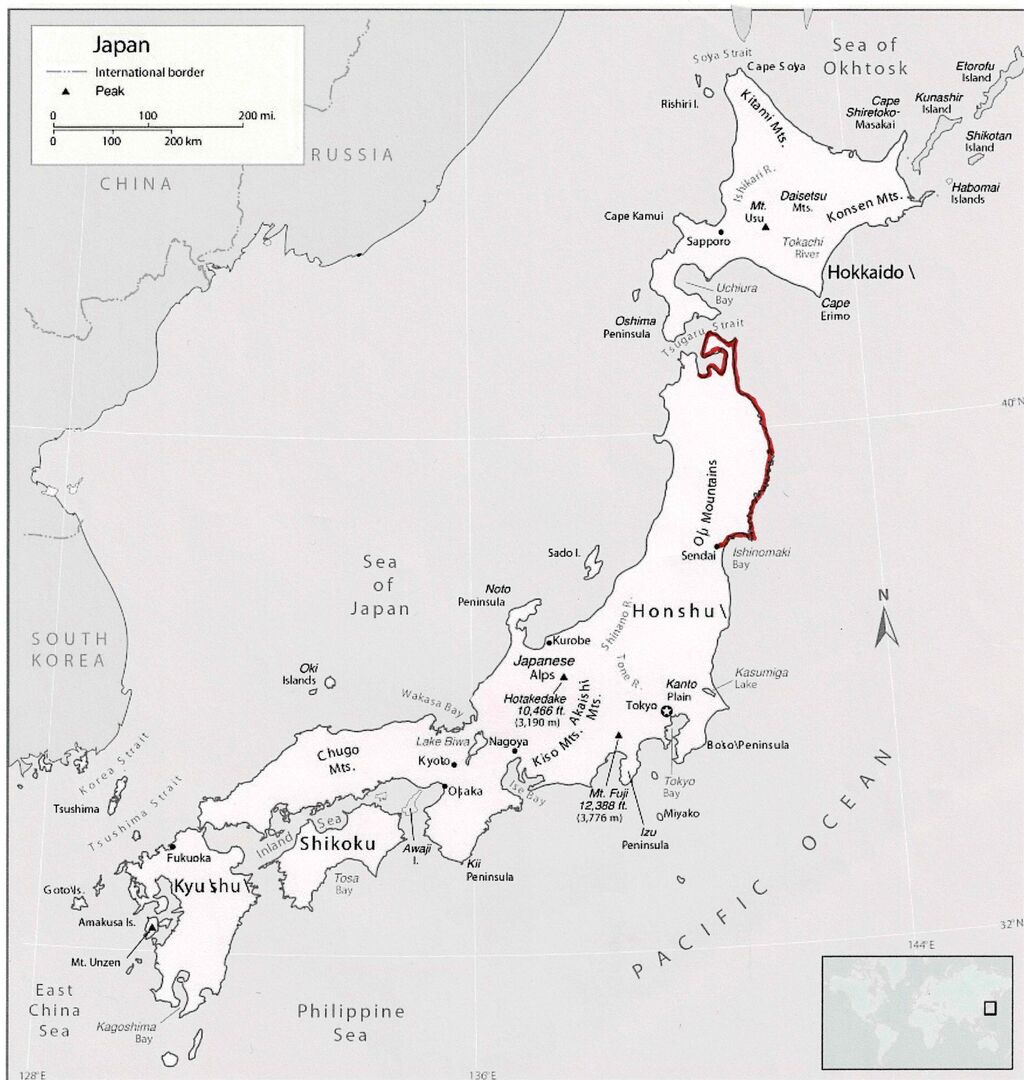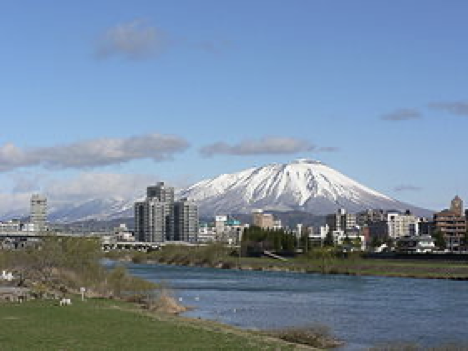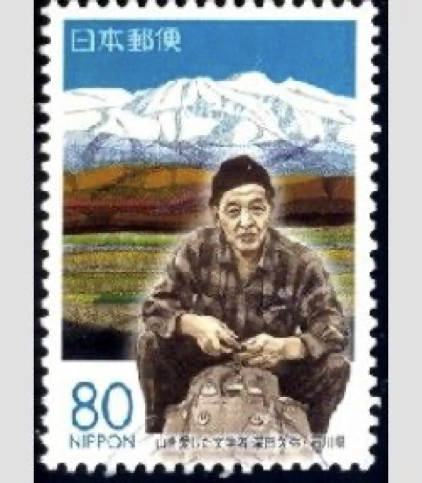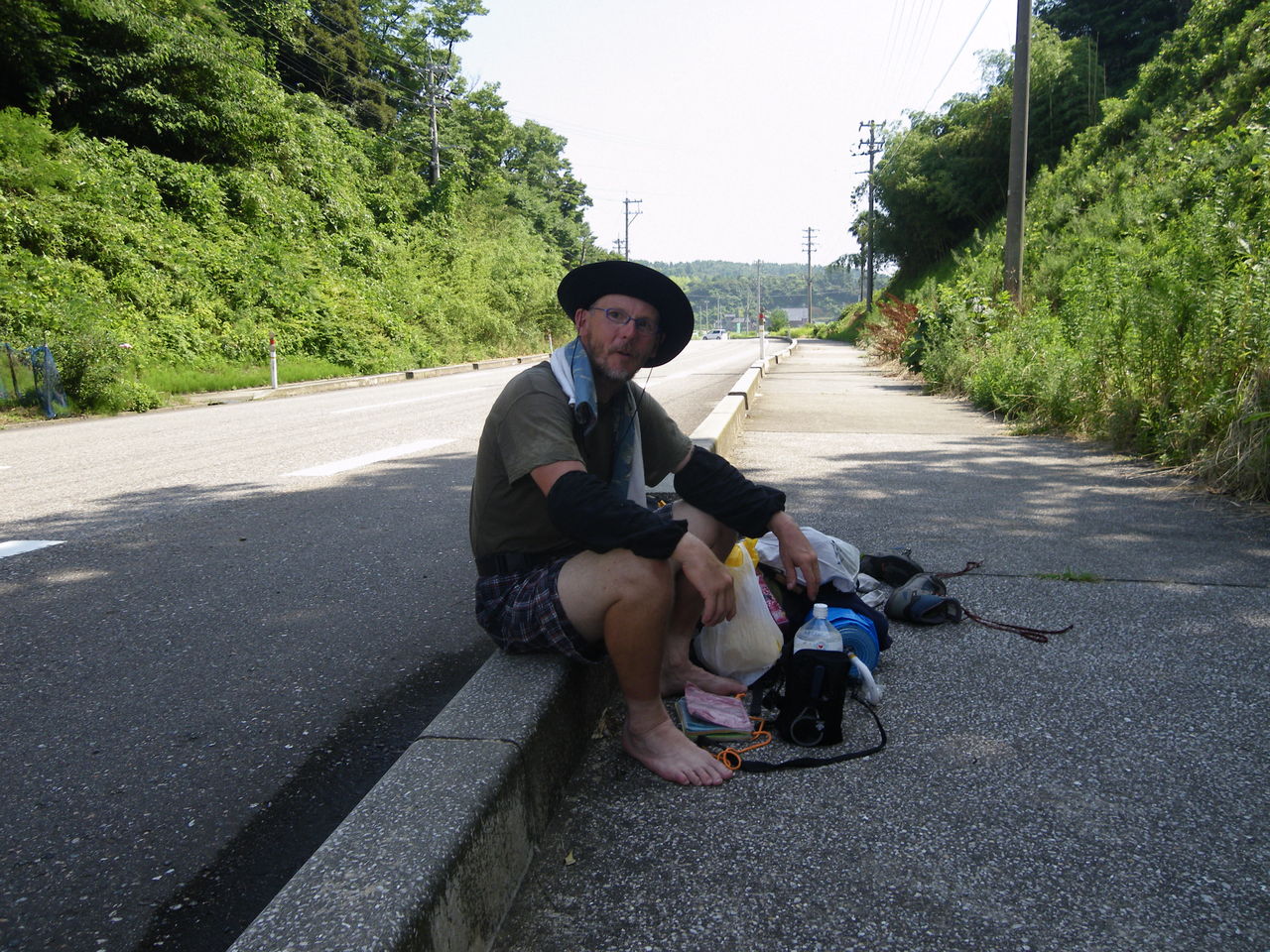
Irishman Walking (Stage 18 Chapter 2) is about my walking the main and coastal roads of Japan. Winter 2015-16.
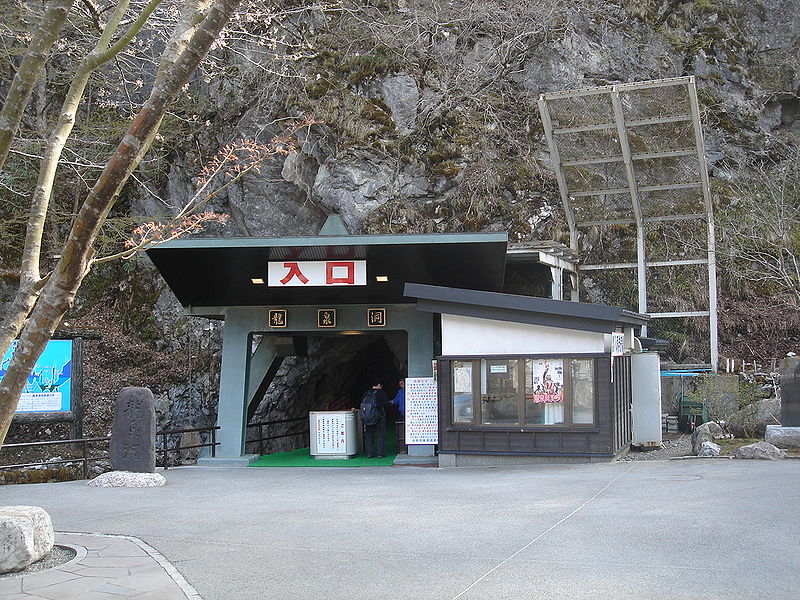
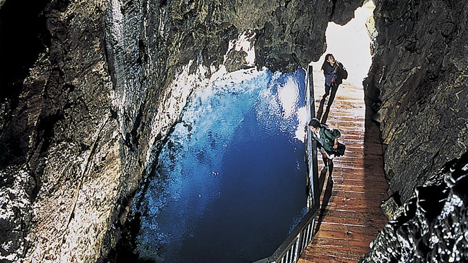
30 Dec, 2015: Slept rather well in the tent. It had been warmer than previous winter nights. What kind of a man would not have gone out like a light, after more than 35-kilometers on the road? The worst thing about hitting the sack too early in the evening, however, was that I tended to get up before sunrise. It was 03:00 AM when I crawled out of the tent-flaps for a piss. The only things that seemed to have life about them, were the stars twinkling high up in the black sky. After I had edged myself into my warm sleeping bag, I found it hard to get back to sleep. Such, such times were the loneliest of evenings. What I did get was the odd catnap, which continued for the remaining hours. Eitherway, I it was not long before I had to get up proper. When the sun did rise, it took its time to climb over a tree covered mountain range. When it did show its face, I had to hang about for a while for my gear to dry. Even the condensation had left the sleeping bag nearly soaked. "Mmm!" If only I had ventilated the tent better in the night, instead of zipping everything up. Or so the thought crossed my mind. In the hot summer months, there was nothing like a good airflow throiugh the tent the evenings. But this was not the summertime. During the winter months, it was not easy to maintain a constant temperature in the tent. The cold and warm air caused moisture. Many houses had gaps between the walls that allowed air to circulate around the rooms. Conversely, air linger between the furniture and the walls. This could cause condensation to build up on the walls, and could cause mould to form. There was no better place to dry clothes than under the sky. When the 'taiyō' ruled supreme -- to use the Japanese word for 'sun' -- then all the better. After a good while, I was back on my way again, along the road, Route 45. Not very long after I had started along the road, when I came to the first tunnel of the day. Fortunately, Omoto Tunnel (1972) was not a monsterly long tunnel, it ran for 729-meters. Thankfully, there was a pavement. In time, I stopped at the start of a minor road, Route 455, which headed toward the uneventful town of Iwaizumi in Iwate, and to the more interesting Ryusendo Cave. The town had a population of nearly 10,000. Like I touched on earlier in my road-notes, the water in the cave's underground lakes were renowned for being one of the world’s clearest. Rather than make a detour to visit the cave, however, I decided to push on along the steep winding road. Soon I was past Omoto Port and in the direction of Tanohata. The Port of Omoto was a large port that catered to large cargo vessels. The village of Tanohata had an interesting, but sad history. Tanohata Village, also in Iwate Prefecture, had a population of around 3,500, which had continued to decline since 1970. After the 2011 Tōhoku earthquake hit the region, a massive tsunami destroyed over 200 buildings in the village, and left 39 residents dead, with most of the 565 vessels in the fishing port destroyed. The local economy was built around commercial fishing and agriculture. The local train station, Shimanokoshi Station, had also been washed away by the tsunami.
Done
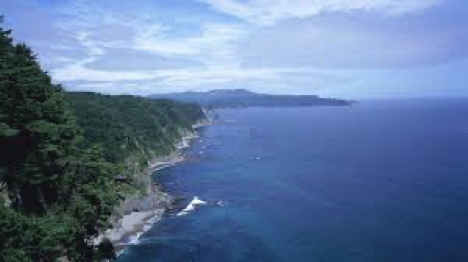
The tsunami was as high as 10-meters in places. About 19-months after the disaster, a sign from Tanohata Village was found washed up on Kahuku Beach in Hawaii, in 2013 (Wikipedia). From the Port of Raga to Kitayamazaki, visitors could enjoy the picturesque view of the rocky Sanriku Coastline, onboard fishing boats called ‘sappa boats’, noted for their maneuverability in dangerous waters. From where I stood, the mountain pass lead up into yet another mountain pass. Needless to saay, I was not a happy camper. Along the way I passed a directional-distance road sign that pointed to the right, for Tofugaura Beach, a good 44-kilometers away. Why was it necessary to announce the beach when it was so far away? The majestic arch-shaped Tofugaura Beach, extended for about 3.5-kilometers. It was touched on in wakas, a traditinal style poetry from the Heian Period (794-1185). At that time, Heian-kyō in Kyoto was the capital, when Chinese, Taoism, Buddhism, and other philosophies flurished. Much of the sand on the beach, if not the region, was composed from fine purple pebbles called, ‘azuki' or ‘legumes’. The beach and much of Sanriku has long been regarded as a rare landscape for its rugged cliffs and reefs. Long ago, the production and processing of salt was common along the shoreline. Back then, cows called Noda-beko, were used to help deliver the salt to the different towns and markets on paths that let across the Kitakami Mountain range. The paths were known as the ‘Noda-Shiobeko Trails. Today, many of the paths were used by keen hikers, especially those who wished to learn more about the history of salt in the region. Luckily for me, much of Route 45, was scenic. The road was one hell too a job o tramp along, with a heavy backpack, or in my case, loaded trolley pulled up steep slopes. Another road sign told me that Kitayamazaki was 30-kilometers away, not that that meant anything to me. Not much later, another road sign pointed right, in the direction of the 'Cliff of Cormorant Nest'. This I took to mean the Kitayamazaki Cliffs, a continuation of the breathtaking rocky coastline. From the road, I could hear its powerful waves of the Pacific, crash against this rocky shoreline. Camp was finally setup beside a narrow tree covered dirt path, at the northern side of a bridge called, Ochiainig-ohashi (1970), and close to the start of Tanohatamura Bridge (1970). Both or the bridges were 130-meters long, and without pavements. Before hitting the sack, I decided to make porridge and coffee, a late dinner of sorts. To paraphrase the English writer, Samuel Johnson, oatmeal was a grain which in England was generally given to horses, but in Scotland supported the people. In Belfast, boiled oatmeal certainly played a big part supporting me in my childhood days. Porridge even dated back to the Stone Age (e.g., Southern Italy). A hot bowl of porridge for breakfast was nutritious and had health benefits -- dietary fiber and carbohydrates -- lowered cholesterol and reduced heart disease. In the case of coffee, it was first harvested in the ancient coffee forests in Ethiopian, and believed to have been first enjoyed as a beverage in the fiveteenth-century.
Done
The dury was still out on the beneifits of drinking coffee. The caffeine in this dark beverage was believed to cause anxiety. Other research, however, showed that it may reduce depression, lower the risk of Parkinson's disease, reduced the risk of type-2 diabetes, among other things. What I did know was that caffeine was known to hinder the old body clock, or sleep. After I had jotted down some stuff in my battered notebook, brushed my teeth, and crawled into the sleeping bag, I did not fall asleep as quickly as I would have lived. The 35-kilometers on the road had made me feel my age. If that was not enough, the evening air had turned out to be uncomfortable, the coldest on this stage, of my mission.
Done
31 Dec, 2015: The time was close to 03:00 AM when I awoke. Everything, inside and outside of the tent was frozen stiff. The condensation was in state of melting. The next hour or so was a series of catnaps. By the time I finally stopped trying to sleep, everything had become wet. This did not bother my any, for I felt sure the sun would put everything right, when it rose a little later. As things turned out, however, a heavy cloud cover blew in over the sea, and made it impossible for the sun to work its magic. For a while it looked as if this was going to be a day of bridges -- a series of bridges called, Fudai, Nos. 1 to 5 -- came and went. Just as my mind toyed over whether I should refer to the road in my notes as: 'Bridge Road', or 'Road of Bridges', anumber of other bridges came into view. Likewise, Yanagibuchi-bashi and then Fukawatari-bashi, came and went. They were followed by a series of other bridges. By now, I did not bother my arse to stop and note about them. Besdes, the bridges would soon be left behind, or thought of ever again. That said, it was at times hard not to stop just to read the ironname plates, like I liked to do at the mouth of the tunnels. At least I was able to get an idea of the length, if not the year they opened. The Fudai Tunnel (1970), for example, ran for 279-meters. Fudai was the name of a village, or 'mura' in Japanese. It was also the name of a damn, located further inland. Like many villages along the Japanese coastline, Fudai had a history of tsunami damage. Thankfully, Fudai Village was spared the Tohoku earthquake and tsunami, in 2011. This was mainly because of its 15.5-meter floodgate. It took about eight-years to construct (1972-84), and cost ¥3.56-billion Yen. Kotoku Wamura, the village mayor between 1947-87, was a main influence behind the building of the floodgate. At first, the floodgate was thought by many, as a costly waste of public funds. As things turned out, however, it protected the village and surrounding area, from the worst of the high waves. After the tsunami (2011), the villagers visited Wamura's grave to thank him for his perseverance over the floodgate project. The village's only casualty was a male, whose body was never recovered. It was thought that the man went to the local fishing port to inspect his boat. The port was located just outside of the protective wall area. Currently, Fudai had a population of almost 3,000, which had declined since 1970. The local economy was geared mainly around commercial fishing, and agriculture. My feet, and the passing of time, led me to the town of Noda in the township of Tamagawa in Iwate. As with much of the region, the local economy was built around commercial fishing, and agriculture. In former days, the region was noted for the production of salt. Still, Noda salt was popular nationwide. The local salt was so popular in fact, online orders had a waiting list of two to three-months. The salt was available at roadside shops in Noda, but often was sold out quickly.
Done
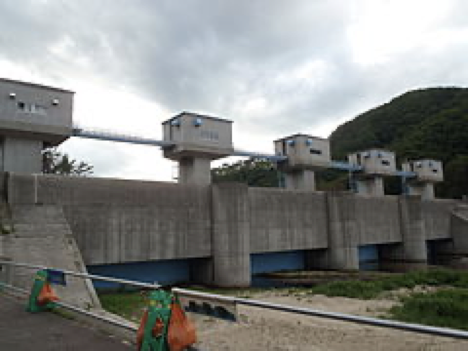
Fudai Floodgate (Wikipedia)
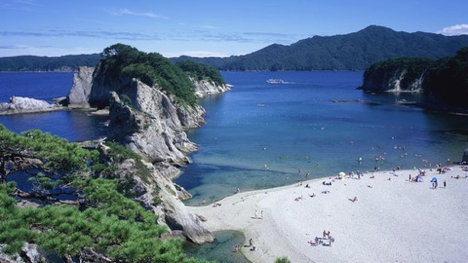
The coastline was badly damaged by tsunami that followed a powerful earthquake, in 1896, called the Sanriku earthquake. It left 261 villagers dead. The village hit again by a tsunami that followed a second massibe Sanriku earthquake, in 1933, and which left seven people dead. Noda Village was not as fortunate as Fudai Village following the 2011 Tohoku earthquake and tsunami. It seemed pointless to relate the extensive damage the dieaster caused the region. Today, Noda Town has a population nearly 4,500 people, a continous decline since 1970. As with Fudai, the local economy was geared around commercial fishing, and some agriculture. Likewise, the area was formerly noted for its salt production. A sign post pointed left for Noda-Tamagawa Mine, less than a kilometer away. At first, I was not sure what had been mined there. Only later, I learned that it was a gem stone called, pyroxene, or 'Marine Rose', to use its commercial name. Pyroxene was believed to have healing powers, and produced a sence of peace and calm. The mine one of the only high grade manganese ore mines, in Japan. These days, manganese was a key component in dry cell batteries. In its hay day, more than seventy different minerals where mined, this included uranium, and rare minerals. The mine had long ceased to operate, however, part to the mine remained open for visitors. Another arrow on the same sign pointed to Asian House, a good 9.5-kilometers away. Similarly, I was not sure why it had its name. Later along the road, I learned a little more about the mine, from people I stopped to chat with. They told me that 'Kunnoko-hoppa' meant 'amber mine' in English, and that it was once a local dialect in the Kuji region. Why not? In the eyes of psycholinguists (1960s), on the use of language, no two people, wrote or spoke in the same way, even if their backgrounds were similar. A touristy sign told me that Kuji amber, a fossilized tree resin in the area, was the largest produced, in Japan. The Kuji Amber Museum was located in Kuji City, where visitors to see, touch, and learn about the history of amber produced at the mine. The mine was near the Sanriku Fukko National Park, and which I was about to enter. The Sanriku Fukkō National Park extended along the Sanriku coastline from Kesennuma in Miyagi to the south to Hachinohe in Aomori, in the north. The coastline was not only noted for its ruggedness, but also for its coastal reefs, sandy beaches, grass meadows, and pine forests native to the area. The natural trail, home to various seasonal flowers -- Japanese Rose, native to eastern Asia -- was well maintained. A pink flower that bloomed around May to August. The senery was splendid, such as Mount Hashikamidake and Mount Kitakami, two mountains that stood majestic away in the distance. The entrance to this segment of the Sanriku Fukko National Park was not far away from Tofugaura Beach, which lay someways to my right. For a good while, my eyes were openned for a place to pitch the tent, and where I hoped to see out the remaining hours of the year. One good spot was Tofugaura, a rich sandy beach along the rocky Sanriku coastline, and had appeared in early Japanese poetry.
Done
1 Jan, 2016: Camp was setup next to Noda Station. There was a tourist complex, also, which comprised of a restaurant and a souvenir shop. The main point for me was a small overhung roof next to a large touristy-poster, which should block out the rain and wind just dandy. The wind became strong in the evening, but thanks to the poster it did not bother the tent much. Early in the morning, I was awoke to the chattering of two female voices, they were cleaners going about their business. It was also a good time to get a few snapshots, the first rising sun of the New Year. The New Year was a time when people partied with friends, in Ireland, whilst in Japan, many people got to gather with their families and visited their local Shinto shrine to pay homage. Most people who spent this time of the year alone, did not spend their time trying to keep warm in a tent. Well, not unless their cercumstances had made them homeless. The New Year holiday period could be a lonely time. At one point or another, I would even feel myself getting bored. I was in no mood to read anything of any great depth, like, even the book that I had taken from my place in Tokyo. As for writing, the old brain was uncooperative. Some broachers that I had picked up earlier lay on the tent floor, next to my unopened notebook. When I pushed the broachers to the side with my foot, one of them opened at a picture of Oshuku Hot Springs in Shizukuishi Town. The hot springs, according to the print next to the photo, had a 450-year history. And, that every minute, more than 3,000-liters of water flowed from the hot springs. Legend had it, that a nightingale once stopped to soak its wounded body in the hot spring water, and became healed. The Japanese inns, scattered about the charming town, had their own unique character. This helped visitors to choose the one that best suited them. Shizukuishi Town had a tourist center, golf course, and theme park, within walking distance. For keen hikers, there was a bath in Uguisuyu Sato Park, where they could bathe their tired feet. A second photo in the brochure showed Matsukawa Hot Spring in Hachimantai City, located further inland. The local economy of Hachimantai focused on agriculture, forestry, and tourism. The Matsukawa Hot Spring was discovered about 250-years ago, on the banks of the Masukawa, a river that flowed through the mountains. Regardless of the season, a hot spring was a great place to relax at, for hikers and skiers, alike. The inns located in the secluded beech and maple covered mountainous areas, allowed visitors the chance to soak in a milky white sulfur hot spring bath. The many small and large hot springs in the Ou Mountain range in Hanamaki in Iwate, appeared particularly stunning in autumn. A third photo was of Hanamaki Hot Springs, located to the west of Hamamaki City, which had a population of around 97,400. Hanamaki had a long history of hot springs, and home to countless cherry trees, pine trees, and rose gardens. According to the broacher, the hot springs was established during the Taisho period, in 1923.
Done
On a related Website, however, the hot spring was established, in 1936, and was one of the most popular hot springs in the northern Tōhoku region. It was believed that sodium sulfate, sulfur, and sodium chloride in the water helped with blood circulation, digestive disorders, eased muscle and joint pains, and so forth. The water used at the Hanamaki Hot Springs was redirected from the Dai Hot Springs, which had a 1,200-year hisotry. Another photo was of Koiwa Farm in Shizukuishi Town. The farm drew visitors who wished to escape a hactic city life for a pastural one. The farm was mentioned in one of Kenji Miyazawa’s poems. Born locally in Hanamaki, Miyazawa (1896-1933) was mainly an arthur of children's stories. Even today, Miyazawa’s works were enjoyed, perhaps becasuse many Hanamaki areas appeared in his fables, and attracted visitors to them, all year round.
Done
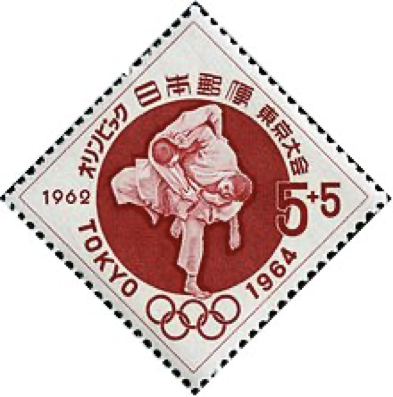
2 Jan, 2016; Rested well at the Kuji Daichi Hotel, a business hotel that, according to a friend, was not part of the famous Hankyu Daichi Hotel chain. Still, the place was clean and comfortable, with kind and friendly staff. In a way, the stop at the hotel was a heaven away from my tent for a short while. The only downside of my spending a night at the hotel was that breakfast was not part of the cost of the room. This had something to do with the holiday period. Just about everything in the town was closed for the holidays. After a humble breakfast in my room -- bread, banana, and a cup of hot tea, with milk -- I headed down to the lobby. There, I sat down at a table to write out some postcards to family, friends, and acquaintances. My aim today was to have a dander about town to see what there was of interest. Kuji in Iwate was a rather small city with a population of around 35,000, which had declined since 1990. The local economy focused on agriculture (e.g., spinach), and some commercial fishing. On my look about the city, I noticed that many of the local shop windows displayed a large photograph of the Sanriku coastline. Such a picturesque coastline on your doorstep, was something to be proud of. Kuji had suffered greatly during the earthquake and tsunami, in 2011. The tsunami was said to have reached 27-meters in places, and travelled up to four-kilometers inland. Although one death was too many, Kuji had four confirmed fatalities, with two missing. Kuji had been devastated by a tsunami on a number of occasions -- one in 1896, left 789 people dead. Much of the town was burnt to the ground, by a fire in 1926. A massive fire ravaged the town in 1945. About 950 homes were leveled by fire, in 1945. The most recent fire occurred in 1983, which distroyed 60 homes. On a lighter note, Kuji was famous for its Ama divers. The Ama divers, or ‘sea woman', to use the translation, regularly dove to depths of 10-meters, without breathing apparatus. This was, perhaps, a kind of 'free-diving', to use one its many terms. The ama divers had collected seawater pearls for around 2,000-years. Today, at such depths, the Ama divers gethered such things as seaweed and shellfish. Like Ama divers, the art of free-diving, if not its specialised breathing techniques, had been around since ancient times. Kuji was also he birthplace of a number of notable figures. One in particular was the judo grandmaster, Kyuzo Mifune (1883-1965). He was one of only 15 judoka ever to reach the rank of 10th dan. Mifune did just a year after the 1964 Tokyo Olympics, in which the first judo comptition took place. The venue was held at the especially built Nippon Budokan in the Chiyoda part of Tokyo. It was restricted to men only. Japan came away with three gold and one silver in judo. One noteable outcome was in the open category, when the Dutchman, Anton Geesink, defeated the Japanese favorate, Akio Kaminaga, to win the gold medal. No doubt, Geesink's victory broke a few Japanese hearts. As to my own neck of the woods, James McCourt, won a bronze medal in judo in the lightweight division at the same Olympics. A year later, in 1965, he went on to win the European Amateur Boxing Championships, in Berlin, also in the lightweight division. Needless to say, McCourt had since been inducted into the Irish Amateur Boxing Hall of Fame.
Done
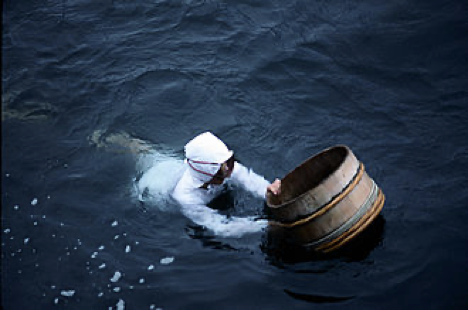
A female Ama diver (Wikipedia)
(Wikipedia)
3 Jan, 2016: The sun seemed perfect to begin the final leg of this stage of my mission, which I hoped to wrap up in Aomori. Hopefully all will go well, but the jury was still out on just where in Aomori was a good place to call it a day. What I did know was that I needed to leave my old friend, Route 45, for this last number of days, Route 45. What I needed to do was to get my arse onto Route 4. Such was my plan if I wanted to reach the city of Aomori. There was a good chance that I might reach there, in a few days. When the going got tough, the tough got going, or so the saying said. As things turned out, I had to get off Route 45 to get out of the Kuji City. The road that I tramped along headed north. Fortunately, I found myself on Route 395, bound for Ninohe in Iwate. Located a little inland, Ninohe had a population of almost 30,000. Like so many towns and cities in the region, the population had been in the decline, since 1970. Ninohe's local economy was geared around agriculture and food processing -- dairy products, apples, and hops. The lowest temperature in the region at this time of the year (January), was around -6.6°C. This I needed to pay attention for heavy snowfall, which I expected would fall soon. As things turned out, I rejoined Route 45, this time bound for Hachinohe. According to a touristy sign by the roadside, Hachinohe was 14-kilometers away, in the direction of Nakanoshirataki, a waterfalls on the Naso-gawa. The sign also told me that Forest Park Kuramai was 35-kilometers away. The city of Hachinohe in Aomori, had a population of over 220,000, a decline since 2010. Still, its population, made it the second largest city in Aomari Prefecture. Like many towns and cities along the coastline, the 2011 tsunami leveled the area and damaged the port and many fishing boats. Soon after the disaster, the US Navy helped to clear the port for the delivery of relief supplies. An US military base, Camp Haugen, was established in Haschinohe after the Pacific War. The base also housed a radio station, the Armed Forces Radio Service -- AFRS Hachinohe. The camp was also from where American soliders left for Korea, after the North Korea invaded South Korea, in 1950. After about an hour along the road, a road sign pointed in the direction of the Kitasamuraihama Camp Ground, along Route 279. Another road sign pointed towards the Sumuraihama train station, on Route 149. Neither of the places were not on my schedule. A large sign over the road told me that the temperature was 7°C. I knew from the TV news that many countries currently enjoyed a mild winter. Such weather conditions was unusual for the Tōhoku region. The weather was rather warm today, and what little snow had piled up at the sides of the road, did not remain for long. In time, I came to yet another little touristy sign that told me I was now entering the Hirono Township. The town of Hirono in Iwate, had a population of around 17,500. Becasue of a 12-meter high embankment, Hirono had escaped the full force of the tsunami -- no recorded deaths, or people missing.
Done
Hirono was founded after the merging of the neighboring towns, in 2006. In English, the names ‘hiro' and 'ono' meant, ‘ocean’ and ‘big field’, respectively. The arrow on the same sign also pointed to Tanesashi, a sandy beach that extended about 12-kilometers along the coastline of the same name. This segment of the coast was designated as a Place of Scenic Beauty, in 1937. In addition to sandy beaches and scenic views, the coastline was also noted for its rocky beaches and grassy meadows. Unfortunately, I still have a good distace to tramp, for Tanesashi Beach was 27-kilometers away -- a good days walk. An attractive chalk-white lighthoiuse, Samekado Lighthouse, built in 1938, had been selected by the Japan Lighthouse Association, as one of Japan's top 50 lighthouses, in Japan. The coast was noted for its powerfull waves, and visitors were advised to be careful when swimming. As this was winter, I did not see this to be a problem, as I had no immediate plans to get even my toes wet. There was also a camping ground near the beach, but that did not matter much to me either. There was no better place to make camp than on a rich sandy beach, and usually free. There was someting fake about campsites, like, consentration camps in peacetime. Beside the cost, the hot showers tended to last for only a few minutes, per-charge. "Mmm!" How I longed for the summertime to arrive. In time, I arrived at a turning for Yagi Port, to my right along Route 216. There were many small local ports scattered around Japan. Some were home to ferries that connected one island or another. "Mmm!" The fund memories I still had of my seven-days of tramping around Sadogashima in the eastern Nihonkai. If only I had the time available to me to visit some of the small islands. In a word, it was my loss. Taneishi Fishing Port came and went, as did the road for Aguri Park in Karumai. According to my maps, Karumai Town was further inland in north-central Iwate, too far out of the way. The town had a population of around 9,000, a decline since 1970. The local economy was geared around agriculture -- millet, and other grains. Also, raising livestock, and the production of charcoal. By now, the traffic on the road was beginning to buildup. This was the first actual rush hour of the New Year. The holidays had ended, so people across Japan were retuning to their jobs. Another road sign pointed right for Kominato Fishing Port and left towards Mount Hashikamidake. The mountain was part of the Tanesashi Kaigan Hashikamidake Kenritsu Shizen-Kōen, a prefectural national park, established in 1953. Like the town of Kuramai, the national park was well out of my way to be of interest. Still, there was no shortage of scenic spots along the road. As I tramped along the Mazaki shoreline, the Rikuchu Kaigan National Park, led me past Kominato, a wee fishing port noted for its Mazaki seaweed catches, and other fish food. In time, I came to a Michi-no-Eki, a reststop called, Hashikami Roadside Station, my first stop to rest since entered Aomori. At the reststop, I decided to boil water for a cup of coffee and make a cheese sandwich, which was the best I could do for a simple lunch.
Done
The sky began to cloud over, and soon it was heavily overcast and threatened to rain. By now, the temperature had dropped, and I could feel in my finger tips. A rather interestingly long footpath, called the Michinoku Coastal Trail, was nearby. Michinoku was the ancient name of the Tōhoku region. The trail skirted along the Pacific coastline, from Soma in Fukushima to Hachinohe in Aomori. It wound through forests and villages, across rivers, and along beaches; a countryside abundant in fauna and flora. With much sadness, however, the Michinoku Coastal Trail was not included among my plans. Not far away stood a giant ginkgo tree that was believed to be around 1,000-years-old. The tree was believed to have spiritual powers. Young women visited the tree to pray for safety of their babies. Even now, I was still unsure if I needed to pass through Hachinohe City. If the city had not been far out of my way, it would have been nice to have paid a visit at the museum, the Hashinohe City Museum. A hisotry buff at heart, I liked to learn something about the history, and culture, of the places I passed through. The exhibition corners of the museum covered archeology, folklore, history, among other things.
Done
4 Jan, 2016: Last night camp was set up in pitch darkness on a raised piece of grassy ground only, a couple of meters from the main drag, Route 4. This was at a place called Tamagawa.
Tamagawa???
The nearby, Tamagawa JR East, opened in 1954, was a train station that serviced the Hachinohe Line. Every hour, a local train rattled along the bi-directional track. Baring the some seats under a tiny shelter on the platform, the unattended station did not have a waiting room to its name. All in all, I liked to know that a railway station was near, just in case some untoward accident or misfortune should occur to me. From my tent, I could see a sky rich with stars. A sudden downturn in the weather caused me to up camp and move the gear under the Niidabashi, a bridge that spanned the Niida-gawa.
Niida River???
The rain did not heavy enough to cause me any concern. The rain first began to fall when I left the Michi-no-Eki, Hashikami Roadside Station. A little later, it rained and snowed. Then, after about five-kilometers along the road, the rain stopped, but the snow continued, and soon increased. It was soon after this change in the weather, I decided to make camp, some kilometers short of my plans. My plan was to mainly stick to Route 45, which at times enclued Route 4. By now, I was 105-kilometers from Aomori City. This was a comfortable three-day tramp, provided the rain and snow held off. Smooth or not, I needed to wait till morning, to go over my maps properly, to understand things better. The old feet, and my knees, had held up well. For some reason, on the road in winter I did not suffer with blisters in my feet, to the extent I had in summer. This time, rather that carry the gear in a backpack, I used a four-wheeled-hand-trolley, which turned out to be a godsend.
Done
5 Jan, 2016: Unlike the miserably weather the day before, which forced me to camp under the bridge, this morning could not have turned out better. A sun rose in a blue sky at about 07:00 AM. It did not take long for much of the surrounding area to dry. As if unperturbed, the snow lingered crispy upon the ground. In a while, I knew that I needed to cut a path, and wide enough for the trolly, to get to the road. On previous occasions, when there was only the backpack to shoulder, thoughts of digging out were nonexistent. Looking about me, I could see no other footsteps or path leading to the road, Route 45. Not long after rejoining road, I made a stop at a Lawson. This was in the town of Ruike.
Ruike Town???
At the store, I made a cup of coffee, thanks to the hot water from a thermos flask. In some respects, I was not a fan of convenience stores, but I was often happy to use the hot water that they had at the ready. At least it saved time, if nothing else. My breakfast was in the form of a roll of bread and a banana, which I ate outside the store. In the short time it took me to finish the food and coffee, the sky started to cloud over. Earlier, an email from a friend told me to expect nice weather all day long. The sky, however, appeared to have other ideas. Along the way I passed Hachinohe Port and then Tatasashi Seaside, on Route 1. The city of Hachinohe and the port in Aomori shared an element of fame -- a sign pointed towards Hachinohe Portal Museum, only 1.3-kilometers further along the road. The port was first developed in the Tokugawa period (1603-1867). At that time, Hachihnohe was a castle town, its domain ruled by the Nanbu clan. The Nanbu was a Japanese samurai clan who ruled over the Tōhoku region for 700 years. The clans demise came after the Boshin War, when it surrendered to the new imperial army, in October, 1868. The Boshin War was a civil war, fought between the armies of the ruling Tokugawa shogunate and a national force that believed political power should follow the Imperial Court. Around that time of the war, the port served as a major fishing and trading location, between Hokkaido and Osaka. During the Meiji period, the port was redeveloped along western plans. An engineer from Holland was hired to oversee the design and rebuilding of the port and its facilities. An area of the port was used for immigration facilities, established in 1925. In 1928, the port was officially opened four-years later for foreign trade. Hachinohe Port was designated a primary seaport, in 1954. Although the port had suffered damage from earthquakes and tsunami over the years, redevelompent continued. The port was severely damaged by the powerful earthquake and tsunami, in 2011. The rebuilding and reconstruction soon followed. Hachinohe remained a major fishing port -- more than 142,000 tons of seafood products were landed, in 2004. It was the fourth largest volume of seafood caught in Japanese waters, particularly olive flounder and squid. The bastard halibut, as the olive flounder was also known, was a large-toothed fish, native to the northwestern waters of the Pacific.
Done
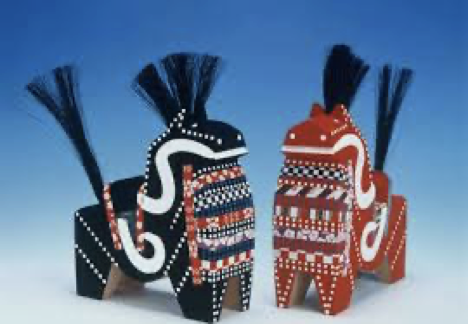
A colorful Yawata-uma (Wikipedia)
Squid were strong swimmers and certain species were known to lift meters above the water. None of their evolutionary skills, however, prevented them from falling pray to Japanese fishing nets. In 2002, Hachinohe became the first port in Japan for commurcial olive flounder and squid catches. The port still prided itself in some of the highest volume of seafood catches in the country. Squid had long been a major food resource in Japan -- sashimi, tempura, among other dishes. The squid also played a main part in literature. It appeared as Jules Verne's sea monster in his 'Twenty Thousand Leagues Under the Sea', and in H. G. Wells' man-eating squid, Haploteuthis ferox, featured in his story, 'The Sea Raiders', published in 1870, and in 1896, respectively. In an effort to promote tourism and culture, the Hachinohe Portal Museum, nicknamed ‘hacchi’, was opened in 2011. However, the Tōhoku earthquake and tsunami struck the region in March of that year. On a lighter note, upon entering the museum, visitors were greeted by colorful Yawata-uma, a symbol of the city. As far back as the Kamakura period (1185-1333), Hachinohe was well-known to bred strong farm horses, also used in battle. The use of horses not only supported peoples' live, but also the culture. The horse was a main theme in local dances and in folk tales. Yawata-uma symbolized a time in the past, when horses carried young brides to their new homes. The art of Yawata-uma figurine carving grew out of the importance of the horse. Today, Yawata-uma, horse figurines, were sold as colorful souvenirs and decorations. Hachinohe as a city teemed with history, tradition and culture that stretched back to the Jomon period -- a prehistorical time of hunting and gathering. The museum was located downtown, where many old side alleys, or yokocho, still remained. Even today, many 'yokocho' could still be found in Japanese cities, but they were certainly on the decline. Similar characteristics had been incorporated into the museum's interior design, to remind visitors of the city’s past. A number of local attractions, culture and crafts, and traditions, were shown in open spacious settings. In addition, the permanent exhibits at the museum, highlighted the work of local artists. The road took me past what looked like ferry wharfs, away to my right. "Mmm!" For a moment, I wondered where the ships sailed to? A sign that told me, the Misawa Aviation and Science Museum was 21-kilometers away. The museum was not far from a local airport. When I was a child I liked to make models of airplanes and ships. I recall, too, that I was a rather imparitent child, who prefered to glue the pieces together quickly, rather than skillfully. The same was true when it came to painting the models and fastening the tiny national stickers to them -- the roundels of the USAF, UK Royal Airforce, the German Luftwaffe symbol, and so forth. There were the fond memories I had of the times my old man took us to watch the prop-passenger-planes landing at the Aldergrove Airport. It was an airport northwest of Belfast that connected our neck of the woods with Europe.
Done
Today, it was called the Belfast International Airport. “Mmm!” Perhaps I should stop make a stop at the museum for a wee look-see. The museum of aviation and science was opened in Misawa City, in 2003. Misawa, after all, had a long history in the development of aeronautics. The layout made it one of largest aeronautical science museums in Japan. There were many educational displays for children and adults to immerse themselves in. There were several workshops and demonstrations geared towards the scientifically minded. The exhibits included restored World War II aircraft and an early passenger airplane. The sign also told me that Shuri Terayama Museum was 26-kilometers away, however, I was not overly interested in anything but the weather just now. In time, I passed Sichihyaku train station, and reached the outskirts of the township of Towada. Towada had a population of around 63,000, and I surmised it had some business hotels. It was now too dark to even think about tramping any further. What I really needed to do was to keep an eye out for a spot to camp.
Done
6 Jan, 2016: Camp was finally made under a heavy cluster of pine trees free of snow. The village of Osawada was a was to my left, with Lake Ogawara to my right. In terms of area, Lake Ogawara was the largest lake in Aomori Prefecture, and the eleventh largest in Japan. The lake was abundant with fish and the surroundings a rich habitate for birds and wildlife. This was particularly so for its biodiversity of aquatic flora, insects, and freshwater shellfish. In previous years, Lake Ogawara was home to the critically endangered -- ‘Huchen perryi’ -- one of the most ancient salmon species, last spotted, in 1943. In recently times, the global population of the species had dwindled, for a variety of reasons, which I will not bother to go into here. The wetlands was also a rich habitat for migratory wildfowl -- the whooper, and the tundra swan, among other birds of a feather. In 2002, the Ministry of the Environment classified Lake Ogawara as one of the 500 important wetlands, in the country. About 3,000-years ago, Lake Ogawara was once a marine bay. The gradual buildup of a sandbar, however, formed it into the beautiful lake we see today. In stormy weather, the 200-meter wide sandbar that seperated the lake from the Pacific shoreline, had been breached on a number of occasions. This accounted for the brackishness of the water in the lake. Over the years, the Japanese government had studied plans to make the water more useable for irrigation and industry, as well as to make it safe to drink. The area was inhabited since prehistoric times, and Jomon artifacts have been uncovered. The Misawa area was once used by the military in the Meiji period, to train horses for the Imperial Army. “Mmm!” It just dawned on me that the lake was shaped like a riding boot. It trained horses up until 1938, about three-years before the Japanese attack on Pearl Harbor. In 1938, the first runway for military aircraft was constructed at Misawa. Misawa was from were the Kamakaze fighters set off on their missions. The lake was used by the Imperial Japanese Navy Air Service as a testing site for its planned attack on Pearl Harbor. Curently, Misawa Air Base housed the 35th Fighter Wing, an air combat unit of the US Air Force, as well as facilities for the US Army and Navy. Misawa was also home to the Japan Air Self-Defense Force. The ground proved an excellent spot to erect my tent. The abundant cover from the pine trees, was a gift of natures roof, for it kept the ground dry and free of snow. Apart from the few meters where the tent stood, everywhere else about the area was as white with snow. This was not the only time I had camped under the cover of trees, and like before, I knew that I could sleep soundly. This was not the first time that I had made camp in a matter of hours. About five-kilometers back down the road, Route 45, I had pitched the tent on a high patch of ground. It was early evening, and I was in no mood to search for a better place. Besides, the tent was well pegged down, for it had become quite windy. At the time I had no idea that it would turn out to have been a miserably poor choice to make camp.
Done
The day had been long and hard, so I was soon snug and warm, and fast asleep. I must have been so tired that I did not even bother to rustle up something to eat. For it was just as well that I could sleep when I did, for at exactly eleven o’clock in the evening, I awoke to bright lights and the sound of male voices. “Mmm! What the fuck was all this about?" I mumbled to myself, and unzipped the tent to stick my head out into the cold freezing evening air to look. Fortunately by now, the strong wind had abated. There were three police cars parked at the side of the snow covered road, with red lights that flashed away like mad. Apparently, the police told me that a local person had telephoned the police station to report that someone had camped at a public place. The public place in question was a snow covered pavement by the side of a snow covered, and isolated segment of the road. No less than seven local police, one of whom was a female, had been dispatched to investigate. The police looked down at me, as they stood, clearly uncomfortable in the snow. The short-jackat uniforms they wore, appeared unsuitable for the cold winter weather. Only one of them held a flash light. They clearly felt the freezing evenig air more than I did. “Aren’t you cold?” One of the policemen asked me, in Japanese. He was the eldest among them. “Not at all! I was sleeping just now!” “We're sorry, but we have some concern!” The policeman continued. “You see, this is a public place! You can't stop here.” They must have froze their balls off, for the best part of the hour that we had been talking. What I did know was, I had lost count of the times I was asked for my alien registration card, and had complied to each time. At first, I was asked to show my passport, and which I answered in the negative. They appeaered confused, as if unable to understand why I had left my passport in Tokyo and not have it on me. This was followed by a series of time consuming phone calls to the main police station. Then, after about 20-minutes of waiting, they asked me for my alien registration card. The card was soon produced, which again led to more telephone calls. Perhaps the police represented different policing areas, but I was not sure. Some of them talked on their cell phones at the same time. No sooner was my alien registration card handed back to me, another policemen would ask to have a look at it. Each time, the card would be examined with great care, as if the previous policeman had overlooked something. By now, I too could feel the cold evening air creep into my bones. It was clear that I was pushing my luck at trying to confince the police that I would move when morning came. What I needed to do was to get my arse in orde, roll up the wet gear. dump it all on the trolley, and get the hell away. It was not an easy task to do, for the snow had begun to fall heavily, since I pitched the tent. For the most part, thankfully, the police were friendly. So, it was easy for me to understand that they were just doing their job. For my part, however, they refused to bend the rules and let me stop where I was, at least till dawn.
Done
Another part of me knew that if I had to go, then I had to go, and that there was no point in bitching about it. The time had gone 12-midnight, and the snow was coming down heavier with the passing hours. The wind, too, had picked up again. Should the snow harden, which I felt it would, it meant the days of the hand-trolley's usefulness were numbered. Its left front wheel was already broke. What had caused me some annoance was how the older policeman had attempted to justify to me the, so-called, informers position -- worried about their safety. I was the one who had to worry about staying safe -- pulling a malfunctioning and loaded up hand-trolley, through the snow in the freezing cold early hours of the morning. The snow had now pilled up so much that I could no longer use the pavement. To pull the trolley at all, I needed to get onto the road, which luckily at the time, was not busy with traffic. Still, I found that each time I did hear a car or truck approach from the rear, I had to pull the trolley well out of the way. From experience, I found that it was easier to decamp than it was to set up camp. Being told to decamp at night, in falling snow at the hight of winter, was not for the faint hearted. There was no point in being angry, it was my own fault, I had become lazy. Therefore, I had to learn from the experience, to choose the spots to camp at more carefully. Still, I did not feel any better, as I looked about me for a suitable place to pitch the tent, hopefully further away from the main drag, away from the prying eyes of strangers. In as complaint a manner as I could, the police and me parted. There seemed little need to fold the saturated gear, and dumped it onto the trolley as quickly as I could. The few hours of sleep had prepared me well to cover whatever distance I needed to go, along a snow covered road. There was little traffic on the road in the early hours, which made the going easier than usual. The only real danger was the black ice that and formed here and there along the way. So, I needed to keep my wits about me in case of danger. There was no hurry, for my progress on the road was already good. Then again, if I could have turned the clock back, this was a segment of road I could have done without. When I did finally make camp, for the second time, a distance-directional road sign told me that my goal, Aomori City, was 69-kilometers away. Late as it was, the heavy cluster of pine trees that kept the snow away, had also made it easy to erect the tent. The spot was not overly ideal place to camp, but good enough when I considered the circumstances. After the tent was erected, I did not feel tired, and decided to boil water for a cup of tea. It was a pleasent surprise to discover that my WiFi worked. For the first time in a while, I was able to check my emails, and get a number off, to family, friends, and acquaintances, and let them know that all was as well as could be expected. After this was done and my tea drunk, I poured some red wine into the same cup. It was an inexpensive wine that I had picked up at a convenience store, back along the road. For a while, my mind focused on trying to make sense of the previous hours, and the road that awaited me later in the day.
Done
Yesterday had been long and tiring in more ways than one, and I was glad it was over with. When I did finaly hit the road in the morning, it was later than usual. Recently, life on the road had caused me to recall the old saying: ‘What you loss on the swings, you gain on the roundabouts’. It was true that some of the days had been slow, whilst others had been exceptionally good progress-wise. This morning, the uneven snow lay hard upon the ground. Along the way I passed some minor roads that led to the towns of Hachigo and Ushikage. In time, I crossed over the Ohayashigawa and its namesake bridge. A number of other bridges and rivers followed. Then a road sign pointed in the direction of Lake Ogawarako, the eleventh largest lake in Japan. Another sign pointed along a road to Misawa. Along the way, I passed many roads that went to Misawa. Was Misawa such an important place? that many roads went to it. Should a problem with North Korea escalate, I had a funny feeling that the Misawa coastline would find itself strategically important once more. Tiny marker signs proportionately placed along the side of the road, Route 45, told me the number of kilometers Sendai was behind me. Similar tiny markings along Route 4, told me how far away I was from Tokyo. In time, the townships of Touhoku, Hokeji, and Hiranai came and went. Hiranai in northeastern Aomori, was a sizable town with a population of over 11,000. Its local economy was geared towards commercial fishing -- roe, squid, scallops, abalone, sea urchin, and sea cucumber. Hiranai also benefited from tourism -- beautiful beaches in summer, ski resorts and hot springs in winter. The places of interest were in close proximity to the town. As with many of the towns, bridges, and rivers that I passed along the road, the hours fell away like domanoes. By early evening, my eyes were wide open for a place to make camp. This was eventually done on the snow covered enclosure of a Shinto shrine -- well away from the prying eyes of strangers.
Done
7 Jan, 2016: The shrine was located on the Natsudomari Peninsula that poked out into the Pacific. A scenic spot at anytime of the year, today the snow lay piled up on the shrine's tori gate. The Yunoshima, a tiny uninhabited island, poked out of Mutsu Bay. At times, the clear evening sky sparkled with stars. Then, almost without warning, the heavens clouded over and a silent snow begin to fall. Although the door to the shrine was closed, the exterior had a meter-wide wooden platform with a roof, which offered some shelter. In the night, the snow blew in sideways from the bay. After a while, the snow became heavier and in a short time it stuck to the sides of the tent. When morning came the interior of the tent was as dark as night, but brightened up when I shook the fabric with my hands. When I poked my head out of the tent, everywhere was covered in snow. The tent had been pitched a good 100-meters from the main drag. When I stood outside in the snow to look about me, I was unsure what I should do first. The snow was up to my knees. The Hiranai region was noted for its cold maritime climate and cool short summers. The region had long cold winters, with heavy snowfall, like today. From experience, I knew that it would take me at least 30-minutes to dig a path to the road, and wide enough for the trolley. Another way was to carry all the gear over to the road, bit by bit. "Mmm!" Even thinking too much, took time, I thought as I grabbed hold of my little army shovel and set to work in the snow. The snow had not long stopped falling. The main road had not faired much better, and just a few vehicles had passed. A glance at the road told me that this was going to be a hard day. The New Yeaer holidays had not long ended, so it would be interesting to see if the morning rush-hour traffic builds up. In time, I was back on the road again, the broken hand-tralley close behind me. I did not bother to make my customary hot cup of tea. What I needed to do was to be careful not to slip on the black ice. To do so could mark an end to things. The main drag led me past a snow covered minor road that led to Karibasawa train station, an old station, opened in 1894. As I past the turning for the station, I thought how easy it would be to just throw in the towel, and return to the wormth of my place in Tokyo. It was easy to call it a day, to return to Karibasawa and continue my mission -- Stage 19 -- when the weather would be better. My clothes always felt damp and my feet cold. Much of this was due to my own carelessness. Like last night, when I thought the weather would turn out to be nice and sunny. Therefore, I had mistakenly left my boots out in the open to dry, and had forgotten all about them. When I dragged myself from the sleeping bag in the morning, and poked my head out of the tent, the first thing I saw were my boots deep in snow. The damp socks did not help the situation any. The last days on the road were always the toughest, in more ways than one. The road was so dangerously icy, thankfully most of the vehicles on the road slowed down as they passed me. There were a few times, too, when I had to drag the loaded trolley off the road altogther, to let the larger trucks manoeuvre slowly past.
Done
Earlier, when the left front wheel broke, I believed the trolley was at its end. Fortunately for me, the trolley functioned just as well on the remaining wheels. However, that was before the snow fell. Now, things were different. What I wanted most was to complete my final day on the road without any further setbacks. Only then could I consider myself a lucky man, if not a successful one. This mornings weather continued to be miserable. The sun made a short guest appearance. The weather effected a person’s mood and hormone imbalance. The unstable weather conditions certainly pissed me off. If only I could call on a Shinto deity to bring nice warm sunny weather when I wanted it. Or wish for the rain and snow to stop and leave me alone. Wishful thinking! The lack of sunlight pissed me off. Every bright school kid knew that the weather influenced the ocean tides. It certainly influenced people's moods.There were a number of terms for human related weather conditions -- ’winter blues’, 'winter depression', 'seasonal depression’, and, 'seasonal affective disorder’ appropriately termed 'SAD'. For me, the weather conditions indicated how life on the road went. Sunlight was a powerful antidepressant. Such conditions are generally related to the amount of light that reached the brain. The chemical reactions that the light set off in the brain, had a positive influence on the body-clock. The brain produced more 'serotonin', a feel-good hormone used in many antidepressants today. The hormone improved neurotransmission capabilities. That said, too much of anything had negative side effects. The effect of light on the brain, meant that the body did not need to produce melatonin, a hormone that influenced sleep. It also made a person less active. It surprised me that depression had nothing to do with the cold winter weather. The gloomy weather certainly pissed me off, especially whenever I was stuck in it all day long. A sudden change in the temperature played a part in the way I felt. On a cold winter evening, for example, the body immune system, and the heart, worked harder to keep warm. There were times when it was so cold at night that would have frooze the balls off a brass monkey, to use the old phrase. All in all, my old body had to work harder in winter than it did in summer, to produce the energy to keep warm. Even when eating, it used up a lot of energy to digest the food. In winter, an overworked immune system was less able to fight off viruses and bacteria. It could lead to depression and feelings of frustration, and the loss of more valuable energy. It helped to eat the right kind of food, rich in vitamins and minerals. Eating properly boosted the immune system, which countered illnesses and bouts of depression, not to mention, sleep. Plenty of sleep placed me in a better position to deal with all sorts of daily things. The weather conditions could play negatively on sleep patterns, if I was not careful. In cold weather I tended not to sleep as deeply as might otherwise be the case. The temperature was lowest on average in January, at around -2°C. So, a lack of good sleep, or irregular sleeping habits, could lead to mood swings.
Done
Hence the term: - ‘get out of the wrong side of the bed'. One thing that put me in a bad mood was to be out in the rain all day long. The snow, nor the heat from the sun, bothered me to the extent the rain did. Drenched by the rain was another cattle of fish. Besides the mind, in that it kind of got into everything else -- clothes and gear. The sunny weather, brought people outdoors, where they socialized more. In bad weather, more people stayed indoors and socialized less. The sunlight had an antidepressant effect on people. Conversily, the rain could leave people feeling tired, frustrated, grouchy, irritable, or depressed. Not long after I hit the road this morning, the sky clouded over. Not much later, the first snow of the day began to fall. Much of the side of the road, where I tramped along, was hard with black ice. The ice had longish, ripple-shaped bumps, which placed stress on my trolley. Not far from the town of Hiranai-machi, located on the mountainous Natsudomari Peninsula, the remaining right-front wheel snapped and fell off. Hiranai had a population of around 11,000, which was in decline, since 1970. On an added note, the last reminents of the Ainu, an aboriginal people, on the island of Honshu, were believed to have resided in the Hitanai vacinity, during the mid-Tokugawa period. Today, the local Hiranai economy lent towards commercial fishing -- abalone, sea cucumber, sea urchin roe, scallops, and squid. Tourism was also an important factor in the economy. Depending on the season -- the beaches, ski resorts, and onsen -- draw many tourists to them each year. A nearby medical facility, the Aomori Sanatorium, was opened in Hiranai to treat wounded soldiers, from the Second Sino-Japanese War (1937-45), and the Pacific War. A local hotspring, Asamushi Onsen, was also used to aid the soldiers' recovery. The local Nishi-Hiranai Station, was opened in 1939, to transport the wounded soldiers to the sanatorium. The town took a battering by American Navy bombers (e.g., Grumman TBF Avenger), in the closeing weeks of the Pacific War, with some deaths. By now, the snow fell like there was no tomorrow. The snow did not let up for hours, the traffic moved slowly along the road, in both directions. After a while, the entire road surface had become covered with ice. The side of the road was waist deep in snow in places. This made it more difficult to find a good spot to make camp. All that I could do for the present, was to push on, the best I could. To pull a loaded up trolley with only two rear-wheels, was not easy. If I had not stopped at the noodle restarant, Tatsu Ramen, earlier, I would not have had the power in me to continue. The fact that tomorrow was the final day on the road, giving up was out of the question. How could I look at myself in the mirror if I had given up? The trolly may have failed to withstand the test of endurance, but I had not. In a while, I would need to transfer camping gear to my back, to bear it. The last two-days on the road must surely go down as the most memorable, for all the wrong reasons.
Done
8 Jan, 2016: Sleep came quick in the warm sleepingbag and dry a tent, pitched in a walkway under a snow covered overpass. In the morning when I stuck my head out off the tent, a couple of elderly people sauntered by. I asked them were they were headed? There were on their way to the hospital, and wanted to be among the first there. The hospital, which I could see over the snowed covered hill, was not 200-meters away from where I stopped the night. Another elderly chap stopped to give me a warm can of coffee that he must have just bought at a vending machine. Needless to say, the coffee was quickly consumed, when the man left. That was nice of the man, and such people made my mission all the more meaningful. The warm coffee was a kind of feel-good treat, in cold weather. The man, I felt, much have bought the coffee for hemself, for how could he have known that I was camped on the underpass? This morning's final ten-kilometer long tramp to Aomori Station, was through hardend snow and over black ice. It turned out to be one of the most testing of challenges in a long time. Or at least since I began this stage of my mission at Kesennuma City n Miyagi Prefecture. Much of the city was destroyed in the earthquake and tsunami, in 2011. Fuel from at the near the port caught fire and burned for four-days. The natural disaste left 837 dead, with 1,196 missing. In the last days of this stage of my mission, I had not bothered to dump the malfunctioning trolley. Instead, I choose to drag it along behind me, regardless. At first, everything seemed to go as well as could be expected, like a wagon pulled by a horse or pony. That was until the elements had other ideas, particuller during my last two days on the road. In no time at all, the road to Aomori City was covered with slow. The slow moving vehicles along the road, headed in both directions, swayed from side to side like bumper cars at a fairground. Thankfully, none of the cars crashed or banged into one aother. As I got nearer to Aomori, the pilled up snow made it impossible to use the pavement. Therefore, I now found myself, on the road nearer to the traffic. The road was still very busy with the morning's rush-hour traffic, but soon the warming air began to work on the snow and ice. A few of the vehicles bumped their horns at me, but what could I do? By the time I reached the citylimits, I was ankle deep in slush and filth, and which allowed the vehicles to increase their speed. Still, I was not so sure that being in a hurry, meant getting somewhere faster. Many of the drivers appeared to be uncaring. The was no letup in the sound of vehicle horns. One rude bus driver even opened the doordoor when it passed, to yet a couple of obscenities at me. The road belonged as much to me and my broken hand-trolley as it did to the dirvers and their vehicles. As such, I refused to budge an inch, until the rude bugger and his bus, maneuvered around me. "Mmm!" Aren't bus drivers public servants? There was no letup in the snow, and it continued to fall like there was no tomorrow. During the first days of this winter stage of my mission, Stage 18, the hand-trolley had been a godsend, even when a left front wheels broke off.
Done
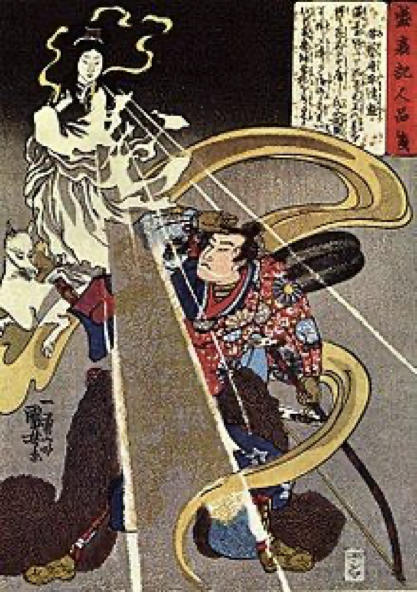
Inari appears to a warrior. This portrayal of Inari shows the influence of Dakiniten concepts from Buddhism (Wikipedia)
One of my most testing ordeals on the road, however, had also to do with the trolley. Walking conditions were so bad -- a pavement piled up in snow and black ice, deep slush at the sides of the road -- it amazed me a that the remaining wheels had not broken off. That said, a fat lot of good a four-wheeled hand-trolley was with only two wheels left. In a word, the trolley was useless. It could not have happened at a worse time, for the snow and rain), fell out of the darkened sky, like there was no tomorrow. It was the evening rush-hour -- the traffic and pedestrians were everywhere -- headed in all directions. This added to my misery. What could I do? What choices did I have? Was it possible to drag the trolley behind me? Along a snow covered, black icy pavement, or a slush covered road busy with traffic. The army-rope that I had fastened to the trolley, had proven to be a great help on the mountain passes. However, I did not see the rope of much help on such a road as this. What I could do was to dump the broken trolley, together with some of the gear, and just carry what I needed. But, with a mass of people rushing to work, even that seemed an impossibility at the moment. In the end, I decided to drag the trolley as best I could, as far as Tokyo Inn, a business hotel, where I would stop the night, and deal with the trolley-matter, later on. Needless to say, I felt a sense of achievement when I did finaly spot the hotel. Like many hotels, it was locacted close to the main train station. In no time at all, my negative thoughts were replaced with that of soaking in a hot bathtub. What my mind had decided on, was that some of the camping gear, and dirty clothes, would get dumped. There was an element of sadness about the trolley, for it really had served me well, when the going was good.. It was a while before checkin time, but I did not mind, for I had things to do first. So, I set down at a table in the lobby to relax and get my mind in order. Yesterday's issue of an English language rag, The Japan Times, hung in the newspaper rack, and so I picked it up. The headlines were: ‘Japan slams N. Korea ‘H-bomb’ test’, ‘Advanced nuclear weapon claim faces skepticism’. As for myself, I had hit the road without breakfast, so I was, by now, a wee bit on the famished side. I thought about popping out to a nearby convenience store and pick up an onigiri, or rice ball, the sort of light food the Japanese loved. Traditionally, onigiri contained any one of a number of sour or salty, pickled ingredients. It was idea as a quick meal, and believed to be one of the world’s first 'fast-foods'. In my view, onigiri was a level up from the 'junk-food' that many people had become accustomed to, today. In the 11th-century, onigiri was considered an outdoor picnic sort of lunch. In a way, it was similar to picnic sandwiches people enjoyed in the West. The samurai kept nigiri wrapped up in bamboo-like covers -- a quick meal away from the battle. These days, there were specialized onigiri shops that sold many varieties, for takeout. Just about every convenience chain store, had their own selection of onigiri on the shelves. Such was its popularity, it had become a popular staple food in Japanese restaurants worldwide. Rice had long been a staple food, in Japan. However, the consumption of rice per-head, had fallen over this last 50-years. In recent times, the Japanese diets had become more diversified. Inari Okami was the Shinto deity for rice, as well as, for the fox, fertility, tea. and for sake, or rice wine. The deity was also aligned with agriculture and industry, general prosperity and worldly success. In earlier times, Inari Okami was the patron deity of sword-smiths and merchants. "Mmm!" Inari Okami seemed to be an over worked kami, I thought, as I placed the newspaper back on the rack.
Done
What happened in Japan and the world on this day????