Irishman Walking (Stage 6 Chapter 3) is about my walking the main and coastal roads of Japan. Summer 2011.
22 Jul, 2011: On my way across some steep and winding mountainous roads (Route 306?), I came upon a group of monkeys sitting rather lazily by the side of the road. One of them, which I took to be a mother, was picking bugs from the head of a smaller monkey. The monkeys did not budge an inch when I passed them, but continued to sit at the side of the road and on a high embankment that led into a cluster of trees, spread up the sides of the mountain pass. “Mmm!” All of them looked at me, and I momentarily wondered if they thought or wondered about what I was doing? If I was not mistaken, the monkeys in question were Japanese macaque, or snow monkeys, a species native to Japan. No other primate, it has been said, made its home in such northern cold climates. These delightful creatures got their nickname, ’snow monkey’ for where they spent most of the time, in snow covered mountainous regions. The macaques were well-adapted to cold weather conditions, for as the temperature dipped, their body fair thickened. They were known to exist in temperatures as low as, -20-degrees celsius. Also, Japanese macaques lived in matrilineal societies, where the females remained with her group for life. On the other hand, the males moved out before reaching sexual maturity. It was long believed that human beings had a monopoly on metacognition, the ability to contemplate one's own thought processes. However, recent published research, in 2009, had shown that captive Japanese macaque were aware of the extent of their knowledge and had the ability to wonder. They did not use language like humans did, but that did not mean a lack in intelligence. Therefore, if they were so damn cleaver, then why would some of them not try and see what was to be had? In truth, I did not have the foggiest about what the monkeys were thinking or wondering as I made my way past them. Leaving nothing to chance, it was better to speculate on the worst possible outcome! Therefore, I kept my eyes glued on the monkeys and held firmly onto my gear, just in case one chanced its luck and swiped something. “Mmm!” One rather muscular looking monkey with a brutish looking pinkish face, which I took to be the boss, stared at me so intently that I decided to cross over to the other side of the road, and keep a safe distance. I learned from Wikipedia, males within a group had a dominance hierarchy, whereby one male ruled supreme over all the others. Fortunately, none of the monkeys advanced towards me, nor even away from me for that matter. Unfortunately, the progress of man over the years, had caused the Japanese macaques to loss their fear of humans. In recent times, the presence of macaques in rural and in urban areas, have also been recorded. Last but not least, the Japanese macaques were very intelligent tool-using animals that existed in quite complex societies. They had the ability to display deceptive and altruistic behaviors and were able to make judgements about fairness. They were known at times even to wash food in river or sea water, rather than brush off dirt like other species of monkeys were known to do. Some macaque also used the salty water of the sea to season food before eating it.
It was also the first species to be observed to roll up wheat into tiny balls, and drop it in water to clean it, before eating. These traits were passed down from generation to generation, a behavioral phenomenon in its own right. As for myself, I was born in the year of the monkey, the ninth in the twelve-year cycle of the Chinese zodiac. The Years of the Monkey included the following years: 1920, 1932, 1944, 1956, 1968, 1980, 1992, 2004, and a bunch of other dates in the future, too. It was impossible to completely avoid the monkeys, as a little further along they seemed to be on both sides of the road! As I drew closer to a group of Japanese macaque, I decided to get a few snapshots the best I could, preferably without stopping. Unfortunately, one particular wee macaque I focused my attention on, suddenly turned and made its way back into the undergrowth, pinkish posterior in the air, as it made its way on all fours. I was not sure if it was a male or a female, but I learned that males spent more time on the ground, compared to females that spent more time in the trees. Not very long after passing the groups of Japanese macaque, I arrived at a most delightfully, quiet, beach on a tiny inlet with a raging incoming tide. Actually, the coastline was known for its roughness. It was here, by the little town of Honjohama in Ine in Yosa in Kyoto prefecture, that I decided to pitch the tent for the night. For the average Joe Public, Honjohama was a rather inconvenient location if they had no transport, whilst on the other hand, the location was perfect for me to rest a while in private, and even decided to pitch the tent. Each town, city, or region one visits, it has been said, has its own lore, and Honjohama Beach is no different. For those with transportation, and some time to kill, could take a peek at the ‘Expedia's Honjohama Beach Travel Guide’ to help with their travel needs, options, and price range. Expedia's Honjohama Beach Travel Guide included dining and entertainment options, with shopping information, and more. Also, not far from Honjohama Beach stands the Shinto shrine, Urashima-jinja, founded around 825 AD. After a nap, I was soon on the road once again, I was beginning to think that I had somehow goofed by taking the wrong road. It was a mountainous road that wound up and up and up. Along the way I passed a farm, and countless trees for company. Apart from the odd car that past me, there was not a human sole in sight to confirm wither or not I was on the right road or the wrong road. With the passing of time and kilometers, I began to think that I had blundered, again. On the road behind me, I noticed a small van pull over and stop. Dropping my backpack on the ground against a tree, I headed back in the direction of the van. Upping my pace a bit, the distance began to lesson. My plan was to ask the driver of the van just were the road headed towards. “Mmm!” The Japanese never failed to surprise me! Just as I got to within about 20-meters or so of the van, the driver started up the engine and sped off, not glancing at me as he past by. An hour after the van past me, I caught sight of a couple of farmers working in a field. Dropping the backpack on the ground again, I headed down a grassy slope, and crossed into the field to make my way towards them.
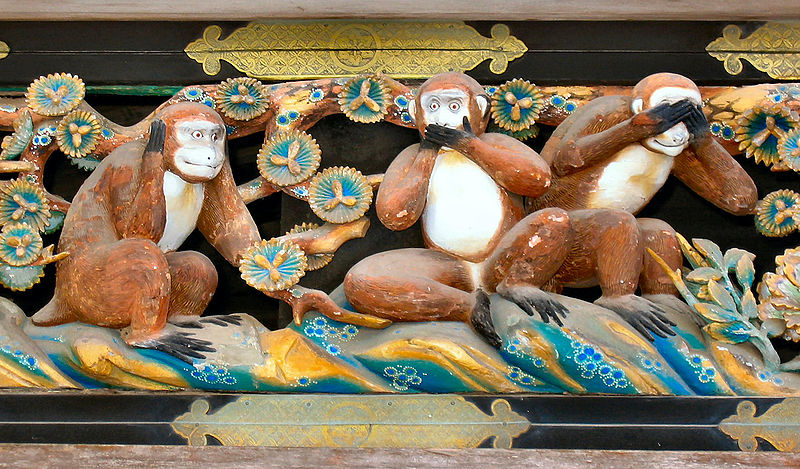
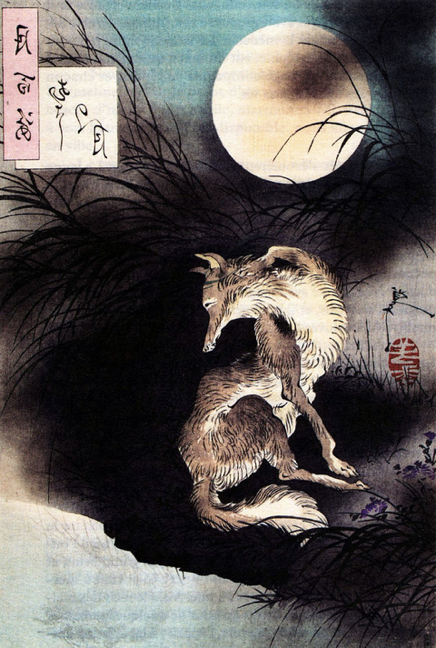
The monkey, said to be a cleaver animal, as depicted by the three wise monkeys at the Tosho-gu Shrine in Nikko (Wikipedia)
(Wikipedia)
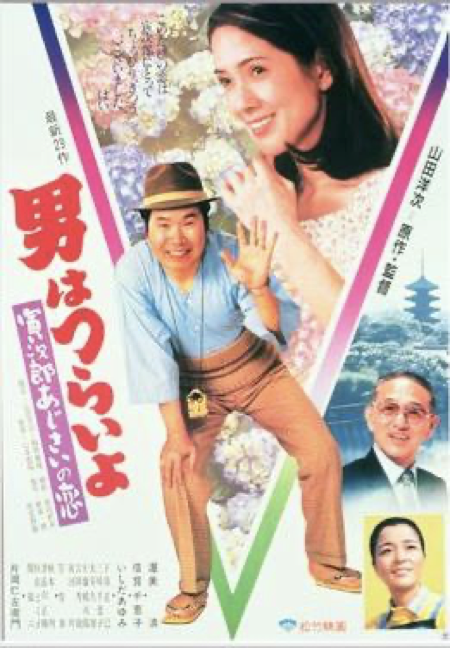
After explaining my situation to the farmers, I was pleased to learn from them that I was indeed heading in the right direction. They also told me that the road I was on, Route 176, would eventually bring me back to the sea. Needless to say, the news pleased me no end. After a while on the road again, and a number of left and then right bends on the downward slope, I was able to get my first sighting of the vast sea. This was my first sighting of the sea, since I had taken my leave of Honjohama Beach, where I had stopped and rested for a while. It was a pleasant sandy beach, that seemed to pop out from the mountains, in the Ine region. It was also said to be a land out of a fairy tale in Japanese mythology, and a Kyoto by the sea. The beach was at one of a number of little inlets along the Tango Peninsular coastline. The peninsular was also noted for its hot spring resorts. The village of Ine stood in the Yosa District of Kyoto prefecture, and was particularly noted for its wooden fishing houses, called "Funaya" in Japanese. The peninsula was an important trade route, between the Eurasian Continent. These days, the local economy relied on tourism and fishing. The village was targeted by American bombers, on 30 July, 1945. The 1982 film, ‘Hearts and Flowers for Tora-san’ was filmed on location at Ine. The protagonist in the film-series was played by popular Japanese actor, Kiyoshi Atsumi (born, Tadokoro Yasuo). It was the 29th of a popular series of films that numbered 48, released in 1995, just a year before his death. Atsumi became synonymous with the protagonist, Toro-san, and the actors death marked the death of Tora-san. About three-year ago, in 2008, Ine Village was selected as one of the most beautiful villages, in Japan. Today, the village had a population of around 2,000 inhabitants, which had continuously declined, since the 1970 census. At the boundary of Kamanyu Township I made another stop, this time at a fork in the road, Route 276. What confused me was the both directions or the road, this time Route 278, appeared to head long the coastline, so I was at first unsure which way to go. The railway tracks nearby also proved unhelpful. I know that I was somewhere just south of an old cotton mill, and that America had provided raw cotton to the Japanese textile industry, since 1910. Japan was a major exporter of finished cotton textiles to America, before the Pacific War devastated the industry. Even further back, cotton came to play a large role in the Japan’s economy for centuries. From a cottage industry, during Tokugawa period (1600-1868), to an essential part of industrialization, during the Meiji period (1868-1912). The Meiji Restoration was a response to the arrival of Commodore Perry and the Black Ships, in 1853, which in ended centuries of relative isolation. The production of early homespun cotton textiles dated to the mid-1800s to the mid-1900s. These early fabrics were mostly associated with the impoverished peasant rural population. Up until the early 1600s, clothing worn by Japanese peasants, was made from hemp, a locally grown and processed common fiber. In fact, hemp was the only reliable fabric generally available for use in Japan, until cotton was introduced from China, and later from India.
Just like Japan had done thought much of its modern history, it adopted from China, the cultivation methods important for growing cotton, including the location — warmer and most fertile regions that suited the cotton plants. In the following years, cotton textile came to be was considered a basic necessity by those who made and used it. The first domestic cotton mill was built on the island of Kyushu, in the closing years of the Tokugawa period. Later, farmers in the Nagoya and Osaka regions, cultivated cotton and their families, mainly women, spun the yarn and wove the fabric in their homes. However, the home-woven cotton industry failed to take off on any massive scale, and even declined in the later half of the nineteen-century. Around this time, the first cotton mill was opened in Sakai, not far from Osaka City. The government hoped that this would inspire private sector investment in similar enterprises. In time, the cotton factory expanded its production, as well as, turn out a small profit. The existence of the factory created an interest, and drew many visitors to it. After a few years, the cotton mill was finally passed into private hands, in 1878. The government, continued to show an interest in the success of the cotton industry, through and purchase of spindles, from abroad. The imported spindles were sold to similar enterprises, on agreeable terms. The private sector came to play a pivotal role in the cotton textile industry, which became a major export product, by the early-1880s. About that time, the giant Osaka Spinning Company, was established by the noted entrepreneur, Eiichi Shibusawa, in 1882. The Japan Spinners Association, which grew to become a powerful trade organizations, was formed that same year. Nevertheless, in the absence of local cultivation of raw cotton, imports proved an important necessity for a growing consumer demand. Next to India, American was the second largest supplier of raw cotton, to Japan. The stop at the forked road, was not just to check my maps, but to boil water for a cup of tea, which I thought a good idea at the time. A few studies had shown that tea helped to keep the weight down. A cup of the old stuff had only two-calories, so I was not sure what good that meant to me, on the road, where I burned off countless amounts of calories, on a daily basis. A hot mug of tea with milk, with one or two teaspoons of sugar in it when I was young. was who we started our days in Belfast, donkeys years ago. After a short while, a group of middle-aged cyclists also stopped nearby to look at their maps, where they discussed the best way to proceed. My maps told me that I needed to stick to the mountainous road, Route 178, or get on to the miner road, Route 624, which would lead me through Kamanyu. The Kamanyu was noted for its local fresh fish served up at eating places, near the waterfront, in Ine Village. The freshly caught seasonal seafood, such as, sashimi, shell fish, tempura, sea vegetables, and much more, selected from the lunchtime menu. Life seemed not worth living without a cuppa. My maps, too, were sometimes near useless. "Mmm!" I wondered if map makers analysed their maps for that very reason?
It was one of the few fishing ports in the region where visitors could buy freshly caught fish in the mornings, directly from the fishermen. “All roads led to Rome!” I called out to them. They turned and smiled back, but did not say anything. “Mmm!” Then I wondered if they had heard the proverb before, or knew what it meant? When they finished looking at their maps, one of them walked over to where I was sitting. The water had just finished boiling! “You have heard that another typhoon was approaching! Right?” Actually, I had not, and thanked him for bringing it to my attention. “He also told me that that was one of the reasons they decided on Route 178, since they felt it offered better cover along the coast, should the typhoon come sooner than later. Soon the cyclists were on their way again, heading left along the less scenic Route 178, which led them uphill past the trees and out of sight. It was back on the road again for me, too, and only a few minutes after finishing the tea and stuffing everything into the backpack. Not far along Route 178, I made another stop, this time at a public toilet I came to, more to see if there was some means that I might be able to recharge the cellphone battery. Mountain passes were for the most part, boringly hard on both the body and mind, with nothing but trees to look at. By mid-summer, of course, the trees and flowers were in full bloom, making it peaceful and comfortable to the mind, but I preferred to see nature moving rather than standing in one place. The cherry blossom trees in Kamanyu could be easily viewed along the road, in springtime, and with their pink petals, they were said to be more beautiful when seen against the blue Nihon Kai. This was not springtime! A touristy sigh post by the side of the road told me that the place I was standing in was called, Kamanyu Scenic Point, located on the northwestern point of Tango Peninsular. At exceptionally beautiful spot in all directions, north and south, made it a worthwhile stop quite worthwhile, if for nothing else. The public toilets stunk of the stale smell of urine, which was not easy to get away from, no matter were I set. The only thing to do to escape the lingering foul smell, was simple to push on. My battle of sorts with the foul smell from the toilets had occupied my mind so much, that I almost forgot the cellphone. This meant having to retrace my steps a good 500-meters to the spot I had left it, recharging at a socket in the public toilet. At the tiny seafront town of Sodeshi, one of the many beach resort towns dotted along the coastline, I decided to stop and enjoy a nice cool bottle of beer, which I bought at a local liquor store. Compared with urban centers, I found the villages and towns I passed through to be mini worlds that emphasized family and community, and were patience was a virtue. Thanks to the Ministry of Agriculture, Forestry, and Fisheries, Sodeshi, with much of the region, has become a main advocate of rice paddies, which utilized the geological features of coastal terraces once left to fallow, and ancient system. Some of these rice paddies are currently overseen by students from a number of universities of the Kyoto region. The revitalization and preservation of the rice paddy terraced system had become part of the curriculum.
(Wikipedia)
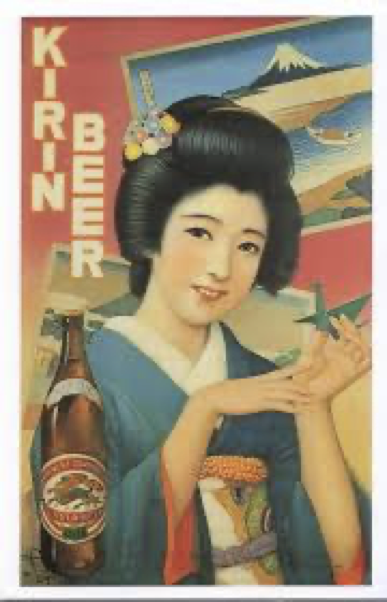
Students of these universities, together with volunteers from local areas and beyond, can experience hand-planting the rice seedlings in springtime, as well as harvesting the rice in the autumn. The Kirin ‘Classic’ lager that I set down to enjoy was a basic pale type of lager, the sort of drink that was just perfect for the hot summer days. As I set under a shade, slowly sipping away at the beer, feeling enjoyment at last, my mind soon began to work overtime. Momentarily I wondered if the beer always tasted the same, like, the sort of alcoholic beverage that foreigners enjoyed during the Meiji and Taisho periods. Some 20-years into the Meiji Restoration, Kirin Beer was marketed for the first time in 1888, by a Japanese brewery, a forerunner to Kirin & Co. The Kirin Brewery Company came into being as a legal maker of beer, in 1907. Some 20-years after the first beers went on sale. As with all good, or bad, things, nothing lasted forever. And with my beer done and the bottle shoved into an empty plastic beer crate, it was back onto the road to see what lay ahead of me. The road took me past the American Armed Forces Base, at Tangochō Sodeshi, but I did not care anything about that. “Mmm!” About that time, however, the thought crossed my mind that a wide range of people liked to visit such military places, on those days when the bases were open to the public. After all, Japan was bending over backwards to uphold its pacifist stance. Formulated on 3 May, 1947, the country’s Constitution was a result of the Pacific War, when just about everywhere got one hell of a kicking in one form or another. Was it any wonder that Article 9 in the Constitution outlawed military action to settle international wrangling? After being on the road again for some hours, it began to rain. At times the rain was not so light, but thongs could be worse. It was pointless talking about the expected typhoon with people along the way, for seemed so unsure, which left me feeling confused. Besides, the mature cyclist had told me about it earlier, and that was enough. So, perhaps something was in the air, or perhaps not! It was all part and parcel of being on the road! The rain finally stopped when I reached the town of Tango Matsushima, located in Kyotango, which took up most of the Tango peninsula. According to a touristy sigh post, the site was one of the most beautiful in Japan, which I took to mean a scenic spot worth stopping to look at. It was also the sort of place that the Japanese flocked to during the summer peek time, if they did not choose to go abroad instead. To quote from the sign post: “Wave erosion also helped sculpt the beautiful coastline into its present form over the years.” “Mmm!” The information kind of made good sense to me, I thought to myself, as I looked about for a place to pitch the tent. Voted one of the best 100 scenic spots in the Kyoto region, the Tango Matsushima also makes up part of the San'in Kaigan UNESCO Global Geopark. The scenic view is quite like what one might see on a postcard. Visitors can enjoy a landscape of a multitude of islets and coastal dunes, and coastal terraces with a rich sandy beach down below. This beautiful coastline is said to resemble the Matsushima Islands in Miyagi prefecture, hence the name, ‘Tango Matsushima’.
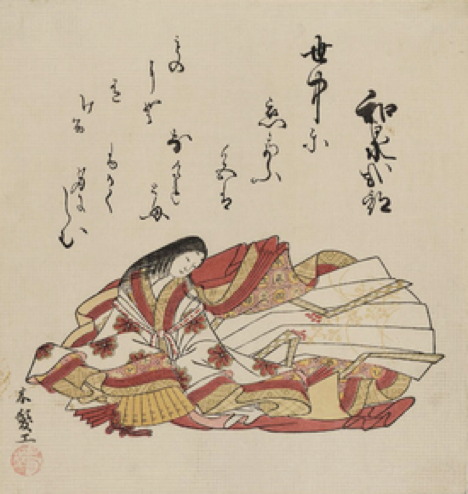
23 Jul, 2011: Got up extra early at 04:00 AM, and just decided to stay up. Sleep was good and most welcomed, but like usual, the morning arrived quickly. Breakfast consisted of two onigiri, or what we might call rice balls in English. Earlier I had picked the onigiri up at one of the few shops there appeared to be along this segment of the road. The shops were at least 30-kilometers apart, almost a days walk. Onigiri were very popular among the Japanese, like sandwiches were to Westerners, or a banana sandwich was to me. It does not surprise me either that onigiri has become a rather popular item on the menu at Japanese restaurants in a good number of countries. Personally, I did not care much for them, and seldom bought any, let alone ever seeing myself making any. A few people I met along the way have given me a couple of origami, some bought and others made. It was also true that in the evenings when I ate them, I was hungry and glad of them. Then again, any food with such a long history must be given more respect. The Japanese novelist and poet, Murasaki Shikubu, and author of the classic, ’The Tale of Genji’, wrote of people enjoying onigiri in an entry she made in her eleventh-century diary. On the road, I suppose, beggars cannot be choosers, or so the saying goes! Onigiri was not so bad, and certainly it was a substantial enough food on the roads. As a breakfast, the origin went down well, and enhanced by a hot cup of coffee, that I almost forgot that I was sitting on the grass covered in morning dew. Looking about me, as I sipped the coffee, a public telephone booth stood a little ways to my left. “Mmm!” Then I wondered if people still used them? After all, there were more cellphone and smart phone users in Japan than ever before. To the left, there was a vending machine, that had a similar story to the cellphones and smartphones, for the overwhelming abundance of them. There were around five-million vending machines across the county, including at the summit of Mount Fuji, which, god forbid, was a world heritage site. This leaves Japan with the highest density of the damn things worldwide. Therefore, proliferation of vending machines on my mission around Japan, was like a cancer impossible to ignore. So too was the case of people and their personal phones, including drivers. Soon I needed to hit the road, but before that, there were the usual morning choirs to take care of, so I headed in the direction of the public toilets, with toothbrush, towel and soup in hand. The vending machines stood close to the public toilets, where, strangely enough, the four smell of yesterday was gone. At time the public toilets I passed along the way were rather fine looking buildings, but often had a sign of neglect about them. Some were clean and well stocked with the necessary amenities. Others were so dirty, with no toilet paper to their name, that one’s eyes must surely roll with disgust. Here too, there was no toilet paper, but fortunately I had my own. Far out on the open sea, all of the fishing boat lights that danced about on the water the previous night, had gone. And how the lights had resembled those on speeding cars at night, after a downpour.
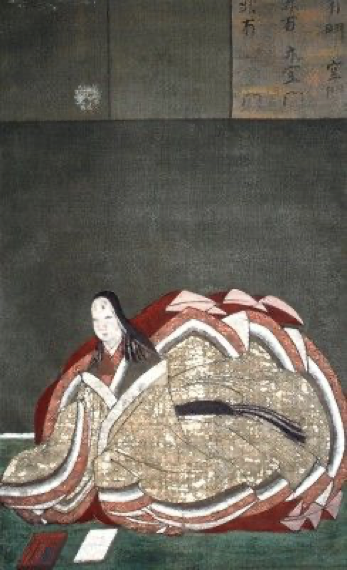
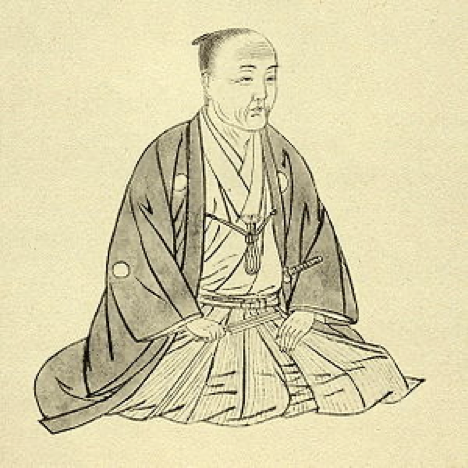
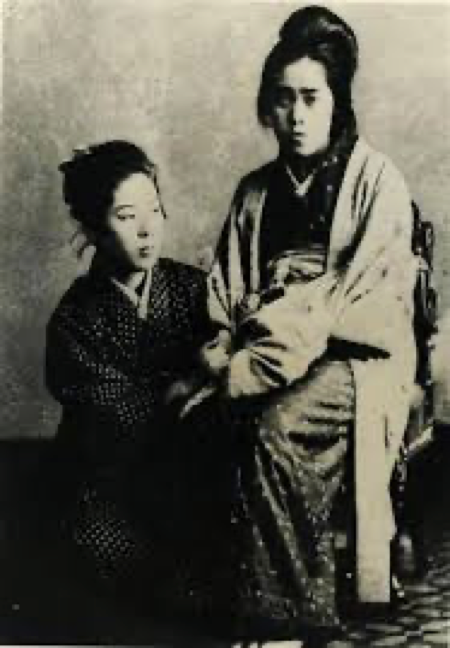
A late-sixteenth-century depiction of Murasaki Shikibu, by Kano Takanobu (Wikipedia)
The giant rocks that pointed out of the sea we stopped to look at a while earlier, where really the harder remains of volcanic rock. The beaches with their cream colored pine groves, sandbars, lagoons, and much much more, had greatly contributed to the regions natural monuments, and was certainly fuel for an amateur poet's pen. On the road out from Tango Matsushima stood an old tunnel. “Mmm!” If 1975, the year it was opened for service, could be considered old? To the side of this tunnel, I could make out the shape of a gravel track. Perhaps in the years prior to 1975, the gravel track was more important, but was now left to the whims of nature. Perhaps the tunnels days, too, were numbered, for progress took few prisoners. My eyes followed the gravel track from where I stood. “Mmm! Surely it would rejoin the main road, or at least to the end of the tunnel?” I thought to myself, picking the backpack up from the ground and fastening it in place. Then I saw a little sign, which told me that the track ran for 1,000-meters, or twice as long as the tunnel, so it went to somewhere worth investigating. Besides, the scenery was simply magnificent, and with that in mind, I made my way across to the start of the gravel track. The track dipped downwards and then veered left and then right, and then left again. The powerful sound of the sea, with the massive rocks sticking up, remained me that it was in charge. If only the mighty sea could have whispered into my ear that the gravel track was going nowhere, but into the sea. The long up hill hike back the way I had come, to where the mouth of the tunnel awaited me, proved even more trying. At times the track leveled out, and I momentarily stopped to take in the view and get a few snapshot, too. Now, the sweat was pouring off me like there was no tomorrow. By the time I reached the tunnel again, I needed to remove some to the clothes to dry them as best I could before hitting the road proper. When I arrived at a Yamazaki convenience store in Taiza, a place with many spas. It was here that I decided to stop to pick up something to eat, including a 500-milliliter carton of milk. Both items were consumed within just five-minutes, my second breakfast of the day. One reason for this was because a colleague in Tokyo had told me during a phone call that shops and restaurants would be few and far between from now on in. So it was better to eat and store up on supplies when possible. The problem with backpacks was that you were limited to what you could carry, and this included food. For what it was worth, I felt it best to eat as much as I could when I could. At the time I was sitting on the ground, leaning against a fence, my sun burned legs and bare feet stretched out, tucking into the food. Just then, one young fellow came out of the store. Passing nearby, he suddenly stopped and commented that I had nice legs. Not expecting such a comment from anyone, especially in Japan, for the people had mastered the art of indirectness from a young age. Therefore, I was not quite sure if the fellow was being rude, or not! However, taking things with a pinch of salt, I thanked the fellow for noticing me, and for his kind comment.
At the same time, however, I hoped that he would not linger about, too, long, and head across to his car and drive away. Besides, I was more interested just then in replenishing my old and battered body with food and the milk, than in explaining anything to anybody. In Japan, it was not good manners to lay about lazily, or even to expose any part of your body. Which brought to mind one event a good while back, when a young police man stopped the police car he was driving just to tell me to put on my T-shirt. Before he said anything about the T-shirt, however, he asked me the usual personal -- who, when, what, where -- questions first. It had been a very hot day that time, and I had been tramping along the road for hours. The funny thing was, I never removed my T-shirt on the road before, but such was the heat that day, I stopped and took the damn thing off. Not 30-minutes later, the police car passed. So there I was, trampling along the road, topless, with only the backpack for cover. The police man did not tell me directly to my face, to put the T-shirt back on. The Japanese were usually not so direct. Rather, we spent the best part of the next 30-minutes conversing about all the dangers of the sun, and the road. It was not until the very last minute, or so, before he took his leave, that his character changed. I recalled how he became a little red in the face at the time. The young police man must have felt that he was getting no where with this hard headed Irishman. The poor fellow finally was forced to tell me directly in not so many words, how he felt about my not wearing my T-shirt -- "It was bad manners in Japan” and “We Japanese would never do such a thing." And a couple of other remarks for good measure. Back to the present, it had long been said that the more you learned, the less the less you knew. Of many rich sandy beaches that I had walked along or camped on in the evenings, not once did I give any thought to the sand that made them what they were. A museum dedicated to this very subject opened my eyes, ears, and mind a wee bit. Other than those more knowledgeable than myself on the subject, who really thought about the sounds the different sands made? What I knew was that the major cause of the currents was the wind, which in its way, dragged the water along, and generated the swells and foamy surf, or breakers, that looked like waves going mad. The waves hurled fragments of rocks at the coastlines, and like the rivers, wreaked havoc on the inland areas. They eroded the coasts, and caused them to recede. One good spot to observe this was said to be the beaches. The beaches were themselves a complex system, where nothing remained the same for very long. The winds and the inland rivers, were to blame, along with the rip currents, longshore drifts, erosion of cliffs, headlands, and no doubt a host of other places. Somewhere along my university days, I learned that the tides were formed by the gravitational pull between the Earth, Moon, and Sun -- the spring-tides and the reap-tides, or the highest and lowest tides, respectively. To step down off my soapbox, there was no getting away from it, I knew nothing about the kind of sand that made beaches what they were. All that I knew was that I had slept comfortably on lots of them.
The name of the very place I am writing about, drew many visits, where they listened to the “singing sand”, was called, Kotohikihama Nakisuna. Thiis was a singing sand museum. located in Kakezu, Amimo-cho in Kyōtango City in Kyoto prefecture. The entrance fee to the sand museum cost ¥300 Yen. The city has a population of more than 55,000 inhabitants. One must-see spot was the nice rich white sand on Kotohikihama beach and the green-leaf pine trees and seasonal flowers, that have flourished for many years. The Japanese beech trees, native to the country and dominant in deciduous forests, was a symbol of Kyōtango, as was the Veronica, the largest of the flowering plants. (In 2011, Kyōtango City became the hometown of the world’s oldest man, Jiroemon Kimora). A search through Wikipedia tells me that theJapan Air Self-Defense Force still maintains a facility in Kyōtango City, the Kyogamisaki Sub-Base, which was part of the Basic Air Defense Ground Environment. And that the Kyogamisaki Communications Site, USFJ a missile monitoring station, was nearby. The beach was famous for its nakisuna, or the sounds the sand made when walked over. Actually, this was true with all the sandy beaches in the country, if only people took notice. Clearly, it was up to local people to make an effort at keeping their beaches clean and free of garbage, including engaging children in activities to conserve the beaches, among other places. Visitors, too, need to be more thoughtful and respectful of the places they stop by at. The plain and uniform design of convenience stores, were designed in such a way that they had absolutely no place to seek shade from the sun or cover from the rain. Baring a few places, most of the stores I stopped by at, for one reason or another, had no place to sit and rest. Or rather, to sit down in some comfort, to eat and drink the stuff I purchased. At one Lawson convenience store, a little ways past the town of Kekaura was no different from most, if not all, the other chain stores. The only shade I found at this place was barely a meters wide, and disappearing before my very eyes as the minutes passed. Here I dropped my backpack against the wall and headed into the store to use the toilet and to pickup something to eat and drink. When I emerged not 10-minutes later, I found a group of young, over weight Japanese guys, literally squeezed together, on either side of my poor backpack, enjoying what remained of the shade. Ignoring the chorus of apologies that came from the them, I grabbed up the backpack, and turned towards the road. “Mmm!” My mind, too, began to work overtime, and found myself thinking if I had done the right thing. Should I have set down in the shade between them, and drink the cool can of beer there, or to find some other shaded place further along the road? By the time I did manage to find a broad shade to sit under a while under, the beer had become warm. After about 30-minutes, it was time to hit the road again, which meant back our under the relentless sun. However, I had not taken fifty steps when I stopped. “Mmm! Did I forget something?” I mumbled to myself under my breath. Then, feeling about my neck, I realized that I had forgotten the little towel that I wore around my neck.
Wearing the towel was more a habit than useful, for wiping away the sweat from my face. Besides keeping my wits about me, for any danger on the roads, also meant that it was easy to forget or lose all sorts of stuff. So I needed to stay sharply focused in more ways than one, which in itself was far from easy. Dropping the backpack to the ground, I retraced my steps to where I had stopped, only to find that the towel was no where in sight. One other little problem was of sorts, the little towel had an emotional value to it. A gift from a dear friend a good while back! Back at the busy convenience store, the young male clerk seemed to be under the impression that I wanted to buy a new tea towel and pointed in the direction of the shelf that contained them. “No! I am not looking for a new tea towel, but my own one! I may have left it here by mistake! My lost tea towel! I lost it!” I again told the young male clerk in Japanese, hoping that this time I was making myself more clear. Just then a bright spark hit the young man’s face, as if he knew something I did not. Unfortunately, it was just to tell me that he understood me now, and after a quick look about the store, including the toilets, told me that the missing tea towel was not there. Back on the road again, I could not stop thinking about how I came to loss the towel, and for a while my mind attempted to go over where I had stopped since upping camp early this morning, but all to ‘no avail’, if I may use that ancient idiom to emphasis this important loss. The tea-towel had been an important piece of the gear on my mission, so it was not so easy to resign myself to its loss, or my own absentminded clumsiness at losing it. The towel was given to me by a fellow traveler from Sendai in the north of Japan. We camped near to each other in the seaside town of Ofuna, north of Otaru City, in Hokkaido. For a while, we had kept in touch with each other, but like so many people and things, I sadly lost touch with him. Every time I wore the tea towel around my neck, thoughts of the fellow and our happy short time together, came flooding back. Just as I was picking the backpack up and turning onto the road once more, a voice called out to me. Turning around, I could see the young clerk walking towards me, waving something in his hand that had a familiar color. “Is this it?” He said, holding up, and looking rather happy at finding the sea-blue colored towel. “The towel! Thank you! Thank you! Thank you!” I said as I approached him, beaming from ear to ear, and carrying the backpack with some difficulty, under my arm. “Thank you so much! I’m so happy!” As it turned out, the over-weight fellows, whom I took to be college students, and who had taken up the remains of the shadow, had handed it to one of the other staff. They had also added that it probably belonged to me. The young male clerk apologized for not discovering it sooner. To this I assured him that it was better late than never. We shook hands, and with another hearty thank you, and a customary wave, I turned to hit the road once and for all, but not before the tea towel was tied firmly in place around my neck. The little towel in question, called ‘tenugui’, was a type of traditional Japanese towel with a long history behind it.
Of course, my neck towel or tenugui did not have such a long history, but I liked it for what it was worth. zIt had a smooth texture to it, and could absorb a large amount of water, or in my case, sweat. Tenugui towels also came in an endless array of interesting patterns and colors, and where inexpensively available throughout the country. Therefore, it was a very useful part of my equipment! Not 15-minutes passed after hitting the road, when up ahead of me a dark green car pulled over on the opposite side of the road and stopped. As I drew near, an attractive young woman opened the door and got out, and coming across the road, she introduced herself as Yuki. She told me that she had seen me pass just as she was coming out of work. I could not remember if it was a tour company or a delivery company that she worked for. In her hand she held a frozen plastic bottle of lemon water. “This is for you!” She said, sticking out her hand. In such hot weather, I could not think of a more sought after gift! So I was more than happy to accept it! She then asked me if she cold talk my phone, of which I was more than happy to obligee. This was soon done, including taking one with both our smiling faces. Likewise, I took some snapshot of Yuki-san with my own digital camera. Then I asked her to take one of me, with my camera. It was never easy to get photos of myself that I could file away. No sooner was this done, when Yuki decided to have some more photos of us both together. I was not sure how much time we spent there posing for our photos, but it was a fair while. It was nice that she did not seem to mind my road dust sweat covered face next to hers, though I was a little concerned all the same. Yuki-san held her camera out in front of us as far as she could. And with a little click sound, the photos of our to smiling faces, came out exceptionally good! After parting with young Yuki-san, I found myself starting to feel a little down. I began thinking that I should have asked her more questions, and made a point of writing things down quickly. Only too often would forget or not remember well what someone told me, when I stopped to chat a while.After all, it was a sign of respect towards the people to report things correctly, especially as some of them made an effort to talk to me, and often presented me with some little gift, and so forth. Someone I met along the way, made mention of a matsuri, a local festival, planned for this evening at the town of Tateiwa. Then when I made mention of this to someone else I stopped to chat with a little while, they told me they had not heard of it. As with so many parts of Japan, the area was more famous for its spas. The local ryokans and minshukus were often fully booked, because of them. The ryokans and minshukus were sort of family operated, Japanese-style bed and breakfasts. The minshuku was somewhat similar to the ryokan, with Japanese style tatami rooms with futon bedding to sleep on. Of course, I had no intention of stopping the night at a ryokan or a minshuku, nor at any sort of hotel for that matter. As I was making my way towards the beach to make camp, an attractive middle-aged woman stopped me. She told me that she had just finished her work at one of the local inns.
Now she told me that she had some work to do out on the streets, like, encourage foreign visitors to sample one of the local public and private baths and spas, particularly at the place where she worked. If I did not misunderstood my interpretation of the good woman's words, I think she even offered to bathe me, should I care to enter the spa. She also told me that the cost for the bath was just ¥600 Yen. Whatever the case, finding a good place to pitch the tent for the night, before it got too dark, was the most pressing issue on my mind just now. And with a wave, a smile, and a few parting words, I took my leave from the friendly woman. Needless to say, the little encounter remained on my mind for sometime. It might be safe to say, that all the famous hot springs in Japan, had a long history, and had become an intimate part of the country's culture. Today, there were more more than 3,000 'onsen' in Japan, with naturally heated waters, that varied in one degree or another, in mineral composition. The onsen were usually located at, or close to the ryokans, traditional inns that were also ingrained in the Japanese culture. The water was piped into the ryokans, and other establishments, and then regulated at various temperatures. At many ryokans, there was sure to be a large indoor onsen , one entrance with a blue curtain for men, and another with a pink curtain for women. They may often have several pools with wall-length windows where bathers could look out over a garden, river, or another natural setting. The ryokan interior may be lined with natural rocks and decorated with various kinds of tropical plants. And some that boasted their own open-air baths, or 'rotenburo' in Japanese. The ryokans could often be found near at hand, and some were often opened all night. The outdoor onsen could be more rustic than the indoor ones. Some times, too, there was no proper place to change clothes. Not that that meant anything to me, since I just about never used them. Also, being an outdoors lover, so I was well used to having no where to change my clothes per se. "Mmm!" I wondered if foreign visitors understood the time and tested bathing etiquette? Did they know that the Japanese washed their bodies, before they stepped into the bathtub. And not to take the tiny soapy towels used for scrubbing that were used to scrub the body, into the tub. I had seen some Japanese, with a small folded up towel placed on top of their heads, but I felt that they were well wrung out before they got into the bath. The Japanese just like to enjoy being in the hot water. In fact, the bath was more popular than the shower, in Japan. The Japanese were a group oriented people, and in away, sharing a bathtub was an extension of that. Therefore, public bathing was an important part of the culture. It was very important to rinse off any soap or shampoo suds, before even thinking of getting into the bathtub, where you did little of anything, but relax. I also wondered if the foreign visitors new to Japan were aware of just how hot the water could be? Too hot at times! As I had penned earlier, I did not mind relaxing in a nice hot bathtub, when the time allowed, but loathed even the thought of sharing it with strangers, or even people I knew for that matter.
24 Jul, 2011: Last night I stopped by at a convenience store and picked up a bottle of inexpensive Cabernet Sauvignon, red wine, Vina Maipo, from the Central Valley region in Chile. However, I felt too tired that I could not drink one cup. My eyes felt so heavy that I could not for the life of me recall drinking even that much. Soon after making camp, I walked barefooted across the rich sandy beach to the sea. The tent was erected about 200-meters from the shoreline, and beside a river that slowly made its way to the sea. Perhaps because of an almost lack of movement, the river water at the riverbank was nice and warm. It was here that I decided to wash my body the best I could. This summer was not nearly as hot as the record breaking temperatures of the previous year. Unlike that time when the sea felt comfortably warm, and when I could never get enough times in the sea, the tidal waters now were damn cold. As to life, the river was very much alive with countless numbers of tiny fish, which at times leaped into the air with gusto. At times, birds flew low over the surface of the river in search of pray. Others set perched on some of the dry wood scattered about, clearly their attention was focused on the water. Clearly there was nothing doing, and after some time, the birds flew away, perhaps in search of richer pastures. For breakfast I had to make do with the two tomatoes that the proprietor of a Yamazaki convenience store kindly gave to me, a nice unexpected gift. On the road, Route 178, I tried to stick to the shade as much as possible, for it felt like the sun was trying to cook me for its breakfast. After a while on the road, I stopped at a Michi-no-Eki, a touristy place called Kumihama Sankaikan, and where it was nice for once to find the restaurant open for business. The morning set was all that there was to be had. This consisted of a think slice of toasted white bread, which had such a thick coating of butter or magazine that was dripping from it. The set also included a small bowl of salad and a cup or coffee, which could be had with ice. I settled on having ice coffee. From the restaurant window I was able to get a splendid view of what looked like a large lake, but was really the landlocked Kumihama Bay. My view of Kumihama Bay did not last long, or until a coach load of elderly Japanese sightseers pulled up and stopped in from of the window and blocked my view. This told me that the time had come to hit the road once more! If I stopped too long in one place, the heat that radiated off the tarmac could almost be felt through the soles of my boots. After some time on the road, which had little shade to seek shelter under, another fork in the road came into view. It was at this fork in the road, that I would say good bye to Route 278 in favor of the minor Route 11, which headed past the lake and towards the sea. Along this road, I stopped by at a shrine, called Nyoji, which allowed me the chance to wash a few clothes, and to spread them out over the hot gravel stones for the sun to do something useful on. There were a number of tourists walking about, stopping and taking photos of this and that, but I did not care one way or another. “Mmm!” The road had hardened me mentally!
As I wrote a while earlier, this sumner I felt was not as murderous as the one last summer. There had been the odd moment this time around, when it would have been difficult to notice a difference. The only good thing about being on the roads was how quickly the washed clothes dried. It was important to have a clean dry set of clothes to change into in the evenings at camp after washing. At times, too, it felt good stopping along the way to have a little rest and scrub down, and to get into a fresh set of clothes. Soon after hitting the road again, however, the fresh set of clothes, would soon be saturated with sweat, too. When it rained, you were permanently wet, and when the sun shown, you were permanently wet. That was how it was on the road! Hence the importance of having a clean set of clothing to sleep in the evenings! The clock on the restaurant wall told me it was time to make a move, and a look over the temple grounds also told me that the numbers of visitors was increasing. Someone told me that Route 11 was a good road for me to use, and a shortcut to the sea, always a main destination for me. For a fair distance, the road wound up through a mountain range, abundant in pine tress, but little shade. The time was three-thirty with the sun still ruled supreme, with me at its mercy! At times a gray shadow formed over the asphalt, as the road curved this way and that. A cool welcoming breeze that blew low over the road urged me on. On the road, one soon learned to conserve water! Route 11 went on and on, as did the suns effort to break me! Of all the things that my tired old brain did not expect was to see a tunnel popping up. The cool air inside this short tunnel job led me momentarily away from a land of rice fields. There were a good number of tiny vegetable allotments that I passed by, and some villages, home to those who worked the fields. In time, I found myself entering the town of Kehi, east of Maruyama River. The river, a good 68-kilometers of it, cut through Hyōgo prefecture, if not Honshu, on its way to the Nihon Kai. The Sanin Main Line accompanied the river for quite a distance.The Maruyama River was the main river in the region, and passed Toyooka and the picturesque mountain passes. A cycle path also ran along the river, towards Kehi Beach and the Tsuiyama Fishing Port nearby. It was also a great river for boating, rowing, and stop and enjoy the boating regattas. It was said that some of the 2020 Olympic rowing teams were set to train on the Maruyama River. Among them was the German team, among the world's top-ranked boat teams. They were scheduled to stop for a couple of weeks in Kinosaki before participating in the games. It was also said that the German rowing team would sport, 'KINOSAKI ONSEN', on their uniforms, as well as, on the boat and oars. The region was noted for its onsen, and home to the Hachigoro Wetlands and the five Genbudo Caves, that had been formed by volcanic eruption, more than 1.6-million years ago. Kinosaki was an old hot spring town, Nestled in a mountainous valley by the sea. The town and its hot springs dated back some 1,300-years.
Kinosaki, a resort area, was just a short distance from the train station, boasted seven public hot springs for visitors to choose from and enjoy. Even the local temple was appropriately called, Onsenji. Guests to the hot springs were encouraged to don the traditional yukata and geta, when they strolled the town streets. It was common for visitors to be seen taking the ropeway that led up to the top of Mount Taishi, where they could enjoy the view out over the town and coastline. One noted visitor to the Kinosaki hot spring, was the Japanese writer, Naoya Shiga, and where he remained for three-weeks, in 1913. The lengthy little stop at the hot spring inn, was believed to have inspired one of his short stories, 'Kinosaki ni te' ('In Kinosaki'). In away, the course of the Murayama River maintained the surrounding nature, the rice paddies, and was habitat to a host of wildlife. This included the wild Oriental White Storks, symbolic to Toyooka City, lived on and around the wetlands. Much further back along the road, in Tsuruga, I passed by a Shinto shrine, called Kehi Jingu. There the shrine was affectionately known by the local people as ‘Kei-san’. Like most, if not all shrines and temples in Japan, Kehi Jingu was very old, said to have been built in 702, and home to no less than seven Shinto deities. This may be why it was considered the main shrine in the Hokuriku region, and boasted a 11-meter tall torii gate, which had been registered as an important cultural asset. The torii gate at the entrance to the shrine, was believed to be one of the largest in Japan. Shinto shrines tended to have more than one torii gate, and often marked the entrance path to the shrines. The torii could be seen in various colors, but mostly either black and orange. They were also constructed with various materials, but mainly wood. The gates are actually giant arch-like structure with two upright posts and two crossbars at the top. The torii gates symbolized the boundary between the secular world and the infinite world, where the kami or god dwelled. Because the tori gates were not actually shut, shrines were always open. Another reason why the Kehi Jingu Shrine was held in high esteem was that the famous poet, Matsuo Basho (1644-1694) once visited there on his travels, in late-1689. Today, a stone statue and a monument inscribed with Basho poetry, commemorated the occasion. Bashō was said to be the most famous haiku poet to come out of the Tokugawa period. Last, but not least, Kehi Jingu has long been noted as a place of matchmaking, and where visitors can buy a variety of o-mamori charms, as well as fortune-telling paper strips predicting one’s fortune love. Not long after leaving the tunnel behind me, I stopped by at a store, which was more given over to selling medical related concoctions. Clearly there was no such things as a nice cool can of beer that I might administer to my weary body. Upon asking the good lady who ran the store where I might run into a shop that sold beer, she pointed back up the road from whence I had just come. “Mmm!” How can that be? I wondered, feeling a bit frustrated with myself. When something does not quite work out as hoped, the Japanese often use the short term, ‘Shoganai’! In English means: ’It can’t be helped’!
And so it was, I turned back on to the road to continue my journey south towards Tottori, fastening the backpack in place as I went. In time, I expected to do some crisscrossing with the Sanin Main Line railway tracks. The Sanin Main Line in western Japan, operated by the West Japan Railway Company, was a major connection of the San’in region. That said, I was not sure if there was some distant connection between the name of the Kehi Town and the name given to this shrine. To rub salt into the wound, the good lady who ran the store also told me that there were absolutely no more shops on this segment of road that sold beer. After only tramping a short distance, my eyes feel on what looked like a restaurant up ahead of me. This was not exactly in complete contrast to what the good woman had told me, and a restaurant that served beer was as good as a shop that sold it. When I drew up along side the restaurant, I could see that it went by the name, ‘Boy’, but I did not care what it was called as long as it was open. Inside the restaurant I ordered chahan, a friend rice dish, and needless to say, a cool beer to keep it company on its own journey to the depths of my stomach. Actually, chahan was the very first food I ordered when I first showed my face in Japan in the summer of 1979. Masayoshi Ōhira, (1910–1980) was a Japanese Prime Minister at that time. Like many of the country’s leaders, Ōhira was in office only a short time. Unlike other leaders, however, he was the most recent Prime Minister to die in office. As it turned out, the chahan turned out to be simply delicious, but I was unsure if it felt that way as I was literally starving. Also, my mind had become resigned to getting absolutely nothing to eat for the remainder of the day, so I was more than happy to stumble upon the unexpected restaurant. After all, the good woman who ran the store that I stopped at al while earlier appeared as though she would have bet her life on being nothing on the road to buy food, nor drink at for the next 30-kilometers at least. When I finished eating, I felt so reinvigorated that I was ready to challenge Mount Everest. Then again, a sudden sharp pain in both my feet began, told me that I would probably struggle getting over the 567-meter high, Mount Kuruhi, the nearest mountain away in the distance to my left. To paraphrase from the official Tourism Toyooka City Website: The view was as if you stood above a sea of clouds that stretched out below you to the Nihon Kai. This fantasy-like world could be seen in the early late-autumn morning from the peak of Mount Kuruhi in Kinosaki. Kinosaki was an onsen town, was about 2.5-hours from Kyoto by car! In addition, at the summit of the mountain, one not only got a beautiful view over the Nihon Kai, but also Maruyama-gawa, and the Ramsar Sites, part of the wetland conservations. Mount Kuruhi had a well maintained hiking path to the summit, an altitude of about 566.6-meters. Kinosaki, an onsen town, was about 2.5-hours from Kyoto by car! Reading over the website caused me to think of a painting, by German artist, Casper David Friedrich (1774-1840), poetically entitled: ‘Wanderer Above a Sea of Fog’, which he painted in 1818.

High up on a rocky landscape, a lone hiker stood and looked down over a sea of mist; “a metaphor for life as an ominous journey into the unknown” (Wikipedia)
25 Jul, 2011: It was well after midnight when I finally got to sleep! For I was entertained a while by distant thunder and lightening, which intertwined nicely with the starry sky above me. The clouds were fast approaching! Soon after crawling into the tent, a light rain began to fall, but only for a short while, then it stopped. When I awoke from a sound sleep, the cellphone clock read 07:00 AM. First thing was first, which meant crawling out from the tent, skirting around thickets and rocks, and where the white foamy tidal water ran onto the sand. Nothing felt better than a washing in salty seawater. This was a ritual that I usually performed in the evenings soon after erecting the tent, whilst the second best thing was to climb into clean clothes, which was little more than a T-shirt and underwear. Before hitting the road proper, a quick dip in the sea was just as good as any hearty breakfast, or so was how it made me feel. Unfortunately, so many of the coastal roads in Japan, were not exactly on the shoreline. Rather, the beaches were separated by a 100-meters of dense thickets, sometimes with vast rocky drops, with the sea far below. At times, the roads that I tramped along led me up through mountain passes. The sea, if you could get a glimpse of it, became little more than part of the scenic view, something to stop a while to look at, or to take a few snapshots. Therefore, was it any wonder that whenever the sea was at hand, I tended to make the most of it? The sea was not as cold as on previous days, but this time it was less enjoyable, for a large crane was noisily at work just 200-meters away. Talking about a hearty breakfast, I decided to return to the restaurant, ‘Boy’ that I had stumbled on by chance yesterday, and where I sampled the most delicious plate of chahan. There were four set-dishes to choose from on the morning menu, ‘A’ to ‘D’, and with that I decided on having the ‘B-Set’ for breakfast. This came in the simple form of a toasted ham sandwich, a small bowl of salad, and a hot cup of coffee. The breakfast left me feeling more than contented, for I was far from hungry and still feeling the positive effects of the chahan yesterday. Getting back on the road again and leaving Kehi Town behind me, meant crossing over the long Minanobashi Bridge that spanned the Maruyama River, which seemed in no hurry to join the Nihon Kai. There was a second bridge, especially for cyclist and pedestrians appeared just as spectacular as its mother, the Minanobash. This narrower bridge led me out of town and soon I found myself tramping along the tarmac merrily in the direction of the place I would make camp for the evening, where that was. As like on other days now behind me, it did not take very long on Route 11 before the first mountain pass presented itself. And like all mountain passes, a series of ups and downs, which bend one way, and then the other, could soon be felt from head to toe. The scenery was simply splendid at various points along the way, and which made the long hard tramp seem more meaningful than otherwise. Fortunately for me, the sky was heavy with clouds. Still, there were a number of time when the clouds broke and the sun had its way with me.
Each time the sun was beginning to be felt, the gap in the clouds closed up again. It was at the summit of one of the many ups and downs in the mountain pass, that I decided to stop and boil water for a cup of tea. When I left the restaurant ‘Boy’ this morning, the proprietors there kindly presented me with a ham sandwich, to enjoy at someplace along my way. If I was not mistaken, the restaurant was run by a husband and wife team. There were so kind! Last night, they had even given me food and a couple of cans of beer to take back with me to my camp, near the sea. Which, I guess, was another reason why I did not hit the sack so quickly last night, and slept soundly when I did. All in all, these kind people gave me more than I spent. “Mmm!” The Japanese never failed to surprise me! Not five-minutes after eating the ham sandwich, drinking the tea, and packing things away, it started to rain. “Mmm!” Not exactly the luck of the Irish! And so it was, or for the remaining kilometers that led me to the village of Takeno, the sky opened up and the gods pissed down on top of me. Even when I reached the town, I was surprised that the tiny umbrella I was using held out under the weight of the rain. Just as I stopped at under the shelter at a sake ya san, or lacquer store, the rain letup. Before heading back onto the road again, I decided to set down on an empty beer crate to enjoy a cool bottle of beer, which the elderly proprietress kindly popped open for me. Takeno was located in the heart of San'in Kaigan National Park, which was part of the Global Geoparks Network, supported by UNESCO. Like many of the small fishing villages, Takeno, too, boosted a lovely sandy hama, or beach. During the months of summer, many of these seaside villages and towns come alive with swimming, snorkeling, diving, and kayaking enthusiasts, or by others who simply wanted to enjoy the sun. The emerald green colored sea water was warmest in late-June to early-September. The rich sandy beach in Takeno, in particular, looked less than a kilometer long, and considered to be among the most beautiful beaches in the country. Further along was Tottori City, where the famous sand dunes, the Japanese desert, was to be found. High above in the sky, I could make out the remains of a vapor trail from an airplane. “Mmm!” It was on the sand dunes that the Wright brothers historic flight happened, or so the thought momentarily entered my head. That was at a place called Jockey Ridge on the outer banks of the Kitty Hawk at Kill Devil Hill, in 1900. What a set of names that place had.In those days, birds were the only things that soared high in the sky. One large bird, the large white colored Oriental stork, with its black winged feathers, were reintroduced into this part of Japan, in 2005. As I had penned earlier, this beautiful winged creature had since become a symbol of the city, if not the region. History was full of people like the Wright brothers. Flying was as old as myth and legend, from the kite in 400 BC - China, a time when man's thoughts turned to flying like birds -- from feathered wings strapped to their arms. Leonardo da Vinci drawings of flight, in the 1480’s, the first hot air balloon, in 1783, and so forth.
26 Jul, 2011: Yesterday, I found myself tramping along the wrong road, Route 1, which led to JR Takeno train station on the Sanin Main Line, was also not that far from Komori Shrine. Shinto shrines were places where believers worship and the dwelling places of the kama, the Shinto gods. Unfortunately, I was not interested in visiting the shrine, but getting my godless arse back on track. In a word — it has been busy! Somehow, somewhere, I had taken a wrong turning. At the time, I was not exactly sure where the mistake happened, for my maps were not very detailed. Of course, I only had myself to blame for not keeping my eyes open. My mind was always occupied with other unnecessary stuff. In the end, the mistake had cost me close to two hours, not to mention the added strain on the old , and not that far from mind and body. One good thing that came from the mistake, was that the road led me to a good store, where I was more than able to replenish my provisions for the evening, if not the day after. When I did finally retrace my steps back onto the correct road, Route 11, it began to drizzle. Earlier on in the day, there had been a couple of really heavy downpours, which even a large umbrella could not have kept one from getting wet. Already by then, I had an eye open for a good place to make camp at. Not much later, camp was finally established on a pleasant little isolated beach, not far from the main drag. There was such a gentle ebb on the incoming tide, that I could have sworn was calling my name. It did not take long for me to decide what I needed to do. Finding a place Japan where you can be completely naked, was not easy at all. And so, when the chance presented itself, I quite naturally felt inclined to take it. Skinny dipping in warm salty water, was a heaven on its own. Then again, swimming naked in a flowing river would freeze the balls of a brass monkey, even if it was the hight of summer. Thankfully, this was such a river, and I enjoyed my dip in the sea so much that I must have been there for the best part of 30-minutes. Whenever I did step out of the water again and onto the hot sand, my body and mind felt so refreshed, that I momentarily contemplated hitting the road and notching up a few more kilometers. Of course, yesterday evening that did not happen, and I remained were I was, camped on the sandy beach. In the sound of silence, I tried to empty my mind of all thoughts. Failing that, I set about watching the setting sun as it cast a reddish shine out over the calm water, where I had just enjoyed a freedom of sorts. Those moments of fighting to remain in my own little world in out of the way places, were at times broken by the distant sound of a train or that of a passing car. Such sounds never lasted, and each time, I would find myself, like in a loosing battle, slipping back into thoughts I tried not to think about. On the road a touristy sign told me that the pile of stones had been crushed by dislocation (diastrophism) and rough waves. Whatever it was behind the formation of this coastline, it clearly was a place of unusual beauty. Along my way, I stopped a while at a cafe called ‘Sea Point’, in the town of Hanasui. For the life of me, I was unable to see or hear any sound of the sea from the windows.
One other thing I found not amusing about the place was that it reeked of stale tobacco smoke. Then again, I well recalled how worse such things as unwanted secondhand smoke was when I first arrived in the county in May, 1997. You could not go into a restaurant or coffee that did not have an ashtray on every table and counter. To make matters worst, the elderly chap who ran the place, nice as he was, turned out to be a chain smoker. In other words. he smoked several cigarettes in succession, whilst I was there. It was too late to get up and walk out of the place, like, talk with my actions. Besides, I had already ordered the breakfast set, and took things as part of the ups and downs of life on the road. That said, I was determined to pay the bill and hit the road, again, the moment I finished eating. There was an air about the faded interior decor at the cafe that it was once a trendy place, a sort of hangout joint for the young fashionable of the 1960s. Or so the faded designs and patterns, and ornaments told me. This included the fashions of the characters in the pictures on the walls, all avant-garde, here and there. Clearly the good days were had gone and left behind, like many of the abandoned roads and tunnels had been left to nature to reclaim. The yellowing wallpaper and ceiling color, and the once bright pictures on the walls, now faded through time. There was an aging about them, caused by more than only the tobacco smoke. How many of those customers had gone to meet their maker? One good point, about the cafe, I should add, was the proprietor's gentle nature.Another, if I could find one, was the background music, oldies from the 1960s. The voice of none other than the glamorous American jazz singer, Sarah Lois Vaughan, putting her touch to an arrangement of love songs and melancholy ballads. According to the music critic, Scott Yanow, Vaughan possessed "one of the most wondrous voices of the twentieth-century.” The Divine One’s voice, to use one of the affectionate nicknames assigned her, in her long career, kind of left me speechless. It kind of carried me to a new level of appreciation for such performers, John William Coltrane, Miles Dewey Davis, Phillip Glass, and a bunch of other artists, if only momentarily. Vaughan, with her beautiful voice, covered a wide range of songs with powerful lyrics, such as, ‘Days of Wine and Roses’, ‘Moon River’, ‘The Shadow of Your Smile’, ‘Smoke Gets in Your Eyes’, ‘Charade’, ‘I Left My Heart in San Fransisco’, among so many others great hits. They were the sort of songs that had been performed by many other great performers, all over the world in different languages, Of course, I would not bother my arse to go into any of this now, otherwise, I would be jotting down into my notebook all day. What I could add, was that my thoughts had caused me to forget all about the foul smell of the stale tobacco smoke. No thanks to Europeans traders, in the 1500s, when tobacco first made an appearance in Japan. According to 2001 figures, as many as one in every two young person smoked, or 50-percent. Compared with other countries, smoking was less restricted by law, in Japan. The urge for a fag, had been steadily on the decline since the mid-1990s.
There was even a lovely rendition of ‘Oh Danny Boy’, which needless to say, reminded me of my own country, for what it was worth. Lost memories aside, it was time to pull myself back to reality. For Danny boy, the pipes the pipes may have been calling, from glen to glen and down the mountain side, but for me, the road was calling, and I needed to get my arse back outside and under the morning sun if I was to make any progress. Not long after hitting the road, I found myself feeling a little depressed, but was not fully sure why. It was because I had misread the man at the cafe, or rather jumped to the wrong conclusion. I enjoyed my little stop there, and my body felt better for it. Once again the road, Route 11, led upwards on a long hard slog through yet another mountain pass. Like other times, the road wound past clusters of trees and thickets. Some of the trees grew at a slant. “Mmm!” I even wondered if the drivers of the odd passing cars could see clearly, for they took the bends at dangerous speeds? Only on the downward slant of the mountain, did the sea came back into view. A field that had been ploughed and ready for sowing, slanted down towards the coastline. That was where I was headed. Yasuki was the first town that I came to after leaving the cafe. Here, I popped a few coins into a Dydo vending machine and set down on the ground next to it to enjoy the cool tingling taste of a can of orange juice, as it ran down the old throat. At times I received confusing, if not conflicting, messages from my colleague in Tokyo. “You will come to two long tunnels. Therefore, you must go right!” Frustratingly, I wondered what long tunnels were being referred to? Or where on the road they were? On previous occasions whole hours on the road would pass by, if not a whole day, before I finally discovered the answer to certain messages. In this case, I was able to understand the two long tunnels in question, and the road that I needed to take, and so forth. But only too often, I would find myself tramping through numerous other monster tunnels that had not been mentioned. For the most part, the information from my colleague in Tokyo was spot on, and I was more than grateful for it. “You will pass a community center!” I was recently told. “There you will see that Route 178 heads off into two directions.” “You mean a forked road?” I remembered asking! “Yes! Kind of. Only, one goes straight and the other sort of diverges sharp to the right. Later, both roads join up again.” He said, and added that it might be better for me to take the road that headed right. To cut to the chase, I was advised to take the road that veered off to the right. That way I wound not need to go through one of the long tunnels, which I was also told ran for a good two-kilometers. This suited me just dandy, for I had it up to the eyes with monster tunnels, which was one of the cancers of my mission, things that often had to be faced. So, an alternative route was more than welcomed, even if it added to the distance! Also, the picturesque scenery often made the detours worthwhile. Before venturing of anywhere though, I made a stop by at a Value Price supermarket in a busy place called Kasumi-cho.
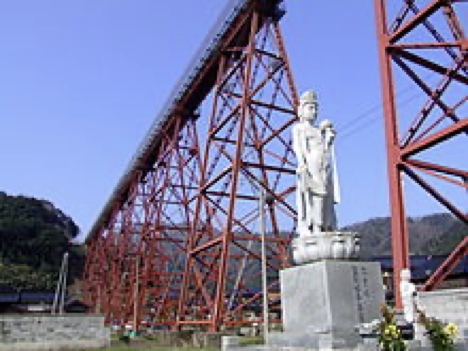
Cenotaph under the steel viaduct (Wikipedia)
27 Jul, 2011: Yesterday had been one hell of a long tramp, and at long last, or after the sun dipped into the horizon, with darkness fast falling, I reached the seaside town and station called Amarube. Here, the tent was soon pitched a little way from the towering Amarube Takkyo, a railway bridge or viaduct. After the Tokan Tunnel, the Amarube Takkyo viaduct was believed to be the most difficult construction project along the San’in Main Line, in more ways than one. “On December 28, 1986 around 1:25 pm, an out-of-service Miyabi train traveling from Kasumi Station was caught by strong winds from the Sea of Japan, and all seven passenger cars of the train were blown from the bridge, with only a few bogies remaining on the tracks. The locomotive's weight prevented derailment. The cars fell directly below, landing on a fish-processing plant. Five women working at the plant and the train's conductor died in the accident. Five others in the plant and one food-service worker aboard the train were seriously injured” (Wikipedia). Following the disaster, schedule changes to the service have been made, depending on wind conditions. A cenotaph was erected in late-1988, and on 28 December each year, a Buddhist service was held there. The viaduct has remained Japan's largest railway trestle, and has historical value as an early railway structure. The original steel trestle bridge first opened in 1912, but like all great and not so great things in Japan, its days were numbered, before it was finally replaced with this spectacular reinforced concrete structure in late-2010. Still, a section of the spectacular old railway viaduct that was opened in the final year of the Meiji period (1912), stands along side new one. It was a cloudy morning when I dragged myself from a sound sleep. Still, I was in no particular hurry, however, I felt that I needed to get a move on if I was to reach the city of Tottori at all. On the road, I needed also to keep an eye out for drinking water, for there was only a quarter of a liter remaining. My quest for water was soon answered. Less that a kilometer from Amarube in the Mikata District of Hyōgo, a freshwater source suddenly came into view. The icy cold water spouted out of the side of a steep pine tree covered side of the mountain. As I needed, of course, to boil the water first before even thinking of drinking it. This was also a good time to make a cup of tea. The mountain also blocked out any clear view of the sea-beams that had previously danced about on the road below. Experience told me to expect another long hard slog up and over the mountain pass, before I reached what looked like near the coastline again. In time I found myself back on Route 178 again. The road led me through Kaminourayama, Angetsuzan, Kutoyama, and Rentaiyama, a beautiful mountain-range. The king of the mountains in this region of Tottori, where I was headed, was Mount Daizan, some 1,729-meters tall. Like Hyōgo, Tottori was blessed with nature, sand, sea, and mountains. Halfway up the mountain, stood an old Buddhist temple, called, Daisen-ji, established there since the Heian period. To climb the mountain was strictly prohibited, without accompanied by one of the monks from the temple, until the Edo period.
(Wikipedia)
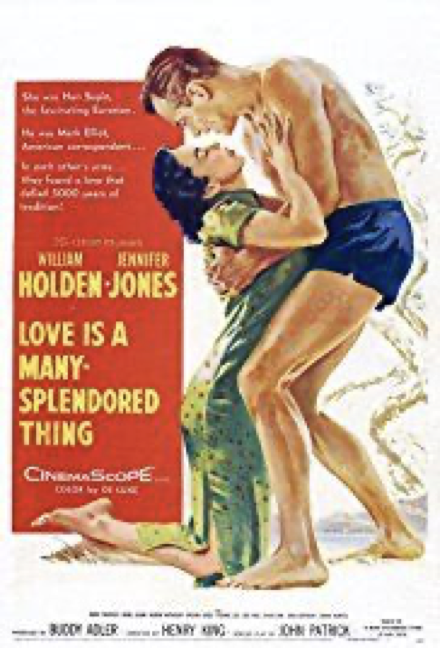
Just as I was sitting and waiting for the freshwater to boil, a butterfly suddenly fluttered over to where I set, and landed momentarily on the top of one of my walking boots. The boots were removed and placed on the ground just inches away. After a short while, the butterfly then fluttered around in the air for awhile, and then landed on my open hand that I had extended out towards it. Then, after a couple of seconds, it made its way back to the very same boot. This little occurrence had caused me to recall the beautiful 1955 film, ‘Love is a Many Splendored Thing’, and being one of my favorite films, I had watched the DVD of it many times before. The film stared my favorite actor, William Holden, and co-stared, Jennifer Jones. Holden played an American war correspondent, Mark Elliott, who was stationed in Hong Kong. Whilst Jennifer Jones, played the role of the Eurasian doctor Han Suyin, who worked at a hospital there. The plot had it, that Mark Elliott was separated from his wife, and that they were not on friendly terms. Doctor Suyin, on the other hand, was the widow of a Nationalist general, killed by Communists in the Chinese Civil War. Needless to say, it was a love story with cultural and personal difficulties, not made any the easier by their growing love for each other. This included the pressure they faced from family and friends, against their cross-cultural relationship. There were two beautiful scenes in the film involving butterflies! In one scene, a butterfly lands on his shoulder, when Elliott and Suyin are together on the Peek. She tells him not to move, for it is a sign of good luck in Chinese mythology. In the second scene, a butterfly comes to rest on typewriter, where he is assigned to cover the Korean War that had just broken out. The Victoria Peak in Hong Kong and the sole tree that grew on it, plays a key part of the story. As a young man, many years go (1980), and long before I ever heard of the classic film, about four0-weeks in Hong Kong. Around that time, I climbed the 552-meter high peak, and even touched the tree that played an important part in the film. Of course, I was not aware of the location or the trees significance at the time, or not until many years later. For the less active people, there was the Peak Tram, a 120-year-old funicular railway, which opened in 1888. Many years ago, the original foreign residents on the peak, were carried up and down, like royalty, on sedan chairs. Easy accessibility to the peak has attracted prominent foreign residents for many years to look at the panoramic view it offered. It was also the location of the Hong kong Governor’s summer residence, built in 1868, which was also marked the start to the Meiji Restoration. Residency today on the peak continues to be based on wealth. The Peak was also home to many species of birds, in particular to the black kite. Interestingly the peak is also home to various species of butterflies. Sadly, however, the tree in question was no longer there. The butterfly continued resting on my boot, but I knew that the time had come to part. And so, with a gentle tap of my boot, the butterfly fluttered away, leaving me to ponder over what form the good luck would take. The silence was also broken across the way, where a farmer had started cutting the overgrowth on the edges of his rice paddy.
The road led my past the Toukan Railway Tunnel. The tunnel ran for 1,922-meters, making it the longest such tunnel in the San’in Kaigan central area. Not that I gave a damn about tunnels, and hoped that I would not face any more long ones. Soon I found myself tramping past the Kutani-Hachiman Shinto Shrine,, where visitors came to watch the Zanzaka Dance, or Drum Dance as it was called in English. The dance event took place in mid-September each year, and was dedicated to the shrine, if not the old chestnut trees nearby. Not to forget the abundance of camellia flowers, which graced this delightful shrine enclosure. Much depended on the species, the camellia, for example, had been known to grow as much as six-meters in height. A nearby sign told me that I was standing next to the secret tree, sakaki, a flowering evergreen tree, native to the warmer parts of Japan. Being evergreen was said to be a symbol of immortality. "Mmm!" If only that was true!" The sakaki was also the Shinto’s holy tree, but there was no satisfactory answer as to why that was so. In ritual offerings to the Shinto kami, branches of sakaki were decorated with washi-paper streamers to make tamagushi. In English, tamagushi literally meant, ‘jewel-skewer’. The grounds of many, if not most, Shinto shrines were home to ancient giant trees, called 'yorishiro'. In the past, such trees were believed to attract a kami, or god. Once that happened, it becomes a 'shintai'. A large thick rope, called a 'shimenawa', was then placed around the sacred tree. The word, 'yashiro' meant 'sacred place', in English. Such ancient trees were said to be connected to the birth of the shrine.s themselves. The translation of the word also meant, ‘grove' that may imply the shinto shrines were established in groves. Today, many shrines still boasted the original great yorishiro trees, with sacred rope around them. However this was more because of association, rather that housed some out of this world god. Further along the Anami coastline I passed many andesitic lava and pyroclastic rock formations that made up the small islands. This was similar to the Shiroshima and Meota-iwa Islands. The Hanazuru Cave was located nearby, was also worth stopping at for a wee peek. The majestic Anami coastline, with its steep natural rocky formations, ran for a good 110 kilometers, and was registered as part of the World Geological Park Network.The road would lead me past Ryujindo on the water, a beautiful cave exploring spot along the coast, popular with kayakers. It was a beautiful scenic stretch of coastline, that was called “Tottori’s Matsushima.” Just as I was jotting down a few entrees into my notebook about the surrounding area, a car pulled over and stopped. A young man, smiling from ear to ear, got out and walked over towards me. Without saying a single word, he raised his camera and took a photo of me. With my notebook open and the pen still in my hand, I glance up at him. Then, just as quickly as he had appeared, the young man turned around and walked back to his car, the engine left idling. Just was I got to my feet to say something, the car door shut, and the car drove off. “Mmm!” The Japanese would never fail to amaze me, I thought to myself, as I stuffed my things into the backpack, and hit the road again.