2017年12月

Irishman Walking (Stage 6 Chapter 7) Summer 2011

IMGP1620

Irishman Walking (Stage 6 Chapter 7) is about my walking the main and coastal roads of Japan. Summer 2011.


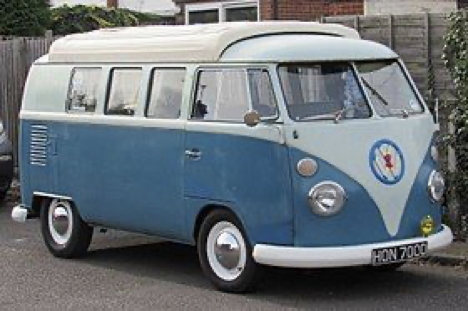
13 Aug, 2011: A narrow road that wound through the tree covered hills and past paddy fields and an old farm house, at last led me back onto Route 191. The blinding sun seemed to rise earlier than usual, but whether it did or not, it certainly heated the sand and anyone who stood barefooted on it. A road sign told me that Shimonoseki, Nagato, and Hagi were 121, 43, and 17-kilometers away, respectively. It felt good to have Hagi City behind me early in the day, for with Hagi done and dusted, the homeward stretch should soon be well within sight. So I could not wait to get started! Not long after stepping back onto the road, I was stopped by a foreign sounding voice calling after me. On glancing off to the left, my eyes caught sight of an attractive looking Caucasian woman in her 30s. She was standing next to a large camper van. A Japanese man who sat at the wheel waved to me as I drew near. “We were heading towards Hagi and wondered if we could give you a lift.” The woman said, smiling at me, as I loosened the straps of the backpack, and quickly dropping it down by my feet. Just as I was about to relate a little of my story to her, the man walked around the van to join us. “Thank you for stopping!” I said, smiling back at them. “But I really need to walk!” I then quickly filled them in on my mission, and added that it was a seasonal thing, different stages along the main and coastal roads around Japan. “What? On foot? No buses or trains?” The woman appeared pleasantly surprised at my words. “This is my husband!” We shook hands, bowing a little at the same time. “It is so hot! The man said, pointing towards the van. “Why don’t you sit inside the van with the air-conditioner on, for a while? We have fruit!” She said. “Thank you! That sounds very nice!” I replied, and added that I often stopped to escape the sun for a spell! Soon we were inside the cozy cabin sitting at a table. Looking about me, I was very impressed with what I saw. It was the near opposite to what I was doing, with a backpack and tent, and I could not help feeling impressed, if not a little envious. What a great way to travel with the person you loved. It was the sort of travel that I had never even though about when I was once a happily married man. But now I was single and my backpack and tent was the best I could do. Such fitted out, self-propelled vehicles for transport, sleeping and living in, were by no means cheap. In fact, the vans were quite an investment since they needed to be looked after. All of this added to the longterm cost of having one. The small kitchens were fitted with battery or gas-powered  refrigerators, and cookers, or even or even electric powered, depending on the date ad model. There was also a dual-voltage powered lighting system, and so on. All of which came at a cost in more ways than one. Some of the camper vans came fitted with pop-up roofs, too, which I thought was a handy invention. I once heard an old saying that went something like this: ‘You could sleep in your car, but you couldn’t drive your house.’ It came from a time in America when people became more mobile-free When people could get away from the confines of their daily life, and head off into the distance and beyond, for a while. 


This was the birth of the American love for the automobile. It was a newfangled invention that proved love at first sight. It was only a matter of time when some bright spark would come along, in 1908, and introduce his new invention, the ’dry-land yacht’. One chap called, Roy A. Faye of Cambridge in Massachusetts, built a 'dry-land yacht' from a Matheson touring car. By the time he finished, automobile had four-fold down bunks inside the cabin. It also featured “extra batteries for lighting, extensive storage compartments,” and a 4.27-meter long canvas tent that was “sewn into the hood for use as a shelter, under which he and his friends” prepared and ate, after a day of hunting in the woods of Maine (automobilemag.com). Needless to say, other auto-camping achievements soon followed. Depending on the location in the world, the camper vans went by various interchangeable names, such as, campers, motorhomes, caravanettes, recreational vehicles, or RVs as they were commonly referred to in the United States, or Dormobile in the United Kingdom, and Kombi in Australia, and so forth. On my travels around the world, I guess the Classic Volkswagen Camper was one such vehicle that often came to mind. In fact, Volkswagen manufactured several types of camper vans over the years. None was more famous that the first generation version called the Volkswagen Type 2 with its split windscreen was manufactured from early-1950 to late-1967. Thanks to many vans, the Type 2 also went by different names, Microbus, Split-screen, and Splittie, if not others that I was not aware of. My wee unexpected encounter with this delightful couple turned out to be a rather informative one. They happily told me about their camper van, and that it had been built in Germany. Tami told me that the camper suited her just fine, for her American roots could be traced back to Germany. It was kind of like part of the family, especially since they had no children, nor had any plans along those lines. They both loved the outdoors, which included camping and all the rest that went with it. They mentioned that they were not being big spenders on lives necessities, so to speak. However, the camper van proved a good investment for them. For them, it was like putting your money were your mouth was, like, use it to do something you really enjoyed doing. Soon a cup of cold Japanese tea was placed on the table in front of me, together with the jug to help myself to more, which I gladly did. I think the jug was empty when I did finally take my leave. We talked mainly about the road ahead, and where I hoped to reach by evening, providing all went according to plans. As we talked, Yoshihiro cut away at a couple of oranges, which where soon placed in front of me to eat. Under the circumstances, it was not a good idea to appear like a greedy pig, even when they told me to eat everything, which I could very easily have done. After all, the sun was baking down outside the cool camper-van. There was one thing one was sure of after tramping the road, and that was building up an appetite. A few slices of cool fresh fruit, as if out of the blue, was like the cherry on the cake, or something to kill the hunger pangs for a while.
 

Unknown


Volkswagen Type 2 (Wikipedia)


Before hitting the road again, Tami presented me with two little packets of Pocari Sweat and Gatorade sports drink powder, and Yoshihiro placed two small cakes in a little plastic bag, which he handed to me. “The sugar should do you good on the road later on!” He told me. The serious expression on his face told me that he really meant it. They also presented me with a good bit of information about the road ahead of me, for which I was more than happy to get. “Sugar! Yes, it certainly will! Just dandy for when I stopped later on, to make a cup of tea, or coffee." I replied. "Thank you both for your kindness!” I added, as I stooped down to grab hold of the backpack. Sadly, such encounters were, mathematically few and far between. Being on the road for long distances was very much a lonely life. The kindness that Tami and her husband, Yoshihiro, was very much appreciated, and cheered me up no ends. It had been two chance encounters in as many days. “Mmm!” Perhaps I was on a roll, I thought to myself, as I looked up the road ahead of me. Or was it just wishful thinking? Such chance encounters did not mean that other nice surprises awaited me, but had more to do with fate, luck, or just good timing. A glance up at the nearly clear light blue sky told me another story, for heavy clouds away on the horizon were approaching. After a while there was a phone call from my friend, Riko, back in Tokyo. She told me about a ferry from Shimonoseki to Kokura City, an ancient castle town, and where I hoped to wrap up this stage of my mission. Nothing was completely decided! If all went well, or I did conclude this stage of my mission at Kokura, then I would have to return again this coming winter, so as to start off on Route 7. “What! Just ¥200 Yen for the ticket? Are you joking?” “No, I’m not joking! It’s really ¥200 Yen!” She replied, laughing loudly over the phone. I then told Riko that there was no better way than to round off this stage with a wee ferry ride across the Straits of Shimonoseki to Kyushu. The ferries also connected Kokura with Matsuyamaon on the island of Shikoku, and on to Busan in Korea. She agreed with me, and we also decided to meet up in Kokura for a few days to celebrate the successful conclusion of Stage 6. My friend had told me that it would do her good, too, to get away from the hustle and bustle of activity, noise, and work in Tokyo, at least for a short while. Of course, I knew how she felt, for getting away from the city life was also a great way of slowing life up and winding things down. In Tokyo in the evenings, I liked to relax with a glass of red wine while watching a classic film, of which I had many DVDs. “Don’t forget to bring your laptop!” I told her, adding that she might try and rent a couple of DVDs. Not long after tramping into Hagi City, I could not resist stopping at a Gusto family restaurant, where I ordered my first cooked lunch since leaving Tokyo in mid-July. The Indian curry dish that I chose at the restaurant, proved to be absolutely delicious. “Mmm!” Or did the curry just seem that way since I was almost literally starving? Either way, the food proved a good thing, for the next 10-kilometers that I covered along the way after leaving the place hardly created a sweat.


14 Aug, 2011: There had been a number of times on the road when I felt like as if I was getting nowhere. Or that I was not walking fast enough! Such feelings often came on the boring stretches of road, where the gray tarmac road curved this way and then that way, through pine tree cover hills and steep mountain passes. My feelings were not helped any when the sun blazed down on top of me. Like hiking, mountain climbing itself was an increasingly popular activity in Japan. Healthy as it was like many outdoor activities and sports, it was also not as cheap as one might hope. Often it required good equipment, training, and for those who really put their heart into it over a period of time, experience, too. Falling was perhaps the most obvious of dangers, therefore, it would be advisable to not do it alone. There were similar dangers on the road, where I had tripped and taken a tumble for it. This was not helped any, for the heavy backpack that I carried at the time. Fortunately, the many mountain passes that I found myself tramping up and over were not as high, mountain climbers faced. Nor did I experience the same sort of affects that climbers succumbed to on very high mountains, dizziness, fatigue, nausea, a shortage of breath, or vision problems, and so on. However, I found on the mountain passes on a hot day, the sun really had its way with me. I found that its was possible to get bad sunburn, even on cloudy days. Of course, exposure to the sunlight was good in helping the body to heal wounds, and for producing bone strengthening vitamin D, but I still found it more harmful than beneficial. Enjoying a drive in an open car or riding a large motorbike, such steep and winding roads might even be considered enjoyable, especially feeling the cool breeze on the face, and please to the mind. The tourist coaches, too, were many, including cars filled with family members off to visit relatives in their respective hometowns. This was Obon time in Japan, a three day long festival that usually started on 15 August.  However the start-date can vary depending on the region. This was especially so, when the Gregorian calendar replaced the lunar calendar at the start of the Meiji period. Obon has been celebrated in Japan for more than 500-years, and many dress in colorful kimonos and perform a traditional dance, called Bon-Odori. Obon is mainly a combined Buddhist-Confusion custom to honor the spirits of the ancestors. Since the Meiji period, however, the custom has slowly evolved more towards being a family reunion, perhaps the only time in the year that allows a chance for everybody to get together. It is also a time when family members will pay a visit to both pray at and to clean the family grave. It has also long been believed that that spirits of their ancestors with pay a visit the family altars and homes. “Mmm!” How does that workout if the families have moved away? Either way, the road was becoming busier than before. That was when I was feeling a bit depressed about not getting along as quickly as I hoped. With the sun dipping down behind the trees, I decided to make camp at a place called, Higashi-Hagi-Eki, a local JR West train station located on the eastern part of Hagi City in Yamaguchi prefecture.

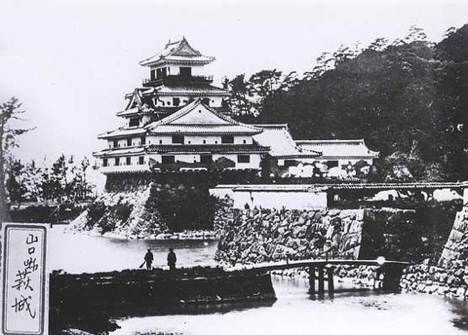
Camp was also a little ways from a road sign that reminded me that I was not many kilometers from the seaside town of Sanmi, and nearer to Abu River, which might have been a better place to have set up camp. The long Abu River split into both the Hashimoto River and the Matsumoto River as it flowed nearer the Nihon Kai coast. At was on the river delta, surrounded on three sides by mountains that Hagi began to take shape as a flourishing castle town. Hagi Castle was later dismantled in the Meiji period, and today its ruins can be seen in the Shizukiyama Park nearby. In more recent times, this beautiful coastline had been designated as the North Nagato Quasi-National Park. Annoyingly, Hagi City beyond the river was taking me longer to get to than I had hoped. But I was in no mood to push on, for I needed to get some writing done, before things faded from my mind. When morning came, it was back onto the road, which soon wound upwards, curving one way and then the other as it went. At the top, the road dipped steeply downward taking me through Kasuri Pass. On the downward segment of the mountain road, I passed through three tunnels. The iron nameplates told me that two o the tunnels were built in Showa 39, and Showa 41, 1964 and 1966, respectively. For some reason, the other tunnel was without a nameplate, but I surmised it was opened to the public around the same period. The Japanese economic miracle soared from the 1950s through the 1970s, a time when the country’s infrastructure was a targeted for improvement. By the 1960s, Japan had become the world's second largest economy, behind America. (Currently Japan had the third largest economy, behind the US and China). Just as the Japanese economy was souring in those days, my own childhood grades in primary school were barely getting off the ground. Just past Nijokubo, another tunnel showed its ugly face. Fortunately for me, the Toyohara Tunnel was only 176-meters long, which was the maximum length that I hoped all tunnels to be. Wishful thinking! That said, I no longer gave a damn about the length of tunnels I came to, for after what I had faced on the coast road south of Otaru in Hokkaido, nothing really bothered me anymore. This was all the more meaningful, as long as the weather was favorable and the kilometers fell away like dominoes. One thing that really got under my skin was arriving at places, especially at restaurants, which had not longed closed for the evening. Another was when I stopped along the road somewhere to take a short nap, only to wake up after two hours, if not more. Both happened today! Then again, I was not feeling my usual self. Today however, I did not feel angry with myself, for my progress on the road had been exceptionally good. The road took me past the train stations of Sammi, Ii, Nagato-Mitsumi, and Nagatoshi almost without noticed them. Now I could feel that I was very much on the homeward stretch. Shimonoseki was just 80-kilometers away, and I was well ahead of my schedule with time to spare. Just on the outskirts of Nagato, I stopped by at a large shopping complex where I hoped to quickly wash a few clothes in the gents. 

Unknown-4


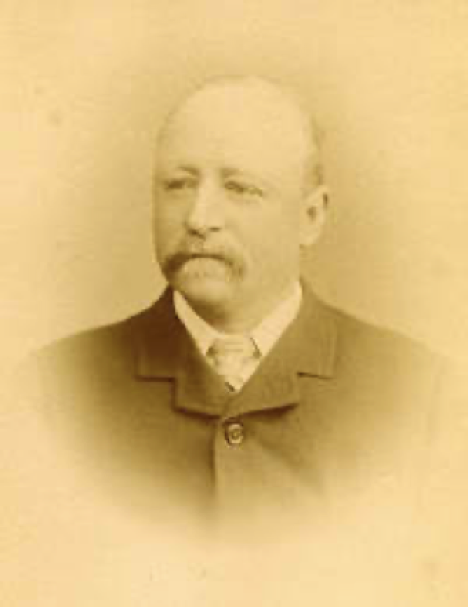
Richard Henry Brunton (1941-1901)


Once that was done, I made my way towards a family restaurant called ‘Donto’, where I ordered a cool noodle, egg and vegetable dish in sweet vinegar sauce, called Hiyashi chūka.  Hiyashi chūka was a good choice, at least it did the job, as I felt more than ready for the road again. The Nagato region, and city was a rather busy place. Nagato was awarded city status in early-1954. Today the city has a population of around 35,000 inhabitants. But that did not matter one bit to me, for all that I could think of was reaching Kyushu. The final segment of my tramp would take me past Tsunoshima Island away to my right, located on the Nihon Kai, on the northwest region of Yamaguchi prefecture. It was a  small island with a lot of coastline, some 4.1-square-kilometers of land mass, with 17.1-kilometers of it on the sea. The Island, which consisted mainly of basalt, was made part of the Kita-Nagato Kaigan Quasi-National Park in late-2008. As of 2008, Tsunoshima had a population of a little more than 900 inhabitants, and was also a part of Shimonoseki City, where I was headed. For a while I found myself toying with the idea of stopping by at the island, after all I had the time to pay it a visit. After all, I loved history and the Tsunoshima was teaming with it. Tsunoshima Island was joined to Honshu by the 1,780-meter long Tsunoshimao Bridge. When the bridge was completed in the Millennium, it was the longest toll free bridge in Japan. That was until the Kouri-bashi in Okinawa prefecture, opened in 2005. The bridge spanned a total of 1,960-meters, from Kouri Island at Nakijin village to Yagaji Island at Nago city, with its longest span some 80-meters. On the northern side of Island stands an old Tsunoshima Lighthouse that was first lit on 1 March, 1876, in the eighth year of the Meiji Government. The lighthouse was designed by the Scotsman, Richard Henry Brunton, who had been invited my the young government to construct lighthouses around the county to assist in the safety of the coastal waters and increase in shipping, since Japan had now opened up to the West. “Mmm!” For a moment I wondered if whales collided with ships in those days, like, what happened in Herman Melville’s epic work of fiction, ‘Moby Dick’?  After all, a whale species known as Balaenoptera omurai. or more simply, Omura’s whale, was first identified in waters around Tsunoshima Island. The Western-style lighthouses were affectionally called, Brunton’s “children”, of which 26 had been designed in the Western style, and built over a period of seven and a half years. One of these light houses was built in the Ota area of Tokyo, not overly far from Shinjuku, where I lived. The Haneda Lighthouse, as it was called, was first lit on 15 March, 1875, but is now extinguished. Brunton himself was referred to as, “The Father of Japanese Lighthouses”. Most of his lighthouses were in the Tokyo Bay area. He also had a hand in numerous other projects during his time in Japan -- bridges, waterworks, and the harbor at Yokohama.

There was even a small statue of Brunton in Yokohama Park, which he helped in designing. He also helped found Japan's first school of civil engineering", in 1871. Brunton was received by Emperor Meiji in recognition of his work, in 1871.


Brunton was believed to have left Japan, in March, 1876, after a disagreement he had with a number of Japanese officials. "Mmm!" I momentarily wondered what lack of correspondence it was, that caused him to undertake such an action? "An obituary published in the journal of the Institution of Civil Engineers states "in ten years he had he executed 50 lighthouses" (Wikipedia). Brunton died on 23 April, 1901, almost exactly three-months after Queen Victoria's death.His body was buried at a 'garden cemetery', in London, a style of cemetery popular during the mid-nineteenth-century. Cemeteries of this kind were "due to the overcrowding and health concerns of urban cemeteries. They were typically built one to five miles outside of the city, far enough to be separated from the city but close enough for visitors. They often contain elaborate monuments, memorials, and mausoleums in a landscaped park-like setting" In addition, Brunton's "marble memorial there was restored by Yokohama Chamber of Commerce in 1991 (Wikipedia). "Mmm!" I wondered how the big man would have thought about such an act of kindness from the Japanese, if indeed that was what it was? Japan had a very long history when it came to lighthouses. The lighthouse was a kind of road-sign to the ocean. The idea of the lighthouses dated back to about 1,200 years. Around that time, the 'Noroshi' (signal torches) and the 'Kagaribi', (bonfires), burned during the daytime and evening, respectively. Such fires were said to have burned along the islands of Kyoshu. Today, there were around 67-lighthouses that dated to the Meiji period, still in operation, in Japan, many of which were now historically symbolic to the area. That was at a time when the country turned towards modernization. One lighthouse that Bruton built, remained a telling symbol of Tsunoshima, an island that was first mentioned in wooden carvings as early as the Nara period (710-794), which were uncovered at the site of the Heijo Place. At that time, the palace was the imperial residence in the Japanese capital city of Heijo-kyo, called Nara today. The Island also appears in the oldest existing collection of Japanese poetry to date.The Man'yōshū was written sometime after AD 759, and literally means "Collection of Ten Thousand Leaves”.  A collection of poetry that contained both philosophical themes that exerted a strong sentimental appeal to the readers. In addiction to other early written records, the Island became developed over the years, particularly for its farming and fishing. It was noted for its sesame seeds and for its beef, as well as, for the production of rice-stray that formed the core of tatami matting, a flooring material once commonly used in Japanese homes, though much less so these days. During the Edo period (1603-1868, Tsunoshima was ruled by the Chofu Domain, and later by the Choshu Domain in 1718, before being returned to its previous rulers, after only five-years. Long before the Pacific War began, Tsunoshima housed an Imperial Japanese Army military base, part of which still remains today. Tsunoshima was merged with Shimonoseki City in 2005. Whether I visited Tsunoshima Island or not, there was another part of me that kept telling me to push on for Shimonoseki. It was not easy to make up my mind! 


One of the things that depressed me, was that I lost my glasses a little distance before crossing into Nagato. A few days before that, the right arm of my glasses had loosened, eventfully dropping off, so I was not exactly in the best of moods.A sudden gust of wind had blown the glasses off my face and landed in a small river a couple of meters away to my right. So I found myself dropping the backpack and climbing over a fence and down a slop to retrieve them, but with no luck. They were definitely lost!As luck had it, there was a ¥100 Yen ship in the shopping complex and it was there that I was able to pick up a replacement of sorts with the suitable range. Gradually, I found myself feeling positive again, for I was lucky it had not been my reading glasses there were lost, for I really relied on them for writing a readying, especially under a flashlight in the tent in the evenings. Wearing a pair of glasses that cost ¥100 yen, was a real climbdown from the sort of money that I had over the years paid to an opticians in the Matsuya Department Store in Ginza. I had gone to that shop almost every other year for close to three decades. “Mmm!” Something told me that my life somehow about to change. Change was the natural course of history, so why not enjoy the ride. Just as I left the store and headed down to where I had left my gear to get ready for hitting the road once again, one hell of a rainstorm began to fall. There was also the sound of thunder away off in the distance. A glance at a clock on a wall told me that it was approaching six o’clock, not late, but the dark sky made it appear later than it was.Through the windows,  I could see that the clouds had become so dark and heavy. Naturally,  began to wonder if the rain would bucket down for the rest of the evening? "Mmm!" I even started to wonder if the time I had spent at the store had been a good idea? The hints of depression began to return, as I made my way towards the main entrance where I had left the backpack. Rather than hang around the busy shopping complex any longer, I grabbed my backpack and headed out the door and into the heavy wind and rain. The region enjoyed a humid subtropical climate, with exceptionally hot summers, with August being the hottest month. The average precipitation for the month of August, was somewhere around 127-millimeters. After only five-minutes on the road, and from where I bought the glass, I came to closed up store building,  which offered a good shelter. At first I planned only to jot down some road-notes into my notebook, but looking about me, I soon decided that it was a good place to pitch the tent, too. Besides, it was getting late, and I was not pushed for time. This was in the center of Nagato City, on the corner of two rather busy main roads. After an hour had passed, and god knows how many passing cars later, the wind and rain stopped, and the clouds in the sky began to open up. The warmth that came with the bright light from the opening blue sky, began to dry up the ground around. “Mmm!” Looking about me, I began to wonder if pitching the tent in this noisy place had been a good idea? “Fuck it!” I mumbled to myself. “Fuck it! There was no point in pushing on now! For once, time was on my side.


A little while before reaching the Nagato region, I stopped to rest outside a little local shop run by an elderly couple. While chatting a while with the man, I learned that he was 78 and I surmised his wife was not far behind him in age. Clearly the shop had seen better days, for now it appeared rundown, with little on the shelves to entice customers into it. Still, I entered in through the door for a looks-see! “Hello! Do you have beer?” I called out, quickly glancing about me, for I could see no one. “Beer? Yes, we do have!”  An elderly woman was sitting on a stool behind the counter just at the entrance. “Mmm!” I was not sure why I had not noticed her when I entered. Perhaps it was because she was partially hidden by an array of stuff pilled on the little counter. “Oh! Good!” I said, smiling back at her, and following her gaze to an old glass doored cooler at the back of the shop. Behind the frosty haze of the glass I could make out a few small cans of Asahi beer. “Fuck it!” I mumbled to myself under my breath, knowing that she could not understand had she heard me. I was just about to head back out onto the road and under the hot sun, when I caught sight of a lone bottle of Asahi in the far corner or the cooler. “Ha! Good! That will do!” I said, sliding open the door and taking the bottle out. Asahi was not my favorite of Japanese beers, but cold bottle felt good in my hands. Perhaps because it was only bottle of beer left was why I felt akin with it. After paying for the beer, I asked the woman if she would kindly pop it open for me, but she could not find a bottle-opener. Soon the woman’s husband appeared to help her look for one. “Never mind!” I said, telling them that I had one somewhere in my backpack outside. Just as I was leaving the little shop, with a hope finding a shade to sit under, too, enjoy the beer, also thought entered my head. Perhaps I should give the elderly couple a copy of one of the last newspaper articles that I had left in the backpack. They might be interested in what I was up to in their country. After getting the copy of the article, I returned to the shop and gave it to the man! “Read this when you have time!” I said, handing it to him, and heading back outside again to drink the beer, before it became warm. It was so hot outside, that nothing stayed wet nor cold for long. When I was halfway through my beer, the woman came outside carrying two tiny cakes, which she handed to me. “Eat them later on!” She said, smiling down at me. Of course, I thanked her from my heart for the unexpected show of kindness. She also gave me a small hand towel, which I know would come in handy. It was the sort of towel the Japanese often gave as little gifts at New Year times. Usually they had a print of the zodiac animal that symbolized a particular Chinese Lunar New Years. My own family often bought more of the towel than they had people to give them to. Even if this was the middle of August, it was a good chance for the woman to give one away, which I was happy to receive. At least, there was an interesting looking print of a Tiger on the towel that she gave me. “Benri!” She said, as she handed the towel to me! She could not have been more correct, for I would make good use of it. Soon the husband, too, appeared and stood like an old soldier next to where I was sitting on the ground. 


Rightly or wrongly, I felt that he had some respect for what I was trying to achieve, but found it hard to express his feelings to me in words. Between a series of deep breaths, the man was clearly searching for the right words to say. Perhaps his difficulty in finding the most appropriate, if not polite, words to say, had something to do with his poor health. Of course, I did not have the foggiest, but it was a wee bit strange for him to come outside and stand next to me gently grunting and puffing. Especially as we had just chatted freely a little while before, without any problems. Even then it had been the usual gauntlet of questions, which I was more than happy to answer. Then again, it was usually the elderly people that asked such questions, before they asked anything else. “Well sir!” I said, in an attempt to get him to say something. “This is Obon time! Will your family be stopping by?” I asked, with a bit of a shy smile on my face. “Oh! Yes!” He replied, as if suddenly awoken from important thought. “Actually, they all live quite nearby!” He told me, in a voice that seemed more polite than before. “I suppose we will pay them a visit!” He added, this time with a smile. “I guess you are lucky that your family are all close by!” By now the roads were really busy at this time of the year, and I had from time to time found myself walking faster than some of the cars on the road. I was not sure how long I set in the shade, in no big hurry to finish the beer, but it was a close to an hour. The elderly couple kept me company outside the shop for much of that time, but fortunately they did not seem to be much bothered by the heart. Whenever I did finally get to my feet and be on my way again, it was not until I had a display of bowing and waving from them, not to mention repeated “thank you” rom me, before I was able to get on my way. And even then, I found myself stopping a few times along the road to look back and wave to them both, which they returned again with a series of waves and bows. Even when the road at last took me out of sight, it was not easy to erase the elderly couple from my heart and mind. The time was a little after nice o’clock in the evening, when I penned the last of some road-notes into my battered note-book, when my attention was drawn towards a set of traffic lights some distance away. A group of bōsōzoku motorcycle gangs, had stopped at the lights and were bent on raving up the engines of their customized motorbikes, like there was no tomorrow. Back in Tokyo, I recalled, such riffraff, never stopped at the traffic lights, but often sped on past them at great danger to themselves and others. The word, bōsōzoku in English meant, ‘violent speed tribes’. Often, too, of course, the police cars that pursued them were just as bad when it came to making noise, if not danger. Either way, it seemed a little strange  to me that the bōsōzoku bothered at all to stop at the traffic lights at all. Soon the traffic lights changed to green and the motorbikes moved off, raving away as they went. “Mmm!” For a while I wondered if they were from Nagato region, or just visiting like many of the other people I noticed on the road along my way. Route 191 was the main road that went through the town that I was headed towards, so I had a funny feeling that I would see, and hear, them again.
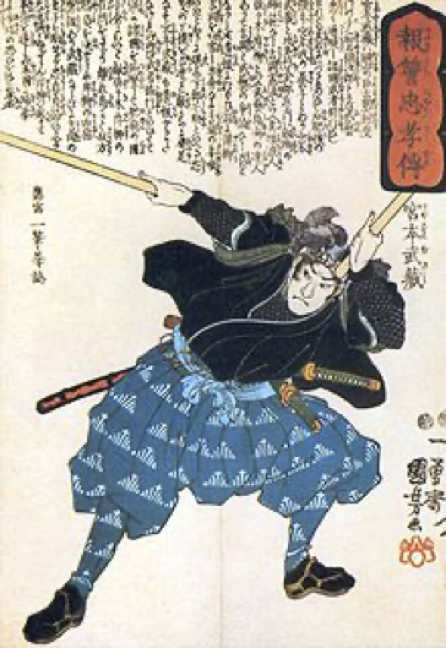

Unknown-5


Woodblock print showing Miyamoto Musashi in his prime, 

by Utagawa Kuniyoshi (Wikipedia)


15 Aug, 2011: It felt more than good to be up and a way brisk and early, at 07:10, even with only a few nuts and pieces of dry fruit inside of me for breakfast. That said, I had not been on the road for more than 10 minuses when my eyes fell on a Joyfull family restaurant a few 100-meters up ahead. “Fuck it!” I swear, as I drew near, for the place was open 24-hours a day. Soon I was sitting at a table inside the restaurant, where I settled on one of the morning services. And which I might add, was rather reminded me of to what might be called, an English breakfast, fried egg, with the greasy trimmings of sausage and bacon, also toast, and tea, even if it was a wee bit on the small size. Going over my schedule, I discovered that I had four-days to get to Shimonoseki and take the ferry to Kokura, where I had planned to visit and stop a while before returning to Tokyo. Much earlier, the noted samurai, Musashi Miyamoto, resided a while at  Kokura Castle. That was during the Edo period from1603 to the start of the Meiji period in 1868. In his prime, Miyamoto was an excellent swordsman unique for his use of two swords. Perhaps best remembered as author of ‘The Book of Five Rings’ in his later years. During the Meiji period, Kokura became the seat of government for Kokura prefecture, and was given city status in 1900. At the close of the Pacific War, the city of Kukura was allotted as a backup target, and as a main target for both of the atomic bombs, “Little Boy” (6 August), and “Fat Man” (9 August), but because of diverse weather conditions, history told otherwise. According to a road sign, Shimonoseki was just 80-kilometers away. If all goes well, like no more heavy down pours, the homeward stretch should be a piece of cake.However, the morning sky was very heavy with what looked like rain clouds. Then again, providing it did not rain, it was a great sky for walking under, sunless. It was just as well that I stopped in at this restaurant, for with a hearty breakfast inside of me, I was more than ready for kicking up dust. A good few years ago, I used to fly over to Tokyo at erm break during my university days in Belfast and in London. Then I loved stopping by at the family restaurants. This was more for the bottomless cups of coffee or tea, than for the actual food on offer. In those days, I used to drink cup after cup of coffee while reading a book, or going over some of the my school assignments that I had taken with me. There was often soothing background music, too, that I liked to listen to during moments of contemplation. Sadly, nothing remains the same, and since then change came in all shapes and sizes. Like the saying goes, time waited for no one, so you had to make the most of it. Therefore, my life was kind of like, hop on the bus or be left behind, with a mixture of go with the flow, and so on. Just as I had finished jotting down some road-notes into my notebook, before I forgot some things, the weather had changed for the worst. The rain had still not fallen, but rather that stop at the restaurant longer, I felt it was better to get a move on. As I was making my way over to the cash register to pay the bill, Acker Bilk’s ‘Stranger on the Shore’ came from the over head speakers. Every time I heard this beautiful 1962 instrumental hit tune, it carried my back. Mainly warm memories of my grandmother, in Belfast, came flooding back to me. 


It was hard not to think about just of great my childhood was in those days. “Mmm!” It was such a relaxing sound, with Mr. Acker Bilk playing that tune on the clarinet, whether it made me think about things of importance or not. Sometimes the tune would come on the radio, when our grandmother would get my sister Anna and me up in the morning for school. Often in the warm sunny days, we would take the shortcut across the fields and around the edge of the bog meadows to school. But to keep your clothes clean, we never did that when the ground was wet. We never used umbrellas back in our youthful days, or at least the children on our street never had such a luxury. Sticking close to the pavement, we always ran to school whether there was rain, sleet, or snow. There was always a kiss on the cheek as we stepped out across the doorstep. The many times we would stop and wave back at her, until we turned the corner at the end of the street. How I miss her endless love. “Mmm!” If only I could see her now, for I have so much I want to say! Sadly, noting lasts for ever! Just as I had set my tired butt down on the ground to rest a spell, the cellphone rang. It was a call from Emi, a home economics teacher I met at one of the schools we both used to teach at about 10-years earlier. We kept in touch ever since. A couple of years ago, Emi had asked me if I would teach her English conversation, but I recall that I was too busy at the time to do so. Emi was at an age in her life when her children were grownup and living away from home, and foremost on her mind was to travel overseas, and to dust the things that she had left on the shelf for so many years. She also mentioned on the phone that she had just returned from a trip she had made to England and to Scotland. She added that she was not able to communicate well, nor understand much of what people said to her, especially so in Scotland. It was a trip that she had carefully planned for sometime, and one of the purposes of going oversea was to see if it would help her English any. Now, in an authoritative, but always polite tone of voice, Emi again asked me if I would teach her English. She felt that with a good grasp of spoken English ability, one could not go far wrong. I could not recall exactly what I replied to her at the time, but I agreed to become her tutor for a while, and that we could work out some times and dates whenever I got back to Tokyo. She was a little surprised to learn that I was still on the road when she called, and apologized, to which I told her not to mind. The last time we met was at a Spanish restaurant, near Ueno in Tokyo. Among the things we talked about at that time, was about my mission of walking around Japan. I also remember how she suddenly laughed when I told her. She said that I was strange, or something to that effect. Of course, I did not mind, for I understood her quite well. I was also aware that travel meant different things to different people, and for Emi it had to include good food and good hotels. My friend had added that she could not fathom walking further than the next street, and could not understand why someone could want to undertake such a massively uncomfortable task. I did not attempt to explain my reasons to her, for I was not quite sure of them myself. We got along well, and that was what mattered most. 

Unknown-2


During the call, I told Emi that my original plan was to be back in Tokyo before the Obon holidays, but unforeseen circumstances dictated an alternative date. Being on road during Obon was literally a pain in the arse. Everything and everyplace was so busy with people. The number of times when I had hoped to spend a night or two at a hotel in some town or city only to discover that all the hotels were fully booked through the holidays. The roads, restaurants, and shops, were likes busy with life. No one enjoyed being caught up in a traffic jam, but it did not seem to bother the Japanese. Therefore, it was easier and wiser to get back to Tokyo before Obon ended, but that was not to be. My second plan, was to continue tramping the roads, and then return after Obon had well and truly ended. I also told her that I had stopped to rest a while, but would start again after the call, and that I was just 65-kilometers away from my goal, Shimonoseki. Again, she laughed, not fully understanding why I was putting my body through such a challenge. “Wonderful!” she replied, then promising to call me again soon and tell me about her time to London, and a few words of encouragement, she hung up. The weather had been a mixture of heavy downpours and dry hot spells. Whenever the rain did fall, it came suddenly catching me out in the middle of nowhere, thoroughly drenching me, if not all my gear. Therefore, it had become a habit each morning to make sure that the rain gear was kept close to the top of the backpack and easy to get at. Sometimes the rain was so heavy that I was fairly soaked even before I managed to get covered up. And if the rain continued for some length of time, even the rain gear failed to be of any use, for the sweat left me soaked just as much. I never really got used to the rain, but as long as it did not slow me down too much, it was tolerable, especially if it stayed warm. There was nothing worse than being held up somewhere waiting for the rain to stop, or conditions to improve. Similarly, I was not quite sure which I disliked the most, the tramping through the heavy rain or being out under the hot sun. Both were annoyingly depressing to say the least. I had countless disappointing experiences with rainwear, which was not exactly cheap, either. More the result of trail and error, I found that the lightweight outer cover of my old army tent proved a great help at keeping dry. Therefore, the tent outer cover doubled in protective importance, to cover the tent in the evenings, and to cover myself and backpack when on the road in the rain. Of course, this was all the more so when I got the timing right. There were a few times, too, when I used the outer cover to cover my naked body when changing into swimming trunks. So I guess it had become one of the most important parts of my camping gear. Needless to say, there was little need for humble chivalry when the beaches were near empty of life. There was a time quite recently, when the outer cover again acted nicely to screen me from the passing motorists up on the busy road. I had been dying to go to the toilet, and found myself needing to stop and dig a little hole near a cluster of pine trees. Cover or no cover, stopping to piss against a tree, or taking a dump behind a bush, was still regarded as backward and an unenlightened immoral practice. In a word, uncouth!  Regardless, on the road, there was no getting away from it, for often there was no other practical means.


16 Aug, 2011: The second day of the Obon holidays began with heavy rain hammering into the sides of the tent. The rain fell for most of the night, saturating just about everywhere around place. Camp was made at a place called Hohoku, and on a side road a little ways off the busy Route 191, which I hoped to rejoin as soon as I got going. At first sight, it appeared like a good place to stop the night at. It was just a few minutes walk from a Lawson convenience store, located on the corner of the two roads. Being near a minor road, I felt it was less frequented by traffic, and therefore  not so noisy. This turned out to be little more than wishful thinking! A lot of the cars, I noticed, left the main drag, and turned onto the minor road pacing by the tent. Whether this was an attempt to avoid the slow moving holiday traffic on Route 191, I had no idea. Regardless of the reasons, the minor road proved just as noisy as the falling rain, at least until midnight when the traffic lessoned. A young Japanese man around collage age also arrived and camped nearby. He was riding a mamachari, the sort of bike that played a principle role in the lives of mothers and housewives in Japan, especially for carrying their children about on, including the heavy shopping. The mamachari was a good way to understand the relationship between the Japanese and bikes. It was not the first time I had stopped and spoke to young men, and women, who rode such contraptions on long distance journeys, loaded up with camping gear. For a while I even wondered why they did not use a proper road bike. Surely it would have been easier to ride for hours on the roads, and with more gears for the mountain passes that they were likely to face. These days, a good road bike could be picked up at reasonable prices. Also,  I used to think that having the proper gear was half to achieving success. When I thought back about our little encounter, I regretted not having asked him why he was using that particular type of bike.  The young man did tell me that he was cycling from Kumamoro in Kyushu, where he lived, to Tokyo. The journey, he told me, was for no particular reason, other than the venture in it. “Mmm!” It was a good way to see about of his country, too, I thought to myself. The young man did not have any relatives, nor friends in the big metropolis to call on, and was sorry that I could not help him. It was easy to see that he did not carry much gear with him. He mentioned that when he was short of water, he preferred to knock on people’s doors, for to have his bottles filled. Like myself, he seldom bought mineral water at convenience stores. After taking the customary photos, wishing each other well, we shook hands, then parted in our different directions. For a while I continued to think about why a good number of young people I had seen doing my the summer stages of my mission rode mamachari kind of bicycles as opposed to something more suitable for long distance journeys. “Mmm!” Perhaps it was something a main character had done on a popular film they had watched at a cinema. The Japanese had a successful history of being influenced by, or copying others. Then again, any bike was better than no bike.
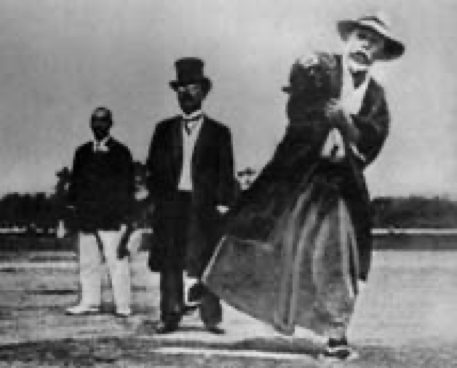

Unknown-16


The first National High School Baseball Championship Ceremonial First Pitch, August 18, 1915 (Wikipedia)


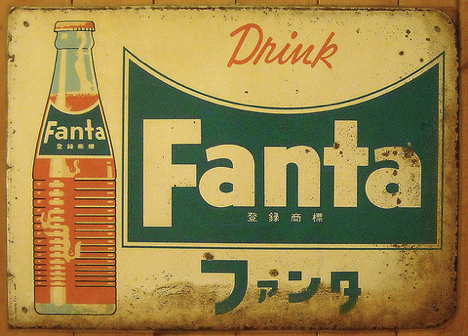
The early morning sky that had been heavy with clouds, which thankfully kept the sun way from me, began to break apart.  Within an hour, there seemed not a single shade to anywhere. For a short while, I stopped by at an old abandoned house, and set down a while under one of the trees in the neglected garden. For added shelter from the rays of the sun, I decided to open up the beach umbrella, too. Just then, two middle-aged women passed by, but not a word was uttered. Perhaps the sight of my backpack placed against a rock told them all they needed to know. My tramp along the road was slow, but steady. Soon I was blessed with the beautiful sight of the coastline, including thoughts of the warm salty water running over my body the first chance I got. It was unlike me to spend money on the beverages from vending machines.  It would be a lie to say that I was tempted. Vending machines were impossible to escape, and I had passed so many of them along my way. They even had the damn things on Mount Fuji, where I heard the cost for a drink was around ¥500 Yen. Earlier on I had stopped at a shop where I bought a two-liter bottle of Fanta. In fact, Fanta Orange was the first ever such beverage that I drank when I was a young child in Belfast, and I still recall quite liking it. Then again, what young child would pass up on the chance of having a sugary drink? Today, the plastic PET-bottles, typically used to store all kinds of liquids, have become part of a world pollution without a solution problem. They can even be found washed up on isolated islands. One can only wonder at how many beaches were ruined by PET bottle, and plastic at large, which must surely be a clear violation of international law. Once I recall using lots that I picked up along the beach I camped on to start my campfire with. Baring the dark smoke, the polyethylene terephthalate that the bottles were made from burned really well. One of the reasons why I loathed the Obon holidays, was that just about everywhere was closed up. Most of the restaurants I passed by were closed for the holidays. At last, I arrived in the town of Yutama, where a restaurant called Imarichiya was open. At the restaurant I ordered its katsudon dish, and a bottle of Asahi ‘Dry’ beer to wash it down. The television was on at full volume. A National High School Baseball Championship game was being played. This annual nationwide high school baseball tournament was commonly referred to as the ‘Summer Koshien’, and this was the 93rd event. For yours, I thought baseball was introduced to Japan by American soldiers after the Pacific War. Clearly I was wrong! It surprised me somewhat to learn that an American man called Horace Wilson (1843-1927), introduced baseball to Japan during the Meiji period. This was because he felt that his students needed more physical exercise. The first baseball game was organized at the Yokohama Country and Athletic Club, by another American called Albert Bates, in 1873. This was followed by the first formal baseball club, the Shinbashi Athletic Club Athletics, being established in 1878. Wilson was posthumously elected to membership in the Japanese Baseball hall of Fame in 2003. During their time in Japan, both men worked as university teachers. 


Today, baseball was the most popular participatory and spectator sport, in Japan. Even though I had spent a good 11-years of my aimless life living here in there, in America, I never once got into professional baseball at all, not even for a minute. Only when I came to Japan in the early days, I liked to watch the odd high school baseball game on the old box, when the chance allowed. In could be argued, that baseball was very much part and parcel of the Japanese culture, because of the two men. It was the last eight teams in the summer tournament. Nichidai-Sanko was leading 4-0 when I left to continue my long walk towards Shimonoseki. Later, I would learn from the television NHK news that Nichidai-san went on to defeat Kosei Gakuin 11-0 in the final. Although my body felt stronger for the food, I also felt a little tired! “Mmm!” Perhaps it was just as well that my goal was now well within reach, I told myself, felling a sense of accomplishment. The roads since starting out from Obama in Fukui were quite dangerous. Even when the coast looked clear, one single car seemed to speed out of nowhere. That was exactly what happened when I crossed the road earlier to the restaurant. Usually, motorists slowed down when they saw me, which of course I greatly appreciated. However, this motorist took it upon him or herself, to bump the car horn like the world was about to end. Actually, it was the  first time on this stage of my mission that someone bumped the horn at me. Bumping of car horns were very common in urban centers, places of tension and stress. Life in a busy place can create enormous tensions, which were usually contained, but never really resolved. Unfortunately, many people carried built up tensions and stress wherever they went.  In short, people had to be concerned with their health. This was particularly true with young people, perhaps new to the workforce, and who had not yet established their own financial security. Since the Bubble burst, t was no longer so easy to land a potentially good full-time job like it once was. Many were forced to accept the practical reality of part-time employment, such as, at convenience stores, and at other futureless jobs. Of course, it was hoped that this was a temperature phenomenon, rather than a permanent condition. It was never easy running when carrying a heavy backpack, especially after having already trumped 25-kilometers that day. The car did not seem as if it was going to slow down and let me cross, but came speeding towards me. There was no time to think, but to make haste and get my arse to the other side of the road the best I could. Besides, what if the person at the wheel had been drinking? After all, it was that time of the year, when people took more chances than they might normally do. One thing I should remember about this stage of my mission was how busy the roads had been, even before the Obon holidays. Not only that, but how so many drivers sped along at great speed. No doubt, this was a time in the year that made the owners of hotels and inns, not to mention restaurants and gasoline stations, happy for the thriving trade. In the case of the hotels, there was not a room left to be had. 


Actually, I could not keep from swearing to myself, as I listened to my friend in Tokyo telling me on the phone of the difficulty oat finding a hotel room. “Fuck it! To hell with it!” What must have sounded like sarcasm, I told my friend that I could just move on. There was noting else to do, but to stay on track and narrow the distance towards my goal. It was only during those times when I made camp on a beach somewhere did I feel some sort of reward. There was noting like cuddling up in my tent at night, nor like the sound of the rolling waves as the water splashed against the rocks. “Fuck the warm beds, the hot baths, and the cooked breakfasts!” For now I felt so free and surrounded by nature, away from tension and stress. On of the best medicines one could wish for was getting away from the maddening crowds, if only for a brief period. There was nothing on earth better than living for a while in the heart of nature and surrounded with pure fresh air, the wild flowers and shrubbery. The sweet fragrance that springs from the countless plants, and the chirping of the birds high in the trees. The individuals whose lifework was spent doing something that they really loved deserved respect, if not envy. Surely those who worked with nature were blessed. Now there was a job! Being paid for spading and digging the soil, planting seeds, cutting hedges, trimming plants and trees, and the countless other outdoor tasks to be performed. The time that I was near the sea was not often enough. Only too often, the road wound inland through mountain passes, taking me away from the salty waters for hours on end. And now, just about on the eve of my final steps to Shimonoseki, a city that I had planned to conclude this stage from the outset. Strangely, I found myself wanting to burst out laughing, like in a fit of madness. Not only did I love nature and being alone in, but I missed certain times and people, too. Alone on the roads gave me a great deal of pleasure, hardship, and satisfaction. However, one thing about this mission of mine that at times leaves me with an element of regret and sorrow, was that it kept me away from people who were important in my life. If only there was more of the vast stretches of open coastline, for the mighty sea to accompany me along my way. Beautiful or not, I found the inland pine tree clad roads so boring. Each time when I tramped over the mountain passes, I longed for them to end, and the reappearance of the sea. Often without luck, I would find myself making camp, and  spending the remaining hours in an intimidating but extremely beautiful environment, often trying to shut my eyes and mind, to the boredom outside. The mountain passes, of course, had more than a fair share of natural beauty. Often on them, I would stop momentarily to look at the beautiful beaches far below, and at grasslands that teemed with wildlife. There was everything that any nature lover loved. The vastness of these pine tree clad hikes gave a sense perspective, if not to remind me that there was more to existence than the daily grind. Still, the experience of tramping up and over the mountain passes was incomplete without a possible visit to the coastline, a pathway that would lead me down to the warm salty waters, where I might enjoy a dip for a while.


17 Aug, 2011: The sky was heavy with dark gray clouds when I stuck my head out of the tent flaps to look about me. There was no time to waste making something to eat, nor even boiling water for tea, for fear of it raining at any moment. At the convenience store nearby, I bought two hamburgers. The food was nothing to write home about at these places, but the hot water from one of the thermos flasks on hand for the customers to use, was greatly appreciated. After dropping a tea bag into my little plastic cup, breakfast was ready. Just as I set down outside the store to eat, a dump truck pulled into the carpark and stopped a few meters away. Everyone inside the truck jumped out, leaving the engine running. That was not the worse of it! A power smell of rotten fish, if not other rubbish, hung about like the clouds in the sky. It was time to get a move on, even if there was absolutely no need for me to hurry. With only 25-kilometers remaining to my goal, with a hotel room reserved for me tomorrow, on the road had more to do with timing, than effort. Bad timing had been a common part of my mission from start to finish. Now I was determined to  play things out in my favor and arrive at my destination, the hotel lobby, at the planned time. Checkin time was usually at three o’clock in the afternoon. How to pace myself on the road until then was easier said than done. Not long after leaving the convenience store carpark, a light drizzle started to fall. Still, something told me that this was going to be a good day. Within a couple of hours the first of a series of road signs told me that I was now 16-kilometers away from Shimonoseki. “Mmm!” Either today, or tomorrow, I would pass through there, I told myself, knowing also that either was the same to me. The hotel that I was booked into stood at the south exit of Kokura on Kyushu Island. In addition to soaking in a hot bath, the short ride on the ferry, was something that I was very much looking forward to. There was something about taking ferries that appealed to me since my youthful days. The first time I ever visited the United Kingdom was in 1969 aboard a ferry bound for Stranraer in Scotland. Stranraer was the closet port, but I recall that it seemed to take all night. Once in Stranraer, we then had to endure the long train journey all the way to Euston in London. Even thought I was to make numbers trips to Belfast, I would spend the next seven-years of my life in London, where I would go to school. In the early-1970s, I well recall a school day-trip we all made on the Dover-Calais ferry that connected England with ' la République franchise'. Exciting as the trip was, I recall, the only thing that really stuck in my mind to this day, was how some of the students found themselves being stopped for shoplifting. Among the little souvenirs many, if not most, of the boys took back with them from the shops, were those little throwaway cigarette lighters, a novelty at that time. The first lighter per se was invented by a German chemist, in 1823. However, the very first truly disposable lighters came on the market, in 1973. They were also the cheapest lighters, which may have made the extremely popular. The disposable lighters remained widely used to this very day. 


Fortunately for me, I never smoked in my life, still, the lighters were rather useful for getting a campfire burning, quickly. Like many of the kinds, I did not have much spending money to spend, either. One of the things that caught my eye at the time, and which I managed to buy, was a little iron bust of Napoleon Bonaparte that was screwed to a tiny marble base. When I lived on the Kowloon Peninsula in Hong Kong, in the early-1980s, I used to travel on the often crowded Star Ferry most days to get to the other side and back. This ferry service had a long history between Hong Kong and Kowloon that dated back to 1888. The ferry vessels continued to transport many million of passengers every year. So it would be hard to imagine what Hong Kong would be without its ferries. I still recall the ferry I took from Harwich-Esbjerg in Denmark in the mid-1980s. My plan at that time was to cycle through Denmark, of course, stopping to visit the Danish author, Hans Christian Andersen’s birthplace on the island of Odense, along my way. I was also dating a nice Danish girl at the time, and planned to stop by at her home for a while. It was while stopping with my friend that I bought a think book of Andersen’s complete works, which still have. Sadly, long distant relationships seldom lasted. (*The ferry route ceased operating in late-2014). There had been so many other ferry journeys since then, some long and some short, but they where great for me in more ways than one. They allowed me the time to read, write, relax, and to simply think about nothing of any importance. A 16-kilometers journey was nothing to me. The real challenge was mind over matter, or whether to march on to Kokura, or stop somewhere short of Shimonoseki and make camp there. Even at a snails pace, I still knew that I needed to make up my mind before the day was out. Like much of the previous day, the road ran parallel with the coastline, and the rolling foamy waves kept my mind occupied, on and off for sometime. In time, I stopped by at a restaurant, where I ordered what the Japanese called, ‘hamburger set’. The hamburger sets were nothing like American hamburgers that came between an open bun, with all the trimmings. In Japan it was more a mincemeat steak served on a plate with a few vegetables, and often with a choice of bread or rice. The later seemed the more appealing. When I finished eating, a cup of hot coffee, part of the set, was placed on the table before me, my thoughts soon turned to the road. After a couple of hours on the road again, I stopped outside a supermarket to rest awhile. It was the first supermarket that I had seen all day. Just as I dropped the backpack to the ground, I noticed an elderly woman walking towards me. “Where from country you come?” She asked me. “From Ireland!” I said, smiling at her. The woman looked puzzled! “Ireland! England is next to Ireland!” I said, attempting to show her by placing my open hands in the air. “This is Ireland and this is England!” I said in Japanese. Most Japanese had some idea of where England was, but much less knew anything about my birthplace, let along country. At least, they knew that Princes Diana came from there. After all, the Princess and had made two visits to Japan, in 1985, and again in 1995. 


The royal visit had created a Diana fever and the Japanese remained big Diana fans until her untimely death in 1997. “Oh! England! You British gentleman! She said with a little giggle, and turned with an air of achievement to make her way towards the entrance of the supermarket. When I arrived at Shimonoseki, I was surprised at how many people I stopped to ask directions, did not know where the ferry port was. The best that two young men working at an Enos gasoline station could do was to refer me the local koban, to ask a policeman. The police box lay about 500-meters along the main drag from the gas station. Rather than bother about asking a police, I stopped by at a local park not a 100-meters in the same direction, where I phoned a friend in Tokyo. Already I had tried calling my friend this last two hours, but without success, so I was starting to feel a little anxious. We had planned to meet! Low and behold, I was happy when the call was at last answered! “Where are you now?” She asked, in her usual air of authority. “For fuck sack! Where are you? I tried calling you many times! Are you okay? I thought maybe you had had an accident!” “Yes! Fine! Just busy! Where are you?” She replied, getting back to the point! “I am standing in the center of Shimonoseki.” I told her, adding that just about everyone I stopped to ask the way to the port did not know. “Everybody?” She replied, then telling me to hang up, and that she would call me back shortly. True to her word, the phone rang after a short spell. I was then told that I needed to get onto Route 250, and that I would find it around the station area. “Just keep your eyes open!” By now my eyes were beginning to feel heavy, and I told my friend that it was getting dark, and that I was toying with the idea of erecting the tent in the local park. Of course, I would need to wait a while until the numbers of people out walking their dogs dwindled away, most likely when the sky darkened, but that would not be anytime soon. My friend told me that if I continued on a bit further, I would find a better place to camp, and nearer to the sea. The advice was well taken, and so I re-shouldered my backpack and stepped back out onto the main drag, which soon led me past the koban, and far beyond to see where it would lead me. Along the way, I caught sight of a Mister Donuts across the road. “What the fuck!” I mumbled to myself, for I knew that this stage of my mission was more or less at an end. Besides, it will not be dark for another couple of hours. For now, I was not so hungry, but I needed to sit down a while and catch up on some writing, and such places were great for doing both. There was a madness about it all! A sense of achievement still had not sunk in. Yet, here I was, a hot cup of coffee and a donut on the table with my opened notebook, pencil in hand. “Mmm! I’ve done it!” Or so the thought came to me.  Getting this far was my aim, and the conclusion of the stage was looking me right in the face. Still, something seemed mad or strange, for my feeling was not one of joy. Already I found myself thinking of the next stage, Stage 7, which of course lingered soon, or just around thee corner. “Fuck it, fuck it, fuck it!” What had I gotten myself into?


What happened in Japan and the world on this day???? 
Irishman Walking (Stage 6 Chapter 6) Summer 2011

IMGP1620

Irishman Walking (Stage 6 Chapter 6) is about my walking the main and coastal roads of Japan. Summer 2011.


8 Aug, 2011: Last night camp was set up a little off the main road, about two or three-kilometers from Ōda City, and just 10-kilometers from the convenience store where I chatted awhile with the young American last night. “Mmm!” 10-kilometers was not so far, but I was still surprised that I had covered so much distance in my condition. When I had started off on the road yesterday morning, my plan was to reach Ōda City by lunchtime today. Ōda City,  located on the coast of the Sea of Japan in Shimane prefecture, north of the Chugoku Mountain range that stretches in an east-west direction for approximately 500-kilometers. Ōda was given city status on 1 January, 1954, it was also home to the Iwami Ginzan Sliver Mine. Once the largest sliver mine in the country’s history, it remained active for almost 400-years, from its discovery in 1526, until in was finally closed in 1923. Now a UNESCO World heritage Site, the mine is a popular tourist destination. Today, Ōda City has a population of more than 34,000 inhabitants. Much of the city’s economy is built around dairy farming and agricultural production. The city is also long known for producing roof tiles. It was at Ōda City that I had hoped to check into a hotel for the night, mainly to soak my tired body in a hot bathtub. Even if I had not been so fortunate with finding a hotel, on the whole, I could not complain about my progress on the road. On the phone last night, a friend had told me that there were about ten business hotels in the small city, but none of them belonged to the famous chain of hotels, like, Dormy Inn, Super Hotel, or Comfort Inn, the sort that I preferred to stop at. So I guess with age, I had become rather conservative, or hardheaded, like my sister Anna once called me. What I really needed was a hotel with free access to the Internet and a PC in the lobby for guests to use. Of course, I had long toyed with the idea of getting my own iPad and WiFi so that I might not be so reliant on others. Hopefully the prices, say around ¥5,000 Yet, included breakfast. This was not so with a number of the less famous business hotels, which were often privately run, and not always so clean, nor had non-smoking rooms. My first stay at the Super Hotel in Yonago City, I still recall, even had bicycles for guests to use free of charge. Anyway, I was not amused to learn from my friend that there was not even one of the famous chain hotels in Ōda City. The cheapest hotel among the business hotels there were in Ōda City, cost ¥6,000 Yen for a single room. The friend also told me that it did not even have a washing machine for guests to use. “Fuck it!” I remembered saying to my friend, Riko, and thanking her for the help, as well as telling her that I would just push on through the city. Of course, this was not what I wanted to do, for my feet were killing me. The Yunotsu Onsen, known for its therapeutic effects, was also located in Ōda City, so it would have been good to stop a while, even if I did loath public baths. Still, the cheapest hotel among the business hotels in the city, cost around ¥6,000 Yen for a single room. The friend also told me that it did not even have a washing machine for guests to use. “Fuck it!” I remembered saying to my friend, Riko, and thanking her for the help, as well as telling her that I would just push on through the city.


This was not what I wanted to do, for my feet were killing me! “Look! I’ll call you again in the morning after 09:00! I shall search about a bit more on the Internet in case I missed something. After the phone call, I lay down on top of the sleeping bag resigned that that was life and I would just have to knuckle down and do the best I can. “Fuck it!” Where the last words I mumbled to myself, and with my eyes feeling drossy, soon I was asleep. The morning sky was very cloudy, but this did not prevent the young sun for making its mark. “Mmm!”  So I was lucky that the building near where I had erected the tent cast out a fair shade. This made it easier than usual to dismantle and roll up and pack away the gear, without being troubled by the piercing rays of the sun. When I did set off along the road again that led me through the countryside, it was with a desire to breath in the pure air. Up ahead, I perceived in the distance a sort of morning mist covered the mountains sides like a carpet. I felt glad that I was not on a mountain pass just now, for the limited visibility to say the least. One good thing I found about being alone on the road was that I was never lost for a wide range of different things to occupy the mind with. One topic that kept entering my head from time to time had something to do with the land and the sea around me. I thought about the Earth, and how there was more oceans than land. And how the oceans were home to mountains and valleys deep below the surface. A number of the mountains, I had read, were taller than Mount Everest. Mountains made up a good 20-percent of the earth. The earth itself could be divided up along a series of lines, for example, 20-percent of the land was covered with snow, another 20-percent was dry land good for growing food, whilst 20-percent was desert, and so forth. Conversely, this was very different from the land of the Rising Sun, where 73-percent was mountainous, and where the population was mainly concentrated on about 27-percent of the land. Therefore, it was impossible for me not to see a mountain in one direction or another through the course of my mission. A little ways off I could make out what looked like a water tap at the side of a disused building, and wondered if the thing worked? It did not take much effort hopping over the fence, and I was happy to see the water gushing from the tap and its coolness running over my hands. Soon I was striped to the waste, giving myself a soapy scrub down. Then I quickly washed the clothes that I had worn yesterday. Of course, not before changing into the few clean clothes that I had taken with me. There was noting like a nice hot cup of tea or coffee, especially after washing and changing into a fresh set of clothes. The road can wait a while longer! Digging into the backpack, however, I soon discovered that I was out of tea, and on the last drip-coffee thingy. The water was already nearly boiled! “Fuck it!” I mumbled to myself, also realizing that I was beginning to find swearing somehow soothing. “I’ll need to see about replenishing my wee stock to stuff the first chance I get.” I told myself, placing the last of the tiny drip-coffee bags into my pocket so as to remind me. Forgetting to do something, was another thing that I was becoming good at.


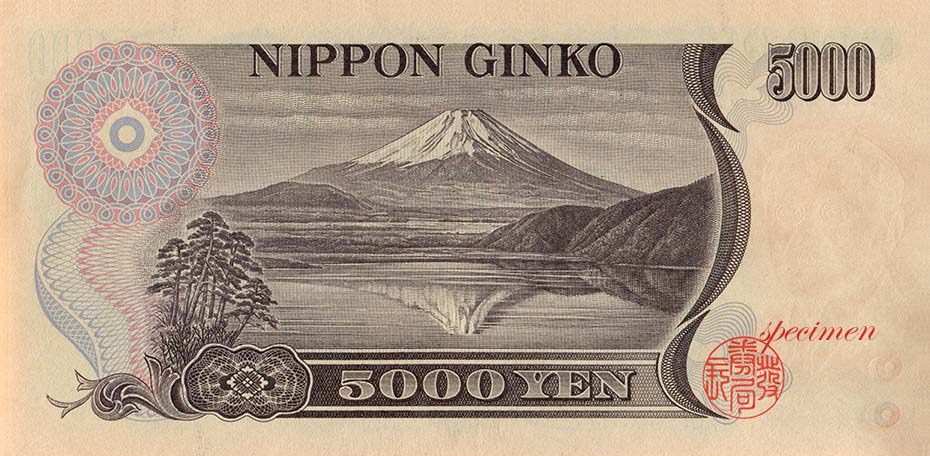
Series_D_5K_Yen_bank_of_japan_note_-_back
 

(Wikipedia)


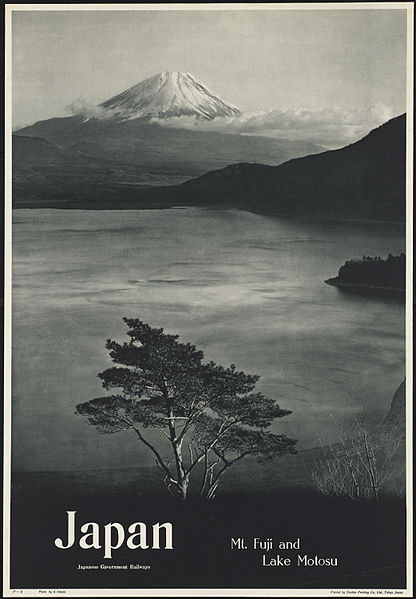
416px-1930s_Japan_Travel_Poster_-_20


A 1930s travel poster that depicted Lake Motosu, the third largest lake in Japan (Wikipedia)


In all honesty, I do not know what I would do without the existence of convenience stores, often popping up whenever I needed something on the spare of the moment. And all the more meaningful whenever they had tables and chairs inside them. It made sense to me, but most of the convenience stores I used or passed by had not gone that far to invest in such luxury. It was at yet another Popular convince store that I stopped by at to pick something up for breakfast, and it did have a couple of tables and some chairs for its customers to sit at. Good! A couple of kilometers earlier, I received a call from my friend in Tokyo. The morning traffic on the road was so busy that I could hardly hear what the friend was telling me. In the carpark at the convenience store, a young Japanese hip-hop group were performing their moves to what I thought was more a loud noise than music from a CD player. “Fuck it!” It was time to get back on the road. The biggest chain of mountains in the world is the Himalayas in Asian, with Mount  Everest being the tallest at about nine-kilometers about sea level. In fact, Everest continues to grow about five-millimeters each year. Often larger deep lakes had formed near high mountains. The same was true with Mount Fuji, one of the three holy mountains of Japan. In fact, there were five lakes in the area of Fujigoko, called Kawagushiko, Saiko, Shojiko, Motosuko, and Yamanakako, at the northern base. Mount Fuji was one of the few large composite volcanoes formed of basalt, in the world. In its long history, Fuji was considered among the more active of volcanos in Japan, with 16 eruptions, since 781 AD. The lakes around Mount Fuji were the result of lava flows that dammed up the rivers. This was caused by eruptions that occurred over three periods, Komitake, Kofuji, and Shinfuji. Mount Fuji erupnioned for the last time during the Edo period. The Hōei eruption, as it was called, happened on Fuji’s east–north-east flank, and lasted for about two weeks, from 16 December, 1707 to 1 January, 1708. However, this eruption brought no lava flow, so the lakes were the result of earlier eruptions. Located in Yamanashi prefecture, Motosuko was the third-largest and deepest of the five lakes near Mount Fuji. Some 121.6-meters deep, it was the ninth-deepest lake in the country. To paraphrase from Wikipedia, the Hōei eruption “released some 800-million-cubic-meters of volcanic ash, which spread over vast areas around the volcano, even reaching Edo almost 100-kilometers away. Cinders and ash fell like rain in Izu, Kai, Sagami, and Musashi provinces. In Edo, the volcanic ash was several centimeters thick. Interestingly, Motosuko, Saiko, and Shojiko remain connected through underground waterways. The three lakes were 900-meters above sea level. Fujigoko was known for its resort area, a great place for hiking, camping, picnicking, and fishing in the summer months, and snow sports in the wintertime; the hot springs and  museums, as well as many other places of interest. Over the years, high mountains around the world, which included Mount Fuji, attracted countless numbers of tourists every year. This was a great source of income for the local economies. Mount Fuji in particular had become one of the most popular trekking destinations, not just with Japanese, but with international visitors, too.


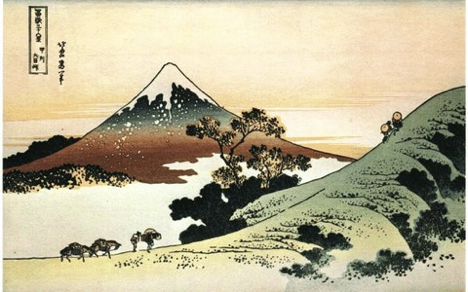
Unknown-25


Mount Fuji in the sunset, by Katsushita Hokusa


That said, I do not believe most of the mountains I walked around and over, were very high. The landscape itself had not seemed to change much since I cycled around the country more than three decades earlier. In part because of the hand of man, nature changed areas slowly, if not taken for granted by the average Joe Public. On the road all day long, however, I noticed more change than perhaps was good for me. Quite a few of the old main roads no longer existed, segments had fallen into the sea, or abandoned and left to the powers of nature. Sometimes it proved a mistake to get on to these old abandoned roads, and sometimes it was not. In was at such places where few people ventured, that I really had a feeling of being with nature. At long last in an isolated space where I could remove myself from a wider life. Kind of like an empty room to think about other things. Of course, the wind was forever doing its work, like, dispersing seeds over the surrounding areas. Following the rain, came the wild plants and flowers, and like the years before, they filled the meadows I tramped past. Each time, I found myself pausing momentarily to take in the scenic view, and each time it was with the belief that I was witness to a many splendored thing. The forests were perhaps the most important places on Earth, particularly rainforests. Yet, it saddens me no ends that so many people out there did not share this view. And why not? Each year, thousands of square-kilometers were destroyed, not to mention the disappearance of plants and animals, too, gone forever. Much of this had something to do with money and greed. Around one-percent of all rainforests in the world was lost to this greed. The trees were cut down and the wood is sold to rich countries, like America and Japan. Japan placed great importance on its own forests, where few trees are cut done for commercial purposes. About 40-percent of the wood taken from the world’s rainforests these days, ended up in Japan. Ōda City was not very far behind me, when the road wound upwards through a tree covered mountain pass. On the downward segment of the pass, I stopped again to take the magnificent view of the Nihon Kai down below. At various points along the way, it appeared as if the road was going to run right into the sea. Apart from a number of scenic spots, Route 9 proved to be a rather boring road to be on. On the downward segment of the road, I was able to cut off the road and make my way down to the sea. I missed the feeling of the foamy cold tide running over my feet. Such moments of bliss were long in coming, and without fail, the pain in the bottom of my right foot had just about vanished. That was the magic of the salty bath! Back on the road again, Route 9, wound upwards through a forest of rich green pine trees. After a while, the road turned further inland, leaving the sea far behind. The only thing that remained unchanged was the constant flow of traffic along the mountain road. Therefore, this was no time for letting the mind wander, but keep my wits about me. For once, the timing could not have been better! Just as I stopped at a bus stop hut to take a rest, a brief rain shower began to fall. “Mmm!” If only this would cool things down a little, I thought to myself, as I watched the water bounced off the asphalt.


9 Aug, 2011: Since hitting the road after leaving Ōda City yesterday, I must have tramped through 10 tunnels. Some of the tunnels were longer than 500-meters, but not one of them had pavements to its name. Come to think of it, none to them had an iron nameplates at the entrances either. “Mmm!” From past experience, tunnels without iron nameplates kind of told me that their days were numbered. Camp was made last night at a place called Yunotsu. There was a spa nearby, but then again, there were spas nearby so many places I had camped at. This did not matter much to me, for I loathed even the thought of sharing a hot bathing area with naked men. “Mmm!” With women? Or so the thought momentarily ran through my head, but that might be a different story. Yunotsu is a coastal town in Nima District of Shimane prefecture, with a population of about 4,000 inhabitants. Yunotsu Town was once a port town. That was until the start of the seventeenth-century, when it became an important port for shipping silver which was mined at the ‘Iwami Ginzan Silver Mine’. Today, the town is famous for its many ryokans, and minshukus, and souvenir shops that line the streets, and where visitors are able to  soak up the tranquil atmosphere of this old town. In addition,  there are two public bathhouses, Motoyu and Yakushiyu, in the town that use the local natural sulphur spring water. According to a touristy guide for the area I read earlier, the temperature of the water was so high, it was advisable for guests to enter the bath repeatedly,  and soaking for only short periods at a time. More than 1,300-years ago, to paraphrase the touristy guide, deep in the forest, it is said that a monk came across an injured raccoon that was splashing about in the hot spring water. Seeing how the water seemed to heal the animals wound, the monk became certain that the spring water had therapeutic powers.Today, this raccoon is the symbol of Motoyu Town. Visitors to the town are greeted by a statue of the raccoon at the entrance. Yakushiyu Onsen, with its old retro building, which somewhat a symbol of the town, is not as old as Motoyu Onsen. Its hot spring was created by an earthquake almost 250-years ago. Interestingly, the water at Yakushiyus, changes its color from clear to reddish-brown color upon contact with the air. The color varies by season and by time. “Mmm!” I don not know what I would do without such good touristy guide information. Regardless, I was too tired to think of seeing or doing anything last night. On the road yesterday, the journey had been long, tiring, and mostly tedious, to say the least. Baring the time when the road drew along the sea, and where I stopped to take a dip in for a spell. I had also felt a little surprised at how the water was colder than usual for this time of the year. Still, the salty waters never failed to work its magical wonders on the aches and pains. On the topic of water, just as I had emerged from the last of the gauntlet of tunnels yesterday, the sky opened up, and for the next 10 minuses, one God almighty downpour fell. The sudden rainfall was so heavy that even my somewhat oversized umbrella failed to keep me or my gear dry. Glancing up at the sky this morning, it was hard to imagine that another heavy downpour could repeat itself. 


A road sign told me that Shimonoseki, Masuda, and Hamada, were 222, 72, and 31-kilometers away, respectively. Road signs had been around almost as long as the first roads. The signs had been around since prehistory times. The Roman strategically placed large 'stone columns' in different parts of the Empire, to mark the distances to particular places. Another name for these markers, was 'milestone', and , besides roads. They were often still found by the side of the road, or at boundaries, along canals, or at the side of railway lines. Like the present, many of the old milestones informed the travelers, who stopped by at them, of the distance and direction to the towns that they were headed. In other places, they were also known as, mileposts'', and ‘mile-markers'. There were a couple of reasons for these names. One was that they  were installed at distances of a mile from one another. Alternatively, they showed the distance to the next town, or beyond. A third reason, argued that they marked relevant reference points along the route. One early system of signposts, was called the 'fingerpost', a kind of tall and thin sign with one, or more, arms, which literally, pointed the way a traveler was headed. They were very common in my own country, Ireland, as well as, in the United Kingdom. In fact, the fingerpost signs were the main signs seen in Ireland, up until 1977, and plenty of them were still in use. Often the arms on the signs had forefingers at the end of them, hence, their name. Another typical variation, of many fingerpost signs showed a pointed arrow-like sign, indicated the directions. The earliest fingerposts were made of wood, or cast-iron, and indicated the distances in miles. Since the Roman times, the distance of a mile represented 1,000-paces, or the size of 5,000 feet. Actually, I had come across the fingerposts, on a few occasions, in Japan, but of course, in kilometers, not miles. This was particularly along cyclist and pedestrian paths. The first truly modern road signs were designated for bicycle riders, during the late-1870s and early-1880s. There were a number of reasons for this. The bicycles allowed their riders to cover longer distances in shorter times. The early bicycles were at times not overly easy to control, along unfamiliar routes. In England, during the middle-ages, the old London mile covered a distance of eight-furlongs. The mile was still commonly used in the UK as a measurement of distance. Like present day signposts, the old milestones helped reassure travelers that they were on the right track. They also told them of the distance traveled, and the distance left to cover, as well as, a number of other reasons. Today, traffic signs in many countries were uniformly similar. This was because of am agreement among a number of international conventions. In away, the road signs that I passed along the way, told me that I had done fairly well, or badly, on the road yesterday. It also felt good that things seemed to be coming together and closing down nicely! The progress on the road, and a short chat with my daughter, Anna, on the phone, cheered me up no ends. “Be careful to drink lots of water!” She told me, before hanging up!


320px-Mash_sign-1


A fingerpost sign that featured in the popular television series, M*A*S:H. Now on display at the Smithsonian (Wikipedia)

Fingerpost roadsign photos???


Once again, Route 9 presented its boring self! That was until my eyes caught sight of not less than 11 windmills, the white colored giants stood majestically away in the distance. Built along the coastline, not one appeared idol, their blades turning. I could also see that a number of them stood high over the sands at Asari-cho, where I toyed with the idea of making camp. However, the road had other ideas. Route 9 seemed to have no intention of heading in the direction of the sea. Instead, the road led me up and through the mountain, past the usual bushes and trees up and down the slopes, though this time accompanied by a never-ending flow of traffic. After a fair while of tramping upwards and around one bend followed by another, I got my first sighting of the sea again, since early yesterday, and where I stopped  momentarily to take a snapshot. Of course, I did not see the road with human-like traits, such as, talking. Still, I could not help but thinking to myself from time to time, as the road turned inwards and upwards, it was trying to tell me something. “Take your eyes off the sea and more focused on the road, for I had not done with you yet.” The road certainly had not done with me, for it continued on and on, and up and up. The road led me thought an old, longish, and pavement-less tunnel, with no iron nameplate at either entrance. The traffic along the road remained heavy, and just as annoying as it was yesterday. No less than thirty oncoming cars, vans, and trucks passed me by in as many seconds. Then again, there was noting wrong with an anthropomorphic road, if it forced me to keep my wits about me. After all, it only took one of those drivers to be preoccupied, say with a smartphone, to turn me into a statistic, a figment of the past, gone, if not forgotten. One thing that I had noticed for quite a stretch along this region of Shimane prefecture was the complete absence of shrines and temples. Not because of anything religious about me, certainly not, rather to lay down awhile under the shade of one of the magnificent quality trees found at such places. Some hours earlier, I had indeed taken a short rest at a little off the road temple. There was not even a single tree to its name, and therefore no cool breeze to help escape from the sun for a while. It was under a narrow shade at the side of the temple building that I spread out the mat to lay down on for comfort. “Mmm!” When I lay down, I remembered wondering it Shimane was the least religious prefecture in Japan? Along the way, there were a hell of a lot of liquor ships and shores that I passed by, or stopped at. Next to getting up after a good nights sleep, there was nothing better for soothing the mind on a hot summers day, than stopping a while to enjoy a nice cool beer. That said, I was I guess a bit harsh with my comments earlier on Shemane Winery. The wine on display for visitors to sample, no doubt worked wonders on the old taste buds. It was just that being out on the road under the scorching sun, it was only natural to want something more full bodied, and which would have left me with fonder memories. Back to the present, another road sign told me that Shimonoseki, Masuda, and Hamada lay some 217, 62, and 21-kilometers away, respectively.


Unknown-26


 Shemane Winery


10 Aug, 2011: It felt good to have Gōtsu City behind me, and to make camp just 10-kilometers short of Hamada City, where I will tramp through before lunchtime. The morning sky over the beach was nearly absent of clouds. Fortunately, the shade from a wall by the roadside cast out a wide shade. The sun was rising quickly, and I only had a short time left to wash myself in the river near by. The river would have flowed into the sea, was it not for the sandbar that damned it. Gōtsu is located on the Shimane prefecture coastline, and is the smallest and least populous city in Shimane, with a population of around 24,000 inhabitants. Not exactly an isolated place, the Super Express Yakumo, on the Sanin Railway Line, stopped at Gōtsu station. Gōtsu was awarded city status on April Fool’s Day, in 1954. On the road my progress seemed good. There was a quick stop at a Lawson convenience store, where I picked up a yoghurt and mixed sandwich for breakfast. What I also needed was a two liter bottle of mineral water, but I noticed that a same sized bottle of ‘Aquarius’, a mineral sports drink concoction, was only ¥20 Yen more, so I decided to buy it instead. Aquarius was first produced by the Coca-Cola Company in 1978, and introduced in Japan in 1983 as a grapefruit-flavored sports beverage. Its competitor, Pocari Sweat, was already a popular sports drink in Japan at that time. (Aquarius had already been the official drink of no less than two Olympics, and was signed up to become the official drink again at the 2016 Summer Olympics in Rio de Janeiro). In time I came to roadworks that were being carried out for a good stretch of the road. This caused me to get onto the road! One of the men, whom I saw directing traffic, came over and led me to the other end of the roadworks, for safety, and to whom I felt grateful. In the distance, a couple of cyclist were approaching from the opposite direction. As they drew near, I could see that they were, like myself, Caucasian. The male cyclist led the way, with the female speeding along close behind. Both bicycles were well loaded up with camping gear, including a little two-wheeled trolley fixed to the man’s bike. Quite a sight to see! Unfortunately, they did not seem to notice me, as they perhaps needed to stay focused for the roadworks and the traffic on the road. Before entering the city of Hamada, the road led me across the winding Shimokogawa River. Located at the southwestern end of the prefecture, Hamada was the third largest city in Shimane. A relatively small city, it has a population of around 57,000 inhabitants. Noted for the beautiful white sandy beaches, Hamada is a popular local tourist destination, particularly in the summer months. As a main commercial port, Hamada is one of the few cities in the region that can accept heavy tonnage vessels. Hamada with a humid subtropical climate, could not have been established at a better location on the eastern seaboard. The city is relatively free of extreme weather conditions, such as, flooding and typhoons, and the occurrence of strong earthquakes are thankfully rare, as it is not located near any of the fault lines. Along my way, I stopped to chat a while with a Japanese cyclist.


The cyclist told me that he was taking a break away from his work as a junior high school mathematics teacher. The man also told me that his school was located in Tokyo, but I did not bother to ask for any details, like, the school’s name or location, and on. The schools that I taught at were also located in Tokyo. However, I was in no mood to share any information that had to do with my work. "Mmm!" Like the man, work was a thing that I also wanted to forget for a while, I told myself. The thought caused me to wonder if the work-time per month, for Japanese teachers, was longer and more stressful than at schools in other countries? What I did know was, the longer the hours a teacher worked, the greater the mental toll was on their health. Or something to do with that thing we called stress. Stress was a big thing in Japan, and a lot of people took drugs to ease the problem. Was the stress the teachers suffered the same or similar at all the different levels of schools -- elementary, junior high, high, and so on? Was the level of stress that the teachers suffered, greater, in any one of the different levels or types of schools? What about the kind of subject -- math, English, geography, or whatever? How about the position held -- principle, vice-principle, or head-teacher? Did the mental health problems caused by their work, affect everybody in the schools -- students, or even the parents? How did teacher's deal with these problems? One morning, a couple of years ago, a Japanese English teacher at one of the schools I taught at, informed me that one of our colleagues, had recently committed suicide. At first, I could not recall the name of the unfortunate teacher. It did come as one hell of a shock, when the teacher who told me the news, described the teacher to me. He had also been a Japanese English teacher, and we had worked together a couple of years earlier. I learned from the young man that he had taken the Shinkansen train from Tokyo to Shim onoseki, his starting point. “How was the ticket?” I asked him, for I was interested in ways and costs for when I returned to Tokyo. He told me that the one-way ticket that he decided on, cost him ¥18,000 Yen. The bike, he said, did not cost  extra, for it was a fold-up type and easy to classify as carryon travel luggage. Before parting company in our opposite directions, we took a couple of snapshots of each other. Then there was the customary sharking of hands and wishing each other the best of wishes on our journeys. Normally I did not give out my email address freely to people I met on the road, but I was interested in how his journey turned out, and also he had take some photos of me with a quality camera, which I wanted him to send me whenever the chance allowed. Just before hitting the road, the young man told me that he had thought that his cycling was a great adventure, but now that he had bumped into me, walking, his mind was blown away with disbelief. Of course, I reassured him that his venture was a great thing worthy of respect, and I wished him all the best from my heart. As with a lot of young Japanese people I had met down through the years, also every word spoken was followed by a tiny burst of laughter.


Like I said earlier, laughter was the best medicine! For a while along my way, I thought about the young man cycling back to his home in Tokyo. Rather than cycling, if he had gone on a long distance walking trip, would that have changed him in anyway? I wondered to myself. Then again, cycling great distances was not for the light hearted either. On the outskirts of Hamada I came to a rather large shopping complex called, ‘Youme’. It was here at the shops that I decided to invest in picking up a new pear of sandals for the road. The old sandals were in such a pitiful condition that a pair of bathroom slippers would have afforded my feet better protection. The American cyclist whom I had chatted to for a while had told me that he had gotten a puncture near here, and had kept the 10-centimeter rusty old nail as a souvenir. The thought of tramping on such a rusty thing sent shivers up my back, as well as the name of a friend of yesteryear. During the summertime in the early-1970s, my sister Anna and me would be packed off on a train to Birmingham in the Midlands to spend the holidays with our Aunt Nellie and Uncle Freddy, and cousins. Whenever I sometimes reminisced about those long gone days, it all really seemed like yesterday. I remembered making friends with a boy next door, called Thomas, and whom I came to know better as Tom. Tom, I recall, was a stocky, good natured boy, who loved to crack jokes, every chance he got. We had got on well together, and I considered it my loss that I did not get to know him better. Nothing lasted forever, and soon the holidays were nearing an end, and I had to return to my school in London! Of course, I could not have fathomed for the life of me that that would be our last meeting. Young people grow up so quickly and other things come into their lives, myself included. That was life! On another school holiday visit to my relatives home in Birmingham, I learned that Tom’s parents that he had left school, and was away somewhere doing a bricklaying apprenticeship. Then a couple of years later, on another summer visit to the city, I learned that he had landed a lucrative bricklaying job in Saudi Arabia, and I recalled feeling pleased for him, even though I also felt a little disappointed at not seeing him at the time. Some years later on yet another visit to my relatives in Birmingham, I remembered stopping into the house next door for a short while, to say hello to Tom’s parents and to ask about him. It was the last day of my visit to Birmingham, and I was scheduled to return to London, and then catch a flight for Tokyo soon after. At the time, I was now living and working in Tokyo. To cut to the chase, I learnt of Tom's death from the parents. They told me that he had stepped on a nail on a building site, were he worked, in Saudi Arabia. Soon after the accident, he returned home to Brimingham, and died a month, or so, later at a hospital there. For a while, I could not understand why my Aunt Nellie, or other relatives for that matter, had not mentioned the bad news to me. Then again, perhaps if they had, I might never have visited Tom’s parents when I did. Much later, I did covered that stepping on a nail was a very common occurrence.


11 Aug, 2011: Similarly, it felt good to get past the city of Hamada, as it did Gotsu City. It was that kind of positive feeling that came with a sense of progress. It was on the outskirts of Hamada-shi or area that I had decided to make camp. An elderly fellow with a large motorbike parked nearby, had also erected his tent as I arrived. The calm water of the Nihon Kai was less than 100-meters away from our tents. However, it was the old story with this God forsaken road, Route 9, so near and yet so far. The San’in Main Line railway line that connected Kyoto and Shimonoseki, ran between our tents. Therefore, it was not possible to get down to the beach. Besides my hope of being close to the sea, the railway line had kept me company on and off for quite a while. The Sanin Main Line in western Japan, was operated by West Japan Railway Company (JR West) was the main railway line of the San’in region. Much of the line ran along the Japan Sea, crossing over to Kyoto, Hyogo, Tottori, Shimane, and Yamaguchi prefectures. The main section of the line running between Kyoto JR Station and Hatabu JR Station was the longest single continuous railway connection in Japan, at 673.8-kilometers. The morning sky was heavy with clouds. It was good, too, that I awoke a little earlier than usual and upper camp when I did, for the rain began to fall. With the gear packed away, I could move off without any setbacks. The rain would fall on and off for much of the day. A study of the maps last night, told me that Masuda City, if not beyond, was a good place to aim for. Masuda was some 30-kilometers from where I had camped. If all went well, I expected to reach there by early evening before the sun went down. With a hot cup of coffee in me, and some almond nuts in my pocket to nibble on along the road, I felt more than ready for the journey. In the early morning at around 02:00, I heard the elderly fellow strapping his gear to the motorbike, the engine starting up, and then the noise died away in the distance. “Mmm!” For a while, I wondered if the sound of the rolling waves had kept him awake. Regardless of the reasons for his early departure, for me, the sound of nature was music to my ears. In the words of the French novelist, Gustave Flaubert (1821-1880), “I tried to discover, in the rumor of forests and waves, words that other men could not hear, and I pricked up my ears to listen to the revelation of their harmony.” At times I surprise myself! There were times on the road when I could tramp along for at least a couple of hours at a time, without the slightest inclination to stop and rest. Not bad considering I was shouldering a heavy backpack into the bargain! Such was how things appeared to be going on the road this morning. It was not until I came to a Popular convenience store, when I decided to make a stop to pick up something to eat, in case I pushed my luck on the road too far without some fuel inside me. The weather was in my favor, for the heavy clouds had blocked out the sun once and for all. Hopefully the sky would remain this way for the remainder of the day. On previous occasions, the stops I made along the way were to escape the scorching sun, not so much to rest. Therefore, I now saw no reason why I could not reach Masuda City well a head of time. 


The roadsigns, too, proved encouraging, for they told me how the kilometers came and went. In time, the first tunnel of the day appeared up ahead of me. Unlike the previous tunnels, including the tiny one I tramped through yesterday, this one had an iron nameplate and a pavement for safety. The tunnel might not have been as old as the others, but I could not be sure. Anyway, might have been completed in 1978, around the time that tunnels were build with pavements, but I was not so sure since I could not see an iron nameplate. Glancing across the carpark from where I set, I saw a rather attractive young girl coming out of the convenience store. Just as she was about to get into her car, I asked her the name of this place. At first she appeared a little puzzled, then with a smile she replied. “Matsuda, I think!” I thank her, and she drove away. Back in the store, I asked the same question to one of the female clerks there, and was told that this was Tsuda, which seemed to make more sense to me. “Mmm!” I guess the girl in the carpark was referring to Masuda-shi or area, and not the city as I first thought. By 11:00 AM, a clear sky began to appear away in the horizon. “Fuck it!” I mumbled to myself, not sure which way the light breeze blew.  It could only be hoped that the clouds would not disperse, but hold firm. Then, at a little before high noon, the sun began to break through the clouds. Soon, the clouds separated even more, and large gaps of the beautiful blue sky could now be seen. It was 12:30 in the afternoon when I tramped into a place called Tsuda, where I made a wee stop for a while to enjoy a nice cool can of lager.The sky above was by now more blue than gray, and more hot than warm. I also knew that my pace would surely be slower from now on, for the pain in my feet and knees was beginning to make itself felt. What mattered now, was to enjoy the beer as I set under a shade that was cast out from the store building. This morning under the heavily clouded sky, the sun was the last thing on my mind. So I could not complain, for I had already more than 20-kilometers under my belt. My progress could not have been better, for just another 10-kilometers, or so, should see me in Masuda, if not past the city once and for all. Matsuda was by no means a large city in Shimane prefecture, on the border of Yamaguchi prefecture. So I was not too concerned about finding my way through it, and beyond. Matsuda had a population of more than 145,000 inhabitants, which had steadily declined in recent years. It was also a city that held onto its ancient past, as well as, its present. It was home to a fair number of museums -- the Iwani Art Museum, the Matsuda History & Folk Museum, and the Sesshu Museum, as well as, a host of temples and shrines. The Sesshu Museum in particular, highlighted the works of Sesshū Tōyō (1420-1506), who was said to be the most prominent ink and wash paintings of his time. In addition to his paintings, Tōyō was also a Rinzai Zen Buddhist priest. Tōyō lived the middle Muromachi period (1336-1573). This was a time of unrest, also known as the Warring States period. It was also a time when Zen Buddhism played a central part of religious practices and teachings, which was greatly influenced by China. 


It was a time that heightened the importance of culture and the growth of art. It was also a time that saw Shintoism sought inroads into the culture. It was a time of the Mongol invasion scare, during the thirteenth-century. This was a time that gave birth to the meaning of the term, divine winds, the kamikaze, that saved the country from invasion. A term that was reawakened, during the Pacific War. Anyway, all that I wanted to think about just now, was the cool can of ‘Sapporo Five Star’, one of the seasonal selections of lagers, as the breweries liked to refer to their products. Sesshū was the head priest at Koji Temple, from 1460 to 1485. During his 25-years at the temple, Sesshū was credited with the design of the temple garden. Visitors today still enjoyed the garden. In more recent times, both the temple and the garden had been designated as a national historic site, and a national scenic beauty site, respectively. Likewise, Sesshu was said to have been responsible for the planning and laying off the garden at Manpukuji Temple, and was designated as a National Scenic Site. The temple itself dated back to 1374, during the short Bunchū era (1372-75). It was a time when an Embassy was opened between Japan and China. It was also a era that fell within the larger Muromachi period, which spanned 1338 to 1573. The temple was later designated as a National Cultural Property. The planning of the garden at Manpukuji Temple, was said to have followed the Muromachi period style. The Muromachi period, was a time that saw a resurgence of Japanese culture and society, from the Middle-Ages to the Early Modern Era. It was a time when the government powers were restored to Kyoto. It was a time when trade relations were established with China, and when improvements in agriculture and economic changes, saw the development of markets, and growth and prosperity of towns, and social classes. It was a time when the first traders (Portuguese), and Jesuit missionaries, stepped ashore, in Kyushu, in 1542. It was a time that introduced firearms and christianity, to Japan. The Someba Ame-no-Iwakatsu Shrine, which dated back to 725, during the Nara period (710-84). It was at a time when Nara became Japan's first permanent capital, before it moved to Nagaoka in ancient Echigo Province, todays Niigata. The capital later relocated to Kyoto, in 794, where it remained for the next 1,000-years. The Nara and Heian periods, was a time that saw the influence from China, decline, and when areas, such as, literature and art, became  more 'Japanized' to better suit the native ways. It was a time that gave birth to the famous tale of Genji, which told of a war between two families of nobility, the Taira (Heike) and the Minamoto (Genji) families. The 'Tale of Genji' was a classic work of Japanese literature written by the noblewoman and lady-in-waiting, Murasaki Shikibu. The current Someba Ame-no-Iwakatsu Shrine building, dated to 1583, during the Azuchi-Momoyama period (1573-1603).  The Azuchi-Momoyama period  was a time that marked the path for the Tokugawa period (1603-1868), and the unification of the country, as well as, the unsuccessful attempt to invade Korea.


Another noted Shinto shrine was, Kakinomoto Shrine, dedicated to Kakinomoto-no-Hitomaro, a poet during the Nara era, who lived about 1,300 years ago. He was said to be the greatest poet of the seventh-century, He was believed to have died in Masuda. Long ago, the shrine was believed to have stood on a small island at the mouth of the Masuda River. But was destroyed in a tsunami, in 1026. Legend had it, that the water carried the statue of Hitomaro, to Matsuzaki, and it was there that the shrine was rebuilt. Later, the shrine was again moved to Takatssu, in 1681, its present location. In honor of the poet, Kakinomoto-no-Hitomaro, successive emperors who visited the shrine, dedicated their own poems in his honor. Kakinomoto no Hitomaro's works appeared in the Manyoshu, Japan's oldest collection of poems. The Hassaku Festival, was held at the shrine, featured the traditional yabusame horseback archery, the shooting of arrows from a galloping horse. Sumiyoshi Taisha was one of Japan's most renowned shrines, was one of approximately 2,300 Sumiyoshi shrines throughout the country. At the start of each year, around two-million visitors stopped at the shrine to pray. Among its numerous cultural properties, where the presence of sacred trees, over 1,000 years old. Like so many of the other shrines and temples, the main shrine hall, was designated as a national treasure. The number of Shinto shrines in Japan was estimated to be 100,000, if not more. That was a lot of deities with their sacred powers. Shinto shrines enshrined one, or more, gods of one repute or another. The deities were housed in the innermost chamber, out of reach and sight from the outside world. Travelers, like myself, could not see the day through, without passing more than one shrine or temple. "Mmm!" Then again, I guess I could say something similar about pubic-houses in Ireland. There were approximately 77,000 Buddhist temples throughout Japan. Like Shintoism, Buddhism was very deeply ingrained in the Japanese culture. It amused me every time I heard that the Japanese did not really believe in a religion, or in a god. On an added note, Ireland boasted more than 7,000 public houses. The pub was a unique and casual part of the Irish culture, at least when I lived in that neck of the woods, some years ago. My father had been a publican for much of his life, and had managed and owned pubs on both sides of the Irish Sea. To paraphrase from Wikipedia: Irish pubs existed for roughly a millennium. The title of the "oldest pub in Ireland" was held by Sean’s Bar in Athlone in County Westmeath, established in the tenth-century. The title of the oldest pub in Dublin, went to ‘The Brazen Head’, established in 1198. The “oldest licensed pub in Ireland”, however, was: Grace Neill’s’ in Donaghadee in County Down. The pub was licensed, in 1611. Somehow I could not imagine an Ireland without pubs. I think if that happened, the natives would leave and search for greener pastures. There were about 58,000 pubs in operation in the United Kingdom. However, every year has seen a large decline in the trade.This was due to a number of reasons — the smoking ban, in 2007, the recession, in 2008, less alcohol consumption, and an increase in taxation, among other things.


12 Aug, 2011: Camp had been made at a little place called, Shiragami, a farming region about five-kilometers west of Masuda. Unfortunately, the town had nothing to do with the more famous Shirakami Mountain range, an area that straddle both Aomori and Akita prefectures. The fauna found in the forest included the Japanese black bear, the Japanese macaque, a goat or antelope-like mammal, called the Japanese serow, as well as 87 species of birds. The Shirakami Mountain range was noted for the trekking and climbing trails through its mystical forest with old beech trees. In fact, Shirakami-Sanchi, which literally means ‘the white god mountain area’ in English, is a wilderness covering one-third of the mountain range. It was also home to the largest remaining virgin beech forest in all of East Asia. The forest is “a remnant of the cool-temperate beech forests that have covered the hills and mountain slopes of northern Japan since 8,000 to 12,000-years ago” (Wikipedia).  This region of the Shirakami Mountain range was included in the list of UNESCO World Heritage Sites in Japan, in 1993. My mistake was to stick firm to Route 9, for which I came to pay the price. The road wound south inland, away from the coastline almost parallel with the Yamaguchi Line. The Yamaguchi Line was operated by West Japan Railway Company, and connected Shin-Yamaguchi Station and Masuda Station in Yamaguchi and Shimane prefectures, respectively. Somehow I missed the turning that would have taken me onto Route 191, and across the 81-kilometer long Takatsu River. The road would led me towards the seaside town of Abu, including Hagi City and beyond. Founded on New Year’s Day, in 1955, the town of Abu is located in the southern part of Abu District in Yamaguchi prefecture, and has a population of around 3,400 inhabitants. The district was home to no less than 13 mountains. Tokonamiyama, Todakeyama,  and Namahirayama, to name a few, were not overly tall mountains, I guess. “Mmm!” Then again, how high was too high? I wondered to myself as I tramped along the road. I suppose it all had something to do with the weight of the backpack or hand-trolley one had with them. Mountains differed on their type, place, and age! The zones at which the plants and trees grew, for example, were basically the same. The broadleaf tress, like, maples, oaks, and poplars grew around the foot of the mountains, Whilst the conifers, such as, pines and spruce could be seen going higher up. Baring the tiny pine plants that grew just below the peaks, little to nothing grew the further up, for the ice and cold winds. The coffee I often stopped along the road to make and enjoy, was harvested from plants that grew on mountainsides in Central and South America, among other places. Hagi City in Yamaguchi prefecture lay further along Route 191 and across the Hashimoto River. Hagi was given city status on 1 July, 1932, and today it has a population of more than 50,000. For me, the city of Hagi was more interesting than Abu. To paraphrase Wikipedia, Hagi was dominated by the Yoshimi clan during the medieval period, and built Hagi Castle at that time. The castle ruins of which can be visited today.


Unknown-27


Main Keep at Hagi Castle, before 1880 (Wikipedia)


The Mori clan became daimyos of Chōshū Domain at the beginning of the Edo period (1603), and relocated Hagi Castle at the foot of Mount Shizuki a few years later, in 1608. The capital of the domain was moved from Hiroshima to Hagi at the same time. Since then, Hagi has developed as the political center of Chōshū for the next 250-years. Hagi gained great historical significance during the early days of the Meiji period (1868). A number of Japanese Prime Ministers and statesmen were born and brought up in this city. Over the years, Hagi has continued to absorb and expand to the city it is today. Thanks to two Korean potters who had been invited to Hagi by Lord Mori Terumoto in 1604, Hagi has become renowned the world over for its Hagi Japanese pottery wear. Tourism remained a strong factor of the town’s local economy. It was not until I had tramped five-kilometers or so from the point that I should have turned, when I set down to look at my maps. Only then did I realize that I was heading in the wrong direction. This was perhaps because I was tired, and my progress on the road was exceptionally good. Often, the old mind often wandered from one useless topic to another. Other than that, I could think of a better reason for my stupidity. This was not the first time that I had found myself heading down the wrong road! For me, taking wrong turnings on the road, was measured in terms of the time lost. Still, it was pointless fretting over it, for like the saying went, ‘a bad workman blamed his mistakes on the tools.’ At least, I did not see myself as “a bad workman”, besides, it was pointless waisting any more time on trying to soften the damage. What was done was done! I just needed to fix things and keep my wits about me in the future. For I while, I wondered why there was no mention of Hagi City on the road signs that I passed by, and even thought that perhaps it was not such an important place. Once my wrong road mistake was realized, I felt furious with myself. It was not important how many times I uttered, “Fuck it, fuck it, fuck it!” Though, I felt a little better for it, as I stopped to recollect my thoughts on what to do next. Not a lover of having to retrace my steps, I set down by the roadside a while so as I could go over my maps, to look for another road that might help me get back on track. Getting no where with the maps, I called into a local shop nearby for help. Thanks to the shopkeeper, I was soon headed in the direction of a minor road  that headed in the direction of the coastline. Of course, providing I did not mess up again and miss it! As things turned out, it was not one road, but a series of little passes that led to the coastal road I was to get onto. Therefore, it was not easy to find the road I needed, and I found myself having to ask a couple of motorists if I was heading in the right direction, for fear that I had passed the road in question. In short, I found myself having to keep an eye out for each of these little roads, for missing them. It was while I was on one of these interesting little passes, that wound through the pine tree covered hills around the Shiragami region, that a fair number of the houses I passed must have been around 100-years old. Old farm houses, with families that had more than likely lived in them for donkeys years.


For a while, it seemed as if I was tramping through a different world. It was at one of these old farm houses that I caught sight of a middle-aged woman watering the flowers in her garden. It was mostly a Japanese-style garden, but clearly there was an element of Western, or British, about it if I was not mistaken. The good old English garden, was a landscaped garden that was first introduced into United Kingdom during the early eighteenth-century, before horticulturalists and gardeners cultivated them in Europe and beyond. There had long been a growing enchantment with Japan even when it was closed to the outside for 300-years. However, about three decades after opening its doors to the outside world in 1854, Japanese arts became the height of fashion.A lot of writings on Japan began to appear in print. This included the first serious description in English of Japanese-style gardens in the late-1870s. Soon the demand for all things Japanese increased. This interest in Japanese gardens was similar in a number of other countries, too. To quote from the Japanese Garden Society Webpage, “The latter part of the nineteenth century saw a series of international exhibitions in Britain, mainland Europe and the United States. It was these exhibitions that were to become the showcase for the Japanese garden in the West. The Japan-British Exhibition of 1910 attracted over eight-million visitors in just a six-month period, with two major gardens constructed to display the skills of Japanese landscapers.” In Ireland, too, a Japanese-style garden had made an appearance. “An exquisite piece of oriental sophistication in the middle of bogland with squalid towns which don’t even boast a public lavatory”. (‘The Counties of Ireland’ by John O’Connor)! “Hello!” The woman, called out as I drew near to her, the sweat pouring off me.”You look tired!” She said, smiling. “Why don’t you stop for a while and rest?”  Before I had a chance to reply, she turned and hurried towards the house. “Let me fetch you some water from the spring.” Tired was the right word! “Water! Thank you!” I called after her, licking my dry lips at the same time. It was interesting how the mind can change almost without warning. For one-minute I was furious with myself at getting lost, or rather for not realizing sooner that I was lost. Thanks to the chance encounter with this delightful woman working in her little English garden, what I night it turned out to be! For I was soon introduced to the rest of the family and offered to spend the night at their home. The woman’s name was Yuki Nakashima! Yuki-san told me that she lived in the old farm house with her 80-year old mother. She was tidying up the garden somewhat since her daughter was visiting the family from her home in Yokohama, for Obon. She told me that the daughter was 30, and worked for Canon Camera. What more could one wish for after a hot shower than a cool can of beer. Later I learned that the elderly mother ran a little shop that sold tobacco, beer, whiskey, and homemade shochu, which I loathed. Shochu was a Japanese distilled drink with less than 45-percent alcohol by volume. Typically shochu was distilled from gome (rice), mugi (barley), satsuma-imo (sweet potatoes), soba (buckwheat), or kokutō (brown sugar).


If I was not mistaken, the alcoholic drink, shōchū, originated from the island of Kyushu, where I was headed. Today, it was produced throughout the country. Not that I gave a damn, one way or another. Like I had penned earlier, I loathed the stuff. Sleep came late, but at least I was able to watch the BBC World News on the television, which had something to do with riots in London. Actually, I do not know what I would do without the BBC, particularly the news via the Internet. In away, it was my only connection with that part of the world, and where I used to live. "Mmm!" Happy times! Before hitting the road, Route 191, to continue my mission in the direction of Kyushu, I was fortunate enough to enjoy a hearty breakfast, followed by a wee dander about the garden. A stop was made at the Nakashima family grave, nearby. Like I mentioned in my notebook on numerous occasions previously, rubbing shoulders with such kind people made my mission along the roads all the more meaningful. Another welcomed surprise this morning was a phone call from a dear old Korean friend of mine, Sabrina, who lived in the Nishi-Nippori area of Tokyo. We first met by chance at the Imperial Hotel in Hibiya in Tokyo in 1982, and remained somewhat close ever since. She was simple worried about me being out on the road in all of this heat. Of course, I reassured her that all was fine on the Western front, and that I promised to see her soon after my return to the capital. When I finally stepped onto Route 191, where I should have been the previous evening, one of the first thoughts to enter my head was relief. It was a sort of relief to finally see the boring Route 9, behind me once and for all. If Route 9 could be said to have a human characteristic about it, then I would say that it was laughing at me. Therefore, I was happy to see the last of it, though it remained on my mind for a fair while afterwards. “Mmm!” What better way for the road to laugh at me than to see me heading off in the wrong direction. Had it not been for Yuki-san’s kindness, I almost surely would have remained depressed for a good while still. At last finding myself on Route 191, I truly felt that I was entering into a new chapter of my life. “Mmm! Surely this road cannot be as boring as Route 9”.  I mumbled to myself, as I tightened the backpack straps about me. As it turned out, the next 10 to 15-kilometers was proved just as boring! That was not the only thing, for I needed to walk through five of six tunnels, which caused unwanted memories of the monster tunnels I tramped through after leaving Otaru in Hokkaido. The tunnels were not new, nor as long as they were south of Otaru, but some of them were close to  2,000-meters from start to finish. The iron nameplates told me that they were built in the early-1970s.  Kakuei Tanaka was the 40th Prime Minister at that time. In fact, Tanaka was strongly identified with the construction industry, even though he never became the construction minister. His government had poured lots of money into rebuilding the Japanese infrastructure, most notably around his hometown, Niigata prefecture. Actually, Tanaka served in the House of Representatives, from late-April, 1947 to late-January, 1990.


The he was the PM for about two and a half years, from mid-1972 to late-1974. Whether people liked Tanaka, or not, he was perhaps one of the most influential politicians that the country had ever produced. In the mid-1970s, Tanaka was charged as accepting $1.8-million dollars, in bribes. This came to be known as the Lockheed Scandal, the outcome of which was a story in itself. After about 15-kilometers of tramping along the road, much of it under the baking sunshine, at long last the road began to turn nearer towards the sea. Needless to say, the sight of the salty water never failed to cheer me up. Stopping to breath in the seaside air, was like bumping into an old friend, who you had not seen for a good while. It was also like rediscovering those moments of peace and calm that had been missing. The new sandals that I had picked up a while earler, were quite comfortable on my feel. My pace, along the road too, began to pickup. Just in case they were not, I kept the old worn-out sandals strapped to the back of my backpack. The old sandals had served me well, and because of that, I kept an eye open for a good place where I could dig a hold and lay them to rest. That place would soon be had hand, for I decided to make camp a couple of kilometers past a tiny seaside town called Kiyo, with its cute little JR West, a railway station building on the Sanin Main Line. Kiyo Town is located in Abu district in Yaamaguchi prefecture, and about four-kilometers north of Abu City, where I hoped to pass through tomorrow. Soon, the tent was pitched on a grassy patch of ground, a couple of meters above the sandy beach that the foamy tide touched. There was no greater thing in nature than the sea for communicating with, as if it was human-like. After all, the Greek god, Poseidon, was an anthropomorphic symbol for the sea. As such, I could hear the god calling to me, inviting me to sample the warm water. It was an invitation that I was only too happy to accept. Children growing up in Belfast in the 1960s, enjoyed substantially greater freedom than perhaps Japanese children do these days. Their parents and teachers interfered extremely in their lives. Not to mention the strenuous  efforts that society placed on the parents and teachers to get the most out of children. Many, if not most of the children in Japan these days found themselves packed sitting in a school kind of after school, called ‘juku’, in Japanese. As children, I well recall that we received relatively little supervision, for our elders were too busy craping out a life to put food on the table. So, we spent much of our time, after school and on weekends, running about and playing amongst ourselves. Like the African-American Frederick Douglass, a social reformer, abolitionist, orator, statesman and writer, once portrayed the “slave-boy” as being “a spirited, joyous, uproarious, and happy boy, upon whom troubles fall only like water on a duck’s back.” Growing up in Belfast was more or less the same for us.  We were hardly untouched by worry or pressure. We were literally unaware of being poor. What money did find its way into our pockets, it was usually spent on a gobstoppers, a kind of hard candy that was popular among children in those days. 


Among my favorite treats was the toffee-apple, which was a whole apple on a wooden stick, and covered with a hard toffee or sugar candy coating. Even exercising our mouth muscles on chewing gum was a thing to be enjoyed. Whilst, the older boys, I recall, often spend what little money they had on a loose fag or two. Cigarettes could be purchased that way from any corner shop in those days. But mainly they were sold in packs of five, ten, and twenty. We were not wild children in any bad sense, rather we respected our elders and had unquestioned obedience to authority, specially our teachers and to the priests, whom we almost subconsciously referred to as ‘father’. We saw the priests as being God’s shepherds, and ourselves as the flock being guided towards God’s open arms. We were taught that our suffering was God’s suffering. We learned at an early age to conform to three sets of authority, parents, teachers, and priests, and all of whom were involved in our upbringing. “Mmm!” I momentarily wondered if the Japanese children feared their Shinto gods as we feared the Christian one? The children, as I recall, my sister Anna and myself included, were brought up to be extremely careful of what was said in front of others. Also, we became increasingly aware of what side of the wall they were from. Of course, the Church paid increasing attention to the family lives of their children. After all, the children represented the future of the nation, including that of the Church. We looked for support from our teachers and religion, but most of all to our families. A strong family life was vital for healthy children. Within families, we loved, laughed, played, and quarreled, much like the other kids. It felt so good to have a sense of belonging. My sister and I were indebted to our grandparents for providing a home for us. May they both rest in peace. In a way, families were basic refuges to go to, to escape our little childhood troubles. This was not to say we were the products of a cozy family unit, with mothers and fathers, and brother and sisters, and so on. Many of us were children of broken families, myself included. (This was something some of my Catholic teachers at Saint Kevin’s Primary School up on the Falls Road did their utmost to make me suffer for, but that was another story). Like in most societies, I suppose, people expected each other to be faithful in marriage. Sexual abstinence was encouraged by the priests at our church, Saint Johns Falls Road Parrish in West Belfast, but I think most of us were too young to notice what the priests were rambling on about. Of course, much of it fell on deaf ears, for as with many young people, sexual experimentation before marriage was more widespread than not. The 1960s, when families were becoming less male-dominated, as opposed to how things typically were in the previous decades. Wives and mothers now found themselves less subordinate to their husbands, they were equal or near equal with them in all or most things. The leadership part women played during the civil rights movement, in politics, and in keeping families together at the hight of the Troubles was an example of the changing times. As a result of new housing programs in the 1960s, most cities in Ireland saw a population at large decline.


In my childhood days, people lived in an extended-like householdm without my parents. Throughout the island of Ireland, families were large, with the average mother giving birth to six or seven children, over the course of the childbearing years. The children were expected to become part of the community, and of course, the local church. We were dragged up in the belief that the sun shown out of the priest's arse. The Roman Catholic Church impinged on the lives of their flock! Perhaps it was similar among the Protestants, in a more indirect way. Divorce was not legally recognized, for the influence the Church wielded over both governments, north and south of the border. Marriages, unless broken by some unfortunate occurrence or traumatic event, were usually long-lasting. The priests preached the importance of family life, and our teachers subverted the same message in their own way. In general, people on our street, I recall, struggled valiantly to lead a normal God fearing lives, and in so doing, they relied on each other, and on the community at large for strength. So, whenever I look back over those years, through adult eyes of course, it is easy to see just how fragile things really were. Already a number of people were at best becoming indifferent to the Christian message. Even I was becoming less devoutly Catholic, or Christian for that matter. Many others regarded their religious aspirations with distaste. By the 1970s,  so many Catholics were fast becoming uninterested in religion, or had little time to practice it. Beginning with the student uprisings in mid-1960, against the ratification of the US-Japan Security Treaty, followed by the student civil rights and anti-Vietnam War riots, which forced the closure of university campuses nationwide, from 1967 to 1969, conditions in Japan could not be taken for granted. Still, how might Japan have turned out had it not been for the country’s extraordinary economic growth in the 1960s. The post-War growth did much to alleviate poverty in Japan, and proved a mighty footstep to it becoming the mass society it is today. Apart from the anti-Vietnam riots of the 1960s, the Japanese, children included, did not go through what many families had gone through in the north of Ireland, from 1969 to 1998. It was a dark period in Irish history that took the lives of more than 3,600 people, many innocent among them. In other words, many fathers, mothers, sons, daughters, brothers, sisters, cousins, nieces, friends, and acquaintances, all lost their lives during the Troubles. I do not think I am generalizing when I sat that at least one person in every family in Belfast knew at least one person who died in the Troubles. What is true, no body wins in a war! The following decades saw widespread unrest, a process that accelerated what came to be called, ‘The Troubles’. Society was fast becoming less obedient to authority, especially the youth towards their elders. Many people had become leery of what they were listening to in their churches. This included the belief that God promised them deliverance from the earthly troubles. Therefore, religious services of the people differed appreciably from those of earlier decades. 


Christianity was no longer a religion of the heart, nor the importance of virtuous behavior, or God seen as their redeemer. There was religious enthusiasm on the other side of the divide, or among the Protestant community. The regular Sunday schools for the children, the Bible classes in the schools, and the frequent nearby religious meetings. Many Protestants expressed a typical ninetieth-century outrage towards anyone who desecrated the Sabbath. The all-embracing ‘Protestant Work Ethic’, an emotionally laden term for many unemployed Catholics, gave order to the Protestant spirit, their lives, and their aspirations. For years, Catholics in the north of Ireland were typically regarded as constituting the lowest element of the British society. I still recall how the old off the cuff pub jokes told by my British friends during my time in London in the 1970s, portrayed the Irishman as the stupid Paddy. “Mmm!” They were funny jokes! The Roman Catholic Church had not thrown in the towel yet, for it still provided a lot of comfort for an oppressed people, especially among the elderly. Even if the rewards it preached where not from this world, but somewhere in the next. Many of the more enlightened amongst us, began to disagree. They concluded that under the existing conditions, such believes only made people more obedient to the British Crown, as well as foster a culture of collaboration and resignation. The Protestant community had their own pro-British-Unionist tradition, culture, and customs that reflected shared values, fused with elements of Irish-ism. Of course, the reverse was turn about the Catholic community, too, who had fostered a distinctive Nationalist-Republican tradition, culture, and custom. All in all, there were differences that set themselves apart from one another. This isolated the Protestant and Catholic communities, from one another even further. Both had their kinships and solidarities to their own lot, an intense attachment to place, with their own sense of collective, political and social interests. For Protestants, it was the Shankill Road, Ulster Unionist Part (UUP), Royal Ulster Constabulary (RUC), Ulster Volunteer Force (UVF), Ulster Defense Association (UDA), Red Hand Commando (RHC), Ulster Resistance (UR) (1986–1989), Loyalist Volunteer Force (LVF) (1996–1999), and so on. For Catholics it was the Falls Road, Sinn Fein (SF), Social Democratic and Labor Party (SDLP), Provisional Irish Republican Army (PIRA), among others. The Shankill Road is one of the main roads that runs through west Belfast, It is predominantly a loyalist working-class area known as the Shankill area. Conversely, the Falls Road is the main road, also running through west Belfast. Its  name remains synonymous with the Nationalist-Republican leaning communities in the city. However, any differences between both sides of the divide never quite faded into the background, but continued to be passed down from generation to generation, and celebrated on certain occasions. The Protestant and Catholic communities were made up of people with their own particular history and mutual responsibility. Everybody struggled to find their niche and make the best of a bad situation, especially so with the Catholics, who felt the brunt of discrimination.


Unknown-28


The Shankill Road (The Irish Times)


The existence of both communities, included a corresponding distrust of outsiders. Warm and kind as my old friends were towards me, sadly, I still felt a bit of an outsider on a visit I made to my old roots, in late-1999. Perhaps this was only natural, for I had been away for some years, and never really lived among them even when I was in Ireland. It was important, however, to keep in mind the limitations a people could be pushed. Away from the growing tensions and immediate control of the authorities as a means to counter unrest, people living in the Roman Catholic areas continued to develop their own laws and anti-British customs. This was part of what became known as No-go Areas or zones. At many locations in towns and cities across the North, barricades were erected against the civil authorities by the residents. Irish Republican Army members now patrolled the local streets and stopped cars and questioned people entering into their areas. In the no-go areas were a challenge to the British government. It was also made clear to the British security forces that they were not welcomed and that intrusion would result in repercussions. Perhaps ‘Free Derry’ was the most notable of the no-go areas during the Troubles. Action taken to dismantle the barricades, in late-July, 1972 under what was called, ‘Operation Motorman’ to reestablish order in the cities, was in fact the largest British military operation carried out since the Suez Crisis. The no-go areas were stanch Nationalist-Republican areas, even after the barricades were finally dismantled. Without the barricades, the no-go areas contained to remain contentious for many years to come. What was an issue in the pre-Troubles period was not whether the Nationalist-Republican areas in the cities developed their own laws and customs, but the nature that they took. The degree to which they were able to operate free from British influence and authority, which undermined the values and behaviors of so many people. The nature of life in Belfast and throughout the North, changed significantly. The Roman Catholic communities were able to resist what the police and the British government throw at them. This gave them a sense of control over their own destiny, if not to overcome the repressive efforts of the local authorities as they saw fit. The Nationalist-Republican areas no longer felt a need to adjust to the rules and laws of their occupiers, as they saw it, but persistently strove to augment an element of autonomy and manage their own affairs. This included the formation of local social and political institutions designed to protect people’s interests. The very act of resisting authority involved sentiments that were normally unvoiced. The deadly frequency and character that the resistance took, came with deadly 0consequences. Such a thing, I think, would be unheard of in Japan! With the presence of well armed police and British soldiers on the streets of Belfast and Derry, and elsewhere, it was seen by Catholics more to uphold the extremely unfavorable conditions, rather than keep the peace. The civil rights movement that grew in the years 1968 to 1969, soon became international news, and was backed by a wide range of political and social activists. 


The marches were influenced by the black civil rights nonviolence demonstrations in America, and by the student protest movements throughout much of Europe. These actions had captured the imagination of many people in the six-counties of Ulster under British rule. The push for reforms included a fair allocation of public housing, equal employment practices in the public services, and a restructuring of the Royal Ulster Constabulary (RUC). The movement also demanded a “one man, one vote” electoral system. Up until then, elections throughout the the six-counties of Ulster were not done on a “one person, one vote” rule. Rather, the outcome of the elections was often the result of gerrymandering, a practice blatantly used for manipulating geographic boundaries in order to secure Unionist majority positions on local councils. For years, Catholics had felt a sense of alienation towards a Protestant dominated political system in the North. As a result, they were met with opposition from every corner. By the late 1960s, fear was already sown in the hearts of the people on both sides of the divide. With civil disobedience, heightened sectarian tension, outbreaks of violence and disorder across the six counties that made up the North, it was hardly surprising to some that things had not blown up sooner. The time of meekly submitting to oppression was at an end. There was no such thing as a passive acceptance of the war that the Nationalists and Republicans waged on the Unionist and British security forces, and vice versa. One was either actively involved in the Troubles, or one was not. Without going into any detail, even my old school friends whom I had spent much of my early life with in Belfast, would become drawn into doing their part for, what they hoped would eventually lead to a united Ireland. In a wide variety of ways, so many innocent people found themselves caught up in the havoc that raged in and around their areas, and many would pay dearly for it. So I guess, life was not so easy for the Japanese children, with untold time given over to their studies in the belief that it would lead them to a better position in life. In some ways I can understand why many Japanese parents pushed their children to study at school and after school. Though I certainly did not envy the Japanese children, for so much responsibility has been placed on their young shoulders. According to a World Health Organization report, Japan has one of the highest suicide rates, which is actually 60-percent higher than the global average. The country counts around 70 suicides daily. Alarmingly, children are also caught up in this problem. Suicide has become Japan’s leading cause of death among children aged 10 and 1910-19 and continues to rise, even when overall suicide rates are decreasing. It was not exactly easy for children growing up through the Troubles in the north of Ireland, either. Similar to the Japanese, the children in the North needed to be taught how to develop their future. To better their environment and area, their town and city, their country, and play a part in developing the world. Even under the clouds of bomb scares in one place, and shootings in another, children need to plan for the future. 


The Troubles affected the whole of the North, not just the individual, but entire livelihoods. The daily newspapers and television news often pointed to widespread patterns of small-scale confrontations showing dissatisfied residents resorting to physical resistance towards the police and the British soldiers who patrolled the streets. As a young child growing up in West Belfast, doing homework was unheard of. In fact, I cannot recall anything I learned at my school in those days. What I do still recall was how people on our street had nothing good to say of the police, whilst others presented at best mixed views, a necessary evil. (The same was true of the British soldiers who would be deployed on the streets from 1969). The last time the IRA raised its head, unsuccessfully, was during what was called the Border Campaign that took place in late-December, 1956 to early-February, 1962. (Incidentally, I was born in the summer of 1956 one started school in 1962). Even as the IRA guerrilla campaign failed, it told the British that they were still alive and kicking. However, from then until just prior to the Troubles, collective protest in the North was discouraged, and was considered as fruitless by many. When the Troubles did finally blowup, it was not rare for a member of the community or one of the armed security forces to end up dead. Murder was rarely the planned aim of the person responsible. Rather, confrontations tended to be opportunistic encounters, with almost no planning other than impulsive action against provocation. In turn, those who challenged Protestant dominated authority faced almost certain response or reprisal, which, if not arrested, came in the form of a beating, or shooting. There were many incidents, too, whereby some conspired  with their comrades, and lurked in a dark corner or waited behind the curtains of an upstairs window to ambush an unsuspecting target. In such cases, the preferred method was often a bullet fired from a gun or riffle. In short, many people felt that they were being pushed too far, and therefore determined to resist. Indeed, various forms of resistance occurred so often, and with such consistency that it was regarded as features of life in the North. Like in many places were the police were disrespected, there was a wall of silence, when questioned by them. Despite the existence of informers, many sympathetic Protestants and Catholics protected those suspected of paramilitary activities, especially when it was directed against the other side. Such was the level of hatred people on each side of the divide had for one another. Those who gained a reputation for standing up to authority earned a measure of respect from members of their community. The Irish had learned from experience that resistance was by no means risk-free, even if many among them felt it had the greatest chances of success. A good number of PIRA members proved to be remarkably resilient when it came to escape, and reached a safe haven overseas, where some remained for the duration of the Troubles. Others remained on the loose hidden in the North for a protracted period of time. Until they were finally confronted by the security forces and arrested. 


Still others escaped over the border to the South, where they would try to make a new life for themselves. A good number of fugitiveness managed to elude capture for protracted periods of time. However, longterm  survival on the run was relatively rare. Some reached one safe haven or another, often overseas. Whilst others remained on the loose at a safe house in the North. That was until they were finally confronted by the force of the law and arrested or killed. Most of those arrested would expect to receive at least some physical punishment for being a member of an outlawed paramilitary organization. All would be interrogated. Regardless of the lives Catholics forged for themselves in the North, it was within the confines of a social, economic, and political hegemony of the British Crown, whether ruled from the Parliament at Stormont in Belfast, or from the Houses of Parliament in London. Many saw themselves as victims of a system that was designed more to oppress them, rather than to assist them. On a general level, virtually all Catholics detested these circumstances and longed for the day when they would be free and equal. Aside from hatred and distrust, ironically, both sides of the device inevitably had much in common with one another, including shared history and language, even if the views on religion and political institutions were distances apart. In the different communities, there was widespread cooperation and self-help groups. Residents living in ‘No-go areas’ made it clear to the security forces they would not let anyone touch or harm their lives, homes and streets without repercussions. The no-go areas were defended by men and women who talked endlessly of their passionate stance for a united Ireland. Conversely, the voices of passionate reactionaries on the other side of the divid spoke along similar lines, or a commitment to Unionism and a loyalty to the British Crown. Needless to say, both sides distrusted each other big time! Few areas of life in the cities escaped the reach of the Troubles. The three decades of this period effected virtually every facet of social relations, from schooling, to attitudes, to law, and to politics. Rooted in the lust for Protestant domination, an ideology that denigrated Catholicism, which was deemed to be extricably linked to Rome. It was an ideology that produced an intense attachment to Unionism and strong economic interdependence on Great Britain. Through the late-1980s and 1990s, the Republic of Ireland was a great success story in terms of its own economic growth. It was referred to as the “CelticTiger” when Ireland experience a period of rapid real economic growth from the mid-1990s to the late-2000s, or until it all came crashing down. It would be very wrong to say that the Troubles was something that was needlessly blown out of proportion by irresponsible agitators and reactionaries. No doubt my views may provide a seriously incomplete and somewhat one-sided picture. For this I apologize, for nothing could be further from my thoughts. For like those who fought their causes regardless on their religion and believes, I too was passionate about something. And no doubt like them, I lost something, too, a culture and a sense of belonging.

Irishman Walking (Stage 6 Chapter 5) Summer 2011

IMGP1620


Irishman Walking (Stage 6 Chapter 5) is about my walking the main and coastal roads of Japan. Summer 2011.


2 Aug, 2011: It was exactly at three o’clock yesterday, when I walked through the glass sliding doors and into the hotel lobby. About 10-kilometers before reaching the hotel, a flood of things nearer to hand began to occupy the old brain. Sometimes it was good for me not to have to bother searching for a place to make camp at. And, like the present, I quite looked froward to stopping at the hotel for a couple of days. At least two-days for a complete rest was all I really cared about just now. “Mmm!” Well, not until I got some washing taken care of first, for I do not think I had a clean stitch among my gear. A colleague in Tokyo had kindly booked the room for me, and also told me that the hotel had a public bath, as if I would be pleased to know that. Of course, I longed to soak in the bath a while. However, I absolutely hated even the thought of having to share a bath with strangers. Therefore, I knew that I would more than likely just have to make do with soaking in the bath in the room. That is unless I timed my visit to the public bath. That means a going there in the early hours when, hopefully, all the other guests were sleeping. It was all up to chance, or more or less a fifty-fifty thing. I had found on a couple of occasions at hotels I had stopped at, that the odd guest had similar ideas. On the whole, the Japanese were not as shy as they liked others to believe, and loved public bathing, regardless of the time.The main aim was to rest as much as possible, and catch up on some reading and writing. However, whenever I stopped in a place for a couple of days, I liked to walk about and see what there was to see. The hotel was right in the center of Yonago City, and located in northwestern Tottori prefecture. This was on the good old Nihon Kai, right next to Shimane, and where I would soon be headed. Shimane was not only a beautiful region of Japan, but interesting, too. Like many part of the country, it was very mountainous and sparsely populated. And like many places in Japan, its capital, Matsue City, boasted a castle and a lake, among other places of interest. It was also the largest city in the prefecture, and the second largest metropolitan area on the Nihon Kai, after Niigata. All the same, the population of Shimane had generally been on the decline, since the 1950 Census. Shimane was a region where its history and traditional culture coexisted in harmony. It was blessed with the sea on one side and the Chūgoku Mountains, that stretched for about 500-kilometers, on the other side. The region boasted the historical remains of the Iwami Ginzan Silver Mine, on the outskirts of todays Ōda City, center of agricultural production in the region. Granted city status on New Year’s Day, 1954, today Ōda City had a population of around 34,000 inhabitants. Many of its residents worked in such areas as diary farming, and in the roof-tile industry. One noted employer of by-gone years was the silver industry. The silver mine was a cultural landscape that became a UNESCO World heritage Site, in 2007. First opened in 1526, it had been the largest silver mine in the country ever. The mine produced high quality silver. In its time, the mind did not only produce silver used to mint the country’s currency, but also the currency of trade, with the outside world. 


Silver from the mine peaked in the early-1600s, to produce one-third of the world's output. However, by the nineteenth-century, the production of silver at the mine fell drastically. This was partly due to competition from other countries, as well as, the mining in other minerals more suitable to the economy. In the following years copper gradually replaced silver to become the predominant metal to be mined. The Iwami Ginzan Silver Mine finally closed, in 1923, the year the Great Kantō Earthquake struck. Parts of the mine was in good condition. The mine and the area were designated as a Special Preservation District, because of the historical buildings, in 1969. Today, the mine was a very popular tourist spot, in Shimane. Another tourist destination was Matsue Castle, nicknamed, ‘black castle’ and ‘plover castle’. I could understand, ‘black…’, in one of the nicknames, for the color of the castle exterior. On the other hand, the nickname, ’plover…’ seemed a wee bit beyond me. I knew that there was a beautiful bird called a plover, which was anything but black, and they were common to Australia. After a wee bit of research, however, I learned that they inhabited swampland and the shores of lakes, among other grassland areas. “Mmm!” Might that be why the castle got the nickname? The castle was completed by 1611, on the orders of Horio Yoshiharu, the local lord. The castle survived wars, fires, earthquakes, and other natural disasters. It also survived the Meiji period’s reconstruction, that saw many castles demolished. During the early years of the Meiji government, the buildings within the castle grounds were dismantled, in 1875. The castle tower, however, was aloud to remain in place. This was believed to have been because of pressure from local interest groups. “The castle underwent a complete reconstruction between 1950 and 1955“ (Wikipedia). Today, Matsue Castle retained its original wooden appearance through the years, and was among only 12-castles, not to have been rebuilt, using concrete. Matsue Castle was registered as a national treasure, in July 2015. The castle overlooked beautiful Lake Shinji, and was one of the three great lake castles, in the country. Unless I was mistaken, the kanji that made up the name of the city, ‘Yonago’, where I stopped, meant, ‘rice child’ in English. Like so many cities I passed through, Yonago was an amalgamation of towns and districts, some rather recent. Today, Yonago City had a population of close to 150,000 inhabitants. It was the second largest city in the prefecture, as well as being the commercial center of the western part of Tottori. There was a fair bit of ground to cover to get a good look about the city. This was not be much of a problem for me, since there was no backpack to weigh me down. Good! Climate-wise, it was good that I had nothing to carry, other that a light bag with my notebook and cellphone, more to use the camera function, in it. Yonago, and the surrounding region had humid subtropical temperatures, with hot summers guaranteed. That said, precipitation as more than significant, with July and September being the wettest months. The Yonago Municipal San'in History Museum, located in the city, was as good a place as any to start my adventure at.

Built by brick, Yonago City Museum of Art was a municipal art gallery that opened in 1983. The museum was home to a permanent collection of works by local artists. This included, sculpture, paintings, poetry, and photographs. Particularly, on display were photographers by Teikō Shiotani (1899–1988), and by Shōji Ueda (1913–2000). According to my reading, the museum also had special exhibitions held once or twice in the year. In addition, there were a wide range of arts workshops that visitors were more than welcomed to participate in. "Mmm!" Now that was a great thing for getting children and young adults away from the damned smartphones, or what ever gizmos the had, if only for a short while, I thought to myself. About two-years after the closing of the old Yonago Yodoe Folk History Museum, in 2009, Kamiyodo Hakuhō-no-oka tenjikan, was opened in Yonago. The three main exhibition halls where visitors were able to see artifacts of early Buddhist wall paintings from Kamiyodo Haiji, Haniwa statues, and Yoyoi poetry on display. The museum also housed a reconstruction of Kondo Temple, which showed some of the temples paintings and sculptures. In addition, visitors talk a look at some of the works of Japanese writer and poet, Yasushi Inoue (1907-1997), on display at the museum. Among his many genres, Inoue was most noted for his historical fictional stories on ancient Japan. Located between Tottori and Shimane prefectures, set the Nakaumi inland sea! It was really not a sea, but rather a brackish lake. The Ohashi River connected Nakaumi Lake with Shinji Lake, located to the west of Matsue City. Nakaumi Lake was the fifth largest lake in Japan, at a length of nearly 64-kilometers. The kanji characters that formed the name, ‘Nakaumi’, literally meant ‘middle sea’. The lake was home to the islands of Daikonjima and Eshima. More importantly, the lake and the surrounding area was home for approximately 130-varieties, some 10,000 birds, at the Waterbirds Sanctuary. It was also an important international wetland, that drew countless visitors to it eat year. Large numbers of tundra swans stopped off at the wetlands, and remained through the winter months. There was little need for me to rush out to visit Nakaumi Lake, for no doubt I would have plenty of time to see it when I hit the road again tomorrow morning. Then again, I still had not decided on which road to take tomorrow. And needed to check things out on my maps later to see if I should stick to Route 9, or make a detour on the longer, but I thing the more scenic road, Route 431. The road ran between Nakaumi Lake and Miho Bay, and at times I should have the Sakai railway tracks for company. The train terminates at Sakaiminato, whilst the road that I would be tramping along will lead me across the long Sakaisuidoo Bridge, which spans the Sakaisuido Strait. Whichever route I decide on taking, both lead in the direction of Matsue City, on the eastern part of Lake Shinji. Besides, I was supposed to be resting and that meant keeping off my feet awhile and not overly doing it. My immediate plans included a wee visit to the museum, and then take a look about the Yonago Castle grounds, nearby. Kotobuki Castle of Sweets, made in the Yodoe area, were modeled after Yonago Castle, which could be dated back to 1467.


3 Aug, 2011: The two-days rest in Yonago had done me good, and with the hearty breakfast inside me, I was more than ready to make a early start proper. My plan was to tramp along Route 181 to the edge of the city. On the previous evening, I was fortunate enough to borrow a bicycle from the hotel to check the best way to get out of the city. On the bicycle, I had crossed over Route 9 and get on to Route 181, which later merged with Route 431. Things were a little complex, with a series of minor roads. For the most part, however, I felt confident enough about retracing the route on foot. Back on the road again, there were a few stops to check the maps, and even to take a coupe of snapshots, and even to sit-down to make some adjustments to the backpack. For the most part, the going was smooth. One of the stops I later made was at a MOS Burger, one of the Japanese run fast-food joints. At this place I ordered a plain hamburger with lettuce, I had no idea why the menu made no mention of a tomato, whilst firmly telling the young female staff member behind the counter, and in Japanese, that I did not want mayonnaise on it. I absolutely hated mayonnaise! I also ordered a strawberry milkshake, which was soon prepared and handed over the counter to me. The entire order was paid for, before I went and took a seat at one of the tables. “Mmm!” The interior design at MOS Burger restaurants was quite nice, and no doubt comfortable places for students to study at, I thought, thinking back to my own university days, donkeys years ago. In fact, I had done a lot, if not most, of my homework at coffee shops in Belfast, and again in London, where I continued my studies. Interestingly, the current MOS Burger company website explained the origin of the abbreviation or phrase: MOS were from the three words, ‘Mountain’, ‘Ocean’, ‘Sun.’ Their hamburgers, including all the other big name junk-food joints, were far from being among the “MOSt delicious” of hamburgers that I had eaten down through the years. That said, the food at MOS burgers, I felt, was better than what the other fast-food joints kicked up. Back in 1989, MOS Food Services, Inc., were first to produce a burger made using rice, barely, and millet, all mixed together to produce what was marketed as the MOS Rice Burger. This was followed by the larger and more costly Takumi Burger, an artisan tasting series of burgers that used Tasmanian beef and multiple toppings, in 2004. Circumstances allowed me the chance to stop by at a MOS burger restaurant again. “Mmm!” As I waited at a table for my order to arrive, I glanced over at the counter, and wondered why the fast-food was not so fast. They were great places reading a book, or for students to do their homework at. During my university days, I loved to call into a cafe or coffee shop to relax with a book, or a news paper. Or even to write a letter to someone. "Mmm!" Now there was a art that had long died out -- letter writing. In fact, I could not even recall when I last received one. I may have touched on it before, the last time I wrote a letter, and a long one at that. It had been to a favorite cousin of mine, who lived in Birmingham in England at the time. About a week later, I got a short email thanking me for my letter.


When my order did finally come,  and placed on the table in front of me, I was far from amused to see that the hamburger was without any lettuce. It was also plastered all over with what seemed to be more mayonnaise than meat. I hated mayonnaise. This was not what I had ordered, and told the young female staff member in as many words. She then scooped the tray up again and went back into the kitchen to explain things to the person who had arranged the food. After a short while, my order was placed on the table again in front of me. The hamburger came with lettuce on it, but this time it was plastered all over with some kind of brown source. I had seen in a film a chef appearing a discrsumpled customers' table with a meat meat cleaver. At another time, I had heard of of the cook spitting into the customer's food, before serving it. God forbid, I could not imagine, even for a second, such a thing happening in Japan. Needless to say, this again was refused, for it was not what I had ordered. Like the mayonnaise, I absolutely loathed any kind of source or dressing. Back in Tokyo, I even ate my salads without dressings or toppings, whether at home or in restaurants. On the good side pf things, I was happy to note that the drinking water was served in clean glasses, not in paper cups, like, in many other fast food joints. The milkshake was also served in a thick glass container! Good! I also felt, the kind young female staff members, were recent entrants to the trade, or workforce. To cut to the chase, the plain hamburger finally arrived and placed in front of me. And just as I had ordered it in the first place, the plain hamburger came with lettuce, and without mayonnaise.Whether or not it was the extra waiting time that added to the hunger pangs at work deep in the old abdominal region of my body, I was not sure. The plain burger tasted rather good, kind of like a homemade burger without all the crap on it. Only too often, commercial dressings or toppings were rather high in calories and fat, the sort of stuff one needed to keep an eye on. So it puzzled me why these places blatantly put such stuff on their customers orders. Surely the restaurants would save a fortune by not doing that. Let the customers decide for themselves. Then again, as a child, I still held fund memories of fighting over the Heinz Tomato ketchup and HP sauce bottles, at the dinner table. Some work was being carried out on the Sakaiminato Bridge, but unlike on previous occasions, I was able to crossover the long bridge without any problems. For a moment as I approached the bridge, I expected someone to say something, but alas, all went well, and in time the Sakaisuidoo Bridge and Sakaisuido Strait it spans were left behind me. Of course, not before stopping to take some snapshots of the mighty structure across the narrow body of water that made its way to Miho Bay and the open sea, away to my right. For its size, I would have expected Sakaiminato Bridge to be more grand than it appeared. Still, I was a pleasantly surprised to discover two broad pavements on either side of the bridge. The view was rather appealing that I decided to make camp early. This was soon done on the banks of Nakaumi Lake. Besides, a nagging blister on the sole of my right foot that had slowed me down, needed to been seen  to before starting off again tomorrow.


Unknown-14


A Panamanian bulk carrier, ‘Oriente Shine’


Unknown-11


(Wikipedia)


4 Aug, 2011: Like I said, the two-days rest at the Super Hotel in Yonago had done me good. On the other hand, the long soaks in the hot bathtub might have softened the soles on my feet up a bit too much. One thing that I missed on this segment of the road was being stopped by kind strangers, and with little gifts of food or drink, or even just to wish me all the best on my venture. “Mmm!” Lets hope that the kilometers ahead of me will lead to some good fortune, I thought, putting a pair of clean socks on my feet. Like on previous occasions, the early morning began with a quick wash at the edge of the lake. Out on the bay, I could make out the shape of the large Panamanian cargo ship, ‘Oriente Shine’, being towed further out to sea by some tugs. (Later research on the vessel told me that it was a bulk career, built in 2001, and still sailing under the flag of Panama). For the moment, boiling water to make a cup of coffee was more important that anything else. After a nice hot cup of coffee, I guess I needed to get my arse ready, up camp, and back onto the road, Route 431. “Mmm! Damn it!” I mumbled to myself, as  I set about dismantling  the gear, for it looked like I was in for another scorchingly hot day. It was around 06:00 AM when I walked into the lake for a splash about. Not far away, an elderly man stood up in his tiny fishing boat, busy fixing some odds and ends. “Mmm!” Momentarily, thoughts of Spencer Tracy, who played the old man in that fabulous 1958 film, ‘The Old Man and the Sea’.  Surprisingly, the film had not done overly well for awards, even if Dimitri Tiomkin rightly won an Oscar for the best music score at the time. A good few years ago, I read this Earnest Hemingway novel, and said to be his best known work.  Of course, I watched the film a couple of times, too, and enjoyed it as much as I had the book. Hemingway completed the ‘Old Man and the Sea’ in 1953, at his home near Havana in Cuba, where he settled. He won the Pulitzer Prize for Fiction in 1953, and the Nobel Prize in Literature in 1954, for his efforts. To quote from the Nobel Prize Website: the Nobel Prize in Literature of 1954 was awarded to Ernest Hemingway "for his mastery of the art of narrative, most recently demonstrated in The Old Man and the Sea, and for the influence that he has exerted on contemporary style”. Back to the real world, my hot coffee was almost finished, the elder man, who was now sitting down in the fishing bout, was still wrapped up in whatever it was that he needed to do there. The time was close to 09:00 AM when I finally stepped out onto the road to make my way towards Matsue and beyond. However, I could not have gone very far when, suddenly heard the ‘put-put-put’ sound of a little engine starting up. Stopping, I turned and looked back! The elderly fellow had just cast off, and the boat  began to move further out into the bay. “Mmm!” No doubt to get some fishing done, I thought. Then, as I turned to hit the road proper, I also remembered wondering if he had noticed me at all? Again turned to glance back, but on the surface of the bay, but the only thing that I could see was the morning sunshine, which danced over it like there was no tomorrow.


Unknown-16


(photo by pinterest.com)


For a while, I thought about the elderly man, and wondered how he could spend so my time fixing something in such a tiny boat? Then again, what the hell did I know about such things? I loved two see the sea, but at heart I was a land man, a tramper on the roads. The sweat was literally dripping off my body, when I turned off the road and into a carpark at the Hojo rest stop area. There was also a Family Mart convenience store nearby, which I knew would come in handy in a little while. First I headed over to the public toilets to wash a some socks and whatnots. Soon the clothes were washed and spread out on the hot ground to dry. So I decided to give myself a quick rubdown, and change into something clean. Not that anything I wore remained clean or dry for very long, on the road. Still, the main thing was for the washed clothes stretched out on the ground to be nice and dry, and packed away, before hitting the road again. A little later on, I found myself at the convenience store, again, where I picked up a sort of yogurt drink, and a small tray of sushi, from the cool shelve. I was not very hungry, but it was hot and I felt that something cool inside of me would not hurt. Both items were soon disposed of in the dark depths of my stomach, in a matter of minutes. Being mostly thirsty, it was back inside the store again, where this time I picked up an orange flowered ice-lollypop. This was soon followed by a 500-milliliter can of orange Fanta. Like the rest of the stuff, the Fanta was disposed off in record time. The only thing that did not seem in any hurry to go away, was the feeling of being thirsty. As a child growing up in west Belfast donkeys years ago, an orange Fanta was the very first soft drink that I had ever tasted. The soft drinks, as well as just about all drinks in those days, came in bottles. Fanta was said to have been the result of a trade embargo with Nazi Germany, during the Second World War. In the words of the creator of this concoction, Max Keith, the drink was made from the "leftovers of leftovers”. “Mmm!” Not everything was what it seemed to be. A five-milliliter can of Fanta contained more sugar than Coca Cola. It was strange how some many people enjoyed such sugary crap, which was high in kilojoules, the unit to measure energy. In other words, people put on weight. Every mouthful from can of the stuf, also lead to the possibility of diabetes, cardiovascular disease, or cancer. Last, but not least, it damaged the teeth. So all the more for tap water, which was not just free, it contained no sugar, no damaging acids, and no kilojoules. Back in the 1960s, I was not quite sure I liked the drink, although I would not be in a hurry to be another one now. Snapping the old mind back to the present, a glance across the way at my clothes told me that they were dry. The time had come to hit the road again, not that I felt overly joyed about doing it, for the powerful sun continued to remind me who was boss! On the road, you soon learned that you were definitely not in charge. That was for sure, for you needed to respect nature and the elements it throw at you, the best you could. Not only had the hand of man carved out, and reshaped Japan’s landscape, but the weather, too. If the weather eroded the mountains away, what could the it do to humans? 


On the road, I found the old brain working overtime, for the umpteenth time. This included thinking about my pace along the road. Previously I had written that there were no particular rules on what could be called ‘good walking'. What I did know, was that long distance tramping had taken up much of my life. In away, the previous stages of my mission simply started and ended, and I surmise that the remaining stages would follow in the same way. There was no particular or necessary planning, other than make sure all the camping gear was in order, and nothing was missing. If anything was missing, then I just had to replace it. Of course, I needed to know the direction in which I was headed, and roughly when I expected to arrive. As I just penned in my notebook, there was no specific training involved, other that to claim to be fairly healthy, which I believed I was at the time I started out on the road for the first time, some days ago. From experience, I knew that each day on the road was different, from the last. The only similarity was that everyday was a mind over body, sort of thing. You soon learned that stopping to rest a while, was just as important as pushing yourself to cover further ground. When I lay down in the tent in the evenings, I was impossible not to reflect about the day just gone. It pleasantly surprised me sometimes to look at my maps and see the distance I had covered. And even after making a number of stops by the side of the road to rest awhile. It was at such times in the evenings that I felt good, like, a job well done. Besides the disciple, and a wee bit of dedication tossed in for good measure, this was why I believed there was no particular rule or rules necessary for good walking. In the evenings I slept fairly well. After all, I was usually tired, if not completely exhausted. The more I found myself on the roads, for the passing of time, the trouble of blisters and muscle pains, become progressively rarer. The sudden urge to go to the toilet, when tramping the road, was not as simple as opening a door and sitting down. Making atop to piss against a tree, or a shite in a hole that I had hastily dug behind a bush, may well be regarded by some people as a backward, unenlightened, and immoral practice. Perhaps such views were correct. When nature called, it was not a thing to be curtailed, but done for natural reasons, at as isolated a spot as possible. Later on along the road, my eyes caught sight of what looked like another MOS burger restaurant, and where I decided to stop awhile at. When I entered, I had forgotten all about the previous MOS Rice Burger, where I had hoped to try the larger Takumi Burger. This time, however, I ordered a plain hamburger and a small potion of chips. This time the hamburger came without any mistakes like had happened at the MOS burger joint hours earlier. When I got married donkeys years ago, our first home together was on the fifth floor of a newly built apartment building, not 10-minutes walk from Takenotsuka train station in the Adachi area of Tokyo. Not a week after moving into the new apartment building, a MOS burger restaurant opened up on the ground floor, or first floor, as it was called in Japan. That was almost 30-years ago, and we did not live there for very long. 


From time to time I passed by the apartment building, and the MOS burger joint was no longer there. The MOS burger is still there. Each time I do pass by, I cannot stop myself from looking up at the fifth floor. And each time I cannot help but wonder where all the years have gone. Anyway, it was my belief that MOS burger was by far the best of the fast-food joints for the quality of hamburgers. "Mmm!" Wait a minute! How could I pen such a thing after being given the runaround at the last MOS burger joint I just visited? I should imagine that the staff were more than glad to see the back of me. The secret was for the customer to take command of things, like, have a say in how they wanted their hamburger served -- with or without mayonnaise, and so forth. Sure things were unheard of at joints such as McDonalds. Regardless of my rambling, I could not have survived long on the road, without the availability of the shops and restaurants to get something to eat and drink at. I still had not idea how I survived in the late-1970s and  early-1980s when I cycled around Japan. Back in those days, there were fewer shops and restaurants. This time I felt my age, I found that I am stopping to rest more, and for longer, than I did all those years ago. The first convenience store opened in Japan in 1969, but such stores, and restaurants, were by no means widespread like they were in current times. Today, the franchise chains operated thousands of outlets around the country. No doubt, this was similar to the very first convenience store that opened in America, around 70-years ago. Japan’s economy faltered badly in the early-1990s, and drifted into a long recession, which it still had not freed itself from. In response to modern public demands, convenience stores continued to open up, and to expand to consumer habits. It surprised me to learn that the first fast fast food joint, in Japan, was Yoshinoya, which opened in the Nihonbashi area of Tokyo, in 1899. This also made it the oldest fast food chain in the world. Today, Yoshinoya was the second-largest gyūdon fast food chain of restaurants, in the country. It even boasted its own motto: 'Tasty, low-priced, and quick'. Fast food, or junk food, as I had heard it referred to on a number of occasions, was not the sort of stuff that I would recommend for energy. Still, it killed the old hunger pangs for a while, if nothing else. For whatever the reason, fast food restaurants were popular all over the world. Japan was no different. Like vending machines, they could be found just about everywhere in Japan. And like the vending machines, it was only a matter of time before the first one was opened up on the summit of Mount Fuji. "Mmm!" Perhaps not in my lifetime! It surprised me even more to learn that that first vending machine in Japan was set up in Shimonoseki in Yamaguchi, in 1888, about 11-years after the first fast food restaurant appeared. There were so many vending machines in Japan, set up just about anywhere. A country supposedly low in crime, the machine were undamaged or defaced. Japan grew rapidly in the post-war period. Among its many success sorties, it was also a country of large  tobacco and beverage companies. So was it any wonder that vending machines would come to dominate the streets?


5 Aug, 2011: Last night camp was made at a pleasant spot that over looked Shinji Lake. Out on the lake, I counted no less than 10 tiny fishing boats, with the occupants plying their trade. The boats were mostly manned by a solitary figure, whilst a couple of the boats had two fishermen sitting in them. As I set on the ground, next to the tent, and sipping the coffee that I had just prepared, I could hear the distant sound of the fishermen’s voices. They were calling from boat to boat, but I could not make out what was said. What was clear to me, the fishermen were comrades in a world of their own, and I envied them for it. Not only did the tent overlook the lake, it was also erected right smack bang behind a place called Matsue English Garden-Mae, a name that spoke for itself. One of the employees at the garden told me that the garden drew visitors from far and wide. However, in my case, it was the same old bad timing all over again. The time was almost six o’clock when I arrived, and the garden was closed to visitors. There was still a good two hours of daylight time left, and I could get a fair idea of the garden from outside. Still, I decided that I should visit the garden tomorrow morning to enlighten myself further, before heading off on my journey along the road again. For I also knew that if I did not, I would regret it afterwards. There was also a restaurant, called ‘Laut’, where I also hoped to pay a visit, though for slightly different reasons. The first thing that I set about doing when morning came was to dismantle, rollup, and put away the camping gear it the appropriate places. There was no point in lingering about, for I knew that I could use the public toilets and restaurant at the English garden. When I did visit there as planned, and take care of a few personal matters first, I set about strolling around the garden stopping from time to time to take a few snapshots. One of the gardeners working there told me that it took the British horticulturalist and garden designer, Keith Gott, about five-years to create this very stunning garden to the exact scale, style, and arrangement found in traditional English gardens. The location of the garden, I felt, could not have been better selected, located right on the lakeshore, which epitomized its artwork of sorts, to its fullest. To quote from the official Website: “Located between Vogel Park and Matsue Shinjiko Onsen Station, Matsue English Garden is free of charge and open all year round. The different parts of the garden are all designed in English style, and there is a grass lawn where you can picnic while enjoying the view of Lake Shinji. Or, for a little finer dining, you could eat at Laut, the onsite restaurant. In addition to the variety of roses and other seasonal flowers, there are also exhibitions and events in the indoor halls and stage throughout the year. This authentic English garden also houses a trendy restaurant” (Matsue City Official Travel Guide). Lake Shinji has a circumference of 48-kilometers, making it the seventh largest lake in Japan. It was also the second large lake that I was happy to make camp next to in as many days. Last night before hitting the sack, I splashed about in the lake awhile, but unlike Nakaumi Lake, it did not have a salty taste.


Unknown-15

Unknown-14

Unknown-13


(Wikipedia)


That was perhaps the reason why Nakaumi Lake was also known as the ‘inner sea’. On my stool about the garden, I noticed that the tiny fishing boats were still far out on the lake! For some reason, the boats were now drifting around in the two circles that they had formed, one boat chasing the other. This momentarily reminded me of the Olympic water-sport, synchronized swimming. “Mmm!” I remembered thinking if the fishermen had notice my tent? It looked kind of like they were putting on a little show for my benefit. Wishful thinking! I also noticed from the corner of my eye that someone was indeed watching me, and the chap soon stepped forward to make himself known. “Good morning!” the man said, approaching me, and smiling. “Didn’t I see you last night?” He asked, pointing across a cluster of hedges towards the front gate. “Yes! That’s my backpack over there!” I told him, pointing in the direction of the lake where I left it. “When you saw me, I had just arrived! The garden had just closed and so I made camp over there by the lake.” I also told the gardener that since I wanted to visit the English garden, it made sense to camp nearby. Then, with a friendly and contented looking smile on his face, the man disappeared back into the bushes, with tools in hand, from whence he had come. When I thought about the little encounter with gardener later on, I felt him a little suspicious. He did not ask me any of the usual gauntlet of questions that I had answered so many times before. He had seen me yesterday, and perhaps felt it unusual that I was still in the garden. Then again, I guess  did not look like the regular foreign tourist, the well-worn clothes, the weather beaten skin, the unkept whiskers and beard. Then again, what the hell did I know, perhaps the guy was just being friendly. Soon after the gardener left, I stopped at a number of figurines and fountains here had there, which I likewise made a point to get a photo of. Two of them were interestingly set up using clay flowerpots, and which reminded me of a children’s television program I loved to watch when I was a young child. Back in its day, the Flower Pot Men was a British children's program, aired on the BBC channel on the old black and while television that stool in the living room corner. Bill and Ben, as the Flowerpot Men characters were known to children, was first transmitted by the BBC, in 1952, before I was born, and continued for more than 20-years. The brain child of Hilda Brabban, the program was basically about two tiny characters made up of flower pots, called Bill and Ben, and a third one called Little Weed, which resembled a sunflower. All of them lived at the bottom of an English garden. I do not think that any child on our street knew what a traditional English garden was growing up in Belfast through the 1960s, or gave it much thought. Not that I knew very much about them now either. What could I say about the Matsue English Garden, other than I needed someone to tell me that it resembled down to the last detail what a traditional English garden looked like. As a university student years earlier, I learnt from a number of books that traditional English gardens were things that the stinking idol rich lazed about it. 


To bring this art form of sorts to the wider public, not to mention English gardening enthusiasts, traditional English gardens have become part and parcel of a number of large parks for visitors to enjoy. In some cases, the whole park area has been cultivated in this way. For example, Barakura English Garden in Nagano prefecture was the first authentic English Garden in Japan. The park opened in the summer of 1990. Then there is the Yokohama English Garden in Kanagawa prefecture, home to many roses, which is now the official flower of Yokohama City. It has been said that roses were first planted by early foreign residents in Yamate Park in Yokohama, creating the first Western-style park in Japan. Among its many different species of flowers, Yokohama English Garden curently has more than 1,250 roses of many varieties.  Last but not least, is the Miyama English Garden nestled on a hillside in Okayama in Okayama prefecture. The park was created by the British horticulturalist and garden designer, Peter Thurman, and was opened during the millennium to commemorate the city's 60th anniversary as a municipality. The garden currently boasts are 300-varieties or flowers, shrubs, and trees, including Japanese cherry and plum trees, camellia trees, and azalea shrubs, and numerous deciduous trees, annual and perennial flowers, not to mention, English roses, too. One of the many things of interest in the Matsue English Garden that caught my attention was an interesting looking old sundial clock, and so I stopped at it to take a couple of snapshots. Around the edges of the sundial was the following inscription:  “Make time, save time, while time lasts. All time is no time, when time is past.” This advice of sorts, told me that it was time to grab my backpack and get a move on, especially if I was to get anywhere in good time. Before moving off, I stood and thought awhile about the sundial! “Mmm!” Navigation in the dessert during the North African campaign, I once read, was largely done by sun compass, or worked on the sundial principle. Baring the distances to be covered, which was worked out and calculated on maps. The baring was then set on the sun compass. If I was not mistaken, the odometers on the army vehicles were used to workout the distances traveled. By the time I did get back onto the road, the heat was relentless, and I knew that the sun would have its way with me for the remainder of the day, if I was not careful. Soon the sun was literally roasting me alive. The sweat was drifting off me like there was no tomorrow. For a while, I kept an eye open for a good spot where I might be able to enjoy a splash about in the sea. Then again, I was sure that the sun would do its best to poach me alive there, too. After only about five-kilometers along the road, I came to a quite and interesting looking little roadside cafe, the sort of place that I  usually tramped on past. Stopping at the cafe was like killing a few birds with one stone, escape the sun a while, eat breakfast, and jot down some notes into my tattered notebook, before I forgot. It was a little after 11:00AM and I wondered if the cafe, ‘Cafe ciel bleu’ had their morning special. Fortunately they did have any specials on the menu.


So I ordered was looked a little like a British fry. Soon a plate with a fried egg, a tiny rasher of bacon, and toast was placed on the table in front of me. For an extra ¥50 Yen, the order came with a glass of ice coffee. On the road, it was easy for me to stop off somewhere to boil water to make tea or coffee. However, what I longed for just now, was to feel something cool running down into the depths of my stomach. Like the other seafront cafes I had previously stopped by at, the food here was good for what it was, and the staff were usually attractive young girls, who were often kind with their delightful smiles. All in all, these little stop offs to eat, often set me off along the road again, a new man. Further down the road, I stopped again, this time at a Popular convenience store to use the toilet and to pick up a cool can of Sapporo beer. just as I was sitting under a shade outside the store, sipping the beet and jotting down some stuff into my notebook, a pleasantly surprising thing happened. An elderly man had just emerged from the store carrying a tiny plastic shopping bag. He then came over to where I was sitting, opened the bag, took out an ice lollypop from it, and gave it to me. The man did not say a word to me, even thought I was quick to get to my feet and thank him for the welcomed little gift. Instead, he turned and made his way towards a white Nissan Cube and drove away. I then set down on the round again to enjoy the ice lollypop and the cool beer. “Mmm!” Momentarily, I thought about the strangers of it all. The man had not even smiled! And, I could not recall ever having a lollypop and a beer at the same time. Such things, I guess, was what made life interesting. Life was full of little surprises! Unlike the previous summers, I did not see so many motorbikes loaded up with camping gear. The few motorbike riders that I did see shoot past, never even bothered to wave at me, which was a common occurrence on the roads up in Hokkaido. At times on those occasions, groups that numbered from 10 to 20 Harley Davidsons, frequently shot past me in both directions. I still recalled how most of the riders waved, a kind of friendly acknowledgement of my presence. This time, however, I felt that many of the riders, who were clad in their shiny leather gear, looked more like a group of young men going through a right of passage, on expensive motorbikes. Then again, what did I know about why people did things? The Harley Davidson Company had a long history in Japan. It made ambitious inroads when it stablished a dealership network, in Japan. That was until it was forced out of the country, by the growing militarization of things, in the mid-1930s. On August 1937, the Japanese military invaded China. The first imported Harley Davidson into Japan, occurred in 1912. Around that time, the Imperial Japanese army was more interested in learning about how the motor bikes were made than riding them. Other orders were placed for the machines, in the following years. A Harley Davidson Motorcycle Sales Company was set up, in 1924. This was followed 11-years later, by the first Japanese-built models (1200cc 'Road King' ('Rikuo') ‘VL’), of Harley Davidsons, in 1935. So I guess there was a bit of an interest in America, if not other countries.


A Japanese Imperial Navy Rikuo circa 1937, part of the special landing force that took Shanghai. (Vintagent Archive) 

From the Battle of Shanghai in 1937, several Rikuo sidecar outfits used as machine gun platforms. Note the 1936 registration of the far machine. (Vintagent Archive)

Perhaps I could say something similar about the touring cyclists, too, who passed me by in this region of the country. On previous stages of my mission lots and lots of long distance cyclist loaded up with camping gear shot past. Many waved, and some even stopped to chat! To play with Peter Segar’s words, where had all the cyclists gone, long time in passing? Just as I got to my feet to head over to the rubbish bin near the store entrance to dispose of the beer can, and someone other bits and pieces, my eyes fell on a young Japanese cyclist. A touring bike lent against the large window close to the rubbish bins. “What! Cycling?” I said, looking down at him, at the same time feeling like a conveyer of stupid questions. “Where are you headed to?” I asked him. “Kagoshima!” the young man replied, smiling up at me. Kagoshima was at the toe-part of Kyushu, and planned to reach there at some point in the next stage of my mission. On a bicycle, however, it should only take the young man a couple of days at the most, but I was on foot and not a young man. “Are you cycling?” “No! Not at all! Walking!” I replied, returning the smile! “Oh! What! Really? Walking? Where?” The young man said, suddenly getting to his feet, somewhat surprised. Of course, I gave the young man a rundown on my mission, when it began, and when I expected it to end, and the this current stage had started and where it would most likely end, and so forth. I then pulled a copy of the newspaper article from the backpack and handed it to him, which he happily received. “Here! Read this when you have a chance!” I then asked the young man which part of Japan he was from, or rather lived, to which replied that he lived in Saitama. Then I asked him if he had cycled all the way from there, but he said that he came by train as far as Hiroshima, where he bought the bike. He told me that after listening to my story, he regretted not cycling  from his home town. We continued to talk a while about our love for cycling. I told him that I once had done  a similar thing in the 1980s, before he was even born. That was when I flew from Narita to Heathrow in London one summer. My plan had been to do a bit of cycling and camping around the English Midlands, and bought a touring bike in London, especially for the purpose. To some people that might seem crazy, but according to my calculations at the time, it was a lot less costly than using the British public transport. Laughingly, I told the young man that the only trouble I can still well recall having on that trip was that it had rained heavily nonstop the entire time. Before we separated to continue our journey, we exchanged email addresses and promised to let each other know how things turned out. It was also then that I learned his name was Kensuke Ogasahara. Of course, the usual snapshots were taken, and after wishing one another all the best and to stay safe, I turned and headed back onto the road. I glanced back a few times only to see that Kensuke-kun was still standing in the carpark looking on, or until I had final vanished around a bend in the road. Last night when I studied my maps, I knew that the road, Route 431, would take me towards Itsumo City. “Mmm!” Then I wondered if I was in a good enough condition to reach the city tonight?

6 Aug, 2011: Yesterday on my way towards Izumo, one of the many things that I thought about along the way was a book that a friend had given to me some years earlier. The book had been a birthday present, but I could not recall which birthday it was. What I did know was that I still had not read the book. The book in question was called ‘Kwaidan’ by the iconic writer, Lafcadio Hearn. A collection of weird supernatural tales indeed, previously the sort of stuff that I did not care to give my time to. Now however, my mind was more open, and I certainly hoped t read the book in the not too distant future. That said, I was very much interested in Hearn himself, and the sort of life he lived in Japan. Various people I knew even told me to make sure I visited the house in Matsue where he lived with his family. Before I had reached Matsue City, some days earlier, I had done a little reading up on Hearn. In so doing, I learnt that Patrick Lafcadio Hearn had first arrived in Japan in 1890, where he worked for a shot while as a newspaper correspondent. That same year, he had landed a job as an English teacher at a couple of schools in Matsue in Shimane prefecture in western Japan. It was while working as a school teacher that he found his greatest inspiration for writing. During the fifteen months that Hearn lived in Matsue Town, he met and married Koizumi Setsu, and had four children together. The house stood on a dusty street that was lined with pine trees, called Shiomi Nawate. The house where he lived with his family remains a popular tourist attractions. The house was one of a number of buke-yashiki or samurai houses located in the old samurai quarter, near the castle moat. Hearn’s wife, Koizumi Setsu, was herself the daughter of a local samurai family. The Lafcadio Hearn Memorial Museum was built next to the writer’s former residence, in 1933. The museum contains a number of first editions of his works, including his writing desk, among various other articles of interest. Some seven-years later, the former residence was itself designated a Historic Site, in 1940, on the eve of the Pacific War. About six-years after his arrival in Japan, Hearn became a naturalized citizen, and took on the name, Koizumi Yakumo, in 1896. Soon afterwards, he  accepted a teaching position that brought him to Tokyo. Like just about every where in Japan, Matsue grew as a result of the emerging of villages, towns, and districts through the years. Today, it is a large and thriving city, with a population of more than 205,000 inhabitants. Matsue is located on the banks of the Ohashi River that connected Shinji Lake with Nakaumi Lake. Because of the city’s closeness to lakes, a large river, and city-canals, it earned the nickname, ‘water city’. Matsue was also the capital city of Shimane prefecture, and the second major port city on the Nihon Kai coastline, behind Niigata. It was unclear when the Shinto shrine, Izumo-taisha, was built. To use its official name, Izumo Ōyashiro, it was recognized as one of the oldest, and most important shrines in the country, behind Ise Grand Shrine, in Mie prefecture. Izumo-taisha was dedicated to two deities, Ōkuninushi-no-ōkami, the Shinto deity of marriage, and to Kotoamatsukami. Kotoamatsukami, said to be one of the first deities to appear when the universe was created.


Unknown-12


Giant shimenawa hanging from the Kaguraden at Izumo-taisha Grand Shrine


On an added note, it was said that these deities came about without any procreation.  “Mmm! Didn’t I read something similar in the Bible? Or so the thought momentarily crossed my mind. About 2,000-years ago, the Angel Gabriel showed up one day and told an innocent, young Jewish girl called Mary that God wanted her to be the mother of His child, whom was to be called Jesus. The rest was history! Izumo-taisha was a good eight-kilometers outside Izumo City, and I was somewhere in the middle. At the shrine I had seen a number of visitors tossing coins at the thick shimenawa, the rice straw or hemp rope used for ritual purification in Shintoism. Shimenawa were found not only at shrines, but around yorishiro, natural objects that were believed to be inhabited by kodama, which means spirits in English. Such giant purification ropes were hung around old trees and over great rocks deemed secret by the Shinto religion. To damage these objects was thought to bring misfortune. On the other hand, at Izumo-taisha it was considered good luck for visitors who had the coins they tossed to lodge in the trimmed ends of the ropes. It can only surmised that Hearn visited Izumo-taisha, during his time in Matsue.  It is known that he delved into a number of religious orders, Greek Orthodox, Roman Catholic, and Spencerian, before he finally converted to Buddhism. In addition to Izumo-taisha, and various other temples, Izumo City in Shimane boosted an ancient cluster of ancient tombs located south of the train station. An archaeological dig uncovered about 20-tools that dated back to an estimated 120,000-years. This was about 80,000-years earlier than previous finds. It also made them the oldest stone tools uncovered in Japan. It was believed that it was here the first humans arrived on the Japanese archipelago. This was in prehistoric times, during the Jōmon period, a time when people turned to a more settled lifestyle. A time of a cord-marked earthenware, used for cooking and storing food and water. In fact, the period got it's name from its cord-marked pottery. This form of cord-impressed earthenware was a typical industry of the period. It predated the iron technology and agricultural civilization that followed, during the fourth-century. Although it became widely distributed in East and Southeast Asia, its roots were believed to be Indian. The earthenware was made in several shapes and sizes, however, its cord-marked pattern varied only slightly, compared to those unearthed in other countries. On a lighter note, Izumo was also noted for its soba noodles. It was about six-kilometers short of Izumo City that I decided to make camp. With around 30-minutes of light left, I decided to erect the tent on a high piece of ground next to a small shrine. One good thing about this spot was that it was well away from the prying eyes of farmers and passing motorists. The traffic remained busy along the road for much of the night. The noise from the road and the clickity-clackity sound of passing trains in the distance, made it difficult to focus my thoughts on the days tramping. In time, the noice died down.


My mind was now occupied with thoughts of one interesting looking fellow who had stopped me on the road to ask if he could take some photos of me. Consenting as I did, soon he was clicking away with the massive camera that hung around his neck. “Mmm!” As the man clicked away, he moved from side to side in search of the best position to get the best shot. As he did this,  I felt that perhaps he worked for a newspaper. Nothing could be further from the truth, for he told me that he was a school teacher at a junior high school. After a good 15-minutes of taking photos and chatting, in English, I felt that it was time to make a move. “I am sorry! But I really need to be pushing off now!” I told him, while picking up and re-shouldering the backpack. “I have a tight schedule that I need to stick to!” The real truth was, the sun had gone down and I needed to find a place to pitch the tent before it became too dark. “Oh! Yes! I fully understand!” He replied. The man went on a while longer, telling me that he had great respect for what I was doing. While he had been snapping away with the camera I had been asked the usual gauntlet of questions, among other stuff. The man asked me if I would be so kind as to write a few words down for him that he might be able to read to his students. “A kind of encouragement! A few words to motivate them!” He added! “Yes! Sure!” I replied! “Tell your students to start walking!” And with a firm shake of the hands and a wave, I turned and hit the road again, while also hoping that no one else was waiting around the corner to stop and chat with me. Later in the tent, a phone call from a friend spoke of an approaching typhoon. Then I told the friend that if it was anything like the previous typhoon then I would be more than happy, for it failed to materialize, at least where I was at the time. The friend told me to keep an eye on the sky, as the next day, or so, should tell me for sure! We continued to chatting for a while about nothing of any great importance. Then after complementing me on being well ahead of the planned schedule, and wishing me a good sleep and an early start, hung up. However, sleep did not come as quickly as I would have liked. I found myself laying awake on top of the cover trying to picture the road ahead. I felt confident of reaching my goal, Shimonoseki in northern Kyushu, if not beyond. Whenever I did at last pull up the tent pegs and leave the shrine grounds, it was close to 09:30AM. The late start did not influence things any. regardless of when I hit the road, most days I was able to tramp at least 25-kilometers, before deciding to make camp. And like the day before, the sun took up where it had left off, doing its best to cook me. To make matters worse, there was no sign of any shops along the road. The whole road, Route 431, was so wide open that I could not see any shade either to stop a while under. The road took me past the Tabushiyama and Hanataka Mountains away to my right. Finally after tramping a good two hours under the relentless sun, I arrived in Hishine in Taisha-cho, where I stood a while to look at two giant wooded barrels near the entrance to a large southern Europe style building, called Shimane Winery. 


Outside I could see coach loads of mainly Japanese visitors. “Mmm!” No doubt a wine tasting stop was quite likely to be on the itinerary. I learned that there were free tours to the wine-making museum that included free wine tasting. Wine, that fermented and delightful juice of the grapes, was first introduced into Japan by the Portuguese missionaries and traders in the middle of the sixteenth-century. For example, Saint Xavier, who brought Christianity to Japan, was also known to have carried wine with him, to give as gifts to local dignitaries. It was not until after the Meiji Restoration that any attempt was made to produce wine domestically. It was not until well after the Pacific War, however, when the production of wine began to take off in earnest. During the 1970s, in particular,  many Japanese began traveling abroad to acquire knowledge about wine. No doubt the Vin de Shimane, likewise, followed suit. There were currently two wineries in the Izumo area! The oldest and largest was the Shimane Winery, which was opened in 1986. The other winery in the area was called Okuizumo Vineyard. The area has acres and acres of vinyl greenhouses, in which grapes for the Shimane Winery were grown. The Delaware grapes, harvested in the area from April to June, were said to have a sugar content and fragrance, just excellent for making good wine. There were several acids in the grape before and after fermentation, and were very important to the tartness. In fact, the tartaric acid was the most important acid found in grapes. The acids gave wine a crisp or refreshing taste. The greenhouses protected the grapes from rain and cold, the kind of weather the region was well noted for. I loved a glass or two of red wine, especially when camped on a nice sandy beach on a warm evening, with the sea and the stars for company. At least it was not raining! The sun’s heat caused water from the sea to evaporate, for could to form, and the rain to fall back from whence it had come. This was greatly assisted by the rivers that carried the water back to the sea, or Nihon Kai. Leaving the backpack near the entrance, I made my way inside the winery to have a look about. There were many other visitors, all eagerly keen to sample from among the many types of wine on display, and which likewise, did not escape my attention. The aroma of the younger wines was good, but the texture on the palate was less so. Each of the sweet and dry wines that I tried ranged from being bitter, juicy, fruity, and at times even watery. In short, non of the wines on display for sampling were full-body. Regardless, the many tourists appeared to be having a time of their lives. Many flocked across to the souvenir shop, perhaps to buy bottles of the different wines sold there. “Mmm!” Why buy something if you can have it for free, I thought to myself, as I headed back over to where I had left by backpack. Of course, wine was anything but free. Actually, I had been thinking of tap-water at that time, for most of the various Japanese wines I had sampled to date, proved little different from water. Turning water to wine was Christ's first miracle. According to the most read book in the world, the Bible (e.g., John 2:1-11), the miracle happened at a wedding in Cana in Galilee that Christ attended. 


For a moment I wondered what kind of wine it was? Surely full body wine! According to the same source, the plan of the master of the wedding banquet was to switch to lower quality wine, once the best wine was finished. Why not? The guests would be too drunk to notice. Therefore, it puzzled the master that the wine Christ, so to speak, had a hand in, tasted so good. Before hitting the road again, I thought it might be a good idea to call into the restaurant that was part of the winery. A plate of beef curry was ordered, and after a little while, it was placed on the table. Just like the wines that I had sampled earlier had proved disappointing, the curry looked better than it tasted. The cost for the curry dish was ¥1,300 Yen. When I did hit the road again, I came away with the feeling that I had been cheated. The cost was above and beyond what I felt the curry was worth. Indian curry was one of my favorite dishes, and sometimes I liked to make it for dinner, at my place in Tokyo. Once when I visited Pakistan many years ago, curry was served for breakfast, lunch, and dinner. At the time, there was no refrigerator, to store the food. I remembered, that the food was served to us out in the open air. One reason for so much curry, was that it could deal with the hot weather better that other foods, and last longer, without spoiling. Another reason was, that extremely spicy food was better for the body in extremely hot weather. The spicy food caused the body to sweat, which in turn cooled it down. A glance at my watch told me that it was 12:45. Before hitting the road proper, I decided to pay another visit to the winery to see if I could cut my loss in some other way. Somehow the tramping along the road seemed easier than before, and no doubt it was influenced by my second stop at the winery and the free vino there. A short distance from the grand shrine, Izumo-taisha, I lay down under a shade in a grave yard, to escape the rays from the sun and the prying eyes of many tourists. A phone call from a friend a little earlier told me that the hotels in and around Izumi City were full up. This did not surprise me any, for that was how it was on weekends in Japan. There was also a convention of some kind going on, and a local festival was going on. Later on in the day, a coach load of high school students pulled into a Lawson convenience store carpark. The young people on board stepped down from the coach and headed right into the store. “Mmm!” The students were all clad in their school track suits, which caused me to wonder if they were part of the events going on in Izumo over the weekend? Actually, I had hoped to stop at a hotel in Izumo, partly to look about the city, but mainly to operate on some blisters on the sole of my right foot that had slowed me down considerably. But like so many other times before, bad timing once again came calling. If there was anything that I could recall about my mission, around Japan on foot, arriving at places at the wrong time, must surely be among them. Then again, I read somewhere that being late did not mean failure. "Mmm!" Food for thought! The truth was, I was not exactly late, in that I had no idea what events the city had planned, until I arrived. There were a number of times on the road when I arrived at a place before opening time. And, rather the hang about for a place to open for business, I would just push on.


7 Aug, 2011: For want of a better place, camp was made on the warm concrete walkway a little to the side of the Lawson convenience store. In the wintertime, such a warm concrete bed would be most welcome, providing the weather was equally obliging. However, this was the high of summer, and after a long day out under the baking sun, did not make sleep come any easier. The only good thing, was that the clothes I washed in the evening, were dry when morning came. Nearby stood the Izumo Traditional Cultural Heritage Museum and the tsukiji pine tree forest. A museum, itself was dedicated to conveying the culture of the Izumo region pf yesteryear. Within the grounds stand a number of old buildings that had been restoration for visitors to enjoy the early architecture. These include the house of the lords of Izumo, the Ezumi family, a Japanese teahouse called Dokuraku-an, as well as the Nagaya-mon gate, not to mention a traditional garden. It wound be nice to have a look about the museum grounds before hitting the road, how ever my right foot was still killing me. When morning came, the blisters on my right foot had still not been properly taken care of. My pace along the road would not be good if I did not do something! To remove the blisters or not, it was going to be one of those stop  and go days, for I needed to take it easy and not over do it. Like the previous days, the heat from the sun was relentless, and the sweat was soon pouring off me. Soon after hitting the road I decided to make a stop at a Family Mart convenience store to pick up a bottle of mineral water, and to make a cup of coffee using the hot water from the thermos flask there. Soon after crossing the Kobe River, I turned right onto Route 9 that would take me past Lake Jinzai. The lake was not so far away from the convenience store where I stopped for a while. During July and August, summer festivals took place all over Japan. The Shimane region was no different, where countless numbers of people enjoyed traditional Japanese dancing, singing, and the festive foods. One of the main attractions at festivals were the firework displays that lit up the surface of rivers and  lakes. The first Saturday of August each year, approximately 2,500 fireworks were set off from around eight-thirty in the evening, at Lake Jinzai. As I set in the carpark at the side of the store, I gray van pulled in and stopped. The driver found it hard to take his eyes off me, that it amazed me he did not have an accident. A man in his mid-30s, clad in a blue colored work outfit got out and walked towards me. I had just gotten to me feet with we met! Trying to communicate with anyone under the blazing sun was not and easy thing to do. The man asked me the usual what, when, where, how, why sort of questions, which I did my best to answer. The man’s face seemed a little embarrassed, perhaps at finding a foreigner walking around his country, the sort of thing that Japanese people should be doing, himself included. Of course, I had not the foggiest what he was thinking. It was just that his facial expression came across to me like that. To my surprise, he suddenly took out from his trouser pocket rolled up money, which he offered to me. 


As much as I would have loved to have a sponsor for my mission, I could not for the life of me accept the man’s money. At least, it did not seem quite right to do so. Therefore, I politely refused the man’s kind offer. With no further ado, the man shoved the rolled up money back into his pocket. Perhaps this was just as well, for if he had of insisted that I take the money, I might well have done so. The man lingered about the carpark for a while, perhaps perplexed about how best to help this strange looking Irishman. Leaving the backpack propped up against the was the side of the store, I walked over to the gray van. The man was just about to drive off, “Here! Read this when you have a chance!” I said, handing him a copy of the newspaper article. He appeared happy to receive it, and I knew that the article could explain things better than I was in a mind to do. Just as I was retuning to the backpack, the man in the gray van drove over to where we had chased earlier and parked. “Perhaps you will allow me to buy you something to drink!” He said, getting out of the car, a second time. I thanked him, and suggested that perhaps a sports drink or one of those energy drinks would be nice! The man disappeared into the store. To cut to the chase, it was pointless to make the coffee that I had stopped to do, and found myself sitting down on the ground again. This time with the two cool bottles of ‘Dekavita’ by Suntory that the man had given me, before driving away. At 12:00 noon sharp, my cellphone rang! It was a rather unexpected call from one of the Japanese English teachers at a school I worked at.  Some moths earlier, the woman had since moved to another school, and the call was just to thank me for the postcard I had sent to her. We chatted a while about how things were on the road, where I was, and where I was headed. Apart from the blisters, I told her, I was in good condition, but the sun had other things to say about that. It was not easy to catch what was being said, for the noise from a build up of the traffic at lunchtime. Keeping in mind, too, that I was still tramping along the road as we talked, I soon decided that I really needed to give my attention to possible dangers along the road. In time, I arrived at a touristy stop off place called Michi-no-Eki, Kirara Taki, which was right smack bang on a pleasant sandy, and well managed Kirara Beach. Being Sunday, the beach was crowded with people. There were just too many people about the beach for me to remain longer than necessary. After soaking my blistered foot in the surf a while, I turned back onto the road, and whatever surprises that lay along it. In time, I came to a less frequented spot called Marine Thalasso Izumo, and where I boiled water for a cup of coffee. After finishing the coffee, I decided to take nap under the shade of a giant pine tree, more to take the weight off my feet awhile. Marine Thalasso Izumo was only  a 5-minute walk from Oda Station on the Sanin Main Line, or a 25-minute drive from Izumo Taisha, which did not matter much to me. This was a comfortable setting while for people visiting the Izumo region. There were places to eat, indoor and outdoor swimming pools, and rooms to spend the night, free internet, and at reasonable prices too.


When I awoke, my right foot was less painful, which I put down to both the rest and the sea. When I did hit the road again, I was able to quicken my pace, even if the blisters reminded me now and again that they were not completely gone. Still, they were less of a hinderance than the excruciating pain yesterday, or even earlier this morning for that matter. The human body needed to be exercised! Walking, running, cycling, and swimming, were long said to be good for you. It was also said that walking was the safest, if not easiest form of exercise. However, the way things seemed to me, walking came with risks. Whenever the brain sensed danger, the old body got into action. A healthy brain and body as ready. If the pain was left ignored, it could lead to chronic problems. For me, the worst place for a walking-induced pain to hit must surely be on the sole of the feet, like, blisters, those horrible little pockets of body fluid in the upper layers of the skin. There were a number of reasons for blisters forming! For me, I think they were caused by the forceful rubbing of my feet within the socks and boots. Was there a true way to avoid aches and pains, common with long distance walking? Was it not all part and parcel of being on the road from morning to evening, and carrying a heavy backpack? That said, the foot had become much better than the previous days. The new problem was an open wound in my lower left leg above the shin that was taking its time to close. “Mmm!” Perhaps another dip in the salty sea water might help, I thought and I continued my way along the road. After a short while, a lone cyclist passed me by, but he was headed in the opposite direction. We waved to one another, but he did not stop. Stopping for a while, I watched the man cycle down the road, until he became a silhouette. Since starting out from Obama in Fukui prefecture, only a few of those who passed me on their bicycles waved, and less actually stopped to chat. And like the motorbikes, they were loaded up with camping gear. A road sign told me that Shimonasaki, Hamada, and Gotsu were 257, 66, and 45-kilometers away, respectively. Oda City, where I thought I was headed towards, had disappeared from the natural radar screen in my brain. Perhaps I had been right on the city’s doorstep without even noticing it. Not seeing the wood, for the trees, would be the cliché! The time was not far off dark when I set down outside a Popular convenience store to eat one of the pre-cooked hamburgers, and needless to say, a cool can of beer. Surely I had not been sitting on the ground long when my eyes fell upon a young foreign man standing some meters away near the front entrance to the store. “Hello there!” I called out to him, mustering a smile at the same time. He was carrying a medium sized backpack and at first I assumed that perhaps he too was walking. But as he drew nearer, I could see that he was also carrying a bicycle helmet under his arm. “Hi!” He said, returning the smile! And getting to my feet, we shook hands. The young man told me that his name was Greg, and that he worked as an english teacher at a junior high school in Akita. And that he had cycled from there and was now on his way to Kagoshima in southern Kyushu.


Then I asked the young man how far did he cycle in a day, to which he told me that if he did 100-kilometers, then he was happy. “Are you camping?” I then asked him, not noticing anything by way of a tent among his gear. “Yes, mostly! Well, kind of! I‘m not using a tent!” He replied, with a smile that broadened with every word. “What, no tent?” I said, an element of surprise, but back from commenting further! There had been countless and memorable times before that I had slept our under the stars. Just then, memories of my own youthful days flowed back to me! When I cycled around the country decades earlier, I too had no tent among the little gear I had scraped to the bike. ”Mmm!” If only it had something to do with what I had chosen to do, like to lighten my weight, and so forth. The truth was, I had just forked out a small fortune to buy a good touring bicycle, and simply could not afford a tent. Fortunately, the weather held well for most of that venture, and sleeping out under the stars proved more comfortable than not. “Well, I suppose you might want to get a few more kilometers in, before you hit the sack! Right?” I replied. A glance up at the sky told me that I also needed to find a good place to pitch the tent, before it got too dark. Besides, a niggling  pain on the soles of both of my feet, needed a look at. Tired from a hard day on the asphalt road, never failed to invite a desire for a dip in the ocean, natures bathtub. After posing together for a few quick snapshots and exchanging of contact addresses, we parted company. “Be careful of the traffic!” I called after him. The young man responded with a wave, but he did not look back. As I made my own way slowly along the road, my mind once again began to work overtime. Every time I met a young cyclist along the road, it reminded me of the time I cycled around Japan, in the early-1980s. Cycling certainly was the next best thing to walking. It stimulated and strengthened the old ticker. It got the blood moving at record speed, and last.but not least, it protected the body from cardiovascular diseases, and burned off a host of other unwanted stuff. The person who invented the bicycle should be made a Saint. Something of like Saint Michael, the Archangel, in the Old Testament. "Mmm! Wait a minute!" I mumbled to myself.  "Didn't he assist people when they were about to meet their maker?" Somehow, I had a funny feeling that St. Michael and I would not be rubbing shoulders for a good while yet. Among the things that shot in and out of my head had something to do with trying to recall some of the people I had stopped to chat with along the road. Sadly, I could not remember very much at all. I also wondered why I bothered exchanging contact addresses on a good number of occasions, just like I had done a little while ago, with young Greg. Even after I parted with the various individuals, relationships of any shape or form never really materialized. Well, not beyond a couple of emails, before even these fizzled out. Then again, much of this had been my fault. Was it really possible to even think about communicating with the many people, I had stopped to chat with along the way? I heard somewhere a good while back that long distance relationships never came to anything. The thought made me feel a little sad, perhaps because this had been my experience, on a number of occasions.

Irishman Walking (Stage 6 Chapter 4) Summer 2011

IMGP1620


Irishman Walking (Stage 6 Chapter 4) is about my walking the main and coastal roads of Japan. Summer 2011.


28 Jul, 2011: My feet where literally killing me by the time I  finally made camp about five-kilometers short of a place called Umedome. There was not much I could do to ease my feet, other than sit down and take the weight of them. A quick examination of my bruised and blistered feet clearly told me that my walking was done for the day! Things were never at hand when you needed them! A glimpse of the mighty sea through the trees and thickets was too far below that there was little I could do about that now! Nothing beat the sea for fixing pain, so perhaps later on I might be able stop somewhere and take a dip. What I needed to do was rest, but first I needed to erect the tent, which was not exactly a quick, if not comical task to perform on all fours. Morning when it did come, came too quickly for my liking, for I had not slept so well. I was still not ready to hit the road and the time was past 08:00. The sun now rising up and over the hills, also told me that it was time to get a move on. Soon there was no place with shade of any worth, as I continued dismantling, rolling up, and putting away the gear. The large light weight umbrella that I had among the gear, offered little help! When I did get back onto the road, my feet were still painful, and now my limbs felt stiff, too. This kind of puzzled me, for I thought rest was supposed to be a good thing, and now I staggered along like an old man loaded down by a heavy backpack. “Mmm!” In addition, I was now conscious of how I might appear to anyone who passed me, for I truly felt like man beyond my years, old. The second of the monster tunnels that my colleague in Tokyo had told me about, did not materialize. The last tunnel that I tramped through was a little short of Umedome, but only around 500-meters long, not so bad. Much of the beautiful coastline was taken up with Umedome Beach, and I was more than determined to stop a while and take the plunge. The road led towards Tottori desert, the most notable sandy spot in Japan. However, I was not exactly sure if the road headed inland, or away from the inviting sea. A phone call from my colleague in Tokyo earlier, advised me to keep my eyes open for Route 319 and to turn onto it. “You want to go through the biggest desert in Japan, don’t you!” “Yes, the desert!” I remembered repeating to myself at the time of the phonemail. I had heard of the many sand dunes in Tottori being batted about from time to time down through the years. Still, t could not recall anything about the desert, not even from when I cycled around the country decades before. Not one of the road sign or touristy signs that I passed along the way mentioned anything about a desert. Therefore, I felt the ‘sand dunes’ a more appropriate description for the coastal region of Tottori. Even whenever I did turn onto the Sand Done Road, it was not for some kilometers before I saw anything in the form of sand. And that was only on the beaches. What proved to be most striking for me, as I tramped along the road, was nothing more than the cars speeding along in both directions. Both sides of the road was flanked by a rich abundance of pine trees and other green thickets. “Mmm!” I never saw a more greener desert before than the present, I thought to myself. 


Unknown-7


In my younger years, I had spent many weeks in the Sinai and the Negev deserts. When I look back, Egypt’s Sinai Peninsula was a sparsely populated place  between the Red Sea and the Mediterranean Sea, and which I first learned about from the 1962 classic film, ‘Lawrence of Arabia’, staring the great Irish actor, Peter O’Toole. There was no real unrest in the Sinai whenever I hitchhiked from Qiryat Shemona, the Golan Heights to Eilat, and then south to Sharm el-Sheikh and Ras Mohammed at the bottom of the peninsula. I had joined Kibbutz Gonen in the Golan Heights for a year, I recall, but left after just short of a month. This was in part to join an archeological dig that I had read about in, The Jerusalem Post, a leading broadsheet newspaper, based in Jerusalem, which published in English. Another reason for my departure from the Kibbutz was because I had badly cut my leg in an accident at work and it was not healing well. So I was advised by the doctor on the kibbutz to move to some place with a more favorable climate. When I look back over the years, Kibbutz Gonen was a growing settlement located at the foot of the isolated Golan Mountains, northeast of the Hula Valley. The region was rich in natural springs, with spectacular scenery of the Naftali Mountain range and the Hula Valley. The wild and furrowed basalt landscape of the Golan Heights could be seen in the other direction. On the whole, the surrounding deserts offered many oases and interesting historic sites to stop a while at. Not getting too much into detail, when I left the Kibbutz Gonen it was with mixed feelings.This included a feeling of failure! I still recall hitchhiking south along the east-west highway in northern Israel, which took me past the Golan Heights and the River Jorden. I recall stopping a while to swim, or rather sit in, in the Dead Sea. A stop off that miraculously worked wonders on my injured leg! The Dead Sea is really a large salty lake that bordered the West Bank, Jordan, and Israel. Later I learned that the famously hyper-saline water in the lake, made floating incredibly easy, or rather swimming near impossible. I could not say for sure how floating in the Dead Sea helped my leg to a speedy recovery. What I did learn was that the mineral-rich black mud from the Dead Sea was used for therapeutic and cosmetic treatments at local resorts. So I guess it had something good in it! It has been said to be one of Israel’s loveliest routes, not that I thought much about it at the time was the Patrol Road, which continued from Gadot Junction. “The road is lined on both sides by dense eucalyptus and fig groves that were planted in the valley to protect travelers during the years preceding the Six-Day War, when the Syrian border was only a few hundred-meters away” (Wikipedia). All that is another story, and so much water has passed under the bridge since I was there. Today, Ras Mohammed, located in what was now a national park, and like Sharm el-Sheikh, the region had become a popular touristy spot, with countless visitors from all corners of the globe each year, to enjoy swimming, diving, and snorkeling around the reefs. My hitchhiking days during the late-1970s, took me down a seemingly endless sand-dusted road that stretched along the length of the Gulf of Aqaba. 


The journey took me through the uneventful towns of Nuweiba and Dahab, often stopping to rest awhile. The aim was to reach where the Gulf opened onto the Red Sea, but I was not quite sure what my plans were after that. Regretfully,  I did not make the detour that would have taken me more inland to the sixth-century Saint Catherine’s Monastery, and to the 2,285-meter high, biblical Mount Sinai, nearby. Back in those days, if I recall correctly, it was not so easy, nor safe to turn inland, for much of the Sinai was still under the strict control of the Israeli Army. Just 12-years earlier, the Sinai was acquired as spoils during the Six-Day War, in 1967. The desert has a long history of foreign occupation, as well as being a base for militant activity, regardless, the Sinai Peninsula has been a part of Egypt since biblical times. The Israeli Army continued to occupy the Sinai until the Israel-Egypt Peace Treaty, in 1979 (Baring the contentious territory of Taba, which remained in Israeli hands for the next 10-years, before finally being returned to Egypt in 1989). Once a prehistoric settlement, Be’er Sheva became the main city located in the Negev Desert, a region in the southern part of Israel. Today, Be’er Sheva is also home to Abraham’s Well, including a cultural center where visitors can lean about Abraham. Another place worth stopping by at awhile is the Negev Museum of Art, where many national and international exhibitions are held. Actually, I once passed along the ancient Hebron Road through Be’er Sheva on my way to the Byzantine archeological dig that I had volunteered for. The dig was scheduled to take place deep in the Negev Desert. The other volunteers, I still well recall, were contented with dusting away the sand from the ancient items being uncovered, with their tiny brushes. On the other hand, my job was to cart away wheelbarrow loads of sand. Backbreaking work to say the least! The sand had to be dumped as far away from the site as my boney body allowed me. Not the easiest of tasks! Each time, the heavily loaded wheelbarrow had to be pushed on top of narrow wooden planks. The planks were placed in a long line to make getting the loads over the sand easier. Difficult work as it was, through trail and error, I was able to master the task, and things became less unsteady. So much could be penned about other countries mountains, lakes, rivers, deserts, and so forth. However, this was Japan, and where I stood looking out over the vast Tottori sand dunes that spread out before me. And now I was about to cross into this Japanese desert of sorts! And where numerous ‘No Camping’ signs greeted me! “Mmm! Why the fuck not!” I mumbled under my breath, as I stopped momentarily to look about me. “Damage? Tsunami? What?” Along the Sand Dune Road, Route 319, I stopped by at a few of the stalls lined up along one of the beaches. Feeling a little hungry, I ordered a frankfurter from one of them, which cost ¥400 Yen. The frankfurters that I had eaten in the West, or in America for that matter, were placed between longish bread rolls, split open and with some salad or vegetables. Not in Japan, where a frankfurter meant a sausage of questionable size, and often did not resemble the menu board picture when you got it. 


At the stall that I stopped by at, the frankfurter was the cheapest thing on the menu board, whilst a 300-milliliter can of beer went for ¥600 Yen. At the neighboring stall a couple of meters away to the right, I could see that various flavors of ice-cream were sold at ¥500 Yen a dab. The stall to the left rented and sold an array of outdoor gear, the sort of colorful stuff people used on beaches or playing with in the sea. Further along the road I stopped by at a touristy place called, Tottori sakyu, and just as I was toying with the idea of eating something, the thought of pushing on further, entered my head. Then, a second thought told me that I needed to replenish my body and mind, if I was to reach any place of a worthwhile distance. Like I penned earlier, Tottori sakyu, or the Tottori sand dunes in English, are the largest in Japan and the regions most famous tourist attraction. Located in the heart of the Sanin Kaigan (Geopark) National Park, the sand dunes stretch for about 16-kilometers of coastline and two-kilometers wide. As with the case in many parts of this progressive country, the sand dunes are not manmade, but have been created over thousands of years. A partnership shaped by the gods, the Sendaigawa River continues to carry sand out into the Nihon Kai, only to be redeposited along the coast by the powerful currents. As a result, the strong tides and the coastal winds continuously shape and reshape the sand dunes causing an ever changing landscape. This is one reason why the sand dunes remain important for research into arid agriculture, and why the area is home to Tottori University’s Arid Land Research Center, located in the south-eastern part of Tottori City. Not far from the tiny sand dunes, stood the Sand Museum. The Sand Museum was in Tottori, iin 2006, on the Tottori sand dunes, it represented, along with many other types of sand from around the world. In fact, the museum was believed to be the first permanent indoor exhibition space for all things made from sand. The indoor  sand art exhibitions would be the work of both domestic and international sculptors. Of course, the magnificent sand sculptures on display were temporary, and changed according to the event and date, usually between April and January, each year. The Tottori Sand Dunes were the only large sand dunes, in Japan, and ran for some 16-kilometers along the Nihon Kai coastline. The sand dunes were the result of thousands of years of sediment deposits, from the Chūgoku Mountains, carried down the Sendaigawa, on its way to the Nihon Kai. Today, this was perhaps the most famous tourist spot, in the country. Close to the city center, made the sand dunes easy reach. The sand dunes of Tottori were by no means the tallest dunes, but certainly were among the most famous. The sand dunes were basically giant heaps of sand, formed through time, by the wind. They were usually seen in deserts, but also along sheltered coastal beaches, where the sand became tapped. The Big Dipper, a sand dunes in Wales, was not only the closest to my own country, Ireland, but it was the second largest in Europe, at 61-meters high. It was also the very same sand dunes where the classic 1962 film, 'Lawrence of Arabia' was filmed, not in the Sahara, as I had thought.


Unknown


(Wikipedia)


There was also a unique looking display close by. On display were giant sand sculptures, each one created by artists from around the world. And where I took a number of snapshots! Of course, the exhibitions changed annually and lasted from mid-April through to early-January, in the new year. Each exhibition had its own theme! In addition to experiencing this beautiful sandy region, there were a number of other attractions nearby for visitors to enjoy. One could even argue that Tottori sakyu would be less of a desert without camels, especially imported for the occasion. Therefore, visitors are indeed able to experience riding camels, and horse drawn wagons over the sand dunes. The more adventurous among us might even try paragliding or sand-boarding. There is also a chair lift that can take visitors to the observation deck to enjoy the scenic view. My rather late Hiyashi chūka lunch finally arrived! This consisted of a bowl of cold noodles with various toppings, such as, strips of egg omelette, called tamagoyaki in Japanese. Slices of carrot, cucumber, ham, (or  chicken, depending on the establishment), and ginger, where placed in respective groups on the plate of noodles, with the tamagoyaki. Everything was  then mixed with a tare sauce, which was usually made from water or rice vinegar, including a touch of sugar, sesame oil, sesame seeds, and of course, soy sauce for taste. Hiyashi chūka was best served in the hot summer months. It was a dish that I had sampled many times in different parts of the country, when I stopped a while at one place or another. I had always called it hiyashi chūka, but I soon learned that it went by different names in various parts of the country. In the Kansai region it was called reimen, and hiyashi rāmen, in Hokkaido. Unfortunately, the restaurant did not have one of my other favorite dishes at this time of the year, and the Hiyashi chūka proved a bit on the disappointing side. The tiny proportion of what was served made up the dish, and the rubberiness of the noodles. God what was becoming of the world? I might as well have eaten chewing gum! Eventually I came away from the restaurant feeling that the ¥750 Yen cost was both a loss and a complete waste of time. One good thing about the restaurant was the kind middle-aged woman who served me,  still, I was glad to leave the place well and truly behind me. Nothing quite beats the refreshing taste of chilled summer noodles, such as, zaru-soba or Hiyashi chūka, if well prepared. Both dishes were best enjoyed in the hot summer months, and which I had done countless times back in Tokyo down through the years. In Japan, zaru-soba in particular, was a common sort of light meal of brown noodles made from wheat and buckwheat, dipped into a dash-based sauce, a sort of soup or cooking stock omnipresent in Japanese cuisine. It has been said that Buddhist monks arriving in Japan from China more than 1,000-years ago, brought with them the first bowl of noodles. Today, Japan would be greatly lacking without its wide range and types of noodle dishes. On the road again, I made a stop at a supermarket called, ‘Sun Mart’ to pick up some provisions, including a bottle of cheap red wine. 


At the supermarket, I talked a while with a German man and his attractive young wife, and her smiling giri no haha, or mother-in-law, in English. “Mmm!” The anagram of ‘mother-in-law’ (‘woman-hitler’) was another story. Or rather a completely opposite sort of person than the nice woman who stood before me now. The man told me that he and his wife were musicians, and that they were visiting some of her relatives in the area. They seemed nice people, and I would have liked to have got to know more about them, but I also needed to push on as it was getting dark. Besides, there was no offer to stop the night, and I needed to focus my mind on finding a place to make camp, before it got too dark. The tent was finally erected on the grassy edge of Jubako Ryokuchi Park beside the Kyufukuro River, some meters away from Route 9. Relaxing on the grass by the tent, with a cup of wine in one hand, caused the old mind to drift off! All sorts of meaningless stuff would enter my mind, and soon replaced with thoughts about something else. Of course, I even thought a while about the German man who I had met a little earlier and hinted that I was looking for a place to make camp, but it was not easy. In my younger days, I used to thrive on the challenge of persuading people I met on the road to offering me a place to stop the night. After all, it often meant a hot shower and food to eat, too! People still do sometimes offer to put me up for the evening, but sadly I no longer feel overly elated about their kindness. Why this was I could not say, other than perhaps I was getting old! Often with age, comes the feeling of wanting to be alone, at least for me. After tramping along the road for 35-kilometers, for example I truly enjoyed finder myself at some isolated spot, snug in my tent without a soul in the world to answer to. When I was much younger, I was shy and did not make friends so easily. Now in my later years, I still find myself in similar circumstances. One good thing about being alone in those warm summer evenings, at some isolated spot, was being able to sleep in my birthday suit without a worry or concern to my name. Not that I slept any better for it! Bing alone on the road, also kind of made more sense. It made me feel more in tune with nature, and to go wherever I liked, and do whatever I wanted, at my own pace. Then again, Japan was not the best of countries to live in for one wishing complete isolation. There were a number of instances when I awoke early to the sound of someone walking their dog, or some farmer making an early start at cutting the overgrowth at the edges of his field, and so forth. Rather than hitting the sack again, I usually found myself taking down, rolling up, and putting away the gear, and hitting the road once more. There was no escape from the real world in this country. My evening entertainment, of sorts, was the firework-like display of bright headlights from passing traffic high up on the long Tottori By-pass that spanned a series of rivers. During the early evening, there were also a good number of people out walking their dogs along the riverbank. After some hours, I watched the last of them disappear from sight, no doubt on their way home where a cooked dinner and hot bath, awaited them.


29 Jul, 2011: Sleep must have been sound for the only thing I could remember was waking up in the morning. The sun rose up over Mount Karigansan away in the distance, and shown right smack in my eyes, as I crawled out of the tent. Again, some people were walking their dogs, as well as a number of elderly people, perhaps having a brisk morning walk before heading home for breakfast. Apart from a nod and a wave from one elderly chap, others hardly noticed me at all, nor I them for that matter, as I set about packing things away. Upping camp was never easy at the best of times, let along under the rising sun. On the road again, a billboard told me that a McDonalds was 500-meters further along, on the left. “Mmm! Why not?” I mumbled to myself. There was no better way to hit the road than to have something oily inside you. Like lubrication on an engine, even junk food kind of minimized any friction with the road, or sort of helped the old body move more smoothly. On the way along the road, I stopped at a Lawson convenience store, where I picked up a two-liter bottle of water. A little later, I found myself standing at the counter at the McDonalds. Soon I was sitting at a table and tucking into a kind of hamburger with an egg on top of it. Glancing at the picture menu on the wall, I could see that I had ordered the ‘Sausage, egg muffin’. One thing about eating at a McDonalds was that it never took long to finish whatever it was I ordered. Each time I left these joints, I would wonder why I bother stopping, for I never felt full. Work was being done on the 305-meter long segment of Tottori By-pass over the Sendai River ! A couple of workmen were busy directing the traffic across this segment of the By-pass, also tried to prevent me from crossing on the side of the bridge the work was being carried out on. The pedestrian walkway was also blocked off! One of the workmen pointed back in the direction from were I had come, whilst indicating with his other hand that I would do better to get onto the pedestrian walkway on the other side of the road. “Mmm!” That was all very well, I thought, but it meant backtracking almost a kilometer down the road again from whence I had come. The bridge was heavy with traffic and it was impossible to skirt across the road to the other side to continue my mission from there. “Fuck that!” I replied, pushing past the two guys, then momentarily wondering if they understood my words. A little further along, I stopped a moment to look back at the two men who were once again busy directing the two-way traffic. Without any further ado, to use the idiom, I turned again and continued making my way across the busy bridge, and little room between the myself and the traffic. Keeping my body as tightly to the side of the bridge and roadworks as possible, I finally made it to the other side of the Sendai River. Later that evening, my mind thought back over things! Undoubtedly I had been foolish and should have listened to the workmen who after all, were only doing their job. Clearly, I had taken a chance that I did not need to take, for I had disrespected the road laws, and the dangers that came with doing so.


For a while, I even wondered what would have happened to the two guys had I been involved in an accident? Also I remembered thinking about why I did not backtrack and get safely onto the other pedestrian walkway, like the guys had advised?  The only reason I could think of when I looked back, was that I did not want to loose time. Then again, what bigger time was there to lose than ones life? On the road, discipline was important and I needed not to forget that! It was important to keep your wits about you, and eyes open, as well as to listen to others! At long last I got my first sighting of the Nihon Kai since leaving the sand dunes behind me. Something must have gone wrong on the road yesterday, or felt that I had taken the wrong turning. But how and where? Now I found myself trimming though Tottori City, a place that I had hoped to avoid. Getting my butt out off the city was not exactly easy or straight forward neither. Tottori was given city status on 1 October, 1889, and was the capital city of Tottori prefecture. The city was located in the Chūgoku region, and has a population of more than 190,000 inhabitants. So quite a sizable place, with its fair share of tall buildings and confusing streets and roads! In fact, most of Tottori sits in the western part of the San’in Kaigan (Geopark) National Park. The city's main and most famous street is called Wakasa dori, which in English means, ‘young cherry blossom’ street. Wakasa dori goes north from the Tottori train station (Sanin Main Line), before terminating at the foot of the Kyushouzan, or ‘eternal pine’ mountain. The Tottori domain was once ruled by the Ikeda clan from Tottori Castle, during the Tokugawa period. The castle ruins still attract many visitors from far and wide. Most of the downtown area was flattened and many people were killed by a powerful earthquake on 10 September, 1943. However, the city continues to grow, especially in recent times, with its borders continuously changing to include surrounding areas and the merger of villages, towns, districts, and so forth. The vast open water of the Nihon Kai now lay before me! “Mmm!” If only I had an inflatable boat among my camping gear, I thought, so as to enjoy this warm body of water more. Wishful thinking! Some ways back, I had passed a billboard that told me a Family Mart convenience store was 1.9-kilometers further along. When I saw the sign I told myself that I would stop there to eat lunch. It must have taken me close to 30-minutes to reach the store, which unlike most stores of this kind, I was happy to see the it had tables and chairs to eat at. Not to mention a welcoming cool breeze from the air-conditioner, like crossing over into heaven from hell. At times on the road, large flies that seemed to bite or sting, were also annoying, that I wondered what the beautiful little Japanese flycatcher was doing? A glossy black, white, and chestnut colored, medium-sized passerine bird, the Japanese paradise flycatcher was a species that breeds not only in Japan, but was native to much of southeastern Asia, too. As to its habitat, the Japanese paradise flycatcher was a migratory bird found in both deciduous and evergreen forests, mainly in southern Japan. 


For the life of me, I  could not see any of them keeping the fly population down. Regardless, it felt good to have a reprieve from outdoors, at least for a short while. From the window, near where I set, the calm sea water looked ever so inviting. Unlike so many of the other convenience stores that I had stopped by at for one reason or another, this one was not so busy. It was also lunchtime, too, and I was the only person sitting at one of the tables. Usually whenever I did stop somewhere for a while, I also liked to do a wee bit of washing before hitting the road again. A little earlier, I had washed a couple of pairs of socks, and left them drying outside. On a hot day, the best way to dry clothes quickly was to spread them out on the hot tarmac. As to the tarmac, the soles of my feet were black and blue, with blisters worsening by the minute. Glancing down at my feet, there seemed no point in going on any further. What I needed to do was to make camp by the sea, near the road, Route 9, and where it unexpectedly turned inland. Soon, I found a pleasant little beach in Yushikami located on the coastline close to Hakuto-Kaikan-Tottori-Sakyu, a large modern ryokan, where coach loads of Japanese tourists stop at to enjoy local food and onsen. The road, Route 9,  had led me across the Sendaigawa a little earlier, and past Lake Koyama. There was a little Shinto shrine, called,  Hakuto Shrine, where In 1937, its trees there were designated as Natural Monuments. Other than it being a good place to seek shelter during a heavy downpour, there seemed little else to report about the shrine. On an added note, Hakuto was also the name of a successful space group, "inspired by the challenge of the Google Lunar X Prize to develop a robotic exploration mission" (Wikipedia). The space group was in the process of developing a lunar rover designed to explore the surface of the Moon. The beach was rather isolated, at least as far as this weary traveler was concerned. The name, 'Hakuto', was taken from a Japanese mytology animal, the white rabbit. Like Ireland, Japan was a nation of mythology and legends, often with a spiritual nature, that created beliefs, folktales, and old stories, which were told for centeries, and passed on down through the years. A notable interest for me, was the connection that the Japanese royal family had with Japanese mythology. A Popular convenience store stood about 100-meters back from where I put up the tent. I could see that it did not look very ‘popular’ like other stores, and began to wonder if it was a good location to have one, for no one seemed to be stopping. What was popular, or rather populated, was this segment of the road with traffic. There were times along the road when I needed to skirt over to the other side, and each time the speeding cars never failed to make the hair on the back of my neck stand up. On thing that I noticed, unlike that rat-race of a place called Tokyo, was that here there were no bumping of car horns at even the slightest of disturbances. Another thing that I soon noticed was the absence of campfires. Apart from the odd couple of daytime visitors strolling about the beach, I was the sole camper. A few others were carrying back to their cars, what looked like barbecue equipment.


Unknown-8


A male Japanese paradise flycatcher, in Kyoto (Wikipedia)


30 Jul, 2011: Someone once said, whatever the length of the night, the day will appear! It was early when I awoke! The sky looked miserably dark and threatening when I stuck my head outside the tent flaps. A little offshore, I could make out through the morning haze, two elderly men in a tiny boat, both with fishing rods held steady over the water. “Mmm!” In a way, fishermen were akin to chefs, they started their craft at an ungodly time. The thought left me feeling hungry. Hamamura Kaigan coastline in Tottori was a long sandy beach that stretched from the Tatsumidai Observatory all the way to Nagaohana. Hamamura Beach was a beautiful place to make camp at, with its white sand and green pine trees in abundance, not to mention a gentle northwesterly wind. Nearby sit the Katsumi Hot Springs and the Hamamura Hot Springs, discovered more than 500-years ago, and more than 150-years ago, respectively. The Irish writer, Lafcadio Hearn (1850-1904) made his home in Japan, married a Japanese lady and raised a family, wrote of Hamamura as "a little village with simple and heartfelt hospitality”. Besides the sand dunes, Tottori City was also famous for its hot springs, including the oldest, Iwai Hot Springs, which boosted a 1,300 year of history. Further along Hamamura Beach, away to my right, I could make out the standing figures of four men, fishing from the foamy tide. The kind of fish they were hoping to land, did not matter as much to me, as the long hours they could spend doing what they did. There were times when I had crawled from my tent in the early hours to take a leak, only to discover I was not alone, for fishermen sitting at the waterfront, nearby. At one time, I even recalled, wondering where the best place to fish was, in Japan? Of course, much depended on the kind of fish one wanted to catch. For example, Hagi in Yamaguchi was said to be good for giant bluefin tuna, the Izu Islands for the giant grouper. With all the big rivers that ran through Tokyo, were I currently lived, it surprised me that so many people visit the little man-man recreational fishing ponds here and there in Tokyo. One fishing spot, in particular, not 10-minutes walk from where I lived, was the conveniently located, Ichigaya Fishing Centre, just across for Ichigawa Station. Actually, I walked and cycled past the place more times than I could remember. It was not busy on weekdays, however, weekends was a different story. The main fish on hand, were carp and goldfish, and the fishing rods could be rented for about ¥100 Yen. The bait was sold for the same price. Of course, I had not the foggiest, nor cared a damn about fishing just now. A glance up at the sky again, caused me to up camp quickly in case it did rain. There was nothing worse than dismantling and putting away the gear was never east when everything was wet.   Rustling up something to eat would have to wait! Still, there was nothing wrong with having water for the boil for a cup of coffee, as I set about taking things apart. Even when the water was boiled and the coffee drunk, I still had not finished folding things up. Just as I was stuffing the last of the gear into the backpack, one god almighty downpour began to fall.


Unknown-9


Lafcadio Hearn (1850-1904), in 1889, photo by American photographer, Frederick Gutekunst (Wikipedia)


Often I preferred to leave the dismantling of the tent to the last, which was just as well. Soon the backpack was tossed into the tent, with myself clambering quickly behind it, for cover. About five minutes later, the rain stopped! “Mmm! This was not the best of starts!” I mumbled under my breath, almost swearing. The trouble of folding up a wet tent, included the added weight to the load I needed to carry, even when I wiped off most of the fabric with a cloth. In a sense there was no point in complaining, for I had to make the best of the circumstances in which you found myself. Down along the beach I could not see the four men. “Mmm!” Like myself, I thought, half smiling, they too, it seemed, ran for their lives, fishing rods in hand. Out on the sea, I could see the two elderly men, sitting almost motionless, but for the ripples of the sea. Soon the rain stared up again, this time it fell in an annoying sort of drizzle. Then, laying on the floor of the tent, with the backpack as a support,  I closed my eyes and waited for the rain to stop. So much for the planned early start, as the morning was running down like a tired clock. It was close to noon and I had still not hit the road! Up on the road, the Yatsukami Tunnel brazened me on! Usually there was no way to avoid tunnels, and I knew that I would have to tramp into its gray open mouth, but when? The drizzle continued, though somewhat less heavy than before. Whenever I tramped through the rain, was hard to shake off the thoughts of finding a place to seek shelter at, if only for a while. Then, after an hour of waiting for the stop-start rain to let up long enough to up camp and hit the road proper, the rain stopped and a opening in the sky told me that   I needed to get my arse and mind into gear and get a move on. “Mmm!” If only the sun would show its face, I thought, at the same time wondering if the rain had really stopped. Tramping through the heavy rain, on a warm day, was not all that bad when compared to a blue sky with only the sun shining down on top of me. At long last, or a good two hours behind my original plans, I stepped out onto the tarmac and soon the Hamamura Beach and Yatsukami Tunnel were left well behind me. Last night, the traffic had died down, had now made a reappearance. It was the lunchtime traffic! “Mmm!” This segment of Route 9 was one hell of a busy road, I thought to myself, as I fastened the backpack straps, and feeling determined to kick up some dust. Along the way, I stopped at a post office in a place called Yurihama to post some plain postcards to family, friends, and colleagues. A little earlier, I felt relieved to see that a water-tap I stopped by at, worked. So it felt good to get a few clothes washed. Not wishing to stop about too long, I then fastened the wet clothes to the outside of the backpack for them to dry as I tramped along the road. The clothes were still not very dry by the time I reached the post office, but I did not want to hang about here neither. Back on the road again, it did not take long before the sweat was dripping off me. In time, I came to an old spirits and liqueurs shop where I stopped. The place was run by an elderly fellow, who for whatever the reason, looked me up and down suspiciously when I entered.


Unknown-3


Jacques-Yves Cousteau (1910-1997)


The only stuff that was in the cooler were a few bottles and cans of Asahi beer. He told me that the bottles of beer, which were not very cold, cost ¥350 Yen. That was the most money that I had paid for a bottle of beer at a shop, to date Outside the shop, I spread the few wet clothes on the hot tarmac, to dry. Then I sat down nearby to drink the beer. Even though it was warm, the sky remained overcast, which suited me just dandy! Besides keeping the hot sun from having its way with me, it was also good that the rain did not fall! In the current temperature, the progress along the road, Route 9, remained steady and good, even if it had been a late start. Perhaps being near my old friend the sea had something to do with it. No one knew the sea better than Jacques-Yves Cousteau “The Sea, once it casts its spell, holds one in its net of wonder forever.” The dip I took in the sea yesterday evening, and again this morning, had worked wonders on the old body. The aches and pains were gone, and for once I was feeling in tiptop condition. “Mmm!” Soon  I began to feel that it was going to be a good day on the road, distance wise! Clearly the old brain was working overtime! I began to think about myself, my distaste for new things! This included even smartphones and how just about all of my students in Tokyo seemed so lost without one. Reluctantly, I was the owner of a cellphone, for emergency purposes, as a friend once put it. Being on the road as I was, was like being in a world of my own. I could enjoy an unusual measure of independence from the immediate supervision from factory, company, or school bosses. Away from the hustle and bustle of city life, I enjoyed considerably more breathing space than in that so called ‘normal life’ that I had never really got used to back in Tokyo. In short, I felt free and beholden to no one. On the road it was not wise to let the mind wonder too far! This segment of Route 9 was not the easiest of roads to be tramping along, for the endless stream of traffic. One really needed to keep their wits about them! Soon the road curved away from the coast, and headed inland.  It was a very straight road that ran on and on and on, which was probably why the road was given the name, ‘Roman Road’. “Mmm!” I then found myself wondering if the long roads were boring during Roman times? The infrastructure back in Roman times were built in a similar way and for the same reasons they were today! “Roman roads were of several kinds, ranging from small local roads to broad, long-distance highways built to connect cities, major towns and military bases. These major roads were often stone-paved and metaled, cambered for drainage, and were flanked by footpaths, bridleways and drainage ditches. They were laid along accurately surveyed courses, and some were cut through hills, or conducted over rivers and ravines on bridgework. Sections could be supported over marshy ground on rafted or piled foundations.” (Wikipedia). Apart from stopping to take a few snapshots of some magnificent giant windmills, it was also a rather boring stretch of road. I had not seen the windmills in quite a long time. Perhaps the last time I stopped to take a photo of a windmill was on the Hokkaido stage of my mission.

On a number of occasions along Route 9, I felt that I was not on a major road. There was an absence of street lights along the side of this busy road. There were almost no shops or businesses of any kind, and only a few office buildings, or so it appeared to me. One thing that major roads shared, I think, was the number of convenience stores dotted along them, or places I could stop by at to eat something. The last time I had eaten anything, was at breakfast time, and even then, it was very little. Also, the last of my drinking water was just about gone, and I had not drunk, beyond the bottle of beer that I had at noontime. Just as I was thinking about my empty stomach and the shortage of water, I suddenly stopped. My eyes could not have opened up wider, as if at the sight of an exceptionally attractive woman or the launching of a great ship. Now I know how the Belfast people must have felt when they set eyes on the RMS Titanic for the first time, almost 100-years ago. About 500-meters up ahead stood the telling blue and white signpost of a Lawson convenience store. It has been said that know one knows the future, but what I knew was that I was going to call in at that store to replenish a few things. Everything burns off something, or in my case I was running low on the old calories! Already today I had a good 25-kilometers of tramping the road under my belt, so I deserved to treat myself, and which might come in the form of a cool can of beer? The Lawson convenience store had literally appeared out of no where, and my heart began to beat faster at the sight of a place were I would surely be able to replenish a few supplies. As I drew near to the store, two attractive young and vibrant ladies of college age came over to greet me. One of them held a tiny plastic bag in her hand. “This is a little present for you!” She said, handing me the bag. Both of the girls appeared more over joyed than I was, who was perhaps still feeling the effects of surprise! “For me?” I replied peeking into the bag! I was really lost for words, and also somewhat worn down from the long walk, let alone the elements. “Well, thank you ever so much!” I replied, this time smiling from ear to ear. The bag contained a frozen Calpis soda, a non-carbonated soft drink, including an energy drink with a name I could not remember. The first time I tried Calpis was not long after I arrives in Japan, in 1979. It had a lightish, milky sweet, acidic, taste about it. Actually, I quite liked at the time, especially right out of the refrigerator on a hot summers day. Later I found out that the company that manufactured this popular sort drink, was a subsidiary of the producers of the beer, Asahi.  This kind of made sense, for Calpis was also used to flavor cocktails. On an added note, it was also one of the toppings used to flavor the popular shaved-ice dessert stuff, called ‘Kakigōri’, in Japanese. It surprised me to learn that Calpis first hit the Japanese market in early-July, 1919, and quickly spread across the country, though less so on the world market. Interestingly, the name, Calpis, was never changed, even if it resembled ‘cow piss’, in English. The young ladies, or so I thought at the time, must have purchased their drinks at the convenience store, where I was also headed.

Of course, I was very grateful for the heartfelt kindness, which made my mission all the more meaningful. “That’s very kind of you! So sweet! Thank you!” I replied, really meaning it! Digging into the depths of the backpack, I soon produced a copy of the newspaper article that explained in Japanese a little about my mission for them. “Read it when you have a chance!” I said, handing the article to them. They asked me if they could take some snapshots with me, to which I gladly answered in the affirmative. Just then, a middle-aged man emerged from the convenience store and kindly connected to taking some photos of the three of our smiling faces, as we stood closely together. Of course, I asked the man to do the same using my cellphone camera, which he was happy to do. The digital camera had finally packed up a few days earlier, and as I did not have the heart to dump it, was now unnecessary weight in the backpack. “Are you all working at the same company?” I asked the man, as I felt they all knew each other. “Oh no! Not at all!” he replied, smiling back at me. “They are my daughters!” he added, still smiling. Now we both smiled and the girls giggled! On the road you thought about all sorts of stuff, but I did not expect them to be that closely related, and was a little surprised to learn so. Thinking about the little encounter made me smile, even when I felt a wee bit embarrassed. I heard somewhere of 15 different words in the Thai language that had something to do with smiling. For example, there was a word for smiling when happy, smiling when shy, and smiling when upset, and so forth. And why not, for smiling was an effective way for anyone dealing with their emotions. The Japanese smiled a lot, and when I observed them talking, often giggled or laughed after speaking only a few words. “Mmm!” How many words were there in the Japanese language for smiling? I wondered, as I picked the backpack up again and headed in the direction of the store. In the merriment of this pleasant little encounter, I had forgotten to ask them their names, which I kicked myself about for a good while afterwards. The only thing I could remember about them was that their home was in the city of Yonago. Also, remembered the father telling me that they lived a good 50-kilometers from where we stood. That was in the convenience store carpark! “Well, I guess I should be tamping through your city in two-days!” I replied! They asked me how far I walked in a day, and replied that I considered a good day on the road was anything from 25 to 35-kilometers, and less in the wintertime. They seemed impressed! After repeating my happiness at bumping into such kind people, and thanking them for the gift, they turned and walked towards their car. I stood and watched them open the doors and get into the gray colored car, and with a number of nods and waves, the smiling faces were gone. As the frozen Calpis was fast melting, there was little for me to do other than to sit down outside the store a while and consume the drinks while they were still cool. This non-carbonated soft drink, with its slight acidic flavor, first came on the market in 1919. It was the first Japanese sort drinks I tried, when I first arrived in Japan, in 1979.


31 Jul, 2011:  There were times on the road when I was never quite sure where the energy came from, or what triggered certain bursts of it. Or even where it went to when I needed it most, for that matter. Food? Rest? Sleep? Or was it something else that was less easy to explain? Usually my sleep was sound, and as I awoke to the rising sun shining on my face, it always came with it an array of positive feelings. Even before I crawled out from under the covers, I knew that my progress on the road was going to be just as good today, if not better. Soon the gear was packed away without the usual setbacks or holdups, like, searching about for something I had just lost, or the rain that fell yesterday. For the most part, the people of Tottori enjoyed a humid subtropical climate, with hot summers, and rain that could bucket down at anytime throughout the year, so I was well awear of that. Before hitting the road proper, there was the 100-meter backtrack to the Lawson convenience store, where I powdered my noise and picked up a few things to eat for breakfast. “Mmm!” A good hearty breakfast, was one way of starting off on the right foot, I mumbled to myself, as I glanced about the store to see what there was in stock. After finding what I wanted, I left the store and headed back over to where I left the gear. Once again I found myself wondering about where the positive energy came from. It was the sort of energy that made a marathon runner succeed, or cross the finish line. It was the kind of energy that went beyond proper food or a good rest. Like something inner or spiritual, but I could not quite put my finger on it. How could I? I was just the average Joe Blogs who longed for the outdoors, who knew nothing about the human mind, or psychology for that matter. Regardless, of what this inner energy was, I knew that I had it, and that I was going to succeed. It had been said by many greater thinkers than myself that traveling broadened ones horizons. For Mark Twain:  travel was "fatal to prejudice, bigotry, and narrow-mindedness, and many of our people" sought it sorely on these accounts. And that broadminded, "wholesome, charitable views of men and things" could not "be acquired by vegetating in one little corner of the earth all one’s lifetime.” Travel certainly had its benefits -- meet new and different people, experience new and different cultures, see new and different sights, and of course sample new and different foods, if not drinks, too. It certainly added to ones experience and perspective in life. I had heard it said that it was better to have loved and lost, than never to have loved at all. Surely a similar thing could be said about the benefits of travel. Right? Taken together, travel was said to broaden the mind, or in my case, an already fairly aged mind. I was unsure just how much of an immersive kind of experience my mission was with the different local Japanese cultures. The time spent with anyone, was usually short, often just a few minutes at the most. Often I would hit the road again, with little more than a first impression to turn about in my head, for a while anyway. No doubt, the Japanese I had stopped to chat with, felt the same. I has left them with a grain of myself, to ponder over. When each stage of my mission ended, and I headed back to Tokyo, I did not feel any different.


Rather, I did not feel any the wiser than when I first set off at the beginning. On both occasions, there were the old feelings of apprehension, but that never lasted very long, one way or the other. Therefore, my mission, I felt, was not what I would call, a life-changing, or mentally transformative adventure, per-say. Not at all! This last couple of days, I felt particularly good about being on the road. Not long after I had set off on the coach from Tokyo, bound for Obama in Fukui, where the stage was to begin, the old brain would soon start be work overtime, like there was no tomorrow. The thoughts that ran through my hard head at such times, I recalled, was to question myself -- my mental ability and committed dedication to accomplish what I had set out to achieve. It had been said that the first step was always the hardest. It was true, for I had taken a lot of them. What I soon discovered, at the start of each stage, was that I was not as fit as I had first thought I was -- the muscle pains and blisters soon came calling -- setbacks that occupied my mind longer than I wold have liked. There were a number of times when I set my arse down by the roadside for a while to rest, and began to ask myself why I was doing what I was doing. Had I undertaken something so massive, it was beyond my powers to accomplish? There had been the odd time when I seriously considered wrapping up things and returning to my, so-called, 'normal life' in Tokyo -- my books, my home, my job, and so forth. At times I felt that I was torn between two worlds, and all the counter questions that went with it -- What was the price of failure? Or glory? for that matter. Each time I could not come up with satisfactory answers, which did not seem to help either. Each time I would rise to my feet again and head off along the road, proper. Whether it was the stop to rest, that made things somehow seem different, if not better, I did not know. Soon I would be telling myself that the ‘Whys’ and ‘Why nots’ could wait, or dealt with later, should they pop up in my head, again. There was nothing to be gained from such questions. Why complicate things more than they already were? Once again, I would find myself with a warm and positive feeling. Not a bad, or a good sort of feeling. But I felt that I could call out at the top of my voice -- NO SURRENDER -- if I wanted to. Actually, this was not a very nice term in my neck of the woods, Belfast. It became a favorite term used by the Unionists in the British run six-counties of Ulster, on the island of Ireland. The 'No Surrender' chant that the Unionist and Loyalists whole heartedly expressed, was to show their opposition to the IRA. This was during Troubles, which lasted from 1969, to the signing of the Peace Agreement, in 1997. The term was still heard, particularly at England fans at football games. Especially, during the Old Firm games between Rangers and Celtic. Many of the Rangers fans had a historical unionist connection, as opposed to the Celtic fans Irish republican sympathies. The chant was also used by far-right groups, like, the British National Party and the National Front, among others. The 'No Surrender' chant came from Siege of Derry, during the Williamite War in Ireland, in 1689.


Unknown-10


The Cheshire cat, envisioned by British illustrator Sir John Tenniel, in a 1865 publication 


1 Aug, 2011: It was just as well that I felt more than ready for the long hard road before starting off yesterday morning, for I was worn-out by the time evening came. In fact, it was well gone eight o’clock in the evening when I found a reasonable place to make camp. Much of this segment along the road was occupied with housing and other buildings, not to mention the prying eyes of the occupants. Finally camp was made on a patch of grassy ground that lay between the road and the sea. There was farmland on both sides of the road, of various produce, but mainly paddy fields. “Mmm!” Looking about me, I thought that agricultural diversification lead to a proliferation of new jobs, and wondered why so many of the young people these days turned away from such a job, in favor of life in the cities? On lot of the farms that I passed on my mission tended to have a solitary middle-aged or elderly farmer working the fields, or driving a tractor. The farms in Japan were relatively small holdings compared to farms in America, which employed many hands, especially during harvesting time. The morning sky began heavy, but as the time on the road ticked away, so did the clouds. Soon, the heat from the sun could be felt. Needless to say, my supply of drinking water lessoned by the mouthful. There was nothing closer to the body than water. On the road, the sweat that ran off me, regulated my body temperature. It created the saliva that helped keep the mouth in tip top condition. Like oil to machinery, water lubricate  the old joints, spinal cord, and other tissues. It kept bowel in working order, to avoid constipation. Or other serious medical conditions, like, dehydration, and so forth. Not enough water, could not only lead to fatigue and anxiety, but also kidney failure, seizures, and swelling in the brain. Therefore, proper hydration kept the mind in good cognitive condition -- alert, focus, and memory-sharp, etc. Eating properly was very important, but it was the water that helped the body to properly digest what we ate. It helped the body to distribute the vitamins and minerals from the food to all the right places, not to mention, the nutrients and blood oxygen circulation, too. It got the old body metabolism going, and energy level moving. Just a 500-milliliters of the white gold, kickstarted the metabolic rate. On a hot summers day, I went through a lot more water than that by the time evening fell. Water was also believed to help with weight loss, not that I needed to worry much about that after tramping the road all day long. In addition to all its worths, water, was said to help prevent serious illnesses. There were studies that even indicated a connection drinking water and the production of collagen, but the jury was still out on that. The body needed to be replenished, not just for what I lost in sweat, but from ducking into the bushes to take a piss or crap. No other drink did that better then a mouthful of water. Then again, I felt confident that I would come to a convenience store along my way sooner than later. Just as I was beginning to worry about the drinking water, a black van that passed me, suddenly pulled over and stopped up ahead. As I drew near, the window on the passenger side was rolled down.


A handsome stocky young man was at the wheel. He then leant across an attractive you woman in the passenger seat, and handed me what turned out to be a 1.5-milliliter bottle of ‘Volvic Natural Mineral Water’. “This is for you!” he said, both of them smiling from ear to ear! And adding that it was hot and the water would help me on the road! “For me?” I replied, feeling a little surprised, and lost for words at the suddenness of it all. But soon we were all smiling at each other like the Cheshire cat popularized in Lewis Carrol’s ‘Alice’s Adventures in Wonderland’. Also surprisingly, there were no questions from either of them, just a waves and nods, a few words of encouragement, and off the van went, fast along the road in the direction that I was headed. Continuing my brisk tramp along the road again, was not until I had lifted the Volvic water to my lips first. I must have emptied a third of the gifted water down my throat, before catching myself on, and putting the bottle away for later. After hitting the road, I could not have been on the road for 30-minutes when my eyes caught sight of another blue and white sign, and then the Lawson convenience store itself, up ahead. Then, as I was hurrying across the road towards the store, for I was literally dying  to use the bog there, another vehicle pulled over and stopped. This time it was a small white car! The suns rays bounded off the car windows, still, I could make out the smiling faces of the father and is two attractive daughters looking right back at me. This was our second chance encounter outside a Lawson convenience store. Of course, it took a couple of seconds to for the penny to drop before I realized that it was them. And even when the car finally drove away, I still could not believe that  I had rubbed shoulders with them a second time. “This is for you!” The father said, handing me a tiny plastic shopping bag, the second gift in as many days. This time it contained an onigiri, a rice ball, and a small can of non-alcoholic beer, which was nice and cool. Usually the onigiri contained a salted filling, or pickled, and often wrapped in dried seaweed. A little later I discovered that my onigiri contained salmon in the center, but it went well with the cool drink. Besides, I was so hungry and thirsty that both of the gifts were gone within a few minutes after the car and the thoughtful people inside it, drove away. While tramping along the road for a number of kilometers, I found myself thinking about the smiling father and daughters, and the two little encounters. It certainly was a small world. The sun was baking down on top of me, and found myself popping into another convenience store, more to use the khaki, but also to escape from the heat for a while. Outside again, I set under a narrow shade at the side of the store to enjoy a can of beer. Just as I was about to pop the can open, a sudden voice startled me. “Hey! Remember us?” The two attractive daughters, whom I had been thinking about a little earlier, stood nearby looking down at me! “Of course I remember you both!” I replied, looking up, and raising my hand to shade my eyes from the sun. “Where is your father?” Again I thanked them for their kindness and gifts. 


No sooner had I done this, when one of the girls held out another tiny plastic shopping bag. “For you! You must be thirsty!” She said, and handed the b to me. “What, another present?” I answered, while gently pushing the can of lager out of sight, behind the backpack. The backpack was firmly placed against a wall. Getting to my feet, I again thanked the two young girls from the bottom of my heart. By this time, their father came across the carpark towards us, As he drew near, he raised his hand to show three fingers, to indicate that this was our third encounter, in as many hours.  Amazing!” I said! We all laughed! “Yes!” He replied, smiling broadly at me. “And think you!” I said, and held up the plastic bag, and added that he and his daughters were too kind. “This was also for you!” The other girl said, and handed me a paper fan. “It might be useful!” “It’s so beautiful! I couldn’t possibly take it! It would only get damaged!” I replied, with some firmness in my voice. However, as I turned the fan over in my hand, I could see that they had written on it:


To Michael

Good Luck

Good Trip

By Ayaka & Misa

in TOTTORI. 


What a loverly surprise! “Wow! Did you do that for me? Thank you! Of course I’m happy to carry it with me!” I replied, and added that the fan would certainly come in handy. Soon they drove away, and I again set done on the ground beside the backpack, to finish the beer. The shadow had disappeared, and after a few minutes, I hit the road in the direction of Yonago City. The city had a population of close to 150,000 inhabitants. Located on the Miho Bay, Yonago was believed to be the birthplace of the triathlon, in Japan. The kind and friendly people, whom I had run into three times, also live in Yonago, and for a while I wondered if I would see them a forth time? However, something in my gut told me that they had truly gone, never to be seen again. “Mmm!”  If noting else, I had the girl’s first names, as well as the little fan to trigger happy memories. Thoughts of nice people tend to remain with me the longest! Along the road, I thought that perhaps I should have told the father and his daughters that I was booked into ‘Super Hotel’, a business hotel located near the Yonago JR train station. Who knows! We might have been able to have met up for a while, even for dinner, or certainly to have a proper chat. Wishful thinking was often little more than a waste of time.

ギャラリー
  • Irishman Walking (Stage 20 Chapter 1) Summer 2017
  • Irishman Walking (Stage 20 Chapter 1) Summer 2017
  • Irishman Walking (Stage 20 Chapter 1) Summer 2017
  • Irishman Walking (Stage 20 Chapter 1) Summer 2017
  • Irishman Walking (Stage 20 Chapter 1) Summer 2017
  • Irishman Walking (Stage 20 Chapter 1) Summer 2017
  • Irishman Walking (Stage 20 Chapter 1) Summer 2017
  • Irishman Walking (Stage 20 Chapter 1) Summer 2017
  • Irishman Walking (Stage 20 Chapter 1) Summer 2017