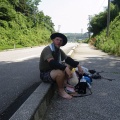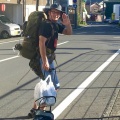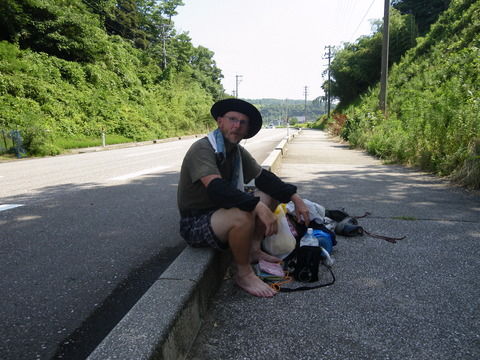
Irishman Walking (Stage 8 Chapter 1) is about my walking the main and coastal roads of Japan. Summer 2012.
*
Dear Friends and Readers:
Irishman Walking was about my walking the main and coastal roads of Japan, in a series of spring, summer, autumn, and winter stages. It took me eight-years to complete my mission. This summer-stage, Stage 8, began on 20 July, 2012, at Shibushi in Kagoshima prefecture, along the southern region of Kyushu. It was also where the previous stage officially ended. The Japanese archipelago consisted of 6,852 islands, with 430 of them inhabited. An island was defined as being land with more than 100-meters in circumference. The five main islands, from north to south, were Hokkaido, Honshu, Shikoku, Kyushu, and Okinawa. Honshu was the largest and was often referred to as the Japanese mainland. After about 37-days on the road, and the trials and tribulations that went with it, the stage was finally concluded on 26 August, 2012, at Fukuoka City, in Fukuoka prefecture, along the northwestern region on the main island of Kyushu. The citizens of Fukuoka enjoyed a humid subtropical moderate climate all year round. Hot in summer, with temperatures that rarely dropped below 0-degrees Celsius. Fukuoka, an attractive city, was bordered on three sides, with the Genkai-nada Sea away to the west, and Hakata Bay off to the north. Fukuoka was also famous for its lush mountains that lay southwest of the city, and drew countless hikers to them. The city was known for its ancient temples, and the ruins of the seventeenth-century Fukuoka Castle; not to mention, its beaches, and modern shopping malls, and much more. In its long history, powerful storms and winds had saved the Fukuoka region from invasion on numerous occasions. It was these winds that became known as Kamakaze, or Divine Wind, highlighted during the closing months of the Pacific War, when Imperial Japanese aircraft dive-bombed into allied naval vessels. Like many parts of the county at the tail-end of the war, Fukuoka was firebombed by American bombers, which destroyed more than 20-percent of the urban area, in 1945. That said, today Fukuoka was a lovely city with heaps of this to do and see, so I was happy to wrap up this stage of my mission here. It would be easy enough for me to return to this coming winter to restart my mission along the road, bound for Hiroshima.
Be happy, keep smiling!
Yours sincerely
Michael Denis Crossey
From Shibushi in Kagoshima to Fukuoka City, both in Kyushu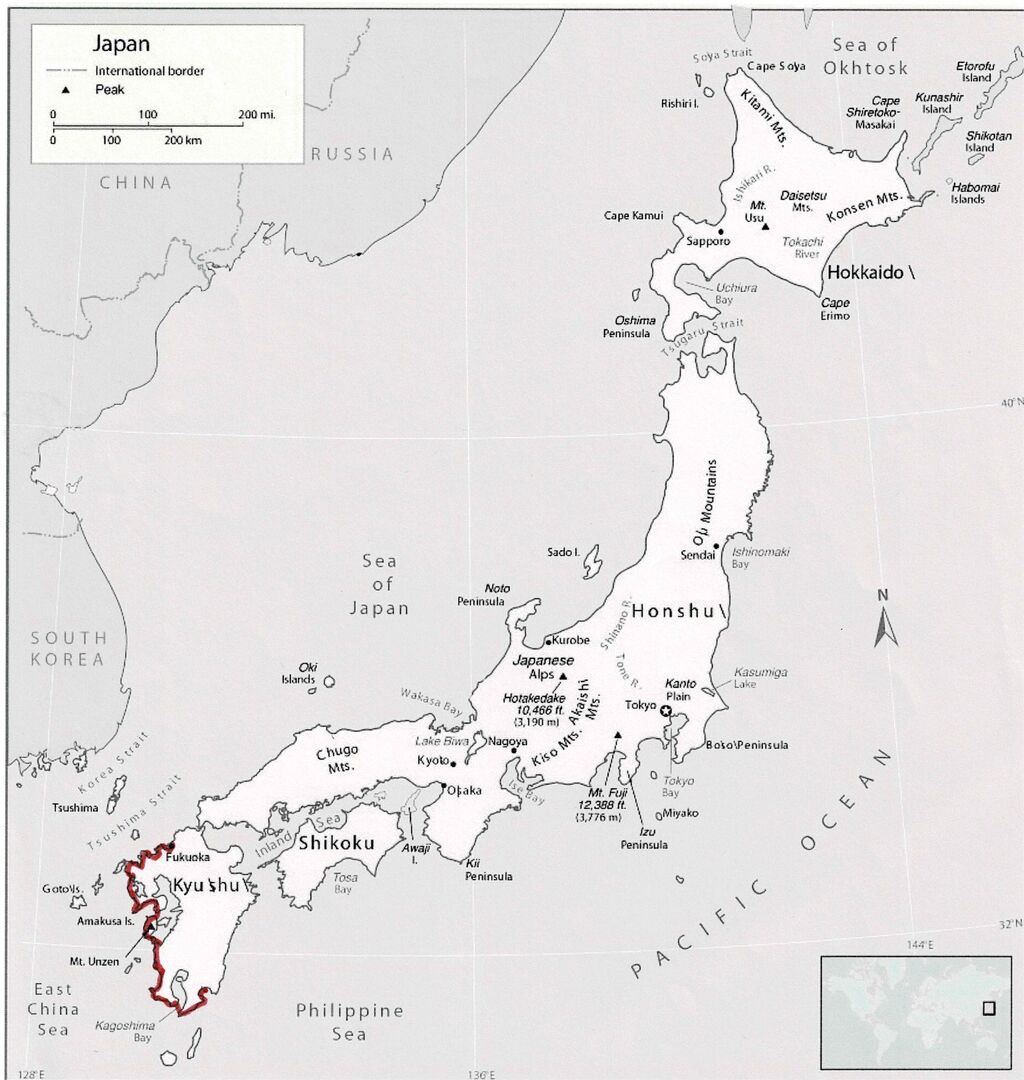
*
19-20 Jul, 2012: The NHK television news made some mention of record rainfall in Kyushu. There was also something said about the upcoming 2012 Summer Olympics in London. Sticking with the weather, people living on that great southern island had not experienced that amount of precipitation in any form over any region before. Likewise, I too was not the luckiest with the weather! “Mmm!” The thoughts of the record rainfall in Hokkaido when I set off on the first stage of my mission, in 2009. Hokkaido was free of the influence of rainy seasons, or tsuyu in Japanese. At least that was what some Japanese friends had happily told me, when I was preparing to fly there to begin my mission. June was usually the rainy season time for most of the country, and as my departure date was in July, was a perfect time to visit the northern island. Japan was famous for its rainy seasons, and predictable weather conditions at large. Therefore, I had little sympathy or want for any unexpected changes in the temperature and weather conditions in the country. As far as I was concerned, Japan was either hot, with oppressive humidity in summer, or freezing cold in winter, with little in between. The fo, followed by 36.6-degrees celsius in Kusu and Hita in Oita, and Daigo in Ibaraki, and 36.46-degrees celsius in Nerima Ward in Tokyo, and the city of Saitama. Major cities recorded their highest temperatures between 15 July and 6 September. In fact, virtually every possible heat statistic had been broken for most locations throughout central and southern Japan, since records were kept. Conversely, in western Japan that year, weather conditions saw more seasonable temperatures, and cooler than average for July. This had to do with the frequent bouts of rain, and passing tropical cyclones. Not only Japan, but countries throughout in the whole northern hemisphere suffered deadly consequences of heatwaves, which lasted from May into September, 2010. By September, the heat wave that year in Japan was reported to be the worst since records began, in 1898. Good places to escape such heat were the mountains, and the northern island of Hokkaido. My own time on the road that summer, was a string of extremely hot days. On some of those days, I found myself drinking as much as eight liters of mineral water a day. Friends had kept me up to date with the news and advised me to take precautions against heatstroke. I could not even stop for more than a few seconds in one spot, for fear of the rubber soles on my boots melting. When I did stop to rest that summer, it was always under the broad shade of a building or tree. Baring the rather mild winter just gone, when I was tramping the main and coastal roads in western Kyushu, winers in Japan at large were miserable times. My original plan was to return to Shibushi Port by ferry, but a phone call from the ferry company put dampers on that. It was explained to me that because of heavy wind and rain, and concern of the approaching typhoon, departure for sailing was expected to be delayed. Naturally I was not happy, and wondered if the weather gods were playing tricks on me. Of all the days and diverse weather conditions in the year, it had to hinder my exact departure plan dates. Amazing!
Then I found myself wondering if it was possible for me to be more unlucky? What was more, a good friend of mine had gone to so much time and trouble to help arrange my departure plans, for which I was very grateful! Now I was going to have to ask my friend to help me rearrange new times and dates. With in a few days, the new and somewhat complex departure times and dates were set. Now everything was set for me to leave Tokyo at eleven-thirty in the evening, aboard a Willer Express coach from outside the Shinjuku Sumitomo Building. The evening coach would take me as far as the Umeda Sky Building in Osaka. If all went well, then I expected to get there the next morning at 08:30 sharp. After hanging about the city for sometime, I would return to the Umeda Sky Building I catch a pink colored bus that would take me to Osaka Port, where I expected a Kamome Ferry to be waiting. Providing all went smoothly, the ferry was expected to set sail for Shibushi Port at five-fifty-five in the early evening and arrive at 08:55 AM the next day. The cost for the entire journey from Tokyo to Kyushu came to ¥13,500 Yen. The original plan that was hampered by the weather, would have come to exactly ¥20,000 Yen. Of course, time was also money, and therefore it would have been better, had it not been cancelled. That was the plan, and all that remained now, was to put my plans into action, and with my apartment door locked behind me, I made my way to the point in Shinjuku were the night coach awaited me. All had turned out smoothly and now here I was, standing in the port city of Osaka. How to kill the time waiting for the bus to take me to the ferry port was easier said than done. The rain was pelting down on the heads of the herds of people rushing to their jobs. “Mmm!” Surely a good number of the rush-hour crowds must have been taken by surprise, I thought as I looked at them, for some many had not an umbrella to their name. Fortunately for me, I had remembered to take an umbrella with me, which was still strapped to the side of the backpack. Rather than carting the backpack around with me, I was able to push it into one of the large coin lockers at the Willer Express coach company. Willer Express was one of the major highway coach companies, which has been operating in the country since 1994. The company operated routes that spanned most of the country, from the southern island of Kyushu to Aomori prefecture at the northern tip of Honshu Island, and as far as Hokkaido. Killing time meant doing everything slowly. The rain soon stopped, and had not started again when I left the spacious Willer Express reception room, which was located on the ground floor of the Umeda Sky Building. However, the rush-hour crowds all seemed to be moving against me as I pushed my way through the long underground passage that ran beneath the railroad tracks towards the northwestern part of Osaka JR Station. Many years earlier, I once boarded a train for Tokyo from Osaka. Now it was more to kill sometime, if not to escape the rain. For the same reasons, I called into a cafe called ‘Bagel and Bagel’. At least the cafe presented the chance to do some writing.
The cafe sold New York-style bagels, or so it advertised itself. Then again, I was never a lover of bagels even when I sometimes stopped at diners on my way to work in the mornings when I lived in the Big Apple in the late 1970s. I still recall in those days how the cinemas showed only two films for the entire year I lived and worked there. The first was the George Lucas epic space film ‘Star Wars’ and the other was the ‘Saturday Night Fever’, the storyline of which was set in Brooklyn in New York. Both films were released in 1977. Neither were my kind of film, and I still have not bothered my arse to watch either one of them. At the cafe, I ordered the BLT bagel set, a sesame bagel with all the trimmings, including a cup of hot coffee, which turned out to be a good choice. The rain had started to fall again, and from the window where I set, I was given a good view of the herds of people rushing past. The rain finally let up and nearly died away as the crowned thinned out. With the rain now stopped, at least for a while, it seemed a good time for me, too, to make a move. I had jotted down in my notebook all that I needed to jot down, and I wanted to look about the city a little before leaving it altogether. When I first visited Osaka in the early-1980s, it was a bit of a dump, to put it nicely. Now there were many fine buildings around the station area and beyond. There were new tall buildings in every direction, banks, offices blocks, hotels, and much more. “Mmm!” So much crammed into just 1,000-meters, I thought, as I turned and looked up at the buildings around me. Of course, this was to be expected in a progressive country like Japan. The shopping arcades seemed to have survived, and no doubt a welcoming target for commuters and shoppers on rainy days. The time was almost 12:00 noon, and part of my killing of time included looking at people walking past from a window in a Starbucks coffee shop. One thing that will stick in my mind when I leave Osaka on the ferry will be memories of the attractive women, young and old. So fashionably dressed, too! It would seem that Osaka had come a long way since I last was here decades earlier. There was not even a Starbucks or a convenience store back then. In fact, the first Starbucks was opened in the Ginza district in Tokyo, in August, 1996. Now, if I was not mistaken, these chain had at least one coffee shop in just about every city in Japan. Most of all, there was a friendly atmosphere about the streets, which I guess were nice thoughts to take with me on the roads that waited me. There will be my old friend the sea, the mighty Pacific. How I longed to plunge into it again, and letting the white foamy tide roll me about like a rag doll washed up on a sandy shore. According to my reading, sea bathing in Japan during the Pacific War years was frowned on as a non-Japanese thing, or too decadent that few people ventured to partake in it. The war years was a period of more important issues, such as, loyalty, patriotism, and obedience to the military and war effort. It was also a period of total mindlessness, if not anti-intellectual, and anti-individualism. Today, the social culture is still rather anti-individual.
The Japanese were better than any other race of people for adopting and readopting to changes in living conditions. Perhaps their peaceful abeyance towards the occupation forces in the postwar years was a case in point. How useful this was to social stability was beyond me to even contemplate. The county had not done so badly in the decades that followed those cruel years. It felt good to me finally at the port with the ferry ticket held tightly between my fingers. The wind, too, was doing its best to deprive me of the ticket. All that I need to do was to slip in a puddle, and it would most certainly be carried away by a gust of wind. Then again, I would only have had myself to blame was it to happen. It was a third-class ticket, in a large common room large enough to accommodate 100 passengers. Each passenger was free to pick where they liked to sleep the night. They could select from any of the tiny fold up mattresses, that were neatly placed around the common room. Of course, each of the mattresses came with a set of white flannel sheets, including a pillow and blanket for warmth. I was one of the first passengers to enter the common room and selected the mattress by one of the main entrances. Not very long afterwards, the room became filled with other passengers with their luggage haphazardly scattered about the floor. It did not surprises me to notice that the mattresses on either side of me went unoccupied. There were similar times on trains in Tokyo when the seats on either side of me remained empty. Of course, I could only surmise at how other foreigners might think, for me I was glad to have the added space. Then again, I was not longer sure if such things were common occurrences anymore, for I seldom used public transport. Personally, I do not give a damn whether it happens or not! What I did give a damn about was getting safely to Shibushi Port and back onto the roads again. Only on the road did I feel free, or sort of free! And where I could make my bed were I wanted to, away from the prying eyes of others. Perhaps the most important item on the road was my tent, if not the mats to sleep on. A one-man tent, it was designed using the lightest of materials. Whenever I bought the tent from an outdoor store in Kanda in Tokyo a few years earlier, it was for my numerous little cycling and camping ventures outside Tokyo. I felt it was light and sturdy enough for dealing with the rigorous Japanese weather. On the road, the weight factor was important, too, since I was the one doing all the carrying. Ways of making the gear stronger and lighter had come along way since the bulkier gear early explorers used. Lightweight backpacking itself was popularized during the 1960s. However, had I been around more than a 100-years ago, my tent would most likely have been made from Willesden duck fat and skin, which I think was the sort of material used on the Irishman, Ernest Shackleton’s Antarctic expeditions. Travelers in the winter months would have had to add a snow cloth, a thinker material used in those days to help keep out the cold. Normally it would have to be spread out over the erected. The snow would then be piled around the lower edges of the material that covered the tent to prevent the cold air from an opening.
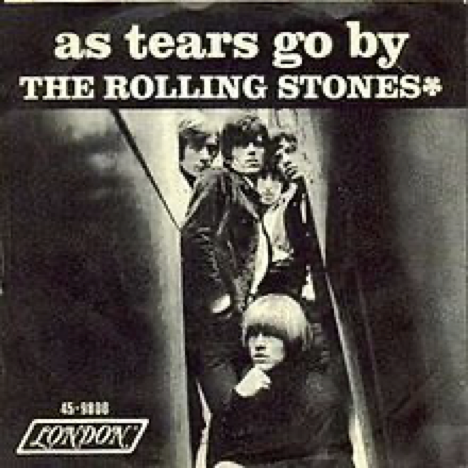
Recreational camping became trendy pursuit in the late-1800s, and was popularized by the exploits of conservationist and naturalist John Muir. Muir wrote extensively from 1868 while living in a tent in Yosemite. Since then, the desire for the rough outdoor experience remains virtually unchanged. When cycled around Japan years ago, I remember not having a tent among what little gear I had strapped to my bicycle. That was mainly to reduce the weight, and the evenings were so warm, that I even slept without the sleeping bag. Then, just two summers ago, which was the hottest on record, I found that I had forgotten to bring a sleeping bag, and never even needed one anyway. Because of that experience, I chose this time not to pack a sleeping bag at all. An unnecessary weight, and at a time when I expected the sun to be relentless. The tiny ‘Colman’ cover that I did have with me should do the job. Besides, I planned to use it more to cushion the ground than to cover my body when sleeping. Then there was the little gas burner that I had grown attached to on recent journeys. It was not a vitally important piece of my gear, like it would be for any polar explorers. After all, these days were countless restaurants and convenience stores dotted about in most places in Japan. So I do not believe I will starve, with or without my voracious appetite. Walking about on a ferry was not the best of ways to burn off calories. Sitting down at a table to do so reading and writing were the best ways at anytime for killing time, or rather making the long and tedious journey seem shorter. There was little else to do anyway, other than to try and sleep. It was often during the hours leading up to bedtime that young children were at their liveliest. The ferry was no different, for tiny groups of children either running about halter-salter, or strolling about the vessel checking out every nook and canny. And why not? Traveling on a ferry was a new environment for them to explore. “Mmm!” That attractive female singer, Marianne Faithful put it more sweetly in the hit song, ‘As Tears Go By’:
“It is the evening of the day
I sit and watch the children play
Smiling faces I can see
Doin things I used to do
They think are new
I sit and watch
As tears go by”
Apparently, Mick Jagger and Keith Richards wrote the lyrics for the song, and was first released as a single by Faithful, in 1964. At that time, the song reached Number 9 in the British and Irish pop charts. The following year, the song was released as a single by the Rolling Stone’s North American record label, ‘London Records’, and got to Number 6 on the American Billboard Charts that year. It was originally called ‘As Time Goes By’. “Mmm!” That was also the same name of the lovely theme song from the classic 1942 romantic film, ‘Casablanca’. It was record producer, Andrew Loog Oldham’s idea to rename the song. Oldham managed the Rolling Stones from 1963-67. According to Jagger’s biographer, Philip Norman, the song was created by Mick Jagger, in co-operation with the session guitarist, Big Jim Sullivan, but that is another story not worth going into now.

21 Jul, 2012: Last night I could not find my little cyclometer device that I removed from my bicycle in Tokyo, for calculating the journey information, such as, distance covered. On the earlier stages of my mission, I found its clock-function was useful. Actually, the cyclometer device had been part of my gear for along time, and I had many happy and meaningful adventures with it. To make matters worse, I did not have time to spend thinking about it. Already I had spent the best part of an hour looking about the ferry for it, but of course with no luck. Of course, I had some enquires at the front desk in the lobby in a while! The time-function on the cellphone read 05:56, as I pulled myself for a noiseless slumber. The common room was not nearly as full as had first thought, and though there was still not a lot of hustle-and -bustle of life about the ferry at large, it was gradually increasing. Most of the passengers in the common room still appeared to be fast asleep. Things continued this way for the next 30 minutes, or when I was by now half way into my second cup of coffee, as I set at the stairwell by the common room entrance. Glancing at the cellphone, I noticed that I had received a phone call. “Mmm!” I guess I must have been really tired, I tried to tell myself, still wondering if others had been awoken by the sound of it ringing? The call had been made at 01:30 AM. Back at my apartment in Tokyo, it was quite usual for me to be wide awake at that time. These were different times! With the activities of the day, I had felt really mentally and physically tired, and had wrapped up the day earlier than I normally would. Steep had come quickly, as did the morning! The churning over of the giant engines soon faded away as I slipped into a deep sleep. Now, I could hear the sweet sounds of young children’s voices. Like evening before, the children hurried up and down the stairs in little groups, rushing here and there, for a last look of their new world. It was also time for me to get my gear in order, for the ferry was due to dock at 08:55 AM, and I wanted to be among the first of the foot passengers to disembark. Most of the other passengers were traveling with their cars, vans, and trucks, and some of them too had begun pushing their larger suitcases closer to the doors. When I got me stuff at the ready, I also needed to stop by at the front desk to see about my lost cyclometer. This was soon done, but with no luck! The rain had long abated and the daylight long returned. Another phone call from my friend yesterday told me that the weather in Kyushu was expected to be good, of free of rain. This was good news, for I had learned from the NHK news in Tokyo that Kyushu had been experiencing miserable weather in recent weeks. Either way, I was more than determined to get started on the roads, and walk off the superfluous energy that had in recent times built up in me. Now I had the opportunity to put my money were my mouth was, as the saying goes. The roads that lay ahead would give me the opportunity. That said, I also needed to make sure that I did not incapacitate myself before I had really got started. It was so easy to pull a muscle when on the road.
The blisters in my feet could be punctured with a pin or knife and cleaned and covered over. But problems with the old muscles could bring an abrupt end to everything, so I needed to be careful. This meant keeping tabs on my pace and adjusting it accordingly with passing hours and changing conditions. In a little while, the ferry would dock and that along gave me the satisfaction Stage 8 was about to begin. For the next 20-kilometer along the road, it really looked as if it was going to rain at any minute. It did not rain at all, and I was contented that the heavy overcast sky kept the rays of the sun away. The sky had cleared by evening, when I had set up camp, and the stars now ruled supreme. Only the bright light from the convenience store across the road, lessoned the beauty of the night sky. Earlier on in the day, a number of cars stopped by the roadside, the drivers offered me a lift, and each time I smilingly refused their kind offers. Of course, this was not before some words of gratitude, before they drove away. In most countries, I think, one had to indicate that they wanted a lift, like, hitch-hiking, before they got one. Clearly, this was not always the case in Japan. One fellow who stopped even offered to drive me all the way down as far as Satamisaki (Cape Sata), the most southern point of mainland Japan, and where I was headed to, on foot. Such kindness was really overwhelming, but like the others, I could only decline such a once in a lifetime offer. On the road, I could not help thinking about such kindness from complete strangers, and wondered why people in places like Tokyo could not show such kindness to one another. What bugged me the most on the road, was stopping people in order to get information about the road I was on, like, when was the next shop, or restaurant, or post office, and is forth. Even if the sea was near, or if it was wise for me to take a detour. And to be told not to go that way, or there are no shops, or there was no life there, or no nothing, only to discover that there were shops or restaurants, or the sea was nearer than I was led to believe. After a few cases of misinformation, I swore to myself that I would be more careful about taking such roadside information for granted. “Mmm!” then I remembered wondering why I needed to bother others I met , after all, it was my mission, I was the one doing the hard, if not dirty work. I once heard someone say that if you do not make mistakes, you do not make anything! Then again, another part of my brain told me that I needed to step down from my soap box. My mission was as much about everyone I met and chatted to along the way. My mission was about the things I saw and experienced. “Mmm! I was in there only somewhere!” I thought to myself, as I made my way across the road to pick up a cheep bottle of red Chilean wine. Soon I was back at the tent where I lay down on my back to gaze up at the stars in the night sky. The depression began to leave me! An hour or so earlier, a fellow suddenly poked his head up over a fence! “What about a hot shower?” He said! “How do you wash?” “Oh! Don’t remind me!” I replied, still feeling a little surprised at this sudden encounter, but mustering a smile as I spoke.
In truth, I often such words seemed to flow from my lips instantaneously, for loaded words often came with an offer. “My place, my place!” The man said, pointing in the direction of a large old farm house about 200-meters away. “Great! Thank you ever so much! Really? Wow!” I replied, still not believing my good luck! There was noting better than a good hot soapy scrub down after tramping the road all day long. A little earlier, I had noticed the man driving up and parking his car at the convenience store carpark, but thought nothing of it, or if he even noticed me. Like many others I had seen so far on my mission, I felt he was simply on his way home after work. “What would be a good time for my to stop by at your house?” I asked the man. “How abut serve?” “Great!” I answer, smiling from ear to ear. “I’ll call over here again!” He said, and then hurried off up a steep path in the direction of his house. A quick glance at the cellphone clock told me that the time was now five-thirty sharp. “Mmm! Good!” A little nap would not hurt any, I told myself, as I rolled on to my side, and closed my eyes. Before leaving Tokyo, I had bought a thin roll up tatami matting, just perfect for camping during the summertime. “Mmm!” It was not easy to fall asleep, for I could not get the want of a hot shower out of my mind. I also thought about the Japanese, or rather, how they were masters at sleeping in so many places and conditions. This did not mean that they got enough sleep, and might even get less sleep than people in other countries. Sleeping seemed to be a natural pastime, particularly on trains, buses, and and in cafes. It was quite common to get a glimpse of commuters, of all ages, on the trains and buses nod off en-route to their jobs. A daily nap had become a part of many a salaryman's everyday life. The average Japanese slept about six-and-a-half-hours per night, whilst the people in most other countries got an average of seven-hours of sleep per night. This may in part be related to a number of things. Japanese was famous for the long working hours, long commutes to the office, the strong emphasis on social events, not to mention the consumption of alcohol, etc. Of course, sleep was a very natural and essential thing, but it was almost an art-form to do it in just about any place. The ability to sleep anywhere, might even have been acquired from childhood, tightly strapped to their mothers back. As for myself, I was normally a good sleeper, who would not be, after tramping the road all day long? In a word, exhausted. Therefore, I think I got the right amount of sleep. There were a good number of times when I ducked under a shade somewhere along the road to escape the sun and rest for while, and often had a wee nap in the process. That said, I was not overly sure it made me do any better, like, cover more distance on the road. If anything, by the end some of the days, when I set up camp, and studied my maps, I would discover that I had tramped less than I had planned. On a number of occasions, I even felt that I had wasted my time, and vowed be refrain from stopping too long. A 30-minute nap, for example, could be equated to about three-kilometers lost.
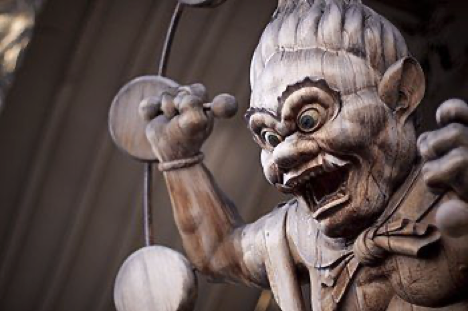
Wooden sculpture of Raijin located at the Hawaii Shingon Mission in Honolulu
22 Jul, 2012: A comfortable night that passed quickly, and with the early morning sun shining right smack in my waking eyes. After a couple of hours on the road, I got a glimpse of the name ‘Sata’ on a roadside sign that pointed straight ahead. Other than that, I had not the foggiest how far or how long it would talk me to reach the cape. Another phone call from a friend told me that the road I was on was the best for getting to Satamisaki. I also learned from my friend that heavy rain was expected to fall this evening. That did not bother me, for I expected to be well hunkered down before then. Or putting a positive spin on things, I could not imagine the rain lasting for long. At around one o’clock in the afternoon, I could hear the sound of thunder in the distance. So frequent did the sound become that I felt the Shinto gods were having a party. In Shintoism and Japanese mythology, Raijin was the god of thunder and lightning, and storms. The blue sunny sky that I had awoke to was now gone and replaced by dull gray clouds. Not long after hearing the sound of the thunder, that a light flurry of rain started to all. So light was the rain, it quickly evaporated soon after hitting the hot asphalt road. Still, I had a funny feeling that more was to come. Just then a little bus stop hut came into sight, and I decided to stop there to rest awhile. At the hut, I spread out the gear on the floor to check later, and lay down on the bench for a nap. After 10 minutes, the light drizzle stopped, so I decided to get back onto the road. I could not have tramped a kilometer when the rain started up again. This time it came down with greater force and soon puddles began to form about the side of the road. Fortunately for me, the rich cover from the pine trees offered some shelter along the road. After a while, I decided to sit down under the trees to pen some sentences into my notebook and to take a good look at my maps. A number of touristy signs by the road had made some mention of a places of historical interest. Even before I got onto Route 269, that would lead me further south in the direction of Satamisaki, and where I hoped to join the Sata-misaki Road Park. Then, if all worked out well, it was back again along the same roads as far as Kagoshima, and where I expected to get my first sighting of the sea again. The last time when I saw the sea was when I was tramping along a minor road, Route 73. The road, I recall, was delightfully alined with small and carefully pruned palm trees. When I finally turned onto Route 269, a distance sight of the sea was still visible. Soon I came to a touristy rest stop, where I decided to stop and boil some water for a cup of tea. It was also a good chance to jot down a few more lines on the sights and scenery around me, into my notebook. Even while making the tea, I found it hard to stop thinking about the sea. Geology did a grand job in shaping much of Japan’s savagely beautiful coastline, concurring up so many giant and wave-battered rocks, and the many tiny island forests that set amidst the roaring surf. The larger island, Yakushima, south of the Kyushu mainland, for example, was home for many giant cedar trees more than 1,000 years old. The oldest cedar among them, Jomon-sugi, was said to be 7,200 years old.
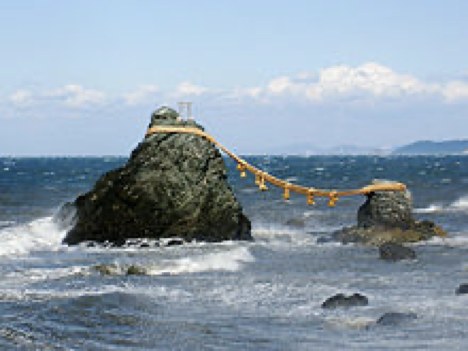
The Husband-and-Wife Rocks located in the sea off Futami in Mie
This ancient tree was named after the Jōmon period, which dates to about 1000 BC, a time of prehistory, when Japan was inhabited by hunters and gatherers. Many of these giant wave-battered rocks were deemed in Shintoism as being ‘yorishiro’. Yarishiro were natural objects, like, rocks, trees, and mountains, and so forth, believed able to attract kami, or gods. Therefore, the rocks often occupied an important place in Shinto religious ceremonies to call the kami for worship. To paraphrase Wikipedia, once a yorishiro houses a kami, it is called a ‘shintai’. Ropes called ‘shimenawa’, decorated with paper streamers, called ‘shide’, were often placed around the yorishiro object, whereby making its sacredness manifest. In Shintoism, both rocks represent the union of the parents of kami, Izanagi and Izanami. Both rocks celebrate the union of two people in marriage. The larger of the two rocks, the male, has a small torii on its peak. The rope that joins the two giant rocks weighs over a ton, and needs to be replaced several times through the year, which is also a special Shinto ceremonyOn my way around Japan on foot, I passed lots and lots of Shinto yorishiro and shintai, especially giant rocks and tall old trees. Though in the case of the rocks, I did not feel they were on the same par as, for example, Ayers Rock, a massive sandstone monolith right in the heart of the Northern Territories in Australia. Ayers Rock was perhaps the most famous rock in the world. At 348-meters high, and some three-kilometers long and two-kilometers wide. However, it was only a small portion of this great rock that remained above ground for visitors to marvel over. To the Aborigine peoples, the rock was called Uluru, and it remains important to their beliefs. Unlike many visitors, non of the Aborigines dare to climb the rock because of their beliefs. Not all of the many islands that made up Japan were natural. The Kansai Airport near Osaka, for example, stands on an artificial island built especially for it. Work on this island began in 1987 and was opened three years later. It took around 10,000 workers and 80 ships to ferry the materials to complete the island. “Mmm!” Incidentally, I read somewhere that the island sank a good eight-meters in the first years of its opening, in 1990. Even now, this sinking threat continued to be a concern. Far in the distance, across the mouth of Kagoshima Bay, I could see the majestic mountain, a bit of natures handiwork aptly known as Kaimondake. Mount Kaimon was a large volcano that rose to a height of 924-meters above sea level. Even as I set and waited for the water to boil, the majestic appearance of the cone was simply breathtaking. The volcano last blew its top in the year 885 AD. Today, Kaimondaki was affectionately nicknamed ‘Fuji of Satsuma’ and ‘Fuji of Kyushu’. Common with hikers, the volcano was also listed the ninety-ninth of the top one-hundred mountains mentioned in Kyūya Fukada’s popular 1964 book, Nihon Hyakumeizan (100 Famous Japanese Mountains). In addition to being a popular writer during the Showa period, Fukada was also a keen mountaineer. No doubt I will get a closer look at the mountain in a few days time! Sakurajima, the active volcano further north, was another one of the famous mountains listed in Fukada’s book.
It would be nice to visiting the mountain and surroundings in the not too distant future. Just as I lifted my cup, and looking aimlessly about me, the sweet sound of a piano drifted across the road. The sound came from a house about 100-meters away from where I set sipping away at the tea. What the tune was, was beyond me, and my mind soon became occupied with a new sound, the sound of nature. The sound of piano was replaced by the distant sound of thunder. Then, suddenly, the sound was soon followed by a heavy downpour. Thankfully, the rain started to fall just as I had packed away the last of my gear into the backpack. The sound of the thunder appeared to be drawing nearer. A break in the clouds, away on the horizon, told me that the rain would not last long, or so I hoped. On the road, a number of green military trucks sped past, headed in the direction of Satamisaki. After a period of saturating the surrounding area, the rain became downgraded to a light drizzle. The thunder, however, continued to get closer. “Mmm!” Too close for my liking, I thought to myself, as I upped the pace along the wet asphalt. The military trucks continued to roll past in groups of two and three, they were divided only by a few minutes. “Mmm!” Was it thunder? Or was it the sound of heavy guns being fired, or so the thought had momentarily entered my mind. For myself, there was no better place to make camp than on a rich sandy beach that looked out over the sea. To mould the sand into a shape that offered better comfort. What more could a weary man wish for than a comfortable place to sleep? Of course, this was not to ignore the sound of the rolling sea, which was impossible to do, even if you wanted to. The stars high up in the sky offered me peace of mind, a company of sorts. At the end of a long hard day on the road, that was what I needed -- peace of mind. On a nice clear evening, some 1,000 bright stars were said to be visible to the human eye. The good old moon, too, was earth's only natural satellite, and was so near to the earth, some astronomers regarded it a double planet, and had twice the suns influence on the rolling tides. It might be argued that camping close to a convenience store was also a welcomed sight, in more ways than one. At the store, I headed directly to the toilets to wash my face and hands, and quickly change into some clean clothes. Then have a look about for something to eat. Anything looked good when you were really hungry, and so I settled on the bento box foods, or packed meals. A nice can of cool beer, was as good away as any, to round the day off. For the most part, the timing was good, in that I was able to duck under one of the touristy picnic places when the heavy rain fell. Therefore, the stores were not bad places to camp near at night. Often along the road, I had made camp in a large park areas, often with wooden picnic-like shelters with tables, or benches, which proved more than handy. Sometimes too, with a place to build an open fire to cook.Thankfully, the heavy clouded sky often kept the sun rays away. After all, the sun was the champion of nuclear reactors, in that, it blazed away at 15,000,000 degrees celsius. Of the 100,000-million stars that made up the Galaxy, the sun was the only star that could be seen in the daytime. Not that I needed to look at the damn thing, even if I could.
23 Jul, 2012: After a hearty breakfast of dried fruit, some mixed nuts, milk and then tea, it was back onto the road. The clock on the wall at the convenience store read 09:00 sharp. The time also told me that I needed to up my pace a bit! By now the sun was already beating down on me, and the T-shirt was already wet with sweat and I had not yet stated. Thanks to some places that i came to that had a good shade to sit and cool down a short while, I had no idea how I could have performed on the road. One of them places a while at was called ‘Jogaseki Viewing Spot’. A number of cars were were also stopping, so I too decided to have a look at what there was to be seen. On a clear day like today, one could enjoy a fine view of the natural beauty, the Jogasaki coast, which stretched for some kilometers. The only Jogasaki I knew of was in Izu in Shizuoka, and where main and coastal roads in my mission would sometime in the future lead me to. There was also the 60-meter long and 18-meter high Jogasaki (Hashidate) Suspension Bridge, in Izu that straddled the coastline there. Some five-kilometers north of the bridge was the more popular Kadowaki Suspension Bridge. Perhaps because of its seclusion, the Jogasaki Suspension Bridge did not have as many visitors to it. That said, there were not so many suspension bridges in Japan that offered a beautiful panoramic view of the coastline, so it wold be worth the while stopping by to enjoy the view at both of these bridges. Hopefully when I get that far into my mission in the future, then I will do my best to stop by for a look. Back to the present, I searched about for my cellphone to take some photos of the Kyushu coastline. Even though this was a good day, the heavy mist that away in the distance over the water told me I was not going to see much of anything. “Mmm!” Only the silhouette of a giant cargo ship moving slowly over the water, offered some interest. And, momentarily I wondered where it was headed and what it was carrying. The viewing spot where I stood seemed unkept, or overgrown with grass and weeds, clearly view visitors ventured past. My progress on the road today was not as I might have hoped. If I did 20-kilometers, it would have surprised me that I had covered even that much. Could I blame the sun? After all, I found it hard not to resist a nice cool shade to stop under a while. A couple of times, I found that my short naps had turned out to be closer to outright lengthy sleep. On both occasions the sleep or rest lasted nearly two hours. This might be seen in terms of distance lost by the end of day, or about 10-kilometers to be exact. Another problem that I found more annoying than not, was the unpredictably of the weather. The rain, when it fell, was really heavy at times. A light rain was no problem, and was even welcomed for its cooling effects. The region was noted for its hot and humid summers, precipitation was also at its highest in June and July. Each time the rain bucketed down, I found myself taking cover somewhere for fear of getting the gear wet, which again only added to lost time. Waiting for the downpours to pass over took anything from 10 to 30 minutes, which added up through the course of the day. Even during the Pacific War, America carried out area bombing, instead of precision bombing, over this part of Japan. This was because of the cloudy weather over the region, in mid-June. The B-29 pilots were forced to navigate and drop their bombs using radar.
24 Jul, 2012: So far, the evening sky was the most beautiful I had seen on this stage of my mission. The time was a little after 07:00 AM and the sun was slowly rising above the mountains. Much of the camping gear lay draped over a fence nearby. The condensation and morning dew never took very long to dry up, and soon every single item would be neatly packed away in the appropriate place, which I hoped to start on shortly. There was noting worse than upping camp with the full blunt of the sun beating down on top of you. For a similar reason, it was good that the rain had passed over, at least for a while. After all, it was because of the annoying rain, I decided to make camp early yesterday evening. Nejime on the broad O-gawa, was about 35-kilometers from my goal, Satamisaki. There was a ferry service there that ran between Nejime and Ibusuki, which was food for thought. It was also a scenic spot, noted for its onsens. This segment of the road was also known as 'Kagoshima Roman Kaido', or the romantic road. The road would take me past a number of interesting places, such as, Kanoya Rose Garden. The Kanoya Rose Garden was the largest park in the region, and home to 50,000 rose trees in its 80,000-square-meters of parkland. Not only roses, but other flowers can be seen, too, such as, cherry blossoms and poppies, among others. It can be said that the Kanoya Rose Garden was a sort of heaven on earth, especially visited when the flowers were in full-bloom. The Kanoya Rose Festival attracted thousands of visiter each year. Among the many international species of roses to be seen in the garden, the ‘Princess Kanoya’, was a rose original to the region. The visitors can also enjoy various kinds of food specialties made from roses. For example, rose flavored ice-cream, rose rice curry, rose cider drinks, and rose shochu, at the restaurant in the garden. In late-May and late-December, each year, the rose garden is illuminated with colorful lights. Also, various shows, events, exhibitions, including live performances are held each year, including a fireworks display. Another place was the Kihoku Uwaba Park, which stood some 550-meters above sea level and offered visitors a 360 degree panoramic view of Kagoshima. Perhaps the best time to view Kagoshima and the natural surroundings, was in the evening when the sky was full of stars. The park was continuously chosen by the Ministry of Environment as Japan's best location from which to view the stars from. Cleary this location in the park was also home to an astronomical observatory. During the Pacific War, the park also housed the Kanoya Imperial Naval Air Base, famous as a Naval Kamikaze Base during the later years of the war. Today, the old base has been redeveloped into part of the Kushira Peace Park, on the eastern part of Kanoya, and which today attracts many visitors, especially during the spring cherry blossom season. Then there was the Arimura Lava Observatory, which was located on the side of the still-active Minami-dake volcano. From the observatory visitors can have a 360 degree view of the entire region. On a clear day, visitors can see the smoke rising from Mount Sakurajima, and where I hoped to tramp around in the very near future.
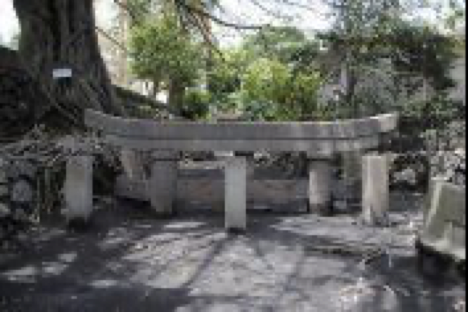
Kurokami Buried Shrine Gate and the old Ficus tree
A public bus service also connects Sakurajima Port to the observatory, but that did not matter much to me. Kurokami Buried Shrine Gate, got its name from a huge volcanic eruption in Taisho 3 (1914), which left it nearly buried by pumice and ash. According to records, the eruption lasted for one month, and spewed more than three-billion tons of lava high into the air, burying many houses. The ash was said to have risen to more than 8,000-meters into the air and drifted as far as the Kamchatka Peninsula. Originally, the Kurokami Shrine torii gate stood roughly three-meters tall, today the top beams were the only parts visible. Rather than dig the shrine’s torii gate from the ash, it was suggested at the time to leave it as it was, in remembrance of the massive eruption itself. Before the eruption, Sakurajima, which means Cherry Blossom Island in English, was an island. Following the 1914 eruption, the island became connected to Kagoshima's eastern peninsula. Next to the torii gate, stands an old Ficus tree, which miraculously survived the eruption, especially so as the species was not the easiest of plants to care for, as well as being the third most common source of indoor allergens. Then again, it seemed an exceptionally sturdy plant. According to the United States Forest Service, "Roots grow rapidly, invading gardens, growing under and lifting sidewalks, patios, and driveways" (Wikipedia). Another area worth stopping by at for a while was Tenmonkan, a busy and prosperous part of Kagoshima City. Tenmonkan was an area of shipping arcades, so designed to keep the falling ash from Mount Sakurajima away. Tenmonkan, was the largest downtown shopping area in Kagoshima, with lovely trams crisscrossing the roads. It was full of stores, boutiques, cafes, restaurants, cinemas, and much more. Actually, the name Tenmon in English means ‘astronomy’. The area has been long noted for astronomical observation and the production of calendars. Flanked by rows of mountains, rich in nature, Kagoshima was also the largest prefecture on the island of Kyushu, and was surrounded by ocean on three sides. The oceans in question, extended to a distance of about 600-kilometers, from north to south. Among the attractions to be visited were the bronze Statues of Saigo Takamori (1828-1877), and Toshimichi Okubo (1830-1878). Takamori, who had been dubbed by historians as the last true samurai, was one of the most influential samurai in Japanese history. There was even a bronze statue of him near the southern entrance of Ueno Park in Tokyo. Toshimichi Ōkubo was a Japanese statesman, a samurai of Satsuma, and an opponent of Takamori. Today, Ōkubo is regarded to have been one of the main founders of modern Japan, or until is untimely death on 14 May, 1878. While acting as Finance Minister in 1871, Ōkubo enacted a law that, among other things, prohibited samurai from wearing swords in public. He was also a key member of the Iwakura Mission that traveled to overseas between 1871 to 1873. Then there was Kagoshima City Aquarium, was a seemingly popular aquarium that featured a variety of native marine life, not to mention, feeding times, including dolphin shows, and other well-designed exhibits.
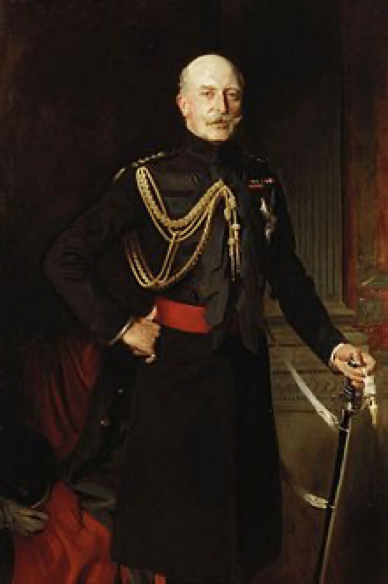
Prince Arthur, Duke of Connaught, painting by John Singer Sargent, 1908
The aquarium was more famous for its large ocean tank that houses a whale shark. Just across from Mount Sakurajima, stood Sengan-en, a Japanese garden that was once the former Shimazu clan residence in Kagoshima. During the Bakumatsu and Meiji periods, visiting dignitaries stopped at this residence, among them was Prince Arthur, Duke of Connaught & Strathearn, in 1906. This royal title was named after one of the four provinces of Ireland — Ulster, Munster, Leinster, and Connacht, to use the Gael spelling. Traditionally, and if available, the title was awarded to the British monarch's third son. In this case, the Prince Arthur was the third son of Queen Victoria and Prince Albert, and their seventh child over all. The Prince was also the Commander-in-Chief in Ireland. Having grown up in Belfast in Antrum in Ulster, I was pleasantly surprised to discover some wee Irish connection to Sengan-en. With the forming of the Irish Free State, in 1922, titles related to locations (later the Republic of Ireland) were no longer awarded. Prior to the Irish Free State, the Prince was also the Commander-in-Chief of Ireland. Today, however, territorial titles relating to Northern Ireland continue to be awarded. “Mmm!” Being very much into reading modern history, I often found myself daydreaming or the old brain working overtime. This included wondering why Prince Arthur stopped over in Japan? Was it at the invitation of the Meiji government? Or was he just undertaking his royal duties, like paying a courtesy call on a friendly allay? The British warship, HMS Dreadnought had just been launched on 10 February, 1906. This sparked a naval race with Germany. Japan also had similar interests with its navy at that time. After all, the new battleship had revolutionized naval power at that time. Even the name "dreadnought" means "a heavy overcoat for stormy weather” or "a fearless person”, so its presence on the high seas certainly opened a lot of eyes. During his visit to Japan in 1906, the Prince was already a Field Marshal and the Inspector-General of the British Armed Forces, from 1904 to 1907. He already had a long and distinguished career in the British Army that included service in South Africa, Canada, Ireland, Egypt, and in India. About that time, the Russo–Japanese War was fought over rival imperial ambitions in and around Manchuria and Korea, in 1904. “Mmm!” I wondered if there was some little connection between the Prince’s visit and growing militarism in Europe and in Asia? Just about everywhere I passed through had interesting histories and geography. Sadly, of course, it was impossible for me to visit all of the places of interest, thought some of which I looked forward to stopping by at for a little while at least, Sengan-en, the Japanese garden, being among them. Soon after finishing the tea, I was back on the road again. This took me past some public workers busy cutting away and removing at the overgrowth of weeds and brambles at the side of the road. “Mmm!” It begged the question as to why the local government did not give more time to cleaning and upgrading some of the rest stops and public toilets that I stopped at, and sometimes even camped near on a few occasions along the way?
Then there were the numbers of kind elderly ladies I saw here and there by the sides of the road, Route 269, each whiling away the time, and chatting about god knows what. They had no objections, I was pleased to note, to my stopping a moment to take a couple of snapshots of their happy faces. One of them, I noticed, was even having a hearty discussion with herself, but I could not understand what she was saying. So I was not sure if her muttering was irrational or not. The woman beamed back at me as I took here photo! When I thought about it later, I sometimes talked to myself, too, but was unsure why I did it. Perhaps it was a way of relieving stress! Research on the matter reported that those who engaged in a little self-conversation was not only normal, but good for you, too. It was a relief to know, for I felt certain I did not have a schizotypal or borderline personality disorder. At least I hoped I was not going overly crazy. I heard it said that talking to yourself benefited thinking and perception, and that people who did so was more common than not. After passing a number of large overhanging structures that combated falling rocks, I arrived at my first tunnel proper. Or rather, the first tunnel since starting out on this stage of my mission. The Ukitsu Tunnel, was opened to the public in June, 1995, and ran for only 283-meters, which was the sort of length I liked the tunnels to be, even if I did enjoy the cool breeze that accompanied me from end to end. The clouds, too, were doing their best at keeping the rays from the scorching sun away from me. On the road, things seemed so far so good, but I needed to see how things in the sky might change by noon. A sky dominated by clouds or by the sun? A road sign that I passed a while back told me that Sata Misaki was 27-kilometer further on. “Mmm!” That was a long way in such heat, I thought, as I loosened the straps on the backpack a little. The sun continued to tease me at every chance. One strange happening was when I decided to stop under the shade of some quality trees, at an out of the way shrine, to take a short nap. Just as I had finished spreading out the mat to lay down on, it suddenly started to rain heavily. “Where the fuck did those clouds come from?” I shouted while turning my eyes to the sky. Soon I found myself rushing to put everything away. It was a moment of helter-skelter, grabbing up everything and rushing towards the shrine for cover. Getting a bit of shuteye seemed less important now, for my mind became occupied with other things, including the rain. Like so many times before, I now placed my butt down on the steps at the entrance and waited for the rain clouds to passover. Even though the rain stopped after only 10 or 15 minutes, it took me longer to organize the gear and pack it away, before I was able to get back out onto the road. It always felt good to be able to escape the scotching sun a while, and all the more so if I was able to enjoy a nice cool can of beer at the same time, if the chance allowed. On the road I again passed little groups of elderly women sitting about chatting. One elderly woman I stopped to chat a while to told me that the place used to be more full of people of all ages. Even young families sitting about talking and laughing, and with the young children running about playing nearby. “The road was nothing like it was now!” She added! “Times have changed!” I replied, as I picked up my backpack to take my leave.