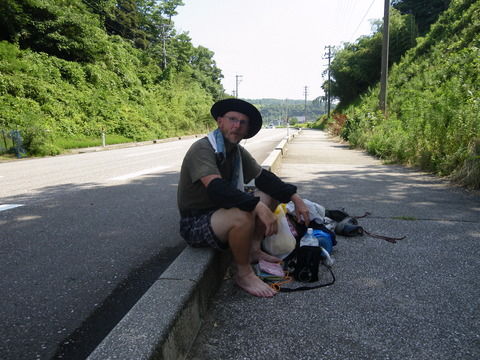
Irishman Walking (Stage 8 Chapter 7) is about my walking the main and coastal roads of Japan. Summer 2012.
25 Aug, 2012: What an evening yesterday turned out to be. It was fairly close to dark, and with an eye open for a place to make camp, I turned off the main drag and onto narrow minor road. The side road led past paddy fields to my right and three-meter wide river that cut through overgrowth and brambles to my left. “Ah ha! This should do!” I said to myself, as I dropped the backpack to the ground, and set about getting the gear into place. The distance that I had covered on the road was less than 20-kilometers, which was easy going for me. This was in part because the clouds had keep the sun at bay. Still, I was a little surprised at feeling tired, which was how I usually felt after tramping 35-kilometers and beyond. It felt good to be free of my heavy backpack, at least until the morning. In the words of D.H. Lawrence, “A rucksack had its moments of treachery, close friend though it seemed.” (‘A Chapel and a Hay Hut’, one of a collection of short stories, in ‘The Mortal Coil’). Whenever the tent was finally erected and all the gear sorted out or tossed into it, the time had just gone eight-thirty in the evening. Soon afterwards, I had dozing off into a deep sleep. What must have seemed a matter of minutes of laying down, the bright headlights of a car lit up the entire tent. When I set up, and peeked out through the tent flaps, a middle-aged man was standing nearby looking on. Judging from the way he was dressed and the tools sticking out of the truck he was a farmer. Anyway, the man stood with a preoccupied expression of face, and with a most mistrustful look. Something told me that he was not about to make some civil remark about my delightful form of residence, the tent. “What the fuck was all this about?” I thought, crawling out from the tent on all fours, and clad only in underwear and a T-shirt. The farmer did not utter a word, but pointed at the little white van with one hand, and up the narrow road and beyond the tent, with his other hand. Clearly he wanted to pass by, and needed me to move the tent out of the way. The time was a little after ten o’clock. The farmer must have been on his way home, where a cooked dinner and a hot bath awaited him. “Oh! Sorry! I’ll move right now!” And with some difficulty, I set about pulling up the tent pegs and dragged it off the road with all the gear still inside it. Soon the road was clear and the farmer, who was already sitting at the drivers seat, drove away. For a short while, stood in the dark and watched its red rear lights dancing up and down, and soon they disappeared from sight. “Mmm!” I then remembered thinking that it was fortunate that I was wearing anything. Many a warm summers night I had fallen asleep without so much as a stitch on my body. It was unfortunate that the place I chose to make camp at was not as isolated as I had first thought. Then again, being a farmer, I suspected that he would return along the same stretch of road early the next morning, so I was determined to hit the road at the first appearance any light in the sky before sunrise, at the latest. What I needed to do now was to hit the sack again and go to sleep. Not an hour had passed since the farmer drove away, when I was awoke a second time, it was to flashing lights and a voice calling to me.
Soon I was standing outside the tent again, only this time a police car was parked on the same spot that the farmer’s van had been earlier. The red lights were still flashing like mad, and the headlights from the police car offered the only light under a dark heavy sky. “Good evening! What can I do for you?” I asked the policeman nearest me, doing my best to muster a smile. The headlights were so bright that I could hardly see before me. Which may have been why the other policeman returned to the car, to dimmed them. The policeman at the steering wheel stayed put, the other two got out of the car. One of them appeared to have the tenacity of a bulldog, as he stood looking down at me, as I made my way out of the tent. The other stood at the car, merely looking on. There was a little bow and salute. He nodded, and looked in an alert fashion. The policeman was not overly tall, nor young, in the dark uniform. His brown eyes flamed with a consciousness of my presence. He appeared to sparkle into life when he asked me to produce my alien registration card, which I did. “Mmm!” Then I thought how everything seemed to be so inevitable, in Japan. This included being stopped along the road by police for questioning. It was the kind of thing that happened without really knowing why. The policeman stood with his head drooped down over my alien registration card, which he held perfectively still. After a short while, it was handed back to me, without any future inquiries. It surprised me a little that I felt no rage at the many times I had been stopped by the uniformed men (and women) of the law. It was all part of my mission, life on the road, just as troublesome as the changing elements. The only difference, I guess, I never felt on firm ground with them, in the presence of the law. All the same, I preferred to go my own way, never to set eyes on a policeman ever again. Wishful thinking. Currently, there were close to 300,000 police personal in Japan, most of them police officers, less that 10-percent of whom were females. The civil police system in Japan was established during the Meiji period after the European-style at the time, in 1874. Late it was expended more nationwide, in the 1880s. Back to the present, I felt the police to be a discontented lot, as if they never really found who or what they were looking for. Then again, I guess the same could be said about Joe Public in general, perhaps myself included. Like I said, the red flashing lights were now turned off, an act that I took to be somewhat gentlemanly. “You cannot camp here!” The nearest policeman said, coming closer and gave the tent a good looking over. “It’s a small tent!” He said, and again telling me that I still was not allowed to camp here. “This is a public road!” He sad, and went on to tell me that it was prohibited to camp on or near public roads, adding that it was also dangerous. “You just can’t camp here!” The other policeman said, now crouching down by the tent and motioning for me to make a start on pulling up the tent pegs. “Yes! I understand!” I said, stooping down at the tent. Pulling the tent pegs up was soon done, for the second time within an hour. I also told them that upping camp was going to take a little longer than usual!”
Then I continued to explain that a couple of the tent poles were broken, because of the strong winds. So I needed to be extra careful not to make things worse.” “Did you fix the poles yourself?” One of them asked me, shining a flashlight at the tent poles that now lay on the grass. Yes, of course! Well, somewhat!” By now I was doing my best to hurry things up, for I really wanted to get back on the road again and keep an eye out for another place to make camp. Even if I felt the policemen were by now feeling more relaxed about having to deal with a foreigner, whose level in the Japanese language was flawed. Then I set about dismantling everything and rolling it up and stuffing the gear in no particular order, into the backpack. Of course, I was thankful for the headlights from the police car, for fear of forgetting something. There was noting that seemed easier to do than loose camping gear, which was not cheap. As I continued with the task of putting the gear away, the usual gauntlet of questions were asked, and which I answered. In fact, I could almost feel an awe of respect developing between us. “Where will you go from here?” One of them asked, to which I replied that I was going to make my way towards Fukuoka and just keep an eye open for a good place to camp the remainder of the night at. “Well, you should see the sea soon, and perhaps you will have no problem on finding a place to camp near there.” And telling me that there was a large park and a sandy beach, which sounded good. Of course, I thanked the policeman for the information. “Look! I really believed that this was a good place to make camp.” I said, as I continued putting the last of the gear away. “You know, well off the beaten track, isolated. Not a sole in sight!” The policemen did not move, nor say a word. They stood nearby shining their flashlights about the ground, making sure that I did not loose or forget anything. “In fact, only one guy came this way in all the time that I had been here!” I said, putting the final touches to things and looking about to make sure that I had not overlooked anything. “Yes, we know!” One of the policemen said. “A farmer told us that he almost ran over you!” “Really? I don’t think so! He must have been pulling your leg!” I said, mustering a smile, while not knowing whether I was angry or annoyed. “You don’t have to wait for me!” I said, looking up at the police men. “As you can see, I am almost ready to move.” Adding that I did not need the headlights from the police car, and that my own little headlamp would do just dandy. “We’re sorry! But you need to move immediately!” One of them said, as they turned towards the car. “Remember, please don’t park on or near public roads again!” With the words of advice, and a handshake, they got into the police car, which then started to reverse slowly back in the direction of the main drag, Route 202. The police car was soon gone! “Mmm! I thought so!” I mumbled under my breath, as I tightened up the last of the straps on the backpack. The farmer had called the police. I also felt that the policemen where only doing their job, and that was that. In a way, the policemen were kind, and I felt even a little embarrassed at having to be there and telling me to get a move on.
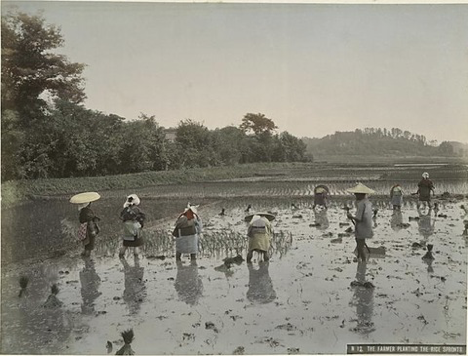
Rice planting in the 1890s. Scenes like this have remained virtually unchanged in some parts of Japan, right up until the 1970s (Wikipedia)
Farmers, on the other hand, tended to have their own routine way of living. Anything that crossed their path in an opposing sort of way was almost a violation of what they regarded as sacred. A quick glance at the cellphone-clock told me that the time was now well gone midnight! I needed to move! Suddenly, my eyes caught sight of what appeared to be a figure ducking behind one of the trees about 30-meters from where I stood. I had only just picked up the backpack and was about to move off to rejoin the main drag when I looked in that direction. To add salt to the wounds, it was the eyes of the farmer in question observing me from behind the tree. When he saw that I had spotted him, he came from around the tree and began to walk slowly towards me. The police car could not have been gone five-minutes, when I saw him. Perhaps he had been standing there all along! “Stop right there!” I said in Japanese, and in a loud enough voice for him to understand, I told him that I did not want to hear anything from him, nor say anything to him. The farmer stopped, he was wearing his pajamas, and as I had not seen nor heard a car approaching, I assumed that he live very near by. He mumbled something that sounded as if he was trying to justify calling the police, but I was really not interested in what he had to say. Besides, the damage was done! There was no point whatsoever in prolonging things, and so I started to make my way slowly back down the little side road, lighting my way as I went with the little headlamp a friend had given to me, in Tokyo. Unfortunately for me, it was not easy to get the unwanted encounter with the farmer out of my head. As I made my way along the road, I could feel my mind was working overtime. Most of the farmers in Japan drove little vans between their houses and their farmland. I even had seen some of them riding little Honda Cub motorbikes, with a cart on tow. In away, farmers were a very important part of any country around the world. In the case of Japan, only about 20-percent of the land was suitable for cultivation, so it goes without saying that the agricultural economy is highly subsidized by the government. Considering that farming, agricultural, and fishing, not to mention mining, formed the primary sector of industry of the economy in Japan, it accounted for a very small part of the gross national product. Just like where I had wrongly thought I would be able to camp undisturbed, about 85-percent of the 2.3-million farms throughout Japan, planted rice on a yearly basis. All the same, the average paddy field per acreage yielded only a very small amount of rice. In addition, the production of rice was highly mechanized. To me, this sounded a little strange, since rice was by far the main agricultural product in the country, and most of the rice eaten in Japanese homes was home-grown. It was a staple food! Of course, rice was not the only crop grown in Japan, but barley, soybeans, and wheat, as well as a large variety of different fruit and vegetables, too. The farming of rice probably came to Japan from Korea and China, as had many other things, including kanji. It was also believed that rice growing started in the third-century BC during the Yayoi period.
In addition to rice cultivation, the Chinese influence in particular also included the introduction of bronze and copper weapons. The Yayoi period was an Iron Age era in Japanese history, and traditionally dated 300 BC–300 AD. In fact, the earliest Yayoi archaeological sites were at Itazuke or Nabata in northern Kyūshū. For a while, the farmer stood and watched me move off, and I could literally feel his eyes still focused on me. Before turning onto the main road again, I could not resist looking back along the minor road. The farmer was no longer standing where I had left him, looking on. Perhaps he had got the cold should message. At least, I was glad that he did not follow me as far as the main road. Justified or not, I never felt comfortable in the presence of an informer, for it caused the hairs on the back of my neck to stand up. Or that was exactly how I felt towards the farmer, for whom I had zero respect. Anyway, it did not matter anymore, or whether he was still there or not. There were more pressing issues on my mind, I still felt sleepy, and really needed to find a new place to pitch the tent. This time I had to be more careful. On the positive side, the moon at last shown brightly, which was good. For the third time in as many hours, I was awakened 02:00 AM, this time to the distant noise of bōsōzoku, a Japanese motorbike gang. The time was after 12 midnight when the tent was at last erected on a barren piece of land, just off a narrow by-lane. The by-lane cut over a broad river and was surrounded by open fields that have been left to the powers of nature, perhaps to make the soil more fertile or productive. But what did I know about farming? Still, it may have been the same river that I camped near some hours earlier, but I was not sure of anything just now. In the distance, I could also catch the sound of the odd passing car. The glow of the moon bounced off a set of train tracks, too, could be made out some distance away, but there were no trains running along it. One good thing, was that there were now more sapping or cracking sound with the tent poles. Camp was accomplished under the light of the moon without any further trouble or unwanted encounters. For the moment at least, I no longer felt tired, or it was not so easy to sleep, the second time round. So I set by the tent and looked about me. “Mmm!” Why else would the vast fields be left barren? I wondered. Every inch of the farmland in Japan was exhausted to the last drop, year in and year out. The next hour or so was spent laying on a mat in the tent writing out some long over due postcards to family, friends, and acquaintances. Somehow, I managed to doze off for a spell, after completing only a few of the postcards. A while later I awoke again, to the sound of the motorbike gang, this time nearer. Then as the sound grew and multiplied, it took on a regular rhythm. As I listened anxiously, I knew the noise of motorbikes being ridden erratically. I could picture them leaning this way and that way, and weaving in and out of the traffic. Most of all, I could hear the sound of a police car siren. Something told me that they out not bother their arses making it near were the tent stood, for the area was too damn silent for them.
Such antisocial groups needed to make their noisy racket of raving engines and bumping of horns nearer to urban places, where people lived so they could be heard. The sirens on the police cars that often followed close behind the motorbike gangs, was just as noisy. At 06:30 AM, I was again awakened, this time by the sound of footsteps going past the tent. The Japanese were keen morning walkers, which was all part of the keep fit craze that was sweeping the country in recent years. This was a time during the economic recession when more people found themselves with time free time on their hands. Fuck it, for me it was time that I made a move. Spending too much time in one place was against everything that my mission meant. Soon all the gear was dismantled, rolled up, and put away in the appropriate place in the backpack for easy excess. The main drag took me past, the Genkō Bōrui, a 20-kilometer long defensive stone wall, located along Hakata Bay coastline. The wall had been constructed in preparation for a Mongol attack, during the Yuan Dynasty. The first attack took place, in 1274, and was followed by a second attack, about seven-years later, in 1281. Both of these attacks were thwarted by typhoons, called ‘kamikaze’ in Japanese. Part of Genkō Bōrui was completed before the second invasion and hindered the enemies efforts to land. They were forced to make anchor along the coast of Shikanoshima Island. It had been a hard fought battle, which lasted for several months. A local samurai leader of Higo Province, Takezaki Suenaga (1246-1314), who took part in the battles, had artists make illustrated hand-scrolls that depicted scenes of the battles. The Battle of Koan, was one such scroll, which depicted the second Mongol attempt to invade Japan. These were a set of scrolls, called, Mōko Shūrai Ekotoba, and depicted Suenaga's valor on the battlefield, a sort of pictorial account of his bravery. For this, Suenaga had hoped to be rewarded, by the shōgunate government in Kamakura. This was thought to be in the form of money and rank, For this purpose, Suenaga had gone to great lengths to have his honor as a warrior depicted in the scrolls. He was reputed to have said: “Other than advancing and having my deeds known, I have nothing else to live for...” During the early-Tokugawa period, some of the stones were removed from the wall and used in the construction of Fukuoka Castle. At this time, several minor repairs were made on the castle. A full-scale renovation was conducted during what was called the Bakumatsu period, a time that referred to the final years of the Tokugawa period. The Genkō Bōrui defensive stone wall was later designated a national historic site, in early-1931. Human bones corresponding to 200 bodies, including a number of ceramics, were excavated at locations in Imazu near the defensive structure, in 1958. The road also led me past Kokokuji Temple in the Tagawa District of Fukuoka. An authentic temple which is surrounded by a sacred forest. The temple was built about 800 years ago to honor Minamoto no Sanetomo, born in 1192, he was the third shōgun of the Kamakura shogunate. The shōgun’s ultimate death was at the hands of his nephew on a heavy snowy evening, on 13 February, 1219.
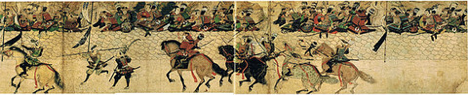
A scroll showing a portion of the Genkō Bōrui at Ikino Matsubara (Wikipedia)
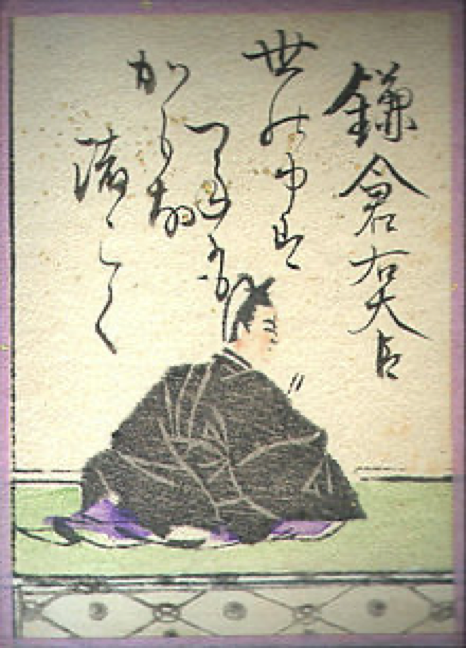
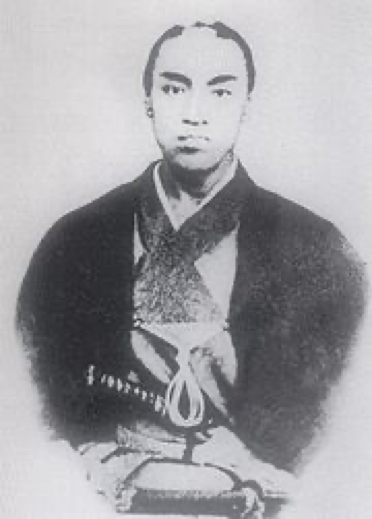
Minamoto no Sanetomo, a depiction from Ogura Hyakunin Isshu (Wikipedia)
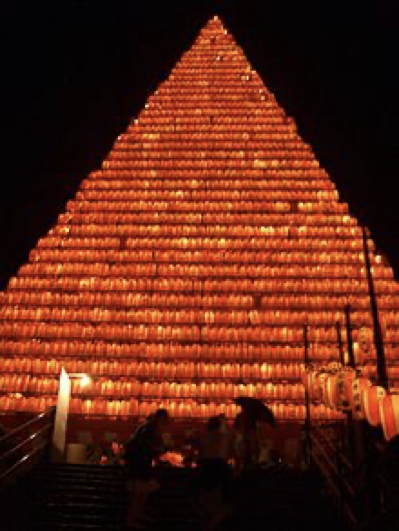
26 Aug, 2012: In the big cities it was never easy to find a good camping place. At the sides of riverbanks were usually the best places to pitch a tent, however, one could walk for ages before coming to one. The same might be said about large parks, but they were not as isolated as the riverbanks. When I found myself in a city, and always kept an eye open for a good place to make camp. Of course, much depended on the time of day, too. No one other than a homeless person, would even think about camping in a city. One good place to have made camp at would have been on the beautiful stretch of beach that was home to the Genkō Bōrui defensive stone wall at Hakata Bay. Or even in the grounds of the Kokokuji Temple. However, it was simply much too early when I reached these places, and stopping to make camp was the last thing on my mind at the time. Besides, I was not sure just how far it was to the Fukuoka City center, and so it seemed preferable to push on. In time, I arrived at a beautiful spot by the Muromigawa River, located in the Muromigawa area of Fukuoka. Servicing the Kūkō Line, part of the Fukuoka City Subway, the train station was opened in late-July, 1981. The sight of the river reminded me of the famous River Thames in London, and so I decided to make camp at an isolated spot there. The footpath that ran along the riverside was busy with people out for a brisk walk. There were also number of joggers, and people out walking their dogs, too. There was also a good cycling course that followed along the river. The Muromigama River had more to attract visitors to its riverbank. On 27 September each year, a candle event was held in the Muromigawa Riverside Park. At sunset, the candles came to life upon the river surface for the visitors to admire. Depending on the year’s theme, the colorful candle light took the shape of either messages or flowers. The event was called Tomyo watching! Traditionally, around 1,000 illuminated “tomyo” lanterns were lit as offerings to the Shinto gods and to Buddha, and at various other memorial services. The Hakata Tomyo Watching festival started in 1994, inspired from a traditional ceremony called Sentomyo that is held at temples and shrines in Fukuoka and Oita The paper lanterns also symbolized prayers for good health and the well-being of the people present. Alas, this was late-August, and I was in no place to hang around for the event. There was a resident homeless cat, which I surmised would be around at that time. At least, I was only able to see one cat sitting contentedly on a bench nearby. Or perhaps it was a feral cat that preferred to live outdoors, or the sort that did not care much for human contact, nor allow themselves to be touched. “Mmm!” For a while I wondered what the cat was thinking about. Many cats looked like they were smiling! Therefore, it would not have surprised me any if it was sniggering about my bedraggled appearance. If the cat could do that, then it was probably also wondering what I was up to. Whether or not the cat thought about me, I was in no hurry to pitch the tent. Even though the night was closing in, I decided to wait awhile until the numbers of people lessoned.
Even still, I was worried about the tent, and if anything it was good that this stage of my mission was nearing an end. Like a dead weight, the battered old tent had become an irredeemable wrack. Both the tent and I needed to part company, and better sooner than later. But all of that would have to wait for a more appropriate time. What mattered now was the present. High above, the stars did not grow fuller nor larger like I had seen them do in other countries that I once passed through. A yellow moon appeared silently and suddenly from no where, or at least I had not noticed it until now. The sound of the cellphone ringing awoke me proper at around 08:00 in the morning. The call was from my friend, Riko, in Tokyo who kindly reminded me that a room was reserved for me at the Nishi-Tetsu Inn in the Tenjin area of the city. As usual, checkin time was at three o’clock. There was definitely no hurry to get there, for I was already camped on the outskirts of the city as it was. Some details on the hotels exact location were also given to me, which I quickly jotted down for save keeping. There was a Mitsukoshi Department Store on the left, where I was told to turn right and make my way along Watanabe dori or street, for three blocks. Whenever I came to Richmond Hotel, I was told to turn right. There I would see the hotel I would stop at. “It was as easy as cake!” Riko told me. My friend had a gift of making me feel that even a village idiot could follow her instructions. That said, I still needed to jot as much as possible down on paper. The lazy tramp along Route 202 was pleasant. It was Sunday, so a lot of the businesses were closed for the weekend. However, the road was busy with traffic along it, but that did not bother me much now, and according to my maps, I had no need to cross over to the other side. Besides, the large buildings on the side of the road I was on cast out a good broad shade, which kept the sun to itself for a good portion of the day. The slow tramp along the road was mainly to kill time, but a glance at the shrinking width of the shadow cast over the pavement told me that I was moving too slowly. Along the way, there were a good number of interesting shrines and temples many with nice cool shades. This was thinks to the quality trees about the grounds, and where I was happy to stop at for a while, if not to admire. At the Hirano Shrine, for example, a notable fellow in the turmoil of politics during the nineteenth-century, was enshrined. During his time, Hirano Kuniomi, a political thinker, criticized the rule of the shogunate government. In other words, Kuniomi pursued anti-shogunate ideas that leant towards uniting and reforming the country behind Imperial rule. He formed an army in Ikuno in Hyogo prefecture, in a failed attempt to unseat the shogun, in 1863. Kuniomi was finally captured, and executed the following year in Kyoto. However, the failure was not altogether without success, for it went someways to influencing the foundations for the Meiji Restoration a few years later. My mind was already thinking about soaking in a hot bathtub, which added to my positive feelings. Besides the heavy backpack and lack of drinking water, the walk was near enjoyable.
Big cities were not easy places to find tap water in. There were many convenience stores along the way, but bottled mineral water was not quite the same thing. Tap water was sent straight to the faucets at our homes, whilst bottled mineral water came with all the added minerals for therapeutic or taste altering value. Bottled mineral water was big business, with more than 3000 different varieties of the stuff sold worldwide. The different convenience stores, for example, sold different kinds of bottled mineral water, including with their own company brands. Tap water and bottled mineral water are generally comparable in terms of safety. That said, the jury of scientists was still out on the so called health benefits of minerals from drinking water. Tap water , was not only free, but often contained more minerals than bottled ‘spring’ or ‘mineral’ water, which of course was not free. Most of the buildings had water taps outside them, but often the little taps or handles were removed, which did not help any. “Mmm!” To me, his did not seem very fair. After passing what seemed to be hundreds of large buildings, I at last found one that had a water tap with a handle on it. Needless to say, I stopped and filled my water bottle and replenished my dry throat and stomach with this clear gold. Suijin was the Shinto divinity of water, including lakes, ponds, springs and wells. Suijin was a big part of Japanese culture and worshiped at many temples, especially by fishing folk, and I should imagine farmers, too. After all, water was important for growing in agriculture, as well as used in sanitation. “Mmm!” All sorts of things now began to run through my head like a rushing river. Already I had lost count of the times I had paused on a bridge ad looked out over a breezy river lost in thoughts. This time, I wondered if those rivers, like broad the Muromigama River, where I camped last night, had their own gods. There was even the Shinto festival, Suijin Matsuri, held on 1 December and 15 June, at various locations in the country. The Suitengū Spring Festival, in particular, took place at the Suitengū Shrine in Kurume City in Fukuoka, from 3-5 May each year. Participants prayed for a smooth and easy child birth, and for the safety and health of children, including protection from drowning. The festival was said to be more than 800-old. Celtic mythology was also rich with its fair share of gods for one thing or another. For example, Li Ban was the water goddess in Irish mythology. Some of the famous rivers that flowed through Ireland were mentioned in Irish mythology. For example, Boann was the goddess of the River Boyne in the reign of Leinster, ran for 112-kilometers passing though the Counties Kildare, Offaly, Meath, and Louth, and into the Irish Sea. Sinann was the goddess of the River Shannon, the longest river in Ireland, at some 360.5-kilometers long. The mighty Shannon passed through the Counties Cavan, Leitrim, Roscommon, Longford, Offaly, Westmeath, Galway, Clare, Tipperary, Limerick, and Kerry, and into the Shannon Estuary in County Limerick. Belisama was also the goddess of rivers, lakes, fire, crafts and light. Whilst, Grannus, was a god associated with the sun, fires and healing thermal and mineral springs, including spas.
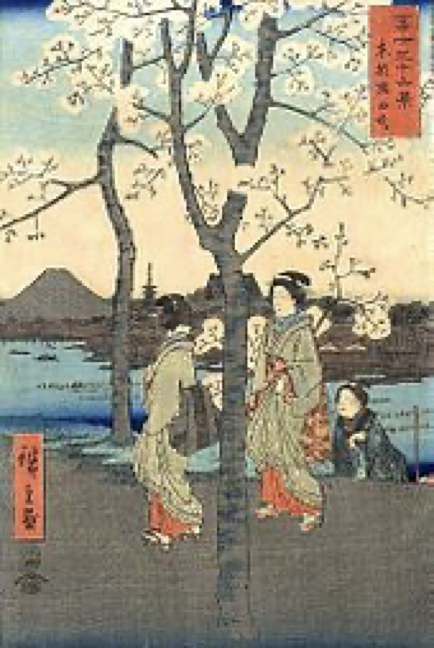
Woodblock print of Mount Fuji and cherry blossom from Thirty-six Views of Mount Fuji by Hiroshige (Wikipedia)
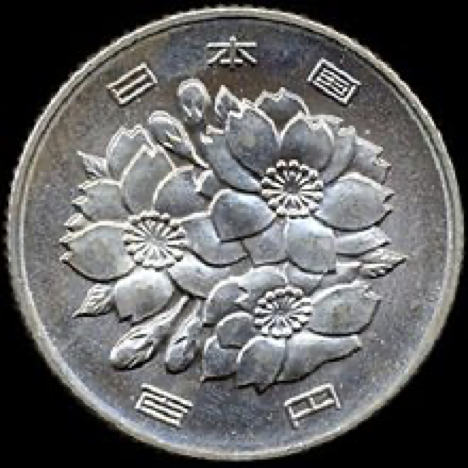
The ¥100 Yen coin in Japan depicted cherry blossoms (Wikipedia)
Both Ler and Manannán were sea gods. The nearer I got to my destination, the Tenjin area, more hotels began to pop up here and there. Large parks also came into view, such as, Ohiri Park and then the Maizuru Park. There was the Fukuoka Castle ruins, which I knew a visit there was best left until tomorrow, when I was well washed and rested, and without the backpack with me to worry about. The main citadel ruins were located nearby, of which I had hoped to take some photos. I was not sure what part the Korokan ruins played in the country’s history, but hoped to stop by there, too, to look it over. After all, looking was learning! Something told me that my couple of days in the city were going to be just pleasant. Found in all sorts of Japanese literature, including the traditional art of Japanese tattoos, the cherry blossom as a symbol was even used during the Pacific War, to inspire the Japanese spirit, feelings of nationalism, and militarism amongst the people. An element of the very first kamikaze unit took for its name, ‘Yamazakura’, which in English meant, ‘wild cherry blossom’. The centuries-old practice called ‘Hanami’, of picnicking under a blooming sakura. was said to have begun during the Nara period (710–794). Hanami carried on in popularity amongst the elite through the Heian. However, by the Tokugawa period, picnicking under the cherry blossom tress in spring, spread through the samurai class to the common folk, and has remained that way to the present time. Each year the Japanese Meteorological Agency tracked the cherry blossom front as it made its way northward up the archipelago along with warmer weather. Of course, this was highlighted on the nightly forecasts during the weather segment of news programs. The blossoming begins in Okinawa in January, and typically reaches Kyoto and Tokyo at the end of March or the beginning of April. It proceeds into areas at the higher altitudes and northward, arriving in Hokkaido a few weeks later. Japanese pay close attention to these forecasts and turn out in large numbers at parks, shrines and temples with family and friends to hold flower-viewing parties. Furthermore, the Japan Cherry Blossom Association developed a list of Japan's Top 100 Cherry Blossom Spots[with at least one location in every prefecture. Many species of flowers grew about the castle grounds. They included lotus flowers that bloomed between July and August. At other times, the plum blossoms were at their best in January and February. Then there were the cherry blossoms from March to April. The fresh green in late-spring, from May to June! There was the autumn leaves that people flocked to look at in October and November. Last, but not least, there was the snowy texture of wintertime in December and January. Fukuoka was one hell of a beautiful city, even with its many modern, tall buildings. The Cyprus-ohwii Kukenth, which flowered in early-June, was designated by the Fukuoka prefecture a protected species. It was a member of the Cyperaceae family, a large perennial plant that could exceed 1.5-meters in hight. The paint was called Tsukushi oogayatsuri, in Japanese, and was said to have been discovered amongst the Fukuoka Castle ruins.
According to a touristy pamphlet that I picked up somewhere earlier, at the western area of the second bailey, stands the famous plum tree, pass Ogizaka on the left. The New Ogizaka stood near the Otsunamon Gate, the pillars of which it has been said, could cause a fever and nightmares to the person who touched it. The gate was named Otsuna-san, after a woman who is said to have made her way to the castle in order to kill her husband. Otsuna-san’s husband had forsaken her after he fell in love with another woman. The legend has it that she died on reaching the castle gate! The East Gate, provided assess between the second and third baileys, and was part of the main route to the keep and the castle tower. The third bailey contained the residences if the chief retainers to the feudal lord. Thought the main castle tower was gone, many Important cultural properties remain, such as, Tamon-yagura turret observatory tower, Otemon Gate and Shiomi-yagura turret remain. The ruins of the castle were located in Maizuru Park, where there used to be an observation tower, Dai-Tenshu-dai, on top of the hill. The castle was said to look like a flying crane when viewed from Hakata Bay. Because of this, it was given the nickname ”Maizuru-jo”, which in English meant, ‘Dancing Crane Castle’. Maizuru Park was located just 15-minutes walk from the Tenjin area in the center of Fukuoka City. Thankfully that was how close I was to a hot bathtub, even if it was still too early for checking in at the hotel. The park was a real oasis for city residents. It featured a number of historical sites, such as, the Korokan Ruins Museum, as well as, the turret from Fukuoka Castle. The place brimmed with nature and all kinds of seasonal flowers. The people who lived nearby were very fortunate, for the park was a great place to take a stroll in on a beautiful day, and to experience cultural heritage. It was at the Korokan Ruins Museum that I learned that the site contained the remains of a diplomatic guesthouse. The guest house was referred to in an ancient book, “Tsukushi-no-Murotsumi”, published in 688 AD. A reception hall was used for entertaining foreign diplomatic missions, in the Nara and Heian periods, from the late-seventh to early-twelfth-centuries. The site has been deemed an important historical value as it was the only site of architectural remains. Visitors to the museum can see a restored accommodation chamber of the period, including seventh to eleventh century Chinese porcelain, archeological relics, and glassware from Western Asia. Trading items of the time were also unearthed during the excavation of the site, around 1988. Even thought much of the buildings in the castle grounds have been rebuilt, only the Tamon-yagura turret remained untouched, an architectural wonder of the Tokugawa period, it has since been designated an important cultural property of Japan. I was able to see an observation deck on the hill as I entered through the Kurogane-gomon Gate and the stone walls that surrounded it. Many years ago, the Dai-tenshu-dai, once the main observation tower at the castle, used to stand on this hill. Like the current observation tower, the Dai-tenshu-dai more than likely offered a 360-degree panoramic view of the area.
During the building of Fukuoka Castle, part of an inlet was blocked off to form a natural moot for the defense of the castle from attack. The construction of Fukuoka Castle began in 1601 and was completed in 1607. When the castle was completed, it was one of the largest in the country, with four floors, 47 turrets, and samurai quarters that spanned more than two-million-square-meters. It was certainly the largest castle in Kyushu. The name Ōhori meant a large moat, and derived its name from the reclamation of the northern half of an inlet for making the castle moot. The Ōhori Park, located in the castle grounds in Chūō-ku in Fukuoka, was one of Japan’s most beautiful water parks, and loved by many local and outside visitors alike. The current park, which opened in 1929, was modeled on China’s Xi Hu, or West Lake. On my way into the city center, I stopped to chat with two interesting fellows. The first was a Japanese man in his 70s, the other man, who was in his mid-20s was from Spain. He. kindly pointed me in the right direction towards the hotel. Just as I stopped to talk some snapshots and jot down some notes of what I learned from a nearby touristy sign to be a protected plant, an elderly fellow came over to where I was sitting. The man then told me that the touristy sign had noting whatsoever to do with the plant that I had just taken some pictures of. “The plant that you really want to take photos of is over there.” He said, pointing in its direction. “That one?” I asked, feeling unclear. “No, that one!” He replied, walking a little in the plants direction. “Just over there, at the pond!” Now it was easier to see from the photo of the plant and the sharp of its leaves on the touristy that the man was absolutely correct. Of course, I was glad that the man was there to put me right, even if I must admit that I did feel a little foolish, too. How would things have looked if I went and published the correct information with the wrong photos? In a word, unprofessional! After getting some snapshots, this time of the right plant, the Tsukushi Onogaya Tsuri, was stood under the blazing sun and chatted awhile. He told me that he was making his way home after playing a few games of table tennis, a thing he liked to do to keep fit, besides walking. He asked me what I was doing, and a happily gave the man a rundown on my mission, and how I was about to wrap-up the current stage here in Fukuoka City. I told him that I preferred to camp at some lonely spot along the roads, but sometimes stopped at hotels mainly to soak a while in a hot bath. In the course of our little chat, I learned that his name was Kozaka-san, and found him to be very informative and intellectual. He knew a lot about local history. Modern history was a subject close to my heart and talk about for hours on. So I felt a little said whenever it came time for us to go our separate ways. While stopping at a set of traffic lights waiting for them to change, I asked a young foreigner if he knew the city well, for something about him told me that he was not a tourist. “Yes, well, reasonably well!” He replied, smiling at me. I then told him that I was looking for Watanabe dori, a road that would take me towards the hotel I was booked into.
If I was not making a mistake, I needed to turn right on that road, and make my way down it for a while. My hotel was located somewhere down the road. “Here, this might help you!” He said, handing me a map, and telling me that even though he lived in the city for a year, he was not exactly sure of the names of the roads. “Don’t you need it?” Not really wanting another map, especially as this was the last day of this stage of my mission. “It is one of those free maps, I can pick up another one later.” He told me. I asked him if he lived in or near the city center, to which he told me that he did not. “No in the center, but not so far away either!” “What are you doing in Japan? Or what was it that caused you to leave beautiful France?” I asked him, at the same time wondering if I was being a it too noisy. “Firstly, I am not French, but Spanish. Do I sound French?” He said, with a smile. To which I quickly replied that I was sorry for my silly mistake. He then told me that he was studying the language, which allowed he to have a cultural visa, which in turn made it possible for him to do some work, too. “Where are you from?” He then asked, and which gladly answered. He asked when I came to Japan, and looked surprised when I told him roughly the amount of years that I had lived here. “So you speak the language very well! Right?” “No, not very!” My answer again surprised him. Then I told him that I first arrived in Japan in May, 1979, and in many ways I never really left the place, but kept returning instead of settling somewhere else. I told him that in my first year in Japan, I only had a tourist visa which lasted for only three months, and could only be extended for another three-months, once. Back in those days foreigners on tourist visas were required to leave the country for a few days before returning and starting the process all over again. I told him that I lived that way for the next couple of years, and even came to feel that flying to Korea was a normal thing to do. Beside I was a very restless sort of kid in those days, and did my best to put a positive spin on things. The young man told me that he was currently studying at a language and was on his way there now. “Can’t you get the school to sponsor you to get a cultural visa?” I asked, as well walked along the bight sunny pavement together. “Not really!” He told me, and adding that he was really doing everything off the cuff, kind of against the law. He was on the sort of tourist visa that I had many years ago. Somewhere in a talk the young man told me that he was living on a farm, where he was studying Japanese farming techniques and agricultural ways. The farm was owned by a 65 year old woman, and who was kind enough to let him practice his Japanese with. “There was no pay, but I got food and board for whatever work I did about the farm.” “Wow!” I said, and went on to tell him that I could not even imagined it. And added that it sounded like an interesting experience that could only be enriching for him. “Actually, I am looking for a job to make some money!” He said, this time without any sign of a smile. “Why don’t you try and find something in Teaching?” I asked. “I’ve tried a good number of language schools, but nothing going.
Sadly, unlike English, no one seemed to want to learn Spanish. At least there were not many people being taught it in these parts!” “What about teaching English then?” “It’s not that easy either, besides, the Japanese people prefer native speakers. There seemed to be no shortage of native speakers in these parts.” “Wow! Nothing! So sad!” “Yes, nothing! That’s a big reason I still did odd jobs on the farm!” Not long before we finally parted company, I told the young man that I felt he was in a much better position than what I was in when I first arrived in Tokyo donkeys years earlier. “Believe it or not, I had only $20 US dollars in my pocket when the French Airways plane I was on touched down at Narita Airport, in Chiba. The American money had to be changed into Japanese Yen before I
took my leave of the airport to get a train that took me to central Tokyo. So I had even less money when I got that far. Even with a near zero level of academic education, or credentials behind me at the time, not even two pennies to rub together. All that I had of any worth, was a youthful head on my shoulders, full of high hopes if anything. Landing a teaching job proved a bit slow at first, and I found myself having to stop for a couple of weeks at a low budget hotel in the Shin-Okubo area of Tokyo. Among the seven other mostly foreign backpackers like myself, was a fellow called Pat Methuen from Edmonton in Alberta. Like myself, everyone including Pat, spent much of the time looking for a job in teaching English as a foreign language, at some school somewhere. Unlike myself, everyone had not long graduated from a college or university in their respective countries. That would not happen to me until a some years later! Pat and I became good friends, and we spent a fair bit of time together during that year he was to spend in Tokyo. Actually, it was not without his kind assistance of paying my ¥1,000 Yen a night rent during the my first week at the low budget hotel, I do not know how things would have turned out. Of course, I was able to find teaching work soon after, or little by little, and was able to pay Pat back, which was the first thing to do on my agenda at that time. We never met again, and he soon left Japan, after a year in the country. Funny how I always referred to Pat as my best friend. “Where were you now, Pat?” I said to myself, smiling at William. “Another thing that was in my favor in those early days, I guess, was that the Japanese economy was thriving, and that teaching English work was there to be had.” Another thing, I told the young man, was that during those early days, the Japanese believed everything they were told. There were a few things that I needed to lie about to get work, such as, having a university degree that I never had. Come to think of it, I had never even set eyes on even the front gates of one of those buildings of higher education. Unlike the present, the age of the Internet, back then you were never asked for proof anything. Before we parted, I asked the young Spaniard his name. “Guillermo!” He answered, now smiling from ear to ear. “Wow! That’s a hard name to say, let along remember!” I replied. “Yes! A few friend’s had said the same! It meant ‘William’ in English.
So, some people I knew tended to call me William, instead. It’s nice and easy!” William then asked me my name, which I gladly told him, while adding that many people in my country were called Michael, if not Patrick, amongst a few other names. “Where are you from?” “Ireland!” “Dublin?” “No, Belfast!” We stopped and shook hands, which was easy to do since we both stood and waited for another set of traffic lights to change. This time the traffic lights were on the corner of Meiji dori and Watanabe dori, which also meant that the time had come for us to part company and go our different ways. Before parting, William asked me what I did in Japan, and I told him that I was walking around the country and jotted down what I could about the experience. Then I told him that I loved taking photos, and took so many of the people and things I met and saw along the way. “In addition to being a teacher, I guess I was a travel writer, too. “What kind of stuff did you write about?” “Oh, anything!” I said, and added that I penned stuff about people, places, feelings, weather, and such like.” “Oh, I see! Interesting!” In truth, there was nothing very exciting, such as, surviving big explosions, or tall buildings collapsing all around me, like they did in the films! “Sounds exciting all the same!” “Mmm! I was not so sure if ‘exciting’ was the right sort of word. It was hard word, to say the least.” And adding that roughing it on the road, there was little luxury to be had, other than a cup of red wine in the evenings. What I was doing was not for the faint hearted. I did not need to tell him that I was thinking about on the road all day long and in all kinds of weather conditions. The traffic light changed a few times, before we finally decided to make a move. William had a Japanese lesson to go to, and like him no doubt, I really needed to get out of the blazing sun. So, with a shake of the hands, we parted company. Thoughts of the young Spaniard and the elderly chap, Kozaka-san, whom I chatted with in the park earlier, remained with me as I tramped along the road towards the hotel. Like Kozaka-san, I was impressed with William’s intellect. There were so many intelligent people like William, who were literally pushed out of their own countries, because of the dire economic conditions in them. Even Ireland could no longer be called the European Tiger like it once was, but more a sleeping pussy cat. Now alone again, I plodded along steadily and silently, thinking my own thoughts. My eyes fixed on the straight gray pavement in front of me. There was a rush of old memories that were intermittent over the toilsome way I had come. Of all things, my thoughts even included tunnels! By now I had passed through a good number of principle tunnels in Japan, the wavering lights on the walls had given me a good enough view of either side. Still, once inside the tunnels, it was hard to appreciate that they were great feats of engineering achievements. Astonishing indeed in the eyes of some! The engineers and builders designed and built tunnels to last, to last forever if need be. Nothing ever remained the same, let alone lasted forever. What had become of the many principle tunnels and main roads that I once cycled through and over? They had become abandoned and left to nature.
The old roads were left to the bramble and fern that came creeping over them, or left to the intricate ways of nature, with its strange winds ad persistent rains. Some of the roads had even fallen into the sea. On the road, it had become a habit to sometimes pause momentarily to look back over the roads that I had tramped along or at the tunnels that I had tramped thought. It could only be surmised that a similar fate awaited all manmade structures somewhere down the line. This was the last stretch, the homeward leg, that part of the road that brought everything to a close. The road took me past other hotels that meant nothing to me, even if the rooms of those I stayed at were clean and comfortable, they were far from ostentatious, nor anything heavy or somber about them. Of course, the obnoxious, box-like, or business-like rooms, were still much more luxurious than anything a night in my tent had to offer. There was never any sense of space, so the hotel rooms always felt more suffocating than my tent. And one never knew until you opened the door, if I may be so bold to quote D.H. Lawrence, if the room would be “fuller of light than the streets outside.” (from New Eve and Old Adam, in ‘The Mortal Coil’). With the tent, feelings of freedom rose out of everywhere around. There was a close, basic intimacy with the tent than any hotel room. The many times when I was able to disengage from the world and chaos around. Often with my tent already erected, I felt far from alone, a campfire raged away like mad, the sea crashed into the rocks, and the stars sparkled far overhead, what better company was there? The room walls usually showcased a somewhat pleasant framed picture by an unknown artiest. Often the image in the pictures was of a bowl of flowers in full bloom, perhaps, lilies or azaleas, by window sill; or a cluster of bright colored roses in front of some rural cottage. The only other ornament, placed at or near the door, a plain floor map of the hotel, which showed the safest way to follow, incase of some tragedy. Everything was tidy in the warm rooms, placed side-by-side in the appropriate places, a hotel-like atmosphere in every corner. The only thing that took up much of my mind now was a nice hot bath and clean clothes afterwards. As I made my way along the road under the hot sun, I anticipated the moment when I would again open the door of my apartment, and be amongst the things I knew and loved, my books, things to write about, and all. For I had more than adventure enough to last until next time. There were no feelings of depression like there were on previous times, rather like a marathon runner, who had crossed the finish line first, I was in high spirits. Soon I would be back to my humble life without any bother or unwanted unpleasantness. Part of me felt good to be heading home again, a home that I had made for myself. Yes, it was true, a sense of home and a curtained life awaited me, a life where nature would be shutout and forgotten, at least until next time. Undoubtedly, this so-called ‘normal’ life would take some adjusting to, for I had become so absorbed with my outdoor life. It was a life on the roads, one of a fresh and captivating experience. The slow nightfall of this late-August would sooner than later beset this lively city, but that did not matter, for I knew that I would sleep soundly in a comfortable bed.