Irishman Walking (Stage 14 Chapter 5) is about my walking the main and coastal roads of Japan. Summer 2014.
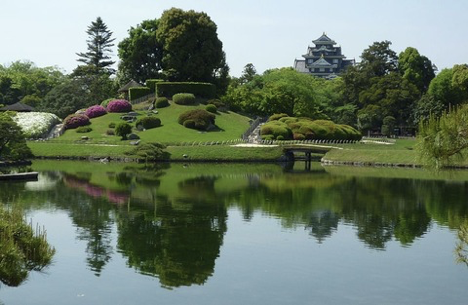
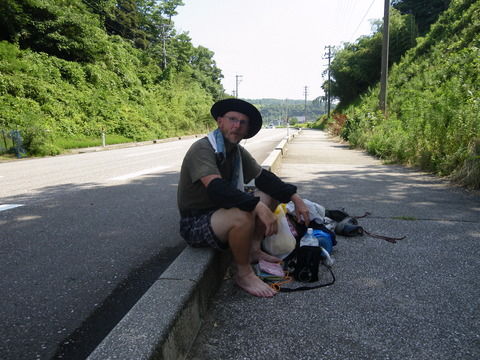
19 Aug, 2014: It was another fresh and beautiful morning, with more blue in the sky than clouds. There were a few flurries of rain yesterday, but nothing to write home about. Hopefully it would not rain on my way to Naruto, and that the clouds would keep the sun off me. Perhaps I could have prayed to the Shinto gods. Amaterasu-ōmikami, was a major Shinto deity. She was the goddess of the sun and the universe. Then again, this was not notoriously adverse climate conditions, that needed a god. My research told me that Tokushima had a humid subtropical climate -- hot, wet summers, and a lot of rain. “Mmm!” If I did need a god, which one should I pray to? I thought. Like on previous days, I was in no hurry to get anywhere soon. The main thing now was to enjoy the breakfast at the hotel, then head back up to the room. All ready everything had been cleaned, dried, and folded up, and stuffed into the backpack. The news headlines in the mornings Japan Times were: ‘Japanese feared captured in Syria’; ‘Sankei’s Seoul chief meets with prosecutors’; ‘Ishiba likely to accept new defense legislation post’; ‘Kawauchi evacuation order maybe lifted on 0ct. 1’; and ’Sapporo assemblyman claims indigenous Ainu ‘no-longer exist’. It was not until I had got my butt across the 1,137-meter long Yoshinogawa-0hashi, a bridge over a river with the same name, that I could feel that Tokushima City was well and truly behind me. If there was one thing that I would remember the city for, it must surely be the many boarded up shops I saw on my walk along the streets yesterday. Tokushima was said to display the characteristics of an old Japanese castle town. The castle gardens were also said one of the most famous in Japan. About two-thirds of the city was destroyed by American incendiary bombs, at the close of the Pacific War, in 1945. Sadly, I could not recall much about my visit to the castle. The same absent mindedness was true with my view to parks, and other tourist attractions. Another thing that I would remember Tokushima for its many bridges. At least 19 bridges spanned the city's rivers. The Shinmachi River, in particularly, flowed through the heart of the city. It was the main transport route for boats loaded up with Indigo, important to the local economy. The Seto Ohashi, an attractive bridge that spanned the river, cost the Japanese taxpayers more than one-trillion yen to build. It took over 10-years to complete. The rail-vehicular bridge system linked Kagawa with Okayama -- five islands and six bridges. A touristy sign welcomed me to the area of Kagawa. “Please take your time enjoying the beautiful natural scenery of the Seto Inland Sea, delicious food, such as, Sanuki Udon noodles and historic tourist destinations, including Ritsurin Park”. Mount Shiun graced the background of the park, with its 13 manmade hills and six ponds, for visitors to enjoy. The park was said to “provide a new view with every step” and beautiful in any season. One place in particular that interested me was the island of Shodoshima, an island renowned for its scenery of Kankakei Gorge. It also boosted a monkey reserve at Choshiki Gorge.
Done
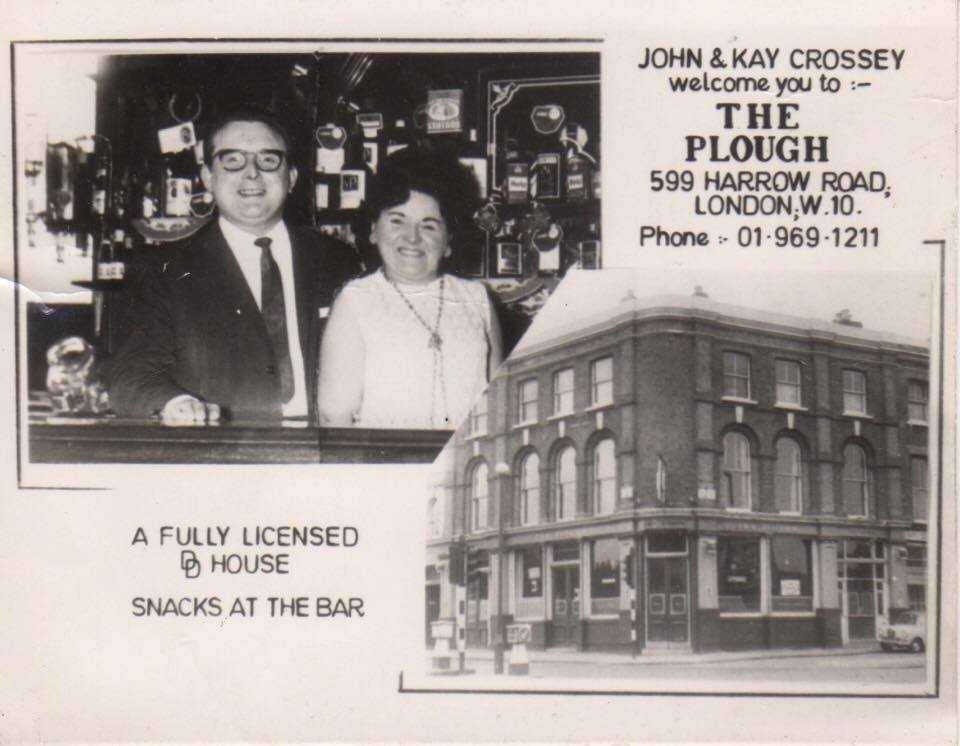
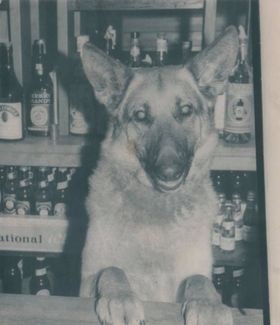
Our guarddog and friend, Mark
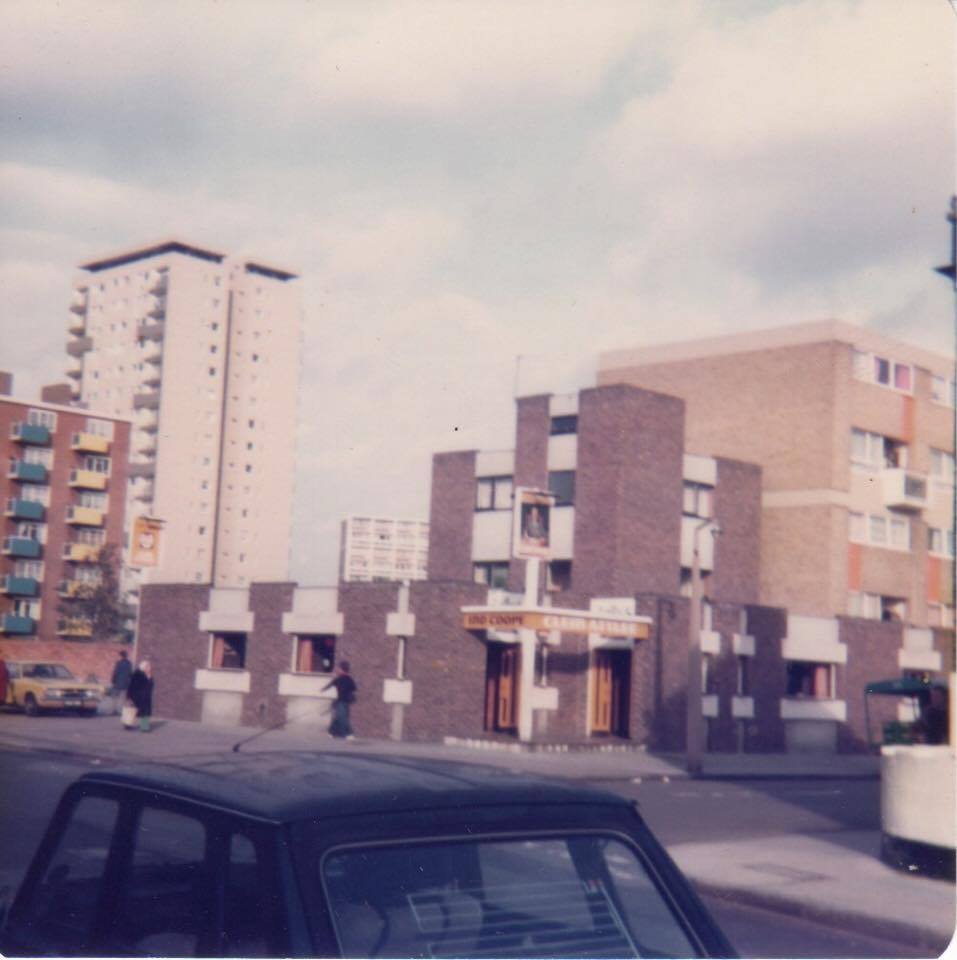
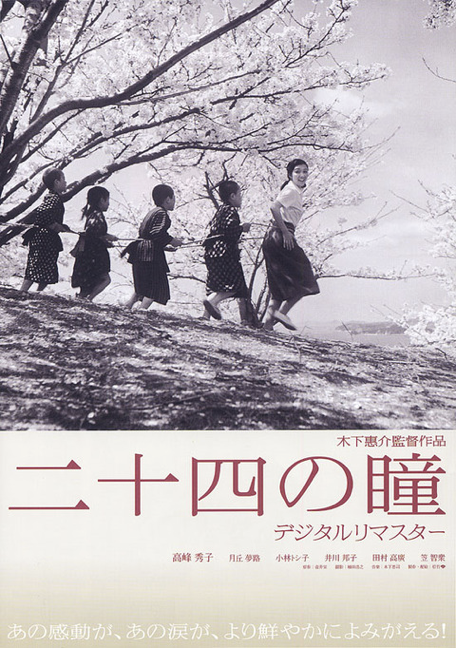
Shodoshim was famous for its olives, depicted in the popular 1952 novel, ’Twenty-Four Eyes’, set on the island. The story plot was about a schoolteacher who formed an emotional bond with her young pupils. A successful film was made of the book two-years later. The many bridges caused me to recall the seven-years I spent in London, in the 1970s. The countless times I walked our Alsatian dog, Mark, along the banks of the River Thames. The Thames was the second longest river in England, at more than 346-kilometers long. The longest being the River Severn, at 354-meters in length. If only I had walked Mark the full length of the Thames -- a memory to treasure. Often I used to take Mark for a walk from The Plough where we lived from 1969 to 1971. On a sunny day, I would take the dog along the Harrow Road, then down along Scrubs Lane towards Wormwood Scrubs Park. At such times, I usually carried a football to kick about with in the park. I well recall how Mark would go tumbling one way or another, it his effort to get at the ball. The Plough stood on the corner of Harrow Road and Ladbroke Grove in Paddington. My father, with his wife Kay, managed the pub from 1969 to 1971. It was the first place I lived in London, after leaving Belfast, at the start of the Troubles. My bedroom window, I recall, looked out over the notable, Kensal Green Cemetery, at the back of the pub. Mark was the guard dog at the pub, but to me he was more like a friend. That was when Mark was introduced to the Thames River. On a good day, I used to take Mark for lengthy walks, that followed along the Thames footpath from Wandsworth Bridge to Putney Bridge, and under the Fulham Railway Bridge. Mark enjoyed the long walks more than I did, for he liked to swim in the Thames every chance he got. Those early days in London that walking, and bridges, came to play a big part of my later unsettled life. We moved a lot during my teenaged days in London, that I do not think I ever settled, nor called a place home. A sence of home was never the same after the death of my grandfather McAleese in Belfast, when my sister Anna and me went to live with dad. It was an uprooted lifestyle ever since. It seems pointless going into the different schools I went to. This was all too familer in the dusty books on Irish history, when children grew up with the fear of leaving home, torn away by economic forces. One of the pubs we moved to was called the Clem Attlee in Fulham, where I stayed from 1973-75. The Clem, as the locals called it, had just been built, so it looked very nice and clean. That is when compared to most of the other pubs my father ran, built in the Victorian era. The distance to Naruto was less than three-kilometers on foot, not 30-minutes away. There, I planned to pitch the tent and stop a night or two, for I felt like I had all the time in the world. “Mmm!” What was there there to do and see once I got to Naruto? Was it worth stopping there? I wondered. According to the pamphlets I read earlier, Japanese people loved to stop and look at the whirlpools.
Done
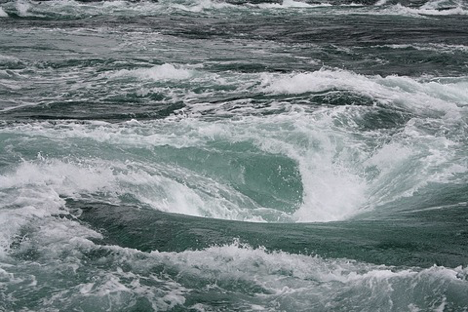
Naruto was famous for, havig the largest whirlpools in the world, if little else. The Naruto Straits was said to be among the most dramatic in the world. It was even compared to the Messina Straits in Italy, and the Seymour Narrows in Vancouver in Canada. According to one pamphlet, the best time to view the whirlpools was around high or low tide time. Further, the best season to do this was in spring and autumn. “Mmm! Food for thought!” I mumbled to myself, as I dropped the pamphlet on the table. This was it the seating area of a Lawson convenience store I called into. The backpack was propped against the chair. I had hoped to enjoy a nice cool can of Sapporo ‘Classic’ beer. However, I remembered that it was prohibited to drink alcohol inside such stores. All the same, I decided to risk it, even if doing so implied a possibility of failure. After a couple of swigs from the can, I picked up the pamphlet again. I read that there were a couple of ways to view the whirlpools -- from the bridge, or from the tour boats. Something told me that this was going to cost money, for nothing was free in Japan. Already Japan was one of the most expensive countries in the world. To view the whirlpools from the Uzu-no-Michi Walkway, cost ¥500 yen for adults. Aboard the Naruto Kanko Kisen, a sightseeing steamship, the cost was a hefty bit more. The cost depended on the boat a visitors found themselves on. The larger vessel, ‘Wonder Naruto’, cost ¥1,530 yen for adults. The ‘Aqua Eddy’, a partly underwater vessel, the cost came to ¥2,200 yen. Unless the visitor was a Japanese politician or a company president, who did not have to worry about their money flow, the cost was not cheap. One way to enjoy the gorgeous scenery, I found, was through the thick glass panels on the bridge. This was a good 45-meters above the water, and the whirlpools below. This suited me just dandy, but the thril would just have to wait until I reached Naruto. “Mmm!” Where the whirlpools a wonders of nature or of the Shinto gods? Such was the thought ran throw my head. My worry was that if I came to feel the same about the whirlpools as I did about religion, before I got to Naruto, then there was a good chance I might not bother stopping.
Done
20 Aug, 2014: Camp , was made just off the side of the road, Route 11, close to a small shrine. There were some graves near by. Graves were called 'haka', in Japanese. On occuasions during my mission I had spent comfortable nights a couple of times in graveyardo, or 'bochi'. Just as I was about to take my usual nap after pitching the tent, the sound of a brush sweeping the ground brought me back to reality. A glance at the cellphone clock told me that it was five-minutes before six o’clock. On looking through the tent flaps, I saw an elderly woman hard at work, her back to me. She did not appear to notice me looking at her. I felt in no mood to introduce myself, and tried to get back to sleep. When I awoke a second time a couple of hours later, I was surprised to still hear the sound of leaf blower. This time an elderly man was busy at work clearing away fallen leaves scattered about the shrine grounds. This remainded me that autumn, and winter, was fast approaching. Accurate seasonal dates in Japan depended on the region. In Tokushima, autumn started in the last weeks of September to the last weeks if December. On closer scrutiny, I could see that the man had a bad limp in his right leg, but seemingly without pain. "Mmm!" Perhaps the limp was the result of a bad accident a long time before. I thought to myself. One good thing about stopping the night at or near a shrine was often the silence. In this case, however, it was the sound of the fresh mountain water that poured from a wall next to the shrine. I asked the elderly man, who was still busy with the fallen leaves, if the water was drinkable without boiling. "Futto - shinaide nome masu ka?" “Hai, nome masu!” He replied in the affirmative. No sooner had the elderly man finished for the evening and driven away, that I was soon crouched down under the flowing water washing my body. The soapy scrub down did not take me very long. The cold water felt so good on my body, that I hoped to do it again in the morning, before hitting the road. A unexpected display of meteors shooting stars in the evening sky, entertained me for a while. When morning came, there was little of anything for breakfast other than a some mixed nuts a friend gave me, before I left Tokyo. The water was soon boiling, and a hot cup of tea was made and soon drunk. On normal cercomstances it was not substantial enough for tramping the road. All the same, the nuts were better than nothing, and it would do until I found a place down the road to eat at. This ws the first time in while that I felt so fresh and clean, and more than ready for the road. Though the shooting star display last night had been entertaining, I could not help surmise if signaled a change in the weather over the over the Kanto region? There was the odd lightening far away last nigt, I could not hear any thunder. Located in the Seto Inland Sea, Shōdoshima was now less than 50-kilometers. On normal cercumstances, that was less that two days away on foot.
Done
I could see the island clearly from where I had camped. The island was famous as the first location to grow olives successfully along its hillsides, hence its nickname, ‘Olive Island’. The name of the island literally meant, ‘Island of Small Beans’. A study of my maps told me that a ferry port was located not far away. During my time in Kyushu, the maps reminded me that I might not be done with the ferries yet. The thought crossed my mind about popping over to Shōdoshima for a while to look about the island. A journey across to the island would be like a feather in my cap, at least something to write about. Unforetunately, I knew that I did not have the time to tramp around the entire place, like I had done on Sadoshima in Niigata. After a while on the sun baked road, the first tunnel of the day popped into view. The Mitsu Tunnel was a 1997 job that ran for 690-meters of nice cool air. In hot weather, the cool breeze in the tunnels felt like a gift from the Shinto gods. Needless to say, I was more than grateful. The Hiketa Tunnel that followed, was very short at just 70-meters. Work was being carried out on the Hiketa Tunnel, and only one of the lanes was open for the traffic to use. Therefore, a workman with the approprate colored flags was placed at both ends of the tunnel to control the movement of the traffic. In no time at all, I was out of the tunnel and back under the scorching sun once again. At long last, I came to the first convenience store, a Lawson, since I left the hotel in Tokushima. Previously, a young male staff member at a store was absolutely useless for information. He did not have the foggiest idea roughly of the location of the store on the map. When I asked him if there were other stores along the road, in the direction of Hiketa, he answered in the affirmative. As things turned out, he was wrong. Along the road, I stopped by at a small local post office in Higashi-Kagawashi. One of the reasons for stopping, was to write out the last of my plain postcards to family, friends, and acquaintances, and post them. Another reason was to escape the relentless heat for a spell. Mainly I found many Japanese whom I stopped to chat with along the road, to be very kind and thoughtful. Not long after I started on my postcards, a clerk came around the counter and gave me a cool drink of green tea. She also presented me with a paper fan, and told me it might be useful when on the road.
Done
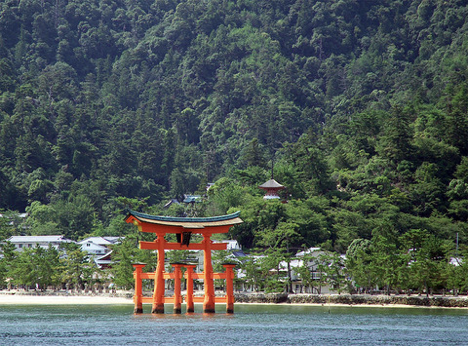
21 Aug, 2014: Camp was set up on a rocky riverbank, not far from the main road, Route 14. This was on the western side of Okarabashi Bridge. It seemed the best place to spend the night. Not far from the tent, the campfire blazed away like mad. An orangey-yellowy reflection danced across the surface of a river, as it made its way into the Inland Sea. The stars overhead ruled the heavens. A cup of inexpensive Australian red wine, that I bought at a Seven-Eleven up on the road, added to the moment. As things turned out the ‘Shiraz 2012’ was not a bad wine at all. Shiraz was a dark-skinned grape grown throughout much of the world, primarily used for red wine. According to the label on the bottle, the wine was made of Shiraz grapes harvested in sun-drenched Southeastern Australia. Being sun-drenched was something that I had in common with the grapes. This caused me to think about the rising sun in the morning. Glancig about the place, there seemed nowhere at hand to shelter under, so I might do well to hit the road early. The label on the bottle also boasted that the wine showed the best harmony between concentrated blackberry and oak flavor -- "Rich and deep ..." “Mmm!” There was noting wrong with a bit of harmony, I thought. It was something that my own life could do with a bit of. My efforts at keeping away from sugary drinks at vending machines had been successful. If only I could say the same about the lollypops I stopped to pick up at shops I passed. Was this something to do with the heat? Or with some lack of discipline on my part? The day before, I had planned to stop and look at the whirlpools in the Naruto Straits. And that the observatory, just below the Naruto Bridge, was as good a place as any. Things did not turnout as I had hoped. A common thing I found myself doing on the road was to daydream. This was not good, for I needed to keep my wits about me on the road. Day dreaming was the reason I missed the turning that would have led to the observatory. After about an hour, I realized my mistake, and was in no mood for turning back. This was not been the first time I had goofed, and no doubt it would not be the last. An earlier mistake was the time I took a minor road in Hiroshima. This was done in an effort to avoid a large crowd of tourists. Little did I realize it at the time, the tourists were visiting the famous tori of Itsukushima Shrine, nearby. The gate dated back to the sixth-century. The Itsukushima Shrine had been destroyed several times over the years. The most recent time the shrine was severely damaged by a typhoon, Typhoon Songda. Typhoon Songda was the seventh or ten to hit the mainland, and the fourth-costliest typhoon on record. It caused the most landfalls since the Japan Meteorological Agency started compiling records, in 1951. The shrine was closed temporarily for repairs, in late-2004. Needless to say, the road I choose not only allowed me to avoid the vast crowds of people, but it also let past the torii gate without sensing that something was amiss. Even if it was said that bad workmen blamed their mistakes on their tools, I had truly misread my maps. In other words, I was not at the place I thought I was at.
Done
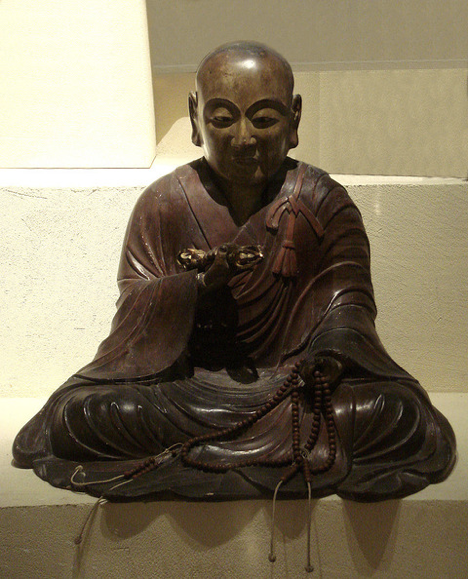
By the time I had realized the cock-up, I had tramped much too far past the famous tori gate to even contemplate retracing my steps. According the legend, the big henro himself -- the Buddhist monk, Kōbō-Daishi (774–835) -- once missed a scenic spot that he had hoped to stop at for a while. The spot in question was called Minokoshi. It was said to be a beautiful area along the Chihiro Peninsula, not that I could find it on my maps. Literally, the name, ‘Minokoshi’ meant ‘I miss it’. The strata along the coastline -- sandstone and shale, a fine-grained, clastic sedimentary rock -- was said to leave visitors feeling as though they were on a different planet.
Done
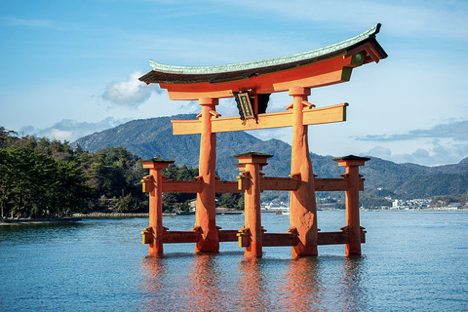
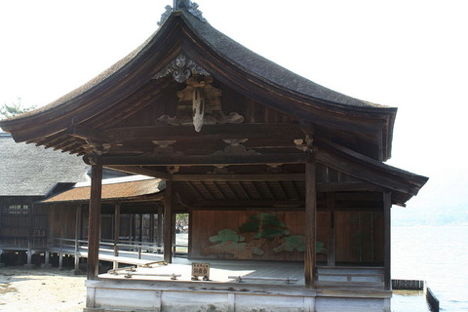
The torii of Itsukushima Shrine, the site's most recognizable landmark, appears to float in the water (Wikipedia)
22 Aug, 2014: When I arrived yesterday evening at Umashino rest stop, I felt it was as good a place as any to camp. The rest stop was located between Tsuruwa and Nibu in the Kagawa region of Shikoku. There were pubic toilets nearby, and a good wooden shelter with benches. The shelter was a good place to be near should it rain. The cheering sound of birds could also be heard from the Cinamomum Camphora trees. There was a water tap, with a little hosepipe attached to it, which should prove handy later on. The water tap was not far from a bench. It was a good place to enjoy the sea breeze, if not the surrounding mountains. The region was not short of excellent places to pitch a tent. One interesting place, for example, was Ohkushi National Park, which featured Shikoku’s first winery, the Sanuki Winery. Further inland, at the base of Mount Nyotai, stood the ancient Ōkubo-ji, the 88th and final temple along the pilgrimage trail. The temple was a tough hike up into the mountions of southeast Kagawa. It had been selected as one of the 100 best landscapes in Japan, by the Ministry of the Environment. This idea behind the award, established in 1996, was to combat noise pollution, as well as, protect and promote the environment. Ōkubo-ji was where the henro who completed the pilgramage successfully, left their walking staff, or kongozue, as it was called in Japan. The walking staffs were said to be an offerings daity at the temple. "Mmm!" I wondered if they prayed for a safe journey back to the starting temple, Ryōzen-ji, in Naruto? In order to acheive enlightenment, the henro needed to complete the full circle, which was also said to be neverending. There were two open plastic containers filled, with water near where I set. "Mmm!" And wondered why they were there. After a little while two cats appeared out of nowhere, and paused at the water. Before quenching their thirst, the cats looked one way and then the next, as if checking for danger. Then they turned and walked away, without touching the water. One of the cats, the larger and more attractive of the two, had a hind leg missing. This did not appear to hinder its movement. The tent had not long been errected when I suddenly realized one hell of a disgusting smell in the air, where I camped. It was pointless upping things and moving to some other part. Upon investigation about the Umashino rest stop, the smell seemed to linger everywhere. At first I thought it might have been the cats, but that did not seem possible. Then I thought of the drain pipes at the public toilets. Thankfully, the smell did not stop me from falling into a deep sleep. The time had gone 06:30 in the morning when I awoke. Once again, there was the sound of an elderly woman sweeping leaves about the ground. Rather that contemplate matters, I headed over to the old toilet building, where I hoped to wash my face and brush my teeth. The sight of the public toilets, and at such a place as a Shinto shrine, surprised me a little. There were so many cobwebs about the wall. The walls were dotted with hundreds, if not thousands, of dead insects that had become trapped in the many cobwebs. In a word, filthy. “Mmm!” What on eaerth was that elderly woman doing? I thought to myself.
Done
What needed seeing to were the public toilets. Rather than take time on my oral hygiene habits, I returned to the tent to dismantle everything. A good distance along the road, I stopped by at a Yamazaki convenience store to see about picking something up for breakfast. Fortunately, there was a place inside the store to sit and eat. This was good, as I also had some writing to do. That was until a Japanese chap entered the store and set down on a chair close behind me. Not five-seconds later, he lit up a fag and began to smoke. This was a first for me, for I thought that smoking was prohibited inside convenience stores. Naturally, I made my way across to the counter, where I brought the matter up with one of the young female staff. Somehow the girl had clearly misunderstood me. “Yes, it’s okey! Please feel free to smoke.” She said, with a broad smile. Needless to say, I was not a happy. The reply surprised me. Surely the girl understood me my Japanese. Did she really listen to my complaint? So I then told the young girl, in slow simply Japanese, that I did not wish to smoke and found it rather out of place that anyone would do so in such a place. The girl seemed lost for words. Just then, the smoker in question, must have overheard that he was the topic of discussion. He stood up and hurriedly left the premises, without saying a word. Now with the smoker gone, it seemed pointless trying to get through to the girl. "Mmm!" What did she care about the effects of passive smoke to the customers and staff? Or so the through momentarily ran through my head. The smell of smoke lingered in the air. Rather than stop longer to finish my writing, I grabbed my backpack off the floor and headed for the door. By now the rain was falling heavily. There were a couple of wooden tables with benches at the side of the store. Fortunately for me, the tables had large opened up beach-like umbrellas over them. So, I set down at one of the tables to continue with my notes, and start on my unfinished breakfast. At the same time, I felt a little angry. The benches were excellent places for smokers to indulge in their habit, kind of like an outdoor smoking zone. Luckily, however, nobody came along and lit up a fag. Not 10-minutes had passed when a car pulled into the carpark and stopped. A man got out, and came over to where I was seated and handed me a large bag full of grapes. Back in Tokyo, such grapes would easily cost more than a ¥1,000 yen. There were a good few bows and smiles, and words of thank you. The little smiling man, returned to the car and, and with another wave and a bow, he drove away. “Mmm!” The Japanese never failed to amaze me. When he gave me the grapes, he said the region was famous for its grapes. This was news to me. All that I knew was, the grapes were absolutely delicious. The bag they were in weighed a fair bit. So, I tried to eat as many as I could, for the though of carrying them for a any distance did not amuse me any.
Done
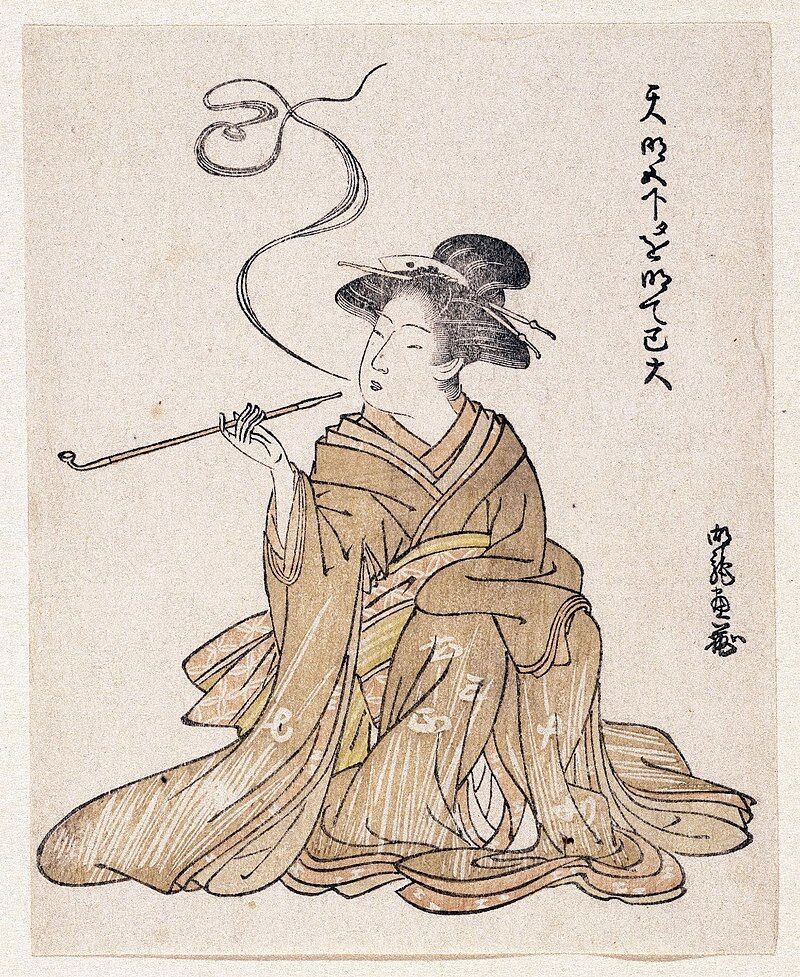
Then again, I had no intentions of dumping the man’s kind gift either. Just as I was toying with where to put the grapes, a young fellow approached the tables and benches. He did not sit-down, but stood nearby and lit up a fag. Unlike a lot of countries in the world, regulations on outdoor smoking were lenient, or permited in selective places. Anti-smoking bylaws have been passed that prohibited smoking in public places. Chiyoda-ku became the first local government in Japan to ban smoking on busy streets, in 2002. A number of wards in Tokyo, such as Shibuya and Shinjuku where I curently lived, had setup designated outdoor smoking sections. People may be fined, should they smoke outside them. Kyoto followed suit in 2007, with the establishment of smoking zones on certain streets. This had since been expanded. Currently, outdoor smoking tended to be frowned upon, particularly on busy streets. Much depended on the floor space at eating and drinking establishments, and how well they were venttilated for bylaws to be inforced. Some places were exempted from such restrictions, such as, Izakaya, Japanese-style pubs. Manutary bans on indoor smoking also applied to childcare certers, clinics, hospitals, schools, hospitals, and government administrative buildings across the country. Efforts were underway to curb smoking at other buildings -- workplaces, food establishments and so forth. Some buildings now had designated rooms for smoking. Some local governments -- Hyogo, Kanagawa, and Tokyo -- had stricter indoor smoking bylaws. For the diehard smoker, designated indoor smoking areas wof were available. ”Mmm!” There was no escape from a Japanese who smoked. I thought to myself. Although in near constant decline, Japan still had one of the largest tobacco markets in the world. Currently, there were more than 20-million smokers, in the country, of whom one-third were female. The age limit for smoking had been 20, since 1876, and which may be lowered to 18, by 2022. The rain was pelting down when I reached Kinrin Park Tsudowa-matsubara, another rest stop area. The park appeared to be geared towards tourism. A number of the wooden benches with shelters were occupied by a group of elderly people when I arrived. Some very young children stood near the edge of the shelter, and tried to push each other into the rain. Other adults sheltered from the rain, most of them smoked. The last time Japan hosted the Olympic Games, in 1964, the government earned one-million dollars from official Olympic-branded fags. Efforts were being taken to restrict smoking further, before the start of the 2020 Summer Games. This month, McDonald’s in Japan, banned smoking at 3,135 of its outletsl. Starbucks maintained a smoking ban, however, there were a number of its coffee shops that had smoking spaces. One Starbucks in Okachimachi in Tokyo that I sometimes went to, had a large smoking area upstairs. It would not surprise me that other big name conglomerates would soon follow suit.
Done
Unlike on previous stages of my mission, it was good that time was on my side. Even the thought of rain left me feeling depressed. Thankfully now, the rain had stopped. A slight breeze had also begun to kick up, and of all places, it carried the foul smell right in my direction. Now, Takamatsu City was well within my reach. In fact, it was too near. It felt like I was on the homeward stretch, or final lap in a race. That sounded good to me! My goal so near at hand, which would mark another successful conclusion to my mission a large. “Mmm!” If only I could master how best to pace myself better during these last couple of days. This was not easy for a man whose body and mind had grown used to clocking up 35-kilometers a day. My mind soon turned to thoughts of a hot bath that awaited me. Thanks to my friend in Tokyo, a hotel room had been booked. Perhaps at the hotel I might be able to think more clearly about making a trip across to Shodoshima. Now I did not want to think much about anything.
Done
23 Aug, 2014: The Tsuda River, near where I pitched the tent last night, teamed with fish. Therefore, it surprised me that I saw no one with a fishing rod, particularly in a country where fishing was a big thing. At either end of the Tsudabashi, the oldest of the two bridges not 20-meters apart, was surely a good place to try your luck with a fishing line. As for me, I never got into fishing, nor eating fish either. That said, if only I had fishing equipment with me now, I would not mind giving it a go. Healthy or not, I preferred bread to fish. There were a few miracles mentioned in the Bible about bread and fish. Incidentally, Jesus’s first miracle was the changing of water into wine, which sounded better to me. Breakfast was cereal, milk, a banana that I picked up at a local Seven-Eleven convenience store. Breakfast would not be breakfast without a customary hot cup of strong tea, with milk. The morning started with the last of the delicious grapes that the kind man had given to me yesterday. The sky was clouded over, ideal for tramping the road. On the road, a cool breeze touched my face and legs. After a good while, I stopped to rest at place called Haryu Pass. Along the way I again noticed the far reaching clutches of the recession -- boarded up business premises here and there. This was at a time when the eight-percent consumption tax was emplimented, soon to be raised to 15-percent, on all things purchased. “Mmm!” Surely the so-called '¥100 Yen' stops should be refered to '¥108 Yen' shops. Something somewhere was wrong. It was another uneventful day on the road. Hardly a word spoken to anyone, baring the staff at the shops I called into along the way. A few attractive women had said hello to me as they passed, but noting more than that, other than a parting smile. It was not easy for me to drag my feet, as it was in my nature to kick up dust. When I did stop and rest, it was not for lengthy periods of time. On the road, for me, time meant the kilomoters trampted. When I reached the Shin-gawa I decided to keep an eye open for a place to make camp near the riverbank. The Shin-gawa flowed into the Ojigaura Bay, which lay between two capes, Kogushimisaki and Ogushimisaki. The names of the capes meant 'small spit cape', and 'big spit cape', respectively. The shape of both capes was said to resemble skewers, like those used for Japanese yakitori. There was a coin operated telescope on Ogushi Cape, where visitors can look out over the water in the direction of Takashima, a small island. The mouth of the Kabe-gawa opened into the Seto Inland Sea. There was a fishing port nearby, called Shinkai Gyoko. The place I finally chose to pitch the tent was a little further along the river, some distance from the Shingaya-obashi Bridge, but with access to the main road. Earlier when I stopped at the Shingawa-ohashi that spanned the river, a large group of boys suddenly showed up. After a short while they started letting off fireworks. They seemed in no hurry to move away, so I decided to pack up and hit the road again. They were nice boys, and seemed to show good manners, and even spoke a few words of English. They could not really converse in English, so most of what was said was in Japanese.
Done
There was a lot of junk laying about -- food wrappers, and bits of spent fireworks. Before hitting the road, I told them to make sure they picked all the junk up. “Oh! Yes, we plan to!” One of the boys replied. The same boy was busy picking out the next firework to set off. Before I left the boys, three of them presented me with a couple of their fireworks, which I was happy to accept. Along the side of every main and coastal road I tramped along, had a fair share of discarded rubbish. It was impossible to take three steps without seeing one kind of dunk or another at or off the roadside. It was easy to surmise that some drivers tossed their empty cigarette packs, and empty cans, from the open windows of their vehicles. The young boys letting off the fireworkd were in the final stages of their summer holidays. Education was said to be the best tool for many things, but I wondered if that was enough. It was also said that a person’s attitude changed when they got behind the steering wheel of a car. They became devoid of their behaviors on the road -- developed a tendency for tailgating, high speeds, and dangerous cutting-off of other drivers. This was road rage in the making. Such mindless drivers were less empathetic on the road, and unaccountable for the environment around them. They were more than likely culprits of the discarded rubbish I passed along the road. If only more people had a sense of pride, a love of nature and wildlife, and their country. Wishful thinking! A Lawson, not far from where I pitched the tent, should come in handy later on. Washing involved a splash about at the side of the river. The remains of my soap did not come to much. Still, it felt so good to climb into a clean set of clothes. The two vehicular-bridges supported trains. It was amusing to look at the faces of the rush-hour passengers. A good number looked down at me, beside the tent. The trains rattled past in both directions. “Mmm!” If only I could read the passengers' minds.
Done
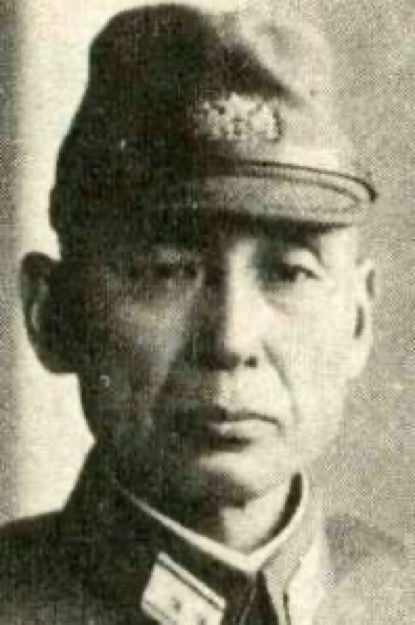
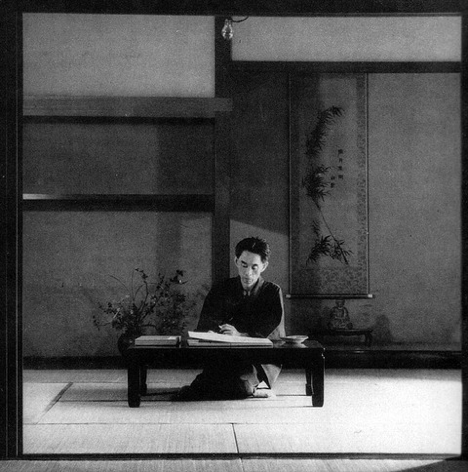
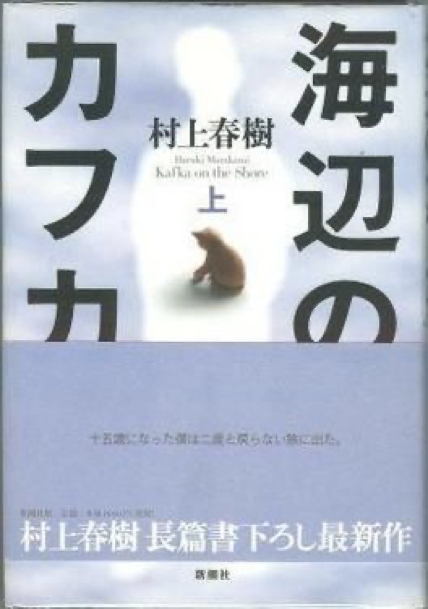
24 Aug, 2014: It was easy to know that I was near to the railway tracks again, before even seeing them. Bells announced the approach of a local train -- single or double-carriage. The Kotoku Line trains seemed not to be overly frequent, even during the morning rush-hour. Longer and faster trains to further away regions, also shared the railway tracks. Earlier, a large seagull sat on the Shingawa Bridge railings, as if to ponder what was for breakfast. No doubt the bird was on the lookout on the river, some 10-meters below. The presence of the bird reminded me that I should pick something up at the store for breakfast. First of all, I wanted to dismantal the gear before anything else. The old mind was also preoccupied with what to keep and what to dump. The plan was to get the backpack-weight down as much as possible. It was a good chance to return to Tokyo with less weight, than what I had started out with. On a bright sunny morning, or with little sign of rain in the sky, I often felt things could not be better. This morning, however, I found myself a little depressed, partly because of the low clouds. Another reason was that this stage of my mission, Stage 14, was drawing to an end. There were mixed feelings about things that I had been apart of -- delighted at compeleting the stage successfully; saddened at the humdrum life that awaited me back in Tokyo. An email from my friend Riko how lived in the Mejiro area of Tokyo, brought be back to the present. The email confirmed my hotel reservation number, and that Takamatsu had two Toyoko Inns. With the help of Google Maps, I was able to locate the hotel that I needed to get to. Hopefully this would help, for I had a habit of showing up at wrong places, or the right places at the wrong times. A good thing about some of the convenience stores was that they had tables and chairs to sit and eat at. They were also ideal to stop and get some writing done. A good number of Starbucks had electrical sockets to recharge electical devices, and whatnot. Outdoors under the elements all day long, such places were welcomed watering holes to shelter at for a while. It was good that Takamatsu had a Starbucks. At such places I liked to sit and read a book for a while, or upload some of my photos. Takamatsu was a port city in central Kagawa on the Seto Inland Sea. The city had a population of around 420,000. It had a large concentration of branch offices that represented companies nationwide. Almost 80-percent of Takamatsu was destroyed by American incendiary bombs, on 3 July, 1945. The city was also the birthplace of Imperial Japanese naval commander, Takeichi Hara, who served his country through the war. After the war, Hara published his memoirs, which remained a prime source for historians. In literature, Takamatsu City was the main setting of the Japanese writer, Haruki Murakami’s 2002 novel, ‘Kafka on the Shore’. The novel was translated into English by Philip Gabriel. The region boosted a humid subtropical climate with hot summers. The rain fell throughout the year, whihc kind of reminded me of my own neck of the woods in Ireland. The heaviest rainfall in Takamatsu was from May to September. Therefore, being late-August, I expected the rain to fall at anytime.
Done
(Wikipedia)
The heavily cloud covered sky began to breakup by around 10:30 AM. No long after, the sun began to rule supreme. The business hotel that I was to stop at was five-kilometers away. Checkin time was not for almost five hours. Therefore, I was reluctant to leave the seating area at the Family Mart anytime soon. Rational thought was not easy under the baking sun. One think that kept popping into my mind was the hot bath that awaited me. Sitting in the bathtub might even be as good a place as any to conclude this stage of my mission. I was in no mood to think about the next stage, Stage 15, in the coming winter. It amazed me no ends at the way things on the road turned out so wrong. Life on the road was a mixture of poor planing and bad timing. Had I decided to wrap this stage up a week earlier, I could still easily have reached Takamatsu. Slowing my pace down, as I had done, proved costly in more ways than one. Because of my misreading of the maps, Takamatsu was the target that I had set for myself. Had I planned better, I could easily have gone well beyond Takamatsu City, perhaps even made it as far as mainland Honshu. Life on the road involved a lot of dragging my feet, or not to get anywhere too soon. The purchasing of a non-changeable air ticket, just to save money, had ot helped any either. My little unplanned trip to Shodoshima in a little while, was going to set me back a pretty penny. Nothing was cheap in Japan, especially when it came to travel, which only depressed me. Actually, I was not sure if I had done my best on the road this time around -- bad planning, walking at a snails pace. In the evenings I slept surprisingly well, even if I was not overly tired. Previosly, covering 35-kilometers really took its toll on you. This encluded the many times I needed to stop to deal with the blisters on my feet. There were a few times when I even questioned my own mind. What kind of a perosn was willing to put up with muscle pain in all parts of their body, on a regular basis? Even when I did my best to stick to a healthy food intake, poor eating habitats seemed part and parcel of life on the road. Clean drinking water was also a main concern day in and day out. And all the more so on the hot sunny days. The only thing I learned in this stage, I guess, was to make sure I put a greater effort into my plans in the futue. Everything needed to be just right, no less and no more. Whenever I returned to Tokyo in a few days time, it would be without a sense of satisfaction. I also knew that the map of Japan on my living room wall would remind me that I could have done better. At a little after two o’clock in the afternoon, I reached the lobby of the Toyoto Inn in downtown Takamatsu. Being a hotel 'club member' the stop included a ¥500 yen discount off the normal charge. The desk clerk remained me that I could not have the key to the room until three o’clock. This was one-hour earlier than non-members. So, I suppose I should look on the bright side of life and stop feeling bad. Also, a long soak in a hot bath was something to look forward to. “Mmm”! I momentarily wondered if the four o’clock checkin time was a thing adhered to only in Japan? Perhaps not!
Done
Even three o’clock seemed late, considering the cost guests got charged at business hotels. There was nothing I could do, other than sit at one of the tables in the lobby and jot down some notes. Thankfully, there was an issue of the Japan Times on the newspaper rack. The headlines were: ‘Hiroshima search delayed by heavy rain’, a subheading read: ‘Rescuers battle on as Abe draws fire for golfing during disaster’. "Mmm!" Nothing surprised me anymore, I thought to myself, as I glance down the front-page. The remaining headlines were: ‘Mudslide dangers to be checked’, ‘Fukuoka floods claim police officer, bigger evacuations’, ‘Bereaved kin of Seoul tragedy time of activists’, and ‘Hirohito annals completed’. It seemed that the conicals of this fellow would be disclosed in the not too distant future for the public to view, as well as for historians to put their spin on. The local elections were looming. I was impossible to get through the day without comig across one of the noisy vans, with smiling, white gloved characters hoping to woo voters to some cause.
Done
25 Aug, 2014: The breakfast area was part of the hotel lobby and was full of guests by 08:30 AM. I toyed with the idea of returning to my room (#506) and wait there awhile longer, instead of hanging around th lobby for a table. Being hardheaded as I was, I decided to stop where I was, with the Sunday issue of The Japan Times in hand. “Mmm!” Today was not Sunday, but Monday. So, I momentarily wondered why the Toyoko Inns that I had stopped at, also had The Japan Times that were a day old. The different Japanese newspapers were always the latest issues. The Japan Times had a circulation of around 44,000. The front-page of this issue was taken up by a single article: ‘Thousands march on U.S. base. More than 3,500 demonstrated at the U.S. Marine Corps Camp Schwab in Nago, Okinawa, to show their anger against a new base being built near Henoko Bay. One article on the third page caught my attention: ‘Beer down, near-beer up in tax shift’. The price of beer was expected to drop, whilst the price of quasi-beer was said to rise. Already a 330-milliliter can of real beer had a ¥77 Yen levy attached to it, which I felt to be ridiculously high. A high tax on beer, or on most things, was never easy reading. “Mmm!” What would Dr. Samuel Johnson have said about a popular growth in artificial beer in his time? Dr. Johnson was once asked the quesion: What he felt was the greatest pleasure in life? He answered that fucking was the first, and drinking was the second. Like me, I think the famous docter perfered wine. The Toyoko Inn was located in a very good part of the city -- right smack in the middle of one of the main shopping arcades with a splendid glass roof. There were shops and stores, and brandname outlets of all kinds, shapes and sizes, traditional and modern, fashionable and trendy -- Louis Vuitton, Gucci, GAP, and a Starbucks, among other big names. Another thing that I noticed as I wandered about the streets was how attractive I found the female gender to be. This was particularly the case among the more mature ladies, not only in looks, but in their fashionable apparance, too. They appeared educated with prosperous backgrounds. Then again, I was a mere onlooker and could only but imagine their backgraound. There were a number of boarded up shops, but most premises were opened for business, even if they appeared nearly empty. There were also many cyclists on the arcade streets. Some of them were moving faster than perhaps they should. There were many eco-cycle points, where people were able to leave the bikes for ¥100 yen per day -- 06:00 AM to 12 midnight. Back in Tokyo, the cost to park your bike ranged from ¥200 to ¥300 yen. That said, it was easy to see that many people preferred to leave their bikes here and there, for free. As for myself, I never realy got into used to paying money to park my bike. Back at the hotel, I made enquires about the best way to get to the airport. A female desk clerk told me that the bus stop was at the Rihaga Hotel, on the opposite side of the road, Route 30. She told me that it was not far to the airport, and handed me a sheet of paper with the bus timetables.
Done
What happened in Japan and the world on this day????