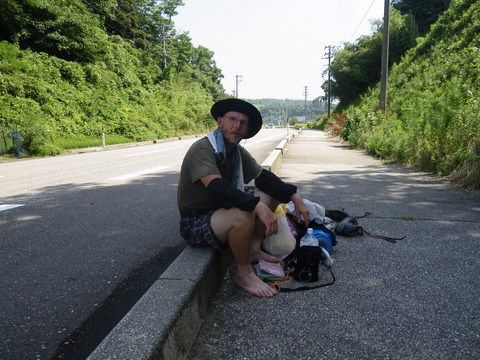
Irishman Walking (Stage 11 Chapter 2) is about my walking the main and coastal roads of Japan. Summer 2013.
2 Aug, 2013: By morning the rain had stopped and everything but the grass along the riverbank was dry. On the road, progress was slow, but steady. On those days when I would let things take their course, I had more time to enjoy the surroundings. Therefore, I had a feeling that this was going to be one of those lazy days. As far as my maps allowed me to believe, Himeji City was about 10-kilometers away. Or not that far to find a place to eat. This was good, for I had upped camp without bothering about rustling up something to eat for breakfast. As I continued my way along the road, I began to feel unsure about the city, or that it was further than I had hoped. A few people whom I stopped a short while to chat to felt Himeji was nearer to 20-kilometers at the least. That was the sort of information I could have done without hearing, especially as I was beginning to feel about of diarrhea coming on. Last night sleep was uneasily. Actually, I could not sleep, even though I was fagged out. An upset stomach that I put down to either having eaten too quickly, or that the pork had not been cooked properly. To make matters worse, the sudden need to pay a penny occurred about five-minutes before I came to a public toilet in a large park. And with a quick glance about me, to see if anyone was coming, I ducked behind a cluster of bushes in order to settle the issue once and for all. Around five-minutes, or so later, I arrived at the outskirts of the park in question, only to notice that there was a convenience store nearby, along Route 250. Of course, being camped near a store was always beneficial in more ways than one. Most of convenience stores, I thought, did a brisk trade. They also more the likely caused the demise of the little local grocery shops that once served their communities. Then again, perhaps the local shops were just as responsible, they were a wee bit more expensive. Besides, they could not possibly have competed with anything near the variety and kinds of goods that the convenience stores had on their shelves. “Mmm!” I wondered if the local shops could have survived in this country of endless change? The little local shops impressed me. Not in any fruitful way, but rather, in showing degrees of poor management that I could not have imagined — dull lightening, poorly stocked, with a dead, corpse-like atmosphere about them, sort of, stuck in the past. One of the biggest phenomenons in life was that time waited for no one, and what there was, passed by so damn quickly. It seemed only minutes ago that I had upped camp and hit the road, but now here I was tramping through the gold of the afternoon, with no sign of my old friend the sea for a companion. Not caring to stop at the convenience store, I continued along the road, passing other large parks as I went. Years earlier the parks had been one large piece of farmland, perhaps it belonged to some rich family. With the cutting, and chopping, and clearing, and laying off roads, the land became what it was today. This was progress! Modernization! Fall into line, become part of the present, or else be left behind. For the most part, a number of elderly people appeared to stroll about some of the parks I passed.
In another park, I saw groups of youth getting ready for ready for football practice. “Mmm!” Was some mini-tournament about to take place? All of the children were clad in their colorful team kits. Some of the teams had lined up, and appeared to be taking hell from the coaches. I never fully understood why the Japanese coaches shouted in loud and angry sounding tones. It was the sort of thing one expected from sergeant-majors in the army. This was not the army, nor soldiers being trained to fight and kill. They were young children with dreams of becoming great players like their football heroes. A lover of the sport, and tuning into English Premier League games when the chance allowed, I was tempted to drop the backpack and sit-down to watch the kids kicking about awhile, but on I chose to push instead. After a while, my eyes fell upon another convenience store, and here I decided to make a stop and treat myself to a nice cool can of Sapporo beer. This was not because the weather was damn hot, which it was, but rather, drinking only water was beginning to bore me. Nothing beat a cool beer on a hot day, and seemed to recharge the old body, if not the brain, too. The first few days on the road were now surpassed by more sanguine expectations, for the kilometers now fell away one after another like dominoes. If I wished to reach Himeji City by late afternoon, then I needed to put my best foot forward, for there was still a good 10-kilometers to go. Now and then, the countryside around seemed to have the fragrant smell of cut grass, borne about by the soft breezes that stirred the early afternoon air. In the end, my own feelings about the distance of the station, near the hotel, ‘Via Inn Himeji’ where I was to stop the night at, turned out to be correct. The hotel was only a two-minute walk from the station, and a three-minute walk from the castle, so I guess it should be easy to find. Everything was about timing now, to pace myself, and enjoy the little rest-stops without a care in the world, that was my plan. Checkin time was at three o’clock. The road led me through the little uneventful area of Mitsu in Hyōgo, which according to the 2003 census, had a population of 11,966 inhabitants. Nearly two-years later, Mitsu became part of the city of Tatsuno, in late-2005. On an added note, Tatsuno was the birthplace of the Japanese poet and writer, Masao Miki (1889-1964), who wrote under the name, Rofū Miki. Miki was baptized a Catholic in 1922, and much of his faith was reflected in his works. Five-years later, he was given the Order of the Holy Sepulcher of Jerusalem from the Vatican, in 1927. He also received the Japanese Medal of Honor from the Emperor, in 1963, about a year before his death, following an accident. The only real noticeable aspect of this day on the road from Mitsu, I suppose, was that the rain held off. Just about now, a tiny flutter of rain had made an appearance, but stopped almost as soon as it stopped. After a while, I finally took my leave of Route 250 and turned onto Route 62, which would lead me to Eikinan-Jji train station. At the same time, I stayed as near as possible to whatever shadows there were. It was not long, I knew, that I would be climbing into a hot bathtub for a good long soak. Any thoughts of tomorrow could wait until then.
3 Aug, 2013: Sleep and time passed so quickly. So fast that I was unable to see anything in the city, museums or the castle, and so forth. It had been said that time was life's most precious commodity. Like money, it certainly seemed rare, or a thing that could not be mere manufactured. Therefore, time had to be prioritized, treasured, for once it was gone, it was truly gone, never to come again. One problem, I was not the best at placing things into perspective, and would spent roughly equal time on just about everything. I tended to see things more important than they really were. There was no strategy for what mattered most and what did not. Was it possible to create more time, in the same way someone stumbled upon a financial windfall? When I was a youth, time seemed to be in abundance, even if money was not. I recall how doing chores and school-life seemed to go on forever. It was during that time I visited a museum for the first time. I think it was the British National History Museum, in London, but I was unable to recall what I saw or who I was with. It would have been nice to have visited some museums, such as the history museum, since I loved history, or the natural history museum and learn something about the land I walk on, or the mosquitos I fought with. About one and a half million different species of insects lived on Earth, of which some 900 thousand different species of living insects were known. This included the 6,000 known species of those six-legged tiny (0.25-10mm in length) springtails, found in all sorts of places on world, from cliffs, the high mountain ranges, the Antarctic and on beaches where I liked to camp. “Mmm!” I momentarily wondered how many bugs inhabited hotel beds? So many people felt rocks dull and uninteresting. Noting could be further from the truth, for they helped tell us how the world began, and how volcanoes and sediment formed on its surface. With the cuts and blisters on my feet far from healed, I decided not to put put much weight on my feet, and stop one more night at the hotel, Via Inn Himeji, to rest and think about as little as possible. Fortunately, I was able to keep the same room (#1106), which was not always the case at some of the hotels I had stopped at. Last night, as I was climbing into bed, I noticed a tiny round hold on the bottom sheet, probably from a cigarette butt. If that was not enough, I also spotted a single black hair on the in-room electrical hotplate device for boiling water for tea or coffee. “Mmm!” Why should I complain? Down at the breakfast area in the morning, I was surprised at how busy the place was. “Mmm!” Japanese hotels were usually very busy on weekends, and I guess I was fortunate to get a room. All the same, I could not help but think to myself that the whole of the Himeji population must have called into the hotel to eat. There was noting else to do, but to join the queue like everybody else. That was not the problem. Rather, there appeared to be only two female staff on hand, and they appeared to be rushed off their feet, dealing with the maddening crowds. Their chores involved preparing food, keeping the buffet area topped up, as well as, clearing tables and ushering guests to tables that became available. No doubt the chores involved washing and drying the dishes, and so forth.
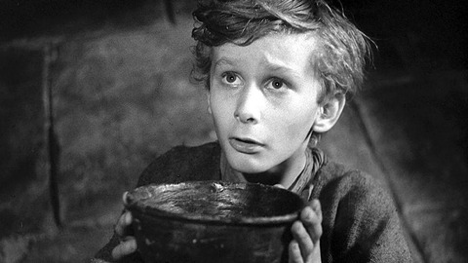
Oliver Twist (John Howard Davies) daring to ask for more, from the 1948 film (mubi.com)
The buffet area, if not the hotel lobby, was so busy, that any idea of lining up again for second helpings, was out of the question, or so I felt. Therefore, I was damned if I was going to do what a certain young boy name 'Oliver' had done: "Please, Sir, I Want Some More.” A number of countries led claim of the function or meaning of the good old 'buffet'. The word itself had twelfth-century French origins. It meant a stool or bench, or something that could be eaten from. Another meaning was 'a blow' was in to hit, and 'a puff of wind'. The word referred to hurriedly prepared food in seventeenth-century French homes, "when gentleman callers would arrive at the homes of ladies they wanted to woo unexpectedly" (Wikipedia). In nineteenth-century England, it referred to self-service food from a sideboard, just like it did today. At that time, it was usual for guests to eat standing up. Then there was the famous Swedish 'smorgasbord', a buffet-style idea, that served various hot and cold dishes from a table. The buffet was deemed an easier means of serving food to large crowds, with the least possible trouble or effort. Then again, a look at the unfortunate undermanned staff at the hotel was more than food for thought. In the meantime there were a few more of my plain postcards to write out and get ready for posting to family, friends, and acquaintances. Then again, I was not sure I wanted to do that in such a crowded place, and would do better to leave it until I returned to my room at the hotel. Even the penning of postcards had a fair history be hind them. The first, so called, official postcards, in Japan, was in December, 1873. They came not long after the first stamps made an appearance in Japan, in April, 1871. The very first postcard ever, was believed to have been both penned and posted by, Theodore Hook, in Fulham, in London, in 1840. Hook was noted for playing practical jokes. Once the postcards were done and ready, I decided to take a slow stroll over as far as the castle. This being a Saturday, I expected everywhere to be also crowded, particularly the shopping arcades. Such places were good to cool down and except the mugginess outside, for a while. The television news forecasted the absence of rain, which was good, regardless of the heat. It did not take me long, even with my sore feet, to reach the castle grounds. As I had anticipated, there were a lot of people, including a good number of foreign tourists. At least, they did not look like people on business, dressed in shirt, suit, and ties, and so forth. I used to think that foreigners preferred to stop at the traditional Japanese inns, as opposed to business hotels. It was around there that I stumbled on a zoo, where I decided to pay a visit first. To my surprise, there was no entrance fee. If it had something to do with good timing, like entering without being noticed. Of course, I would have been happy to have bought a ticket had someone been at the gates. Many of the animals appeared to be knackered out, if not bored with their situation. Zoos may have more positive points than negative ones, but all the same, they were a kind of animal prisons. In the end, I came away feeling sorry for the animals.
When I finally did reach the castle grounds, I could not help feeling that it was at the worst of times. At the time, the castle was in its third of five-years of restoration, and very little of the exterior could be seen. A massive scaffold and fabric cover surrounded the main castle keep. There were two elevators in service, with many people waiting in long queues to use them to the top. Once at the top, after using the steps, only a tiny portion of the inner wall and roof could be seen, and only then from a incasement recently constructed for the purpose. To quote from a pamphlet that I picked up: “Experience the overwhelming scale of Himeji Castle’s main keep and expert craftsmanship from a prime viewing spot open for a limited time only.” What? Two more years! The last great restoration job on the castle was carried out in the late-1950s to early-1960s. At that time, the main keep was covered with scaffolding made of wood. A completely different form of engineering, which according to records had successfully withstood a couple of voracious storms that struck the region. The full-scale restoration project this time, was to re-plaster the damaged walls and replace the tiles on the roof. Himeji Castle became a UNESCO World Heritage site in 1993. According to what I read in a touristy guide-cum map of the castle and its surroundings, the castle was in its original design since it was built in the early seventeenth-century. For example, the main castle keep, including the turrets, stone walls, gates, and moat, etc, remained in their original state. That said, the castles history dated back as far as the mid-fourteenth-century. The city’s elegant white appearance caused it to be compared to a white bird in flight, hence the nickname, ‘White Heron Castle’. This made the castle rather hard to miss. Then again, I was not exactly a novice when it came to missing things of importance. No doubt, had I passed by the castle on my cycling journey around Japan, in the late-1970s, and again in the mid-1980s, but I was damned if I could recall anything about making a stop to see it. My visit to the castle this time was one of the reasons for my deciding to stop an extra day in the city. A mistake to say the least! On an added note, part of the 1967 Jame’s Bond film, ‘You Only Live Twice’ was shot on location in the castle grounds. “Mmm!” It would be nice to watch the film again, as I had mostly forgotten it. Looking across the city from the top of the castle I could make out Mount Shosha, where the Engyo-ji Temple stood on its summit. The temple was founded in 966, and in its hay day, was one of the most important centers to practice Buddhism. In more recent times, visitors to the area preferred to look at the mountains rich abundance of nature. Many of the main buildings in the Shoshazan Engyoji Temple complex were rebuilt in Muromachi period (1336–1573). The mountain drew pilgrims all year round, and the summit could be reached either by using the 1.6-kilometer long hiking trail, or by the Mount Shosha Ropeway, which was opened to the public in 1958 and took four-minutes to reach the summit. On an added note, part of the 2003 film, ‘The Last Samurai’ that stared Ken Watanabe and Tom Cruise, was shot on location at Engyo-ji Temple
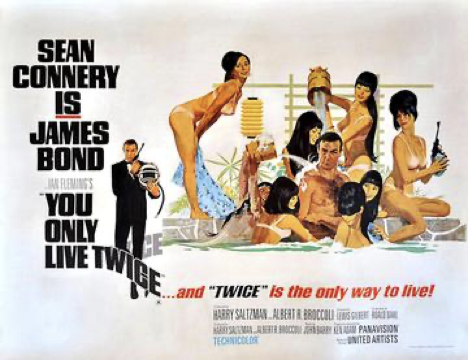
(Wikipedia)
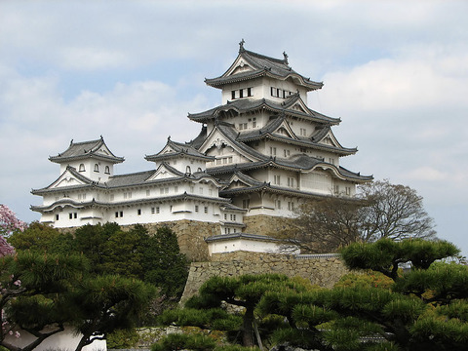
The Himeji Castle, the location of the ninjas' training scene in You Only Live Twice (Wikipedia)
4 Aug, 2013: After a simple breakfast at the hotel, the time had come for me to get my arse into gear and make my way in the direction of the main drag, Route 250. Once there, I looked up at a directional road sign that pointed towards Takasagi City. A glance at my maps told me that the city was too far to reach by tonight. I know I must arrive sometime. Takasago City was located in Hyōgo prefecture where I was headed, and was the smallest city in region with a population of around 92,500 inhabitants. The city was founded in mid-1954. Takasago was a fishing town, known for its ports, but had since industrialized with many factories that dotted its skyline in the south, such as Mitsubishi Hitachi Power Systems, the Kobe Steel Takasago Manufacturing Complex, Mitsubishi Paper Mills, Takuma Power Plant, and Kikkoman Soy Sauce (Wikipedia). A sight to behold every September was the Takasago Lantern Festival and one of the city’s main events. Spots around town were illuminated with some 10,000 candles placed all over the town. The colorful candle lite lanterns could be enjoyed at a number of important city landmarks, such as at, historically important buildings in this area, this included at Takasago Shrine, along the Horikawa River, and at the Takasago Park. Empress Jingu was believed to have paid a visit to Takasago Shrine on her triumphed return from Korea. The main deities worshipped at the shrine, since 1600, were Onamuchi-no-Mikoto, Susano-no-Mikoto and Kushinadahime-no-Mikoto. The two-day festival was held in recognition of the city’s old fishing port being granted as an area of cultural significance, in 2006. Along the road again, I made a stop at a 7-Eleven convenience store to replenish my water bottles, and treat myself to a cool beer. The young girl behind the counter was a little surprised at my request, and asked a coworker if it was alright to refill my bottles. Such places sold various brands of bottle-water, so I guess I could well understand the young staff members apprehension. “Mmm!” For a moment, I even thought my request to be a bit of a bridge too far. Fortunately, however, the other young staff member nodded her head in the affirmative, and with that, both of my 500-milliliter water bottles were picked up and filled at the sink behind the counter. Even when the road signs along the road were clear and plenty, it was easy to get lost or take a wrong turning, if you did not keep your wits about you. To cut to the chase, that was what happened. Somehow I had found myself tramping along Route 551 for a good hour, or about five-kilometers, before I realized that something did not quite seem right. Needless to say, I had to turn around and head back the way I had come to get back onto Route 250. Once back on track, I headed left towards Takasago City as planned, and which according to a distance-directional road sign, was seven-kilometers further along. Naturally I was not in a good mood, and knew that I would have reached the city by now, had I not fucked up. Of course, needed to be more careful from no on. “Mmm!” How many times had I told myself that? I wondered. All the time the sun continued to back down on top of me like there was no tomorrow.
Away on the horizon heavy clouds appeared to be moving in my direction. How much more worse the loss of time and distance might have been had it already rained. Now I found myself tramping along the road, Route 225, with thoughts of the seemingly deteriorating weather on my mind. Thankfully, the road was not very busy, and in fact much of the road and the surroundings seemed to me as thought I was still in the countryside. The built-up areas, if they could be called that, reminded me of the outskirts of Tokyo, such as, Adachi-ku, where I had lived for many years. The other wards on the edges of that busily mad metropolis were also similar, or not quite part of the city. Camp was finally made on the Kobe side of the banks of the broad 31-kilometer long Kamo-gawa River. Much of the river was flanked by cherry blossom trees. Kadogawa City was located in Hyōgo prefecture, and was granted city status, in 1950. Today, the city had a population of more than 266,000 inhabitants. A big employer, was Kobe Steel, which had a large steel plant in Kakogawa. The current Japanese prime minister, Shinzō Abe, was once employed at Kobe Steel, before he took up politics. "Mmm!" Just 31-kilometers was a relatively short length for a river, I thought. Most of the rivers in Japan ran for a 100-meters ad much more. Still, the Kamo-gawa had a bit of history about it. It passed near the imperial palace of the ancient Heian Capita, in todays Kyoto, in the eight-century. In fact, the course of the river was diverted to pass to the east of the place. This may have been because of the threat of flood that plagued the capital. The emperor at that time, Emperor Shirakawa, was reputed to have said that the Kamo-gawa was one of his three unmanageable problems. The other two being, troublesome monks, and playing dice. Even though the problem of flooding still existed, the banks of the Kamo-gawa, like many of the rivers that flowed through the country, was reenforced by concreted, with improved drainage systems. Because of the unstable condition of the rivers, heavy goods were often transported by canals instead, during the Tokugawa period. The river was once a source for clean drinking water, for the residents of Kyoto. Water from the river played a part in the creation of Kyo-Yuzen dyeing, a famous craft of Kyoto. Not only Kyo-Yuzen dyeing, the river was also the source for the traditional craft of raku pottery, to say nothing of it being the birthplace of the Japanese art of Kabuki. Kabuki was the ancient form of dance-drama, and whose founder, Izumo no Okuni, a miko, a Shinto shrine maiden, was said to have given a new performance of her dance, on a dry river bed on the Kamo-gawa, in 1603. As her troupe of performers were exclusively female, they therefore played both male and female roles. Althought Okuni was believed to have retired from kabuki, in 1610, the shōgun Iemitsu Tokugawa, eventually banned women from having anything to do with the art, in 1629. This was thought to be the result of the growing immoral behavior at the time. Sometime later, the roles were filled by male performers, but this too was eventually banned, for the similar immoral reasons.
Rather little was known of Izumo no Okuni's private life, which included even the year of her death, the contribution she made to Japanese theater was immense. Unfortunately, it was an art that I never grew to appreciate. In the 1980s, when I used to teach English conversation to doctors and nurses at the Cancer Center in Higashi-Ginza in Tokyo, I used to walk past the old Kabuki-Za, built in 1950. It was Tokyo's premier Kabuki theater, on the main drag not far from the hospital. A history buff as I was, I sadly never even ventured inside the building for a look-see, for its doors were always open in those days. I still recall the fuss that was kicked up when plans were underway for the 1950 building to be demolished. That was back in springtime, of 2010. The new Kabuki-Za theater took the best part of three-years to complete. Many Japanese acted as thought a large part of the Japanese culture was being surgically removed and dumped in a heap for the crows to scavenge over. Correspondingly, a number of goodbye performances were held in memory, called ‘Kabuki-za Sayonara Kōen’, in January through April, the year work on the building began. Needless to say, the kabuki performances continued, at places like the nearby Shinbashi Enbujo. This was until the new theater opened a short while ago, in late-March, 2013, with its baroque Japanese revivalist style just like its predecessors. The post-war architectural style was was similar to that of Buddhist temples and Japanese castles, of the Tokugawa period. In the light of the baroque revivalist style, buildings had come along way in recent years. Especially since the original Kabuki-za building, a wooden structure, opened in 1889, was like many such buildings, prone to earthquakes. The Seismological Society of Japan had been established, about nine-years earlier, in 1880. The Shindo scale, which recorded the seismic intensity, was how the measurement of earthquakes was made, in Japan these days. Similar, though different scales were used in a number of other countries, like, America and China, etc. The Kabuki-za establishment itself was the brainchild of Fukuchi Gen'ichirō, a journalist, in 1903. The early building, however, was destroyed a few decades later, in 1921. This destruction of the building was not caused by an earthquake, but rather by a fire from a malfunctioning electric mains. Actually, the first electricity was introduced into Japan, in 1878, just 10-years into the Meiji period. This was at the Institute of Technology in the Toranomon part of Tokyo, not far for the Kabuki-Za. In those days, most Japanese were still unfamiliar with the use of electricity. The use of electricity was still uncommon in many countries in the world, even in Europe and America. Japan's first electric power company, the Tokyo Electric Lighting, was set up in 1886. Other companies would soon follow. The Great Kanto Earthquake, of 1923, caused considerable damage on the new reconstruction, which would finally be completed in the following year, in 1924. By the similar token, the Kabuki-Za building would again be destroyed, this time by American bombs at the tail-end of the Pacific War, in 1945.
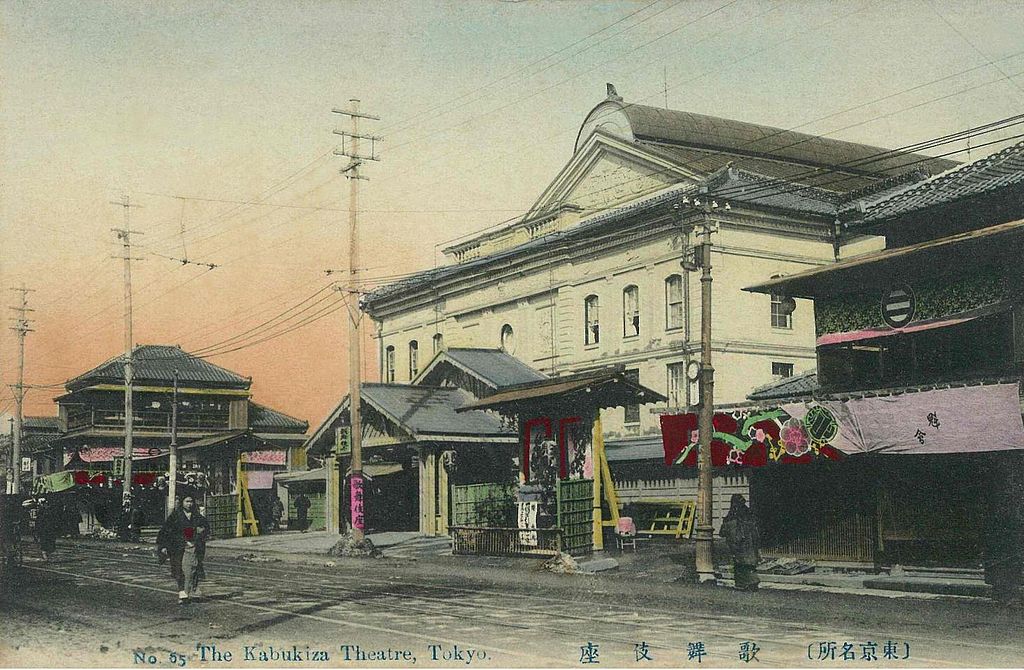
Postcard depicting the original structure, 1889-1911 (Wikipedia)
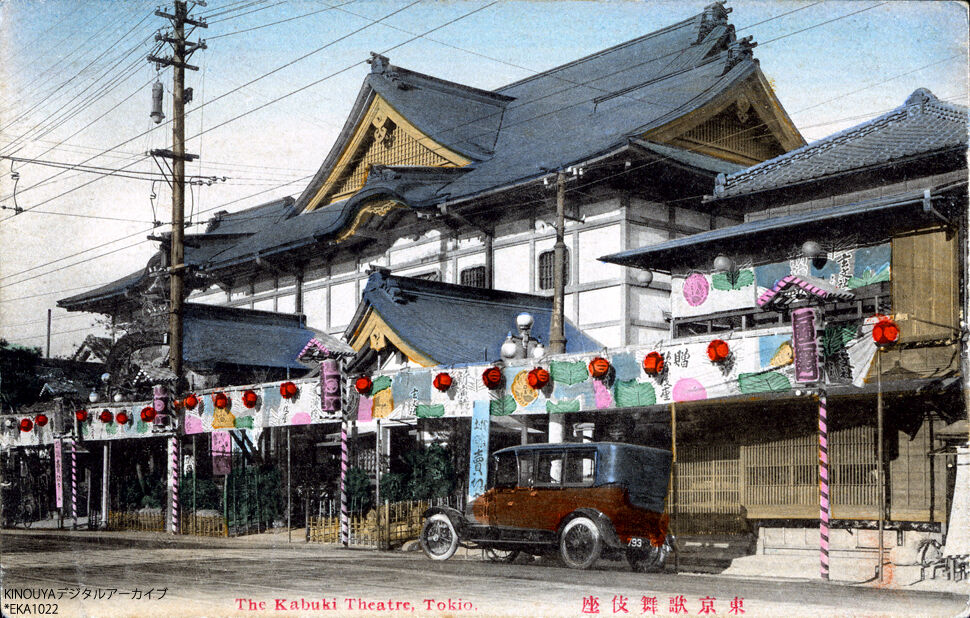
A postcard depicting the theatre as rebuilt, 1911-1921 (Wikipedia)
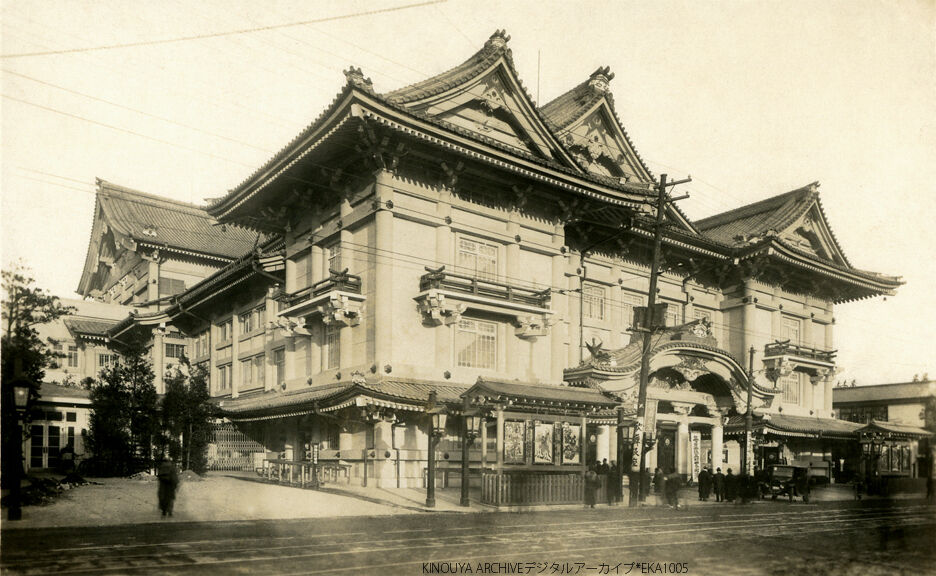
Postcard depicting the pre-war reconstructed theatre, 1924-1945 (Wikipedia)
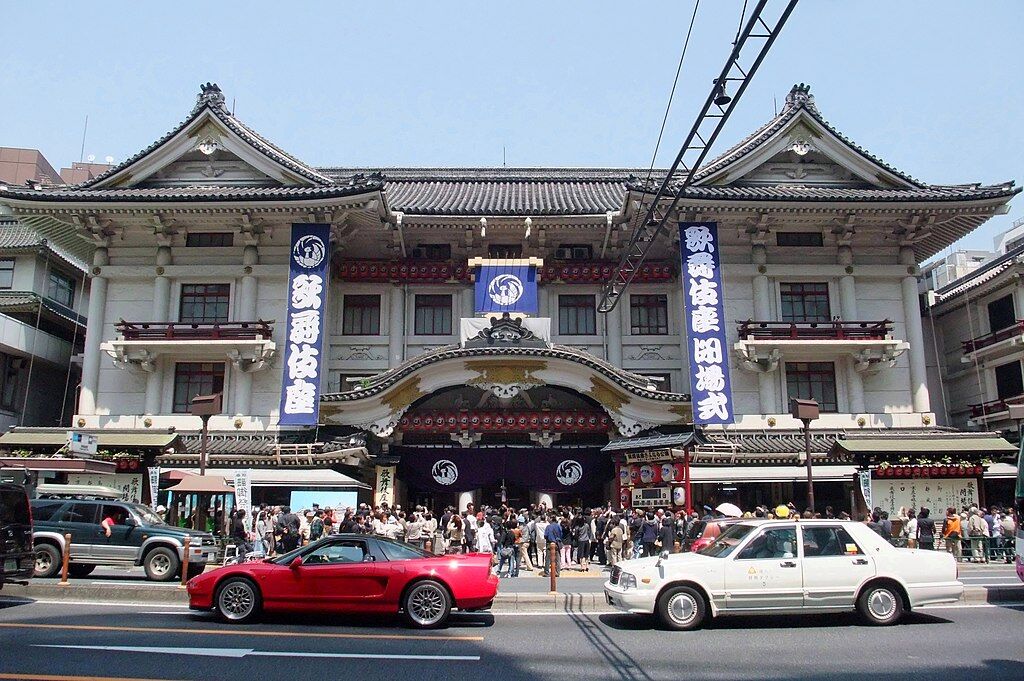
Photo of the post-war reconstructed theatre, 1950-2010 (Wikipedia)
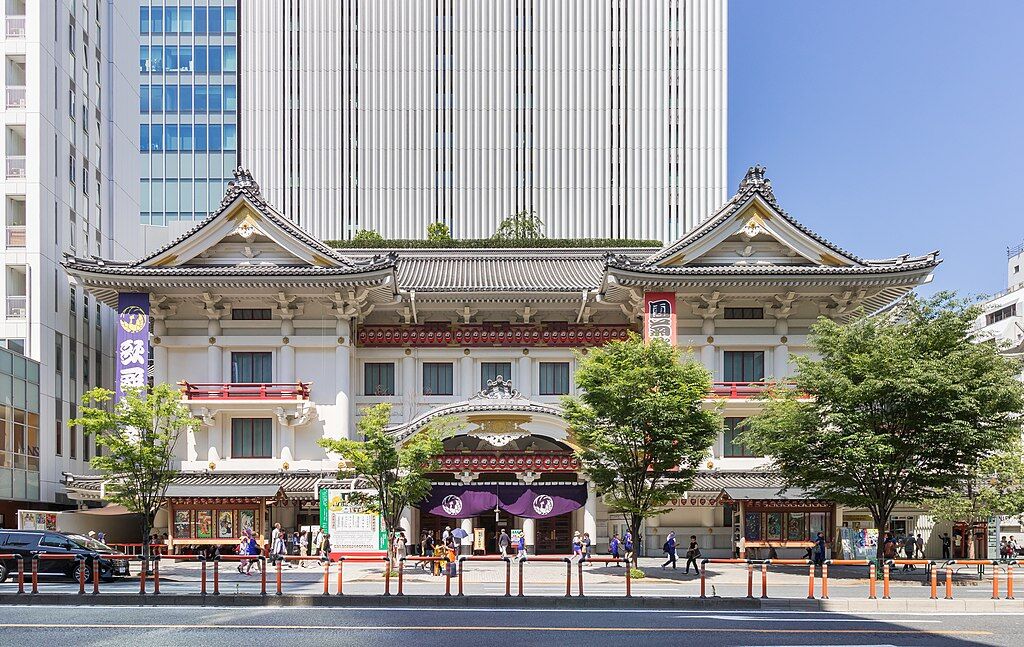
Kabuki-za, Tokyo's premier kabuki theater (Wikipedia)
To put it another way, Tokyo took a a hell of a hammering from American bombs in the closing weeks of the Pacific campaign. On night in particular, 9-10 March, codename, 'Operation Meetinghouse', proved the most destructive of the lot. The event was referred to as the 'Great Tokyo Air Raid', in Japan. The raid leveled about 41-square-kilometers of central Tokyo, killing around 100,000 people, and countless numbers homeless. After a while, lots of people, such as, mothers, fathers, and their children, and a fair number of elderly, too, cycled, walked, and jogged along the footpath the rain along the riverside. Water was life, it was what people needed most, so it was vital in more ways than one. Living close to water certainly had its benefits. This did not only mean out for a stroll with the pet dog on a footpath along a river, or relax on a rich sandy beach somewhere, with a splendid view for company, or a scenic drive with a close friend somewhere nice. No, not at all! A breath of fresh air near the water was richer in both moisture and oxygen, and therefore worked wonders on stress, the sort of thing people experienced on a daily basis. People who lived near rivers, ponds, lakes, or the sea and ocean, had stronger immunity systems that city folk. Therefore, their bodies were better equipped to deal with health conditions, or diseases that might snuff out the average Joe Blogs. Water gave people a way to clear the mind and body and relax. As for myself, there was nothing better than grabbing a well earned uninterrupted sleep on a beach. The sound of water had meditative or therapeutic powers on the mind. At least, it certainly had a positive effect on mine. The sound of water moving helped me to relax, and often gave me something comfortably worthwhile to think about. "Mmm!" Did that have something to do with the hormone dopamine? I momentarily wondered. It was hard not to wonder, also, if the benefits of water not only reduced stress, but help people to live longer? The plants and trees released phytoncides into the air. This was a group of chemicals that increased the white blood cells, which activated the body immune system, not to mention, calm the old nerves. Clearly being out along the riverbank was popular spot for the local people to burn off some stress in the form of exercise. A good number of high school age boys and girls, likewise made their way along the footpath in little groups. Where they were headed I had not the foggiest idea. Some of them sauntered past my tent and up onto the bridge, where they stood and merrily chatted away awhile. The people appeared friendly and even cordial. Afterwards, it became clear why most of the people seemed to be on the move in one direction. In the distance a fireworks display lit up the sky. The Japanese were mad about fireworks. Unfortunately, I could not see much of anything from where I pitched the tent, on a raised embankment, about 100-meters from the bridge. No sooner had the first fireworks begun to light up the sky when the rain also started to fall. Most of the people up on the bridge did not seem to have umbrellas, nor did they appear too perturbed about getting wet. Nothing was going to budge them from what they had come to enjoy.
Fireworks were known as 'hanabi' in Japan. The kanji for 'hana' was 'flower', and for 'bi' (also 'hi') stood for 'fire'. When placed together the word literally meant, 'Flower of Fire'. Fireworks were invented in China in the Song Dynasty (960-1279), founded by Emperor Taizu. As for myself, I never cared much for fireworks displays, and even less for the crowds that flocked to see them. Fireworks were believed to have come to Japan via China, in the 1600s. The first appearance of a firework display in Edo (modern Tokyo), was held on the Ryokoku-gawa, in 1733. It was organized on the orders of the shogun, Yoshimune Tokugawa (1684-1751), to commemorate the many lives lost to cholera, and to pray to the gods that the pandemic would soon end. "Mmm!" How come I could not find any records of a cholera outbreak that hit the region, around that period? The only records I could find stated that cholera first arrived in Japan in 1822, but did not reach Edo. Anyway, that was another story. The idea of holding fireworks displays soon spread to shrines across the country, where they were seen as offerings to the Shinto deities. One of the most famous fireworks displays in Tokyo, today, was held along the banks of the Sumida-gawa. It was quite a spectacular event, with the worlds tallest tower, at 643-meters, the Tokyo Skytree, in the background. These days there were more than 1,000 hanabi, or fireworks displays, throughout Japan. For example, the Biwako Fireworks Festival in Shiga, the Akagawa Fireworks Festival in Yamagata, the Nagaoka Fireworks Festival in Niigata, the Omagari National Fireworks Competition in Akita, the Lake Suwa Festival in Nagano, to name only a few. The firework festivals had become an integral part of Japanese summer evenings. In other words, it was a season of fireworks. Many of which had their own long history behind them. There was even a fireworks museum, called Ryogoku Fireworks Museum, also located close to the Sumida River. The museum exhibited many books, brochures, photographs, newspaper clippings. and other historic materials, from the Showa Period (1926-1989) up to the present. This time, I crawled into the tent the rain to wait for the rain to stop, which it soon did. The Japanese were very resilient when it came to doing something that they believed in, and this included their fire firework displays, even when it rained. After an hour or so, the firework display ended and the people began to disperse the way they had come, back along the footpath. The many bicycle headlights heading along the path in the same direction looked like fireflies, an attractive picture to gaze at. After a little while, the only sound and light I could hear and see came from the traffic that sped across the bridge. Further along the road, another bridge spanned the river, but it was not for traffic, but rather for the Shinkansen. From 0.5-kilometers away, I could make out the lights and heard the roar of high speed bullet trains as they headed towards their distentions. At one time I counted 16 train carriages, whilst on another time I counted only eight carriages, however, I was unsure if it was a bullet train. All of the trains shot over the bridge at great speed, and continued until well after eleven o’clock in the evening.
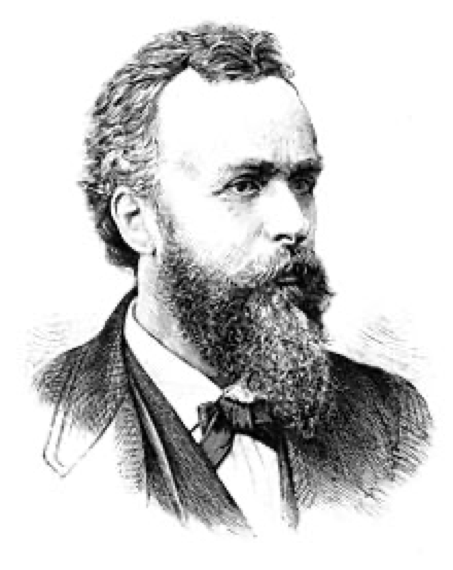
Edward Sylvester Morse (1838-1925) (Wikipedia)
5 Aug, 2013: Yesterday had been an uneventful day, if ever there was one. There were many automobile tire shops, and of course convenience stores along the road, a good few that I had stopped at to buy one thing or anther. What a hot day this was, and by lunchtime there was not a shade to be seen anywhere, for the life of me. All that I knew was that I had consumed more water than usual, not to mention, a couple of beers, before I had wrapped the day up. Drinking water in particular, had so many benefits for me. According to my reading, it rid the bladder of bacteria, helped digestion and prevented constipation, which was a thing that I never even thought about. In the same way, it helped to carry the oxygen and nutrients important for the cells, and to keep blood pressure and heart beat at the right levels. The water helped protect the tissues and organs in my often weary body. Last, but not least, the water that I poured down my gullet, also helped to cushion the old joints, which kind of helped with the weight off the backpack, and the distance along the road that I covered. Being summertime, there was no better drink to avoid dehydration. On an added note, I was happy to learn from my research that it was not only water that kept the old body hydrated, but that all beverages could play a fair and positive part, too. This included any of the caffeinated and alcoholic beverages. Baring the tea and coffee I liked to stop and boiled water for, there was a cup or two of red wine at camp in the evening. There were the many memorable times on the road, when I stopped at a shop somewhere to pick up can of cool lager in the late afternoon. Providing, of course, the chance and hot weather, rekindled an interest in me to do so. Even if such drinks may have caused me to duck behind a tree more frequently, the water in them still added to the necessary fluid that my body needed in order to function properly. Camp was made rather close to the sea, near the Akashi River, not 10-kilometers from Kobe City in Hyōgo prefecture, where I hoped to pass through early tomorrow. It was a large city, with a population of more than 1.500-million inhabitants. This made it a designated city, a title Kobe has held since 1956. Moreover, Kobe was a city with a long history. In like manner, the same could be said about so many locations throughout the country. Early tools excavated by the American zoologist, orientalist, and scholar, Edward Sylvester Morse, in 1877, at the western part of the city, showed that the area was inhabited by a hunter-gather people, during the Jōmon period (14,000-300 BCE). Kobe was situated on Osaka Bay, its scenic mountain range made it one of the most attractive parts of Japan. In addition, antique cablecars connected Kobe to the 931-meter hight Mount Rokko, which gave visitors a panoramic view out over the bay. In the autumn season, countless numbers of people visited Mount Rokko to see the colors of the forests change color. Kobe had long traded with the West, since the 1853 policy of seclusion ended. Kobe City was home to Ikuta Shrine, which dated back to the third-century. This made it one of the oldest Shinto shrines in the country. The shrine was inadvertently responsible for Kobe’s very name. The name came from the kanji that made up the word ‘kanbe’, an archaic title for followers of Ikuta Shrine.
During the Pacific War, Kobe was among the places bombed in the General Jimmy Doolittle Raid on April 18, 1942. The main target was Tokyo during the raid. Later in the war, American B-29 bombers dropped a series of incendiary bombs, which caused the lives of nearly 9,000 residents, and flattening some 21-percent of the city’s urban area. The incident inspired the well-known Studio Ghibli film, ‘Grave of the Fireflies’, including a novel by Akiyuki Nosaka, on which a film soon followed. Kobe was granted city status on 1 September, 1956. In more modern times, Kobe had become “known as a cosmopolitan and nuclear-free soon port city” (Wikipedia). Kobe Port was Japan's busiest port and one of Asia's top ports until the Great Hanshin earthquake struck the region, in 1995. As of 2012, Kobe was the fourth busiest port in Japan, and the forty-ninth busiest worldwide. One of the many items exported from Japan was its quality Kobe Beef, for which the area was especially famous. The sooner I could get Kobe and Osaka cities behind me the better. Both were massive and busy god-forsaken places that reminded me too much of Tokyo, and where I was always happy to get away from for a while. Merging and renaming the cities, Kobeosaka or Osakakobe, might not be a bad idea. After all, they made up one hell of a metropolis. Surely it was only a matter of time before this issue was discussed by those in power, if it was not already. Or so I thought, not really caring to think about either one. The place I decided to make camp was not the best. Partly for the prying eyes, and partly for the giant manmade rocks placed frightfully close to the sea, where I pitched the tent. A while earlier, I saw a number of high school boys swimming and mucking about in the sea, the sort of thing young boys did. No sooner was the tent erected, that I too decided to take a dip. This was the first time since leaving Tokyo, to date. Hopefully not the last! At night the massive Akashi-Kaikyo-bashi was rather beautiful to look at, lit up like a ghost-like giant, as if it had popped up out of no where. The bridge had a ghostly, almost phosphorescent luminousness look that reached out over the water, to connect Kobe and Awaji Island. The bridge had a nickname, 'Pearl Bridge’, because of the 28-different patterns and colors of lights used on it. In addition, it lit up in rainbow colors every hour. If I were a poet, I would certainly have composed something to that effect, for it seemed to be alive, as if it wanted to speak. After all, I once thought anyone, when placed in the right situation, was capable of becoming a poet. Actually, the bridge replaced a ferry service that ran between the city of Kobe and the island of Awaji across the Akashi Strait. However, the strait was plagued by frequent storms, which resulted in construction of a new bridge in late-1980. It was believed that about 1,400 ships passed under the bridge everyday. Far out on the sea the strong hanging lights on the fishing boats added to the pleasant scenery. On the fishing boats everyone had a particular job to do. Working so close together, responsible, capable, with no goofing off, like happened in other industries. After a while, I headed over to the convenience store across the road, where I picked up a cool carton of milk. It surprised to learn that the place did not have a public toilet to its name.
6 Aug, 2013: Even though where I had camped on the rocks, gave me a good evening view of the bridge, sleep was not so comfortable. When sleep did come, it did not come easily. A couple of times I dragged my tired butt from the tent, out into the moonlit sky for a piss, not an easy thing to do in the unremitting wind. At other times I awoke at the thumping sound of the vehicles passing over the bridge. Across Route 2 Maiko JR Station stood, or hidden under a walkway of concrete. According to a touristy looking sign nearby, I had made camp 220-meters from a pine grove (Maiko Park), 110-meters from Akashi Kaikyo Bridge Exhibition Center, and 180-meters from the Maiko Marine Promenade, perhaps an ideal place for young lover to discover one another. Another 300-meters further along led to Ijokaku, Sun Yat-sen Memorial Hall. A little further still, the former residence of Kenji Muto, stood some 390-meters away.The forest had around 1,800 pine trees, and like in olden days, it still retained the atmosphere of a “road bordered with pines.” The area had long been a place of scenic beauty, its mixture of white sandy beaches and green pine trees. Maiko Beach landscape was portrayed by Japanese ukiyo-e artist, Hiroshige Andō (1797–1858), in his ‘Maiko Beach, Harima Province’. Perhaps Andō was best known for his ‘One Hundred Famous Views of Edo’ and ‘The Fifty-three Stations of the Tōkaidō’. The tremendously popular, One Hundred Famous Views of Edo had been published in serialized form, from 1856 to 1859. Andō’s son completed the remainder of the series after his death. Maiko Beach was again touched on by Japanese novelist and short story writer, Naoya Shiga (1883-1971), in his major work, ‘An’ya Koro’, (’A Dark Night's Passing’): “The beaches of Shioya and Maiko were beautiful. The sea of evening calm reflecting the sunset glow…”. The novel was serialized in the magazine Kaizō from 1921 to 1937, a socialist-leaning general-interest magazine, published from the Taishō period, until it finally closed its doors in 1955. Unfortunately, I did not have the time nor inclination to stop at any of these places of interest. The only thing that I was interested in just now, was making an early start on this road, under a heavily cloud covered sky. The Akashi-Kaikyo Bridge was the world’s longest suspension bridge, at approximately 3,911-meters in length, and 47-meters above the Akashi Strait. Visitors could get a splendid view of the bridge from an observation lounge at the Maiko Marine Promenade, a circuit-style promenade at the foot of the Kobe side of the bridge. The bridges main tower pointed some 300-meters into the sky. It was possible for visitors to climb to the top of the towers, which afforded a breathtaking view of the bridge, the Akashi Strait, and Osaka Bay. The bridge was opened to the public in early-1998, about three-years after the Great Hanshin Earthquake that devastated the region. The Akashi-Kaikyo Bridge also stood as a monument to Dr. Chujiro Haraguchi, an engineer with the Ministry of Interior, before being elected the twelfth-mayor of Kobe City, Haraguch was the brainchild behind the bridges construction, an embodiment of half a century of technology. The estimated cost for the construction of the bridge stood at ¥500-billion Yen.
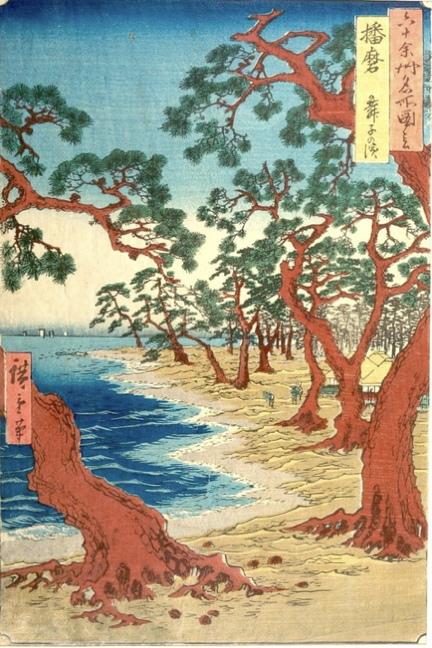
Maikohama in Harima Province (1854) (Wikipedia)
The money was expected to be recouped through tollgate costs. The toll charge stood at ¥2,300 Yen and was used daily by approximately 23,000 cars. Close to the Akashi-Kaikyo Bridge stood the Moebius strip, a monument made of three different types of rock joined together in a large circular shape, to represented people, nature, and science. It also represented the islands of Awaji and Shikoku, which were connected by the bridge. A wealthy Chinese merchant named, Wu Jintang (1855-1926), had a villa built on Maiko Beach, in 1913. It was a kind of second home away from his residence in busy Kobe, and which he named, ‘Shokai Villa’. An annex, named ‘Ijokaku’, was added two-years later, in the spring of 1915. The building was also famous for its unique octagonal-shape. Although the iconic three-storied annex building was octagonal-shaped, it was generally referred by locals as the ‘Ryōunkaku-do’, which in English meant hexagonal building, as it appeared that way to them. Further along the coast, Old Sakai Lighthouse, which overlooked the harbor in Osaka Bay, was of hexagonal design, built in 1877. “Mmm!” For some reason I momentarily thought about the Ryōunkaku, the first so-called, western-style skyscraper in Japan, which stood tall and proud in the Asakusa (now Taitō) area of Tokyo. This was around the time the Ijokaku was built. The “Cloud-Surpassing Pavilion”, also “Cloud-Surpassing Tower” as the Ryōunkaku in Tokyo was referred to at the time, had twelve-stories, a phenomenal hight in those days. The tower stood from 1890 until it was badly damaged following the Great Kanto Earthquake, in 1923. (The only thing to my knowledge that remained of this piece of architectural history was a replica of the tower at the Edo-Tokyo Museum). The Sun Yat-sen Memorial Hall was opened in late-1984, and housed important materials related to Chinese revolutionary, Sun Yat-sen, who once paid a visit to the hall, in early-1913. It was also the only facility to commemorate the Chinese revolutionary, in Japan. A medical doctor by trade, Sun Yat-sen was the founding father of the Republic of China, and its first (provisional) president. Today, his legacy was held in very high esteem in both Taiwan and in mainland China. Later, the Ijokaku building was registered aa an important prefectural tangible cultural property, in late-1993, and then as an important national tangible cultural property, in late-2001. A wealthy businessman named, Sanji Muto (1867-1934, ordered the building of a Western-style wooden two-story house in the colonial style, at Maikohama, in 1907. The houses stained glass windows, fireplace, furniture, and so forth, were well preserved in their original state. It was hoped that visitors could learn how wealthy people lived during the Meiji era. Muto was assassinated on 9 March, 1934, by militarists after he had denounced government corruption and financial misdealing, which became known as the Teijin Incident. At the time of his untimely death, Muto was the president of a daily newspaper company, Osaka Jiji Shinpo Sha. The house was later dismantled for the expansion of National Route 2 and the Akashi-Kaikyo Bridge, and relocated to Kariguchidai in the Tarumi area.
Much later in 2007, the prefecture relocated and restored the house back to its original location at Maiko Park. Sanji Muto former residence was registered as a national tangible cultural property, in mid-2011. Last, but not least (not mentioned on the sign I referred to earlier), was the former residence of the Kinoshita Family: The house was of a modern Japanese-style design, it was formally the private residence Ryosuke Matano, after it was built in 1941, which was also the start of the Pacific War. The house later came into the possession of the Kinoshita family, in 1952, and was finally donated to the prefecture to be preserved as a museum, in 2000. A year later, the house and former residence of the Kinoshita Family, was registered a national tangible cultural property, in late-2001. The house almost retained its original appearance since it was built. This was even after The Great Hanshin Earthquake that struck the Hyōgo region early in the morning of 17 January, 1995. The earthquake left between 5,502 to 6,434 people dead, with 36,896 to 43,792 injured, and 251,301 to 310,000 displaced (Wikipedia). Today, visitors to the house were also able to enjoy its leafy front garden and courtyard, which harmonized with the adjacent Maiko Park. The garden layout dated from the time of the residence was built. After a while, the country seemed so rather open: long spurs of deep-sided hills. Oh how the road seemed so familiar. It was wonderful to be tramping in the bright morning towards the heart of my destination, near Osaka. In the distance a fishing town glimmered tiny and alone. At a glance it might have been a tiny coastal town in Ireland. “Mmm!” A part of Ireland! The “old nostalgia for the Celtic regions began to spring up in me.” If I maybe so bold to quote from the writings of D. H. Lawrence again, or such were the thoughts that entered my head at the time (Sea and Sardinia). It was easy to imagine that the inhabitants of tiny isolated places like this had no interest in the world outside. Still, no denying, it was beautiful. On previous stages of my mission, like, the Aomori coastline, at times I had passed through gray, dull, lifeless, and wearily gloomy villages and towns, with not even a single shop to their names. The streets, I remembered, were absolutely empty of life. Only the disconsolate and dreary houses with their uneven bare walls, that had nothing to say for themselves. Many of the houses I passed were as dry and naked as prison-dungeons. With the villages and towns behind me, I did not care anymore about the dungeons and the dreariness. My feet carried me past the fishing town below, and in time it was gone from view, if not from my mind. The road was always climbing, and curved in great loops, leaving the shallow uphill valleys behind. Unconcernedly, under the intense summer sun, I pushed on, in an August morning. August and September being the hottest months! The landscape always changed when you got nearer to the towns and cities. The famous and not so famous names on advertisement boards began to appear. At first it was only a few that advertised one thing or another. Soon you became smothered in them, and the ugly buildings, too, began to appear. And when you leave the towns and cities behind, the landscape really began to change again.
Fortunately, much of the tramp towards Osaka was through parklands with trees to stop and rest under whenever the sun proved too much for me, a road hardened, thickheaded Paddy. Already to date, there had been a number of lengthy stops to rest, and at one I took the opportunity to wash some of my clothes, and mend some of the gear, again. The power of the sun usually dried everything in only a few minutes. At another stop, an interesting woman stopped to chat with me. At the time I was sipping a can of beer under a shade when she came over to where I was sitting. In the course of our little talk, I learned that she lived in an apartment, or what the Japanese called, mansion nearby, and that her name was Shoko Ohtani. Shoko-san told me in exigent English, that she had spent some seven-years studying in Kent in England. After studying in England, she worked for the Japanese Embassy, but I could not recall if she was assigned to London or to some other place to work. It was all such a long time ago, she said, which caused me to surmise that I also may have be living in London at the time. Shoko-san mentioned that she missed her time in London and that she would love to return, if only for a holiday. Likewise, I had a good few fond memories of my own time in London through the 1970s, not that I missed the place any. I asked her what she did now. She told me that she had turned 66-years old, and though retired, worked part-time at a local McDonald’s, where she was very happy. “The people working at the place treated me kindly.” She replied, smiling. “I bet you look cute in the little McDonald’s uniform.” I said, grinning. We both laughed. Then she asked me when I planned to return to your own country? “England! Right?” I told here that I was born in Belfast in the north of Ireland, but that sadly had been away for so long that I felt a stranger each time I returned. She told me that she would love to learn more about my city and county, which I jokingly replied that I would like to learn something about my birth place, too. “It would be nice to stay in touch.” She replied, and which I had no objections to, even though in my heart I did not have a very good record at it. Only god-knew how many fine people I had lost touch with down through the years, due to my own clumsy-absentmindedness. Unfortunately, hopes for making a return to Belfast, or to anywhere in Ireland, was not among immediate any plans, which I of course told her. Before we parted company, we exchanged email addresses, and I also told her that she could read some of my road-notes that I had uploaded onto the Internet. We parted company with the usual handshake, but did not take any of the customary snapshots. “Take care in this heat, and drink lots of water.” She called after me, as I made my way down the road. The weather was indeed hot, too hot. Later on I would find out from the NHK news on the television at the hotel in Kobe the temperature had reached 34 degrees celsius. And that some 30,000 people had come down with symptoms of heatstroke, a rise of 10-percent from the previous year. Needless to say, the television also aired programs of the Atomic bombing of Hiroshima, now 68-years from when the bomb was dropped on the city.
7 Aug, 2013: One trouble about tramping through built-up areas was that I found them monotonous and almost always reminded me of Tokyo, which I always loved to get away from for a while. In addition, if it was not about keeping my defenses up against any dangers, I would have died from the boredom. Already this had been an uneventful day. There was one sudden and heavy downpour to content my mind with, if nothing else. The rain started to fall just as I reached a convenience store where I stopped to buy a cool can of beer and rest up awhile. As I wrote earlier, when it did rain, everything cooled down, even if only for a short while, it was more than welcomed. The rainfall lasted for about 30-minutes, but when it did stop, it stayed that way for the remainder of the day. One less fortunate girl who came into the store a wee while ago, was literally soaked through. In away, she had been caught with her trousers down, as the idiom implied. No sooner had the girl bought a new umbrella, and a few other items, the rain stopped. In away, the Shinto gods had rubbed salt into her wounds. ”It’ll come in useful another time.” I remarked tin Japanese to her, as she passed me by, which brought a little giggle to her cheeks. Outside the store, she stopped and lit up a cigarette. People smoked for so many different reasons -- pressure, social reasons, stress, and no doubt a host of other reasons. The drug nicotine was the main additive substance in the fags. Around 80 to 90-percent of regular smokers were addicted to this drug. Their bodies built up some kind of a tolerance to the drug, but not the people who happened to be near them. The damage smoking did to the mind and body, not to mention passive smokers, was another story, which I had no intention of going into here. It was early Wednesday evening and the time had already gone five o’clock. There was an end-of-work-and-heading-home feeling in the air. The road was fast becoming busy, again, with the rush-hour traffic. Further along the road, Route 43, for Kobe, I stopped again, this time at what appeared to be a recently built business hotel called, ‘Novotel’ to check the room prices. “Mmm!” If the prices were not so bad, then I might stop the night, I thought to myself, as I retraced my steps a little after first passing it by. The glass doors slid open and I made my way into the lobby. “Sorry! We were full up tonight!” An attractive young desk clerk informed me, before I had a chance to open my mouth. The Hanshin Koshien Stadium was located just across the road. The baseball stadium was first opened on 1 August, 1924, to host the national high school baseball tournaments. The stadium became the home ground for the Osaka Tigers, now Hansin Tigers, in 1936. Various other invitational tournaments were held at the stadium, but I was not sure what was going on today, or what the fans waited to see. Unless I was mistaken, no other baseball stadium than the Koshien, became part of many baseball manga comics. Along the sides of the stadium and the main drag, numerous fans stood about clad in what looked like club colors. There were a good number of other fans sitting on fold-up chairs and on plastic mats, their backs proped firmly against the stadium wall.
This told me that the surrounding area was going to become even more busy in a wee while. That included all of the hotels in the area, too. “No! I don’t want to stay, I just wanted to know the prices.” To quote from the little piece of paper the clerk gave to me: “Moderate single ¥13,000, Twin or Double ¥20,000; Superior single ¥15,000, Twin or Double ¥22,000; Grand Superior single ¥17,000, Twin or Double 24,000; Executive single ¥23,000, Twin or Double ¥30,000; Suite (for two) ¥46,000, ¥70,000, 116,000, Japanese Style ¥32,000 (for two), ¥29,000 (for three), Extra bed ¥7,000, Baby Cot Free!” To me, that was a lot of money, just for a room. Of course, there were other hotels that charged a damn lot more. As I made my way through the sliding glass doors to the road again, I could feel a good few Japanese eyes glancing across the road at me. Then again, I must have looked a scruffy sight, like some homeless guy escaping the outside heat for a few moments. “Mmm!” What would the hotel desk-clerk have said had I asked for the baby cot? I thought, as I restrained myself from laughing. By now, the evening was falling fast, the sun had just about sunk into the horizon. In a very little time the sun would be gone. When I did find a place t camp it was behind a little, sort of, agricultural-cum scientific college. Somewhat thankfully, the college was located on a quit out of the way piece of public ground. There was nothing much else to do other than to wait awhile for the sky to get darker, before pitching the tent. This was soon done next to one of the wooden benches near the college steps by a footpath. Just as I was putting the final touches to the tent, a voice called out to me. “You are not about to camp there, are you?” Looking up, I saw the voice belonged to an attractive woman with short dark hair, that had a slight brownish tint to it. Perhaps she was in her late-30s or early-40s, certainly no older. At the time, she was just about to get on her bicycle, no doubt on her way home. “Yes, I am! You could not have been more right!” I replied, as I got to my feet and glance across to her, of course, smiling form ear to ear. She looked a little surprised! “Well, I have to sleep somewhere!” I added. “Here was as good a place as any.” Besides, being on the road to the extent I was, I had to take life as it came. After all, “blessed was he that expecteth nothing, for he shall not be disappointed”, to paraphrase from D. H. Lawrence’s 'Sea and Sardinia'. Actually, the words were originally penned by the eighteenth-century English poet, Alexander Pope, in his colorful workings on the style of the Bible. That said, Pope was best known for his satirical writings. There were a few other things talked about, which caused me to walk a little closer. In the course of out chat, I complemented the woman on her being able to speak, what seemed to me at the time, quite good English. The woman told me that her name was Reiko and that she had lived in California for some years when she was a student. She then told me that she taught at the college, and pointed at the large gray building, just meters from where I pitched my tent. By now the warm evening was falling into dusk. The red of the sun had just about faded in the far-off western sky.
8 Aug, 2013: It was late when I went to sleep, but it came quickly all the same. Then when it came to getting up, the time could not have been better. The red sun slid up from behind some buildings, it rays hit me square on the face. All the same, I felt in no hurry to hit the road. On the Japanese calendar this day marked the end of summer, or the start of autumn, either way, it was going to be another hot one. The woman I chatted to last night, Reiko-san, came by at 08:30 AM. She asked me how I had slept, to which I replied that I had gone out like a light. “But wasn’t it too hot?” I told her that the cool breeze that blew in over the river made things comfortable. “How about mosquitos?” I told her that there was no problem there either, and that the tent had a good netting to keep them out, and that I often liked to use the classic Japanese karori senko repellent that worked just dandy. Then I asked Reiko-san if it would be all right for me to use the toilets at her college. She told me that she had thought about that when she was cycling over, and that though she did not have any problems about it, some of the admiration staff may not like it. Especially as the college was still shut for the holidays. Being a Thursday, normally the place would be packed with students, but clearly they were absent. "Mmm!" The schools across Japan were still out for the summer holidays, that I wondered why the teachers had to be there? But I did not bother to ask her.“Actually, some of the other teachers and myself call the admin-office little North Korea, for they seem to police just about everything.” Then she told me that three of the other teachers and herself had recently formed their own little workers union to fight against some of the school policies and decisions. Reiko-san than went on to tell me that one of the other teachers had even brought a lawsuit against certain bodies in the administration. One of the reasons was that he felt they bullied him and that he was even demoted. Like the evening before, our little morning chat was again cut short, for she had to attend a meeting, and with that we said our goodbyes. However, before Reiko-san left, she directed me to a small public park at the far side of Route 43. There I could find a public toilet and drinking water. She also took a few quick snapshots of me, posing with my backpack in place, to upload onto the college blog page, along with some notes about my mission. Likewise, I took a couple of snapshots of her and with a little wave and a bow, she turned and hurried down the flight of steps to her school. In a little while, I was ready for the road, and made my way along the path from whence I had come. It was a little before 12:00 noon when I stopped at a sizably large park to rest under a shade cast-out by a number of quality trees. Japan had a countless number of local parks, many beautiful and many less so. The country was famous for its landscaping, no to mention, the famous traditional gardens. Since the Heian period (794-1192), the planing of the Japanese garden, was an artistic technique that had been introduced from China. It was an art-form that grew to become a crucial part of the Japanese culture. It was particularly sought after by the aristocracy and in those who moved in religious circles, such as, shrine and temples.
Many parks and gardens had been designed to mimic noted areas or landscapes. The Kobe City Forest Botanical Garden, established in 1940, was just one of many interesting landscapes. Kobe and its neighbors, Osaka and Kyoto, were garden cities. The Japanese Gardens in Expo Park in Osaka in Kyoto, was a city of thousands of set gardens. It was also home to the oldest botanical garden in Japan. The purpose behind the local parks and gardens was to provide a place for busy people to rest a while, to escape the hustle and bustle around them. That was the sort of thing I liked, if to wash a few clothes, too. To my dismay, a group of workmen, were busy at work trimming the trees on a rather large scale. The sound of the cutters kind of made my plans impossible. “Mmm!” Surely a sin was being committed.” I thought to myself. Was it right on the last day of summer to begin trimming the trees, and when the leaves were at their greenest. Fortunately, I was able to find a part of the park, which the workmen had not yet reached. Good! It was also approaching lunchtime, and what little I knew about the Japanese, they should be knocking off for a break shortly. Al least, it would give my head a rest for a wee while. Actually, the road had kind of made me immune from unwanted noise. Even the traffic rocketing along the busy Route 43 and its flyovers did not seem to bother me, nor kept me from sleeping when I camped. Stopping for shot naps here and there from time to time seemed somehow seemed different. One other thing a little disconcerting on this increasingly horrible road from hell concerned the people I passed along the way. Each time I nodded or smiled and said hello to them, I was always met with a stern face, or got no response at all. A coldness that I had not experienced since the time I tramped down through the coastline of Aomori prefecture. It was as if I was not noticed. At long last, that horrible and ugly part of modernization called the flyover at long last curved away to the right. Not soon enough, the flyover was gone from sight and soon forgotten. “Mmm!” Good ribbons to it! Now I had a food view across the road without any hinderance. More often than not, I found myself walking against the oncoming traffic, for the shade from the buildings. All the same, I still needed to keep an eye out for some hidden surprise, like missing a turn that I should have taken. Something that I was, unfortunately, good at. My maps were not as helpful as I had hoped, and therefore I was unsure how much longer I needed to stay on Route 42. Some distance up ahead, I could see two tiny figures, young men, getting to their feet after sitting down. They looked to be examining their bicycles. As I drew nearer, they got on their bikes and cycled away. Perhaps they had not notice me, not that my appearance was of any interest to them. Then I noticed that they had left the plastic food wrappers scatted about the ground, where they had been sitting. A couple of hours earlier, too, I notice one young chap toss an empty juice can onto the pavement as he and some friends cycled past me. None of them seemed to care one way or the other. “Mmm!” What kind of people did such things? How would they contribute to the future of their country? I wondered.
9 Aug, 2013: On the Japanese calendar this day marked the start of autumn, and like yesterday, I felt it was going to be another hot one. An overcast sky was what I awoke early to, but the clouds soon started to break apart as I dismantled and folded away the camping gear. A little away to my right and to my left, the toys of the wealthy, yachts, lay moored at the quay. About 1.5-kilometers beyond the tiny manmade bay, I could see the flyover that had accompanied me for most of the time when I left Kobe. Further still, smoke bellowed out from a tall red and while colored chimney. Before the flyover, a little to the right, a religious statue stood in some commanding manner. Last night, as I set by my tent enjoying a cup of red wine and the evening scenery around the place, I could have sworn I saw smoke protruding from the giant statues feet. A lot of the factory chimneys in Japan burned in the night and early hours. Perhaps the tall pillar or pedestal, if to the statue, was some kind of a chimney in disguise. “Mmm!” Then again, it may well have been a crematorium. Sure of where the deceased followers of this sect were kind of sent to meet their maker. Only man among all living things prayed, and only the Japanese prayed to both a Shinto god and a Buddhist god, especially whenever the circumstances presented itself. When it came to religion, they spoke of Shinto or Buddhist, irrespective, in Japan. Whatever was behind the building of the statue, or whether it was for Shinto or Buddhist purposes, I had not the foggiest. The Sakai region had been inhabited since approximately 8,000 BC. Sakai City was known as home to the Mozu Kofun, large ancient keyhole-shaped burial mounds. Some 100 such tombs were built during the Yamato period (300-500 BC), today less that 50 of them survive. One of them was the Daisen-Kofun, the fifth-century tomb of Emperor Nintoku, who according to the traditional order of succession, was the sixteenth Emperor of Japan. In traditional dating terms, Nintoku was said to have lived to the age of 142. The Sakai region prospered down through the years 1450 to 1600, and gained autonomy in the hands of its merchants. This was during the Muromachi Sengoku periods (1336-1573), a time of social upheaval and military conflict. Sakai’s ideal location at the mouth of the Yamato River and the inland routes helped make it one of the most prosperous points in Japan and the outside world. Particularly in terms of textiles and ironwork. The famous Zen Buddhist monk, Sōjun Ikkyū, was said to lived in the Sakai, because of its free atmosphere. Through his life, the monk influenced the infusion of Japanese literature and art with that of Zen ideals and attitudes. The first reliable account of Sakai were from legal documents that dated to the 1480s, after Ikkyū’s death. By the 1530s, the Sakai area had a population of some 40,000 inhabitants, many worked at various levels of mercantile. One of the most successful merchants of Sakai around that time, was Sen no Rikyū (1522-1591). Born in Sakai, Rikyū was credited with the title of being the greatest master of Japanese tea ceremony, and had a profound influence on chanoyu, the ‘Way of the Tea, particularly the tradition of wabi-cha. A founding father of Japanese tea ceremony, Murata Jukō (1423–1502). Rikyū, however, develeped the early wabi-cha style.
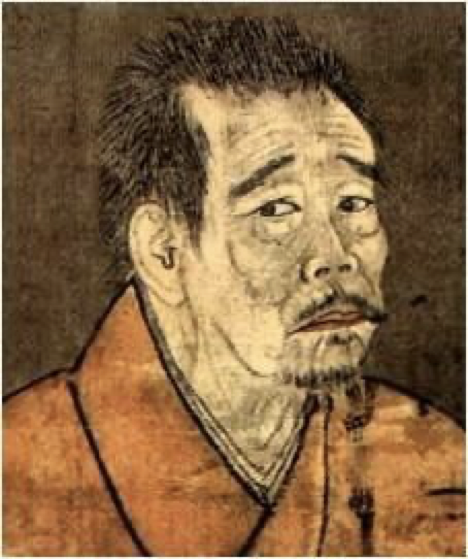
Sōjun Ikkyū (1394-1481) (Wikipedia)
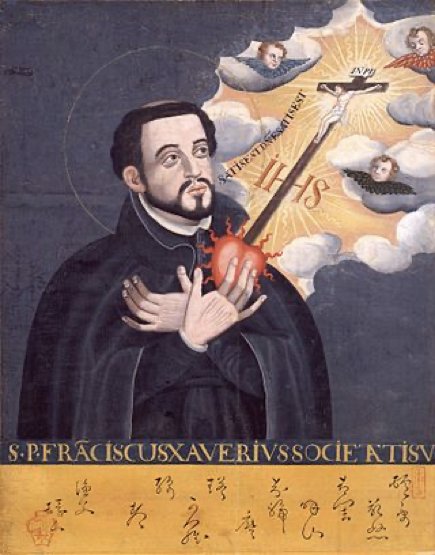
A painting of Saint Francis Xavier, held in the Kobe City Museum (Wikipedia)
This style of tea ceremony, however, was particularly associated with Rikyū. The prosperity of Sakai and the surrounding region, was documented in the writings of the Roman Catholic missionary, Francis Xavier (1506-1552), who visited there during the Sengoku period, in 1550. Francis referred to the city as being governed by consuls, just like Venice in Italy. Xavier was the first Christian missionary to visit Japan, however, he found the Japanese uneasy to convert, for they were strongly tied to their own Shinto and Buddhist beliefs. Influenced by European merchants, Sakai directed its interests on producing weapons, particularly for Oda Nobunaga Oda (1534-1582) a powerful feudal lord during the late-sixteenth-century. At the time, Oda was regarded as one of three main unifiers of Japan, the other two being, Hideyoshi Toyotomi and Ieyasu Tokugawa. Oda’s ambitions threatened Sakai’s autonomy. This led to an uprising of the citizens in the region, and the destruction of the Sakai. Following Oda’s death in 1582, Sakai fell under the rule of Hideyoshi Toyotomi, who in turn finally abolished autonomy there. This forced many of the leading merchants to relocate further along the coast and set up their business interests in and around Osaka. Business in and around Sakai did not cease altogether, in time region became prosperous once again, under Hideyoshi’s reign. In those years, unrest festered, which saw the distraction of Sakai by fire, in the early-Edo period, in 1615. Following the fire, Sakai was quickly rebuilt and remained an important center for trade, but not with the outside. The Tokugawa government had implemented a police called, ‘Sakoku’, which meant, closed country, in English. Japan at the time was under the rule of the Tokugawa government under the third Shōgun, Iemitsu Tokugawa. For the next 220-years, all relations and trade with the outside world were severely limited, foreigners no longer allowed to set foot in Japan, and Japanese prevented from leaving. For the most part, the country remained this way until the American Black Ships, under the command of Matthew Perry, boldly forced Japan to open its doors, in 1853. The opening up the countries economic doors and communications with the outside, Western ships once more began to stop at Sakai Port for trade. Foreign ships were not always welcomed at Japanese ports. For example, as many as 11 French sailors were murdered at Sakai Port, following an attack by samurai from the Tosa clan, on 8 March, 1868. This became known as the Sakai Incident. In more recent times, the port suffered widespread damage from American bombing raids during the Pacific War. The war had practically gutted many of the buildings. Today, Sakai was and industrial city with a population of some 800,000 inhabitants. In addition, it was the fourteenth-largest city in the country, with a modern and thriving port. Here, the hexagonal-shaped old Sakai Lighthouse, built in Meiji 10 (1877), still looked out over the harbor at Osaka Bay. A popular tourist attraction, it was one of the oldest wooden Western-style lighthouses that still remained in Japan; the others being, the old Anorizaki Lighthouse and the old Fukuura Lighthouse. The words for lighthouse in Japanese were 'tōdai' or 'toudai', whilst 'shima' and 'jima' meant 'island'.
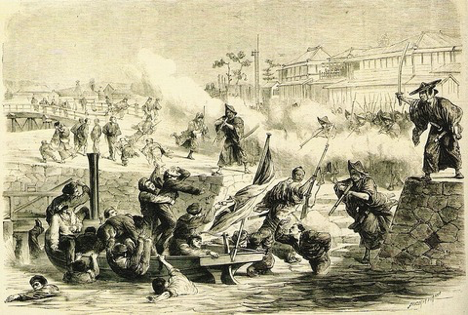
Sakai incident, Japan. Le Monde illustré, 1868 (Wikipedia)
In addition, 'wan' meant 'bay', and 'kō' meant 'harbor'. All of them were places one was likely to stumble upon a lighthouse of one kind or another. In Japan today, lighthouses were both operated and maintained by the Japanese Coast Guard's Maritime Safety Agency. The very first European-designed lighthouse was the Kannonzaki Lighthouse. It was built on the Miura peninsula in Yokosuka in Kanagawa, by the French engineer, F.Verny. The Lighthouse was lit for the first time on 11 February, 1869 during the final months of the Boshin War. On an added note, the Kannonzaki Lighthouse, was one of eight lighthouses built under the Anglo-Japanese Treaty of Amity and commerce of 1858. The original structure was built with more than 64,600 clay bricks, and therefore weak against earthquakes. This was noted on 26 April, 1922 when the lighthouse was destroyed by one. Its reinforced concrete replacement saw a similar fate, just six-months later, when it was severely damaged by the Great Kanto Earthquake, on 1 September, 1923. The current Kannonzaki Lighthouse came into being on 1 June, 1925, an eight-sided concrete structure that stood about 56-meters above the sea surface. Scottish engineer, Richard Henry Brunton was one of a number of engineers invited by the Japanese Meiji government to design and build lighthouses throughout the country. The total number of lighthouses constructed by Brunton was 36 and took him nine-years to complete. The lighthouse was designed by Brunton, it was said to be the first concrete structure to be built in Japan. The Mikomotojima Lighthouse, located on Mikomotojima, a small uninhabited islet located about 11-kilometers south of Shimoda Port in Shizuoka prefecture. The lighthouse was first lit on 1 January, 1871, and remained the oldest lighthouse still in use in Japan. The old Sakai Lighthouse stood some 11.3-meters in hight. At the time, many lighthouses were built at various points around the county, to help foreign ships navigate safely. The old Sakai Lighthouse in particular was designed by the English architect, Biggleston, and was mainly paid for by donations from local citizens. In those early days, kerosene lamps were used, and gave of a greenish-light that reached well out to sea. The lighthouse was finally decommissioned in Show 43 (1968) Today, the old Sakai Lighthouse stands as a national historic site. It underwent preservation repair work from 2001 to 2007 to restore it to its original form. Furthermore, Maritime museums taught things about the sea and life at sea. The old and existing lighthouses made great museums. Visitors would be able to look at the early lighthouses and imagine what it was like to have the lonely job of guiding the ships, past and present, to safety. “Mmm!” It was forever annoying when my research on something came up blank. It was not easy to dig up information about the English architect, Biggleston, like, what was his full name, where in England he lived, or what else did he design and build, etc. One early business I found, H. M. Biggleston & Sons, located in Canterbury in England, had dealt in iron castings from 1835 until its closure in 1963. I wondered if perhaps the Biggleston I was researching was a descendant of William Henry Biggleston? The following was the reply email to my inquiry:
Dear Mr Crossey
Thank you for your email to the CHAS website. I have looked through a publication I have 'The Bigglestons of Canterbury' and unfortunately there is no mention of this lighthouse or even of one of the family having been an architect. I hope you are able to find an answer to this question to finish your research.
Sylvia
Originally, the name of the H. M. Biggleston & Sons fire casting business was called Drury & Co, then and then Drury and Biggleston. According to my own research, William Henry Biggleston settled in Canterbury in 1835. An 1841 census showed that the Biggleston family lived at a house by the main foundry facing Crown Yard. An image showed that the railings around this house reflected the name of the original business Drury & Co. In the foundry’s hay day, output included iron castings for bridges, railway, lamp posts and railings, munitions for both World Wars, and even supplied iron castings for the building of the Channel Tunnel, in 1880. It was long held among many thinkers that blast furnaces for cast iron and steel, developed in Europe and in China, and other Asian and Southeast Asian countries, long before the technic was adopted and used in Japan. Despite a shortage of raw materials, and trial and error, who would have thought in those early days that the iron and steel industry would grow to become a massive part of the Japanese economy? To put it another way, Japan became one of the main producers of steel in the world? Subsequently, the source of the ores, important to the industry, was iron-sand, a product from the erosion of andesite and granite, a substance that was easy to extract from mountainous regions, which made up around 80-percent of Japan. Given Japan's environmental constraints, it became famous for developing a traditional furnace for smelting iron and steel, called, 'tatara'. Like I penned above, the steel produced from this system came from iron-sand. The most effective of this steel was used to produce the 'katana', the Japanese swords, characterized by their curved, single-edged blades, and which dated back to the Heian period. One of the few tatara foundries in Japan today, was the Nittoho tatara in Shimane prefecture. There were a few small natural deposits, including coal and oil, but nothing to write home about. Therefore, mining for iron in Japan was minimal, because of the country's lack of mineral resources. For much of the country's history, Japan was heavily dependent on importing energy and raw materials. The first large steel plant in Japan, Yahata Steel Works, was located in Kitakyushu, and opened in 1896. The plant helped furnish the country's growing railway, shipbuilding, and armament industries. The Higashida First Blast Furnace, at the plant, was designed by a German engineering factory called, Gute Hoffnungshütte, and began operations at Yahata, early-1901. At this time, a Western-style smelting system, 'reverberatory furnaces', came to replace the traditional Japanese tatara system. These days, Yawata was a major producer of the hard stuff. Because of it importance to the Imperial war effort, the Yahata plant was targeted by American bombers during the Pacific War, in June, 1944. It had also been identified as one of the sites for the atomic bomb, but because of the heavily clouded sky, the Nagasaki became the target, on 9 August, 1945. Currently, China was the world's largest producer and exporter of steel.
Therefore, I did not think I was stretching things too far, when I surmised the same family name was involved in designing and building lighthouses in Japan. “Mmm!” The jury was still out. At last I left the port city of Sakai, just south of Osaka, near the place where I camped, and headed in the direction of Wakayama. The main road, Route 26, soon turned left onto a road called, Phoenix-dori. At that point, a directional-distance road sign told me that Wakayama and that Izumiotsu were 55 and 13-kilometers away, respectively. Even with my early start, there was no way I could reach Wakayama until the day after tomorrow, Sunday, 11 August. High above, the sky had become overcast, and so I began to wonder if it might rain. The good thing was, the condition of things kept the relentless sun off my sad back. After a while, I made a little stop to rest and pulled a touristy pamphlet out from amongst my maps and notebook, to look at. To paraphrase from the pamphlet, which had something to do with Doigawa Park: The Azuchi-Monoyama era in the sixteenth-century, was Sakai’s golden age. Sakai was a corporate town, it protected itself from invasion by constructing moats and ramparts. Today, Doigawa Park comprised about four-hectares of land on the former sight of these fortifications. Featured by a six-meter-diameter flower clock, Gokuraku Bridge, and other scenic spots, the park boasted a number of historic places within its vicinity, which made the area of great interest to strollers. Doigawa Park also played a role as a roadside buffer greenbelt. “Mmm!” Greenbelt my arse! When I left Tokyo, I was determined to do two things. One was to stay away from vending machines, so as to avoid the high sugar concoctions in them. The other was to stay off Route 2, for the heavy traffic and heavily built-up areas it passed through. On the first, I had failed miserably, for the hot weather and pleasure on pouring something refreshingly cool down my throat. As to the second, however, I had been rather successful, but disappointedly so. Both of Routes 43 and 26, which I had hoped to use as far as Wakayama City, turned out to be amongst the busiest of roads that I had ever used in my life. As I sit to pen this into my note-book, all kinds of vehicles roar past me like there was no tomorrow. Further more, since heading out of Kobe, not an inch of ground had gone untouched by the hand of man. Buildings of all shapes and sizes, businesses, factories, shipyards, and even tiny vegetable plots of land, all had signs of human life scurrying about them. “Mmm!” The fact that the clouds had long dispersed. And on top of it being one hell of a boring day, an uncaring sun was still having a field day with me. It was the sort of day that would force one to pack up and head home. At least at my place in Tokyo, I could sit and enjoy a glass of red wine, while watching an interesting video on YouTube, with my feet up. Or even enjoying one of my many DVDs on classic films. “Mmm!” Clearly I was feeling tired. Tomorrow was another day. Surely it would be better, when something beautiful and interesting, such as, more wildlife popped into view from time to time. If only I could have lived during the late-Tokugawa, or Meiji, or Taisho periods. Then I could really feel and touch a long lost Japan.
Admiral Henry Craven St. John Photograph: Navy & Army Illustrated (Wikipedia)
Iron Duke at anchor (Wikipedia)
At the time Captain H. C. St. John traveled through Wakayama, in the 1870s, he noted the presence of badgers and deer in the villages. Mandarin ducks, cranes, and herons appeared unperturbed by villagers at work in the paddy fields nearby. “Mmm!” I found myself wondering if this was this the same Admiral Henry Craven St. John (1837-1909) of the Royal Navy? During his time in Asian waters, St. John was promoted to the rank of Commander for his skill and courage following an attack by a force of Chinese junks, in April, 1866. St. John’s travelogue, ’Notes and Sketches from the Wild Coasts of Nipon’ (Published by David Douglas, Edinburgh, 1890), included chapters of his “cruising after pirates in Chinese waters”. CHAPTER X, which focused on Japanese customs and habits, and so forth, also claimed the Japanese to be an unromantic people. “Mmm!” A similar thing might be said about the Japanese today, too. About seven-years later, in September, 1873, St. John was promoted to the rank of Captain. This was around the time he commanded the scoop HMS Sylvia, in November, 1873. Later, in August, 1885, St. John commanded the Central battery ship HMS Iron Duke. In his long naval carrier, St. John became Senior Officer at the Coast of Ireland Station in Queenstown (now Cobh) in January, 1892, St. John was promoted to the rank of Rear-Admiral in August, 1889, Vice-Admiral in January, 1896, and Admiral in June, 1901. At his own request, Admiral St. John took his leave off the navy and retired in June, 1895. The ship had quite a lengthy service to foreign lands that included visits to Japan. However, I should surmise that this was not at the time St. John visited paid his visit to Japan. All the same, the ship, HMS Iron Duke, was in service from 1 April, 1871 until she was decommissioned in 1890. To paraphrase Wikipedia, Princes Takuhiro Arisugawa and Takehito Arisugawa both visited the Iron Duke on 22 July, while she was visiting Yokohama in Japan. Several weeks later, Arisugawa Takehito again came aboard, this time to serve as a midshipman on the ship. The Iron Duke struck a rock just off the coast of Hokkaido while en route to Aniva Bay in Sakhalin Island, on 30 July 1880. After two-days, the ship was floated off on 1 August. At that time, another ship also grounded while trying to assist. Repairs on the Iron Duke required a month in dry dock in Hong Kong. On 2 January 1881, Coote hauled down his flag and was relieved by Vice-Admiral George Willes, the new Commander-in-Chief of the China Station. On 10 October, the ship was dry docked in Nagasaki, Japan and then set sail for Wusong District in Shanghai in China, on 26 October. Iron Duke returned home to England in January, 1883 to undergo a lengthy refit that included the replacement of her boilers (Wikipedia). Around the same time as St. John’s visit to the region, the German, Julius Helm, who lived in Yokohama, was invited to Wakayama by local government officials to oversee the training of local peasant soldiers. The castle moat had proven to be an excellent for Helm when he taught the young men how to build pontoon bridges.