Irishman Walking (Stage 11 Chapter 4) is about my walking the main and coastal roads of Japan. Summer 2013.
16 Aug, 2013: Again there was no sign of rain, which in the morning was a blessing. Later on, whenever the sun was up and kicking, then things were a different story. With not a cloud in the sky, I was in for another scorchingly hot day. According to newspaper reports, it rained in many parts of the country, but not here on the road. The country was well into autumn now, but the weather was just as hot as the middle of summer. On the road again, a quick stop was made at a Lawson convenience store to buy a 500-milliliter carton of Bulgaria yoghurt and something heavy to eat. Once unfamiliar, these days the convenience stores had become a near cultural part of Japanese everyday life. At least, I could not imagine for the life of me a young person envisioning existence without one nearby. The same could be said about their love of cellphones. Or should I say, ‘smartphones’, for the capabilities of sending emails, taking photos, making electronic bank payments, and even watching digital TV, and so forth. “Mmm!” For me, I saw both convenience stores and smartphones evil necessities. Even when the country was in a recession it seemed unable to free itself from, such was the growth of both the convenience stores and smartphone companies that it was impossible not to see one without the other. Indeed, shopping may have become less time-consuming and laborious, but it came with a cost. The impact of both the convenience store and the smartphone on society had become increasingly severe and extensive, and forced changes in the pattern of peoples life. Perhaps even an impoverishment of cultural life, when such luxuries were unheard of. The past had virtually disappeared overnight by the introduction of the convenience stores, and smartphone companies, not to mention, vending machines, all over Japan. The small local shops and traders had all but gone out of business, or fell sharply in the neighborhood. Some of the local grocery stores here and there still managed to hang on, but only just. Face to face communication fell sharply, if not disappeared overnight. Lacking in social skills, not to mention, a dip in their knowledge of Japanese grammar and kanji. Even the skill of penmanship. How sad that people no longer took the time to write to each other anymore. Whatever next? Long gone were the days when I used to sit in a coffeeshop on a weekend, where I would read a newspaper or write a letter to someone. Every month, if not every week, the appearance of smart looking convenience stores, with eating areas, and smart phone stores were opening in all the town and city centers and strategic locations points around the country. Many convenience stores subsequently flourished since they first appeared on the scene in the late-1960s. However, the disruptive impact of natural disasters, such as, the massive earthquake off the coast of Tōhoku, on 11 March, 2011. On that ungodly day, people were forced to walk hours in order to get home. A friend of mine had to walk six hours from her job in Kanda in Tokyo to her apartment in Saitama prefecture. Saitama was part of the Greater Tokyo area. A couple of hours after the Tōhoku disaster, I rode an old 50cc Honda Cub motorbike, at walking pace, from Adachi Ward in northeastern Tokyo to my apartment at the time in Shinjuku. It was a three-hour journey that usually took me one hour.
Shinjuku had long been a major commercial and administrative centre in the western part of the Tokyo, and busy at the best of times. What I recalled most at the time, was that I was one of a tiny few who seemed to me moving against the masses of people, calmly on their way home. As a consequence of the disaster, convenience stores across the country were soon emptied of food, drinking water, batteries, and just about anything of use, for the hoarding that went on. They could not be resupplied for the chaos that insured. The condition of the infrastructure became strained, with the closure of gas stations and business throughout the country. Public transportation at a standstill! Even smartphones proved useless or dead for sometime afterwards. All social life became hectic, schools closed, people unable to get to work, shortage of food, outside communication severed, gas stations and road services at large, were literally pulverized. There was no escape from the deprivations at that time. The shortage of gasoline saw the profusion of long queues at the gas stations, and with public transportation stopped, noting moved, everything ground to a stop. Perhaps it was easier to analyze, describe, and quantify problems than to resolve them. The Tōhoku earthquake and tsunami of 11 March, 2011 brought with it countless sympathy and aid from around the world. In a word, traumatic, for everyone! The disaster had traffic repercussions on the country and certainly damaged Japan’s image as a modern nation. It might even be considered the Japanese governments response the situation to be much worse than in any comparable modern nation elsewhere in the world. The aftermath of a disaster was a time when just about everything was scrupulously monitored, regulated, and restricted by local authorities on what to do next, how to overcome the predicament the nation was in. Even when I stepped down from my soapbox after rambling on about the repercussions on life at large, there was no escaping another truth. These days there were so many franchised convenience stores that they were forcing hardships and changes on each other, like, cutting costs, staff shortage or low moral, fall in customers, as well as, questionable hygiene levels, etc. Even the quality, if not the cost, of the food sold at such places was questionable. Nevertheless, nothing seemed to dampen peoples enthusiasm of popping in at convenience stores or buying the latest smartphones. Before I did hit the road again, I decided to give a quick wash to a pair of socks at the tiny sink in the toilets. The sink water was as low as the river, for it only dribbled from the faucet. So rather then bother trying to wash the socks, I decided to leave it until I came to somewhere better down the road. The fresh morning weather told me that it was a good idea to kick up some dust and get as many kilometers under my belt, before things changed. For the most part, both of these areas of business continued to prosper. When the yoghurt was finished, I headed out of the store carpark and onto the road. A little later, two interesting looking shrines standing side-by-side popped into view. The shrines were called, the Nichi Shrine and the Wakamiya Shrine.
However, when I stopped to take a look-see, I discovered not two shrines, but four shrines. “Mmm!” Talk about coexistence, in harmony, surely only in Japan was such a thing possible, I thought. According to my research, the Nichi Shrine was founded by Norihede Yoshida, who enshrined the spirit of the deity, taken from Use Shrine, in 1167. The building was rebuilt, using a unique type of architecture, called Kasuga-zukuri, in the late-Edo period. A traditional style of shrine architecture, its name came from the Kasuga Grand Shrine’s honden, located in Nara in Kansai. The kasuga-zukuri style was mostly found in the Nara area. The Nichi Shrine also boasted many sculptors characteristic of the region. For example, the shrine was home to eight Mune-fuda boards, which dated to the Muromachi period (1336-1573), were preserved. The Mune-fuda signboards or plaques, placed at a building's ridgepole or beam at the time of construction (or reconstruction) to show the donors' names, as well as, the buildings significance. The Mune-fuda boards were examples of ceremony and symbolism of early Japan. The Muromachi period was a time of military and social unrest, when the first Europeans had arrived; Portuguese in 1543, the Spanish in 1587, and the Dutch in 1609. The period was a time of Christian missionary activity, with some two-percent of the population believers in Christ, and with some 200 churches, throughout Japan. “The Japanese began to attempt studies of European civilization in depth, and new opportunities were presented for the economy, along with serious political challenges. European firearms, fabrics, glassware, clocks, tobacco, and other Western innovations were traded for Japanese gold and silver. Significant wealth was accumulated through trade, and lesser daimyō, especially in Kyūshū, greatly increased their power. Provincial wars became more deadly with the introduction of firearms, such as muskets and cannons, and greater use of infantry” (Wikipedia). This was called the Nanban trade period, or the Southern barbarian trade period, and lasted from 1543, to its almost total exclusion, in 1614. Inari Shrine was located on the left of the Nichi Shrine, with the Wakamiya Shrine to its right. Both shrines were built in a small scale version of the Kasuga-zukuri style of architecture, during the late-Edo period. The Itsushima Shrine, located at the rear of the main shrine, was built in a small scale version, called the Ikkensyanagare-zukuri style of architecture. The shrine sculptures were similar to those at the Nichi Shrine. Not long after taking my leave of the group of shrines, the first tunnel of the day popped into view on Route 42. The Hitome-zaka Tunnel was thankfully not a long a long tunnel. On a hot day, tunnels would be said to be a gift from heaven. The tunnel was 206-meters of cool breezy air, and something to be enjoyed while it lasted. The tunnel itself was built in 1962, a time when Hayato Ikeda was Prime Minister. The year 1962 was a time when a number of very serious accidents occurred in Japan. For example, on 10 April, a Japan Airlines Douglas C-52 flying from Fukuoka to Tokyo’s Haneda Airport was forced to make a belly landing at Osaka. No one was killed or injured, but the aircraft was a write-off.
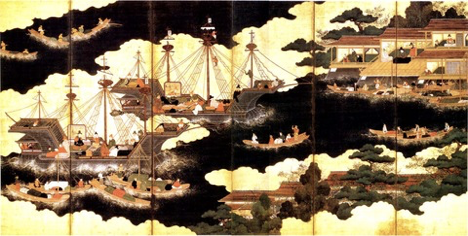
Nanban ships arriving for trade in Japan. 16th-century painting (Wikipedia)
Then almost three-weeks after that, on 3 May, a couple of passenger trains and a freight train crashed near Mikawashima Station in Arakawa in Tokyo, and left 160 dead with 296 injured. Some six-months later, an All Nippon Airways Vickers Viscount crashed in Aichi prefecture. The accident killed all four onboard. The Vickers Viscount was the largest airline in Japan, and was the first turboprop-powered in service at the time, in 1953. Just before making my way through the Hitome-zaka Tunnel, I set down near the entrance awhile, in order to jot down some notes about the Itsushima Shrine. Trying to focus on what to write about the shrines took me a little longer than usual to do. Usually I would be engrossed in my writing without much problem. This time, however, it was not easy to concentrate when the sun ruled supreme in the sky. Actually, I had not noticed the sun creeping high up into the sky. It would not be much later when the power of the sun was really felt. After all, much of ones life involved chance, luck, and fate, in no particular order. For example, not long after I had stopped to jot down some notes, when a small tanker lorry pulled up outside a house across the road, close to he tunnel. At first I did not give the lorry a second thought, until I was suddenly hit by the most foul of smells. If I may be so bold as to use the words of the American satirist, essayist, and journalist, Henry Louis Mencken: “The stink” was “enough to knock you down”. The five senses — see, feel, hear, taste, and smell — were good things to have, both healthy and in good working order. Especially for myself on the road at anytime — day or night! The five senses helped us to connect and deal with the world around us. The cells used for smelling, in particular, were among the oldest parts of the human brain. The foul odor molecules were soon carried in the air in force, right towards my unsuspecting brain, via the old nasal passages. Talk about feeling uncomfortable, this did not seem normal, out in the open, the fresh coastal air, and so forth. It was worse than the smell of rotten eggs. So wicked was the smell, in fact, that I was soon back on my feet again and heading off down the road to escape it. Momentarily, I thought about possible damage caused by inhaling airborne bacteria fumes, like, respiratory or sinus infections. Of course, I was not sure of anything just now, as I fastened the backpack into place, and picked up pace along the road. Unfortunately, I needed to pass by the open cesspit to reach the tunnel. Thinks to a strong breeze that blew about the tunnel entrance like there was no tomorrow, the horrid smell quickly went away. “Mmm!” On glancing back as I hurried along the road, I saw the uniformed occupants of the lorry busy emptying fecal sludge from a cesspit at the house. There was noting else to do, but grab my stuff and leg it as quickly as possible through the tunnel to the other northern side, which I did. Not long after leaving the tunnel, a couple of tourist coaches rushed by, headed in opposite directions. Along the road, I made a quick stop to take some snapshots of the splendid scenery out over a tiny inlet with a few fishing boats moored to a quay in the foreground, a small away mountain at the rear.
In time, a second tiny tunnel came into view, which appeared to blend pleasantly into the view before me. The tunnel was opened to the public in 1964, a time that might explain why it had no pavement. Alas, the tunnels name was in a kanji, or distinct script, which I could not read nor copy. A good 11-years of my life was spent, on and off, living in America. It did not take me long to learn that Americans were a car loving people. Actually, it might be more accurate to say that the Americans needed their cars. Conversely, my years of living in Japan also told me that the Japanese loved their cars, and never failed to keep them spotlessly shiny-clean. At least, I had not seen a single car on the road (or parked) during the Obon holidays that had not been washed and polished. Further along the road, Route 42, I called in at the Michi-no-Iki Tsubakihanayu, a public rest stop area located in Shirahama in Wakayama. My plan was not to stop very long, but wash some clothes and hit the road soon afterwards. There was a place to have a hot bath, but I was not very much into public baths. Also, I did not feel very hungry just them either, so I did not bother about calling in at the restaurant there. There were a good number of hotel places to stop the night at, but nothing beat a good beach. Other that have a wee nap, however, it was not quite the time to start thinking about making camp. Just as I was about to turnover onto my side and rest a bit longer, I heard the sound of car tires moving slowly over a gravelly track. Whenever I set up to have a better look, I could see that it was a police car backing up near where I lay. The main road, Route 42, was only a few meters away and it was still very busy with traffic. The police must have caught sight of me from the road, and pulled up to investigate matters. They may have thought that I was suffering from heatstroke. The sun was still making itself felt and much of the ground was baked hard. There were two policemen in the car, and whenever they saw me sitting up and giving a little wave, they nodded to me and drove away. “Mmm!” All was well, that ended well, I mumbled to myself, as I grabbed onto the mat and got to my feet, dragging it with me. Actually, I preferred to be the kind of man no one took no notice of, unless I chose otherwise. One did not quite have that luxury when it came to the Japanese police. I liked being alone, solitary, often isolated in my own little world, if not among the wilds of nature. Often along the road I stopped to look at a tiny, solitary figure of a farmer working like a magpie, alone on the hillside, or in some distant field. A fisherman, too, alone with his fishing rod, had extra-ordinary amiable patience. This was only too different from Japan, where I felt most people could simply not be alone. They must be in groups and in crowds. Only this and nothing more! Then again, isolation was good for some, but an illness for others. In Japan there was a subculture, a kind of recluse, called, hikikomori. In English this referred to those who withdrawal from society, preferring isolation. It was also called, social withdrawal syndrome. However, there was no need for me to go into that just now.
(Yahoo)
ot long on the road again, when the Ichie Tunnel popped into view. The tunnel was only 366-meters long, but unlike the previous tunnels I passed through, there was no cool breeze running through it. Rather, the tunnel had a stale musty smell about it. Such smells were caused by dampness and mold, if not decay. Just at about the halfway point in the tunnel, my ears caught the piercing sound of a siren. As I looked up, an ambulance was fast approaching, its red lights flashed away like mad. In the tunnel, the sound of the siren was really fierce. This was the first time ever that I had shared a tunnel with an ambulance, and I hoped it would the last time. A police car followed close behind the ambulance, its lights blinking like a Christmas tree, but thankfully its siren was silent. “Mmm!” For a short while after both vehicles were gone, I wondered where and why they were headed in such a rush. Whatever the reason, it happened back where I had come from. Soon another tunnel appeared. The Mitsuishi Tunnel, with a cool breezy air welcomed me in from the hot baking sun. What joy! The tunnel was built along National Route 42 in 1964, and ran for some 180-meters long. My clothes were blotched with sweat. If only I could wash it from my hands, and arm, and legs, but what was the point? Then I could feel the air moving on my face. It felt so good. Just as I came out of the tunnel, five or six large motorbikes past me by along the road! I had heard the engines at the other end, just was I was nearing the bright sunlit sky, again. They where not bōsōzoku, however, for some reason a police car was close behind them. The tunnel was opened in 1965, a little after the Tokyo Olympic Games. As I had hoped, it was just 180-meters long, or to put it another way, it was a distance that had a cool heavenly breeze. Most short tunnels deserved a gold medal for the breeze that flowed through them. In time, the road appeared to slant steeply upwards, which was not the sort of thing one would wish on their worst enemy on such a hot day, or I should hope not. Some distance further up the road, the Kasaba Tunnel came into view. At 465-meters in length, one would have imagined that its architects might have included a pavement for the safety of people like myself. The hair on the back of my neck never failed to stand, each time I tramped along such dangerous places. Just as I surmised, the tunnel was build in the early 1960s, or March, 1963 to be precise. That was a time when safety and human rights were being talked about. Martin Luther King Jr. at the head of civil right marches in America. One example of this was the confrontational, yet nonviolent campaign against racial segregation and economic injustice in Birmingham in Alabama, in April, 1963, just a few weeks before the Kasaba Tunnel was opened. King was picked up and jailed for the thirteenth time, early on in the campaign. King was among the leaders during the famous ‘March on Washington’ for jobs and freedom took place on 28 August, 1963. That was the time King gave his famous 17-minute long, ‘I have a Dream’ speech. The speech was regarded as one of the most revered speeches in American oratory history.
The northeastern part of Honshu was hit by record snowfall in early-1963. According to reports at the time, 231 people died with 356 people injured. Other disasters in that year, included the Mitsui Miike Coal Mine explosion that left 458 dead, with 839 injured, many by the blast, other by carbon monoxide poisoning. “Many of the poisoned survivors suffered severe, permanent brain damage” (Wikipedia). Then there was the Tsurumi rail accident in Yokohama, which caused the lives of 162 people, with 120 injuries. The accident involved a JNR freight train that derailed blocking the adjacent passenger railway line. Within a matter of seconds a passenger train bound for Tokyo sloughed into the freight train. Both disasters occurred on the same day, 9 November, 1963. Later along the road, nothing other than another tunnel popped into view. The pavement-less Terayama Tunnel was built in 1967, and ran for just 110-meters. Not much further along the road again, I found myself passing through another tunnel, called the Kaizoji Tunnel, also built in 1967, and was some 170-meters long. At first I was not able to make head nor tails of the tunnels name, for the difficult script in which the kanji was written. Only later when I returned to Tokyo, and with the aid of a Japanese colleague was I able to research it properly. The 1960s in England were best known as home to a youth-driven cultural revolution of political activism, with movements like sexual liberation and anti-nuclear movements. The Swinging Sixties was a phenomenon that was symbolized by its art, music, and fashion and symbols, and last but not least, photography. The period included music by bands like: The Beatles, The Rolling Stones, The Who, The Animals, The Kinks, Procol Harum, The Searchers, Freddie and the Dreamers, The Small Faces, The Hollies, and many others. Whilst, other noted faces included Jimi Hendrix, Cilla Black, Lulu, Sandie Shaw, Donovan, Gene Pitney, and so on. All of the big name stars appeared at one time or another on a popular Independent television (ITV) music show at the time called, Ready Steady Go! Or had records played by the offshore pirate radio station, Radio Caroline. The radio station broadcasted from five different ships, anchored in international waters, from 1964. Radio Caroline was the brainchild of Ronan O’Rahilly an Irish businessman, and was said to have been named after Caroline Bouvier Kennedy, President John F. Kennedy's daughter, and the former U. S. Ambassador to Japan. Names like Mary Quant influenced the fashionable parts of London, such as, Carnaby Street in Soho and King’s Road in Chelsea. The period was most notably marked by the birth of the mini-skirt. The supermodel and icon of the time was Jean Shrimpton. Another cultural icon was the fashion model, Lesley Lawson, better known by her nickname, Twiggy. The 1960s phenomenon featured in many films of the time. One of the popular films I recalled seeing back then, was Alfie, a sort of romantic-comedy-drama that stared, one of my favorite actors in my youthful years, Michael Caine. The Swinging Sixties was a time when every family in Japan was on the verge of owning a car.
It was a time of the rebuilding of infrastructure, better roads, many with new tunnels that bore through this mountainous nation. Yes, it was a time, too, when so many people had so little free time away from their work. All that changed when the Bubble Economy burst in the late-1990s. For myself, this had turned out to be a day of tunnels, though thankfully they were mostly short. If only every tunnel was that way. Wishful thinking! During the 1960s, Japan was undergoing what became known as 'economic miracle’ and was well on its way to becoming the second-largest economy in the world, behind America. Not bad for a country that emerged from its loss in the Pacific War, and much else with it. Even when I first arrived in Japan in May, 1979, there was a great sense of pride and prosperity among the people. The 1960s were also a time of rage and griff in Japan. Japan in the 1960s was a time of social unrest. The country was rocked by the largest protests in its history, in May and June, 1960. The protests had to do with the Treaty of Mutual Cooperation and Security between Japan and America. The Tokyo Summer Olympic Games and the introduction of the Shinkansen ‘bullet train’ were both representative of Japan's rapid economic growth, in 1964. The arrival of the American nuclear aircraft carrier Enterprise at Sasebo in Kyushu, was welcomed by protests. Already many Japanese were up in arms against the Vietnam War. In 1969, student protests erupted at several universities across Japan, in opposition to the war. The occupation of Tokyo University, in particular, resulted in the cancelation of the entrance exams of that year. Like in London, it was a time of extraordinary creativity in art, music, and fashion in Tokyo. In away, Japan, too, was experiencing it own kind of Swinging Sixties. On the big screen films like: The 1960 film, ’Cruel Story of Youth’ directed by the politically minded Nagisa Oshima, with Yusuke Kawazu and Miyuki Kuwano in the staring roles as teenage delinquents-cum lovers. In time another tunnel popped into view. Earlier I had noticed the existence of a tunnel nearby, for a roadside map and sign some distance back down the road. This was not exactly good a good thing, for I suspected the tunnel to be long. Or what I tended to call, monster tunnels. As it turned out, I was right! The Hiki Tunnel ran for an ungodly 1,184-meters, or what I called monster tunnels because of their ungodly length. The damn thing was opened to the public in 1994 along National Route 42. Of course, suspecting was one thing, knowing was another. The roadside map and sign only covered a small area of land. Not long after leaving the Hiki Tunnel that I came to another that was not mentioned on the map. Not quite in the monster tunnel class, the Asara Tunnel ran for some 918-meters. The only good thing about the tunnel was the faint breeze that blew through it. All that I could hope for, as that it was the last of the long tunnels, at least for the remainder of the day. For the tunnels were literally running around my head. Both of the previous long tunnels were built in the mid-1990s, and was therefore pleased to mention that they had pavements to tramp along in safety.
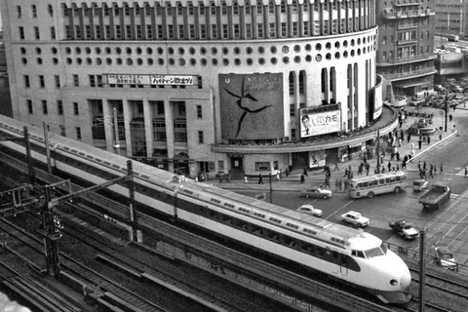
The Bullet Train passing over the Ginza area of Tokyo (1964)
Just as I emerged from the Asara Tunnel, a blue and white direction-distance sign told me that Shingu and Kushimoto, were 86-kilometers and 42-kilometers away, respectively. “Mmm!” The number 42 was also the number of the main road that I was using, and momentarily wondered if there might be something in the form of good luck awaiting me. The time had gone five-thirty when I entered the pleasant little seaside town of Susami, its beachfront seemed an ideal place to make camp. Susami was a little town located in the Nishimuro region of Wakayama prefecture, and had a population of around 4,000 inhabitants. Talk about surprises! Located just off the Susami coastline, there stood an underwater officially recognized red colored postbox, just like any of the local postboxes people pass along the road, without so much as a thought. The postbox currently held the Guinness World Record for being the deepest underwater postbox, at about 10-meters. It was used by divers who wrote their water-resistant messages, and that during busy periods, it contained as many as 200-pieces of mail per day. Two elderly ladies, with a little dog, also on in its years, told me that there was a convenience store a little further along the road. That was all I needed to know in answer to my question. The tent was soon erected between the foamy tide on one side and the convenience store on the other. Or not a 100-meters between the two, separated by the busy main road, which I would worry about later. With the light was still good in the sky, I decided to catchup on writing out some of my plain postcards to family, friends, and acquaintances. “Mmm!” Perhaps I would jot down something about my good fortune at stumbling upon such a pleasant spot to pitch the tent for the evening. Especially whenever I considered some of the other places I camped at up until now. A number of cold water showers stood some meters from where the sides of the tent fluttered away like mad in the breeze. Needless to say, I had every intention of using one of them, for I planned to take a wee dip in the sea shortly. Not long after arriving, a lot of the Obon holiday makers had begun to gathered up their stuff. By now most of them were gone. To my left, a large family, or was it two families, camped about 100-meters away. They looked like they had no intention of moving anytime soon, for a campfire was blazed away like there was no tomorrow. Straight ahead of me, the hump of a tiny islet poked out of the water, the sort of image found on picture postcards. A few telltale signs about the islet told me that it had some Shinto significance. Away to the left off the islet, a number of beautiful yachts, toys for the rich, set moored on the calm water close to each other. Still further left of the yachts, a number of Japanese inn roofs pointed up into the darkening sky. Ryokans where not cheap places to stop at. Not far from the ryokans, I could see what looked like a concrete block of public apartments, usually for low-income families. Such apartments were called danchi in Japanese. The rents in these municipal housing complexes was rather cheap. So it seemed kind of out of place in such a costly touristy location as this.
Then again, what the hell did I know, as I dug about in my backpack for some clean clothes for after my dip and cold shower. The danchi building’s tiny windows were not designed for the residents to enjoy the picturesque scenery from. When I thought about it, the windows on all of the traditional buildings from Cape Soya in Hokkaido to Susami, were not designed to enjoy anything from. Actually, I was not sure the residents of yesteryear ever really cared. Much of the daylight hours of early rural life was spent working in the fields. That said, I had seen so many new apartments building located in beautiful regions, with main windows that faced in less attractive directions. Most Japanese preferred their main front windows to face either south or east, rather than north or west. Once again, the sun ruled supreme, regardless of any picturesque view. The interior of the convenience store across the road appeared to be more a franchise operation and was run by an elderly fellow. To my disappointment, the shelves were stoked with a lot of varieties of Japanese sake, and not a single bottle of red wine anywhere in sight. Instead, I bought a 500-milliliter can of Kirin beer. The price was ¥4 Yen less than the ¥280 Yen the cans beer cost at the more famous chain stores, so I should not complain. “What time did you close the store?” I asked the elderly smiling proprietor, who was also hard of hearing. “About nine!” “Well, I might pop back a little before then.” I replied, returning the smile, and heading out the door with the beer stuffed into one of my pockets. It was nearly seven-thirty when I finished writing out the postcards, and washing and hanging a few odds and ends of clothing. Already I had taken a dip in the sea and the cool shower and knocked any dreariness out of me. The only thing left to do, before hitting the sack as to get something substantial inside my belly. Within a few minutes I was back at the store, where I picked up one of the few bento dishes, fried pork on rice, from the cool shelf. My second can of beer of the day was also paid for, and with the pork and rice heated up in the microwave, it was back across the road to the beach. It surprised me a little at how good the pork and rice tasted. Whether this was because I was hungry, I was not sure, but what I did know was that I was still hungry. After a little while, I decided to take a dander about the town, and to pass by the toys of the rich, moored not 500-meters along the coastline. Also to keep an eye out for another store. It did not take very long to look about the tiny town of Susami. There were no other shops or places to eat at. A glance at my pocket watch told me that the time was a little after eight o’clock. Then I remembered seeing a hamburger on one of the shelves at the at the convenience store, and decided to call into there again on my way back to the tent. To my dismay, however, the store was closed for the night. Everything was shut down, except for a set of vending machines, with cigarettes, soft drinks, and 500-milliliter cans of beer. A can of Kirin beer cost me ¥290 Yen, which was not such an outrageous price. Therefore, the appropriate coins were inserted, the correct button pressed, and my third beer of the day dropped to the slot at the bottom.
17 Aug, 2019: In the absence of a glass of red wine, and the old eyes feeling a bit on the heavy side, an early night might not hurt. However, at around 01:00AM I was awakened by a loud voice. On poking my head out through the tent flaps, I caught the silhouette of some Japanese guy standing nearby, his cellphone held up to his ear. He must have stood talking there for the best part of a quarter of an hour. Then suddenly, he stopped talking and went away, perhaps to annoy someone else with his loud voice at some other place. “Mmm!” Japan was not the kind of place to find peace and quit or solitude. These days people were so much in love with their cellphones, and never without one. Somehow I drifted off to sleep again, only to be awakened again, this time by the voices of two young people, male and female. The time on my pocket watch was 02:45AM. There was a stone bench not five-meters from where I had pitched the tent. On this very bench, the young lovers planted their butts. For the hour or so, the guy never seemed to shut up. Apart from the odd giggle and words of agreement, the girl did not speak much. She listened intently to her young Socrates, who seemed to have all the right words. Although I could hear everything being said, I could not understand everything. All that I really wanted to do was to go back to sleep and ready my mind and body for the long road that lay ahead. The guy just rambled on about his views on life, and how he felt men should care for women. And that women should care for the children, and that this would make a strong family basis, out of which the child would grow to become strong and happy, and so on. And then added: “That was the true meaning of life.” The time was now 03:30AM And I was simply had enough of waiting for them to leave. So, I set up, unzipped the tent flaps, and glanced up at the dark star covered sky. Earlier I had zipped up the tent in the hope it might kill the noice a bit. It did not! “Listen! Why do you have to sit so close to my tent?” I said, in as calm a voice as I could. Actually, I almost laughed at the sight of two surprised faces quickly swing around in my direction. “I’m trying to sleep! It was 03:30 you know!” I said, looking right at them. “Why don’t you move a little, like, to one of the other benches.” I said in Japanese, pointing further along the beech. Almost immediacy, the young man got to his feet. “I’m sorry!” He said in English. By now the young girl was also on her feet, and together they headed away in the opposite direction to my halfcocked suggestion. As they made their way along the sandy beach, I caught the sound of one word. “American!” Thankfully, or of what remained of the darkness, I could not hear any thing other than the slopping sound of the waves hitting the shore. After all, love was blind, or so it was said to be. It was a time when both people tended to overlook the faults of their partners. No doubt noting mattered but to be in each others arms. The young couple may not have noticed me or my tent. There was a popular hit song in the 1950s called 'Young Love'. The song reached number one in America, the United Kingdom, and in Ireland, and was performed by a number of noted artists over the years.
18 Aug, 2013: Yesterday had clearly been a day of tunnels, one after the other, again and again and again. So it did not take me unexpectedly or surprisingly when another tunnel popped up into view. The Shiroshima Tunnel was built in 1967. Shiroshima meant ‘white island’ in English, and was part of National Route 42 that ran near the coastline. “Mmm!” I momentarily wondered if the name had some local mythological meaning. I even surmised if the next tunnel, if it was near, might use some opposing kanji meaning for its name. The tunnel was opened in the same year Prime Minister Shigeru Yoshida died, the first PM held office after the Pacific War. It was also the year when so many great bands were making a mark on the music scene. That said, the architects of the Shiroshima Tunnel failed to leave a mark in the size and shape of a pavement. Soon after leaving the tunnel, an overhead structure presented itself. No doubt the history of this segment of the road was prone to falling rocks or landslides. Then there was the splendid view of my old friend the sea, located between the tunnel and the overhang. That said, there was little time on my schedule to stop and enjoy it. According to scientist, the closer you lived to the sea, the better you health was. That kind of made sense, for walking along the beach, swimming in the sea, and of course the fresh air you breathed. More time spent out under the sun meant the abundance of Vitamin D, not to mention healthy minerals, in the already magnesium-rich salty waters. Inside the overhang, it was easer to imagine that it was more for the protection against the rush of water than anything else. A life close to the sea came with its risks, like, storms surges, the rise of sea level, flooding, and whatnot. Therefore, if I lived so near the mighty Pacific Ocean, then I would want something along similar lines. Then again, what the hell did I know? It was inside the overhang, when my own worst fears came to light. The inside straps of my left sandal came apart. Somehow, and with great difficulty, the next few kilometers along Route 42 were covered like there was no tomorrow. On looking back, I must have covered the distance like a prima donna, for fear of tripping, falling over and hitting something hard. Falling was something that I had become quite good at doing during my mission, even in the best of footwear. This was made all the more problematic with a heavy backpack strapped in place. If I did not keep my wits about me, it would be impossible to break the fall properly. With the backpack, it felt as if I was being pushed downwards. At last, I called in at Michi-no-Eki called Inobootan Land Susami, a public rest-stop area, just off the main road. The name of the rest-stop was a hybrid word, which in English meant: wild boar, called inoshishi, and domesticated pig, called buta, symbols of the area. Therefore, unique inobuta souvenir goods were sold at the shops, among other things. Located further along the road from the rest-stop, was the Yoshinokumanokokuritsu Park and the specular view of the Okanokuro Island. Low and behold, along the way, or in the direction of the Michi-no-Eki-Inobootan Land Susami, I spotted a sports shoe by the side of the road.
Michinoeki-Inobootan Land Susam (Yahoo)
The shoe was in reasonably good condition, or it seemed hardly used or worn. Naturally I stopped to look it over. Even more surprisingly, the left-shoe fitted comfortably to a tee. “Mmm!” Someone up there was watching over me, I thought. It was not quite a sports shoe, like I had first thought when I saw it from a distance. Rather, the sure was the kind of thing used on building sites. The toe-part of this newly acquired friend of sorts, had a metal cover for protection. If the previous owner was not in the building trade, then perhaps he was into hiking and climbing. Whatever it was the person in question did for a living, or hobby, I felt strangely grateful, in a funny sort of way. What also occupied my head at the time was how the guy had managed to loss only a single left shoe. "Mmm!" It was possible that they were tossed out of the window of a passing car, or so the thought hit me. In similar fashion, I then spent the next few minutes looking about near the side of the road for the other shoe, but it did not turn up. Not long afterwards, on the road again, feeling happy with my new friend comfortably on my left foot, when I suddenly stopped again. This time an important thought had just crossed my mind. “Mmm!” It crossed my mind that something nasty might have happened to the previous owner of the left shoe. This included thoughts of retracing my steps back to the spot along the road to make a wee search around the trees and undergrowth for its owner. For all I knew, the guy could have met with some danger, and lay somewhere helpless, waiting to be rescued, if at all alive. Surely my tired brain was barking up the wrong tree, for like many times in the past, it worked overtime. While at the rest-stop area I ate three delicious lollypops, at ¥130 Yen each. That added up to five such icy treats, when I counted the other two I had picked up at a similar place some kilometers back down the road. These days, manufacturers used lots of sugar or sugar substitutes in their ice cream products as sweeteners, or to create the right texture as they liked to call it. On the labels of the food and drinks at the stores more than likely had words like, 'shishitsu', for fat, 'tansuikabutsu', for carbohydrate, 'toushitsu', for sugar, and 'shokubutsuseni', for fiber printed on them. In other words, efficient and safe grocery shopping in Japan, was not always easy, particularly for foreigners. One Internet site I browsed over asked its readers if they felt like Alice in Wonderland when shopping at a Japanese supermarket. People spent more time than they had just looking at the package labels. Poor diets, like, processed foods, sugary drinks, and so forth, led to millions of untimely deaths each year. Despite this, there was no place for apathy or lethargy on the road, even when at those times I felt anxiety and strain about finding drinking water or food. Thankfully, there was no observable physical detention, even when there was the odd time I could not eat properly. All the same, it was wrong for me to consume so much sweet stuff in such a short time. Talking about time, it was not even 11:00AM yet. I had long done my best to avoid sugary stuff, especially the sugar-laced concoctions bought at vending machines, regardless of what the sun had to through at me.
The heat from the sun that endlessly seemed to bounce up off the road, along with the dust, and into my face, kind of played tricks on the old mind. Then when I saw a nice mouthwatering ice cream looking up at me from the freezer in a shop, it was nearly impossible to resist the temptation. Along the way another tunnel popped up. The Kuroshima Tunnel was some 488-meters long, and being a 1967 job, it came into service without a pavement. Just about all of the tunnels that were built during the Swinging era of the 60s told of the country’s plans for the future, a nation on the move. Kuroshima meant ‘black island’ in English, and was located near the coastline, though a bit more inland than the previous tunnel, Shiroshima Tunnel, I passed through. Sometime later, I stopped at a cafe that overlooked the sea, and where I ordered a spaghetti dish. This was followed by a dessert of what the Japanese called, ‘kakigōri’ a flaked-ice. Of course, there was often a wide range of flavored toppings, such as, cherry, grape, green tea, melon, and so forth. In my case, I settled on a kakigōri with strawberry topping. As a sweetener, either syrup or condensed milk was usually added along with the fruit flavor topping. Kakigōri in Japan dated back to the eleventh-century, when the aristocracy enjoyed it in the summer months. At that time, kakigōri was made by “a hand cranked machine to spin a block of ice over a shaving blade” (Wikipedia). A traditional technique still used by street vendors in summertime. It was not until as late as the nineteenth-century when it became more widely available. These days, kakigōri could be bought at convenience stores and supermarkets throughout the country. Since starting out from Tokyo my food intake had been noting to write home about. Of course, I was aware of this, and each morning I would tell myself to make a point of picking up something more nutritious, which meant cutting down of sugar, salt, and oily stuff. In this case, the chance allowed for to stop by at a cafe that happened to have spaghetti on the menu. I read somewhere that whole-wheat spaghetti was a good source of fiber, but in restaurants once was never sure of what they got. Spaghetti at large contained iron and was low in fat. The problem was what the chefs put on top of the pasta. The cafe was not so busy when I entered. With the hands of the clock on the wall nearing lunchtime, customers started to trickle in from the hot weather. More than likely, to substitute their air-conditioned cars, for an air-conditioned cafe. The string that I tied around my broken left sandal to hold it on my foot seemed to have held fairly well, even after tramping for at least five-kilometers. Therefore, I may not need to use the shoe that I found along the road earlier. Besides, I had a ready supply of string to last me a while. Fortunately, the right sandal remained reasonable sturdy. However, the tread on the soles of both sandals was just about gone. Therefore, rather than dump the left shoe I found, I decided to strap it to the backpack for a spell longer, just in case. All in all, I needed to be careful just where I place my feet, at least until an outdoor shop popped up. “Mmm!” A part of me wondered if I could make the damaged sandals last until the end of this stage of my mission.
It would be one hell of an achievement. Wishful thinking! If all went well, I expected to wrap things up in Shizuoka. Up ahead a direction-distance road sign told me that Shingo was some 67-kilometers away, whilst Kamoto was 23-kilometers. My progress along the road was second to none, and I felt good about it. Not even the relentless sun was able to slow me down. Or was it the heat from the sun working on my brain that caused me to strictly stick to some self-destructive ideology? “Mmm!” No! It was not the sun. I told myself, as I set down on a wooden bench at a shop to enjoy my first cool beer of the day. More than likely it would be the last beer, too, since the shops and restaurants appeared to be so far and few between on this stretch of road. In time I came to the Wabuka Tunnel was built in 1967, and which I felt was named after the Wabuka area. The pavement-less tunnel ran for some 270-meters of cool, breezy air. So many tunnels were built in this part of the country, in the 1960s. In fact, the scenery had been so stunning that I hardly noticed a tunnel until I was almost entering into it. The Toyama Tunnel was built in 1966, and ran for just 73-meters long. Or should I say, short and sweet? The tunnel was opened to the public in the same year that England beat West Germany 4-2 at Wembley to win the Jules Rimet Trophy in the FIFA World Cup Final. It was a time that would remain notched in my brain until I took my last breath, for at the time, someone dear to me went to meet his maker, a little earlier. A few months before the World Cup my grandfather died of a bad heart, at the right old age of 61. The life expectancy of males in Ireland, in 1966, was around 70-years (71-years in the UK, and the same in Japan, in 1966 ). So it could be said my granddad left us before his time. Today, the life expectancy age for males in Ireland was said to be around 80-years (81-years in the UK, and 82-years in Japan, where I currently lived). The age of his death was just one short of the number of our door at St. Katherines Road in west Belfast. Three large sections of open space made up the cemetery, each about the size of a football pitch, designated as ‘poor ground’, built on wetlands. My granddad’s grave was located in the poor ground part of the cemetery. The Milltown Cemetery, in west Belfast, was opened in 1869, to service the city’s expanding Roman Catholic population. As a result granddad’s untimely death, my sister Anna and myself went to live at out father’s house in the Oldpark area of north Belfast. We were ten and nine-years old, respectively. That meant a change of those things important to a young growing mind, such as, family, school life, friends, and just about everything else, which I will not go into in any detail here. In time, another direction-distance road sign told me that Shingu was now 56-kilometers further along the road, or in other words, about two-days of tramping. On the other hand, Nachikatsuura was 41-kilometers away, which was a little more than a day away. My pocket watch told me that it was ten-after-five, or time to think about making camp somewhere. There was also little hope of finding a shop or store now.
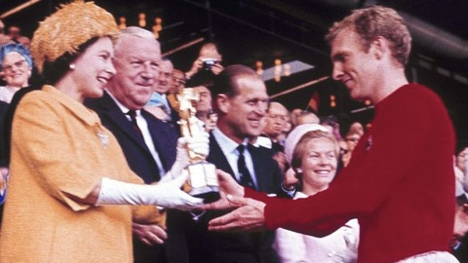
Queen Elizabeth II presenting the Jules Rimet trophy to 1966 World Cup winning England captain Bobby Moore (Yahoo)
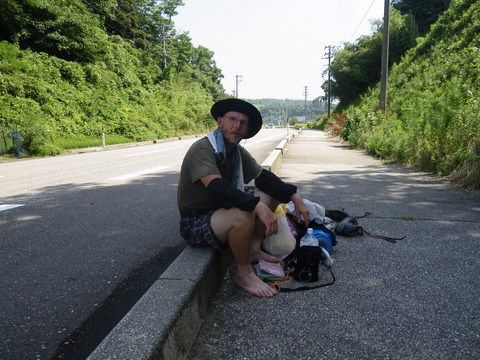
19 Aug, 2013: Things could not have turned out better when it came to making camp. An elderly woman kindly directed me in the direction of a small local shop where I bought milk and bread for breakfast, and a can of beer for the evening. In the early evening I chatted a wee while with another elderly woman, who stopped near my tent, and gazed out over the tiny Tanami Bay. The woman told me that her name was Hitomi, and that she and her husband, Hirofumi, were visiting her parents for Obon. Hitomi-san and her husband were both from Tanami, but that they now lived in Osaka. They had three grown children, all girls, who also lived there. Of course, there was the usual who-when-where-what gauntlet of questions in the course of our wee chat, which I was happy to answer, even if my mind and body were fairly shot. It had been a long and uncertain day. About two hours we parted, just I was taking a nap in the tent, naked but for a small towel draped across a certain part of my body, I thought I heard voices. Then I distinctly heard the sound of footsteps getting closer over a gravel path. “Michael! Hello Michael! ‘I brought my husband!” “Oh! Just a moment!” I said, while fumbling in the dark for the clean T-shirt and short trousers, I had set aside for tomorrow. “Don’t you have a light?” “I don’t think he has a light.” She said to me and then to her husband, before I had a chance to reply. Just then I grabbed up little lamp and turned it quickly on. “Ah, yes! A light!” She quickly said to her husband. “See! I came well prepared!” I said, as I looked up at them, through the tent flaps, smiling from ear to ear. Within seconds I was outside the tent standing in front of them, introducing ourselves. Pointing at one of the houses across the way, Hitomi-san then told me that her mother was wondering if I would care to take a shower. I then said that I had taken a dip in the sea an hour ago and did not feel very dirty now. In my heart, I would love to have had a hot shower, but a part of me did not feel overly keen to do much of anything just now. Actually, I was nodding off to sleep when they visited me at my tent just now, and still felt tired. “How about food? Something to eat? Have you eaten?” She asked. For much of the day, the hot weather had kind of killed any hunger pangs, even thought I did my best to eat when I could. This I told to both Hitomi-and and her husband, adding that I had earlier eaten spaghetti at a place some 15-kilometers or so, back down the road. “Come! You will sleep well after a hot shower.” She said. Her kind-faced husband’s smiling and body language more than echoed the wishes of his persistent wife. To cut to the chase, Hitomi-san proved a very persistent kind of woman, in a nice sort of way. They both had intelligent, lively, genial, and affable personalities. It was more than clear that any desires of having a quiet night of inactivity was a nonissue. And with hand waving and nodding their heads for me to follow, we all headed along the gravel path towards her mother’s house. This was not before I dugout my razor and toothbrush, and grabbed a few clean clothes, and zipped up the tent, first. “A shower would be most appreciated! Thank you!” I replied. There was noting better than a good warm soapy scrub down after being outdoors all day long.
A dip in the salty waters were good, too, as it left me feeling refreshed and clean every time. With all the fishing boat engines, and offshore building activity going on here and there, the water was not as clean as it seemed. “How about tomorrow? Why don’t you stop for breakfast!” And with that, my near future was soon decided, at least until the morning. After a nutritious breakfast, the first cooked since leaving Tokyo, and some snapshots taken, I was soon on my way again. After waving goodbye to my kind friends, I made my way across to the main road, Route 42, under a clear blue sky. This time with a large stray hat on my head that I was assured was better than my usual black hat when it came to keeping the sun way. Even without the new hat, I was bursting with energy after the breakfast. It was not long on the road then a tunnel popped up into view. The Tanami Tunnel was built in 1966, and ran for 276-meters long. The tunnel was named after the village close to the coastline. The road was busy, but not like it would have been during Obon, which had ended about four-days ago. A cool breeze greeted me at the tunnel, which also kind of reminded me of the heat and the dust that blew up of the road each time a truck passed by. “Mmm!” It was going to be another scorching day, I thought to myself. This was as I headed into the tunnel, and loosened the straps on the backpack, to feel the air on my back. Not three-kilometers had passed after I left the Tanami Tunnel behind me, when I entered the Ousakayama Tunnel, a 272-meter long pavement-less job, built in 1967. It looked like this was going to be another day of tunnels. For soon I came to another 1967 job, this time the little Takahama Tunnel, which thankfully ran for only 62-meters. “Mmm!” Strange the way certain unimportant things reminded one the past. Momentarily, recalled our front door number on St. Katherines Road in West Belfast, where I spent the first 10-years of my life at No. 62. Of course, I could not recall seeing or playing around any tunnels, derelict or otherwise, in those days. Actually, there were a good few derelict railway tunnels in Belfast. For example, the eight railway tunnels, called the Lanyon Tunnels, near East Bridge Street in Belfast, once connected the Belfast Central Station with the old market area, and other places. Closed to rail-traffic for some 70-years, the tunnels were later used as holding pens for cattle, before being moved to the slaughterhouse on Stewart Street, a short distance away. The Belfast City Council planned to reactive the tunnels for potential commercial development. So I guess it might be said there was a light at the end of the tunnel. Most of the tunnels throughout Ireland dated to the nineteenth-century during the building of railways. They were typically excavated through rock by blasting and then hand excavation. Modern tunnels included the longer road tunnels and utility tunnels, were constructed around 1940 to the present. A variety of tunneling methods were employed. Many aristcratic country estates had private tunnels below the main buildings. The tunnels offered a kind of privacy for coming and going, or a means of escape should the time arrise.
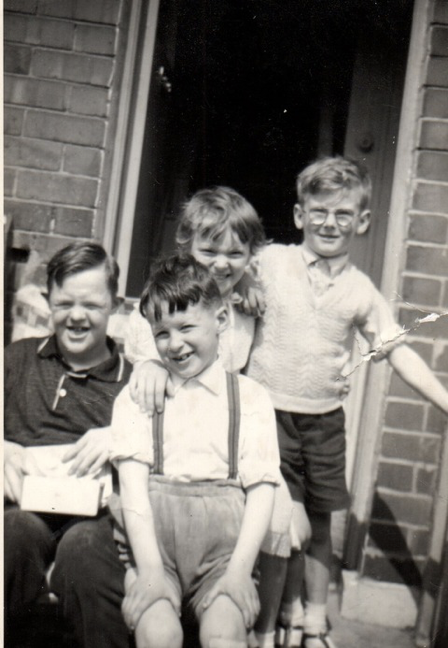
Family and a friend with yours truly at the rear
Photo taken outside our house in Belfast, summer 1961
Hitherto, the nearest I got to a tunnel, of sorts, was crawling thought, climbing over, and legging it around the long concrete pipes with my mates. Of course, that was when the workers disappeared to their home, or the pubs, before it got too dark in the evenings. In those days the sites were not deemed as highly sensitive construction sites with fences and watchmen, or guard-dogs to keep uninvited people out. Nor was there any caution about the Official IRA orchestrating plans to blowup or make off with costly equipment from the site. The last active, though ineffective republican campaign against British rule in Ulster, was from 1942 to 1944. An RUC constable, Patrick Murphy, died in the 5 April, 1942 incident, for which the IRA member, Thomas Williams, was hanged about four-months later (Friday, 30 August). The 19 year old Williams was the only republican ever to be executed in the North. There had been a number of IRA armed raids on British military bases in Ulster and in England, between 1951 and 1954, including a short lived border campaign, in late-1956. Irrespective of any IRA treat or sectarian divisions, our wee childhood antics were unlikely to foster dissatisfaction amongst the local people regardless of their religious persuasion. As children, we more or less watched the building of the M1 Motorway in the early-1960s. Planned since 1946, it became the longest motorway in the North, at some 61-kilometers long, from Belfast to Dungannon. The motorway venture was part of an economic prosperity in the six-counties that characterized the 1950s and early-1960s. “The M1 is the only motorway in Northern Ireland completed to its full planned length… The motorway remained free of a blanket speed limit for several years.” (Wikipedia). This was one of the aspects of what became known as, O’Neillism’. Terence Marne O'Neill, a strong advocate of economic planning, was also the Six-Counties forth Prime Minister and leader of the Ulster Unionist Party (UUP), from 1963-1969. His hope was to develop communication and industries, and create a pleasant environment in the of Ulster. This included a massive road-building campaign to facilitate the growing modern travel, all of which he hoped would provide ready employment. In those years, the Six-Counties had the highest rate of unemployment in the United Kingdom, including the lowest income for households that had work. At that time, the unemployment rate was even higher in working class areas, like, West Belfast than anywhere else in the UK. Along the way again, I stopped to take a rest by a statue of renowned monk, Kūkai-Sama (774-835). Kōbō Daishi, as he was also known, was active in Japan during the early Heian period (794-1185) where he introduced the Shingon (Esoteric) School of Buddhism. A little ways from the statue I watched an elderly woman working away like mad. She was on her hands and knees, as she fought to pull up weeds from the hard sun baked soil. “Mmm!” There was no job better than having a garden to work in, I thought, as I shouldered my backpack to continue on my way again. This time with thoughts of Kukai Sama on my mind, her he had also traveled over much of the country on foot.
There were plenty of shops along the road for the first few kilometers after leaving the Tanami Tunnel behind me. After that, however, I began to wonder when the next one might appear. The delightfully breathtaking scenery had taken my mind away from any hunger and thirst for some distance along the road. In the calm salty waters off to my tight, a giant rock poked out, as if to say hello to me, and wonder where I was headed. “Mmm!” I seemed easy to understand why Shintoism held such things as divine. My thoughts were momentarily broken by the sight of a large cargo ship passing far off in the distance. The scenery included a tree carpeted mountain range that stretched away in the background, to my left. My pocket watch read, six-fifteen, which told me how long I had been on the road. Somehow, too, I did not want to face anymore tunnels, or not until another one came into view, which I hoped would not be too soon. The Tamanoura Tunnel was a 1965 job, it ran for 322-meters. If only there was a pavement! Then again, even in the tired state I was in, positive thinking was necessary. After all, it was not a monster tunnel that went on and on and on. The Prime Minister at the time was Eisaku Satō, a fellow of many achievements. He was the third-longest serving PM in Japanese history, not to mention the second uninterrupted term in office, from 1964 to 1972. Satō was also the PM to hold office to be born in the twentieth-century. He was the the first post-war PM to visit Okinawa, in 1965, and the last to pay an official visit to Taiwan, since 1967. The PM strongly believed that the defense of Taiwan was key to his own country's security. Satō was also supportive of the government of South Vietnamese during the Vietnam War. Last, but not least, he was the first PM to visit Singapore, also in 1967. Although a strong allied with America, and was not altogether opposed to American plans of keeping nuclear weapons in Japan. On the other hand, he was strongly against President Nixon's visit to China, in January, 1965. Satō's long term in office was a time in Japan of rapid economic growth, which included a lot of building. The PM was responsible for the formal return of Okinawa from American occupation, since the end of the Pacific War. The return of the Okinawa Islands included the remove its nuclear weaponry there. The return of the islands was made formal, on 15 May 1972. The deal also included the Senkaku Islands, the sovereignty of which remain in dispute with China. He would go on to receive the Nobel Peace Prize for his efforts on taking Japan into the Nuclear Non-Proliferation Treaty, in 1974. On an added note, in a popular magizine, Shukan Asahi, interview in 1969, Satō's wife accused her husband of being a wife-beater, amongst other things. The Tamanoura Tunnel was very near the coastline, and where the mighty Otawa River flowed into the Kumano Nada, a body of water that connected the North Pacific Ocean and the Philippines Sea. Earlier in the day, my poor inexpensive sandals fell apart beyond repair, especially the left one. Thankfully, however, the sudden appearance along the road of a Komari, a kind of gardening, outdoor, DIY chainstore, forced my hand.
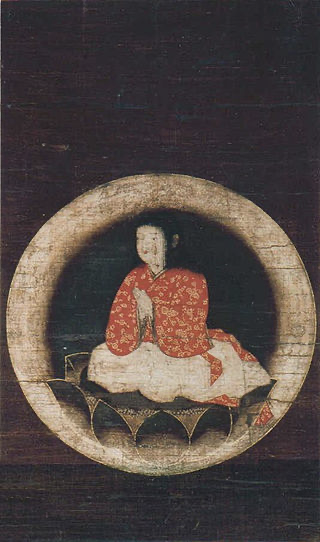
Painting of Kūkai as a child (Wikipedia)
If I did not do something about my feet, I knew that I would only regret it more sooner than later. Besides, with the scarcity of shops I was not sure when the next chance to pickup a new pair of shoes might arise. It did not take long to decide on an inexpensive, size-27, pair of footwear. Unfortunately, the store did not seem to have any sandals in stock. I was bugged as to why not, as it was still, I felt, the hight of summertime. The sports-like shoes cost me less that ¥2,000 Yen. They were the only shoes at the store with soles that looked like they could deal with the trails and tribulations of the road, like, long distance walking. At least I try much hoped so, for there was still nearly two-weeks left to go. That said, it was not the soles of the sandals that caused the problem, rather the glue that held everything together. The heat from the sun proved too strong, that they were oolong fit for purpose. The main problem now, I felt, was that wearing shoes or boots in this kind of weather added to the heat and discomfort. Then again, I hoped that that would be the only problem I faced on the road. With this in mind and my new shoes on, I set off along the road keeping my eyes open for a good place to make camp. Camp was finally made rather late for even myself, at around seven:thirty. This was by a Shinto shrine, called Shimosato-jinja. One good thing about camping at such places in the evenings, was that people seldom showed up out of the blue. Peace and quiet was what the doctor ordered. Not very long after eating the last of the two onigiri Hitomi-san had kindly prepared for me this morning, I noticed something moving about the tent. That was when I noticed a Japanese cockroach climbing up my old plastic cup that I had used since starting out on my mission at Soya Misaki in Hokkaido. To make matters worse, the damn thing jumped right into the red wine that I had poured into the cup not five-minutes earlier. The unfortunate little creature swam about for a little while, then it stopped and slowly sank to the bottom of the cup. Primarily an outdoors species of cockroach, the Japanese ‘Yamato’ cockroach was native to Japan. “Mmm!” I thought my little invader was a female, since its wings were much less than its body size, as opposed to e male which were much longer, not that this was information to help me any. Cockroaches had been on this plant for hundreds of millions of years. As I was thinking how the cockroaches were sturdy little buggers, I decided that one of us had to go. Suddenly I reached across the floor of the tent for some useful weapon, extra careful not to spill the wine, for I was damned if I was going to let the little unwanted encounter spoil anything. With the help of a table spoon, I was able to remove the cockroach with little difficulty, and flick it out through the tent flaps as far into the evening air. It landed in the sandy soil, and wiggled about a little, then it stopped. This surprised me a little, since I thought it had drowned in the wine. When I looked over that way about 10-minutes later, the cockroach had disappeared. “Mmm!” Who said insects did not have the time of their lives? I hope it enjoyed the wine. As for myself, the wine tasted no different.
20 Aug, 2013: Sleep had been surprisingly good, if only the cockroaches would leave me alone. The pitter patter sound of the odd one running along the sides of the tent. In the summertime I liked to leave the tent flaps open, in the hope of a light breeze may come calling. The mosquitos were the biggest problem, but usually I was well prepared with katorisenko, a kind of repellent for the little buggers. That said, I needed to keep the coils away from the tent, could be fire hazards. “In 1999, a fire in a South Korean three-story dormitory caused the death of 23 people when a mosquito coil was left unattended” (Wikipedia). Two workmen and a workman, all clad in similar dungarees, arrived at their cabin a short distance away from the tent. Some maintenance work was being done about the shrine, but I was not sure what or where. After a short while, I asked one of the men what was the name of the shrine, and he told me, Shimosato-jinja. A little later, as I was about to leave the shrine to hit the road again, I stopped to chat with two other workmen how had just arrived. One of them told me that the area was called, Shimosato in the Higashimuro area of Wakayama, but that the shrine may have a different name, but was unsure of it. There was not mention of the shrine on my maps. The Shimosato JR Station nearby, that served traffic along the Kinokuni Line. This not very busy little station was opened in July, 1935. Admiral Keisuke Okada of the Imperial Japanese Navy was the Prime Minister at the time. The Japan military was also flexing its muscles at the time. The Battle of Khalkhyn Temple, a boarder Mongolian border with the Soviet Union. This was followed by a number of other incidents and broken agreements with China. Three notable black and white silent films were screened, in 1935. For example, Orizuru Osen (The Downfall of Osen), directed by Kenji Mizoguchi. The Downfall of Osen centered on the theme of the strength of a woman who gave everything to the man she loved; a theme which Mizoguchi explored his whole life. A moving cinema technique with bold retrospective scenes that greatly reflected Mizoguchi's experimental approach (Wikipedia). This was followed by Tōkyō no yado (An Inn in Tokyo), directed by Yasujirō Ozu. Tp paraphrase Wikipedia, the plot was set around the industrial flatlands of Tokyo’s Koto district and the trials and tribulations of finding work and make ends-meet during the depression years. The main protagonist, Kihachi (Takeshi Sakamoto) relied on his two sons to catch stray dogs for the reward money. However, one of the sons wasted the money on buying himself a much-desired officer's cap. The brothers quarreled and lose the family's bundle. Kihachi told this sons they no longer have enough money for both a meal and a bed for the night. They choose a meal. As luck had it, they met Kihachi's old friend at the cafe, who kindly helped the father find a job, while also allowing them to rent a room at the cafe. Of course, the film do not end here, even if I felt that it was a good spot to end. In that year, 1935, Japanese film goers were also able to watch the lesser known, Kodakara Sodo (Kid Commotion), a black and white silent film directed by Torajiro Saito, who was perhaps more famous for his comedies.
The benshi performance came with puns that proved a good part of the attraction of the plot. The plot was centered round the poor Fukuda family, who had lots of children. And a private war of an unemployed husband and father, who comically chased a pig for the rewards it might bring. As with most early Japanese silent works of art, people watched the films with benshi accompaniment. The film itself was a rare example of the silent Japanese slapstick kind of film, a Charlie Chaplin-like influence that survived to this day. Nearby were the Hashigui Rocks and the Kujirahama Beach, which would have been a more inviting place to have camped, as well as, the Taiji Kujirahama Park and the Dolphin Resort. There were a number of onsen, too, but I had no time nor interest. What my maps also told me was that the tunnels would be popping up by the minute, as if this was something I needed to know. It was not long before the first tunnel popped into view. The Kujiraura Tunnel was a pavement-less job, built in 1966, and was a 142-meters long. Once again, the name of the tunnel was carved in script and therefore hard to make sense of. All the same, there was something rather attractive about the short tunnels. Not much later, I found myself standing before the short Oura Tunnel. Built in 1966, it was only 50-meters long. The first kanji character in the name of the tunnel meant ‘big’ in English, which I thought did justice to this little job. Within only a matter of minutes another tunnel came into view. Yunoura Tunnel, was also built in 1966, and was only 97-meters long. A length that was for me sheer heaven, for the cool breeze that blew through it, even too short when compared to other tunnels. In the year that the Yunoura Tunnel opened to the public, Japan was said to have experienced a sudden drop in its fertility rate, and a rise in abortions. The reason behind the drop was believed to have something to do with a cultural superstition. Many families chose not to have children in that year, for any disadvantage or discrimination that their children may face in the future. It was called the year of the 'Fire-Horse', or 'Hinoue-Uma' in Japanese, and was more prevalent in rural areas than else where. Anyone born in that year, particularly females, may have trouble securing a mate, especially for arranged marriages, known as 'omiai' in Japan. Up until the beginning of the Pacific War, some 70-percent of marriages in Japan, occurred through omiai. In the 1960s this number was halved, whilst through the 1980s it averaged somewhere around 30-percent. By 2010, the number of omiai marriages had dropped to just five-percent. In like manner, the numbers of people wanting to marry in the coming years, I should surmise, would care even less about the superstition than previous generations had. 1966 was a year of airplane crash in Japan. An All Nippon Airways plane crashed into Tokyo Bay, on 4 February, leaving 133 dead. A Canadian Pacific Air Lines Flight crashed as it was landing because of poor visibility, at Tokyo International Airport, o4 March, leaving 64 dead. A day later, a BOAC plane crashed over Mount Fuji, soon after take off, on 5 March, leaving 124 dead. An All Nippon Airways plane crashed over the Seto Inland Sea, on 11 November, leaving 50 dead.
On the previous day, the sun had felt like it had gone all out to seek revenge on me. It was thinks to the clouds in the sky and the tunnels that kept me from going mad. Suddenly the foul stance of a dead animal nearby caused me to stash away my note-book and pen, clamber to my feet, and get on my way. The decaying beast much have been hit by a vehicle while trying to cross the road.. Along the way I must have seen innumerable wild animals crossing the road, thankfully without incident. The foul stanch, caused me to recall a few days earlier at another tunnel. That was when a spotlessly shiny-clean medium sized tanker-truck was emptying the cesspit. “Mmm!” What a mess things would have been had the damn cesspit exploded as I passed it. What away to die! My gravestone might include something like: ‘Here lies Irishman Walking, who met an untimely death, because a local cesspit exploded in his face. RIP (Rest in Pieces).’ It was usually around the early evenings when I liked to make camp, or kept an eye open for a suitable place to do so. Soon after erecting the tent, I would then wash myself down the best I could with soapy wet cloth, then get into something clean. If I was lucky to camp on a sandy beach, then all the better, for a dip in the sea. There was nothing like having a clean feeling when I lay down for a nap after being on the road all day long. In time the fifth tunnel of the day popped into view. The Shin-Yukawa Tunnel ran for some 350-meters long, and to my surprise, it had a narrow pavement. The tunnel was opened to the public in 1972. Then there was the Shin-Kogushi Tunnel, a 1980 job that ran for 283-meters long. There were two pavements, with the wider one on the left side heading north. As expected, the tunnel was nice and breezy, too. After waking up again, I would then set about doing some reading, and then penning some road-notes. More often than not, however, the nap would become a proper sleep, and when I did wake up some hours later, the time was too late to do anything worthwhile. Or I was in no mood to do anything, even pour myself a cup of red wine, or enjoy the evening sky. That was what being on the road did, it knocked you for six.The weather could be dealt with, like, adjusting my pace to sort the heat, resting here under a shade for a while, and of course drinking an appropriate amount of water. In time, the fifth tunnel of the day showed its face. The Shin-Yukawa Tunnel ran for 350-meters. Being a 1972 job, it surprised me that it had even a narrow pavement. Out under the sun to the extent that I was, it felt so natural to stop and rest under a good shade when at chance allowed. Back on the road again, a distance-direction road sign told me that I was some 15-kilometers from Shingu. The town of Nachisan was away to my left along a minor road, Route 46. Nachisan JR Station was off to the right along the same road. Owase also lay straight ahead in the same direction as Shingu. There were a fair number of World Heritage sites of interest along Route 46. These included, Kumano Nachi Taisha Shrine, Seigantoji Temple, and Fudarakusanji Temple. For nature lovers there was the Nachi no taki Waterfall, which was worshiped at the Hiryū Shrine where the kami, Hiryū Gongen was enshrined.
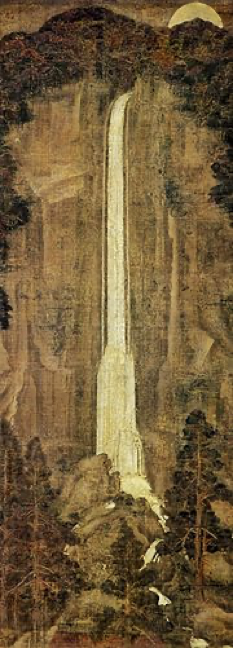
Nachi Falls depicted in this hanging scroll of the Kamakura period (1185-1333) (Wikipedia)
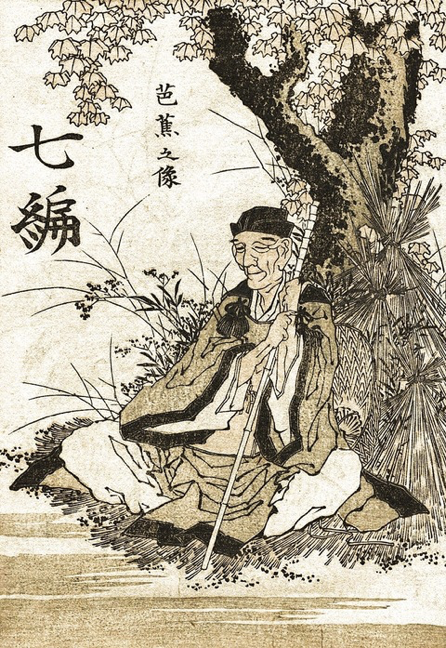
Portrait of Matsuo Bashō by Hokusai, late 18th century (Wikipedia)
In the mist-strewn mountains of Wakayama, sat the Kumano Nachi Taisha, one of the three sacred main shrines in the region, the other two being, the Kumano Hong Taisha and the Kumano Hayatama Taisha. Pilgrims frequently traveled to all three shrines to worship. Early in the mornings, priests at the Hiryū Shrine prayed to the kami Hiryu Gongen, thought to be the incarnation of the Buddha, who inhabited the awe-inspiring 133-meter high, 13-meter wide, Nachi no Taki, or waterfall. “In 1918, a Sutra mound was excavated at the base of the waterfall and found to contain many important archaeological artifacts, including statues, mirrors, altar fittings and Sutra cylinders. These are now displayed in the Ryuhoden (“Treasure Hall”), located next to the Pagoda. These Sutra mounds were created by priests in times of war to hide their treasures but also many items were buried in this way as a result of the belief that the end of the world was coming at the start of the tenth-century” (Wikipedia). The Nakahechi Route had been the main mountain path since the Asuka, Nara, and Heian periods. This was known as the Classical Period in Japanese history. At that time, the Nakahechi Route was the preferred path by the royal family and nobility. For example, In 988, Emperor Kazan (968-1008) was said to have visited the Kumano area on his first pilgrimage. At the time, the Emperor was said to have completed 1,000-days of severe spiritual training under the Nachi no taki, a large waterfall. He became so deeply moved by the image of Kannon that he declared the temple one of the Saigoku Kannon pilgrimage stops (Wikipedia). Emperor Kazan wrote goeika poems at the places he stopped, which were still read as sacred hymns along the pilgrimage route. Likewise, in later years, other emperors along the pilgrimage route, composed poems at visits to each of the sacred sites along the way. Emperor Go-Shirakawa (1127-1191) made 34 journeys to Kumano, whilst Emperor Gotoba (1180-1239) some 31 visits. The temple buildings, like many of the temples on the pilgrimage route, were burned to the ground by Oda Nobunaga during the civil wars of the sixteenth-century (Wikipedia). Of all the famous temples and shrines in Japan, none was more popular than the Ise Shrine. Matsuo Bashō (1644-1694), the most famous poet of the Edo period, was said to have visited the shrive six times. And that as many as three-million people made a pilgrimage to the shrine, in 1705. In the absence of anything by way of public transportation in those days, most of them made the journey on foot. The Seiganto-ji meant ‘Temple of the Blue Waves’, in English, and was one of the few combined Shinto shrine-Buddhist temple complexes in Japan. An attempt was made during the Meiji period to separate Buddhist temples and Shinto shrines that had for over a 1,000-years shared the same grounds. Because of this, Seigantoji was formally abolished, the priests stripped of their authority and no funding was given to the temple) (Wikipedia). Together with other secret locations along the pilgrimage route, Seiganto-ji was listed as a UNESCO World Heritage Site, in 2004.
The United Nations Educational, Scientific and Cultural Organization, to use its full name, promoted the preservation and growth, of intellectual and cultural properties in the world, there were deemed to have outstanding universal value, both cultural and national. Currently, Japan boosted 19 cultural, four national, and no less that 23 world heritage sites. UNESCO is probably best known for designating World Heritage Sites, cultural and natural sites that show "outstanding universal value". There are currently 23 world heritage sites in Japan, 19 cultural ones and 4 natural. Centuries old Japanese cedars, camphor tress, and bamboo groves lined the ancient Daimon-zaka. The roots of many of the Meitosugi, or ‘husband and wife cedar trees’, were entwined beneath the steep cobblestone path. Part of the Nakahechi Route, Daimon-zaka was a 600-meters long cobblestone staircase that led from the base of the Kumano Valley up to the Nachi no taki Waterfall, passing by the Kumano Nachi Taisha and the Seiganto-ji as it went. There was a good rest area just by Nacho JR Station, where I decided to pull up at for a while. The toilets even had hot water, therefore, it seemed as good a place as any to get some washing done. Across the way I stopped in at a little joint to see what they had to eat. Such was the heat, I treated myself to two helpings of kakigōri, one with strawberry topping, the second with melon topping. The cost was ¥200 Yen each, which was not so bad. By the time I finished eating the kakigōri, which did not take me very long, my clothes were just about dry, thanks to the power of the sun. In time, my tramping along the road led me to the umpteenth tunnel of the day. The Ohkuji Tunnel was built in 1983, and had two pavements to its name. The wider of the two pavements I took, was on the left side of the tunnel headed northwards. The tunnel ran for a good 170-meters of cool breezy air, which I do not need to say was simply delightful. Then there was the Shin-Kogushi Tunnel, a 1980 job that ran for 283-meters, which also had two pavements. Like the previous tunnel, the wider of the two pavements was on the left heading north, and was nice and breezy. To paraphrase from a touristy road sign post, the Kinki Long Distance Nature Train left from Ukui JR Station. Apart from hiking, visitors were able to enjoy the Yoshino-Kumano National Park from the train. This included viewing the natural vegetation at the site of the former Ebisu-jinja Shrine, as well as, the Mesameyama Mountain forest. Warm temperature-subtropical trees and shrubs could be seen in the Ugui Forest. Also, there was the Komagasaki Lighthouse, which still assisted fishermen today. Kumanonade Sea was blessed for its splendid fishing, where yellowtail and mackerel were often landed. The Jigoku-no-hama, a rocky beach, might also prove an interesting place to visit where at low tide various species of wildlife could be observed in tide pools. Then there was the Kumano Sankeimichi (Koya-zaka-Hamanomiya-Oji) An ancient road along which many worshipers from all over Japan made their pilgrimage to the Kumano Sanzan. There were many routes for them to take, but the Kumano Sankeimichi was one of the most preferred.