2019年05月

Irishman Walking (Stage 11 Chapter 6) Summer 2013

56439087_2291153687790871_6976789749440708608_n

Irishman Walking (Stage 11 Chapter 6) is about my walking the main and coastal roads of Japan. Summer 2013.


25 Aug, 2013: Camp was made last night at Kii Nagashima, near the Nagashima Shipyard and Nagashima Port. There was a Circle K convenience store also nearby, which would prove useful.  It was such a built-up and fishy smelling area that I needed to turn off the main drag and follow along a dark side road in the hope of finding a place to pitch the tent. The best spot I could come up with was in a rocky field, with the roofs of some buildings, dark against the night sky, for company. When I arrived in the town, it was already nearly dark. The entertainment for the evening were the innumerable and silent flashes in the sky. The faint sound of thunder was heard far off in the distance. It was hard to distinguish the sound of the thunder, from that of a passing airplane high overhead. After sometime, the sound of the thunder drew closer, and with a few drops of rain, it was time to zip-up the tent for a while. Today’s weather, I felt,  seemed more confused than myself at times, with long snatches of sun and now spits of rain. A cup of red wine was already drunk, and I felt in no mood to read or write, other than to lay down stretched out on my back and listen to the rain drops tap against the sides of the tent. Not very long after I lay down, when the thunder and lightening, and the rain sounded like all hell was breaking loose. “Mmm!” Naturally, I begat to wonder if the spot that I had picked to pitch the tent on was a good one. The rattling sound of a cluster of trees could be heard nearby. The ground was hard and rocky, and I began to worry that puddles might start to form, or seep under the tent. There was noting worse than getting wet from the bottom up. It was too late in the night to bother or think about doing anything, other than hope for the best. When morning came, the thunder and lightening had passed over. The ground about the area was still very wet. Thankfully, puddles had not formed. When I did dismantle, roll up, and put away the camping gear, the time was 09:00 AM when I finally hit the road, without breakfast. After only a few steps along the road, a light drizzle began to fall. The pain from the blisters on the soles of my feet had not completely gone. All the same, the cool air on the sides of my cheeks should prove beneficial along the road. At least, when compared with previous days. My plan was to cover more than 25-kilometers before the end of the day. Then again, unless I did something about the blisters on my feel, I was not so sure who things on the road might turnout. By the time I reached the first tunnel of the day, the rain was really pelting down. There were two good things about tunnels. The first was the cool breeze that blew through them, and the second was the shelter then provided from the heavy rain. A pavement-less job that was opened to the public in 1966, the Nakashima Tunnel ran for 491-meters. This was much too long tramp along the road with the passing traffic. Actually, I gave up counting the number of heavy trucks that shot past me when I was passing through the tunnel. It was only when I emerged from the Nakashima Tunnel, when I caught sight of a narrow tunnel, especially for pedestrians and cyclists away to the side. “Mmm!” For a moment I thought about stopping by at the narrow tunnel to wait out the rain, but decided not to.


Rain or no rain, I needed to push on if I was to stick to my schedule. After all, there was no escaping the rain, and it was part of being on the road, so there was no point in bitching about it. At least I had well marked out roads to follow, dotted with road signs and shops and restaurants, and whatnot. The time was long gone when people trudged from one village to another, along mountain passes that ran undaunted over the most precipitous regions of the country. Of course, there must have been days when the paths were intolerably bad because of heavy rain and winter snow. God knows the times I had become wet to the skin. Soaked, scrawny, and tired, I had been caught out so many times that the rain might as well have been an illusion of the mind. The early travelers must have carried with them a sense of freedom, as they set off early in the morning along the bare path, through cold fields and over flat out-cropping rocks. Roving along paths through wild valleys, over tree clustered hills, and across fast flowing streams. Oh what a life! Back to the present, away in the mountains I could see a mist building up. This kind of told me that it was better to be tramping along the road in the rain that stuck on a mountain pass in a low mist. That was unless I mat my future sole-mate, like one of the main scenes in the 1939 classic film, Goodbye Mr. Chips, I would soon give the mountains a miss, for a while. The biggest concern that troubled me for the moment was the pain in my feet, which was by now, killing me. I needed to sit down and do something. If it was the same blisters that I thought I had fixed last night, then I should be able to cut or burst them better with my knife. For a while along the road, I had got into the habit of trying to cover every five-kilometers without stopping for anything, even to pee. It was interesting to time myself, in an effort of beating it. Up until now, I was able to cover five-kilometws in just 50-minutes, regardless of the pain on the soles of my feet, not to forget shouldering a heavy backpack. The battering that this had on my feet was now beginning to pay me back. Now I found myself not worrying about the pain, but about whether I would be able to reach my planned goal, Hamamatsu City. Perhaps I really needed to slow down, or even take a rain check and make camp somewhere. It was not be the fist time that I made camp at a place that I had not the foggiest idea of the name of the place. Hopefully when light and morning came, I would be able to put that right. After I fixed the blisters once and for all, my plan was to considerably lesson the 160-kilometer distance to Hamamatsu. Thankfully the little distance-markers along the side of the road would keep me well informed on this matter. Something told me that today was going to be a complete shame. Already I was unable to get far beyond five-kilometws, for the pain in my feet and realizing that I really needed to stop and do something. Now I considered myself lucky if I got anywhere close to 25-kilometers by the end of the day. I could feel bouts of depression creeping in. With the aid of my knife, it did not take me very long to discharge the fluid from the blisters and plaster them up the best I could. “Let’s hope everything will be better tomorrow.” I shouted, not caring if anyone heard me.


26 Aug, 2013: According to one woman I chatted with, I was camped at a place called Yanagihara Koen, park. Like myself, the woman seemed unsure about anything else about the area. She told me that she was passing through with her husband, who waited for her in their car a little distance away. And like the woman, I too needed to pay a visit to the public toilet, however the rain was by now really bucketing down and I needed to do a few other little odds and ends first. Just as I was fiddling about tightening this and fastening that, I could hear voices drawing near. On looking up I saw a young girl carrying a baby, and accompanied with two other giggling female friends. So I asked them about the place. Just as I had suspected, they told me that this was indeed Ōuchiyama in the Watarai District of Mie prefecture. A relatively uneventful little village, Ōuchiyama had a population of just over 1,500 inhabitants. This kind of disappointed me, not for anything to do with the village, but rather a glance at my maps told me that I had not trampled as far as I had hoped. To make matters worse, I had somehow gone a bit far too inland for my liking. To rephrase it, I had fucked up somewhere along the way. Consequently, I needed to get back to the Mie coastline. "Mmm!" How could I miss a coastline that stretched for some 1,094.9-kilometers? Or so the thought momentarily crossed my mind.  The water I could see was the  Ōuchiyama River that touched the Miya River on the edge of Mie.  “Mmm!” I felt stupid, for could not understand how I had missed getting onto correct road, Route 260, which was much nearer to the shoreline. Rain or no rain, pain or no pain, I really needed to make the day better. When I did set off again along the road in the right direction, my feet were well bandaged up. As a result, for the next 10-kilometers, or so, my feet were anything but comfortable. “Mmm!” Clearly this had something to do with the bandages, I thought to myself looking about for a dry place to duck into, to see if I could put things right. Perhaps even remove the bandages altogether. By now, just about everywhere was saturated by the rain, which showed no signs of letting up. This was a sigh of the autumn rain. Myth or not, it was said that the eskimo language had 50-words for snow. It was true, however, the Japanese language had 50-words to describe the different kinds of rain that fell over the country. Why not? It rained a lot here, and I think I had experienced all kinds of the stuff. The rainy season in Japan, in particular, inspired anyone who let it. The writers and poets were greatly influenced by the sound and sight of the rain. The Japanese poet Kenji Miyazawa (1896-1933), penned a famous poem about the rain, titled: 'Ame ni mo Makezu', or 'Be not Defeated by the Rain'.  Matsuo Basho, one of most celebrated haiku poets that Japan had ever produced, was greatly inspired by the falling rain, or so his writings informed us. Somewhat similar to myself, Basho travelled around Japan, mainly on foot, but of course at very different times and experiences, during the Edo period. One thing we both experienced was the falling rain, which he wroted about in his poems and travel journals. 


That said, I do not believe that I saw the falling rain in any poetic manner, like the great Japanese poets had done, not unless it being a pain in the arse could be seen in such a light. At last, I found a dry wooden bench with a bit of a covering above it, and quickly found myself sitting down to deal with the problem or adjust things the best I could. Back on the road again, matters seemed only a little better, certainly to worse. Further along the road, I stopped in at a touristy place called Kitsutsuka in a place called Takihara in Ōdai in Taki at the southeastern part of the Kai Peninsula in Mie prefecture. It was here that I ate my first deep fried fish dish in years. Not a fish lover, I first had to ask the staff if it included head, tail, and skin. Alas, I was pleased to learn that it contained only the white fish-meat. The food turned out to be rather good, and for just ¥500 Yen, though a wee bit on the oily side. The rain continued to bucket down when I left Takihara, at times it would become downgraded to a drizzle, before starting up again. By now my shoes, socks, clothes, my body, and finally the backpack, and just about everything, became saturated. The pain in my feet soon worsened with every step I took Every slow step felt like I was tamping barefoot over an area covered in salt. At one point along the road I began to question why I was doing what I was doing. The idea of throwing in the towel and calling it quits to this stage of my mission crossed my mind, then and there, and getting my sorrowful arse back to Tokyo. The more I thought about it, it was not that easy. It still involved tramping to a train station and spending God knows how long waiting for the train.  I was not even sure where the nearest station was located or how best to get to it. Somehow it did not seem right retracing my steps back as far as Takihara Station, a JR Central station that served the Kisei Main Line. Takihara Station, I later learned, was opened on 18 August, 1926. The way I felt just now was not at all like when a marathon runner suddenly quit during a race. No, not at all! These days there was always a van or bus waiting nearby to ferry them to some appropriate point along the way. I did not have that luxury. Regardless of what I decided to do, I had to walk the remainder of the distance no matter how far that may be. In a word, I felt frustrated. It was not like I was exhausted, for I was not. It was the miserable weather and by bloody feet that were doing me in. How could  this happen to me, and just short of my planned finishing point, Hamamatsu? So desperate to do something, I stopped at a large Value Mart store to see if there was something there that might help ease the pain in my feet. At least it gave me a break from the rain for a while. At the store I decided to buy a pair of inexpensive sandals, the sort one wore about their neighborhood. The sandals were certainly not designed for wearing long distances. Hopefully they would give me enough time for my feet to rest. At another store next door, I picked up some surgical tape to wrap around the cuts, especially on the soles of my feet to ease the pain. Alas, the rain did not help things any, and the little adjustments to my feet only offered scant improvement, but it was better than doing nothing. In the end, it was a wonder that I could make it as far as Odai at all, let along cover the entire 25-kilometers in such pain. 


27 Aug, 2013: At around 06:00 AM, the rain had begun to fall again, just as I was toying with the idea of making an early start. “Fuck it!” I said to myself, as I set up, it was going to me the something allover again. How I hated having to dismantle and rollup the gear with it was wet. There was no point in waiting for the rain clouds to passover, and so I set about folding up what I could, inside the tent. This was not so as everything was wet. Hopefully I would be able to stop to dry the gear somewhere down the road. “Mmm!” What a big difference it would make to the weight of the backpack. The time was around 08:00 AM when I at last did get back onto the road. Then the thought entered my head that it might be a good idea to dump some of my gear the first chance I got. The socks and underwear, including a T-shirt, had holes or were in tatters. So there would be little consideration when it came to getting rid of them. A thought even entered my head of dumping the new shoes. They still needed breaking in, and my feet were not at the moment in good enough state to even try. At least, it would help to reduce the weight I carried. The sandals proved a good buy. Then I decided to hang on to the shoes just in case the sandals feel apart along the road. For the next number of kilometers my mind was occupied with what I could get rid of and what I should keep. The backpack was feeling a bit on the heavy side. Thankfully, I was able to move more smoothly than the previous day, and with little on my but my well plastered up feet. As luck had it, a blue directional road sign came into view, and which should give me some inkling on where I was. As I drew near the sign, I saw that it pointed right for Use and Watarai. A glance over my maps told me that both places lay in a direction that might save me time, was I to head that way, Route 709. This was confirmed by a local man. At the time, the rain had been downgraded to a drizzle. So I set outside a house to make same adjustments to the tape on my feet, when the man came out. The road, which appeared to be a pleasant walk, even in the drizzle, led on towards Route 38. The man told me that if I could keep a steady pace, I should reach Ise by early evening. That would be great, for I planned to take the ferry at Toba across the Irago Suido. The ferry would skirt right around Sakatejima, and pass between the two larger inhabited islands of  Tōshijima and Sugajima. The economy of both islands was based on aquaculture, commercial fishing, and of course tourism. Writers and poets must surely be amongst the tourists on the islands, for inspiration for their writings. A visit to them would most certainly rejuvenate my mind in more ways than one. The city of Ise was located along the coast of central Mie prefecture on the main island of Honshu. Parts of the city, like, Okage and Yokocho, and the Oharai Machi alleyways, was like walking back through time to the Tokugawa and Meiji periods. Any historical house or building was a good place to begin to give visitors some idea of how people lived years ago. In away, Ise was also a place of shrines, with as many as 100 in and around the city limits. The most notable shrine of the lot was the Ise Jingu, or the Grand Shrine of Ise. 


The shrine was dedicated to Amaterasu-Omikami, the sun goddess. Originally, Amaterasu-Omikami was worshipped at the Imperial Palace by successive Emperors. Ise Jingu was now the most important location for ritual purification in Shintoism. To paraphrase the official Ise Website: During the reign of the 10th Emperor Sujin (b.148 BC), the Holy Mirror, the symbol of Amaterasu-Omikami, was moved from the Imperial Palace. About 2,000-years ago, during the reign of the 11th Emperor Suinin (b.69 BC),  Yamatohime-no-mikoto was ordered by the emperor to find an appropriate place to enshrine Amaterasu-Omikami. After sometime, the princess received a revelation that led her to the Ise Grand Shrine. Formally, called Ujiyamada in Ise Province. Today, Isi had grown into a city with a population of more than 127,000 inhabitants. Built between 1980 and 1930, the railway lines not only connected Ise City to the main cities and surrounding prefectures, but also made it easier for more visitors to pay homage at the Ise Grand Shrine. The number of visitors to this most cherished of shrines was believed to be more than eight-million per year. On the economic front, many of the city residents worked at the Yokohama Rubber Company, famous for its motor vehicle tires; the NGK, which manufactured technical ceramics, automotive goods, including, spark plugs. Another main employer was the Japanese multinational ceramics and electronics manufacturer, Kyocera, headquartered in the not too distant city of Kyoto. Ise was also noted for the production of a traditional Japanese paper, called, ‘Ise washi’, used at the Ise Grand Shrine. This form of paper had been made in Ise since the early-Meiji period. In those days, woodblocks were the main form of printing. The introduction of washi, at traditional handmade Japanese paper. The introduction of washi brought to a wider range and more flexible form of printing techniques -- letterpress techniques, linoblock, wood engraving, to name a few. The carefully prepared fibers that made washi strong, also gave it a wide range of characteristics -- absorbent, malleable, and translucent, amongst other things. This gave washi a wide potential of use -- cut, draw, paste, print, dye, and so forth. For many years, Ise had produced its own form of udon, simply called 'Ise Udon', an extra thick noodle dish. The noodles were soaked in a special slightly sweetened soy-based sauce made of dashi. It was said to predate the Tokugawa period, eaten with traditional seasonings. Akafuku was an early tea house that welcomed pilgrims to the Grand Shrine, more that 300-years ago, and where people enjoyed a kind of sweet cake with their teas. Today, the name symbolized a kind of mochi that Ise was famously produced. Akafuku mochi was a pounded rice, formed into tiny cakes, wrapped in sweet red bean paste. This formed a confectionary-like sweet, the sort enjoyed by visitors many years ago. The shape of the cakes was said to symbolize the Isuzu River that flowed through the local Ise Grand Shrine region. According to Wikipedia, the three ridges in the sweet bean paste represented the clear water of the river, whilst the white mochi depicted the pebbles along the riverbed.


28 Aug, 2013: It was across the broad meandering Isuzugawa River when I felt that I had left Ise City well and truly behind me. At long last, any signs of the rain had also gone. The rain clouds were replaced by a bright blue sunny sky. The wind was a bit on the strong side, still, tamping along the road was tolerable. The previous night had been spent at a business hotel, called Ise Inter Business Hotel Hane the Kurosecho part of the city. Unfortunately, the non-smoker single rooms were fully booked. The room I stopped in (#607) had cigarette burns and strange looking stains on the carpet. To add to the misery, the cost for the room was not what was advertised on a large sign on the wall outside the building -- ¥5,000 Yen for a single. The single room came to ¥5,670 Yen, without breakfast. The television did not have a single BS channel.The only good thing, was that there were four bicycles for guests to borrow, one of which I soon borrowed. The nearest shop was a good 20-minute bike ride away, in the rain, which now fell with gusto. At the supermarket I was able to pickup something for the evening to eat, and for the morning. All the same, it felt good not to be walking. In the morning, after a quick look about the town, I was back on the road again by 12:00 noon, backpack strapped firmly in place. My target was the city of Toba, a small city port with a population of a little over 19,000 inhabitants. Actually, the area had been inhabited since before the Jōmon period. During the Sengoku period (1467-1600) —  the Age of Warring States! The area had been controlled by pirates, from whom emerged Yoshitaka Kuki (1542-1600), a naval commander and one of the most feared rulers at the time. He also taught martial arts, so he was well aquatinted with fighting. Kuki allied himself with Oda Nobunaga (1576–1582), the most powerful daimyō, or feudal lord, at the time. Nobunaga attempted to unify Japan. Kuki remained active on the high seas, and played a large part in the Siege of Shimoda, in 1590, and two years later on the invasion of Korea, in 1592. After having dominated the local seacoasts, Nobunaga established Toba as his capital and built the castle there. The Japanese naval ships took a battering in the Battle of Myeongryang, in 1597, and again by the opposing forces under the command of Ieyasu Tokugawa. This was in the decisive Battle of Sekigahara, in late-1600. Kuki's son Moritaka fought on the victorious side of Ieyasu. Kuki would come to take his last breath that year, in the traditional manner of suicide, called seppuku. Under the Tokugawa shogunate, the castle became the center for Toba Domain. From that time onwards, Toba flourished in trade, particularly between Osaka and Edo. Modern Toba was granted city status in late-1954, after its merger with five other villages in Shima District. If all went well, I hoped to get an evening Isewan Ferry at Toba Port for Hagomisaki. The journey took a little less than an hour and was the shortest route that connected Toba in Mie prefecture with Irago in Aichi prefecture. There were eight ferries each day through the year, so I knew that I would have no problem getting one of them. If not, then one early in the morning would do. Ever since chatting to the local man who was kind enough to direct me onto Route 709, that led me to the main road, Route 38, the kilometers continued to fall away like dominoes. 


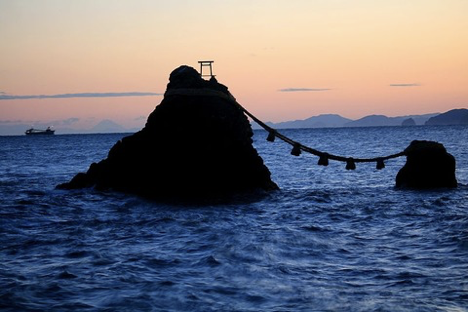
Nothing could be more unlike the previous day. The bouts of boredom and depression were not helped any either, by the miserable weather and my sore feel yesterday. This time, there was a feeling that I was at long last on the homeward stretch. Or had the upturn in my feelings got something to do with the nice cool breeze that kept me company? About nine-kilometers from Tobe where I was headed stood a large hotel, and where I decided to see if there was vacant single room for the night. There was! The hotel went by the name, Hotel Resort Inn Futami, and as the name suggested, it was located in the touristy area of Futami. Throughout the year, countless numbers of visitors flocked to the Futami coastline to pay homage to two giant rocks. The two rocks that poked out of the water were called Meoto Iwa. In English they were referred to as the ‘Married Couple Rocks’, or others as the ‘Wedded Rocks’. The larger of the rocks was symbolic of the husband, whilst the smaller one, the wife. Both rocks were worshipped at the Futami Okitama Shrine, nearby. According to Shinto belief, Meoto Iwa represented the bonding together of the creator of kami, two married deities, Izanagi-no-mikoto and his wife, Izanagi-no-Ōkami. From another angle, the rocks symbolized a male dominated Japan, if not the world -- the larger rock the stronger male, and close by set the smaller and lighter rock, the female for support. For the writer, Herman Melville, marriage was a ghastly disillusion, because he longed for the perfect marriage, the perfect relationship. It would blow a few Japanese minds to stretch this even further, like, both rocks were male, or female, lovers. They did not just pop out of the sea, but had come out of the closet, too. Who knows? One day perhaps, in the not too distant future, a lonely poet or writer might one day sit-down nearby the waterfront and pen such views. It was said that the best time to look at the rocks was at sunrise in summer. Mount Fuji was also visible in the distance on a clear day. The view of the first sun of the day rising between the two rocks, with Fujisan in the background, was surely captivating. All ready there were countless tourist pamphlets in existence, with bright photographs of the sunrise (or sunset) at the Meoto Iwa area. To witness the whole occurrence in person must leave one hell of an impression on the mind of the beholder. The view of the sun over the rocks must have caused a good view visitors to sit down and pen what they saw in verse. Incidentally, the Celtic sun god was called Lugh, which was the Gaelic name for the month of August. For me, it was a month that would soon be drawing to an end in more ways than one. I read in one such pamphlet that the rope that joined the two rocks was changed three times, each year. The task was performed only on a Sunday, which caused me to wonder why only on Sundays? The other option was when the rope became broken or severely damaged during a storm. On a lighter note, a tourist pamphlet also told me that more than 40,000 irises could be seen in full bloom in the Futami wetlands, from June each year. The room at the hotel turned out to be a bright and comfortable room that cost me ¥5,300 Yen for the night. Alas, breakfast was not included in the price. Unless of course, I forked out an additional ¥900 Yen, which I was in no mood to do.

Unknown-19


Meoto Iwa and Mount Fuji before sunrise (Wikipedia)
 

Needless to say, I felt overjoyed at the sudden and welcomed surprise, and was only too happy to accept the kind offer. Well, that is very kind of you.” I replied, and added that an ice-coffee would be very nice. She laughed and drove off. About 15-minutes later I heard a female voice calling from across the road. When I looked over, I saw the woman motioning for me to cross at the traffic lights, a little future along the road. “Well, again, thank you very much for stopping and inviting me to your home.” I said, as I drew up to where she stood, and smiling from ear to ear. “I don’t know your name.” I said, smiling back at her. The thought also momentarily crossed my head that it was not often an attractive woman invited me anywhere, at least in recent times. “Mmm!” Then I quickly wondered to myself if being on the road to the extent I was kind of caused people to drop their guard. Sadly, such things just did not occur in so many places. It felt good that she felt at ease with me. Actually, I must have looked an untidy sight, clad in dusty clothes and with the sweat dripping off me. Once we had officially introduced ourselves, Yoshimi-san led the way. In no more than two or three-minutes, including a right turn that took us away from the main drag, I found myself in front of a very pleasant house, which appeared to have been built quite recently. A young man looked up from the table as we entered. He was introduced to me as Toshinori, her son. At first Toshinori’s face looked a little startled when I was led into the living room. No doubt he was a little surprised at the sudden appearance of a bearded foreigner. Yoshiko-san then explained to her son how we had come to meet. Of course, I did not bother to mention that I had stopped at the Lawson convenience store that time to pick up a can of beer, as well as something to eat. In the course of our chat, I learned that Yoshiko-san worked at a convenience store and there Toshinori-san worked as an electrician. Just as Yoshiko-san went to the kitchen to make the ice-coffee for us, she said that perhaps I would like to wash my hands or go to the toilet. Of course I did, and I thanked her, as I left my backpack in the genkan and headed for one of the doors that she pointed towards. Just as I was coming out of the bathroom, an attractive young girl, perhaps in her mid-20s was coming down the stairs. “You must be the daughter. Right?” I said, smiling. I did not take  long to learn that I was correct. She told me that her name was Rieko. However, I was a little taken aback to learn a little later that Rieko-san was in her mid-30s. During our short meeting, I also learned that she was married and had a four-year old son, who was called Aruma-kun. Rieko-san’s husband currently worked in China, and that in the near future her and the baby would join him there. Whilst, Yoshimi-san told me that she herself was divorced, and that now she had a boyfriend. The ice-coffee was soon finished, and before leaving their home, Yoshimi-san told me that I would be more than welcome to visit them again, should the chance allow. In no time at all, I was back outside under the scorching sun, headed in the direction of the ferry.


30 Aug, 2013: Camp was made about 10-kilometers after leaving the ferry port on Iragomisaki. The road, Route 42, was rather busy with traffic, so I made sure of finding a spot well away from it. This was done behind one of the many flower nurseries that had lined the road for many kilometers. The spot chosen to pitch the tent overlooked the mighty Pacific. However, as the moon failed to show its face because of the heavy cloud cover, I had the feeling I would be in little mood to enjoy the scenery for long. When I awoke for a nap the evening sky had cleared to reveal the stars. The sky was also home to a good number of airplanes on their course to one place or another. It was not only the sky that appeared to be busy, but the sea, too. Unfortunately, only the lights from the ships that passed in the night were visible, not so much the types of vessel. This morning I awoke with the determination  to make an early start. This was in order to get as many kilometers to Hamamatsu City under my belt before noon. My aim was to reach there by Friday at the latest. This was important if I was to keep to my schedule. A blue distance-directional road sign told me that my target was 56-kilometers away. A distance that I needed to cover well within the next two-days. If all went well, it would not be too late when I tramped into the city. Along the road, I chatted a while with a middle-aged farming woman, or so they manner in which she was appeared to be dressed told me. She had been riding one of those little electric four-wheeled vehicles, when she suddenly stopped and handed me a little bunch of grapes. Needless to say, I was glad for the kind gift, which tasted so sweet and juicy. All of this was part and parcel of a manner that was unheard of in large urban areas, like Tokyo. It was one of a good number of kind gestures that I had experienced along the rural roads, from a stranger to a stranger. Apart from my thanking the smiling woman from the bottom of my heart, she did not utter a word. “Mmm!” I could never understand the Japanese race for as long as I lived. The last time occurred only the day before, when an attractive young woman stopped the van she was driving “Hay! Where were you headed? Walking?” She called out through the open window. Of course, I skirted across the road to where the van had come to a stop, an eye open for oncoming morning rush-hour traffic. “I’m headed to Hamamatsu.” I said, while trying to appear that every thing was well under control. Actually, I had not slept very well and had toyed with the idea of stopping somewhere along the road and take a short nap. Back to the present, I thanked the woman for noticing me and for stopping, and gave her a quick rundown on my mission of making my way around Japan, on foot. She appeared impressed!  About 15-minutes after we parted company, I caught sight of a Circle K convenience store, and now toyed with the idea of making a stop there. Just before I reached the store a female voice called out to me, again. On looking across the road, I saw the same young woman, this time with three young children standing close beside her. “Are they your?” I said, again crossing over the road to where they stood. “Yes!” She replied, smiling from ear to ear. 


The three beautiful little faces looked up at me, smiling. That was before the tiniest among them, suddenly turned and ran off in the opposite direction, as I approached. Everything wee children saw or encountered was a new experience to them. Their brains were like little sponges that soaked up all knowledge from whatever way it came to them. What a shame the gift of memory deteriorated with age. "Mmm!" How important our senses really were, or so the thought momentarily came to me. Surely humans could play some wee part in keeping them in working order. Baring any unforeseen diseases in life, including aging, it seemed senseless that people seemed blind to caring for their five basic qualities -- 'hear', 'see', 'smell', 'taste', and 'touch', to use the colloquial terms. The amount of damage many people did to their hearing by load music, was one case in point. The eye, too, were delicate and complex organs, which could become damaged by some trauma, such as, a laceration or impact, or even something so simple as overexposure to bright lights. Research on the inability to smell, or rather anosmia, to ability to perceive odor, was unclear and undiagnosed. However, infection or even a blocked nose, like what many people had experienced, could be prevented. Similarly, there were a whole host of causes that affected the taste buds, beyond our powers. However causes, such as, tobacco, eating junk foods, or foods that were very spicy and acidic -- processed, sweetened beverages, high-protein foods and supplements, and so forth. Also, a vitamin B deficiency did not help matters any. Many Joe Publics out there needed to take a long hard look at the old bad habits. Perhaps myself, too! What I envied about the wee children I saw here and there on my long tramp around Japan, was the time that they had ahead of them. I certainly was done and polished with studying at schools and that sort of thing. No! Thank you! Enough was enough! The world was their oyster, as the say went. They were going to see and experience all the things that I would never be able to.  Death, tax, and the changing weather, were things we would all experience, if not others. God forbid, hopefully nothing as drastic as a full scale war, for the world had already had more than its fair share of that to do a life time. Surely they children would grow up and see the world. My only hope was that they would grow up to be less conservatively minded than their parents and grandparents, if not teachers, had been. I would also hope that they would welcome everybody into their life, regardless of race, creed color, and religion, and all the other things that made people what they were.“Ah! That one must be a boy. Right?” I said, smiling at the young mother, our second encounter in a short while. “No, all girls!” She replied, and added, pointing at a child in the rear seat, that that one was a year old. The mother called after the wee one that had just bolted, and sent an elder sister to get her. Just then, the woman’s husband came over and introduced himself to me. From a large open building, which I took to be a work place, another voice called out. “Coffee?” Then I was told that that was the children’s grandmother, and that the grandfather also worked there. It was a kind of family business, growing and potting, and caring for hibiscus flowers.


The many open fields, enclosures, and buildings that I passed along my way, told me that many people in the region were clearly in the flower business. There were around 200-species of hibiscus. Typically a tropical flower, the hibiscus grew in a variety of climates worldwide. The flowers could thrive in soils that were less moist, provided they were watered regularly. Particularly, when grown in a wind-sheltered environment, in mild temperatures, around 18-23 degrees Celsius. In addition to enjoying their beauty, I read somewhere that these colorful and fragrant flowers were good for brewing tea with. Now a good hot cup of strong tea, with a drop of milk, was something that I had time for. Now tea had a long history in Asia. Chinese tea, for example, was first imported into England, in 1652, where it gradually became a national obsession. Accordingly, it was just a matter of time before tea became a part of Irish life, too. Not to forget our Gaelic cousins in Scotland and Wales, where the consumption of tea soon rose like there was no tomorrow. Similarly, coffee and cocoa also made an appearance in England in that year, and would soon become a popular taste, although not quite on par with tea. That said, I never really developed a taste for Japanese green tea, or o-cha, as the Japanese called it. Come to think of it, I never understood why tea was called ‘cha’ or ‘char’ in the British Army, a name that had stuck since the early-1800s. English pamphleteer, journalist, and author William Cobbett viewed drinking tea “as a destroyer of health, an enfeebler of the frame, an engenderer of effeminacy and laziness, a debaucher of youth and maker of misery for old age”. He also wondered how things might have been had he made his wife brew beer, instead of tea? The grandfather who ran the hibiscus business, appeared to be a kind and gentle sort of man. If I was not mistaken, the gray hair on his head made him look older than myself by a good few years. The grandmother on the other hand, was a rather attractive woman, who I felt was a few years younger than myself. She had such a genuine and captivating smile, the sort that one could not get enough of, or did not forget easily. A genuine  smile, I read, reflected happiness, positivity, and warmth. I had known since my early school days that nice smiles signaled friendliness, and often the start of good relationships. The grandmother’s beautiful smiling face certainly made me feel more than welcomed. As I set down to enjoy a nice cool can of black coffee that the grandmother had given me, just about everyone got back to work, potting away madly, like there was no tomorrow. Even when I arrived at the potting place, I could see hundreds had been finished, and stacked away in little black crates of twelve “Mmm!” Momentarily, I wondered how much one of the crates with the potted hibiscus cost? At first did not venture to ask. However, the curiosity got the better of me and I asked the young mother, putting a little humor in my smile. “Well, case by case.” She said, returning the smile. “Some this much and some that much!” We both laughed! The coffee was done, and it was time to hit the road again, and keep an eye out for a place to make camp at. 


31 Aug, 2013: A long last I found myself sitting at the window of a Starbucks coffee shop in Hamamatsu. In short, Stage 11 of my mission on foot around Japan was now at its end. It will stay that way, or until it starts again where it ended, this coming autumn. All that I knew now about things was that I needed to be better prepared in more ways than one, whenever the time came. One thing I needed to remember was to pickup a few rolls of medical tape, for the soles of my feet. Past experience taught me that there was no better prevention measure against blisters forming than to apply the tape first thing each morning. That was exactly the problem this time around. I had run out of the tape too early, only to be plagued with bruises, cuts, and blisters on my feet soon afterwards. A fair bit. of time was taken up fixing them. When I did manage to get my hands on some tape, my feet were too far gone with damage for it to do much good. Back to the present, I did not care now, everything was done and dusted, the stage was over. I had walked the walk, and no doubt bitched about it from time to time, at least to myself. So in away, I had talked the talk, too. Yes, it was very true! Alone on the road day in and day out, I often talked to myself, and sometimes with little coherency into the bargain. I was not frightened to admit. Most of my thoughts were of people whom I had lost contact with. “The past, the Golden Age of the past — what a nostalgia we all feel for. Yet we don’t want it when we get it” (Source: D.H. Lawrence’s ‘Studies in Classic American Literature’). Now all that was something to be placed on the shelf of my past, something that I might get around to later. I hoped so. That was all over with, too. All that I wanted to do was to rest my body, particularly my feet, knees, and legs. Hamamatsu City had a lot of interesting places to see and things to do. The city was well planned, clean and attractive, if it was possible to say such a thing about modern cities, which I often loathed. After all, there was little of old or of the past that remained. The city had a walking course that traced the remains of Ieyasu Tokugawa’s dreams. According to history, Ieyasu spent his youthful days living in Hamamatsu. A leisurely stroll along the walking course led to Shusse-jo, (Hamamatsu Castle), which in English meant: ‘castle of promotion’. “Mmm!” This caused me to wonder if the name had something to do with Ieyasu’s ambitions? The course also led to the Toshogu Shrine. For reasons well beyond my own limited knowledge, the shrine was once said to have been the most powerful secret spot in the history of the country. This again caused me to wonder if it had something to do with the two most powerful men in Japan at the time, Ieyasu Tokugawa and Hideyoshi Toyotome? As for myself, Shinto shrines were good places to stop awhile to rest or take a nap. Especially in summer under a shade from one of the quality trees found within the grounds. Or at times to make camp when the sun went down. In the evenings, shrines where usually silent places, free of the prying eyes of unwanted stares. Near the Toshogu Shrine there was an old well which I could not resist peeking into. According to legend, the second shōgun, Hidetada, Ieyasu Tokugawa’s third son, was said to have been given his first bath at the old well soon after birth. 


Did they heat the water first?  Surely the future emperor had not been lowered down in a bucket. No doubt a chilling experience if the water was not first heated. Hamamatsu was not short of its delicious foods, and a man who enjoyed his food, Ieyasu Tokugawa loved to indulge his tastes with such things as Hamanatto, a form of fermented soybeans And said to have been the first of its kind in Japan. One of the many questions that I have often been asked in Japan was: ‘Did I like natto?’ Sometimes I liked to eat it on top of rice, for breakfast, especially when I was in a bit of a hurry. However, many of my foreign counterparts loathed even the sigh of natto. “Mmm!” Barring any foul smell, natto appeared like someone had taken a dump on the rice. In truth, natto had a pleasant smell. Visitors were able to enjoy a rich variety of gourmet cuisine, such as, Lake Hamana Eel, Hamo or Pike Conger, Enshu Nada Blowfish, Oyster Rice Bowl, and last but not least, Hamamatsu gyōza, a kind of dumpling. Japanese soldiers who returned from northeastern China after the Pacific War, brought home gyōza recipes. The dumpling gyōza derived from the Chinese word, ‘guōtiē’ , which dated back more than 4,000-years. The word first appeared in literature that dated to the medieval Chinese Song Dynasty (AD 960-1280). It was written to guōtiē to be very good for the human soul. “Mmm!” Hopefully, the gyōza would work some of its reported wonders on me. The region was particularly famous for growing sweet and juicy Mikkabi mikan and Topia mikan, or oranges. This was due in great part to the areas mild climate and the sunny locations on the hills that overlooked Lake Hamana, where most of the oranges were grown. Today, Hamamatsu was a main supplier of oranges across the country. For lovers of flowers, of which I most certainly would include myself, one of the flower exhibitions was a must-see. The area close to Lake Hamana was also said to be a flower kingdom, and one of the best production areas for flowers in Japan. In similar fashion, the local geographical conditions in this part of Shizuoka prefecture, could not have been better for the cultivation of flowers. In recent decades, the lake itself, a Brackish lagoon, was developed into a large resort area, with hotels, and inns, and boating, and other waters sports for visitors to enjoy. Lake Hamana was in ancient times a freshwater lake. However, a great earthquake that occurred in 1498, opened the lake up to the ocean. On account of this, the water and its color, changed. It had been a very powerful earthquake with severe shaking. The earthquake had a magnitude of 8.6, and was followed by a tsunami, which left around 5,000 people dead. The tsunami destroyed the structure that housed the statue of the Great Buddha located at the Buddhist temple of Kōtoku-in. The statue, which visitors take snapshots of in modern times, survived without damage. The old name for the lake was 'Tohotsu-afumi', which meant 'distant fresh-water lake', in English. In the closing days of the American occupation years of Japan, two Type-4 Chi-To tanks were dumped into the lake. This was to prevent them from falling into American hands, for whatever good came out of such an action. According to Wikipedia: "One was recovered by the US Army, but the other was left in the lake. In 2013, there were efforts to locate the remaining tank, but it wasn't found."


1 Sep, 2013: By early morning, a wee while before checkout time at 10:00AM, I decided to stop another day. This would allow me to have a better look about the city. As a result, this would allow me to dander over to the Ninomaru Ruins of the Hamamatsu Castle. The castle itself was like many other castles in Japan, a replica of what one was. The Hamamatsu Castle that visitors stopped to photograph, was built in the hirayama-style used for a number of Japanese castles. (The castle was burned down by a fire, in 1727, and was not rebuilt. Administrative affairs were then moved to the Ninomaru Palace in Nagono.  On the eve of the Meiji period, the Ninomaru Palace burned down in another fire on 19 June, 1867. In more recent times, the castle was demolished by American bombs in the closing weeks of the Pacific War). The Ninomaru Palace, or ‘second compound’, was on a lowland area of some 5,000-square-meters in size. It was located east of the main compound, Honmaru Palace. Both palaces were believed to have been built after 1594, when the main Keep was completed. In its day, the Ninomaru Palace had been the main residence for the lord of the castle, as well as, the key point of the feudal government administration, during the Tokugawa period. Originally, Hamamatsu Castle was named Hikuma Castle, before it was rebuilt. This was when the castle was occupied by Ieyasu Tokugawa, the first shōgun, who retained power until his death in 1616. In fact, the Tokugawa period (1603-1868) was a time of building and progress, economic growth, peace, art and culture. It was also a time of isolation from the outside world. Hidetada Tokugawa, was actually born at the second compound, and a pine tree was planted nearby to commemorate the birth. The old pine tree could be seen in an early drawing that was completed, in 1716. That was at a time when when Japan was ruled by the shōgun, Hidetada, from 1605 until he abdicated, in 1623, in favor of his elder son, Iemitsuin. The Iemitsuin Tokugawa ruled for the next 18 years, until his own untimely death, in 1651. Consequently, even in retirement, Hidetada still retained a considerable amount of power over the government. In these years Hidetada was anti-Christian and banned all books and relics that adhered to Christianity. This included forcing the Christian Daimyōs to renounce their religious and political principles on order of death. Under those circumstances foreign, as many as 55 Christians, not only Japanese, but also foreign, were put to death. Thousands more would follow the same fate, in the 1630s. Only small pockets of Christians continued to practice in secret, which gave birth to the term: the 'Hidden Christians'. The first foreigners to set foot in Japan in any great numbers came from Portugal. This was on the island of Kyushu, in 1542. Not only would they introduce Christian doctrines, but also gunpowder. So in a sense, they came well primed to succeed in their mission. At first they were more than welcomed and well received, even by the daimyo Nobunaga Oda. Oda became known as the 'Great Unifier' of the country, through the 1560s. The weapons that the new foreign visitors brought with them proved useful for his political and military ambitions. The missionaries activities proved very successful in western Japan.


Photo of the Dodge??? 


The Christian faith was practiced openly without fear of persecution. High ranking people were among the converted. The missionary Francis Xavier even traveled to Kyoto to seek an audience with the Emperor, in 1550. Today, there were quite a small number of Cristians in Japan, or just one percent of the entire population. In the Tokugawa period, Christians mainly resided in the western regions of the country, and continued to do so. Iemitsuin's death, Hamamatsu Castle became the seat of a number of fudai damyō. From a viewing deck located on the third-floor, visitors maybe treated to a glimpse of Mount Fuji on a clear day. These days little remained of the second compound, and where the Hamamatsu Shiritsu Motoshiro Elementary School, founded in May, 1873, and the Hamamatsu City Hall, currently occupied the site. Unfortunately, as I had experienced before during this stage of my mission, much of what there was to be seen about the city, was under renovation and reconstruction. Therefore, all that I could do in peace and quiet was to dander about the park-like grounds and enjoy the nature, while I sweated like a pig under the scorching sun. In more recent historical terms, Hamamatsu had a strong and prosperous background in the world of industry. The top three major industries were, textiles, musical instruments, and my favorite being, motorbikes. Other industries included, woodworking and lumber. Among the places of interest surely included, for the industrially minded, was the Soichiro Honda Craftsmanship Center, where the Honda empire began. Similarly, Suzuki Plaza allowed visitors to view products that dated back to the automobiles founding. Cars had never really been my kind of thing. In fact, the only car I ever owned in my life was a secondhand 1969 Dodge Charger. At the time, 1978, I lived at a place on Long Island in New York, called Patchogue. The car was one of two used cars for sale at the garage. To cut to the chase, I paid $300 Dollars for the thing. The guy at the garage, whom I recall, appeared surprised at my wanting the Charger. That was about the time he told me that the car could not reverse. I replied that that was fine, for the only direction I wanted to go was forward. We both laughed. I also soon learned that the tires were as bold as a pool ball. Another place of interest was the Shizuoka University Takayanagi Memorial Hall, where visitors were able to get a good overview of the ideas of Kenjiro Takayanagi, said to have been the father of television. Besides being uninterested in automobiles, another thing that I never got into was television. For me, to watch Japanese television programs was a complete waste of time. One reason was that I considered much of the so-called, TV talent faces, to be amongst the most untalented mass of noisy characters I had ever seen, if only for a short time. Sadly, the only thing I watched on the box was the daily evening news. A city in Japan would not be complete if it did not have its hot springs. The most notable of which was the Mikkabi, the Bentenjima, and the Kanzanji, which was the largest in the Lake Hamana region. Like the automobile places, I never cared much about being in a hot bathtub with other naked men. Regardless of my own critical views of this and that, there was so much in and around Hamamatsu worth stopping by at to enjoy.


Conclusion/Locations -- Start-End Dates/What happened in Japan and the world at this time???
Irishman Walking (Stage 11 Chapter 5) Summer 2013

56439087_2291153687790871_6976789749440708608_n

Irishman Walking (Stage 11 Chapter 5) is about my walking the main and coastal roads of Japan. Summer 2013.


21 Aug, 2013: When I tramped into the Hashimoto area of Shingū City, I felt literally worn-out, and could hardly keep my eyes open. The time was after seven o’clock, which was not so late in normal circumstances. It had been a long day on the road, under a hot sun. Still, I felt a little proud for the distance covered without whining much about the muscle pain and blisters in my feet. One of the first things that caught my tired eyes was a sign up ahead of me was that of a business hotel. The Shingū Central Hotel was located by the main road, so it was easy to see. For the previous hour, I had been chatting on and off on the cellphone with a friend in Tokyo, and was told that all the hotels in Shingū were fully booked. Or rather, the hotels Riko-san had kindly checked out for me and to phone to ask if a single, non-smoking room was available. I was not sure if Shingū was worth stopping at. It was a city located in Wakayama prefecture, and had a population of close to 29,000 inhabitants. It was the main  commercial city of the Kumano region of Wakayama. The 183-kilometer long Kumano-gawa flowed from the secret 1,719-meter high Mount Ōmine, through Shingū and on to the Pacific Ocean. Mount Ōmine  was located in the Yoshino-Kumano National Park in Nara, and was said to be noted for its three tests of courage, whatever that meant. The name 'Shingū' literally meant 'New Shrine' in English. The shrine in question was the Hayatama Shrine, one of the three grand Shinto shrines in Kumano. The exact date of the establishment of Hayatama Shrine in particular was unclear, however, it was believed to predate the country's earliest written records, the Kojiki. An archeological dig had unearthed religious relics that dated around 300 AD. Kamikura-Jinja, a main shrine located in Shingū, was said to be the actual spot where the Shinto deities first descended from heaven. The shrines had drew countless numbers of pilgrims to them to prey, for more than a 1,000-years. The sacred rock 'Gotobiki-iwa' was one of many main places of worship. This ancient pilgrimage was known as, 'Kumano Kodo' in Japan. The three Grand Shrines of Kumano along the route were called, Hayatama Taisha Grand Shrine, Hongu Taisha Grand Shrine and Nachi Taisha Grand Shrine. The two main deities at Hayatama Taisha Grand Shrine, were husband and wife gods called, Kumano Hayatama no Ohkami and Kumano Fusumi no Ohkami. The Kansai area pilgrimage route, Shingū included, covered some 33 Buddhist temples, also known as the Kansai 33 Kannon Pilgrimage. The Grand Shrines were also known as the Kumano Sanzan, and were central places of worship of the Kumano faith. The course of the Kumano River marked much of the pilgrimage route along the Kii Mountain Range, and was listed as one of the UNESCO World Heritage Sites, in 2004. The Kii Peninsula, marked the center of the main island of Honshu. Only the foundations of the castle at Shingū, Tankaku Castle,  remained. It was one of many castles across Japan, whose importance dwindled and later dismantled, during the Meiji Restoration years. The Kumano region was believed to be one of the birthplaces of the martial art of Aikido. 


The area was also said to have been the birthplace of 'sushi', or rather 'Nare-zushi', the earliest form of sushi, and which in turn was believed to have been introduced to Japan from China. The local waters were famous for catching 'Saury', a fish commonly used for sashimi, as well as, dolphin and whale meat. All that I could think of at the time was soaking in a hot bathtub for a while. This was more for my dirty body than my mind. The Japanese loved to soak in a hot bathtub. There were a good number of benefits for the hot bath. Like a dip in the sea, a good soak relieved any mental stress and muscle pain I had after tramping the road all day long. It also improved insulin sensitivity, and good for cardiovascular health. An Epsom salt bath had anti-inflammatory properties shown to have helped people that suffered from metabolic diseases, such as, Type 2 diabetes. Nonetheless, being a lover of the outdoors, I very much preferred a dip in the sea, as opposed to fixing a salty bath, which a lot of people liked to do. Soaking in a warm bath was good for blood circulation and reduced blood pressure, which in turn helped to prevent serious heart problems. It was also said to burn off the calories. Soaking in warm water certainly felt good, it changed my mood, say from depression or pessimistic feelings and made me feel more at ease.The benefits of quality sleep were widely recognized, and a warm bath before hand, was a good place to start. It helped produce melatonin, the sleeping hormone. After a good sleep, I certainly felt more refreshed and more mentally awake. The water temperature in the bathtub should not exceed your own body temperature, too much, if at all. A warm bath was said to be better for a person's skin and immune system, than a hot bath. All in all, if stepping into a warm bathtub was good for the health, it was at least certainly food for thought. When I saw the name of the hotel up ahead of me, it downed on me that my friend had not mentioned it to me. With noting to loose, I made my way into the lobby to see if they had a room available for the night. When I stopped at hotels, I preferred to show up exactly at checkin time, usually around three o’clock. That way felt I was getting my moneys worth, like, more time to relax and to take care of personal matters, such as, reading and writing, in comfort. One problem with not having a booking, however, was that the hotels could charge you an arm and a leg. Looking up things on the Internet was perhaps the best way to booking a room at hotels, for the bargains that might be had. In this, I was more than grateful for the help of my friend in Tokyo. There was a single room available, at ¥6,825 Yen a night. This I felt to be a wee bit on the steep side. There was not even a single laptop in the lobby for guests to use for free. The price did include breakfast, or morning service, as it was usually called in Japan. There was a set-menu, prepared by the staff. Personally, I preferred the buffet-style breakfasts, since I was able to get second helpings. All the same, I decided to stop the night, and forked over my personal details to the desk clerk. The clerk punched everything into the computer as I looked on. That said, the night passed quickly and after a good sound sleep I felt more than ready to tackle the road again. Not an hour had passed when the driver of a large truck pulled up and stopped. 


The driver stepped down from the truck and walked towards me just as I drew near. There was a broad smile on  his face, as he stretched out his hand to give me an onigiri. It was clearly not homemade, but the sort of rice-balls that I had seen so many times at convenience stores. “This is for you! Energy!” He said, giving the onigiri to me. Needless to say, I was more than happy to accept the man’s kind and unexpected little gift, and thanked him from my heart for it. I also added that it would do me nicely for lunch. It surprised me a little that he did not offer me a lift, like others who had stopped their cars had done. “Mmm!” Perhaps he had passed me at various points along the road, which kind of told me that he understood that I really needed to walk, or so I thought. I was right, the man told me that he had seen me on the road yesterday, and when he saw me again he wanted to stop and give me the onigiri, which he had bought a little earlier this morning. It surprised he, he told me, that I seemed as if the heat did not bother me so much. Caring the heavy looking back, and my brisk pace along the pavement, and so forth. Of course, I did not say much about my feelings for the sun, or what it was really doing to my body and mind. Why should I bore him with my problems? All the same, he told me that he felt for me out in such heart and added that I should be extra careful, for the effects of the sun kind of crept up on you. After the truck driver climbed back into the cabin and drove away, I felt that there was a lonely expression about his face. Being on the road, like long distance truck drivers, was often a lonely business, at least it was for myself. Momentarily, I even wondered which of us was the most lonely, but I could not decide. Driving a vehicle all day long had its fair share of difficulties and setbacks, as did tramping the road, but in different ways, I guess. There was a little bump of the truck horn as the man drove past me, and a hearty wave for my part. That was another sad thing about being on the road as I was, you never saw the people ever again. They were truly gone out of your life for good. All the same, parts of the day were often taken up with thinking about them, as well as formulating a number of questions that could never be asked nor answered. The onigiri was carefully deposited into the backpack to enjoy later, when the chance allowed. When that time did come for me to eat it, thoughts of the truck driver would again rush back into my head. The man who drove the truck was very right. Japan was experiencing very crazy weather conditions. He told me that for the lack of rain, rivers were at record lows in so many parts of the country. In mountainous places where it had rained, there was a worry among locals of the high risk of landslides, and floods in low-lying areas. This was especially true, the man told me, along parts of the Nihon Kai areas of the country. And where around 60-millimeters of rain had fallen, accompanied by thunder and lightening. It was difficult to hate somethings so personal as the weather. Its uncertainty had to be faced, that was the top and bottom of it. As for myself and the roads that I tramped along, the only water I saw was what I drank and what saturated my clothes in the form of sweat.


22 Aug, 2013: The distance from Shingu to Kumano was no more than 20-kilometers, or there about. Kind of the distance from door to door, so to speak, since I planned to stop the night at another hotel, the Business Hotel Kawakama, not far from the broad Ido River. To get to the hotel, thought, I would have to lave the coastline and get my butt off the National Route 311, and head about half a kilometers inland. Actually, I never noticed the change of roads. Within just one-minute I was on Route 42 and the next time I noticed, I was on Route 311. No doubt my mind was on other things. This had been one of the hottest days on the road for me to date. Progress had been slow, with many stops to rest and escape the sun for a while. Thanks to a splendid cluster of trees, at times my little rest-stops included a lengthy nap beneath a broad and breezy shade away from the side of the road. The view along this segment of the coastline was simply breathtaking. The welcomingly rich sandy beaches, the mighty rolling waters off the Pacific Ocean far below me. “Look deep into nature, and then you will understand everything better’ (Albert Einstein). Did Einstein have an appreciation of the landscape? Like the many masterpieces that hung in museums, the scenic view before me appeared to wait for a poet to sentimentalize it in some romantic picture. True! It was in the poet’s vernacular literature that nature lived a second life, again and again. Much time and ink and paint had been spent by the poet and the painter on nature. Somehow, the colorful and influencing imagery created by them never seemed to do a thorough enough to protect nature, or their partial conquest of its beauty. Close behind them were the industrialists, with their so-called progress, which continued to leave a heavy and telling mark on nature that would never be quite erased. Was it any wonder that the early inhabitants in my own country (the first Ulstermen and women), hunters and fishers who depended on trapping animals and catching fish for survival were drawn to the sea. They settled along riverbanks, by lakes, and on seashores, around 8,000 BC. “Mmm!” How I just loved being near the sea, I thought to myself, as I gazed out over the vast ocean below. My mind was working overtime, that I no longer was in a mood to stop too long, and soon was back up on my feet again. The lengthy segment of asphalt road that led me into Kawano in the city of Suzuka, was lined with quality green trees. Much of the area around was idea for camping. Had I not already been booked into the business hotel, I would almost certainly have pitched the tent amongst the trees without a second thought. Suzuka City had a population of nearly 197,000 inhabitants. Suzuka was home to major factories, such as, Honda and Sharp, with large parts of their workforce carried out by South American workers employed on a contractual-basis. No doubt this had something to do with why the local government required all garbage and signage information to be printed in both Spanish and Portuguese. Not in English as the national government had hoped. In addition to Honda and Sharp, the city was also home to the Suzuka Circuit, the only racing circuit with a figure-eight design. Regardless of the difficult bends, the Japanese Grand Prix was held there from 1987 to 2006, and again from 2009.


Ise Bay lay to the west of the city, it was also bordered by the Ise-no-Umi Prefectural Natural Park (established in 1953), and the Suzuka Quasi-National Park (established in 1968). Unfortunately, much of my tramping was accompanied by the railway tracks. The Kawano Station, previously called Suzuka eki, was located in Suzuka in Mie prefecture, opened in mid-July, 1928. Today the station was operated by the JR Central and served the Kansai Main Line. This stretch of land, I suspected, was part of the Yoshino-Kumano National Park area, and it was rich in vegetation, various species of wildlife, and history. The park was established in 1936, and was home to Mount Yoshino, famous for its many sakura trees. The mountain which was included with the rest of the region in the UNESCO World heritage Site, in 2004. The mountain and its sakura trees was the subject of wake poems that dated to the tenth-century, in Kokin Wakashū. This was a collection of early poems that covered both ancient and modern times. Needless to say, the cherry blossoms attracted innumerable number of visitors in springtime. There were several important pilgrimage destinations located around Mount Yoshino, this included Kimpusen-ji, Kimpu Shrine, and Yoshino Mikumari Shrine. Yoshino Mikumari Shrine was said to be closely associated with Emperor Go-Daigo. The shrine was dedicated to Mikumari, the female Shinto kami of water, fertility and safe childbirth. The current main building dated to 1605. It was believed that Hideyori Toyotomi had the shrine rebuilt as his father, Hideyoshi Toyotomi, had once prayer there for a successor. The father was said to be Japan’s second great unifier. Kimpusen-ji, Kimpu Shinto shrine’s main building was the second largest wooden structure in the country. (The largest was the Great Buddha Hall at the Buddhist temple, Tōdai-ji (Eastern Great Temple), in Nara). Both the shrine and the temple were along the pilgrimage route. “Mmm!” If only I had time to enjoy the locations more, but I had a schedule to keep. This absence of spare free time was in away, my loss. The kind of thing I know that I would regret later on, for something in me told me that I would never return. The cost of the room, a pleasant and comfortable piece of space, set me back ¥5,900 Yen, without breakfast. Located around the hotel area were many restaurants and shops, including a large AEON, where I was able to pickup some stuff to eat for the evening and morning, which I hoped would set me right for the road. With all the shoppers and a good number of tourists about the place, I was under the impression that something was in preparation. Back at the hotel, the television NHK news had something to do with being near the coastline during earthquakes, and touched on the possibility of a tsunami. To paraphrase the report, should an earthquake last for over a minute, then it was advisable to get your sorry arse out of there. And to make your way for higher ground as quickly as ones feet would carry them. A quick glance out of the window told me that anyone may have little chance of escape should a disaster strike. The buildings about the area did not look like they could stand much of anything, or protection of any kind. There would be causalities! 


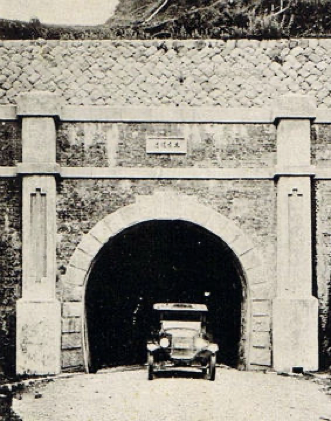
The nearest piece of high ground, and the closest mountain, was about a kilometer away. How fast would you need to run to out run a tsunami? The Niohigogawa Bridge led me onto the pavement-less Onigajo Hodo Tunnel ran for some 570-meters in length. Originally, the tunnel was named Kimoto-zuidobuilt in 1925, or Taishō 14. Emperor Taishō was on the throne at that time, although by 1926 he would be dead and replaced by his son, Hirohito, which was the start of the Shōwa reign. The Onigajo Hodo Tunnel was opened at a time when the NHK Radio One made its first broadcast in Tokyo. Broadcasting to other regions would follow in the coming months. 1925 was the year that the famous Matsuya Department Store opened in Ginza. It was also when one of my favorite writers, Yukio Mashima was born. The old tunnel got its name because it led to the most scenic spot along the coast at the time, called Onigajo. The old tunnel was designated as a Civil Engineering Heritage Site, in 2003. Soon after I emerged from this rather muggy, stale aired smelling tunnel, two cyclists passed. Both of them were foreigners, their bikes loaded up with camping gear. They also appeared to me having more trouble with the road than I was , if the expression on their faces was anything to go by. The girl led the way, but did not seem t, o notice me. The guy was a good 50-meters behind, said hello to me, in what sounded like an American voice, or perhaps Canadian. “Ganbatte kudasai!” I called back, smiling from ear to ear. Hopefully he understood what I meant. A look at a touristy road sign map at the side of the road told me that it would soon be leaving Route 42 for a good while, for Route 311 as it was nearer to the coastline. This kind of surprised me a little, as I believed that I was already teaming along Route 311. “Mmm!” I wondered if there were any shops nearby. Segments of Route 42 had covered parts of an ancient road. The twists and turns on this winding road, Route 311, caused me to surmise that it too was quite old. Up ahead of me I saw a couple of lookout men clad in their uniforms, green and red flags in hand, as they oversaw the safety of the traffic and roadworks. Then I made a stop to ask about the nearest shop. They told me that there were no local shops or convenience stores that they knew of for a fair distance along the road. However, there was a supermarket, but perhaps it was at least 30-kilometers away. “Mmm!” Knowing my luck, I would more than likely pass without noticing it, or so I thought to myself, after thanking the two men, and heading on up the road, the sweat dripping of me. It was while doing this up hill tamping, turning one bend and then the next, when the Isozaki Tunnel came into view along the road. The 175-meter long tunnel of cool airy breeze, was built rather recently, in 2009. This was the very summer in the year that I started my mission, walking around the main and coastal roads of Japan. This segment of road, National Route 311, was also part of the Hatasu-Isozaki Bypass. Whenever it came to modern tunnels, there was most always pavements, often one on either side. In time, I came to two classic looking road signs. One of the signs pointed back in the direction of Kumano Kodō Obuki-toge Pass, from whence I had come. 


The other sign pointed towards Jofuku’s Village, Hadasu. Further along the road another sign pointed over to the sea, near where the steps that led up to the small Jofuku Shrine stood. The shrine was named after Jofuku, the doctor to the Chinese Emperor Qin. On a visit to Japan some 2,000-years ago, Jofuku was said to have brought with him many advanced ideas and techniques on medicine, farming, and pottery from China. Reverence to the shrine went unperturbed, even during the First Sino-Japanese War (25 July 1894-17 April 1895), which was fought to gain influence over Korea. The famous Buddhist monk, Kōbō-Daishi was believed to have passed this way. Nearby, a holy water spring was said to have formed from a footprint made my the monk. “In 816, Emperor Saga accepted Kūkai's request to establish a mountain retreat at Mount Kōya as a retreat from worldly affairs” (Wikipedia). Therefore, it became revered as the ecclesiastical headquarters of the ‘Koyasan Shingon School’ of Buddhism. The other classic looking road sign appeared to point for Hadasu Path, in the direction of the rugged interior of the mountains. All of these areas were registered as UNESCO World Heritage Sites, on 7 July, 2004, as ’Sacred Sites and Pilgrimage Routes in the Kii Mountain Range’. Actually, the Kumano Kodō area included a series of ancient pilgrimage  paths and minor-paths that wove through the Kii Hantō, which was the country’s largest peninsula.The earliest records of the popular Nakahechi route from the ancient capital of Kyoto, for example, dated as far back as the early tenth-century. Still used today, the pilgrimage paths led to the sacred  Kumano Sanzan, the Three Grand Shrines of Kumano: Kumano Hayatama Taisha, Kumano Nachi Taisha, and Kumano Hongū Taisha. The most popular spot along the Kumano Kodo Iseji pilgrimage route was Magose-toge Pass through Mie and Wakayama prefectures, a stone-paved path that was blessed with tradition. The path led to the Three Grand Shrines. The second very old tunnel presented itself not 100-meters after the first, and was perhaps twice as long. On the first of the two tunnels it was difficult to understand its name for the script. The second tunnel I felt would cause me more or less a similar problem. It certainly was more overgrown with brambles. Just about in between both tunnels, I was almost caught in on hell of a welcomed downpour. Fortunately, too, I was able to seek shelter in a dry spot where I lay down to wait it out. It took about 30-minutes for the nimbus cloud to passover. Just about everyone watched clouds, for one reason or another. I found the clouds to be fascinating, if not beautiful. When I was a young child I used to try and find faces in the clouds. For me, they were the faces of dead people on their way to some resting place, perhaps in heaven. On the road once again, the ground and surrounding area felt nice and cool, thanks to a sudden downpour. That said, the sun was doing its best to alter things, again. Along my way, I passed yet another tunnel, though this time it was still under construction. A quick stop to glance at the iron nameplate, kind of told me that it was behind my schedule: ‘2012, Dec.’ “Mmm!" I momentarily thought that the Japanese were like their trains, usually on time. 


Unknown-5


Kimoto-zuido Tunnel (haisentn.blog41)


23 Aug, 2013: Last night, not so long before it became dark, I was disappointed to learn from a local chap that I was not as close to the city of Owase as I thought. There I hoped to rejoin Route 42. As I penned earlier, Route 311 was one hell of a curving road, with segments that headed more upwards than down. A most scenic road indeed, but too slow moving, as far as my progress was concerned. Of course a lot of distance had been covered, but because of the endless bends, it all looked depressingly little and unimpressive, when I looked at my maps. Impressive or not, Owase City, where I was headed, was still a fair distance away. Still, I hoped the city would be my target before nightfall. Then again, a study of my maps told me that the city was a bit inland and out of the way. Owase was a small city located in Mie prefecture, and it was granted city status on 20 June, 1954, after the merger of surrounding villages. Today, the city had a population of close to 18,000 inhabitants. The main industries of Owase were forestry and commercial fisheries. Sugari and Kuki were just two of the fishing villages located along the eastern Owase coastline. Itadaki Ichi was a farmers market held during the first Saturday morning of every month. It featured little stalls that sold local produce from the Owase region; dried fish, fresh seafood, salt from the sea, and jam, and so on. A great place to camp, Mikisato Beach was a beautiful white sandy beach, noted for its clear turquoise waters. It was easy for day trippers to get as it was not very far from the Mikisato train station. The region had a rich abundance of cryptomeria and Japanese cypress trees along the mountain sides. Nonetheless, along this most scenically beautiful segment of the road, I lost count of the times I found myself stopping to take snapshots. Most times with the sea in the background, yet each angle that I shot of the same location, appeared so very different. Thankfully, this segment of the road did not seem to be overly busy with traffic, which suited me just dandy. In other parts, the road narrowed considerately that only one car was able to pass. How things might be here during rush-hour remained to be seen. Nakamurayama Castle, built by Naka Shinhachirō, once stood on a hill in Owase in Mie prefecture. That was until it fell after being attacked by a local a minor warlord called, Ujiyoshi Horinouchi, in 1582. Ujiyoshi was a follower of Nobunaga Oda and Hideyoshi Hashiba (later Toyotomi), and was granted 7,000 koku for his part in the Battle of Yamazaki, fought Yamazaki,  (currently in Kyoto prefecture), in 1582. Therefore, I would surmise that the attack on Nakamurayama Castle was a strategic part of the Battle of Yamazaki, fought during the Sengoku period (1467-1600). The period was marked by political intrigue, constant battles, and sieges, hence the term: ‘Age of Warring States’ often used by historians to describe the period. Today the site where the castle once stood had been turned into a public park. Surely every country on this planet went through its own ‘age of warring' one time or another. In the case of my own country, for example, social unrest and countless skirmishes were part and parcel of the early Irish history calendar. 


In Ireland during the middle-ages, the resolute and restive Gaelic chieftains, as well as their barons, had personal ambitions for themselves and their sons, if not for their daughters, too, in a male dominated Irish Isles. Characteristically, neither side, male or female, was faithful to the other. The erstwhile lesser chieftains often lived in tolerable amity, at times treasonable, to the greater ones. With their disorganized and often ineffective armies, they sought to exploit any central weaknesses of their enemy. The Gaelic forces tended not to be committed to all out pitched battles, but rather to a strategy of harrying and ambushing their enemy, when the chance allowed. Sporadic guerrilla activity was something the Irish came to be good at. Whatever individual traits and storybook characteristics the Gaelic chieftains may have possessed, they never saw it in their interest to subdue and control the whole of Ireland. Any attempt to do so would have been impossible practically and economically inadvisable. Rather, their main interests usually extended little further than their own territories. Like Japan at the time, their only foes were internal. It was often only an unruly alliance that kept the peace, until the time arose for them to blows, again. “Attempts at  establishing a highest king of all who would rule Ireland as continental kings ruled their lands came to nothing. Individual petty kings were too jealous of their own domains. There was no outside enemy against whom they needed to unite. So though Ireland had cultural, legal, religious and linguistic unity for nearly four centuries it was politically and military unsound” (‘Beyond the Black Pig’s Dyke A Short History of Ulster’ by Art O’Broin). That was around the time the Vikings first landed in Ireland, to attack, rape, murder, including plunder the monasteries on the islands of Inishbofin, in County Galway, and Inishmurray in Country Sligo, in 795. The Viking terror regularly pillaged countless locations and settlements in the North during the first half of the ninth-century, before quickly withdrawing back to their ships. In fact, the English word ‘Ulster’ was believed to have derived from the Viking word ‘Uladztir’ or ‘Ulaid’, though this may be disputed. In historical documents, the term Ulaid referred to a population-group in the province of Ulster. It was a term that featured prominently in the Ulster Cycle of Irish mythology. The area was dotted with popular hiking trails, such as, Magose Toge Trail that connected Kumano Kodo to Ise-ji. Adjacent to the Owase Jinja, stood the Buddhist temple, Kongobu-ji, that dated to the Tokugawa period. Japan certainly remained a country of shrines and temples. Today (2013), there was said to be more than 80,000 Shinto shrines in Japan, with close to 1,500 of them in Tokyo, where I resided. The number of Buddhist temples was a little less at more than 77,000, with almost 3,000 of them in Tokyo. It also surprised me to learn, that there were almost 33,000 churches in the country, in 2013. Almost 2,450 churches existed in Tokyo. There was a time in history when Ireland was a monastic country. According to tradition, Patrick landed in Ireland in 432, when he introduced Christianity.


Unknown-11


An inscription found in 1975 in Ratass Church in Tralee in County Kerry (Wikipedia)


The largest of the secret and profane buildings in Ireland at that time were the places of prayer, the churches. Like the temples and shrines in Japan, they were constructed of wood. There was no Irish saint with more accretion wonders than Patrick. As children, we truly believed the way mythology had it, that Patrick who drove the snakes out of Ireland. “Mmm!” Just as well he did not reach as far as Japan. It was around Patrick’t time in Ireland that that Latin script was also introduced, allowing religious records to be written down, as well as, Celtic myths and epics that survive today. Up until that time, important script was carved into a standing stone, called an Oghan. An Oghan was an early-Medieval alphabet that was used to write the early Irish language, and then the Old Irish language. The period marked a golden age in Irish history. A time when Roman rule over Britain was crumbling, when the Pick Scots followed paganism. It was a time when the Irish monks carefully recorded and illustrated manuscript after manuscript, and act that helped preserve the ancient classics through the rigors of time. The most notable of early Christian works to survive being the Book of Kells. Shintoism had its own kind of ‘Bible’, too. The holy books of Shintism were the ‘Kojiki’, which in English could be rendered as 'Records of Ancient Matters’, the oldest extant chronicle in Japan, that dated to the eighth-century. It was one of the two primary sources for Shinto, the national religion. The other primary source was the Nihongi, which was more elaborate and detailed than the older Kojiki. The Nihongi was an equally important tool for historians and archaeologists as it included the most complete record of ancient Japan. All in all, Shintoism and Buddhism co-existed in Japan, if not complemented each other. However, Shinto was made the state religion, during the Meiji period. Along the way stood the imposing Kongōbu-ji Temple, the ecclesiastic head temple of Koyasan Shingon Buddhism, of which Kōbō-Daishi was the founder. There were a number of noted visitors to the temple, such as, Emperor Toba (1103-1156), and by Hideyoshi Toyotomi, both of whom took an interest in leaving their mark on the temple structure. For example, Hideyoshi was accredited with having the temple built as mausoleum for his mother, in 1593. At that time the temple was called Seigan-ji Temple, but was given its current name around the start of the Meiji period, in 1869. The Kongōbu-ji Temple was razed to the ground in 1863, but was soon rebuilt in 1868. The temple was surrounded by a botanical garden that was cultivated during the Tokugawa period. The garden was home to a wide variety of plants, flowers, and trees. For instance, Hinoki cypress was a species of cypress native to central Japan. It was mainly grown for its high quality timber, in Japan. The timber had a lemon-scent with a light pinkish-brown color, and a straight grain, not to mention, highly rot-resistant. Therefore, the Hinoki cypress timber was often used for building important buildings, such as, palaces, shrines, temples, and Noh theaters, and so on. Some of the more famous buildings for which the Hinoki cypress timber had been used were Hōryū-ji Temple in Nara, Ise Shrine in Mie, and Osaka Castle. 


At one time there were more than 5,000 castles in Japan, today about 100 of them remain, many as national heritage sites. There was said to be more than 30,000 castles, many in ruins  dotted about the medieval Irish landscape. Quite a number of the castles and ruins were rather famous and drew thousands of visitors to them each year. One that I recalled visiting as a child, and again when I cycled around much of Ireland during my university days was Carrickfergus Castle, located on the north shore of Belfast Lough. If only the Irish tourist board could thank the Normans for the castles. The Normans showed up first in 1169 AD with suitcases loaded up with better weapons. They set up home and built the castles, but not before receiving homage from many of the Irish chieftains and accept them as overlords, not to mention,  pay dues for the privilege. This I guess financed the building of the castles. The Norman, John de Courcy, who subdued Ulster, in 1177, and set himself up there was its prince for about 30-years, was also credited with establishing monasteries and the growth of towns. This included the hamlet of Le Fort, better known today as Belfast, my birthplace. The land throughout Ireland was covered  with large stones and rocks that persistently required clearing away. Therefore, there was no shortage of the right sort of material for building castles and walls. The Hinoki cypress timber was also used for making a host of smaller items, such as, ‘masu’, tiny square wooden box-like containers, once communally used to measure rice during the feudal period. These days, masu, a delightfully smelling wood, was often used to drink sake from. The botanical garden that surrounded the Kongōbu-ji Temple also was home to Japanese cedar, Japanese red pine, and Japanese umbrella pine, which were emblematic of the region. The Japanese cedar (or Japanese red cedar in English) was endemic to Japan, where it was called ‘sugi’.Previously it was thought to have been cultivated in China, though a lack of definite evidence placed doubt on this. Besides the beauty, each year the pollen from the sugi tree, was a major cause of hay fever across the country. The Japanese red pine was widely cultivated in Japan for timber production and as an ornamental tree, and played an important part in the classic Japanese garden (Wikipedia). Its Japanese name was akamatsu, which literally meant ‘red pine’.For what it was worth, the Japanese umbrella pine, in particular, had received the Royal Horticultural Society’s Award of Garden Merit. Last, if not least, “a symbolic representation of the tree (known in Japanese as kōyamaki) was chosen as the Japanese Imperial crest for Prince Hisashito of Akishino, currently third in line to the Chrysanthemum Throne” (Wikipedia). The Kongōbu-ji Temple was located on Mount Kōya in Wakayama prefecture. In English the name meant: ’Temple of the Diamond Mountain Peak’. It was included among the "Sacred Sites and Pilgrimage Routes in the Kii Mountain Range" UNESCO World Heritage Site. Thanks to the quality trees about them, temples and shrines were often great places to stop and take a nap at. The region had a subtropical weather conditions in summer.


The region was also known for its excessive precipitation. With July and August the hottest months, the summers were no more uncomfortable or humid than in other parts of southern Japan. Humidity was marginally lower than on cities close to the Seto Inland Sea or along the southern Nihon Kai. As with so many places in Japan, are area came with its events and festivals. Owase Jinja was where the city’s famous festival start ed from. It was known as ‘Hadaka Matsuri’, which meant ‘Naked Festival’ in English. The festival was more widely referred to by its nickname, ‘Yaaya Matsuri’ due to the sound of participant, mainly young man, chanting. This Shinto shrine was also home to an ancient and sacred tree that was said to me more than 1,000-years old, and was the starting point for the annual Yaaya Matsuri. The Yaaya Matsuri was  the largest and most famous festival in the Owase region. Held from the 1-5 February each year, and historically it took place in the hope of a good harvest. It was a lively and unique festival, whereby participants were clad in white, some held large lanterns, often collided violently into each other as they made their way slowly through the narrow city streets. This went on throughout the night, accompanied by the banging of large taiko drums and the sound of flute music. The events were rounded off participants plunged themselves into the cold Owase Bay, in an effort to purify their minds and spirits. However, not before having consumed sake first! On the final day of the festival a long street parade featured both dance performances and an archery contest at Owase Jinja. Owase Minato Matsuri was held in the summer on the first Saturday in August, it featured a huge fireworks display. About six weeks after the Owase Minato Matsuri, the Hachiman Jinja Matsuri took place each year on 15 September. It featured a day-long parade that reached its climax at the local Hachiman Jinja. When it suddenly poured down around this time yesterday, thanks to the quality trees, I was in no shortage of places to duck under. That said, there was not a single convenience store along the road, that I would have considered myself lucky to stumble upon even a dilapidated and poorly stocked little local shop somewhere. Apart from the scanty remains of some dried fruit, and water to quench my thirst along the road, I had not eaten a bite since I left the hotel in Kuwano yesterday morning. “Mmm!” Hopefully things would improve on the food front, I thought, as I began to put things away into the backpack. Almost the moment I left the wooden hut, where I had spent a restless night, the road began to wind upwards through the tree covered mountain. The morning sun appeared higher for the time, 07:30. The quality trees offered a good shade to walk under as I made my away up along the side of the road. If only the shade would help keep the sweat from dripping off me. Earlier this morning when I lay on the sandy beach, my bed for part of the night, I listened to the sound of a car slowing down, pulling off the road and into the tiny parking area, where it stopped. The engine idled, then the car moved again, this time it drew nearer to the  wooden hut, but it did not stop. 


On glancing over in the direction of the car, I saw it turn around and move away. For a while, I watched the car kept until I could not hear it anymore, and even wondered why it had bothered pulling in off the road at all. The wooden hut, which I returned to after the car left, did not have a single glass window pane to its name. It was easy to peek either in or out. Then again, I would not have been amused if someone looked in if I was sprawled out asleep. Momentarily, I wondered at how many travelers had slept at the hut before me. Perhaps not many! It was not the best of places to shelter from a heavy downpour under. The region was noted for an excessive amount of rain fall. The driver of the car may have seen my washing hanging from one of the windows and stopped to investigate. The time was around 06:00 AM when I woke and set about getting the gear ready for hitting the road. A middle-aged man along the road, headed upwards. He had no bags with him, so I felt he was out for one of his daily early morning hikes. No doubt I would follow along in the shade in his direction a little while later, and might even see him again. As things turned out, I could not have been more right. Just 10-minutes or so after hitting the road, I caught sight of the man drawing near me in a brisk pace. Other that a smile and a nod or heads, not a word was uttered by either of us. Being on the road was far from easy. Shouldering a reasonably heavy backpack, I found that I needed to stop and catch my breath a short while from time to time. Which told me that I needed to find a place to get food inside me for the sake of energy. It was still quite early when the last of the adrenaline rushed through my body. If it was not the luck of the Irish, thankfully anyway, the steep road now began to wind downwards. Soon after starting on the downward direction, I spotted yet another tunnel up ahead of me. The Suno Tunnel was opened to the public in Showa 56, or September, 1981, and it ran for exactly 197.5-meters along the National Route 311. Thankfully, there was a pavement along both sides of the tunnel. The Prime Minister at that time was Zenkō Suzuki, who held office for about two-years, until late-1982. It was a period of political instability, fractional politics, a time that saw cabinet members frequently coming and going, Somehow though, I do not think the PM had gave a damn about the safety of venturers like myself tramping through tunnels. Soon after leaving the tunnel I spotted a white sign with blue words on in. As I drew up to the directional road sign I saw the words, ‘Owase City’. This was too good to last, for I was not exactly in the city any time soon. Such signs tended to appear a good 10-kilometers before the actual city. Another tunnel soon came into view, the second of the day. This time there was nothing good about it. Opened to the public in March, Heisei 12, the third month of the millennium, the Kajika Tunnel ran for an ungodly 1,370-meters.  A relatively recent tunnel, of sorts, it had two pavements, the wider on the righthand side headed north, which I used. That was not all, just as I emerged from the tunnel, not 100-meters away, stood yet another. Both monster tunnels were separated by the Kajikabashi Bridge, built in Heisei 11.


The 1,106-meters long Sone Tunnel that the bridge led me into, was built in Heisei 9,  or August, 1997. There was no iron nameplate at the time I tramped through the tunnel, but I suspected it was opened around the similar time as the tunnel before it. Later research told me that I was about three-years out. If there was a good thing I could think about both of the tunnels, he damp air inside them was nice and cool. This was quite unlike the muggy air that I well recalled when I tramped thought the long tunnels in south of Otaru in Hokkaido. Another favorable point about the two tunnels was that only five cars passed them. “Mmm!”  God forbid, I hoped there were no more monster tunnels waiting for me up ahead. In the little seaside town of Sone I decided to stop at Asukajinji to replenish my water bottles. It surprised me that just a few steps further along the road stood a little coffeeshop. “Mmm!” Was the place open? I wondered, as I put my hand on the doorknob to see. Surely the place served food of some kind, I mumbled to myself, when I saw that it was indeed open. As luck had it, cooked food was served. The coffeeshop was run by an elderly woman who told me that her name was Nakamori, and that she and her husband opened the place some 40-years ago. They had raised two children together, who were no grownup. During our little chat together, Nakamori-san told me of a tsunami that had hit the area about 70-years ago, but she was young at the time and could not recall much about the damage it left. The rice curry could not have tasted better. It was the first proper food inside of me in quite a while. This was followed by a glass of ice coffee. With my body feeling more than replenished, and the water bottles also full, it was back onto the road. A good meal was just as good as a good rest, either way, I was more than ready for anything that might pop up. Although I was a ware that I needed to see about them soon, the blisters in my feet did not seem to bother me very much. It might have been nice to watch out the remainder of the high school baseball tournament game on the television. One of the teams was from Sendai, but I did not get the name or place of their opponents. Later research told me that the 94th high school summer baseball tournament was won by Maebashi Gakuen, located in Gumma. It had been a very close game, since the outcome against Nobeoka Ikuei High School in Miyazaki, was 4-3. Along the road again, I passed by a number of classical looking, if not touristy signs near the side of the road. One sign pointed in the direction that I was headed, for the Hago-togo-Pass, the other pointed back towards Sone-Jirosaka-Tanozaka, where I had just come from. By now the sun had a freehand high up in the cloudless sky. This would turnout to be the hottest day in the year. At the time, I certainly did not care to hang around for along. After a while, I noticed low clouds linger around the mountain ridges, a lone peak poke through. A fat lot of good the clouds were going to do me anytime soon, if at all. At a little before two o’clock in the afternoon, I joined Route 42 for the second time, and where I made a right in the direction of Nagoya.

The old Sone-Jirosaka-Tanosaka route wove its way between the towns of Owase and Mumano. In addition to the beautiful nature, this old mountain path passed numerous grave stones of pilgrims who died along the difficult journey, in years gone by. Along the way, there was also a monument dedicated to Danjo Sono (real name, Uemon Sasaki), who lived during the Muromachi period (1336-1573). Legend had it that Sono helped local villagers suppress unrest and bring about peace to the area. Local residents played a large part in the recent excavation to uncover the short Hago-toge, an old mountain pass. Unfortunately, segments of the pass still remain lost to nature. All the same, the pass proved popular to hike along, with glimpses of the ocean through the clusters of trees. In addition, the long abandoned terraced rice paddies along the way, offered an insight into the past. The short Miki-toge pass led in the direction of the Kumano coastline, and offered a number of splendid scenic locations to stop a while at. Along the way, hikers can stop to view rock-walls, believed to be more than 300-years old. The walls were constructed by early farmers to keep wild boars way from the rice fields. Among the items of interest was an old gorintō, a  Buddhist pagoda, believed to date back some 400-years. Some thinkers believe the pagoda to mark the grave of a local lord. Barring the couple of times I that I had sought shelter from the sudden downpours, Route 70 had been one of the most difficult of roads on my body and mind that I had ever tramped along. The entire road appeared to head up and up with no end in sight. The traffic along the road was mostly large trucks, which sped past like there was no tomorrow. Clearly there was work being carried out about the road somewhere up ahead. I was not sure, but I felt the work may have more to do with stabilizing the high rocky clay sides of the pass than on the road itself. “Mmm!” Momentarily, I wondered how often this segment of the road experienced landslides? The fear of landslides was surely a common thing amongst motorists and the local government, in a country prone to heavy rain and earthquakes. When a blue directional sign told me that I was about to turn right and onto Route 42, I felt my heart skip a beat with joy. This turned out to be a joy that was short lived, as worse was to come. Not 200-meters further along the road, on the other side of the Enko Bashi Bridge stood the third monster tunnel of the day. The Yanoko Tunnel was one hell of a long tunnel, at 2,075-meters long. However, rather than head right, and make my way through the tunnel so as to get it over and done with, I decided to find a place to take a nap under the shade for a while. The heat from the sun had really worn me down, for it had been a long hard day. On a little isolated patch of ground away to the side of the tunnel, I spread out the blue tarpaulin sheet. It usually acted as a groundsheet under the tent when I made camp in the evenings. The tarpaulin offered a sense of comfort away from the ground. Where I lay, somewhat comfortably in the shade, I still felt the vibration of the trucks as they thundered in and out off the tunnel. The sound of the traffic only reminded me that a monsterly long tunnel awaited me.


24 Aug, 2013: For a while I had the feeling that I was well past Owase, but according to a staff member at a Circle K convenience store, and a map there, I was still at the outskirts, and was about to enter the city proper. This was not what I had wanted to hear, still, that was the way it was, and that and that. There was fuck all I could do immediacy to change things at the time. Last night I had made camp in a rich Japanese pine forest, some ways off the main drag, Route 42. Camping itself was a fantastic experience for just about anyone regardless of age or gender, with family or friends, or alone like myself. My own personal preference was on rich sandy beaches, with the noise of rolling waves for comfort. Often at times, beggars could not be choosers, and so it helped to be flexible. This included small local parks, in graveyards, or even registered campsites, which I tended to avoid. There were a lot of great campsite locations scattered throughout Japan. At times I was faced with setting up camp on the edge of a forest, or as near to the road as I could possible. Forests were incredible spots to spend the night, and allowed the opportunity to live amongst nature. Nevertheless, camping in the forest came with a number of new challenges. It was often more difficult to clear a space to pitch a tent, or to start a fire to boil water. A good camp fire took time and patience to get going, and always needed to be looked after. This included properly putting out, when the fire was no longer needed. The daylight seemed to sink away from the forest quicker than at other places. Therefore, there was nothing like a glowing campfire to get through the evening, if not the night. The old mind had to be prepared in advance for all of this, so that nothing turned out to be a difficult surprise. Of course, I was not new to the camping scene, and knew the importance of having a suitable tent and well insulated sleeping bag, or covers, and a ground mat, all of which I had. An evening in a forest could be damn cold, regardless of the season. At the foot of the forest, a freshwater stream flowed along, but for where it was headed, I was not sure, nor cared. Thankfully, I was able to replenish my water bottle at the stream without too much trouble. One good thing about spending the night in a forest was that the abundance of leaves kept the strong rays from morning sun from troubling me. Often I had stopped by a stream to get water to boil for a cup of tea or coffee. At such times, I liked to sit-down to soak my tired feet in the frightfully cold water for a while. This time, however, it was anything but cold. This kind of surprised me a little, since it appeared to be flowing from the mountain. The only reason that I could think of for the water being warm was that the power of the sun was even working its magic on the mountain streams. "Mmm!" Did it have anything to do with global warming? Or so the thought also crossed my mind. In away, I felt a little disappointed with the water not being cold that I was about to splash out and buy myself a two-liter bottle of drinking water at the first shop or store I came to along the road. Up until recently, I was determined not to buy drinking water, as I was fast becoming anti-plastic. 


Heading into Owase involved a good part of tramping uphill, which could not be further from a Sunday stroll, or on a Saturday, like today. There seemed no end of the upward climb that led me along the forest covered road with high pine slopes on one side and great drops on the other. After a while, the first tunnel of the day popped into view. The 600-meters long Owase Tunnel appeared to be under some kind of construction when I arrived at its mouth. A lookout man at the start of the tunnel was redirecting traffic onto one narrow lane. Only the lefthand lane that headed north, was opened for use. On account of this, I was instructed to use the other lane, or the one that was closed to the traffic, but clearly more than enough space for me and my backpack. Accordingly, the lookout man told me to be careful and to keep close to the lefthand side of the lane that the work was being carried out on. Needless to say, the long line of vehicles that passed through the tunnel moved at a crawl. As I drew nearer to the far end of the tunnel, I could make out another line of vehicles, and the tiny figure of a second lookout man, red flag in hand, before them. The tunnel was by no means as breezy as the many other tunnels I had entered, but that did not seem to matter much to me just now. On the contrary, I felt like I had been given some kind of mad reward for a homeless tramp. It felt good in a strange sort of way. to have the whole lane to myself, and free of danger, if only for a short while. At least safer than usual! From a softy point of view, the construction work appeared to have been well orchestrated. The lookout men carefully in charge of things, official cars with their lights flashing, one at each end to block the tunnel lane being repaired. Then there was a single bump of a car horn to let the lookout man at the other end know that the last of the vehicles was passing through. Not long after I emerged from the Owase Tunnel when I came to the Magose Bridge. Once again I found myself pausing to marvel at the splendid picturesque scenery of the roving green hills, the distant mountain range, and an isolated village, I did not know the name of, in the distance below. Consequently, the usual snapshots were soon taken, and which I hoped to show to family, friends, and acquaintances, whenever I got my tired arse back to Tokyo. “Mmm!”  If only some of them could be here with me now, to look at the real thing. Wishful thinking! In time, a touristy sign pointed to the right in the direction of Kumano-Kodo and Magose-toge Pass, which I commented on earlier. Japan was a country of mountain passes, some of which were rather famous in their own way. Last night I had been woke by a couple of phone calls from friends in Tokyo. They asked how I was coping with the hot weather. One of the friends even proposed that I call it a day, cut this stage of my mission short. “Mmm!” God forbid, that was like throwing in the towel. No doubt, the time would come soon enough when I would be back in the hustle and bustle of city life. The friend added: “You could aways make up any lost ground the next time.” My friend were very right. The comments reminded me of the eighteenth-century Irish novelist, playwright and poet, Oliver Goldsmith’s who wrote:


He who fights and runs away 

May live to fight another day; 

But he who is battle slain 

Can never rise to fight again


Unknown-17


Portrait of Goldsmith (1769-70), by English painter, Joshua Reynolds (Wikipedia) 


Unknown-12


A poster for the 'Seven Samurai' (Wikipedia)


All day long the late-August sun high up in the sky cast its hot rays over the teeming earth. It certainly did its best to cook me with every step I took. The thought of giving up had entered my mind more than once as I made my way over the hot asphalt, under the scorching sun, hour in and hour out, day after day. There was a part of me that kind of kept me going, like, being aware of the words of thinker, Benjamin Franklin, one of the Founding Fathers of the United States, amongst a load of other things: ‘Don’t put off until tomorrow what you could do today’. The truth of the matter was, I was still alive and kicking, and there was more than enough fight still left in me. There was no mistake that as long as I was able to move and breath, progress was at hand with ever step I took. For the present, however, all that I really needed to do right now, was to get back to sleep, but it was not easy. The old mind would not let me. What sleep I did manage to get was interrupted by a series of tosses and turns, like people struggle in a dream. There were a few times when I setup to straighten out one thing or another. The dawn, too, seemed reluctant to come, but when it did, I gradually began to feel better. In time, it felt good to breath in the pure air of morning. The old lungs felt good for it. The morning air was said to give the body more energy and mental focus. It worked miracles on the heart and blood, not to mention, digestion. This was going to be a lovely day. If only I could say a good day for walking. The whole countryside was awaking to a new day, all around was bathed in a golden haze as the sun appeared to rise from the sea. A bird settled momentarily on a rock. I could see the beautiful summer plumage on its breast and wings. The sun rose, dispelling the morning mist, I looked over to the road that I would soon follow. The road was completely empty of traffic, but I knew that that would soon change. Perhaps I was beginning to feel the effects of along day on the road. The time on my pocket watch was four-thirty when the Mifune Tunnel popped up. The tunnel was built in Showa 40, or 1965, and ran for 420-meters. Therefore, it did not surprise me to see that it had no pavement. And what a very busy tunnel it turned out to be, with the traffic rushing through to somewhere in a hurry. The Mifune Tunnel ran though Kii-Nagashima and Miyama-ku, both of which were merged in late-2005, to form Kihoku-cho. On an added note, Mifune was the family name of the famous Japanese actor, Toshiro Mifune, and the kanji for his name matched that of the tunnel (三船). Mifune acted in more than 150 feature films. This included, Aka-hige or Red Beard (1965), for which he received the Venice International Film Festival Award for best male actor. Perhaps Mifune was best known for his work with the film director and screenwriter, Akira Kurosawa, in the classics ‘Rashomon’ (1951) and ‘Seven Samurai’ (1954), amongst others films. The equally famous United Artists Hollywood block buster, ‘The Magnificent Seven’ (1960) was a Western-Style remake of Kurosawa’s great film. Granted a good few excellent classic films came out of Japan over the years. Nonetheless, that was another story for another time.

ギャラリー
  • Irishman Walking (Stage 20 Chapter 1) Summer 2017
  • Irishman Walking (Stage 20 Chapter 1) Summer 2017
  • Irishman Walking (Stage 20 Chapter 1) Summer 2017
  • Irishman Walking (Stage 20 Chapter 1) Summer 2017
  • Irishman Walking (Stage 20 Chapter 1) Summer 2017
  • Irishman Walking (Stage 20 Chapter 1) Summer 2017
  • Irishman Walking (Stage 20 Chapter 1) Summer 2017
  • Irishman Walking (Stage 20 Chapter 1) Summer 2017
  • Irishman Walking (Stage 20 Chapter 1) Summer 2017