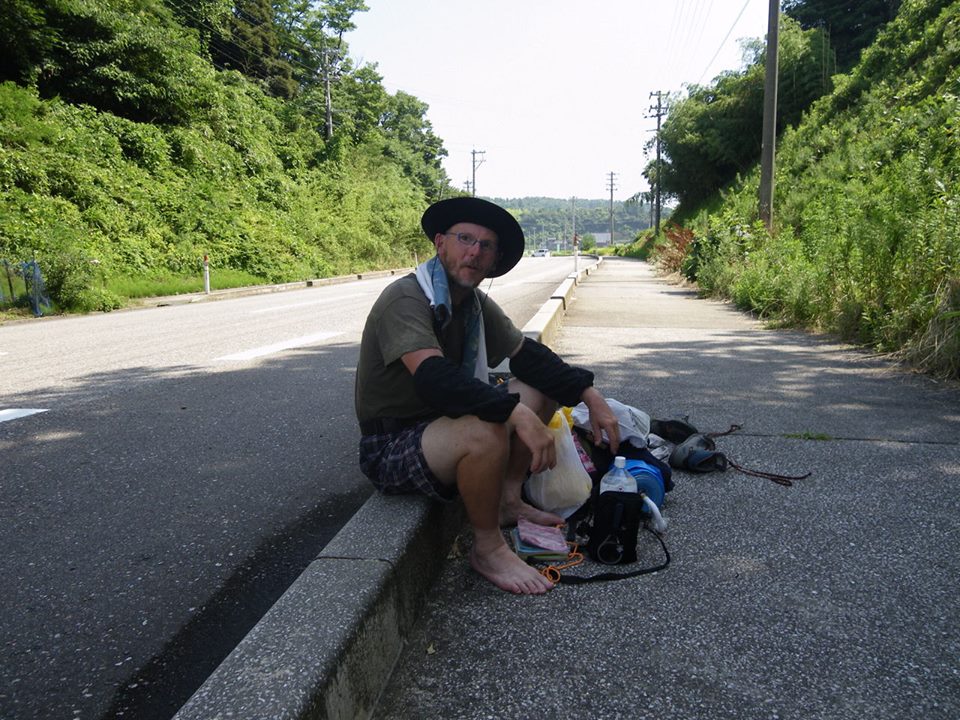
Irishman Walking (Stage 17 Chapter 1) is about my walking the main and coastal roads of Japan. Summer 2015.
*
Dear Friends and Readers:
Irishman Walking was about my walking the main and coastal roads of Japan, in a series of spring, summer, autumn, and winter stages. It took me eight-years to complete my mission. This summer-stage, Stage 17, began on 27 July, 2015, at Mito City (via Takahagi), in Ibaragi prefecture, on the eastern coastline of Honshu. It was also where the previous stage officially ended. The Japanese archipelago consisted of 6,852 islands, with 430 of them inhabited. An island was defined as being land with more than 100-meters in circumference. The five main islands, from north to south, were Hokkaido, Honshu, Shikoku, Kyushu, and Okinawa. Honshu was often referred to as the Japanese mainland. After 20-days on the road, and the trials and tribulations that went with it, the stage was finally concluded on 16 August, 2015, at Sendai City, nicknamed the ‘City of Trees’. This was because it was said to be one of Japan's greenest cities, for the abundance of plants and trees. This was not a recent idea, rather dated to the Tokugawa period, when residents were encouraged to plant trees in their gardens, or ‘yashikirin’ , household forests. It also proved a useful source for wood, to make everyday materials. Sendai was located in Miyagi prefecture along the northeastern Pacific coastline of Honshu, the largest of Japan’s mainland islands. Sendai was not only the capital city of the prefecture, but it was also its largest. Around 20-percent of the earthquakes in the world tended to occur in Japan. As with much of Japan, the Sendai region had its fair share of natural disasters, earthquakes among them. The 1978 Miyagi earthquake, for example, had a magnitude of 7.7, had caused number of landslides and widespread damage to the infrastructure around Sendai, on 12 June, 1978. Only one death was reported. The 2005 Miyagi earthquake, with a magnitude of 7.2, also caused considerable damage, and a number of deaths, after the collapse of a swimming pool roof, on 16 August, 2005. Much of the long Tōhoku coastline and beyond, was decimated by a massive earthquake, in 2011 Tōhoku earthquake, with a magnitude 9.1. It was said to have been the most powerful earthquake ever recorded, in Japan. According to the records, it was also the fourth most powerful in the world. It was a disaster that left thousands dead, and contributed to the Fukushima Daiichi nuclear disaster that followed. The Sendai region had been inhabited for around 20,000-years. Sendai was said to have be founded by the daimyo at the time, Masamune Date, in 1600. Date had been given permission, by Tokugawa Ieyasu, the first Shogun, to have a castle built. The location was an ideal location for trade, and a town soon grew up around the castle. On an added note, the grid plan roads in present-day Sendai City center were based upon Date’s plans (Wikipedia). The first railway line to that connected Sendai with Tokyo, was opened in 1887. Needless to say, the line greatly reduced the travel-time. People were able to make the journey within only a day, which was considered revolutionary at the time. Furthermore, Sendai University, founded in 1907, was not only the first school of higher eduction in the region, but was the first in Japan to admit students of the female gender, in 1913. An Imperial Japanese Army division, locally recruited troops, was stationed in Sendai, during the Pacific War, and participated in the Battle of Guadalcanal, among other bloody encounters. Needless to say, the city was targeted by American bombers in the closing weeks of the war, 10 July, 1945. The historic city center was leveled as a result, including the loss of almost 12,000 inhabitants. After the war, the American occupying forces operated two camps in and near the city, Camp Sendai and Camp Schimmelpfennig. Sendai was also home to the largest festival in Japan, ‘the Tanabata Matsuri’, held every summer. Also known as ‘the Star Festival’, and believed to have been introduced into Japan by the Empress Kōken, in 755. According to legend, the empress had a lasting love affair with a Buddhist monk called, Dōkyō. The Tanabata celebrated the meeting and subsequent love of two deities, where were separated by fate. The empress was the sixth of eight females to rule Japan. When she died in 770, her lover fell from grace and was banished from the capital Nara. “Mmm!” ‘Love was a Many Splendored Thing’, to coin the title of one of my favorite films. After all, it was better to have loved and lost, than never to have loved at all. Food for though! Back to the present, I was glad to have wrapped this stage of my mission up in Sendai City. Not only was it an interesting place with a lot to do and see, but it would be easy to return to this coming to continue on my mission around Japan on foot.
Be happy, keep smiling!
Yours sincerely
Michael Denis Crossey
From Mito City in Ibaragi to Sendai City in Miyagi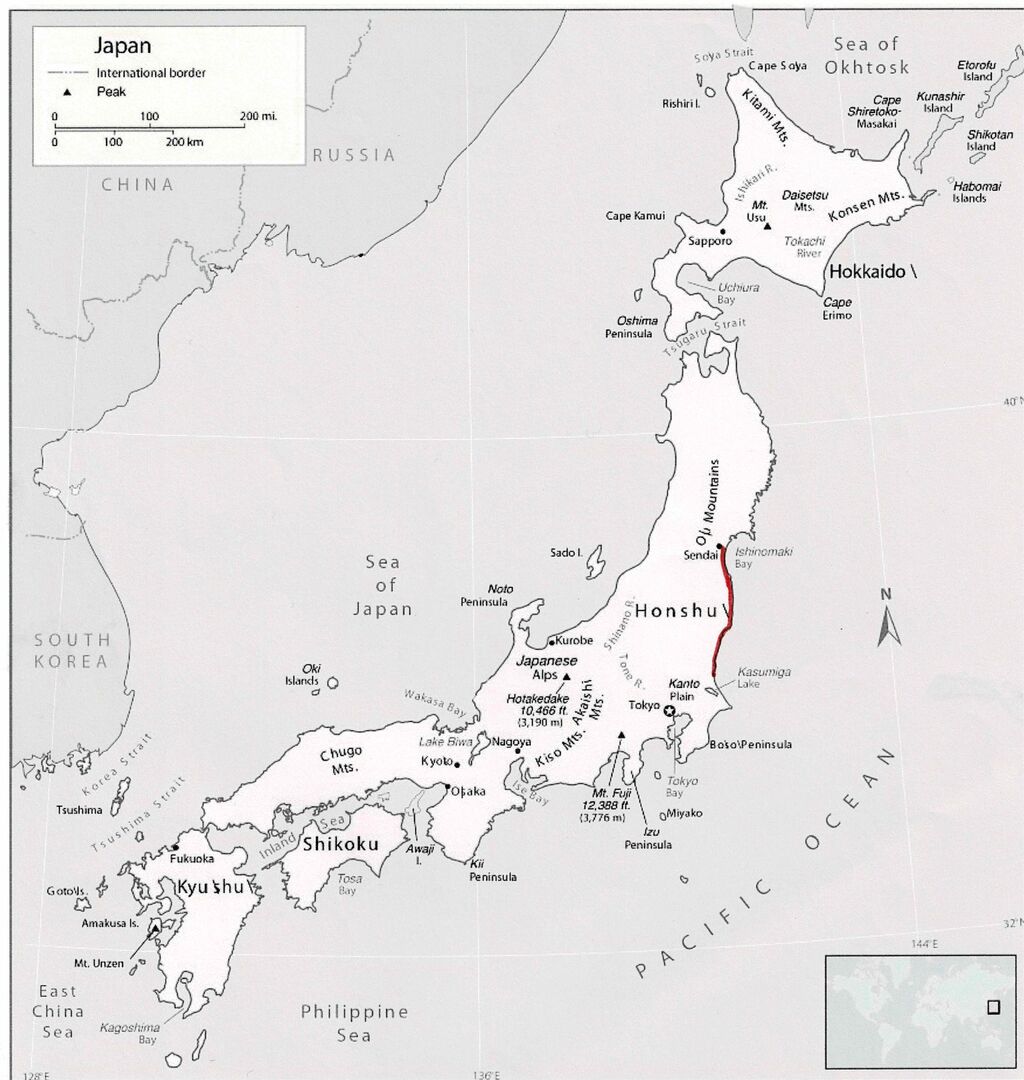
*
21 Jul, 2015: Prior to getting my gear together for this stage, Stage 17, of my mission, a massive earthquake hit Nepal and left more than 7,000 people dead. In recent years, the British have experienced about 20 to 30 earthquakes per year, with an intensity above 2. Many more smaller earthquakes were recorded by the British Geological Survey. An earthquake in Kent in England registered 4.2 on the rector scale. When I lived in London for seven-years, I never felt a single tremmer. In other news, the Takasakiyama Zoo in Oita in Kyushu, apologized for naming one of its newly born monkeys, Charlotte, after the British royal baby. According to the zoo, the name Charlotte got the most votes. The Takasakiyama Natural Zoological Garden was a unique kind of place, located on the 628-meter high Mount Takasaki. In 1953, the zoo started feeding a group of wild monkeys. This monkey-feeding activity attracted more visitors to it, than to the mountain itself. Prior to this, the Oita City Mayor, Tamotsu Ueda, had made an unsuccessful attempt to intice the monkey population in the area. His plan was to entice the monkeys with apples. A hora-gai, a horn made from a conch shell, was blown to attract the monkeys. The attempt to control the monkeys was financed out of his own pocket. A hora-gai was often common among the Yamabushi mountain monk's gear, in Yamanashi. Later, another attempt was made to intice the monkeys, by a Buddhist priest called Onishi, from the Manjuji Temple. This time he used sweet potatoes to intice them, which proved successful. Soon, the monkeys began to visit the area more frequently. The monkeys in the region were first recorded, in 1698, and were known to harass local farmers. By 1964, the monkeys numbers increased. In time, different groups of monkey formed. In June 2002, one of the groups left the protected zoological area, never to return. The big news in Japan focused on a change in the constitution, so as to send armed forces abroad to fight abroad. This would be the first time in 70-years. The move was welcomed by Washington. America had been instrumental in drawing up the pacifist Article 9 of Japan’s postwar constitution. Japan had long been the target of unprecedented international pressure for a more active role in world affairs. Needless to say, antiwar protests were planned to counter any change in the law.
Done
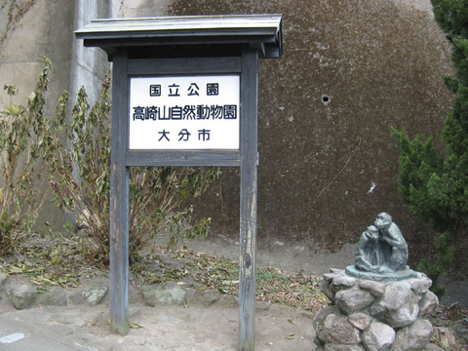
Takasakiyama Park (Wikipedia)
22 Jul, 2015: This coming Monday, 27 July, was officially set for the start on this stage of my mission. This was at a time when I had just recovered from an alien illness, which kept me in my futon for seven-days. On my mind at the time was a pressing need for a spot of exercise, so as to get back into shape, before I left Tokyo proper. Looking over my maps at the time, I decided to take a short cycling trip for a few days as far as Kamakura and back. Cycling was as good away as any for beefing up the old muscles. Rather than load up any camping gear this time, I decided to book myself into a Toyoko Inn in Fujisawa for a couple of days. My plan was to cycle as closely as possible to the kyu-Tōkaidō, which was easier said than done. There was just about nothing left of the old Tōkaidō, the main road now being, Routes 1 and 2 (and Route 3), which I cycled along on an earlier cycling trip to Fukuoka in Kyushu, many years ago. These days, the Tōkaidō was so built up, over, and around, it was hard to believe that any of the old road survived at all. The land between Tokyo and Yokohama made up the country’s most intensely developed industrial zone. To paraphrase the words of Keio University founder, Yukichi Fukuzawa years earlier: ‘All that Japan had to be proud of was the scenery.’ “Mmm!” What scenery? Fukuzawa must be turning with anger in his grave. Busy roads were no places to pause for superficial attention. No matter how much I had planned for the various stages of my mission, circumstances often dictated how things went, or turned out. Thankfully there was nothing magical about getting the old mind and body ready for the road. So, I hoped this short cycling venture would help to do just that. There were two things I never got used on the busy roads -- the fumes and the speeding vehicles. This fumes were most noticeable at times of traffic jams. A traffic jam was a microcosm of the real world, not easy to escape, a thing that needed to be dealt with. It did not have to be rush-hour for veciles to get slowed down on the roads, even for cyclists. There were a few things that came to mind -- accidents, roadworks, weather conditions, blisters, muscile fatique, etc., etc., really could put a few dints in my plans. Any unwanted occurrences proved sobering to say the least. Not a day passed not see a reckless driver speeding madly along the road, or weaving in and out of the traffic. What was the point of hurrying? Life was short as it was. Often at times along the road, the scenery was blocked out on all sides by hideous buildings. Trees planted and cultivated by man, ornamented the buildings along the sides of the road. The hand of man had left its mark in all directions. As I was cycling, there was no need to be in any great hast, a thing I was guilty of in my younger days. Besides, I was still recovering from a misterious illness. With the sun beating down on top of me, a lazy paddle along the Tōkaidō, Route 1, was good enough for me in the hight of summer.
Done
Besides the cycling trip to get the body and mind ready for walking the road again shortly, there was another reason. My plan was to pay an unexpected visit to a certain cafe for lunch, and to see my friend, Mayu-san, who ran the place. Mayu's attractive smiling face never failed to work wonders on my emotions. The lack of scenery, which I touched on earlier, did not prevent me from taking in other places of interest along the way. Many of the houses I passed, had attractive Japanese-style gardens with admirably arranged plants, trees, and rocks, and so forth. It was hard not to pause momentarily, to take some snapshot. On the odd occuasion, providing the weather was favorable, I liked to sit down for a while to enjoy the environment. The good thing about cycling, I roughly knew when I would arrive at a certain place, in this case Yokohama, where I was headed. How many Japanese knew that it was at a local summer festival in Yokohama, the female gender were first carried the mikoshi, the sacred and heavy religious palanquin? Juring the Japanese festival, the mikosh was believed to hold a Shinto deity on a journey between the main shrine to a temperory one.
23 July, 2015: The headlines in the morning Japan Times offered a little food for thought: ‘Govt reveals map, photographs of China’s ‘structures in E. China Sea.' No doubt the Japanese government hoped to deter China from unilaterally developing gas fields in the region. In other headlines: ‘Japan greets over 9 mil. visitors in 1st half of year’, and ‘Toshiba sued in U.S. over stock price plunge on scandal’. The scandal in question had to do with accounting irregularities that involved top management, over a series of years. Whenever I thought about it, I could not recall a year in Japan that was free from white-collar scandals of one kind or another. Then again, white-collar crime, or any crime for that matter, was synonymous the world over. Thankfully, the rain that I expected to fall did not materialize, which suited me just dandy as made my way along the road, Route 32. The road led in the direction of the famous Daibutsu, a gaint bronze statue of Buddha, some 13.35-meter tall from its base. Like Mount Fuji, the Daibutsu was considered a Japanese icon. An outdoor statue, in the grounds of the Kōtoku-in, a Buddhist temple, about a 10-minute walk from Hase Station, the third-stop on the Enoden Line, from Kamakura. On a visit to Japan in 1892, Rudyard Kipling saw the Daibutsu as 'a Japanese idol at Kamakura'. The Daibutsu was more famous than the temple itself, it took about 10-years to complete. It was originally made of wood, in 1243. Damage casued by storms and earthquakes over the years, however, led to the construction of the bronze statue we see today. Now, the visitors waited paitently in the drizzle to get their snapshots of the statue of Amitābha -- the Buddha of Limitless Light -- just one of a number of phrases of the statue, in the different touristy broachers. It represented the main deity of the Buddhist Sect Jodo, which in English meant Pure Land. It was hard to keep the broachers dry in the rain, as I jotted down my notes. The statue was commonly referred to by local people as the Kamakura Daibutsu, and was designated a National Treasure. A notice at the entrance to the [Kōtoku-in] grounds read: "Stranger, whosoever thou art and whatsoever be thy creed, when thou enterest this sanctuary remember thou treadest upon ground hallowed by the worship of ages. This is the Temple of Buddha and the gate of the eternal, and should therefore be entered with reverence.” The 1923 Great Kanto earthquake badly damaged the base or the statue, but it was repaired in 1925. Repair to the statue’s neck was carried out in 1960–61, and included work to strengthen it against earthquakes. Further restoration and preservation work was planned. When I reached the Daibsu, a light drizzle began to fall. The rain remained light that the other visiters appeared not to use an umbrella. Likewise, I saw no reason to open the one I had borrowed at the hotel. "Mmm!" For some reason, I wondered if famous visitors to the Kamakura Daibutsu, worried about the weather? The British journalist, writer, and poet, among other talents, Rudyard Kipling, who visited Japan twice, in 1889 and again in 1892. No other British literary figure than Kipling, fully documented his life in Japan in the late-Meiji period. His newspaper despatches from Japan were seen by the noted Japanologist, Basil Han Chamberlain, as: "the most graphic ever penned by a globetrotter".
Done
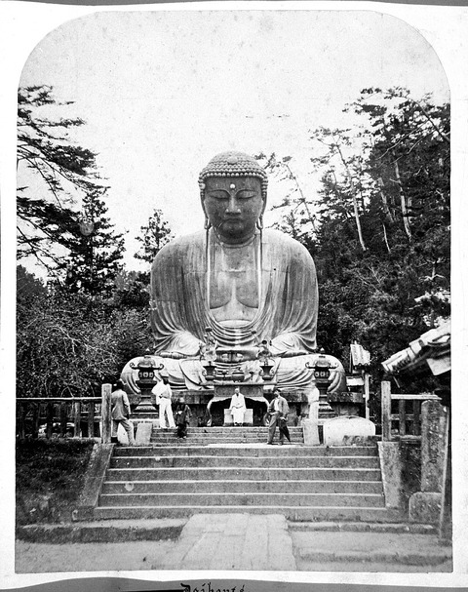
One of the earliest photographs of the Great Buddha, by Italian-British photographer, Felice Beato (1867) (Wikipedia)
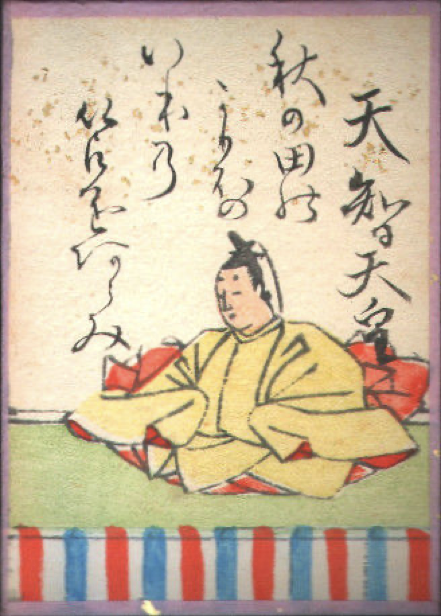
There were a good number of Chinese and European tourists, not to mention a few Americans, or Canadians, if my ears were not decieving me. And of course, an Irishman! Yours truly! I mumbled to myself as I looked about me. Everytime I found myself in Kamakura, it was hard not recall earlier visits to the place together with old friends, sadly gone from my life. A day-trip to Kamakura Daibutsu was a favored pastime for foreign residents of Yokohama, at least since the late-nineteenth-century, if not before. The Daibutsu drew Japanese visitors to it all year round. But where the hell were they today? The official Webpage reminded visitors on a number of rules: “Refrain from eating and drinking in front of the Great Buddha and near the pedestal. In addition, please refrain from eating while walking as this can inconvenience other temple visitors. Please take any trash with you when you leave. Wheelchair users should, as far as possible, be accompanied by a helper, as some areas on the temple grounds are difficult for wheelchair users on their own. There was a wheelchair-accessible unisex restroom facility, on the grounds. Visitors with pets may enter the grounds only if their pet is in a pet cage or carrier. Except for service dogs, no dogs on leashes may be walked on the grounds.” In adddition: "Smoking was not permitted anywhere within the temple grounds. When taking photos on the grounds for commercial use, please obtain the temple’s permission beforehand. Download the application from the website, fill out and sign the form, and submit it to the temple office. Visitors were free to take photos for personal use as they wish. But we ask all visitors to refrain from flying drones in the precincts and using selfie sticks in the interior of the statue. There were no professional photographers on duty, at the temple. The templeʼs cycle parking lot is for bicycles and mopeds only. The temple assumes no responsibility for theft, minor accidents or other incidents in this parking lot.” Besides the different and overpriced souvenir shops, I could not see very many Japanese tourists at all. This last number of years there had been an active drive to promote domestic tourism, as a good way to get them to see and learn more about their own country. Each summer different prefectures in Japan made efforts to hold cultural festivities, though mainly for your people, or students. The festive events covered various interests, with a Japanese leaning. The events ranged from arts, calligraphy, crafts, creative writing, Japanese poetry, the board game Go, music, natural science, tea ceremony, theater, and so forth. Another was Ogura Hyakunin Isshu, a traditional card game, enjoyable especially amongst children. The game was attributed to the scholar, Fujiwara no Nobuzane (1162-1241), in the late-Heian and early-Kamakura periods. Before I cycled back to the hotel in Fujisawa where I was stopping, I bought the tiniest model of a Kamakura Daibutsu that I could find, from a shop in the temple grounds. My plan was to give it to my friend, Mayu-san tomorrow, when I stopped by at her cafe in the Ōfuna part of Kanagawa. It was just a wee gift to mark the occausion, and hope that she would not forget me.
Done
24-25 Jul, 2015: One good thing about stopping at the business hotel was that I could sit and read an English language newspaper in comfort. In this case, a morning issue of the Japan Times, which I read over breakfast, and take my thoughts away from the road for a while. At times I wondered about the level of intelligence needed to make a choice headline? The headlines in this mornings paper were: ‘Jan-June trade deficit down 77-percent from last year’, ‘Yui enters ISS after Soyuz launches docks successfully’, ‘One-stop tax desks lure tourists to localities’, and, ‘TPP talks near deal on rice quota under 100,000 tons’. This was the final day of my wee cycling trip to Kamakura and back to my place in Tokyo. There was no hurry to return to Tokyo, so I intended to peddle slowly, and try to enjoy the remainder of the roundtrip. My mind had a habit of working overtime, so I would have to make a greater effort to stay focussed. Of course, I looked forward to my stop at my friend's cafe in Ōfuna, the next town. Sadly, both of us were not as close as we once where. Our phone calls and emails, were now few and far between. How her many emails used to cheer me up no end. There were two things in life that were said to be certain -- taxes and death. Noting lasted forever. Everything came to an end. Almost a year had passed when Mayu-san ended the relationship. The reasons for which I still could not understand. Behind the smiling faces it was hard to gauge the mind of a Japanese woman, or any female for that matter. I worried that my friend may misinterpret my out of the blue stop off at her cafe. Another part of me hoped that she would be happy to see me again, regardless of circumstances. Such was her character. For me, I looked forward to seeing her beautiful smile again, if only for a short while. There was one problem, my friend’s place in time for lunchtime. Checkout time at the hotel in Fujisawa was at 10:00 AM sharp. Nothing beat the solitude of a warm and comfortable night in a well pitched tent. I liked to enjoy my stop at a hotel to enjoy to the fullest, not just a hot bath and a comfortable bed, but to think about things that I needed to do that may have slipped my mind. The clock was barely gone 11:00 AM when I dismounted the bike outside the cafe, which had just opened for business. After securing the bike, I opened the door and entered. Just as I had thought, Mayu-san welcomed me with a delightful smile. Apart of me felt sadm as I knew that this would be the last time I would see her, as I had no reason to come this way again. The truth was, I would ever see her again after today. There was no reason for me to visit this part of the country again. A pleasant pedestrian and cycling path followed for a fair distance along the Kashiogawa. If only I had known of the path a couple of days earlier, for it would have made Ōfuna easier to get to. For the most part, the roads back to my place in Tokyo proved uneventful. In a word, boring. There had been a heavy downpour in the afternoon, when I crossed the border into Yokohama. Unfortunately, a bout of depression lingered for much of the journey back to Tokyo. The sort of feeling that something dear was lost.
Done
Ōfuna had a train station since 1888, long before it was absorbed into Kamakura City, in 1948. Today, Ōfuna was a busy built-up area, so I was glad to have left the place behind me. The region was not short of beautiful spots, such as, the Ōfuna Kannonji area, particularly at cherry blossom time. The temple was by no means as old or had the history that most others. A Buddhist temple, the Ōfuna Kannonji, was home to a 25-meter tall concrete statue of Bodhisattva Kannon, the Goddess of Mercy. The outbreak of the Pacific War halted work on the statue. When it was finally completed in 1960, and contained a museum and shrine. 'The Ōfuna Kannon incorporated stones from ground zero of Hiroshima and Nagasaki to commemorate those who died in the explosions of the atomic bombs. A fire originating from the atomic fires of Hiroshima burned at a mushroom-formed statue' (Wikipedia).
Done
26 Jul, 2015: Jul, 2015: The first thing I wanted to do when I got back at my place in Tokyo, was to email my friend in Ōfuna to thank her for her kindness. She had even treated me to the sandwich lunchtime set special at her café. Mayu-san never failed to surprise me in one pleasent way or another. In another email, I learned that she did not mention my unexpected visit at the cafe, to her mother, whom she lived with in Yokohama. In away, this saddened me a little. It kind of hammered home that our relationship had truly ended. The only thing I wanted to do now was to think about and get ready for the next stage of my mission. I could not wait to get started on the road again, on foot. Tramping the roads again would burn off the stress that my short cycling trip to Kamakura had failed to do. All the same, I was physically and mentally ready. All that I needed to do was to return to northern Ibaraki, where the summer stage, Stage 17, of my mission would soon start. Tomorrow I planned to get the morning train from Nishiarai, near where I lived, and make a change at Kitasenju, only a few stations away. From there, I planned to take a Joban Line train as far as Mito City in Ibaraki. During the previous stage in spring, Stage 16, I had already passed through Mito. In the closing days of the Pacific War, students at a school in Mito had boycotted their classes. This was to force their military-minded principle to resign. "Mmm!" Weren't all of the school princples at that time military-minded? For better or for worse, Japanese schools across the country had come along way since those days. These days teachers in Japaneses schools, if not in schools in many countries, where prohibited from using physical punishment. When I looked back over the years, I was among the last bunch of boys to get the cane for misbehaving. That was when I attended secondary school in London, the early-1970s. Actually, about 99-percent of my schoollife in Belfast, and in London, involved one form of discipline or another. Looking back, the happiest part about my schooldays was when I quit school a couple of weeks before graduation day. That was a time I never looked back on with any regrets. Incendently, the word 'boycott' came from an Englishman called, Charles Cunningham Boycott (1832-1897). After his retirement from the British Army, Captain Boycott worked as a land agent in County Mayo in Ireland. He became so disliked by the local people, that they refused to harvest the crops, and to have anything to do with him. This was at a time when agriculture was the main means of survival in Ireland. The shops in the nearby town also withdrew their service to him. This was not only a campaign of isolation by the local community, but an act of resistance against the evictions that were to take place on the estate. Hence, a new word -- boycott -- found a new home in the English language dictionaries. Back to the present, the old bouts of stress and anxiety had returned. This was noting new for me. It occured each time I checked and rechecked the gear in preparation for life on the road.
Done
Stress was part of life, like normal human reactions to a problem. People needed to manage their stress and anxiety, to succeed in something. This was important to following plans and reaching goals. Too much stress, like to much of anything, could lead to whole host of other problems -- fear of something, lack of sleep, bad eating habits, and so on. To combat such things, I needed to enhance self-discipline, self-control, and my mental and physcal health. After all, physical exercise was as good away as any to reduce stress. That said, I was not sure tramping 30 to 35-kilometers under the elements all day long, was the same as physical exercise or a workout. Exercise was any bodily activity or workout that maintained physical fitness and overall health. The amount of endorphins, or stress defeating chemicals that my aging body produced after hours on the road, was open to debate. The kind of stress that I suffered from, tended to pop up out of the blue, unexpectedly. This was especially true at camp in the evenings, when I went over my maps, and saw with my very eyes that I had not done as well as I had first thought. Like the bad workman and his tools story, the weather was a good thing to blame a poor performance on. Doing so, however, did not lesson the problem any.
Done
27 Jul, 2015: The night passed as well as could be expected, in a comfortable futon. A hot shower was followed by a hearty breakfast of porridge, yoghurt, and tea. Now I could not be more ready for the train ride to Mito, and then to Takahagi. Unfortunately, things did not turn out as smooth as that. The train arrived a little late, which was quite unusual in a country that prided itself on good time keeping. According to the schedule, the trained that stopped at Platform 1 at Kitasenju at 10:01 was not the train that should have pulled in at this time. Therefore, not realizing this at the time, I found myself on the wrong train. Thankfully, I soon relized the mistake, and got off at the following stop, where I waited for the correct train to arrive. The mess-up was partly my own fault for not reading the destination on the sides of the train carriages properly. Somehow, in my haste to get the right train for Mito, I left behind a cool bottle of water that I had taken from my backpack, to quench my thirst. Things were not off to a good start. There was no sign of the bottle anywhere about the platform when I retraced my steps. The bottle was unopened, so perheps another passenger nearby, must have picked it up. After all, this mornings weather was a hotter than usual. "Mmm"" Something told me that this was not going to be a good day, or so the thought ran through my head. The Mito region had greatly prospered since it was first inhabited in 400 AD. Today, Mito was a large city, and the capital of Ibaraki, with a population of around 271,000. The city had long thrived on tourism, and boasted the Kairaku-en gardens and many local museums and art galleries. Why not? The mission of a museum, if not a city, was to transmit culture and promote learning, especially to children. Among the many attractions, was the 100-meter tall metal tower, Art Tower Mito, opened in 1990. A date that marked Mito's 100th aniversary as a city. The cultural plaza complex next to the tower, housed a concert hall, a gallery for contemporary art, and a theater; for a wide variety of local and foreign events, concerts, dramatic productions, and art exhibitions. At the close of the Pacific War, more than three-quarters of the city took a pounding in an air raid, in the closing days of the war. Mito was severely damaged again, by the 2011 Tōhoku earthquake and tsunami, which cost some lives and many homes completely destroyed. Unlike my previous visit to Mito, I had no plans of hanging about the city for verylong. Mito City was about 10-kilometers from the Pacific. My plan was to follow along, or near the ocean for much of my journey. Takahagi, where I was headed, was a city located at the northeastern part of Ibaraki. It was previously called, Matsuoka, but was renamed, Takahagi, in 1937. “Mmm!” What was wrong with keeping the old name? I thought. Takahagi was granted town status on April Fool’s Day, in 1889, and city status in 1954. Today, Takahagi City had a population of over 29,000, a decline since 1990. Many locals worked in areas, such as, agriculture, commercial fisheries, food processing, and light manufacturing.
Done
In yesteryear, Takahagi local economy was fueled by the Jōban coal fields, which had pettered out by the 1960s. Takahagi also boasted a rich white sandy beach, a great place to pitch the tent for the night. It was not easy to put a positive spin on the train journey mess-up this morning.When I did finally reach Takahagi, it was a good 25-minutes later than I had hoped. Still, I had to stay positive, and look on the brighter side of life. “Mmm!” I momently wondered if positive people lived longer than nagative-minded people? The damage was done, and I was where I wanted to be. Other regrets would just have to wait. A book that I pulled from the shelf before I left Tokyo, was titled: ‘A book of Nonsense’. I quickly learned that is was a load of nonsense or crap. For want of a word, a dead-weight. It surprised me that the book included the works of Lewis Carrol, Edward Lear, William Brightly Rands, among others, all specialists of literary nonsense. There were just too many books at my place in Tokyo, a fair number of them remained to be read. Before hitting the road, I was already halfway through reading ‘A Road to Freedom’ by the one and only Nelson Mandela. It was a book that I found hard to put down. However, it was much too cumbersome to cart about with me on the road. To continue with it would just have to wait until I got back to Tokyo. So I decided quickly on the 'nonsense' book, which I felt was lighter in both weight and content. How true the old saying was: ‘Never judge a book by its cover’.
Done
28 Jul, 2015: Slept rather well to the rolling sound of the Pacific waves. The tent was pitched at an uneventful place called Isohara, previously called, Kitanakago, on the northeastern tip of Ibaraki, where it touched Fukushima and the coast. Today, Isohara had a population of around 13,000 inhabitants. The old Tanagura highway, also known as the ‘Road of Salt’, was once a main commercial route during the Tokugawa period. However, the coal mined at the Jōban Coal Field, was transported on water, which seemed appropriate for the long coastline and fine ports in the region. All in all, the coal industry in Japan had played an important part of the country’s modernization. A coal reliant Industrial Revolution was already up and running in Britain. It was the matrix of the modern world -- in the eyes of popular historian, Paul John Johnson -- formed around 1815 to 1830. Coal remained important to the local economy through the Meiji and Showa periods, until 1976 when the mining finally ceased. The city's flag and seal depicted the joining of the Kuroshio and Oyashio currents, warm and cool, respectively. Becasue of the nutrient-rich currents, the fishing in the area was abundant. The Izura coastline, not far from the Otsu fishing port, was noted for its scenic beauty, and boasted seven beaches. The region was famous for its red hexagonal buildings, tea houses, called ‘Kanran-tei’, as well as being a good spot to view the coastle scenery. The six-sided building, or ‘Rokkaku-dō’, in Japanese, was designed in the Meiji period, by a Japanese scholar, called Tenshin Okakura. Okakura was a forerunner, if not saviour, of 'Ninonga', an artform that used traditional Japanese techniques. This was to counter the influence that modern Western art, had on Japan at the time. In other words, traditional Japanese art, was threatened of being replaced by Western-style paintings, known as 'Yōga' in Japanese. In an earlier book, ‘The Awakening of Japan’(1904), he wrote that: 'the glory of the West was the humiliation of Asia countries'. Okakura was, however, mainly remembered for his ‘The Book of Tea’, which was published in English, in 1906. Like Nihonga, Okakura's book attempted to show how the drinking of tea -- its purity and harmony, etc., was a part of Japan's social order and cultural heritage. The Japanese scholar and artist's work influenced one of my favorite thinkers, the American poet and critic, Ezra Pound. “Mmm!” If only I had taken a book on his poems with me on this stage of my mission, or so the thought momentarily hit me. Regardless, I was stuck with the book on nonounce, whather I liked it or not. For what it was worth, the book was now my tent-friend in the evenings. Before I left my place in Tokyo, I almost brought Mandela’s ‘The Long Walk to Freedom’, which I had not yet finished. However, experience told me that I really needed to consider the weight I carried on my back, so the big man's big book was left behind until my return. The early morning sky became low and heavy that I felt rain to be imminent. Taking no chances, I hit the road early. A tiny road marker along Route 6 told me that I was a good 174-kilometers away from Tokyo. As I emerged from the Hirakata Tunnel, all 60-meters of it, the first signs of the sun momentarily broke through the heavy cloud covering. All the same, I felt glad that the heavy clouds kept the sun from having its way with me. Whenever I cycled to Kamakura a few days ago, the sun had had a field day with me. In a word, it burned me to a crisp. Therefore, thoughts of how best to protect myself from the sun, never left me.
Done
Done
Tourism was a growing industry to the economy -- hot springs. Iwaki was home to one of the oldest Japanese hot springs in the country, the Iwate Yumoto Onsen, that dated back to the Nara period (710-794 AD). The "hot springs at Iwaki [were] developed with borehole drilling in the Jōban Coal Fields in the Meiji period” (Wikipedia). The Spa Resort Hawaiians (previously named Joban Hawaiian Center) opened in 1966, was the first theme park in Japan. The resort drew around 1.5-million visitors every year. Long before it was developed as for tourism, natural hot spring water seeped into the coal mines. Later, the issue became the main theme in the 2006 Japanese film, ‘Hura Girls’, directed by Lee Sang-il. The summertime had a special significance, in Japan, particularly in the case of festivals. In summer, Iwaki was a city of festivals. On example was the Taira Tanabata Matsuri, a three-day festival held in early-August, each year. The dates were based on the old lunar colander. Many of the stalls sold festive feasts and attractions -- scooping up gold fish, from large water-filled containers. The attraction called kingyo-sukui, was in Japanese. Visitors also had the chance to write their wishes, or dreams, on colorful little stripes of paper, called tanzaku. Another festival called, the Onahama Hanabe Matsuri, was a combination of fireworks and music. Each yeaer, a large fireworks display, skillfully synchronized to music, was held at Onahama Port. It was said to be one of the best festivals of its kind in Japan. The night sky background, over the Aquamarine Park, greatly added to the awe. The Iwaki Odori, a major summer festival, was held in front of Iwaki JR Station, usually on the first Sunday in August, each year. The festival was an anual dancing event, with 15,000 to 20,000 participants. The Iwaki Odori continued to grow in size each year. It was held for the first time, in 1981, to commemorate the founding of Iwate City, with a population of more than 340,000. It was the largest city in Fukushima, and the tenth largest in Japan. Another anual festival was the Jangara Matsuri, held on 6 August. The festival was made up with groups of dancers, with well coordinated performances to the sound of kane bells and taiko drums. The performances were dedicated to the recent natural disaster in the Tohoku region. When possible, it may include paying a visit to the homes of families who lost someone in the disaster. The most interesting and attractive and interesting matsuri, I felt, was the Natsui River Lantern Matsuri. Almost a 100-years old, the festival involved thousands of floating lanterns drifting down the Natsui-gawa to the sea. The lanterns symbolized the spirits of loved ones passing onto the other world. Originally, the festival was held to commemorate the accidental drownings of children. It also usually marked the end of the Obon holidays. In the mid-1980s, I watched a different lantern festival with a gilfriend, Arimi-san, from Fukuoka. At the time, we were on wee a cycling trip to Kanagawa for a few days. Arimi was on holiday from her studies at Tsuda College in Tokyo. Sadly, I could not remember the name of the lantern festival. It might have been the famous Kaga-Yuzen Toro Nagahi Matsuri in Ishikawa, in Kanazawa.
Done
Photo of Arimi Kanamori???
The festival name literally meant, 'flowing lanterns',said to have existed since the summer of 1583. A three-day festival in late-August, which marked the end of Obon, a time when the spirits returned to the after world. Each year, more than a thousand colorful candle-lit paper lanterns floated down the Asano-gawa towards the sea. The floating festival took place just before another, the Hyakumangoku Matsuri, the largest festival in Kanazawa. There were actually a good number of paper lantern festivals across Japan. The festivals were often referred to as festivals of recovery from unfortunate events. The Asakusa Toro Nagashi was first held on the Sumida-gawa in Tokyo, in 1946. It was to commemorate lives lost during the American fire-bombings on Tokyo, and other cities, in the war. It also included lives lost during the Great Kanto Earthquake, in 1923. Larger floating paper lantern festivals were held in Hiroshima.
"Mmm!" When the tent was pitched, I wondered if I would sleep well tonight, for the busy road, Route 6, was less than a 100-meters away. I also thought about tomorrow, and hoped that all would go well. Or that I would be able to make a left on the road as planned, and get onto Route 49. Then again, I was well used to things not turning out smoothly, according to plans.
Done
29 Jul, 2015: By late evening the clouds made a hasty departure revealing the sort of sky that lifted emotions to new levels. The change made me feel good, after being on a long, hot, and monotonous segment of road for much of the day. Like the clouds, the traffic on the road became fewer, with the odd car or truck speeding along every few minutes. The warmth from the morning sun gradually replaced the cool and gentle breeze that blew into the open tent through the night. This told me that it was time to dismantle the gear before I broke into a sweat. After a short spell of tramping along the road, Route 6, I decided to stop by at Mos Burger to try one of their morning breakfast specials. Surprisingly, the food was not so bad. At least it set me on the right foot, to hit the road proper. My mind was preoccupied with looking out for Route 49, which would take me further inland. Leaving the coastline was like leaving an old friend. This unwanted detour was the result of the Fukushima Daiichi nuclear disaster a few years back. Since 1967, when the nuclear power plant began to operate, it was plagued by a series of problems -- violation of building regulations, malfunction of the condenser and the cooling pumps, etc. Following flooding of a backup generator of Reactor 1, in 1991, future safety recommendations were made, in 2000 and again in 2008, but were ignored. Located on an active seismic zone, Japan was prone to earthquakes on a daily basis. At long last, I reached Route 49, thankfully without too much difficulty. The scorching sun still found away to get at me, or such were the stifling hot days of summer. Today, however, turned out to be one of the hottest days so far. Therefore, it did not surprise me that I appeared to be the only person outside. These days every house, car, and truck had air-conditioners, which the Japanese loved. The best I could do was to duck under a shade somewhere, or into a store, just to cool doen for a short while. That said, many of the shops and stores seemed to have disappeared, or few and far between. Something told me that this was going to be a tough day. As expected, I soon felt thirsty. With my water bottles nearly empty, however, it was not long until I found myself popping coins into a vending machine. Up until the present, I had done my best to avoid such machines. There seemed nothing better than pouring a cool drink down the old gullet, particularly a nice cool beer. On the downside of quenching my thirst with beer, however, it would not be long when I felt thirsty, again. What I needed to do was to replenish my water bottles as soon as possible. After some time, I arrived at an interesting looking ramen restaurant, run by an elderly woman. The place had some tables and chairs outside, and soon I set down at one, under a cool shade. A bowl of shio ramen ws soon ordered, and a cool bottle of beer for good measure. As the woman took my order, I happily told her that there was nothing better than an energized body to achieve something. I was not sure what or how she thought, but she came to my table a few times to see if I was all right.
Done
A few times she replaced the cool wet flannel, which I used to wipe the sweat from my neck and forehead, as well as presented me with a tiny bowl of cool pickles for me to enjoy with the ramen. “Energy, energy!” She said with a smiling face, and placed a small bowl of pickles on the table. It was the first time that I had pickles with ramen. Of course I did not care one way or another, and was happy to have something tasty inside me. On the whole, the people I had met along he road since I left Tokyo, were kind to me. When I did finish eating, I felt a wee bit tired, and toyed with the idea of stopping for a nap at some point along the road. Another part of my brain told me that I was far from beaten and to push on. Thanks to my stop at the restaurant, I soon felt the energy building up inside me. The thoughts of a nap, was the result of being longer than I should have at the restaurant. Now I wanted to kick up some dust. Earlier, the women at the restaurant had said something about a long tunnel, up the road. After a while, I found myself standing at an iron nameplate at the mouth of the tunnel. The Iwaki Mizuishi Tunnel, opened in August, 2005, ran for an ungodly length of 1,385-meters. The tunnel was named after the 735.2-meter high Mizuishi-yama, that was home to a large park of the same name. In the 1950s there used to be a golf course, and an area for horses to graze. It was possible to reach the summit of mountain by car. At New Year time, many people visited an old Buddhist temple, near the summit. The Jofukuji Temple was one of 36 other temples listed on the pilgrimage map in the Tōhoku region. The woman also kindly told me about a convenience store along the road. She added that I would do well to load up on necessities, as there were not other shops for a good distance. What I really needed most, was water. Foolishly, I had forgotten to refill my water bottle at the restaurant. As things turned out, there were two convenience stores. The 7-Eleven and a Lawson, were located quite close to one another. The time was a little after five o’clock, so I decided to make camp early, close to the stores. The tent was soon erected, but with much difficulty. This included a tumble into a ditch at the side of the road. A fall made all the more forceful by the heavy backpack. Thankfully I was not injured. All the same, the fall was all the more troublesome as the ditch was full of thick, slimy muck, with a foul smell. My fall from grace, of sorts, happened close to the Goudo area of Miwa Town. Other than my fall, it was an uneventful little place. The town of Miwa had a population of nearly 3,700. The local athorities were currently drawing up plans to entice interested parties to relocate to the township, or even to setup second homes there. All that I could do was to focus on tomorrow, and get what information I could about the road ahead of me.
Done
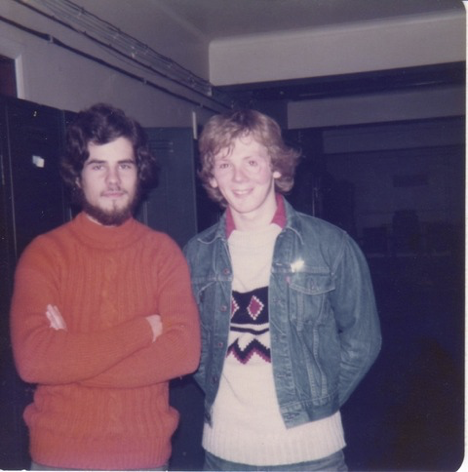
My old karate-friend, Vincent (left), and yours truly sporting a smile, around 1979
30 Jul, 2015: Slept well enough, even if it was not until midnight, later compared to previous nights. The sun rose from behind a cluster of trees, as I set about dismantling and rolling up the camping gear. When everything was in order, I retraced my steps about 500-meters to one of the convenience stores. There I picked up a carton of milk for the muesli that I brought from my place in Tokyo. Nothing was better than a hot bowl of porridge for breakfast, which I was more than familier with since childhood. Muesli was the next best thing, and which I first got to know in my teenage days. I think it was a Dutch friend called, Vincent Van Dorp, who first introduced me to it, during my London days, in the 1970s. Back then, Vincent was studying health related coarse at a collage in London, so he was more infromed on what to eat than I was. It was also through my friend that I learned about the benefits of eating brown rice and soybean sprouts. In away, it was funny how little things allowed me to recall people I once knew. "Mmm!" What are you up to these days, my old friend? Before hitting the road proper, again, I asked a young male staff member if there were other stores along the road, where I was headed. “Not before Koriyama.” He replied, with his smiling face. The smile on my face soon disappeared when a directional-distance road sign reminded me that Koriyama was 50-kilometers away. In other words, a good one and a half days on foot. Thankfully, the heavily clouds kept the sun rays off me. Life on the road was made all the more tolerable by a cool breeze that blew in over the road. In time, I came to another tunnel, the Iwaki Miwa Tunnel, which thankfully, at 743-meters, was not overly long. Along the way I stopped again, this time at a bus stop hut, where I to boiled water for a cup of coffee. The water was poured carefully, not to spill any. I did not have the fogiest when I could next replenish the bottles. Across the road, a stocky woman, in her 40s, was hard at work pushing a small motor-powered rake. The women did not appear to notice me looking at her, as she worked away like there was no tomorrow. “Mmm!” I momentarily wondered what the woman’s husband was doing? Then again, it was nice to own a piece of land to work on. The bus stop hut was dirty or neglected -- gits and pieces of rubbish and cigarette butts scattered about the floor. Who was at fault? -- The local government? The local residents? The bus companies? The sharing of responsibility for the upkeep of the bus stop huts, was a many splendid thing. In recent times, fewer people used the local buses to commute. These days, just about everybody had access to cars or vans. Most commuters in Japan prefered trains, to buses. Soon the water for my coffee was ready. Before I left Tokyo, I made sure I brought enough coffee and filters, and tea. That said, it was not unusal for me not to forget something -- a corkscrew, or whatever. In this case, I foolishly forgot to bring a cup. Thankfully, I kept the empty plastic-bottle, of the sports drink I picked up at a store earlier. A cup was soon fashioned out of it, with the aid of my trusty knife. In a matter of moments, the hot coffee was ready and welcomed.
Done
On average the Japanese, per-person, drank around 10-cups of coffee a week. For whatever the reason, they drank most of the coffee on Saturdays, Sundays, and Mondays. When I got back onto the road, Route 49, the distant sound of a bell told me that it was twelve-noon. About 30-minutes later, a small brown van pulled up just ahead of me, and stopped. Its rear lights flashed on and off like a Christmas tree. As I drew nearer to the van, a young Middle-Eastern looking man leant over the passenger seat, to speak to me through the window. “Where are you going? Can I give you a lift?” It was the last thing on my mind that a foreigner would stop his car to offer me a lift. Still, it was not the first time that a fellow foreigner had offered me a lift, but few and far between. So I thanked the young man for the unexpected kindness, but explained that I needed to walk. This included a quick rundown on my mission, and how I avoided all forms of transportation, other than on foot. He told me that he had just passed me by, and then made a U-turn. He wished me luck, and with a nod, a smile, and a wave, he drove off. For a while, my mind was occupied with the kindness from strangers. It would have been nice to have chatted to the young man more, for I had many questions to ask. The road remained busy with traffic, and I knew that it was not safe to stop for too long. At last, I came to spot in the road when it crossed Route 349. A directional road sign pointed left for Yamatsuri and right for Ono, which led towards the Ban-Etsu Expressway. The cities of Koriyama and Aizuwakamatsu, home to Tsuruga Castle with its distinctive red-tiled roofs, lay straight ahead, along Route 49. Fukushima Airport also lay in the same direction, but I could not give a shite about such things just now. This segment of road was called, 'Abukuma Kogen Road'. A little further along the road, a touristy sign post pointed in the direction of Abukuma Limestone Cave, 27-kilometers away. “Mmm!” Kuma was also the Japanese word for bear, which kind of sent a shiver down my back. Abukuma Limestone Cave was located in the Tamura area of Fukushima. It was not far from the smaller Irimizu Limestone Cave, discovered in 1927, and designated as a Natural Treasure, in 1934. The caves must be interesting places to visit, especially at the hight of summer. The temperature inside Abukuma-do, was around, 15°C. For a country as modern as Japan, it surprised me to learn that Abukuma Limestone Cave was discovered, in recent times (1969), and opened to the public about four-years later, in 1973. Originally the cave was called Kamayama Shonyu-do. In that year, it was designated a natural heritage site, of the town. A touristy sign also pointed to Licca Castle, and to Jupeerland, 19- and 9.3-kilometers, respectively. Licca Castle was a fairytale castle located in Ono in Fukushima. Opened in 1993, it was the sort of place one expected to come across at a theme park. It was designed in the image of a European-style castle, to showcase Japanese fashion dolls, called Licca-chan dolls, hence its name. The castle was also an open factory, where visitors were able to see how the dolls were manufactured. The Licca-chan dolls were especially popular amongst young Japanese girls.
Done
There was also a museum that displayed limited editions of the dolls, and hands on activities for vistors to enjoy, amongst other things. Jupialand Hirata was located at the base of Mt. Yomogida-dake in Fukushima. A large parkland area, home to a wide variety of flowers -- hydrangea, lilies, and others. The region had a lush landscape, with gentle mountain slopes and many farms. Mount Yomogida was a symbol of Hirata Village. The Hirata roadside station offered a wide variety of locally cultivated fresh vegetables at resonable prices. The locally grown vegeables were used in the making of various foods -- ice-cream, shortbread, curry, etc. The stifling hot weather this last number of days seemed to have broken at last. One moment the sky was blue, sunny, and hot. Then suddenly there was heavy cloud cover. Therefore, I had a funny feeling that the dice were heavily loaded in favor of rain. After awhile, a cool breeze blew across the road. This was soon followed by a heavy downpour, which lasted for the best part of two-hours. Then, the sky cleared up, and the road became dry and dusty, and hot once more. Of course, I did not mind if the sky being clouded over, but the rain was sure to follow. The rain fell so suddenly, that everything got soaked, including my nerves.
Done
Photos of landslides???
31 Jul, 2015: The night passed comfortably, in my little one-man tent. How else could it have gone, under a scorching hot sun all day long? The Japanese weather was blunt and to the point. Each year, somebody fell victom it the weather, in one form or another -- earthquakes, tsunames, typhoons, floodings, mud and landslides, or countless cases of heatstroke, like at the present time. Today, Friday, 31 July, was the hottest day since I left Tokyo. It was essential to keep your wits about you, especially when out in the open. God knows how many plastic bottles of sports drinks or water I must have drunk. Not to forget a 500-milIliter cool can of Kirin beer. If it had not been for the sweat, or the pores in my skin, the sports drinks would be coming out of my ears. At long last, my tired legs carried me into Koriyama City, just 21-kilometers from where I had camped last night. The time had just gone four-fifteen. Since leaving Tokyo, finding a place were my WiFi worked properly, was not for the faint hearted. I could not recall the last time I listened to the BBC, or checked the emails. Whenever I did get a signal, it was too faint to be any good. Finding a hotel to stop the night, now occupied my mind. Thankfully, I was able to get a single room at the Dormy Inn. The hotel was about half a kilometer from the Toyoko Inn. My membership card at the Toyoko Inn hotel chain proved useless. Being Friday, it did not surprise me that it was fully booked. My stop at the Dormy Inn cost a more. That said, 'beggars can't be choosers', as the proverb put it. The NHK weather news reported that the hot weather will continue for some time. A cold mass flow will blow in, gaining strength as it moved. This meant rain in the form of thunder clouds, was expected. Unfortunately. I was too tired to comprehend, which part of the country was expected to have rain.
Done
1 Aug, 2015: Apart from a bit of tossing and turning, I nodded off into another world reasonably well. There was the odd time when I itched one part of my body or another. It was hard to imagine that there were lice in the bed -- clean bed sheets, regularly changed. I read in a book a few years ago that a main difference between the bed in your home and the bed at a hotel, was that the first contained your lice, and the later contained other peoples' lice. Whatever the cause, I could not stop myself from itching. A fair portion of the evening was spent emailing a friend who lived and worked in Kitakata, not far from Aizuwakamatsu in Fukushima. The Aizu region was said to be where the 'akabeko', a traditional toy originated from. The word 'aka' meant 'red', and 'beko' was the local Aizu dialect for 'cow'. Today the akabeko toy was a popular souvenir tht countless numbers of visiters to Aizu liked to buy. According to legend, this mythical red-cow, was based on an actual cow that lived in Japan in the nineth-cenutry. Around that time, the cow was used as a work-anamal in the construction of Enzō-ji, a Buddhist temple in Yanaizu in Fukushima. When the temple was completed, the akabeko gave itself to Buddha, and was immediately turned into stone. Another version of the tale claims that the akabeko refused to leave the temple environment when the construction work was finished, and became a permanent fixture about the grounds. Granted city status, in 1954, today Kitakata had a population of around 47,000 -- in decline since 1960. In 1882, a large number of peasants in Shiokawa in Fukushima once marched on the nearby Kitakata Police Station to protest against the oppression by the prefectural government. This became known as 'the Kitakata Incident', and was the first public demonstration for Human Rights in the Tohoku area, if not in the country. Today, Kitakata was noted for its lacquerware and sake brewing. “The city has over 2,600 kura storehouses which are now typically used as sake breweries, living quarters and workshops” (Wikipedia). The city was also well known for its own distinctive ramen -- 'Kitakata ramen' -- characterized by its unique thicker than usual varieties of noodles. The ramen was believed to have originated from a noodle shop in Kitakata, called 'Genraiken', in 1927. The old city boundaries, was home to the highest number of ramen restaurants, in Japan. As I was walking, my friends place was a bit out of my way. Thereofore, it was decided that we meet up somewhere along the way. This I was happy to leave to my friend, who not only had a car, but knew the area much better than I did. However, our meeting, I later learned, was accomplished with some difficulty. The month of August was in the peak season, when hotels did a thriving business. This was also the weekend, which added to the difficulty. It was decided not to meet up at my current hotel, the Dormy Inn. When a place was agreed, all that I needed to do was to see about how to get there. At Koriyama JR Station I bought a return ticket, which workouted some ¥400 Yen cheaper than two, one-way tickets. Our meeting would last until Monday, when I needed to return to Koriyama, to continue with my mission, on foot again.
Done
When that time came, I needed to get my butt onto a different road, Route 4 that headed further north. Such thoughs could wait until the time came. Back to the present, I looked forward to seeing my friend again, as a lot of water had passed under the bridge since we last met. Unfortunately, because of work, we would not meet until the evening, and so it was decided that I should eat dinner alone. At such times, the Japanese often said, ‘Shoganai!’, which meant, 'It could not be helped. Again I tuned into the weather conditions across the country on the NHK news. Areas in Gifu Prefecture, reached record highs of 39.9°C. The seasonal temperature in August, on average, was around 35°C. Many people had come down with symptoms of heatstroke, some died, others remained unconscious. The stifling hot summer weather was expected to continue for sometime. It was expected to hover around 36°C in Fukushimam, where my friend lived, and 35°C in Tokyo. The news advised people to drink lots of water to help prevent heatstroke. Heavy rain was expected to fall in other areas, with a possibility of landslides. Rain clouds were expected to develop in wider areas and people should be careful of swollen rivers. The times when it did rain, it did its best to dampen what enthusiasm I had left in me.
Done