Irishman Walking (Stage 20 Chapter 3) is about my walking the main and coastal roads of Japan. Summer 2017.
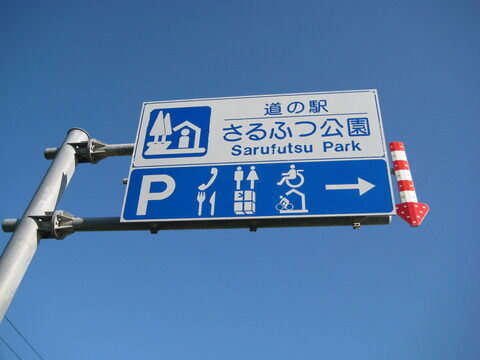
28 Aug, 2017: In the morning I was in no mood to do much of anything, other than to take my time to up camp and hit the road. My washed clothes lay strewn about the warm ground to dry. Sleep too, had not been easy. The late hours was spent listening to a Liverpool-Arsenal game on the BBC. By halftime, Liverpool were 2-0 ahead, then the WiFi died. As I was in no great hurry, I was able to recharge some batteries. Later, I learned that Liverpool thrashed Arsenal 4-0. The win left Liverpool second in the English Premier League, behind Chelsea. I had followed Liverpool ever since I first moved to London to go to school, in 1969. My first school friend at the time, was a Reds van. Needless to say, I swore when the WiFi died. A call from a friend, told me that a room had been secured for me at an hotel, just two-kilometers from my current location. The cost was a just under ¥6,000 yen. This was not bad, as two meals were included. I also learned of the possibility of rain in the morning. To have booked an extra day at the hotel might not have been a bad idea. Then again, a fat lot of good that would do, for the weather was said to be unstable. Before I left the roadside stop behind me, I decided to pay my third visit to the restaurant. It was not good to judge anything from photos, particularly food. This time I decided on a katsukarē dish, rice topped with beef cutlet and curry. The dish placed in front of me was not what I ordered, but hayashi, a hashed beef stew on rice. Often hayashi included some chopped onions and mushrooms, and a thick tomato or red wine sauce. Both katsukarē and hayashi were popular dishes, in Japan. Stew had been around since ancient times, and first documented in Japan in the Jōmon period (6,000–300 BC). There were many types of stew, each with their own particular history, hayashi among them. The earliest evidence of hayashi was found in Japan. A common explanation was that the name, ’hayashi’, came from the English phrase, ‘hashed beef’. Another view was that hayashi originated from a yōshoku (Western-style food) restaurant in the Ginza district of Tokyo, after the Pacific War. One frequent patron at the restaurant, at that time, was a Yomiuri Giants baseball player called, Shigeru Chiba. Chiba was said to have influenced the creation of a new curry dish, katsukarē, dubbed, 'Chiba-san's curry'. The hayashi placed on the table in front of me appeared to have a meat-based source, without any meat or vegetables. My night in the tent proved comfortable, but chilly in the early-hours. The tent was pitched a short distance from the public toilets, which I felt to be a good idea. This was mainly in an effort to escape the force of a wind, which had kicked up expectedly. Thankfully, the night remained calm, and I slept well, even if the tent was a little chilly. All the same, the air outside was a lot nippier than inside the tent. So, I did not bother to head to the toilet when the need called. Instead, a paper cup solved the problem, which I then tossed outside, at arms length, into the cold morning air. This act of sorts, was repeated thrice in the course of the night.
Done
Back on the main drag again, I made a wee stop at the corner of a minor road, Route 138, partly to see where it was headed. A sign told me that the road was bound for a place called, Onishibetsu. The second reason I stopped was to use a Seicomart, a convenience store nearby. Thanks to a thermos flask at the store, I was able to sit down outside for a while and enjoy my first coffee in a good while. Not 50-meters from where I set, stood a brown building, built around 20-years ago. This was the Sarufutsu Marine Inn, where I had a reservation. It was a rather dull building, situationed on the side of the Okhotsk Sea. Checkin time was not until 15:00, so I had a bit of time to kill. So, it was it was good that there was no rain. Much depended on the state of the place -- cleanliness of the room, quality of the food -- to extend my stay, if possible. The room (#201) that I was assigned had a tatami-mat floor. There was a time in the not too distant past when such floors were common. In recent times, however, I had grown accustomed to shinny wood paneled floors, particularly at business hotels. One good thing about my tent, was that I never needed to consider such things. In addition, around 95-percent of the time, most nights in the tent usually proved quite comfortable, to say the least. As I had some time to kill, I treated myself to a cool 500-milIliter can of Sapporo ‘Extra Brew’ lager, as printed on it. The theologian, Martin Luther, was reputed to have said: 'If you don’t have beer, you have nothing to drink'. That said, my own beer turned out to be a wee bit too sweet for me to fully enjoy.
Done
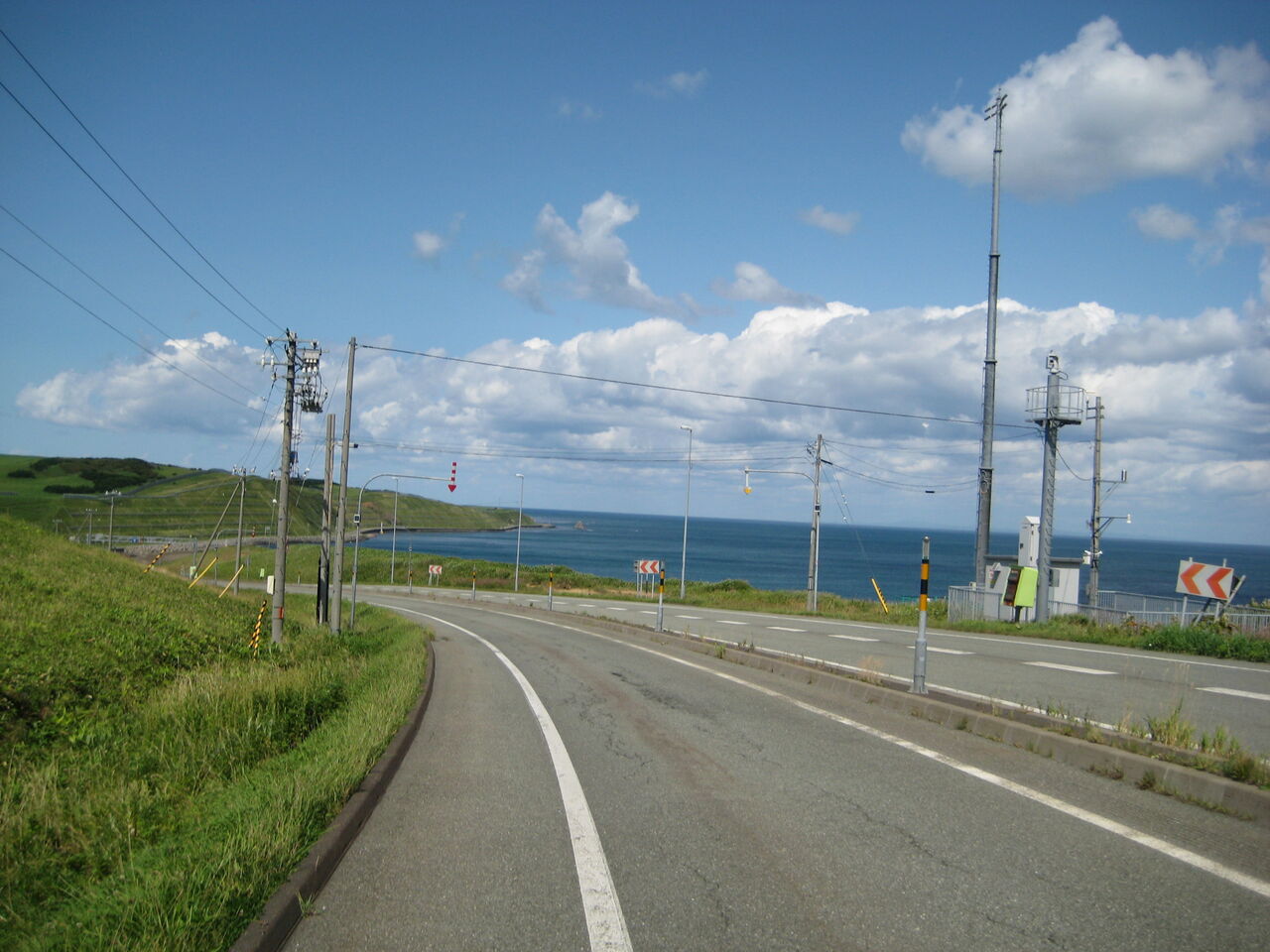
29 Aug, 2017: The rain bucketed down, when I climbed out of bed. That was not all that had come down. The NHK news babbled on about a North Koran missile. Apparently, the missile passed over Japanese waters between the main islands of Honshu and Hokkaido, before it crashed into the Pacific, a distance of some 1,180-kilometers. A road sign told me that Cape Sōya was just 29-kilometers away. Of course, Wakkanai was further at 60-kilometers, but I had no intention to visit there. The rain stopped, and I hoped it would stay that way. A cyclist shot past, headed in my direction, the cap. He did not wave nor stop to chat. A few seconds later, a large motorbike sped past, in the other direction. The rider waved, which I returned. There was no need for him to stop. There were a number of small tents, dotted along the coastline. The tents were not the kind that campers used, but norrow for fishermen to sit under, to stay dry if it rained. It had rained for awhile in the early-hours. A short stop was made to take some snapshots. From the appearance of the fishermen, I would say that some of them were retired. It was said that everyday was a Sunday for retired people, but I was not so sure in the current state of events -- the cost of living and rising prices. Further along the road, Route 238, I passed other tents of various colors and sizes. The occupants did not seem to be around. My plan was to reach Chiraibetsu, an unevent little township, some 15-kilometers away, or half the distance to my goal. Both the road and pavement had quickly dried up from the rain. A second large motorbike passed by, headed in the opposite direction. Like the previous rider, I was greeted with a wave, which I happily returned. On this final stage of my mission, a good number of cyclists and bikers passed by, as I made my way along the road, flanked by large open pastoral fields. Conversely, I was unsure why I had not seen many coaches, loaded up with tourists. It was hard to see why this was. The most northern point in Japan drew many trekkers year round, for its natural beauty, an abundance in wildlife, and its hot springs. It was bordered by two seas -- the Nihon Kai and the Sea of Okhotsk Sea, noted for the drift ice in winter. In the course of time, tents popped up here and there along the seashore. Some of them had fishing rods fixed to the ground that pointed high out over the foamy surf. Regardless of the many technological improvements through the years, the idea of the fishing rod dated back to ancient times. Why the art of fishing failed to make an impression on me was another story, which I will not go into here. The main thing on my mind, however, was the hot weather. Earlier, this morning’s weather forecast news on the box, spoke of sunshine. The road headed past a small fishing port, Chiraibetsu Fishing Pork. Altogether, the islands of Japan boasted more than 2,000 fishing ports. Only the Shinto gods knew just how many I had tramped past along the coastline, on my way around the country. In time, a young man I bumped into, accompanied with his two-year old son, told me that a bear had been spotted in the vicinity, but had not seen one himself.
Done
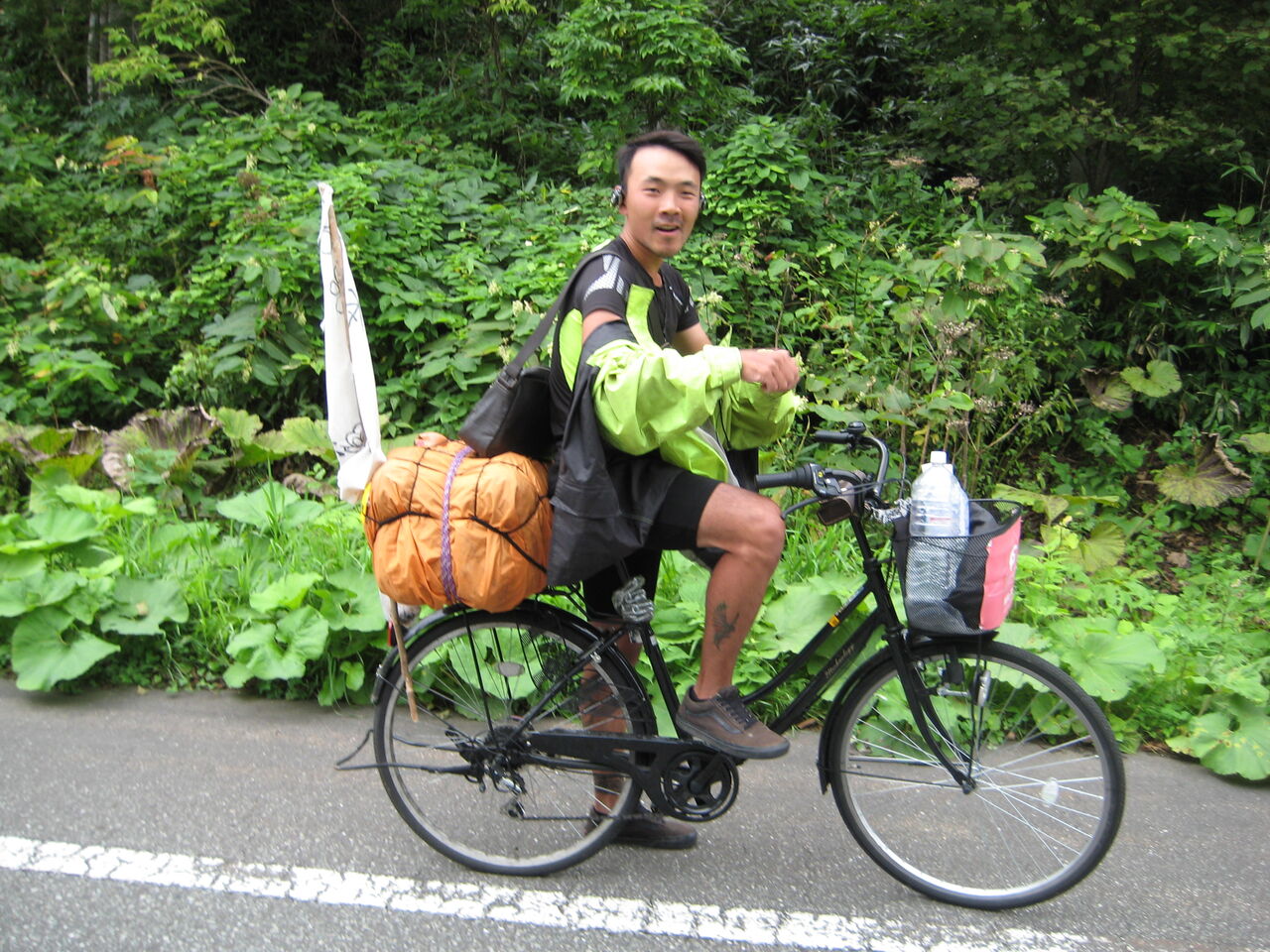
He also told me that he was the local policeman, and pointed to the direction of a recently built building, the lower part of which was a koban, or police box. The young man was not in uniform, so I surmised that this was a sort of day off for him. “Be careful!” He said to me, as I headed off along the road. After about 12-kilometers, the road rose at a sharp angle upwards for a kilometer. A tiny sign along the road, told me that I was about to enter Mineoka Township, and where the road started to head downwards. It was also at this point along the road when I realized that this was turely the homeward stretch, the last leg of my mission. "Sōya Misaki, here I come.” I shouted at the top of my voice. The road continued for some distance through a low mountain pass. When I headed on the downward stretch of the road, I caught sight of a cyclist slowly peddle his way upward. It was easy to see that the bike was loaded up with gear, as it swayed from side to side. For a moment I thought that he was about to take a tumble. There had been a number of times when I had fallen of my bicycle, and on one occasion had boke my collarbone. Even on foot, there had been the odd time I took a tumble, which I put down as part of life on the road. Regardless, I had an elemeent of admiration for the young man. He drew nearer, then stopped and dismounted. Perhaps the heat from the sun or the steep road, or both, had gotten the better of him, for he appeared exhausted. My encounters with people along the road, usually proved reason enough to stop and rest. The cyclist greeted me with a warm smile. “Konichiwa!” I said, with a smile. “Sorry, but I don’t speak Japanese. But, Hello there.” He introduced himself as Wenhan Yu, from Taipei. In the course of our chat, I learned that Wenhan had just graduated from university, and like many young people, he wanted to travel a bit, before he knuckled down to a career. We chatted more about life on the road, than about ourselves. The best way to see the world, he added, was to do it as cheaply as possible. To cut costs, Wenhan told me that that was why he chose to use a mamachari, an inexpensive bike with a limited set of gears. “Why not?” I said in agreement. I told him that I had had a similar adventure, around Japan on a bike. Unlike Wenhan, things had been in reverse -- worked, traveled, studied. Wenhan had a pleasant laugh, which lifted my own sprits. Before we headed off in our oppisite directons, snapshots were taken, and contact addresses exchanged. In away, my travels had never really ended, and even life itself was one big journey.
Done
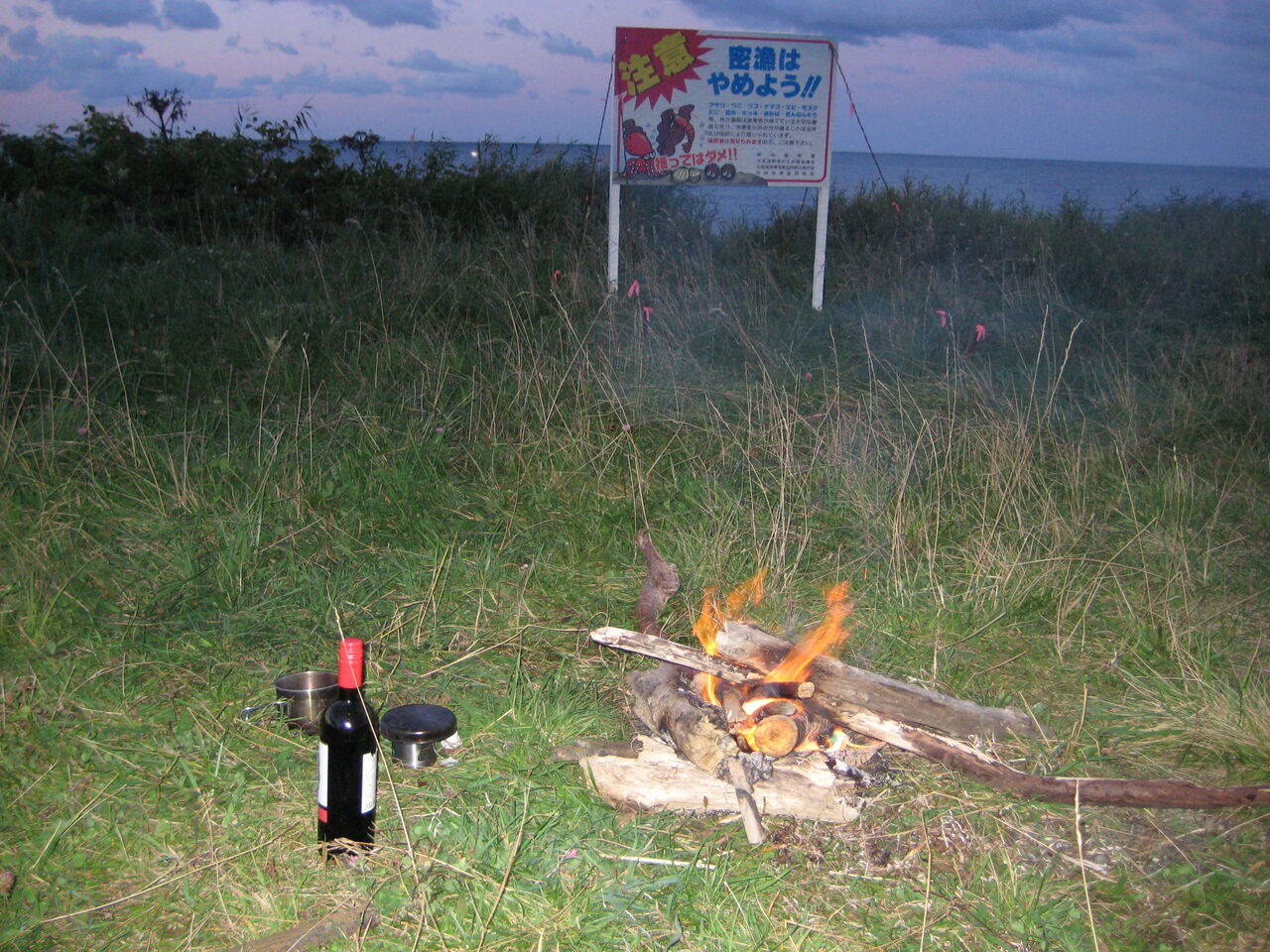
30 Aug, 2017: Yesterday, the tent was pitchd on a raised piece of ground, beside a brown sandy beach, along the Okhotsk shoreline. A road sign told me that the distance to Sōya Misaki was exactly nine-kilometers away. This was less than two hours tramp, or nearer than I hoped. It was not always easy to find a suitable spot to spend the night, when on a steep mountain pass, for the dense growth of shrubs, and whatnot else. Even my campfire to boil water for tea, proved more difficult than usual. At first, I had thought of coffee, but could not find the coffee filters. It seemed that I had inadvertently left filters at one of the places I had stopped at along the road. Unfortunately, the words 'lost' and 'misplaced' were frequent occurrences on the road. There were more important things on my mind, as I tossed a piece of wood on to the campfire. By now the fire burned well. Nothing fascinated me more than a beautiful clear evening sky -- home to more stars than the earth was to grains of sand. In away, I envied the ecademics that were well-rounded about all that stuff out there. If anyting, the star was what I knew least about, their formation, planets, galaxies, and whatever else made up the Milky Way. Back down to earth, some 50 giant windmills stood far off in the hills to my left. All the blades appeared frozen. The cost of a single wind turbine was not for the faint hearted to even think about. A large turbine on a wind farm could cost anything from 20- to 40-million yen. The jury was still out, if it was money well spent. Back to the present, the road headed at a downward slant, as if to go right into the sea. In the distance below, another cyclist popped into view. He struggled up the steep slope towards me. His efforts reminded me of the young Taiwanese man I had chatted with yesterday. This time, however, the cyclist rode, what to me looked like, an expensive touring bike. The cyclist seemed determined to reach the top, so he did not stop, nor wave. About four-kilometers from my goal, Cape Sōya, I made a stop to read an historical sign. It had quite a bit of information after the title, so I set down nearby to pen some notes. The Toyoiwa unearthing was designated as historical heritage sites. The sites were located 3.4-kilometers from the northern most point, Cape Sōya. All 10 of the Toyoiwa sites dated back to the Jōmon to Satsumon periods, and were excavated, in 1985. The Jōmon period dated from about 14000 to 300 BC. The people lived in small settlements, mainly on the islands of Honshu and Kyushu. They lived in sunken pit dwellings, usually near rivers and along the seashore, where seafood, particularly shellfish, was a major food source. At the start of the Jōmon period, the Japanese archipelago was still linked to Asia -- via Kyushu and the Korea peninsula -- from where many early settlers entered the Land of the Rising Sun. The earliest pottery in Japan was said to have been made around the start of the Jōmon period. The people produced earthenware figurines and distinctive cord-patterned vessels; and lacquerware, as well as, jewelry and tools made from antler, bone, shell, and stone.
Done
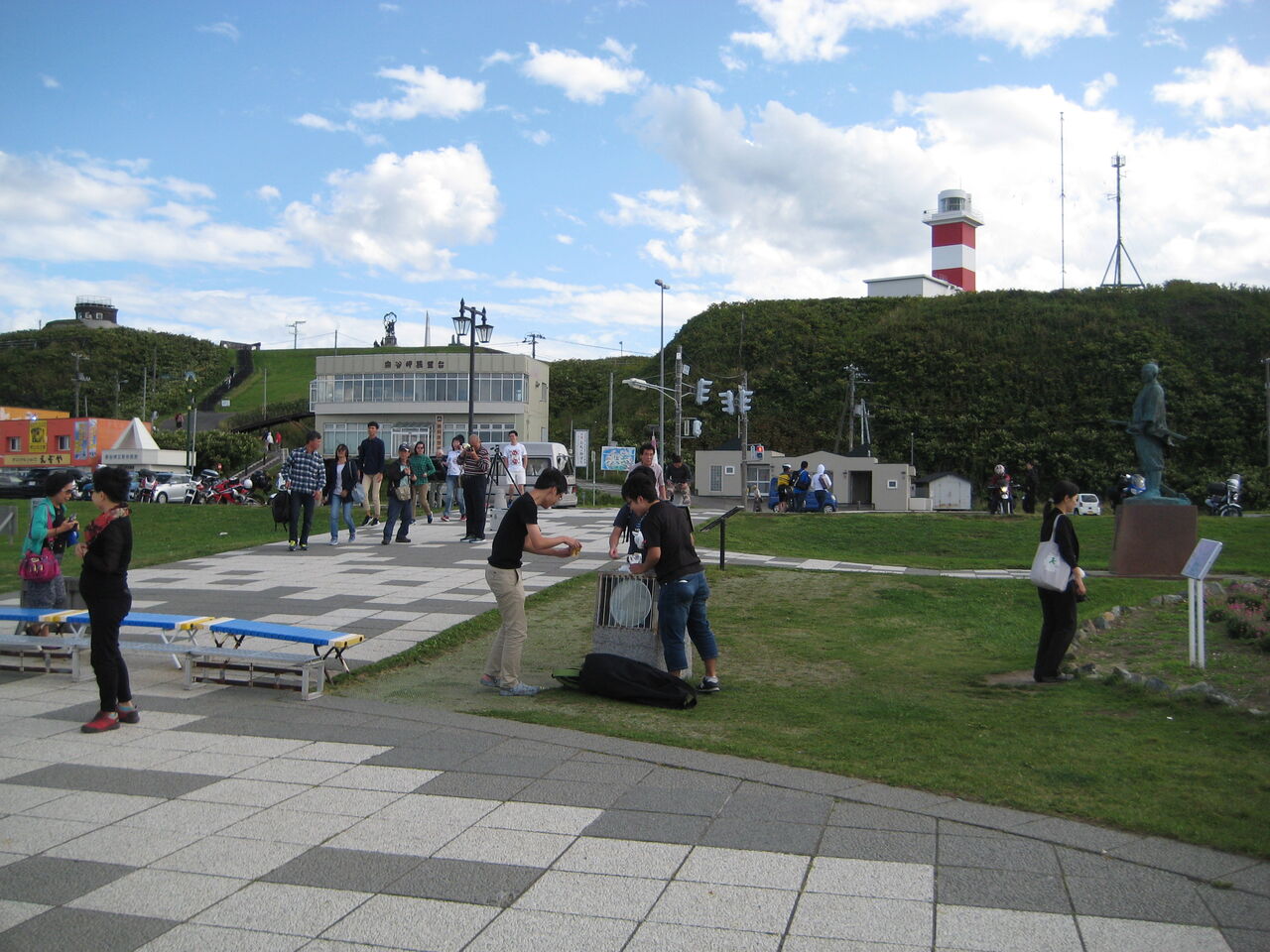
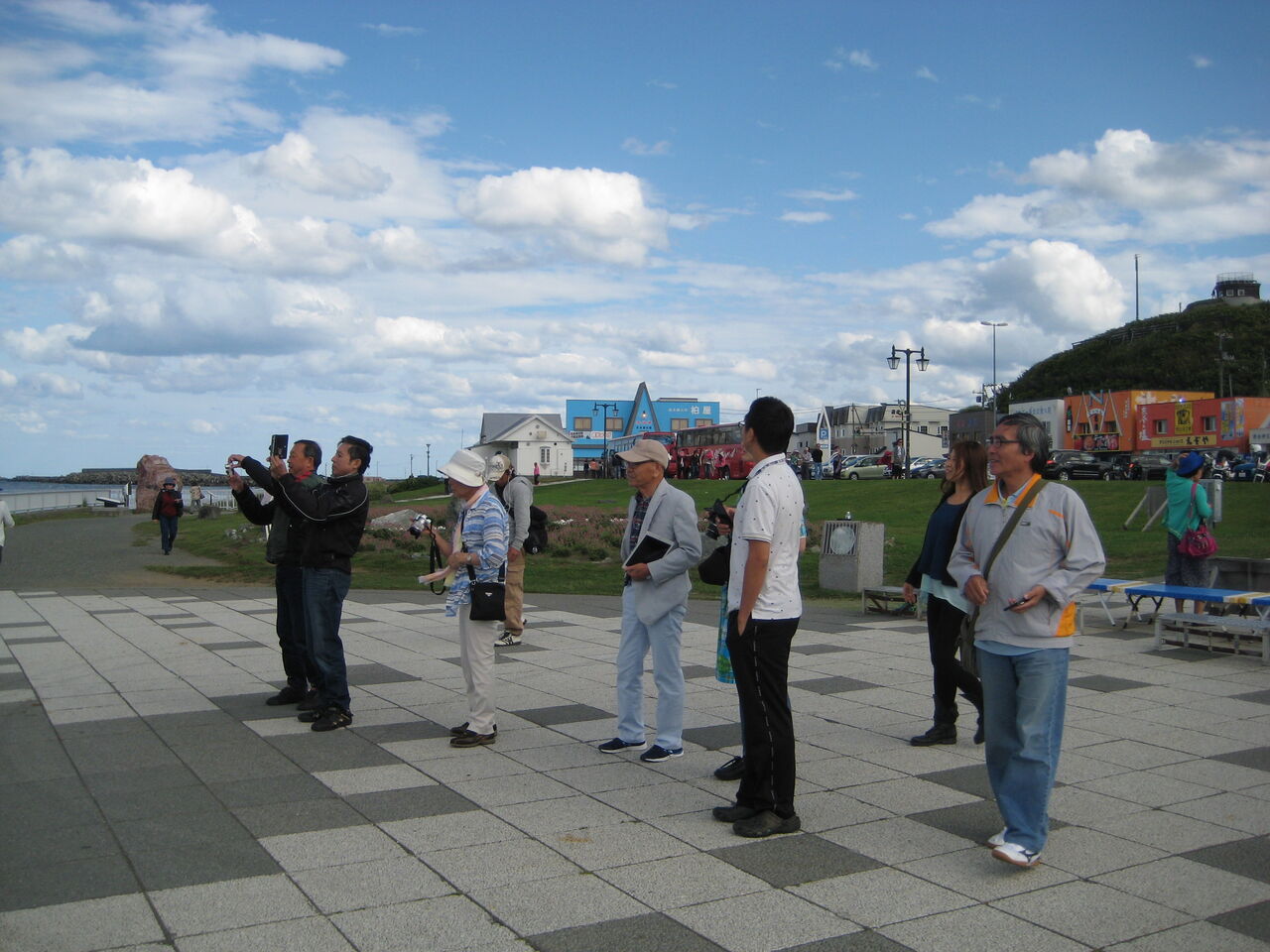
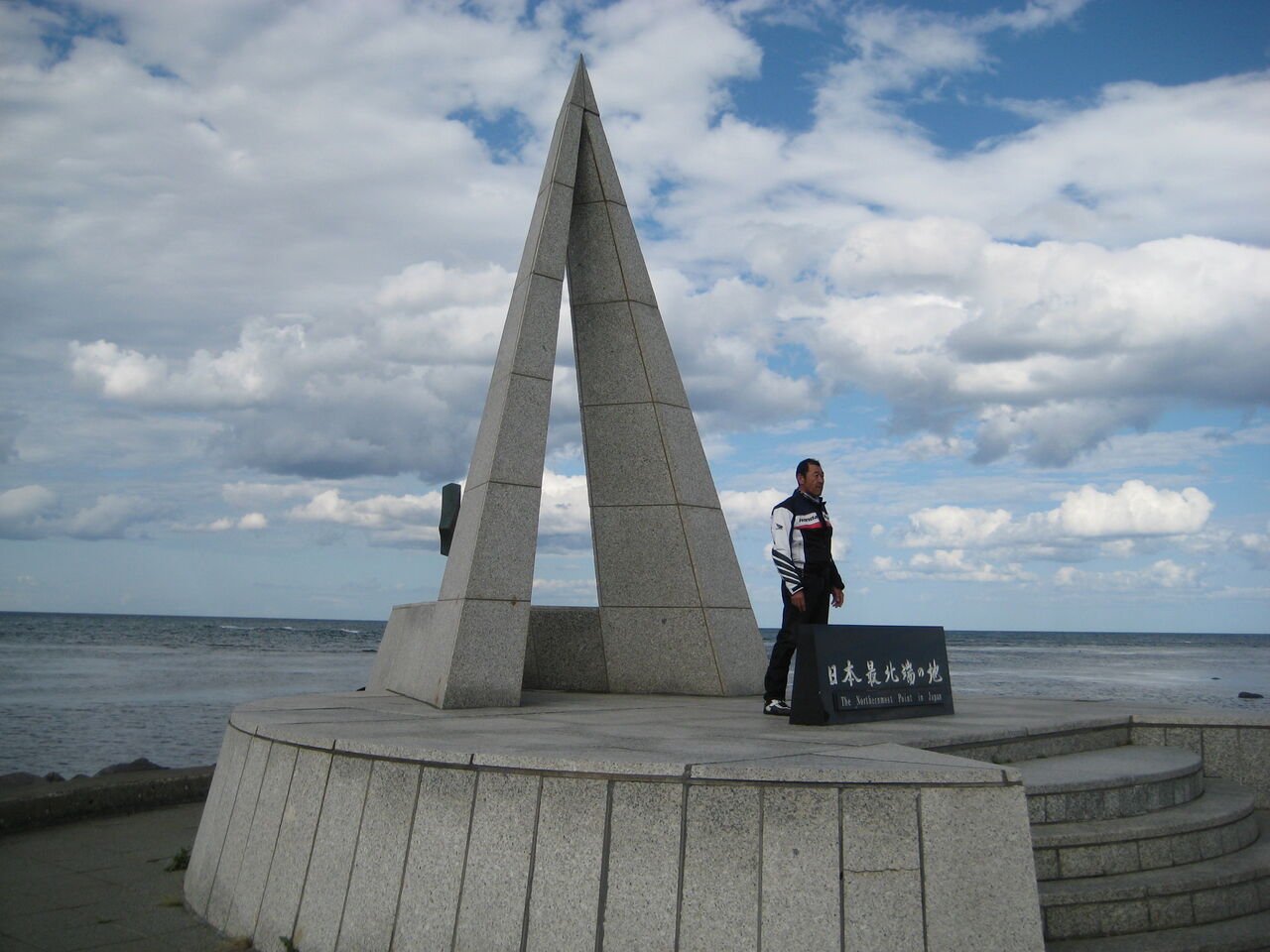
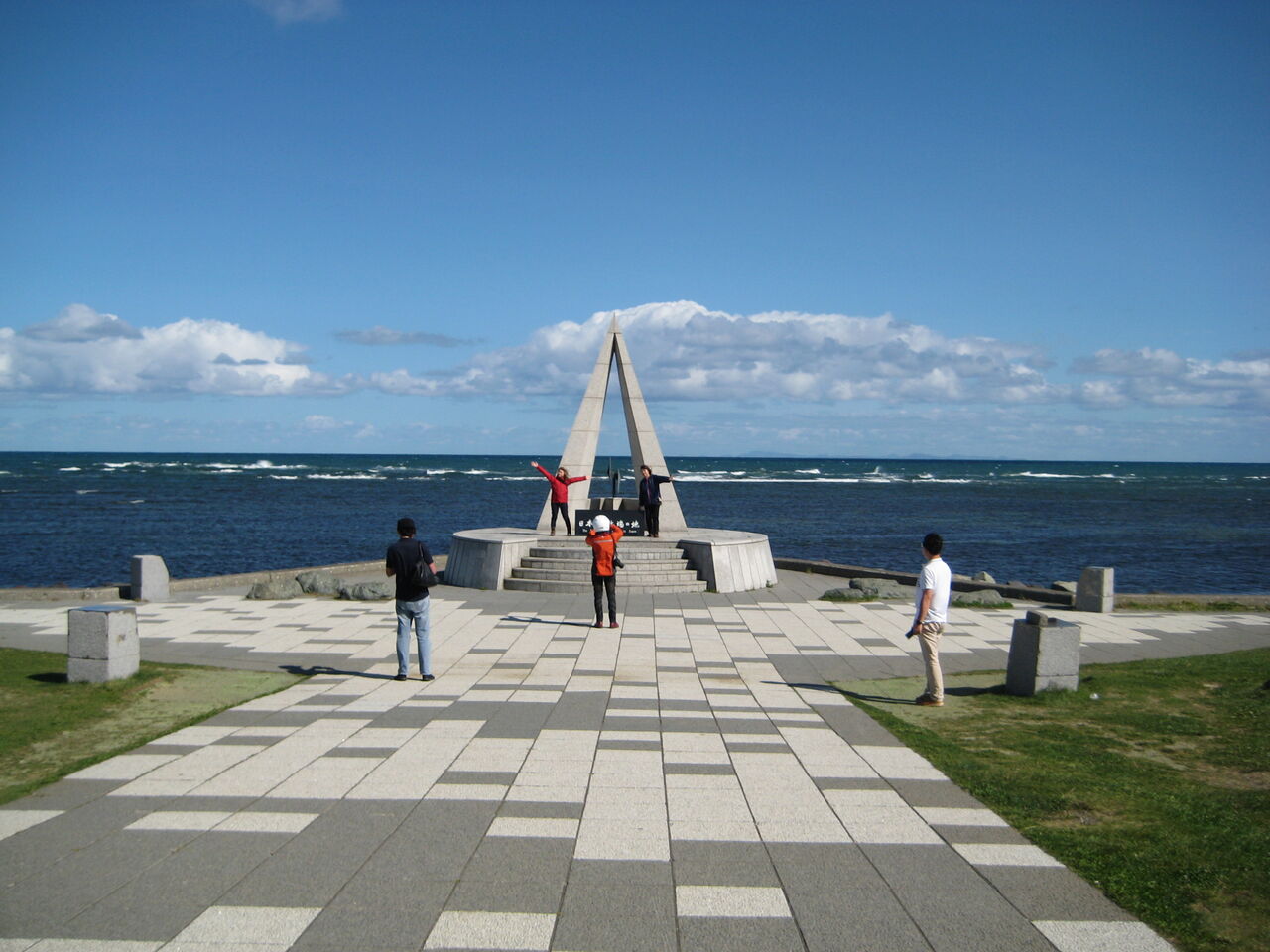
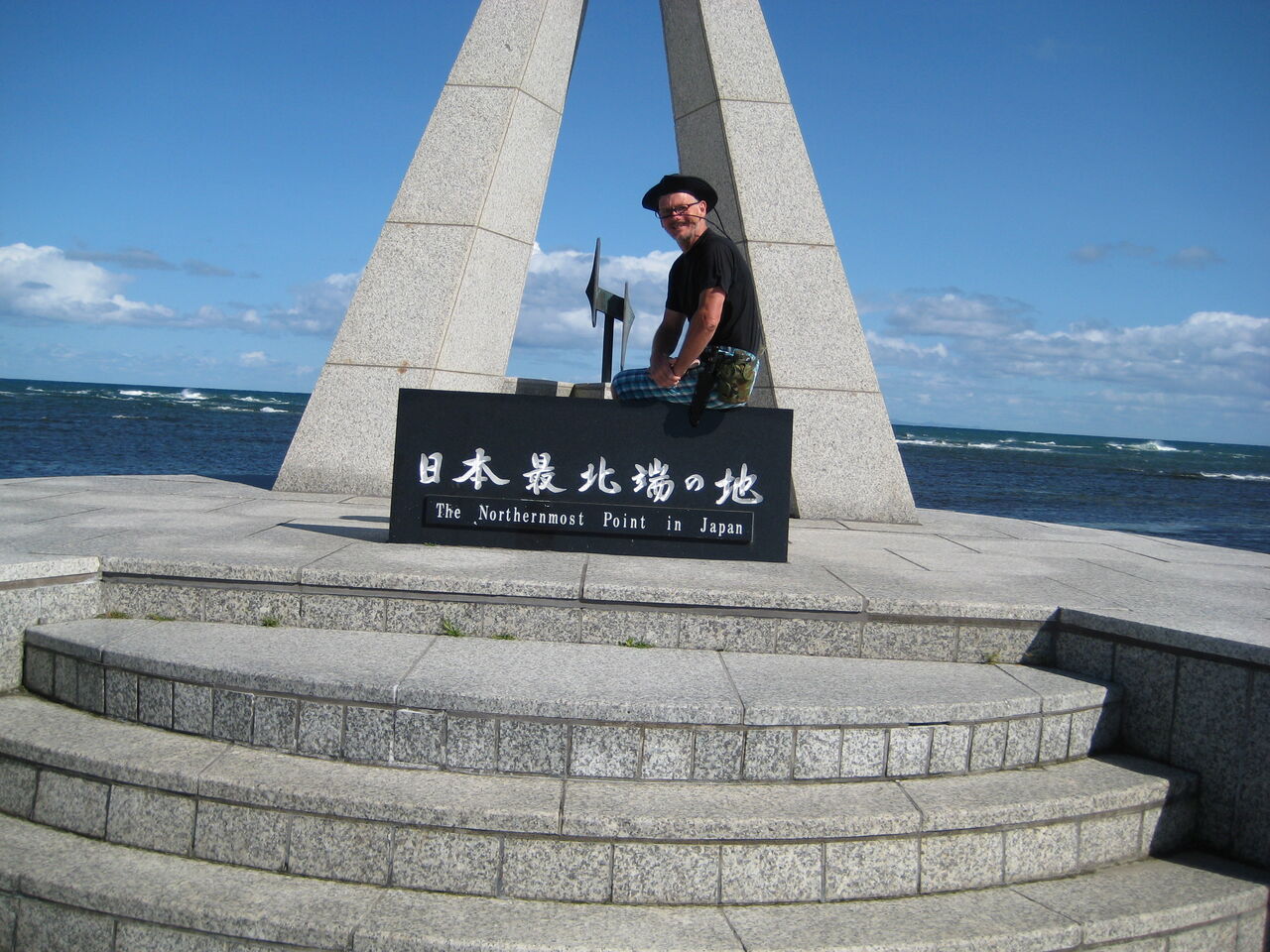
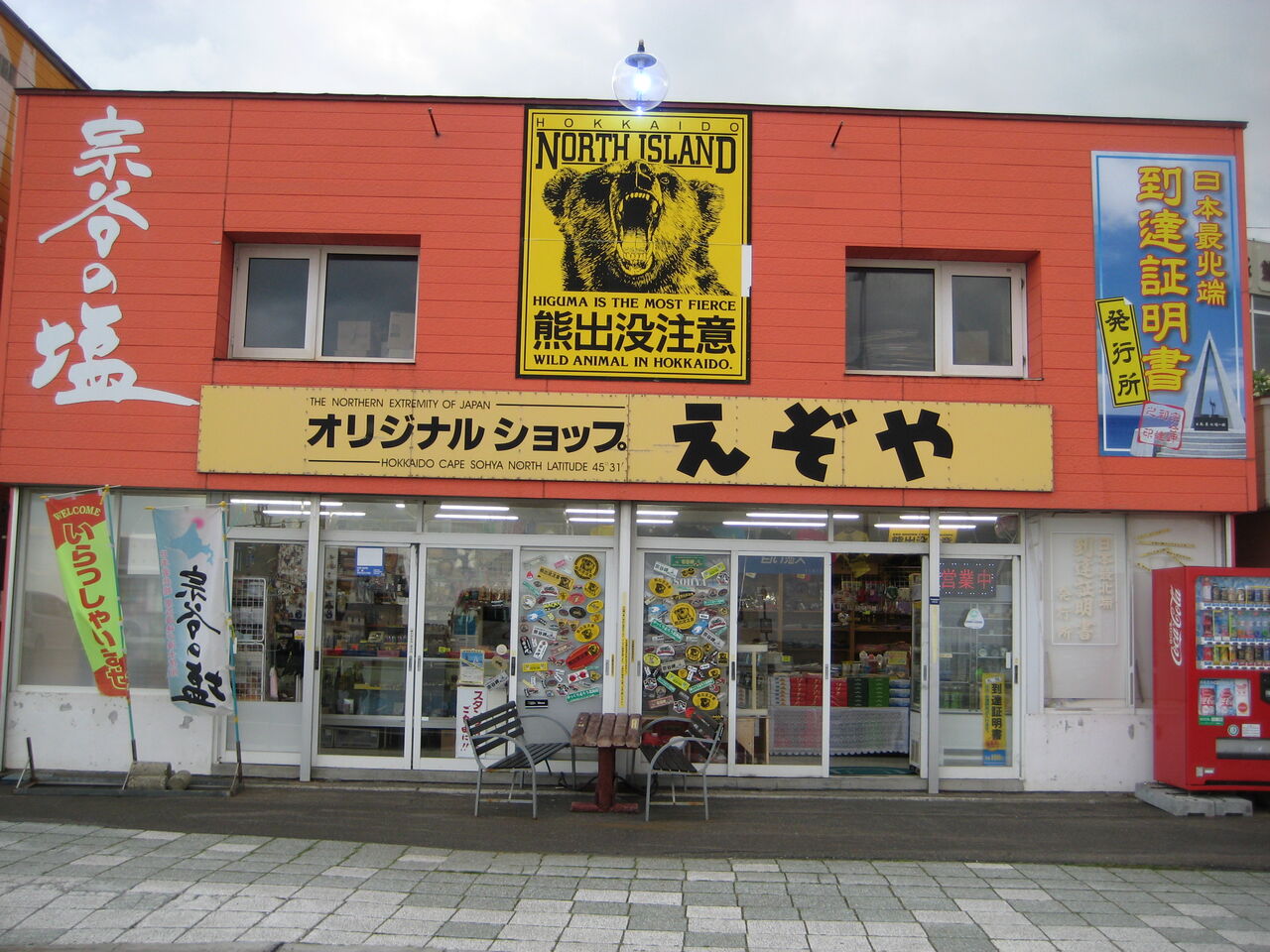
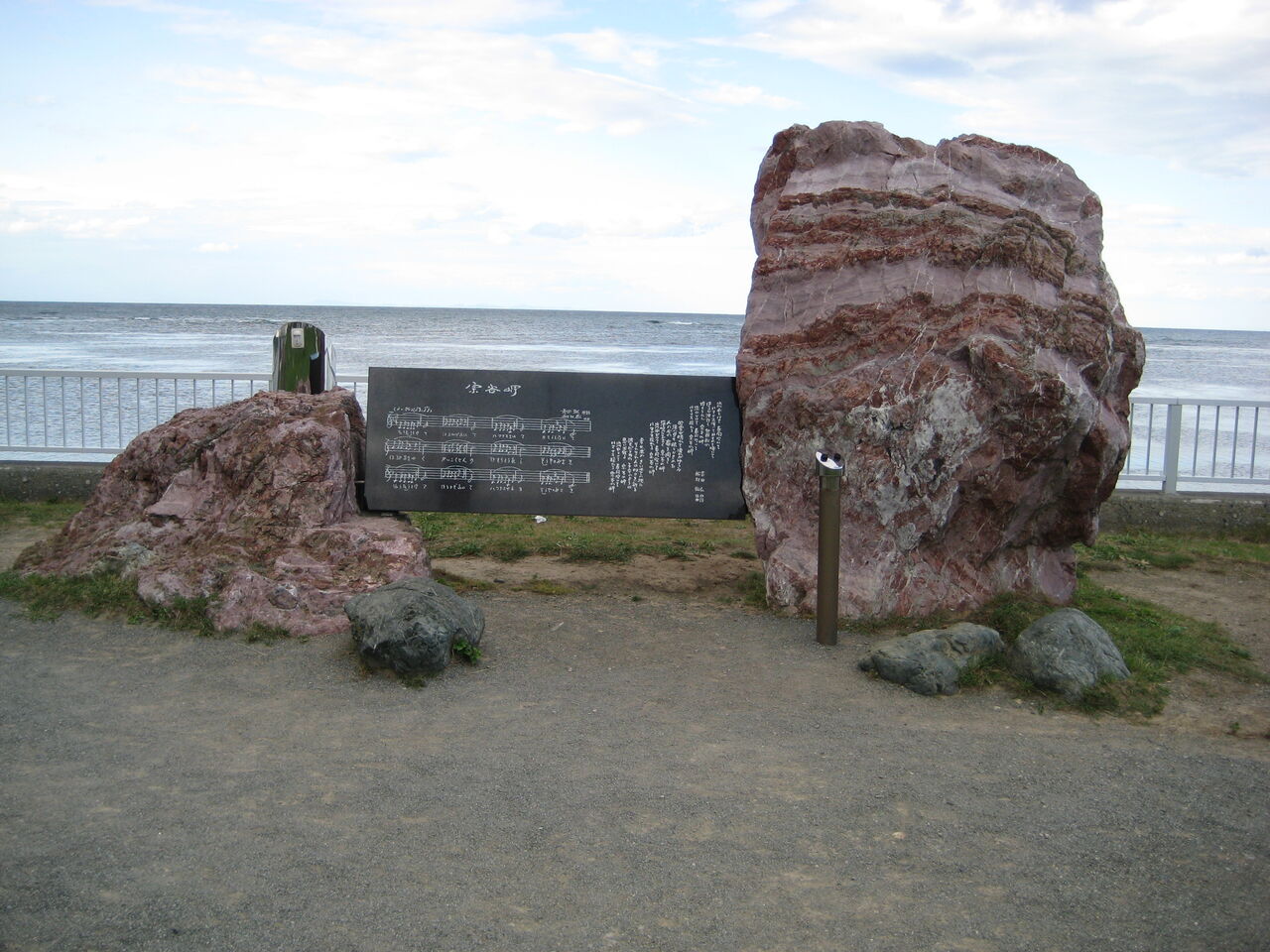
Bronze and iron metallurgy also made an apparance around that time. Wet rice farming was introduced to Japan from Korea and China, in the later half of the Jōmon period. Although some horticulture was practiced in the Jōmon period, it was primarily a hunter-gather culture. The Jōmon period was followed by the Satsumon period, which dated from about 700 to 1200 AD, in the northern regions of Honshu and the southern regions of Hokkaido. Some of the findings uncovered from several sites, dated to the Jōmon period. The Satsumon people shared similarities with other ancient ethnic groups -- Ainu and Emishi -- iron tools, place names, archeology, agriculture. The Satsumon people grew a wide range of cereals -- barley, wheat, millet, and perhaps even rice, a diet staple in the country today. Hunting-gathering, and the use of horses, and fishing, remained important activities during the Satsumon period. A small road sign told me that I was now entering into Sōya Misaki Township -- the last leg of my mission. The time had gone one-thirty in the afternoon when I tramped into Cape Sōya proper. The cape was home to a good number of famous, and not so famous, monuments. The most photographed monument in Hokkaido, if not the country, marked Japan's northernmost point. The monument was constructed in 1968, it was moved 20-meters closer to the sea twenty-years later, in 1988. On a clear day, Karafuto Island (now known as Sakhalin Oblast, Russia) could be seen from the monument. The northernmost point in Japan was a popular destination for national and international tourists. And, just as I had done in the summer of 2009, the monument was a common start-point to set off from on a tour the country. In addition, 'Commemorative Certificates' were available from the souvenir shop at Cape Soya to mark the arrival. One monument that caught my eye when I started my my mission in 2009, was dedicated to an American submarine, USS Wahoo (SS234), sunk in 1943. That was around the time with the Pacific War began to change in the Allies favor. Already following the Battle of Midway in early-June, 1942, and the Guadalcanal campaign a few months later, Japan’s capacity to replace its losses were greatly limited. Some 80 crew members lost their life. From the monument: “Eighty Americans sleep in the Sōya Strait 12 miles northeast of here.” Up until that fatal day, the Wahoo was the most successful submarine in the US Navy, in tonnage sung. Again from the monument: “Many Japanese sleep in the Sea of Japan from Wahoo attacks.” The exact location of the Wahoo was found by a dive team from an investment firm, in 2006. This monument was erected by the members of the Japanese Attack Group and relatives of Americans had served on the Wahoo. From the monument: “Old enemies met as brothers to ensure that our countries will have lasting peace and war will never again destroy the friendship we enjoy today. — George E. Logue.” By chance, I came upon an interesting American television series, ‘The Silent Service’ (1957-8) on the Internet (YouTube).
Done
The programs were produced and narrated by Rear Admiral Thomas Michael Dykers (1905-1975). During the Pacific War, Dykers had been a submarine commander, and knew of the Wahoo. One of the episodes (#13) was dedicated to the USS Wahoo and her crew, and was refered to in other episodes. As I drew nearer to the spot were all the tourist coaches stopped, two muscular young cyclists stood near the public toilets. One was making repairs to his bicycle, when I stopped to chat to them. They told me that they were on a clockwise journey around Hokkaido. They asked me the usual Who-What-Why-When-Where-How questions. They were the sort of quetsions I had been asked on countless occasions before. Some of the people I met wanted to know everyting -- where I came from, who I was, what I did -- every circumstance of my life. Some how, this time, the questions seemed a wee bit different. The cyclist seemed confused, when I pointed to a spot a few metters along the road. “You see, that’s where it all started for me, on a rainy day in July, 2009.” Still, they did not seem to understand what I meant. For all I knew, they may have thought that they had bumped into the village idiot. It would have been nice to have shared the moment with someone I knew and understood where I was coming from, or had a handle on my mission. There was nothing better than to be understood, especially by someone you loved. There had been no one to meet me, and even though I had planned it that way, I felt lonely. Already I had begun to think about what to do next. “Over there at that monument was where my walk around Japan will end.” I told them. “Just a few more steps to go.” The two cyclists appeared a wee bit impressed. They finally understood me, or so I felt at the time. It was hard to read a Japanese face, in a country where facial expressions could be so misleading. For all I knew they might even have wondered why I bothered my arse to share such a personal thing with to strangers. At the time, I felt mentally tired, and in little mood to go into great details. I even, momentarily, felt sorry for myself. Why should they care? We had just bumped into each other. Besides, they had other things to think about -- fix the bike, head off along the road to accomplish their own goal, and so forth. In away, I envied them. To be sure, life on the road had been for me another world, away from the humdrum of city life and unsmiling faces. Oh sure, it was a hard life, really. Somewhere between the sun and a hot road one day, then drenched by rain, or frozen in snow, the next. Life on the road in the summertime, was a series of in and out of the sun, to duck under a shade somewhere to escape the heat, for a whille. They were about to start out on a new adventure, an experience that would unfold before them. My own excitement had since petered out somewhere along the road. Not a single feeling of genuine enthusiasm remained, nor a sense of accomplishment. This was unlike the time when I reached Cape Sata Misaki, on the southern tip of Ōsumi Peninsula, on the island of Kyūshū. I still remembered the lighthouse at Cape Sata, which stood since 1871.
Done
A decade when many western-style lighthouses were built, in Japan. It was designed by a Scotsman, Richard Henry Brunton (1841-1901), who was said to be the ‘Father of Japanese lighthouses’. At the time, the British government felt obligated to make the waters and harbors of Japan safe for shipping. Juring his time in Japan, Brunton was responsible for no less than 26 western-style lighthouses, most of them were still in operation today. The lighthouses were refered to as, his children. He also initiated a system of lighthouse keepers, modeled on its success in Scotland. In addition, Brunton was responsible for the first detailed maps of Yokohama -- the sewage system, street pavments, and gas lights, and a telegraph system, and the first iron bridge. Brunton also helped found the first School of Civil Engineering, in Japan. Incidentally, the lighthouse at Sata was where the travel writer, Alan Booth, ended his own mission. Booth started his mission from Cape Sōya, in 1977, as I had done about three-decades later, in 2009. He travelled mainly along the small backroads from top to bottom, Cape Sada, whereas I stuck to the main and costal roads around the intire country. Booth's travelogue, ‘The Roads to Sata’, was first published in 1985, which I came across secondhand, more the 20-years later. In away, his book kickstarted me on my own mission, on foot around the Land of the Rising Sun. This was done on a series of spring, summer, autumn, and winter stages, from 2009 to 2017. Such was my enthusiasm, each time a stage ended, I could not wait for the next one to begin. Life on the road was like a drug, it opened up my eyes, and gave me something to live for. In the interim, I never suffered despondency, or self-doubt. Pessimism was a word that was not in my dictionary. This was perhaps because, I was one of the most restless men to inhabit the planet. A child of a broken family, with little to hang about for, and with two itchy feet, the road seemed as good a home as any. My school-life had been a hotchpotch of institutions — two primary schools and five secondary schools, in Belfast and London. And, various three colleges in as many American states. My school days included two universities, in Belfast and in London, both of which I finally graduated from. In the years I spent in Tokyo, I moved no less than 12 times to news addresses, such was the restlessness in me. One of the first things I did when I arrived in Japan for the first time, was to climb Mt. Fuji, Japan's tallest mountain. Mt. Fuji, the most photograpthed peak in Japan, was also an object of Shinto worship since ancient times. It became a World Cultural Heritage site, in 2013. I climbed Mt. Fuji more for a sense of movement it give me, than the joy to reach the summit. Not long after the climb, I bought a bike and cycled around Japan, again for the same reasons -- movement. I moved from one place to another since as long as I could remember. Often this was more out of need, than by choice. Like the proverb, I believed that the grass was greener on the other side of the fence. Back to the present, the only thing on my mind at the moment was to replenish my hip-flask with water.
Done
Done
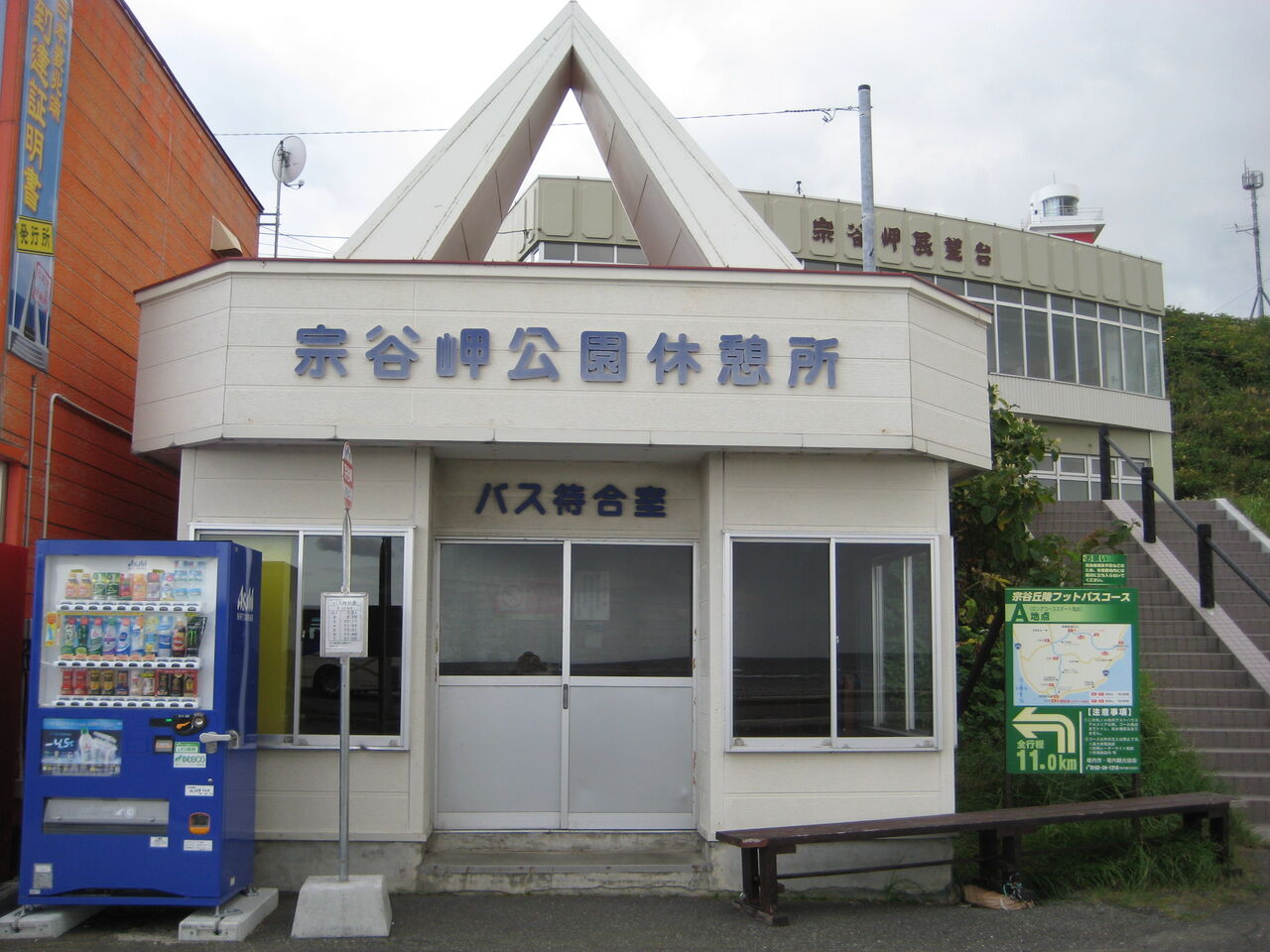
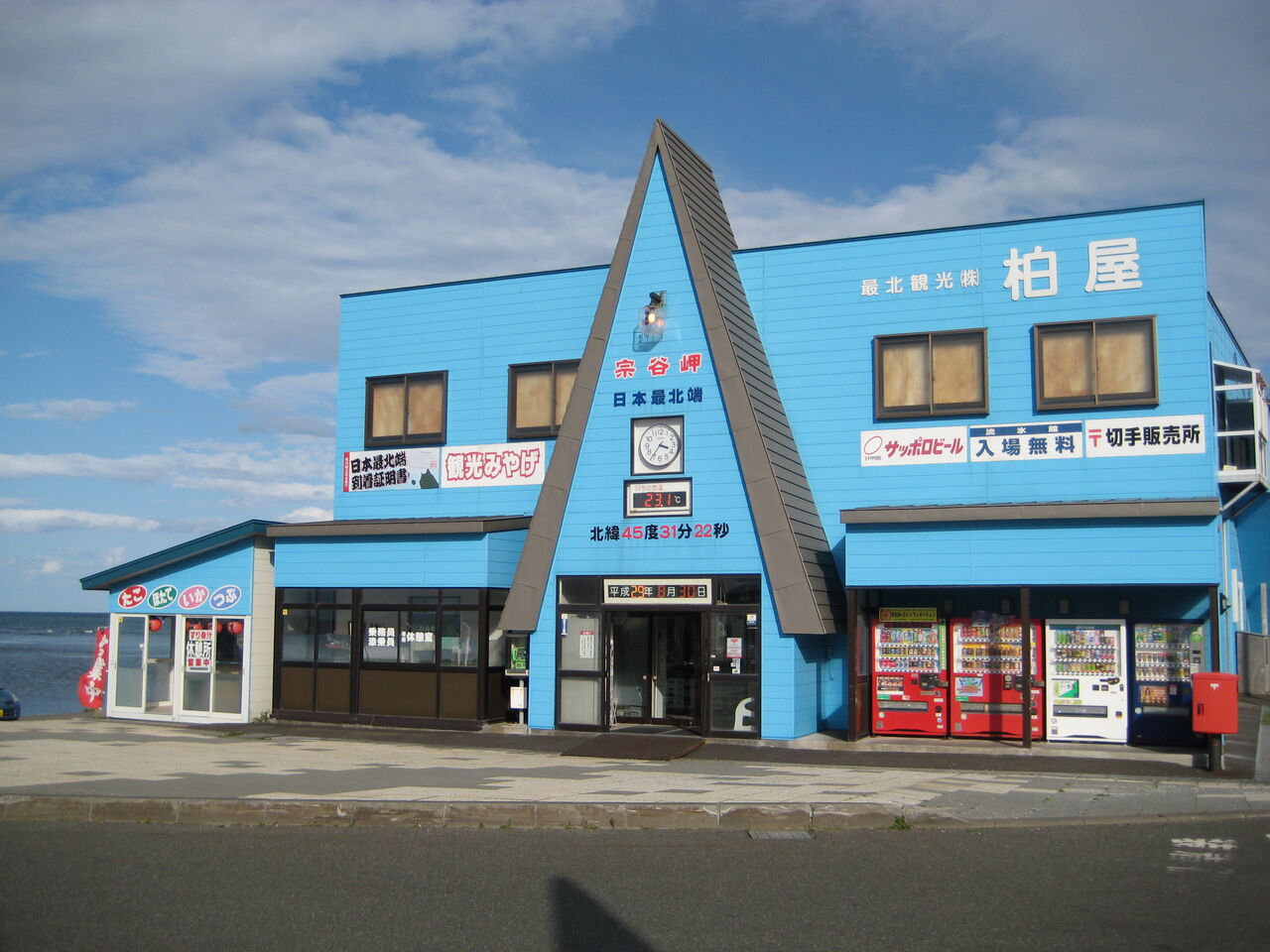
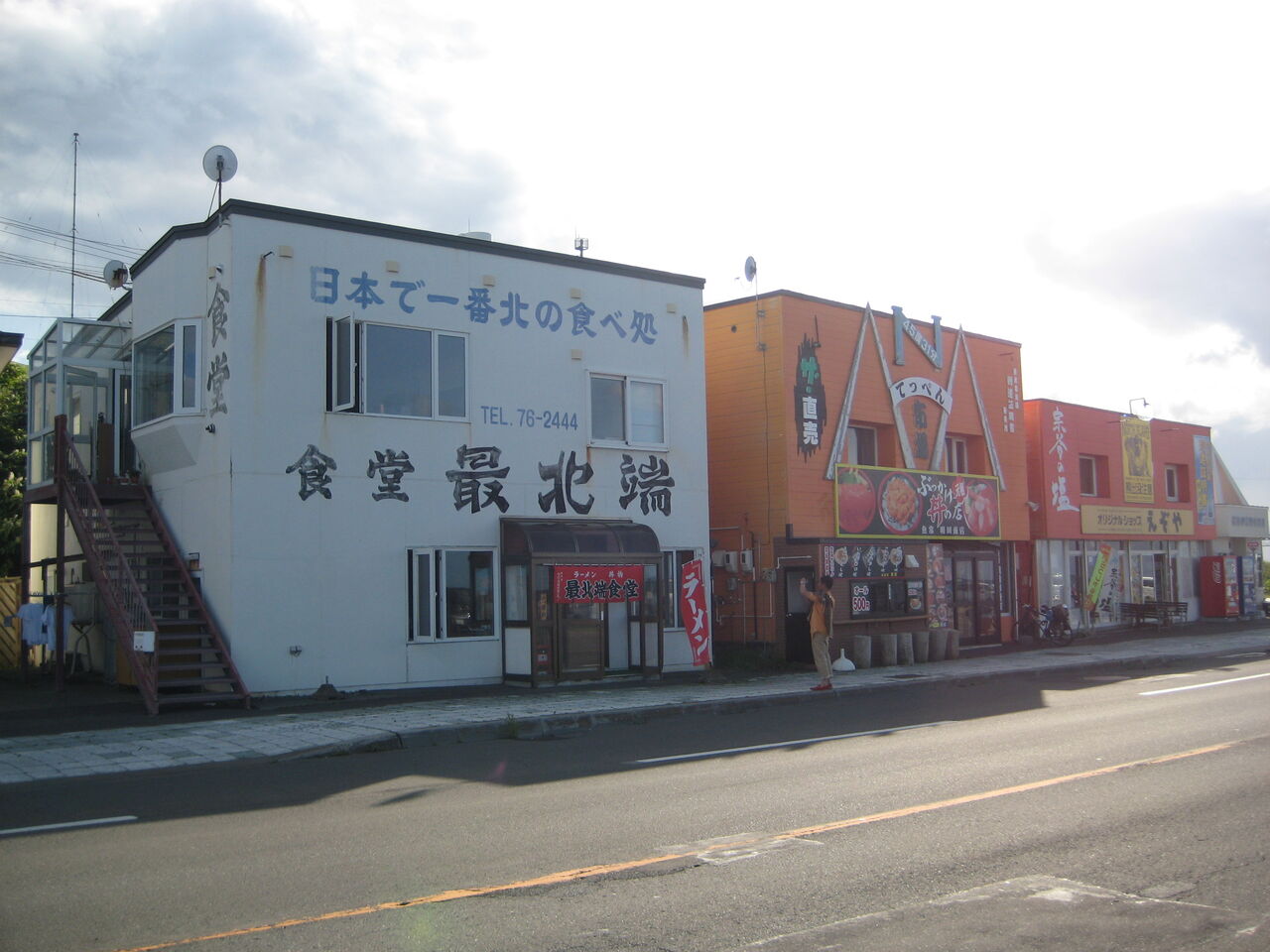
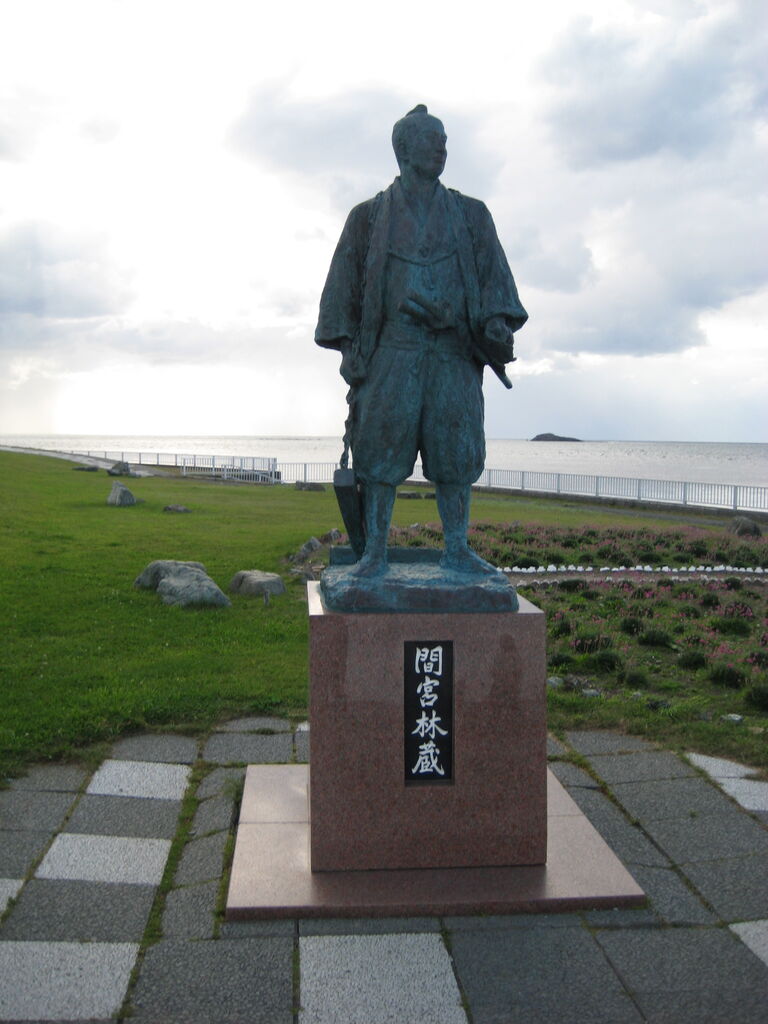
Then I needed to get something to eat. There seemed no better place than to stop by at the establishment, I ate at nine-years earlier. At that time, a typhoon held me up for four-days of bordom, so I was glad to stop by at the restaurant a number of times. If it was not the nice sunny weather playing tricks on my old mind, a coat of paint worked wonders. There had been some changes done to the exterior and interior of the restaurant, since I last ate there. The other buildings, too. Many of the facade shopfronts appeared cleaner than before. A large bus stop hut, some meters away, would have come in handy, had it been there nine-years earlier. Most of the building-facades had an image of the monument that marked the northernmost tip of Japan. Back in the day, it amazed me how my tent had stood up well as it had done to the strong wind and relentless rainfall. Success in life had many meanings for many people -- get married, raise children, a happy family, build a nice home, yearly holidays, all helped by a well-paid job. Many others were literally tied to their jobs, in the hope that things would turnout for the better. In life, people could not see into the future, foresee how things panned out. Like everybody, people hoped for the best. Yet, how strange life really was -- gave with one hand, and took way with the other, whilst time ticked by in spite of it. Now, when I looked back, I felt curious about how pleasant life in the open, day in and day out, regardlless of the elements and hardships, had been. On the road, I felt full of life, whilst now, at the end of my mission, I felt lost. This may have been the reason why I did not care to hang about the northern most point of Japan longer than I needed to. What I did need to do was to check the bus schedule, on the buses to Wakkanai Airport, about a 30-minute ride. There was a statue, which I stopped to look at, dedicated to an early traveler. It was the Statue of Rinzō Mamiya, who explored Japan's northern reaches. He was accredited with the discovery of Mayiya Strait, in 1809. Recent times had been less kind to the explorer. In popular culture Mamiya was represented as one of the two villains -- a chief henchman, and a master of disguise, in murder. The villians appeared in the manga series, 'Shin Kozure Okami'. Although Mamiya was thought to have been childless, however, recent documents (2022), stated that he had been related to an Ainu woman, who gave birth to a girl. A heavy downpour, fell around four-fifteen in the later afternoon. So, I hurried across the road to get some clothes, scattered about the grass to dry, which I had washed earlier. Feelings were so complex, as were any feelings of achievement, now absent from my mind. Perhaps things might have been different had someone I was close to, been near to share the moment with. Nine-years earlier, when the typhoon passed over, I felt like a child about to embark on a big adventure.
Done
His eyes did not smile. For some reason, I did not ask about his family, or if he was married. There were, of course, times in life when things turned out miserably horrible. There was no room or time for empathy or sympathy on the road. You needed to keep your wits alive, for fear of ending up a statistic. What I did know was a long-distance tramp was a great way to burn off stress. "Mmm!" I was unsure if the same could be said about driving.
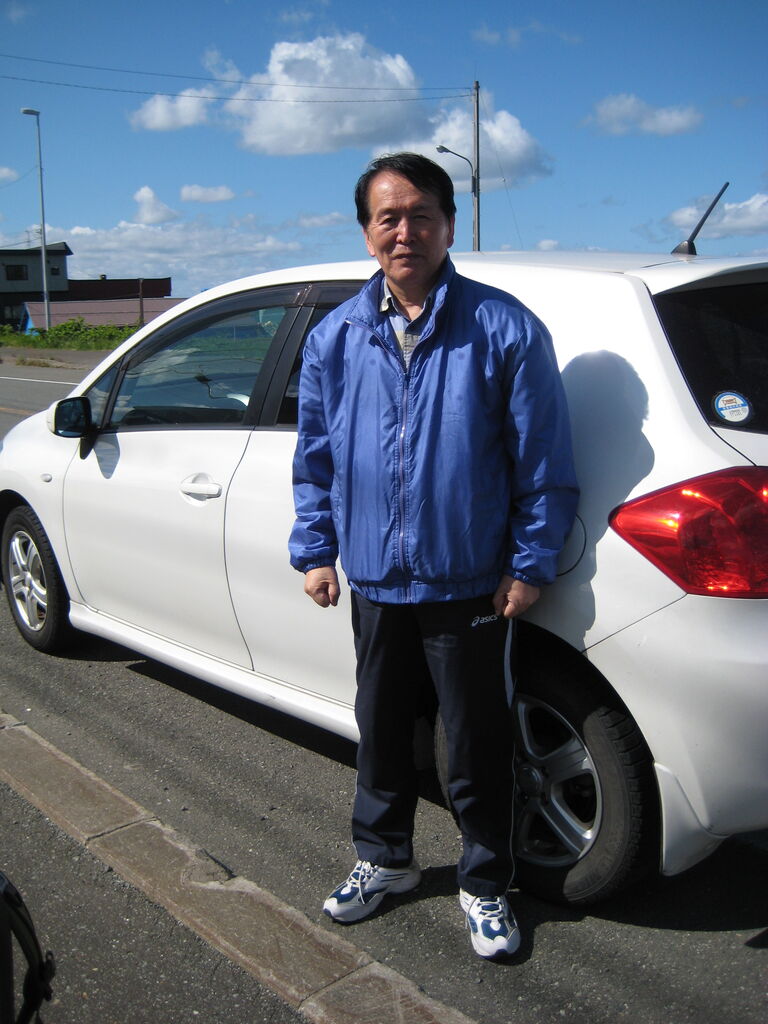
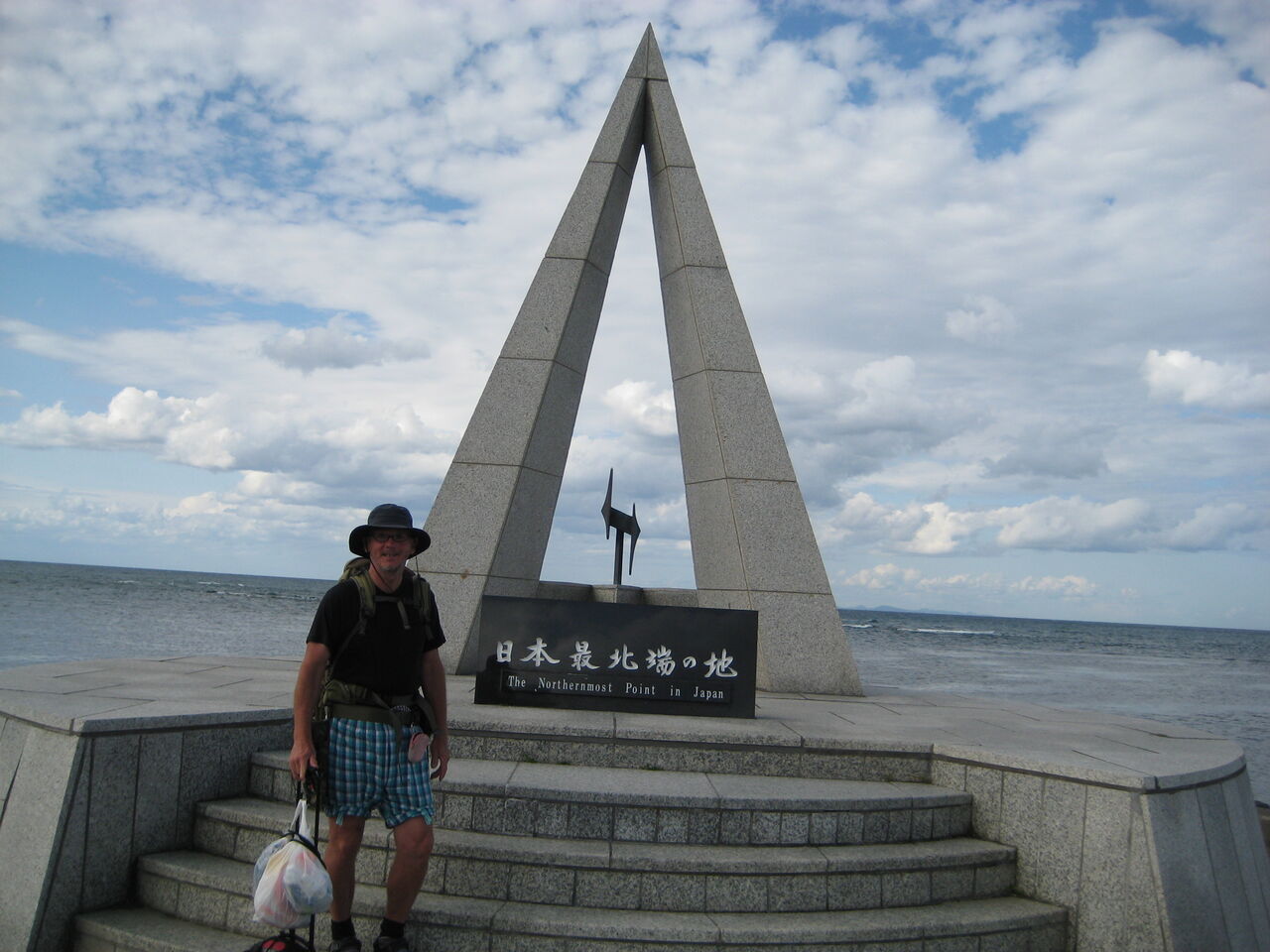
There was something about him, which I did not see and never would see. Yet somewhere there was a gentle kindness about the man's character. In the course of our time together, I told Mr. Shirado that I sometimes stopped at business hotels, mainly in large cities, but preferred to sleep in my tent than any hotel. In away, our situations were quite similar -- washed in public toilets, liked the outdoors, and so forth. Our time together was only too short. It did not take long to reach the carpark of the store. With a beep of the horn and a wave, the car was gone. For a while, I thought about the pleasent wee encounter. With his help, I was now within easy reach of the airport. It was not often one could hope to meet such kind people, along the road, which was just about imposible in cities. It came about when I asked a man, a stranger, to take a snapshot of me in front of that famous northern monument. The incounter resulted in a lift to the airport -- 'The luck of the Irish', as the phrase put it. The Tomiisogyoko was not just a fishing port, but a very beautiful spot on the Sea of Okhotsk. The Tomiisogyoko was not just a fishing port, but a very beautiful spot on the Sea of Okhotsk. The port was known for its wide range of fish landed there -- pink salmon, trout, and squid, etc. My home country, Ireland, was famous for salmon and sea trout fishing. Each year, the fishing season opened in January to May, and closed at the end of September, depending on the location. Sea trout fishing continued on some of the rivers, until mid-October. In recent times, conservation measures were introduced to many rivers, lakes, and estuaries, to ensure fish stocks continued in abundance. By now, a steady wind kicked up, and scattered any thoughts I had to pitch the tent. I even wondered if it was better to move nearer to the airport. The move would make things easier, if it was not too hard to find a spot off the road to spend the night. The tiny bus stop hut, were I currently set, was a good place to escape the sun for a while, but only that. The interior was not overly inviting -- an absence of chairs, or a bench to take a wee nap on. Even if it had a bench, the hut was too narrow to fully stretch-out. All the same, it served well enough to stop and sort out my gear, and pen a few things in my notebook. Among my note were were a few lines on the three yellow plastic Kirin beer crates, instead of chairs. The crates were spaced a part, so I thought if I moved them closer together, I might be able to organize something worthwhile. There was a wood factory next door, where I grabbed a broken plank of wood, which solved the bench problem nicely. The wind seemed in no hurry to let up, so the hut served its purpose to kill time. Later, after a couple of hours on the road, I decided to make camp for the night. This was done on a raised ground in front of a small Shinto shrine, called Tomiiso-jinja, just off the main drag, Route 238. More importantly, as a committed atheist, a convenience store as also not far away. Shintoism, the ancient national faith, had a countless number of deities, thought to be around eight-million. Shintoism was a way to reconnect with nature, hence, it was sometimes refered to as 'nature religion' -- a spiritual power within nature.
Done
In his novel (St Mawr, 1925), D. H. Lawrance wrote: 'the landscape' lived its life in a world run by the gods, a world man did not exist. "The landscape lived, and lived as the world of the gods, unsullied and unconcerned. The great circling landscape lived its own life, sumptuous and undaring. Man did not exist for it.". Shintoism had once been revived for the manifestation of xenophobia, by the rulers in eighteenth-century Japan. Much of the world that I was acquainted with was less than squeaky clean -- “clothed in the priestly robes of religious cosmogony” (Paul Hohnson, 'The Birth of a Nation'). The Shinto priest, Hirata, a disciple of Moto-or, saw Japan as the birthplace of the gods, ancient ancestors of the clans. In the absence of a clear ethical or moral code, Shinto fundamentalism formed a philosophy in an aggressive militaristic light -- well documented in the first half of the 1930s. It was a world created my man. Similar tendencies festered in a nother of countries long before then -- nineteenth-century Europe was an age of racism. Then a demographic revolution swept across the globe, and continued to the present time. Johann Gottleib Fichte (1762-1814) held the view that the Germans were nature's chosen people, thus needless to learn from the outside. Conversely, to help keep evil in check, Germany should teach its natural civilized ways to the outside world. The meaning of life for academics like Fichte, influenced by Machiavellianism -- to carry out the work of God, to awaken the people to struggle for supremacy and assimilation of other nations -- for survivsl, profit, prosperity, and so forth. Such theories (e.g., Fichte, Hegel, among others), clouded in military metaphors, were strikingly similar to those held by the Japanese, in later years — a totalitarian state, like the German Reich — to rule over by hereditary divine right. Even though Hegel did not believe in a master-race, per se, he opposed to German philosopher, Immanuel Kant’s ‘perpetual peace’ — rulers of states had no right to arbitrate over other states. For Hegel, life followed a predetermined course that could not be prevented from happening. The torii gate at Tomiiso-jinja, near where I camped, was no so old, erected on Showa 59 (1984); a local jinja. In a blog about the shrine, visitors were warned not to tramp on deer droppings. Deer pellet-shaped droppings were similar to rabbit droppings, which tended to be a little larger. All in all, I spent a comfortable night without any problem. A grim bent and twisted pinetree, with a grayish bark, was my guardian for the night. Its air of permanence, the old-growth pine shielded the tent nicely, from a wind that blew in from the sea. The wind could be so powerful in these parts that they could blow a person into isolation. The tree had undoubtedly, felt the power of the winds through the years. The tent faced out over the Okhotsk coastline, a magnificent view. "Mmm!" If I cut the grass, the view could be greatly inhanced, I momentarily thought. It was a splendid spot to spend the final night in Hokkaido -- the last day of my mission. The store nearby made it easy to pick up a few things. The weather was too warm for anything fresh to last for long.
Done
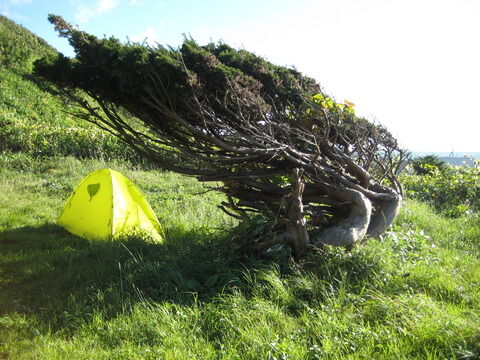
The area around the tent seemed devoid of mosquitoes. All the sae, a coil of katori-senko was placed at the ready, just in case. Thankfully, as the evening wore on, I did not need to strike a match. For lunch, I picked up a deep fried pork sandwich, which killed any old hunger pangs. In itme, I would make another stop at the store, to pick up someting for the evening. For the present, however, I did not want to think about food. High overhead, the sun focused its powers on the tent. Thanks to a cool breeze, the heat was tolerable. The absence of mosquitos was one thing, but the absence of birds seemed a wee bit strange. Apart from the sound of my breathing, the sound of insects was the only indicator of life. The odd insect paid me a visit to my tent. On a warm summer evening, it was a bit of a ritual for me to leave the tent flap open. Rituals were not always practical, yet they were just as old as humans were on earth. They were believed to be a means to foster a sence of community. Still, I was not so sure I cared much about getting too close to the insect world. particularly mosquitos and ants. Animals, if not insects, had rituals, believed to be a form of bonding, like birds of a feather, flocked together. Like, 'symbols of the curious debasing malevolence that was in the spririt of the place,' to use D. H. Lawrance's words. Lawrance had pack-rats that came down from the hills, on his mind when he wrote his short novel, 'St Mawr', published in 1925. The Shinto shrines had their fair share of rituals, symbolic of Japan, the most group oriented developed country in the world. The Japanese flocked to shrines and temples, where they turned to unseen deities to help quell some hidden fire that raged in the inner sanctuaries of their hearts. They visited shrines and temples over the New Year holidays, to pay respect to the local kami, and prayed for things important to themselves -- pass an examination, good fortune, and so forth. During my time at the shrine, I thought about something important to me, the ins and outs of my mission -- life on the road, weather conditions, and people I met along the way, and more. Unlike now, there were few visitors to Cape Soya when I started my mission. The rain was so heavy, few toursits stepped down from the coaches that stopped near by. Then, after only a few quick snapshots, it was back onto the coaches to continue on their journey. Back to the present, a vast number of visitors appeared happy to hang around the monument for group photos, and enjoy the moment. The weather could not have been better to travel. The visitors scurried about, which made it impossible to simply pitch my tent. I had hoped spend my final night on the same grassy turf, behind two touristy signs, as I had done, in 2009. The public toilet building was only about 200-meters away. For a moment, I stopped to look at the grassy spot. The visitors moved past me in all directions. It took me nine-years of long hours, out under the elements, to complete my mission. My mission had aged me in more ways than one. It was damn hard, it had worn me down mentally and physically. At times, along the road, I wondered just what on earth had I gotten myself into?
Done
Why had I bothered? The funny thing was, I was unsure what I had exactly got or gained out of my mission. It was said that an old dog could not be taught new tricks. There was something positive about life on the road, but what? I was unsure if it had made me a better man, hopefully not worse. In the best sence, a day on the road was a kind of intoxication that had possessed my spirit, while it lasted. The time I spent outdoors had pulled me away from irritation and tension of my life, the friction of life in the city, and all its strict rules had vanished. The road had provided me with an aim, something to occupy my life. This was not like a brick in a wall, but the wall itself, an inner strength. The coastal road was easy to accommodate -- places to eat, drink, and sleep, and the biggest bathtub in the world to wach in -- the Pacific Ocean. One thing I may have gained on the road, if nothing, was a more thoughtful and considerate attitude towards other people. My humble tramp around Japan was done and dusted, and soon to be left behind me, forever. All that I wanted to focus on now, at the close of the day was to look at the last sun of the month sink into the horizon, and to imagine that it too wanted to sleep. The world was heavily dependent on the sun, a star of stars. In a book, I once read that the weather represented a state of the atmosphere, a place at a given time. When the summer weather was not quite the way I wanted them to be, was a pain in the butt. Only too often, the heat emitted off the road was hotter than the sun, which did its best to cook me alive.
Dome
1 Sep, 2017: Slept quite well, apart from the early morning cold. It seems that I had underestimated the northern Hokkaido weather. Foolishly, I had failed to pack a bed cover when I left Tokyo. Like the gas burner, I felt a cover an unnecessary weight, and how I regreted it now. Still, the damage was done to put things right on this stage. In away, I felt depressed. A mood swing was part of the trials and tribulations of life on the road, as was any expenses incurred -- food, acomodation, and outdoor gear, particularly footwear. In one of D. H. Lawrance's novels I read that a shoe had only two excuses for existence -- perfect comfort or perfect appearance. On the road, appearance was less important than comfort and cost. The time and cost it took to return to where a previous stage ended, came at a fair penny, particularly if it involved the cost of an air ticket. A journey by rail in Japan was not exactly cheep. Japan had long been closed (for 265-years) to foreign visitors, hence tourism, as such, did not exist. It was only when Japan opened up to the outside world (in 1853), and a railway system was buildt in the Meiji Restoration, was tourism made possible. The first railway line, in Japan, ran from Tokyo to Yokohama, in 1872, whilst the first low-cost passenger journeys by rail, in Europe, became possible, around the 1830s. Becasuse of economic, political, and social issues in the 1800s, Ireland did not enjoy the pogress of the Industrial Revolution. The first commuter railway in Ireland, however, began in 1834, and ran from Dublin to the coastal town of Kingstown (now called Dún Laoghaire). In the course of the following years, the railway was extended from Dublin to Cork, and to Belfast and Galway. The trains stopped at some of the smaller towns and villages along the way. Progress, however, often did not apply to the poor, who had to rely on their feet to take them just about everywhere. The first step was the hardest, as the saying went. Then, of course, I was off, away into the distance, silently assertive and self-satisfied. All in all. I prefered the outdoors when I could be more or less alone in it. To tramp the road was a much pleasent way of travelling, particularly on a nice warm day. My mission around Japan, on foot, was not exactly an original venture. During the eighteenth-century, long-distance walking had become a fashionable activity among the literary middle-classes. The historical archives had many recorded examples of ventures on foot. The English poet, Samuel Coleridge, had ruined his shoes when he walked almost 500-kilometers on a tour of Scotland. Compatriots of Coleridge, William Wordsworth and his sister Dorothy, once accopanied him on a long walk as far as Stirling, where he branched off by himself. In the case of Dorothy, she regularly liked to walk from her home in Penrith to visit friends near the historic market town of Halifax in West Yorkshire. A walk from Penrith through the Yorkshire Dales to Halifax was more than 200-kilometers. Other poets and essayists -- Keats, Southey, De Quincey, Hazlitt -- were keen long-distance walkers. Perhaps the most celebrated walker of the eighteenth century, was a man called Foster Powell (1734-1793).
Done
Powell was said to be the first true exponent of long-distance travel, on foot. His fondness for walking, was firmly established from a wager he made, in 1764. At that time, he covered a distance of over 80-kilometers, along the Bath Road, in Summerset, in seven-hours. Another of Powell's successful ventures, on foot, was from York to London and back, a jourey that took almost 645-kilometers, in 1773. All in all, his long walks gained an element of fame for him, and at times crowds of people flocked to see him. There was a host of noted long-distance walkers around that time -- George Wilson (1766-1839), nickname, ‘The Blackheath Pedestrian’; and Captain Robert Barclay-Allardyce (1779-1854), the 'father of pedestrianism' -- a competitive form of walking. They were followed by Emma Sharp (1832-1920), the first woman to successfully emulate Barclay's times and distances on the roads, in 1864. Many artists of the period like to trek the highways and byways for inspiration. Today's weather could not have been better for tramping the road, Route 238. Across the way, a road sign told me that Abashiri and Sōya Misaki was 310- and 16-kilometers away, respectively. From time time to time, motorbikes and cyclists passed in both directions. Some of the motorbike riders had tiny cameras fixed to their helmets. A short stop was made to look at a monument with what I thought to have a long name -- 'The National Monument Mekuma Mizunara Colony' -- a colony for plants. The monument had been designated a cultural asset, by Wakkanai City, in 1968. Mekuma (or spelt Meguma), was an Ainu word. ’Me’ meant ‘bumps in the land’, and ‘kuma’, ‘ridge’ or ‘rod’. ‘Mekuma’, was also the name of an eight-kilometer stretch of beach, located between Koetoi and the mouth of the Masuhoro-gawa. The mountainside was ornamented with Ezo spruce and Sakhalin fir trees, a natural windbreak. A row of Mizunara trees seperated the highway, Route 238, from the mountainside and the sea. Mizunara was refered to as Mongolian oak, a white, broad-leaved oak. The cooler Hokkaido climate was ideal for the Mizunara to grow up to 30-meters tall, with trunks of 1.5-meters in girth. Widely known outside Japan for the production of whiskey barrels, its wood was sought after for luxury furniture. During the Jōmon period, the wood had been used as a food preserver, in the cold winter months. The food was eaten in mountain villages, up until recent times. The first book on shiitake cultivation in Japan, was published by Japanese horticulturist, Satō Chūryō, in 1796. Mizunara logs had been used for the cultivation of shiitake mushrooms, since the twenty-century. Traditional medicine used shitake for medicinal purposes. The shiitake mushroom became popular, and today was cultivated throughout the world. Ezo spruce, found in cold, humid rain forests, was a large evergreen tree with needle-like leaves. The spruce grew as high as 50-meters, a trunk that had a diameter of up to two-meters in girth. The Ezo spruce was commonly grown in parks and private gardens, but mainly it was used for timber, particularly for the production of paper.
Done

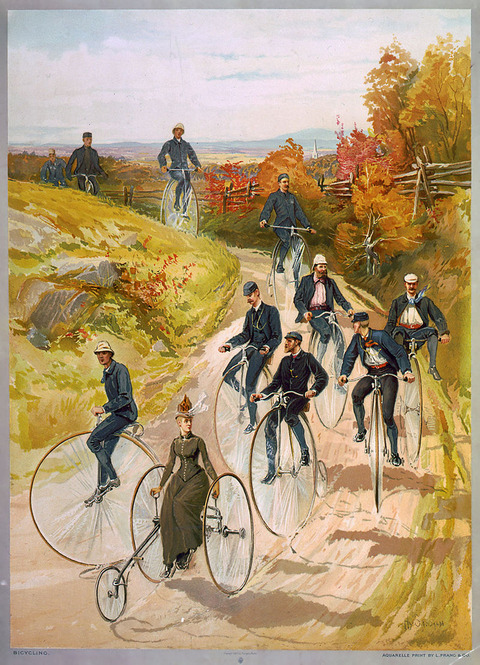
An 1836 illustration of a "Walking Wager" (Wikipedia
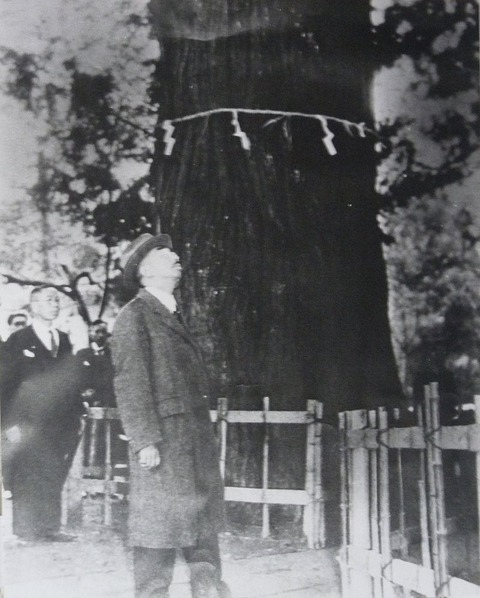
Emperor Hirohito gazes up at the giant Kayano Osugi (54.8-meters tall), in 1947 (Wikipedia)
It was also used as the main body of the Ainu five-string instrument, tonkori, thought to have orignated in Sakhalin, a Russian island north of Hokkaido. The tonkori became nearly extinct, in the 1970s, but, like the Ainu language, the instrument was revived, in recent times. Historically, 'Ezo' was a Japanese name that referred to the lands to the north -- Hokkaido, Sakhalin, the Kuril Islands. It was renamed 'Hokkaido', in the early-Meiji period (1869) -- a time of military reform and industrial growth. After their defeat in the Boshin War (or Civil War), many Tokugawa shogunate forces resettled in Hokkaido, where they attempted to establish a breakaway republic. National forces, loyal to the Emperor, put a stop to such plans, with victory in the Battle of Hakodate, in 1869. Often, strong northwesterlies blew directly in over the Sōya Strait. Only a few species of trees flourished under such harsh conditions. Many countries boasted a colony of ancient trees of one species or another, Japan was no different. The Great Kayano Cedar, was one of four ancient cedars along a path to Sugawara Shrine in Ishikawa. It stood about 45-meters high, with a maximum 12.6-meter girth, the cedar was thought to be around 2,300-years old. Old-growth trees once thrived in abundance. Today, however, old-groth trees -- Kayano Osugi and Houkisug, thought to be around 2000-years old -- were mostly found on mountainside forests, or on shrine grounds. Japanese mountainsides were home to a wind range of tree species -- cypress, elm, fir, and conifer, like the Japanese hemlock, a species native to the islands, particularly, Kyūshū, Honshū, and Shikoku. During the Tokugawa period, the felling of these trees became prohibited. Later, in the Meiji Restoration, cryptomeria trees were cut down to grow plants for the production of green tea. The Jōmon Sugi was believed to be the oldest individual tree, in Japan. Even though its exact age of the tree was unclear, it was believed to be between 2,170 to 7,200-years old. The tree stood on Miyanoura-dake, the highest peak on Yakushima, at 1,934-meters. The island was designated a World Heritage Site, in 1993. The Jōmon Sugi grew to about 25-meters, with girths up to 16.5-meters. It was the largest among the cryptomeria trees on the island. There were two routes to the tree -- the Arakawa Trail and the Kusugawa Hiking Path -- however, access was restricted. Another road sign told me that I needed to get my arse off Route 238, and turn left onto a miner road, Route 121 for the airport. The road led to Numakawa and Keihoku five-kilometers away. Along Route 121, I passed a narrow sign sign that pointed right for Wakkanai Megasolas Power Station. After only a couple of kilometers along the road, I then turned left onto Route 1059 that will take me directly to where I needed to go, toilets, restaurant, and the airport. Just as I turner left onto Route 121, there was a kind of biker rest-stop. The Red Baron Bikers Station Wakkanai, a rest stop area, seemed to have accommodation and places to pitch tents. A young man was busy watering a large flower bed, in full bloom.
Done
Water was the most important physical source to man. If one tried to live without it, it would be an exceptionally short life. Water was important for for the life of just about everything -- industry and agriculture, medicine -- the things we needed to live. About 97-percent of the water made up the seas and oceans. Most of the water, according to what I read, came from the Earth’s interior. What was more, my own water bottles, needed to be topped up. The young man did not appear to notice my approach, but quickly looked up at the sound of my voice. “Is it possible for me to stop the night here?” “No! Sorry! Bikers only!” To which I replied: “Oh! I see!” Baring a bicycle, or even my motorbike in Tokyo, I hated all other vihicles. As a rule, I prefered to walk practically everywhere. After being told that the place was for bikers, I was tempted to to add that the remaining wheels on my trolly made it as much a vehicle than any motorbike, but I did not bother. What was the point? The Japanese were sticklers for rules. It was a waste of time trying to be a comical smart ass with a Japanese person, hard at work, or so I thought to myself at the time. Similarly, I did not bother to ask him if I could have some of the water that he abundantly used on the flower bushes. However, I did ask if they had a restaurant at the place, where I might get something to eat. There were a number of other related buildings, but I was not sure what they were used for. The hostal appeared to be well maintained. “No! Sorry!” “Well, how about a convenience store, nearby?” I asked and pointed along the two roads. “Yes but, quite a distance.” When I thought back at the start of my mission, I recalled a convenience store, on the outskirts of Wakkanai City. Whether the store was still there or not, it was not worth the journey, too far. Besides, I would need to return to the airport. "Surely the airport shop, or restaurant, was open. Right?" I knew that the passenger area at the airport was by no means large. To arrive at the right times, was important at local airports in more ways than one. “Wakkanai Airport!” Not sure! It’s also quite a distance.” This time the man replied in Japanese, and with some concern. Time was on my side, so the distance did not bother me any. “No problem!” I said, with a faint smile. Needless to say, I did not tell him that I had walked just about everywhere already. "I've a flight back to Tokyo, early tomorrow.” Then I thanked the young man and headed back onto the road, and turned in the direction of the airport. The uneventful encounter with the man proved food for thought. Surely businesses needed to be nondiscriminatory if they had any chance of survival. Right? Apart from a couple of riders clad in their bikers gear, the Red Baron Bikers Station Wakkanai, seemed devoid of clientele. After a while, I tramped into the passenger area at the airport, about 24-hours too early. With the help of a kind ANA ground staff member, a mature woman, I was able to take care of my flight-necessities. After that, I headed to the public toilets for a quick wash, and don what few clean clothes I had left in my backpack.
Done
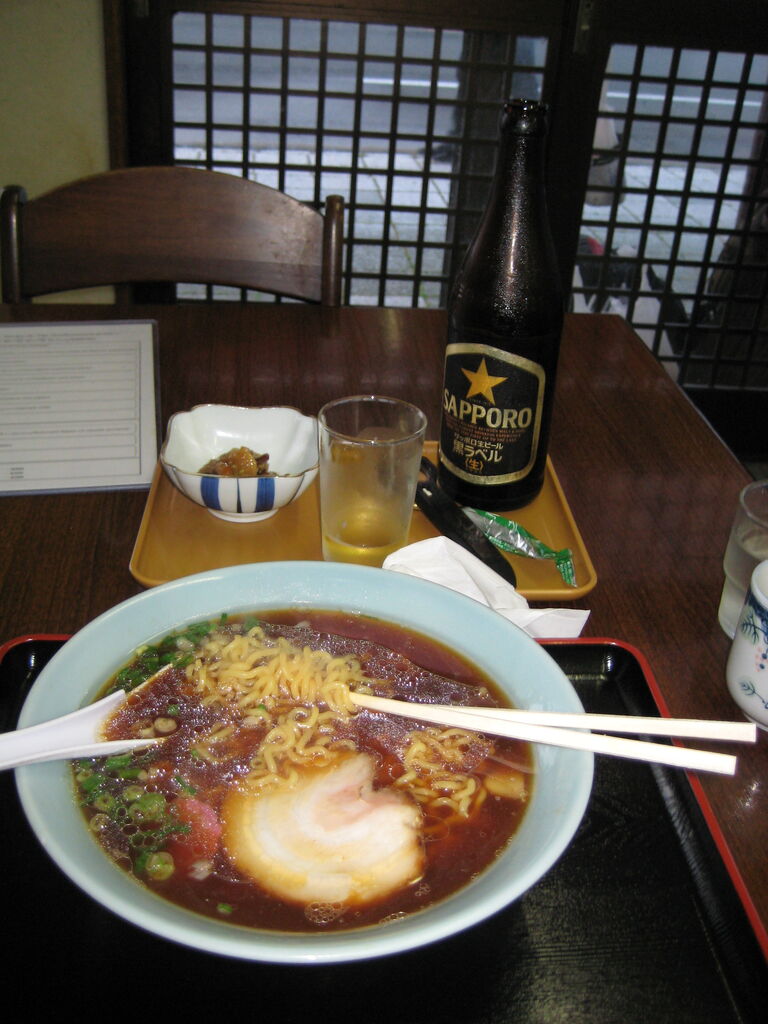
The clothes would need to do me until I got back to Tokyo, tomorrow. The trip to the toilets did not take long. Soon I found myself at a restaurant table, on the second-floor, suitably called, ‘Airport Restaurant’, where I ordered a bowl of soy-based ramen, and a plate of french-fries. A strange assortment of food, washed down by two large mugs of Sapporo lager. Such was the extent of my wee private celebration that marked the end of my mission. It was also as good a time as any to reflect a little about the future. When at the table, a new plan had just entered my head -- coast to coast tramp, the route to be decided. However, I could not see myself embark on a new mission anytime soon. And, for the present, I had other matters on my mind. The airport was scheduled to close its doors for the evening. This included the surrounding area. My mind was refocused on the road, this time in the direction of Sōyafureai National Park, a short distance away. At the park I hoped camp for the night.
2 Sep, 2017: Needless to say, it felt so good to sit on the floor for awhile, under a hot shower. Unfortunately, I did not have a stitch of clean clothes to put on after I washed. All the same, I felt fresh and clean. If only I could have said the same about my sleep in the night. The night air proved to be cold and damp. The plastic shopping bags, spread out on the ground under my body, for added warmth, did little good. During the early hours, things had become so unbearable, that I considered a move to the main building. Somehow I managed to nod off to sleep in the end. When I did open my eyes a couple of hours later, it was to a brightening sky. The tent was saturated with morning dew, in no hurry to dry. At about that time, Sir Walter Scott's narrative poem, ‘The Lady of the Lake’ (1810), popped into my head:
This was the sort of topographical features the Earth was home to — mountains, rivers, seas, hills, valleys, and so forth. They interfered with the movement of the air-currents, at least in the Northern Hemisphere, and made the weather so unpredictable. The predictiona of the weather, for certain locations, had come a long way since I was a boy growing up in Belfast. Still, the weather forcasts could, at times, be way off base. Yet, somehow the weather did not seem to matter anymore, in the way that each stage of my mission had begun with the first step, whather it rained or not. Now, my mission had finished. There was a time when I wanted it to end, for the pain and hardship remained fixed in my mind. In time, the mystic of life on the road, had become a kind of drug, unable to shake off, which I consumed for self-indulgent reasons. The drug released a fire in my limbs, and opened the undiscoverd doors to life. The outdoors gave me fresh air, and took me away from the rules and modernity of the concrete jungle. It took me to places where I felt free to do as and when I liked. It had, in fact, crystallized a hate in my heart for citylife, a life that I was soon to return to. In Tokyo, where I lived, the air was not fresh, and even stale in places. I had grown to dislike the cold interier of my apartment -- rooms so artificially lit, a stuffiness in the atmosphere. Since nothing lasted forever, the effects of life outdoors, would through time, wear off.
Done
As Scott’s poem implied, the end of my mission was definitely a goodbye to the many damp mornings, hills, mountains, valleys, and forests that I had come to along the road, in all kinds of weather. In away. my life outdoors was a goodbye to a different world, with its rivers and bridges, long and short, which I had tramped crossed on many occasions. It was a goodbye to the fountains and waterfalls, where I momentarily stopped, to admire and photograph. The end of my mission marked a goodbye to all of the long and short tunnels, old and new, which popped up from nowhere, along the way. Even the monsterly long tunnels were forever notched in my mind. It was also goodbye to the major, and minor roads, particularly those along the coastline. It was along such roads where I met my old friend, the sea, again, which kept me company for hours on end. My mission would not have been possible, had it not been for the many kind people I met along the way. Sadly, their names had long fallen by the wayside, but memories of the times remained warm in my heart. Undoubtedly. many of the memories will be cherished right up until my last breath. How I loathed Tokyo and the relentlessness of pressure, disillusionment, and hostility within. In cities, people spoke in vague and confused sentences, if they spoke at all, and where nothing of worth was remembered. And, where unwanted occurances never really went away, but lingered, only to return in some other form. There was a mysterious endurance about citylife, where the doors to victory, success, and prestige opened only to a few. My loathing for citylife was just days away from being apart of my life, again. How was I to coup with that? Each time I returned to Tokyo, at the end of a stage in my mission, it was always with a curious reluctance. In Tokyo, I lived the usual life of a city dweller -- not short of money, enjoyed good sanitation, nutrition, and healthcare, and so forth. The rest of my time, however, I half yearned to be part of another world -- travel from place to place, like, an itinerant trader. To return to places I once knew to, long long ago. To travel back in time to those places that had come and gone, too soon. To rub shoulders once more with the people that had made me feel at home. To daydream was part of my nature. The outdoors had given me a backpack full of victories, more than I could ever have hoped for. My continous preoccupation with, and opposition to, cities and citylife, was a mix of paradoxes, contradictions, and ambiguities, and feelings with lots of jagged edges. Feelings were a more complex business to sort out. Any concentration on feelings and the place they played in my hatred for large cities, Tokyo in particular, would only distort the story of the final days of my mission. As to life on the road, I felt indebted overwhelmingly to my mission -- around Japan on foot, and hugged the coastline as best I could. The numerous spring, summer, autumn, and winter stages, from 2009 to 2017, would continue to hunt my thoughts for years to come. My journey around this island nation, the land of the rising sun was home to a relatively stable society, undisturbed by the outside, was for me, a thing of the past.
Done
Thanks to the people I mat, and life on the road at large, had made me a more rounded man than when I began. The experiences, difficilities, and hardships presented at every turn. were for my readers to imagine and ponder upon for themselves.Many of whom, I surmised, had a shared experience of long distance walking, and therefore were well aware of the trials and tribulations of life on the road.
Done
What happened in Japan and the world on this day????
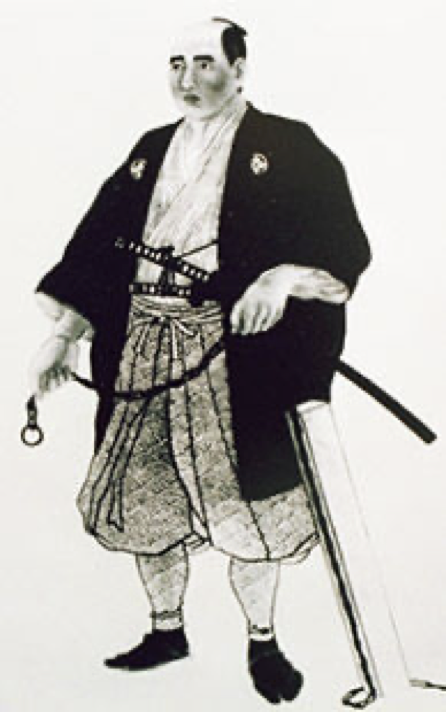
Rinzō Mamiya (1775-1844) (Wikipedia)