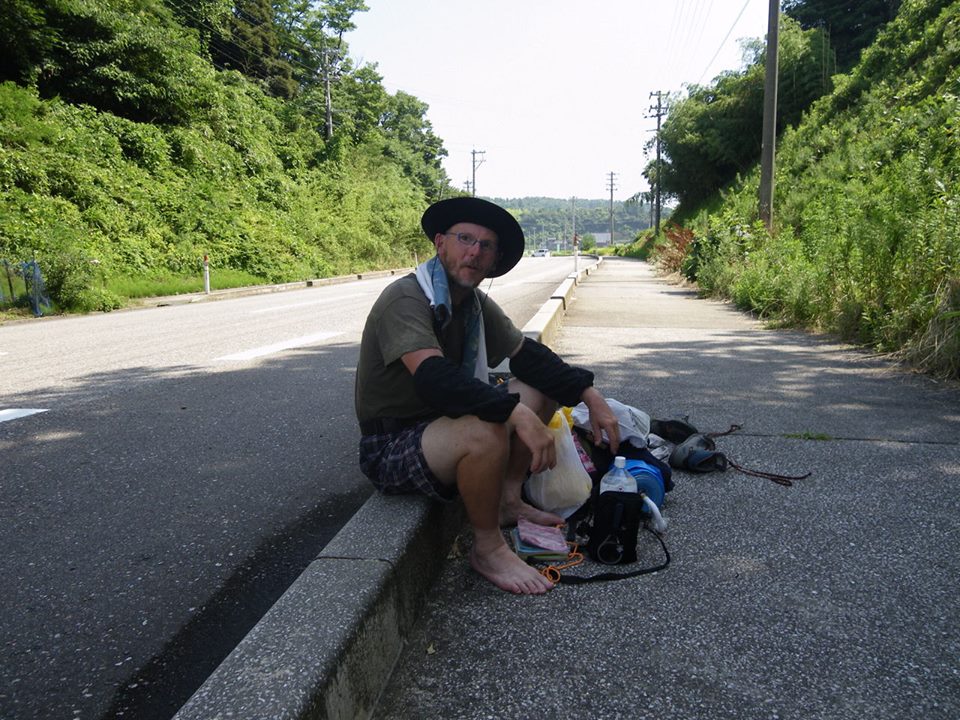
Irishman Walking (Stage 17 Chapter 3) is about my walking the main and coastal roads of Japan. Summer 2015.
11 Aug, 2015: Camp was made at around seven o’clock in the evening, right next to Kazuma JR Station. This was not two-kilometers past the Naruse Ohashi and the two rivers the bridge spanned. Kazuma JR was a small station, opened to the public in 1929, and serviced the Senseki Line, in Miyaki, much of it along the coast. Much of the line took a battering by the 2011 Tohoku earthquake and tsunami, and was only fully returned to service in May, about three-months ago. The train line was completed in 1928, less than a year before the Wall Street Crash, in 1929. The Great Depression, an economic crises that affected most of Europe, particularly Germany, with repercussions across the world. Though the country's economy shrank to around eight-percent, the depression did not affect Japan, like it did in other countries. This may have been in part true becasue of the person in charge of the money. The Finance Minister during the depreesion years was a man called, Korekiyo Takahashi. Takahashi was involved in a number of controversial, but successful financial policies -- he did away with the gold standard, devalued the Yen, and reduced interest rates, among other things. The policies proved especially effective in textiles and light industries -- industrial production doubled, through the 1930s, and by 1933 the econom was on the up. In the 1930s, however, the climate in Japan drifted more towards nationalism -- a greater military influence in the government. According to Ben Bernanke, chairman of the United States Federal Reserve from 2006 to 2014, commented favorabaly on Takahashi's efforts, for "brilliantly rescued Japan from the Great Depression". Conversley, Masaaki Shirakawa, who served as Bank of Japan governor from 2008 to 2013, saw Takahashi's policies as a "bitter experience", and "the bank's biggest mistake in its 100-year history". Even if the jury on the country's hisotry was still out, Takahsshi paid the altomate price for his believes he was assassinated by a group of disgrumpled military officers, in 1936. “Mmm!” There could not be a more local looking train station than Kazuma, I thought to myself, as I set about erecting the tent. By now, the sky was heavily covered in clouds, and ideal for tramping along the road, as long as it did to rain. It was the sound of the first train of the day that I woke up to, in the morning. My ears were also wide open to the beautiful sound of the birds that chirped away like mad. If only I knew what the birds communcated about, high up in the trees. If only alarm clocks sounded like the birds. It was the kind of morning call any positively minded human would be happy to get awake to, without complaint. I read some time ago, that birds with the least color, or prettiest of plumage, sang the sweetest. The sound of the birds never failed to give me a new lease of life feeling. What mattered now, was to up camp and hit the road, just the rain started to fall. The new hand-trolley proved a gift from heaven. Life on the road seemed easier for it.
Done
The morning sky indicated that rain was expected, it certainly took its time, as things turned out. The clouds appeared to get lower with the passing of time. Thankfully, the morning air remained warm and comfortable, with a gentle, but unsteady breeze. The weather, I hoped, would continue this way, even if a feeling lingered in me that it would not. Made a stop at a Lawson, at a place called Higashimatsushima. At the store I picked up something that might do me good for breakfast, if not for life on the road -- a large banana and a 500-milIliter carton of milk. The milk went down well, together with the last of the muesli, which I brought with me from Tokyo. A good thing about stopping a convenience stores was the hot water in the thermos flasks, they kept at the ready. Such stores were even better if they had a place to sit-down at, too. Most of them, however, did not seem to have any such luxury. A cup of hot tea, or coffee, was a good way to round the morning off with. A place to sit, also allowed me the chance to pen a few things down in my notebook. Just about every part of Japan had some ancient history to write about. Higashimatsushima in Miyagi Prefecture was no different, first settled during the Jōmon period. The area on which the city now stood was part of the ancient Mutsu Province, in todays Tōhoku region -- Aomori, Fukushima, Iwate, and Miyagi, and a host of municipalities. Like many modern cities, after the merging of towns and villages, the modern city of Higashimatsushima was established on April Fool’s Day, 2005. Today, the city had a population of around 39,000, a bit of a drop from earlier figures. The population grew steadily since 1970, but had declined this last few years. In addition to tourism, Higashimatsushima was traditionally a center for commercial fishing, particularly the cultivation of oysters. The Japan Air Self Defense Force Base, was located nearby.
Higashamatsushima was severely damaged by the Tōhoku earthquake and tsunami, in 2011. After some hours of tramping along the road, under a heavy and depressive sky, it was time for me to get my arse off Route 45, with the four-wheeled hand-trolley in tow, and onto Route 398. The new road would take me closer to my old friend the sea, or in this case, the mighty Pacific. Needless to say, I hoped the road would not be as difficult, or as busy, as Route 45 had been, which was now well behind me. The first signpost of the day told me that I would soon pass Saint Juan Bautista Park and Ishinomori Manga Museum, which sadly, I had not the slightest intention of stopping. Saint Juan Bautista was also the name of a Japanese galleon, which made a couple of voyages to Eurupe, between 1613 and 1620. It was hoped that the voyages would help to open up Japan to the outside world -- A group of Franciscan missionaries were among the passingers on the return journey, in the hope of establishing a religious order, in Japan. In addition, around 50 specialists in silver-refining, and mining were also invited. This was to help develop the mines in the
Tōhoku region (e.g., Sendai). The plans failed, and a long period of isolation ensued upon the galleon's return to Japan. The galleon was built for shōgun by the English pilot William Adams.
Done
This Tokugawa period of isolation was called 'Sakoku', or 'locked country', and lasted for 214-years, from 1603 to 1868, when the Meiji period began. A Japanese replica (1993) of the seventeenth-century galleon, San Juan Bautista, dislayed at a theme park in Ishinomaki, in Miyagi, not far from it was originally built, in 1613. The giant lumber used for the galleon's masks, came from British Columbia in Canada. As with much of the region, however, the San Juan Bautista sustained structural damage in the powerful earthquake and tsunami, in 2011. The dury, therefore, was still out as to what to do with the galleon -- reconstitution or dismantle it? Ishinomaki's economy had long been connected with the sea -- commercial fishing, such as, the cultivation of oysters. The nearby town of Ayukawa, a town in Oshika, was once a main bases for whaling ships. The town of Ogatsu, long famous for the production of inkstones, held an annual scallop matsui, or festival, every summer. Today, Ishinomaki had a population of around 140,000, which had beenon the decline, since 1980. Manga was not only a massive moneymaking enterprise in Japan, but had left a wide mark on many countries, too. Ishinomori Manga Museum, also called Ishinomaki Mangattan Museum, was opened in 2001. This was to commemorate the works of the Japanese manga artist and author, Shotaro Ishinomori, who was born in Ishinomaki. Like any able child, I enjoyed art-class, at school. Not that I had any natural aptitude for drawing and painting, compared to a lot of kids, whose works I had admired over the years. My first ever encounter with a comic, which I joyfully read again and again, was 'Orr Wullie'. Although I could not recall the time or what I was up to, or even the exact year for that matter, I do remember that it was a miserably wet day. Drizzle was a common part of life in Belfast, a small city with few umbrellas. I had been walking along out street at the time, and something on the pavement up ahead of me, caught my attention. As I hurried nearer, in case another kid might get to it before me, I saw that it was the back-half of a tattered comic book. To cut to the chase, I quickly picked it up and ran home. That was what kids did, they stood or ran in the street, or squatted at their doorsteps. And, when I did not run, it was my habit to walk swiftly in the street. Always hurry and scurry, looking for someting, but never finding it. There was no doubt about it, the youth always seemed to be going somewhere, and never coming from anywhere. If you wanted to succeed in life, you had to leave and go away. I think most of us knew what it was like to be corner boy, destined to become one of a band of tramps, huddled over some fire together to keep warm. Those childhood days were tempered with recurrences of simple joys, and at a time when the future would just have to wait until it came. The remains of the comic book was a great find, which occured in the early-1960s, and I think the great man, JFK, was still alive at the time. Whether or not someone had lost the comic, or thoughtlessly discarded it, did not matter one way or another, for I was happy at my unexpected find.
Done
For the most part, people, mainly Chatolics, were poor in my part of west Belfast, so finding anything of value or interest, was rare to say the least. At the time, I remembered how unsure I had felt when I entered the house, the comic stuffed up under my pullover for good measure. I was worried my grandparents, who raised my sister Anna and me, would think I stole the comic. Or whether I should tell them about my lucky find, at all. Had I told them, they might have said that some boy may have dropped it, and was looking for it. Shyness had always held me back, so I harbored a fear that they would tell me to take it back to where I found it. Other than an old Bible, I could not recall a single book on the shelves in our house. The streets in Belfast were so close-knit, everyone knew what everybody was up to, and if they did not, they would soon find out. In spite of this, I remembered that I said noting to no one. In those days kids could not afford to buy anything, let alone on such luxuries as comics. Kids were aquatinted with comics, they came across the odd one from somebody somewhere. As far as I understood the youth culture on our street, none of us bought one. Even the bigger boys, spent what few coppers they had on a loose fag, or two. Back in the day, people, regardless of age, bought cigarettes in ones and twos. The local shops sold cigarettes in packets of five, ten, and twenty. Smoking was a cool thing to do. Why not? All the film stars and artists did it. That said, I never smoked a fag in my life. The luxary of pocket money was unheard of, and if I got any money, it was barely enough to get me into the pictures. The odd newspaper comic stripe, did come my way, but seldom complete. As far as I understood things, most people could not afford to buy newspapers. Therefore, it had long remained a mystery to me how we came across newspapers at all? Newspaper cuttings hung on the back of toilet doors. The toilets were located outdoors, usually in a far corner of tiny yards. So, blocked up toilets were common on our street. For Orr Wullie was a popular Scottish comic that first appeared in The Sunday Post, in Dundee in Scotland, in 1936. Not that I ever read any of the comicstrips. There were no Orr Wullies among the newspaper clippings that hung on our toilet door. I still recall the upturned bucket, Orr Wullie set on. The comicstrips were first created by the Scottish editor Robert Duncan Low and English cartoonist Dudley D. Watkins. Like most kids on the street, we were more familiar with the Beano and the Dandy. If my research was not barking up the wrong tree, the Beano was the longest running British children's comic magazine in history, whilst the Dandy, the world's third-longest running comic. The Japanese, regardless of their age, loved their manga. In recent times, the manga or comic book industry had made similar inroads in Europe and beyond. To quote from the New International Version of the BIble (1 Corinthians 13:11): “When I was a child, I talked like a child, I thought like a child, I reasoned like a child. When I became a man, I put the ways of childhood behind me.” That was how I thought about comics.
Done
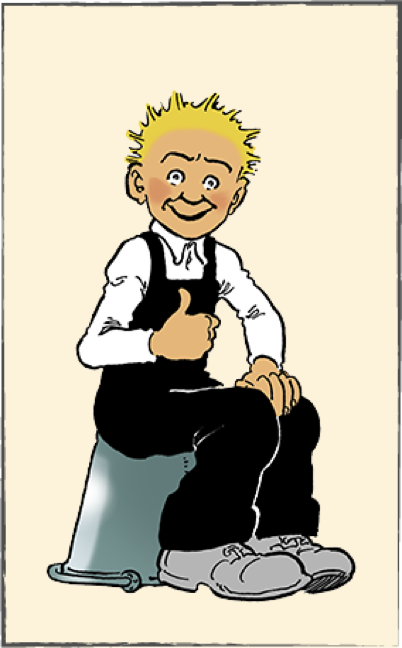
‘Orr Wullie’ (Natural Library of Scotland)
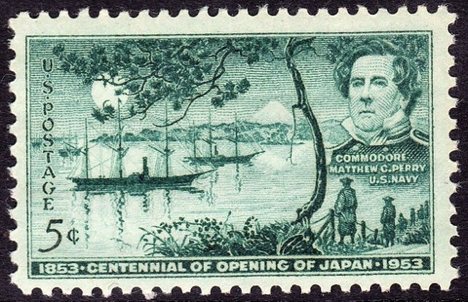
Commodore Matthew C. Perry on a USA postage, 1953 issue (Wikipedia)
Nothing lasted forever, particularly 'time', or Father Time, to use the personification term; or what the presence of the 'Grim Reaper' implied, each time he appeared to collect his victom's soul. Therefore, I preferred to give what free time I had to reading good books, not comics. The Tokugawa government's policy of isolation, ‘Sakoku’, came to an end, in 1853. Even if it was helped along by Commodore Matthew Calbraith Perry, (and the presence of his Black Ships), which forced the country to open its doors to outside trade. The weather continued to hold nicely, no rain, not overly hot, and a welcominng breeze graced my body. “Onagawa here I come!” I mumbled to myself, afher I passed a signpost. This segment of road, bound for Onagawa, was called the Cobalt Line. Onagawa was first established as a village, in 1889, and granted town status, in 1956. This was part of the new municipalities system, enacted at the beginninng of the Meiji period. For reason or another, a lot of the villages, towns, and cities, had been elevated to their status, on an April Fool’s Day. Onagawa was enclosed by a deep harbor that not only proved important commercially, but also militarily. The port became a target for American air raids, and had several ships sunk, in the closing days of the Pacific War. The port was, incidentally, bombed on the same day the second atom bomb (‘Fat Man’) exploded over Nagasaki. A memorial was unveiled in the town, in 1989, for a Canadian pilot, called Robert Hampton Gray, who died during one of the raids. Today, the town had a population of around 6,000, but on the decline, since 1970. Economy, commercial fishing -- coho salmon, pacific saury, including the cultivation of oysters. The kanji used in the name of the 'pacific saury fiah', meant: 'autumn knife fish'. The shape of the fish was said to resembl a katana, a traditional Japanese sword. The Onagawa Nuclear Power Plant, once a major source of income for the town, has remained offline since the 2011 earthquake. Onagawa JR Station fell within Onagawa Town, located on rugged Sanriku Coastline, and the the Kitakami Mountain range that extended some 250-kilometers to the west. Japan was a country of national parks. Much of the town bordered along the Sanriku Fukkō National Park, created in 2013. Onagawa boasted a humid subtropical climate. With its mild summers, it was a great season for hikers. Presently, dark clouds sailed slowly across the sky, and appeared to nest, momentarily, on the tops of the mountains. The deep water port, home to many fishing boats, played a key role in Onagawa's local commercial fishing industry. The port was housed the Onagawa Nuclear Power Plant, the most hastily constructed nuclear power plant, in the world. Fortunately, the plant escaped damage from a powerful earthquake, in 2005. However, the plant was shut down for about a year, as a result. Onagawa Nuclear Power Plant was shutdown a second time after the 2011 Tōhoku earthquake and tsunami. Requests were made by the plant owners, Tohoku Electric Power Co., Inc., to restart the plant, in 2013.
Done
The Japanese Nuclear Regulatory Agency, however, pushed for newly required safety measures to be implemented, before any decision could be made. In the 2011 desaster, the Onagawa area, was one of the most heavily damaged oceanfront locations, in the Tōhoku region. The tsunami reached as high as 15-meters in places; with many evacuation sites inundated. Around 70-percent of the buildings in the town were distroyed, this included the train station and the tracks.
Done
12 Aug, 2015: Camp was made in Sawada Town on the coasline. It was a silent enough spot to pitch the tent at, just off a not overly busy road, Route 398. The odd local train shuttled along the tracks, that ran between the road and the shore. The clouds were heavier than on previous days, which caused me some concern. My thoughts were well justified. Not long after the tent had been securely pegged down, the rain came down like there was no tomorrow. The rain did not let up until the early hours. When I got off the mat, it stopped altogether. A well tented, was an art in itself. If not, all hell could break loose, and no one but myself to blame. It was easy to be sloppy, if you were not careful. That was part of the trials and tribulations of life on the road, all day long, On a number of occasions, the tent had to be erected on a concrete surface, not for the faint hearted on a windy or rainy day. To cut to the chase, it did not take long for puddles to form here and there, and in no time at all, the water to began seep in under the tent. Once the tent's interier got wet, it became just about usuless. If it had not been for the mat I lay on, I would have been soaked. By the time I did realize what had happened, much of my gear was inundated with rainwater. Thankfully, the clothes that I wore, where dry. A satiated tent was a bummer to get dry. After some hours later, the rain had finally stopped, and then I was able to make an effort at putting thing right. This segment of the road, Route 398, was devoid of shops, restaurants, and people. The only sign of life came in the form of passing cars, but not so many. There were a good number of birds high up in the trees. The road could be a lonely place at times, if it was not for the pleasant sound of the birds for company. A road sign told me that I was heading towards Ishinomaki. Hopefully I could pick up something for breakfast there. The region was part of ancient Mutsu Province, once controled by the powerful Date clan. For years, Ishinomaki prospered as a major port and transshipment center from northern regions to Edo (Tokyo). Ishinomaki was granted town status, in 1889. It became a city on April 1, 1933. This was a time Japan freed itself from the Great Depression, when other countries still felt the affects. Today, Ishinomaki had a population of around 150,000, on the declin, since 1970. The city was known for manga lovers, of whom I was not among them. It was also home to the Ishinomori Manga Museum, opened in 2001, and dedicated to the work of Japanese manga artist and author, Shotaro Ishinomori, who came from there. The window-like eyes of this rather strange looking museum building, looked out over the Pacific, and the majestic Tashirojima, an island, about 11-kilometers in perimeter in size. The islanders were merely elderly, and an untold number of feral cats that had been there for donkey’s years. The feral cat population outnumber humans 6 to 1, which did not bother visitors to the island one bit. "Mmm!" I wondered why there were no pet dogs on the island? The human population dwindled from 1,000-residents, in 1950, to fewer than 100-residents, today.
Done
The island’s last school, Tashiro Elementary School, closed its doors for the last time, in 1989. The two villages on the island, Oodomari and Nitoda, were said to be ‘threatened’, and refered to as ‘terminal villages’. Tashirojima and a neighboring island, Oshika, merged with Ishinomaki City, on April Fool’s Day, 2005. The livelihood on the island was geared toward the sea -- fishing and ospitality. Fixed-net fishing became popular during the early-Meiji period. For many years, silkworms were raised to produce silk for textiles. Rodents were natural predators of silkworms. The cats, therefore, were kept mainly to keep the rodent (mice) population down, and lesson any damage to the silk. There were around 10 cat shrines in Miyagi, and many more cat-shaped stone monuments. There is a small cat shrine located in the middle of the island, called Neko-jinja. There was a story that in the past, rocks were being collected, by the fishermen for their fixed-nets. One of the rocks fell and killed a cat. The death of the cat affected the fishermen so much, that its body was enshirined around the same location where Neko-jinja stood. Today, Miyagi had more shrines and monuments to this small carnivorous mammal, than any other prefecture in the country A Fuji television series (2006), directed by Terebi Asahi, had been shot on the island. The theme focused on a droopy-eyed cat, one of the many cats. A BBC television program series (2012), called: ‘Pets, — Wild at Heart’, featured the feral cats on Tashirojima. This was followed by a documentary (2015), entitled: ‘Cat Heaven Island’. It focussed on human life on the island, past and present, which included the cats. Thanks to media interest, photo contests and exhibitions about cats, had become popular events on the island. A large number of tour-groups visited Tashirojim, just to see the cats. The hospitality on the island forcused on lodging (B&B) and tourism. The hospitality on the island forcused on lodging (B&B) and tourism. Tashirojima was known as ‘Manga Island’, for its strong connection with Shotaro Ishinomori. The lodges were also manga-themed based, hence The Hyokkori Hyōtan Tashirojima Marathon -- six and 10-kilometers long -- was held on the island, in 2007. In Shintoism, cats harbored good luck, or wealth and good fortune. Although much of Tashirojima was extensively damaged by the earthquake and tsunami, in 2011, the feral cat population survived relatively unscathed. The cat population fled further inland to escape the advancing water. Through time, fishermen developed a fondness for the cats and would observe the cats closely, to interpret their actions as predictions on the weather and fish patterns. Something told me that I was going to go to sleep hungry this evening. A glance over my maps this morning, told me to expect a long tunnel. Each time a long tunnel popped into view, I was reminded of the monster tunnels I faced south of Otaru in Hokkaido, in 2009. Back then, the long tunnels popped up one after another. At time, the maps could be so deceiving.
Done
After a while, I came to Wakenami Tunnel, opened to the public, in 2006, it was just 462-meters long. “Mmm!” Surely this was not the tunnel in the map? Or so I thought, as I headed entered, the hand-trolley pulled carefully behind me. It certainly was the same road, Route 398. The tunnel was located in the township of Ogatsu-cho, part of Ishinomaki. It was not the monster tunnel that I had expcted, but a series of tunnels close together. Almost immediately, I entered a second tunnel, Mizuwake Tunnel, only 186-meter long, and opened in Heisei 15 (2003). "Mmm!" Surely the other tunnels were nearby, I though, as I set down a moment to jot down a few lines into my notebook. "Where were the hell where they? The road curved this way and that way, for some distance, but I could see nothing in the form of a tunnel up ahead of me. After a good distance along the winding road, which by now slanted upwards and downwards, I arrived at a place called Ogatsu, a Michi-no-Eki, or roadside rest stop area. Like the other Michi-no-Ekis, it had its restaurants, shops, and public toilets, regional-tourist information. There were more than 1,000 Michi-no-Eki-like reststops located throughout Japan. Ogatsu was one of a group of small towns located in Miyagi, that were absorbed into Ishinomaki City, in 2005. Ogatsu had historically manufactured ink-stones, a stone mortar for grinding and holding ink. The inkstone was intoduced into Japan from China, and dated back for thousands of years. Later, the inkstone was not only produced in stone, but also from bronze, clay, iron, and porcelain. The tool still played an important part for artists, and others, in calligraphy and painting.
Also, a scallop festival was held in the town every autumn. Today, Ishinomaki City had a population over 141,000. It's residents enjoyed a humid climate with mild summers. The highest average temperature was in August, like the present, at around 24.2°C. It certainly seemed a lot hotter pulling a four-wheeled hand-trolley behind me. And, undoubtedly even hotter with a heavy backpack. I stopped a while, to rest and make a cup or two of coffee. Also, to take stock of my location on the map. According to a
touristy map nearby, the monster tunnel, still lay up ahead of me. When would I come to the tunnel? was another question. As I waited for the water to boil, I began to feel tired. It was not easy to stay focused on things. This was my first stop in four-hours of tramping. The last number of kilometers had slowed to a crawl. I rea somewhere that slower walkers showed signs of aging, faster than those who walked fast. This was the twilight of my years, so I was no spring chicken, even at the best of times. The thought of a nap, crossed my tired mind. If only I felt contented, or proud of myself for a job well done. Life in the open was unaccompanied with problems. The times when I had fucked up somewhere a long the road -- had not tramped as far as I had hoped, misread the maps, taken a wrong turning, lost bits of the gear. Even the times I had neglected eating, and covered long distances on a near empty stomach. Life on the road was not for the faint hearted. Only after eating, did I feel, if not see, a change over my body.
Done
Thanks to the rest and replenishing the old body, I at last found myself at the mouth of the monster tunnel. Thankfully, the Kamaya Tunnel, was not as long as the maps implied. Opened in 1986, the tunnel was 995-meters in length, so not quite a 'monster tunnel'. According to a couple of tales, the Kamaya Tunnel was said to be hunted. The ghost of a woman was believed to hunt the tunnel. At times, a hand was said to touch the windscreen of a passing car. In another tale, a red car, it was noted, moved slowly in front of some of the cars, only to suddenly vanish in front of them. That said, I did not notice anything spooky appear in front of me, as I tramped through the tunnel, with the trolley close behind me. The Kamaya Tunnel stood between Okawa East School and the old town of Ogatsu, at a raised point, called Kamaya Toge. The word 'toge' refered to a mountain pass, or a winding narrow road. More than 80-percent of Japan was mountainous. Kamaya Toge was a mountain pass where many locals sought escape, during the Tōhoku earthquake and tsunam, in 2011. Unforetunately, 70 out of 108 students and nine staff members, perished when they sought safety on the Shinkitakamiohashi Bridge, nearby. The bridge over the broad Kitakami-gawa, had become engulfed in the flooding waters. On a lighter note, after I left the tunnel, I was happy to see that the road, Route 398, started to head downwards. It led me across the Kitakami River, where I took a sharp right, towards the towns of Minamisanriku and Kitakami. By now, the sun had long gone down, and darkness was fast falling.
Done
13 Aug, 2015: Not two or three-kilometers after l left the Kitakami-gawa, behind me yesterday, my tired mind and body told me to stop and make camp. It was dark by the time the tent was finally pitched. On the shoreline, not 200-meters away, two fishermen stood on a recently constructed quayside, to applied their honorable trade. From inside the tent, the wizzing-sound of the casted lines out over the water, could be heard. The sound, I remembered, resembled that of a bullwhip, wizzing through the air. Regardless, I felt too tired to care, and it was not long before I drifted off to sleep. My eyes opened around 04:30AM. It was never easy for a hungry man to just dilly-dally about and do nothing. Food, and water, was foremost in my mind. A look at my maps last night, did not exactly leave me feeling optimistic. I had a funny feeling that I would not come to a shop or restaurant anytime soon. This was Obon, a time when many places were closed for the holidays. Signs of the country's long recession, caused me to wonder how any of the businesses in the area, survived at all. By 06:00 AM, I was back on the road, again. The road seemed lonely and devoid of traffic. It was just as well I headed off when I did, for not much later, the sky darked and the rain suddenly began to bucket down. After about an hour of tramping along the road, in the rain, I made a stop at a building site. The site was no different to the many I had passed along the road yesterday. My aim was to shelter from the heavy rain, for a while. Tap water to drink, and replenish the water-bottles, would have been ideal. If not, the traping some rain, was just as good. The tasks were soon accomplished. In no time at all the water was boiled, and the coffee ready. For what it was worth, a cup of hot coffee or tea for breakfast, was better than nothing. Not long after getting arse back on the road, the building site left behind me, I came to the first tunnel of the day. My mind had a habit of going off in tangents, a common occurrence of life on the road. This was particularly true, as far as my love of modern history was concerned. Getting water was at times easier said than done. Thankfully, the time had long gone in Japan, when getting water to drink, was truly problematic. The more fortunate households, in the Tokugawa period, got water from fixed pumps. Much of the water in the Meiji period, was fetched from shallow wells and springs. In some instances, the water was piped through wooded pipes. In Victorian London, the main water supply was the River Thames, which over 230 sewers emptied into. Such unsatisfactory arrangements served a similar purpose, in Japan. The less foretunate among the Japanese got their suply of water from nearby rivers or steams. The rivers were often polluted and had to be boiled before drinking. The first modern piped-water system was setup in Yokohama, in 1887. In more recent times, Tokyo had faced a chronic water shortage, in the early-1960s. The supply of water in many households, had to be rationed, during the 1964 Tokyo Olympic Games. Hence, the city earned the nicename, ‘Tokyo Desert’.
Done
Lake Miyagase, in the picturesque district of Aiko in Kanagawa, was the main source of drinking water for the Greater Tokyo and Yokohama areas. The lake was a purposely built dam, completed in the millennium. Back to the present, the 465-meter long Shirahama Tunnel (1992), where I stood, was located in a place called Jusan-hama in the township of Kitakami in Ishinomaki. There used to be a thriving fishing port, as well as, a popular beach called, Shirahama, famous for its white sand. In fact, the kanji in its name meant: ‘white beech’. Land erosion, however, had narrowed the beach area. A sole survivor was a gasoline station, but severally damaged by the Tōhoku earthquake and tsunami. (The beach was reopened to the public, in 2018, and the nearby Shitahama Beach Park, in 2019). The land used for the park was where a small village, with around 200 people, had previously stood. The village had been completely destroyed with the loss of life. There were a number of beaches in Japan, that had the same name, Shirahama. Not long after passing through the Shirahama Tunnel, the rain finally stopped. Soon after that, I made a stop a long the road to jot down some notes, before I forgot. No sooner had I set down by the side of the road, pencil and notebook in hand, the rain started up again. "Mmm! This was not good." I mumbled to myself. Earlier at a building site, I made a stop to wash clothes. I had hoped to hang them out, for the warm breeze to work its magic on. Near where the Kitakami-gawa joined the mighty Pacific, I spotted a scenic spot to pitch the tent for the night. It would given me the chance to splash about in the sea. Becasue of the dismal weather, however, I was in no mood to do either. Later, a road sign pointed right, for Shirahama. The second tunnel of the day popped into view. The Jusan-hama Tunnel (1995), ran for only 537-meters. Therefore, I was soon back out in the rain. The only good thing about very long tunnels was to escape the rain for a while. A glance up at the sky, told me that the heavy rain had not plan to letup anytime soon. Another stop was made at the northern mouth of the Jusan-hama Tunnel. There I decided to make my third cup of coffee in an hour. Coffee or not, I still had to continue along the road, in the rain. There was no point in bitching about the rain. The different weather conditions was what my mission was all about, if it was about anything. The Jusan-hama Tunnel tunnel was a good dry place to stop at for a while. Thankfully, the breeze was not very strong, like the entrances of tunnels often were. It was not damp, nor busy with traffic, like so many other tunnels I had passed through, the sort that I needed get through and leave behind me, as quickly as possible. If only the rain would stop, or lighten a bit so that I might enjoy the final days on this stage, Stage 17, of my mission. At long last, the first restaurant, since I left Route 45, two-days before came into view. It was a ramen joint, called ‘Tsunomiya Daishizenjyuku’ in the village of Tsunomiya. It had a strange name, part of which meant: ‘big nature school’.
Done
The building was donated by a NPO volunteer group, JAPAN TEAM OF YOUNG HUMAN POWER (JHP). There was a photo of Japanese actor, Shōhei Hino, who had stopped by at the place. Hino played General Hideki Tojo, in the film 'Emperor', in 2012. The only thing that I knew about the actor was the popular television traveling program, ‘Nippon Judan Kokoro-tabi’. The couple who ran the restaurant were very friendly, with a sort of kindness that softened the hardship of life on the road.
Done
14 Aug, 2015: The rain really did a job on me yesterday. The state of the sky this morning, looked like I was in for another drenching. The rain had not let up thought the night, before it finnaly stopped some minutes earlier, at 05:00 AM. Thankfully, the camp gear was folded up and stuffed away, when the sky opened up, and the rain fell with gusto. Last night, camp was made near a 7-Eleven along the road, on Route 45. It was in the evening, when I rejoined the road after making a detour along a minor road. The camp site was under a large roof, part of an old fish factory, closed for the Obon holidays. Therefore, I felt that I would not be disturbed by any workers. It proved a good place to hang the gear and clothes to dry. Although I was aware that the police could show up unexpectedly, and charge me for trespassing, I still drifted off into a comfortable sleep. All the same, life on the road was about taking chances. Perhaps the same could be said about life at large. The way I saw it, the rain was going to be a start-stop affair, and there was nothing I could do about it. At times the rain was heavy, at times light, and at times even nothing at all. Then it would start to fall all over again. By the time I decided to hit the, at 07:30 AM, it started to fall, again, with gusto. The first sign post of the day, not long after hitting the road, read: "End. Past Tsunami Inundation Section". This was not the first time that I was reminded of the dangers of the region, and no doubt it would not be the last. It was nice the road ran beside the railway tracks, again. The tracks kind of told me that this stage of my mission was nearly ended. The easiest way was to return to Tokyo by train. The train passed through Sendai, where I planned to make a stop for a while. It seemed a little strange that no trains passed by, as I made my way along the road. At least I had not heard any, during times with the tracks disappeared from view. It was not until some kilometers along the road that the reason became clear. Two sections of a railway bridge had vanished, the handiwork of the Tōhoku earthquake and tsunami. “Mmm!” That was three-years ago, I thought, as I looked up at where the trains once shuttled past. Much of the coastline was under redevelopment, but the railways, at least for the moment, appeared neglected. Something told me that any plans to return to Tokyo by train, were dashed. What I needed to find out where I might get a local bus to Sendai City. The trains out of the city were running. A glance over my maps told me that I should be able to get a bus from Kesennuma City in Miyagi; where the Ōkawa River flowed into Kesennuma Bay. The area was also home to Mount Ōmori, some 711.9-meters high. If all went well, Kesennuma would officially mark the end of this stage of my mission, Stage 17. Kesennuma, was a port city, which bordered two bays -- Hirota and Kesennuma, which touched the Pacific. Kesennuma had a humid subtropical climate, its highest temperature on average was in August, at around 23.3°C. Kesennuma was also located on part of ancient Mutsu Province and had been settled since the Jōmon period, around 1000 BCE. Kesennuma became a town, in 1889, the same year the Japanese emperor proclaimed the Meiji constitution. The town was granted city status, in 1953. Today, Kesennuma had a population of around 61,000, in decline since 1990. Much of the regions economy relied on commercial fishing and associated industries, as well as, tourism. What I did know was that memorial services took place for the victims of the earthquake and tsunami were held throughout the country, including Kesennuma. My brain worked overtime at the thought of how easy it was to return to Kesennuma, this winter, for Stage 18 of my mission.
Done
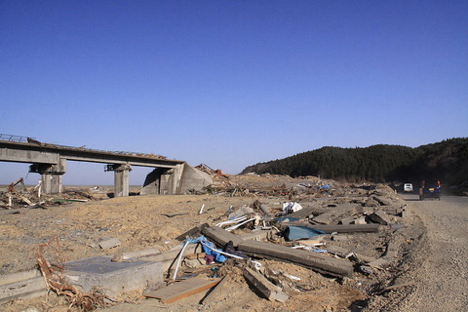
Rikuzen-Koizumi Station after the 2011 earthquake and tsunami
(Wikipedia)
15 Aug, 2015: Camp was made a bit early at four o’clock. This was at a place called Rikuzen-Koizami, about 20-kilometers from Kesennuma. Actually, Rikuzen-Koizumi was located in Hiraga, which fell within Kesennuma City boundaries. The Rikuzen-Koizumi train station was completely destroyed by the earthquake and tsunami, in 2011. A number of stations along the line were severely damaged, or destroyed. The train services were replaced by a provisional rapid bus service, along the narrow road that replaced the tracks. Therefore, any traffic jams that hampered the roads, during Obon, was not an issue. An eye out for a post office was easier said than done. Because of the disaster, many businesses in the Tōhoku region were closed, or shutdown for good. The spot where I decided to pitch the tent proved to be a good choice. A local family invited me to their home to use the hot shower. Such a luxury had not been enjoyed in a good while, and had nearly forgotten what a soapy scrub-down felt like. The prefab houses were supposed to be temporary shelters for the victims, left homeless after the natural disaster. A good number of the people continued to live on the site. They kept for the most part to themselves, so I was unable to talk to them. Thousands of people lived in similar sites dotted about the region, if not further afield. Even four-years after the disaster, many people were still confronted with the problems in rebuilding their lives. In Kesennuma, around 9,500 homes were destroyed, with more than 1,000 lives lost. There were a couple of businessmen I met, from Tokyo and Yokohama, told me that their company was instrumental in the recovery. They also told me that they were in the city to attend a thank you party, orgnized by local people. They invited me to join them at the party, but as I was pressed for time, I declined the kind offer. I needed to hit the sack as soon as possible, for I was exhausted and needed to be up extra early, at sunrise. The site was run by a delightfully friendly fellow, who introduced himself as, Mr. Takahashi. He and his wife, oversaw the running of the site. A JR bus left Kesennuma City at four-fifty-six in the afteroon. If all went well, I should reach Sendai by five-twenty-seven. According to the bus timetable, I had to make a couple of changes first. The bus retraced much of the journey that I had trampled. From the windows, I was given a glimpse of some of the places where I camped along the way. Thankfully, the road, Route 45, appeared devoid of the Obon traffic. This surprised me a bit, for I still recalled the traffic jams I had tramped past. After a while, the bus turned off the main drag. It was a pleasant surprise, seated on a bus that sped along the Kesennuma Line, with its narrow train tunnels. At times, it amused me to observe the bus driver navigate carefully, though not exactly slowly, through the dark narrow tunnels. Obon was a time of many travelers and bus roads. Therefore, I was a little worried if the bus would arrive on time, for me to change buses for Sendai. Fortunately, there were no problems.
Done
16 Aug, 2015: Camp was made on a rich grassy-green patch, along the banks of the 45-kilometers long Hirose-gawa. The river flowed by Atago Green and through the center of Sendai. The source of Hirose-gawa was the 650-meter high Sekiyama-toge, a pass deep in the Ōu Mountain Range. The Ōu Mountain Range was the longest in Japan. It stretched some 500-kilometers south from the Natsudomari Peninsula, in Aomori, to the Mount Nasu volcanoes, in Kantō. Mount Nasu was located in the Nikkō National Park, with Sanbonyari Peak, its highest major peak, at 1916.9-meters. Atago Green was home to Atago Shrine, with a winding staircase that led through a forested greenery. The shrine was built on a large hill, with a panoramic view over the city of Sendai. The shrine was built around 1591. The shrine was home to the Shinto deity of fire, Kagutsuchi. Kagutsuchi was a favorable god to have on hand, in a country with a long history of structures made from wood and paper. The main shrine was designated a tangible cultural asset, in Sendai. According to a nearby sign, this was a designated disaster refuge area. It seemed a strange, to me, a disaster prevention center set next to a river. There was not much I could do before heading back to Tokyo. There were a number of postcards to sort out, and get off to a number of family, friends, and acquaintances. A dander about the city and do a bit of window shopping, was a good way to kill some time. This included keeping an eye open for a postoffice. The Sendai JR Station complex, with its many shops and food outlets, might be a good place to start from. So, I headed in that direction. Along the way, I stumbled upon a ¥100 Yen shop, where I ducked into to buy a T-shirt and a pair of socks. The clothes from such places were great for the road, easy to wash and quickly to dry. Sendai JR Station bordered Aoba-ku and Miyagino-ku, wards in Sendai. It was a major station for the Akita and Tōhoku bullet trains, as well as, the Senzan, Senseki, and Tōhoku lines. The station was opened in 1887, in the nineteenth-year of the Meiji government. In that year, Tōkyō Denkō (Tokyo Electric Lighting) introduced an electric lighting system. to the public. At that time, the Imperial Palace, in Tokyo, switched to electric lighting. This made it the first electric power company, to supply electricity, in Japan. Like other countries in Europe at that time, Japan was keen to make a transition to electric lighting. The first electric street lighting appeared in relatively well-to-do areas, like status symbols. The very first electric street lamps appeared in Ginza in Tokyo, in 1882, in Kyoto, in 1883, and in Osaka, in 1886. As the first electric street lamps were being installed in other parts of the country, Hirobumi Itō, became the first Prime Minister, in Japan. His four times in office, made Itō one of the longest PMs in the country’s history. Itō played a main part in creating the first modern constitution, in 1868, which defined Japan as a modern nation, capable of playing an equal part among the other powers. Unfortunately, the PM was assassinated by a Korean nationalist, in 1909.
Done
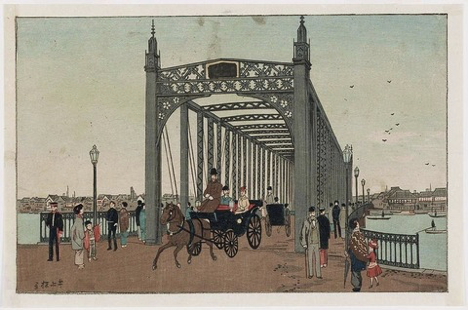
Azuma Bridge, and note the street lamps in this woodblock print (1887), by Inoue Yasuji (1864-1889) (Wikipedia)
A ride on the Sendai Sightseeing City Loop Bus to Aoba Castle, seemed a good idea. An interesting bus service, affectively known as ‘the Loople Sendai’. Thanks to a one-way bus pass, visitors were able to use the buses in any direction, at a leisurely pace, as often as they liked. The bus routes covered many tourist attractions. One attraction I stopped at, was the Zuihoden Mausoleum, where the remains of Date Masamune and his heirs, were housed. Unfortunately, most of the original monuments at the mausoleum were destroyed by American bombs, in 1945. Like much in the city during the postwar years, the mausoleum, and monuments, were subsequently rebuilt, in the original style. The bus made a short stop at Sendai City Museum, the site of Sendai (Aoba) Castle, Botanical Gardens, Museum of National History, Miyagi Museum of Art, and other places of interest. It was not always easy to find the damn bus stops. When I did at last arrive at one, a hell of a long queue op people waited for a bus to arrive. Needless to say, I was not able to get a seat when I climbed a board the bus, and stood packed shoulder to shoulder, as far as the castle. It was just as we that I did not have a full backpack with me. The roads that the driver skillfully maneuvered along, were busy with traffic. The bus moved at such a slow speed, it would have been better had I saved the money and walked. Unlike the heavy rain the day before, the weather was perfect for walking. When the bus did finally pull up and stop at the castle, I felt disappointed. There was nothing what looked like a castle in any shape and sizeeen. The Aoba Castle grounds were well planned and led out. The castle had been built on Mount Aoba, hence its name. During the Kamakura period (1185-1333), Aoba Castle acted as a fortified residence of a branch of the Shimazu clan. After the Battle of Sekigahara (1601), and a visit by Ieyasu Tokugawa, the area was renamed, Sendai. The castle fell to the Date clan, and Masamune Date (1567-1636), became the first daimyo, or feudal lord, of the Sendai Domain. Around that time, reconstruction was carried out on the castle.
Done
Work on the castle was finally completed, in 1637, by Date’s son, Tadamune Date (1600-1658). After the surrender of Senda, Aoba Castle fell into the hands of the new Meiji government. Work to dismantle the castle was carried out, in the 1870s. Much of what remained of the castle was destroyed by fire, in 1882. Two of the few original structures of the castle remained-- the Wakiyagura tower and the Omotemon Gate -- were designated as National Treasures, in 1931. The castle grounds became a military base for the Imperial Japanese Army. That was up until American bombers destroyed what remained off the castle, in the final weeks of the Pacific War. The America occupied the castle grounds, before it was finally returned, in 1957. Soon afterwards, work began on repairing the surrounding area. A number of quality trees survived the war years, whilst others had since been planted. “Mmm!” The trees caused me momentarily to wonder if this was why Sendai got its nickname? -- ‘The City of Trees’ -- a pleasant spot to stroll about in. More recently, Aoba Castle and its surrounding grounds, efforts were made to beefi up the Aoba Castle grouds to appeal more to tourists. The site was designated a a national historical site, in 2003. The castle was deemed one of the 100 fine castles of Japan, in 2006. According to a touristy pamphlet that I read at breakfast: Sendai (Aoba) Castle Guidance Facility was opened in 2006, to teach visitors about the original structure of the castle. After a lazy stroll about the castle grounds, next was to pay a visit to the near by Sendai City Museum. The museum had stood on the site of the San-no-Maru enclosure, since 1961. It was home to a host of interesting cultural assets. Many of the artifacts on display were lnked with the Date clan. Why not? After all, the Date clan was responsible for building Sendai Castle, if not putting Sendai on the map. Another tourist pamphlet told me that the museum building was designated by the Japanese architect, Toyo Ito, and was awarded the World Architecture Award. It was designated the best building in East Asia, in 2002. The museum building was multi purpose -- gallery, and studio for various venues, and so forth. The building did not cause me to pause in awe, not even for a second. I found design of the building similar to discarded trash by the roadside. On countless occasuaions, -- unwanted furniture dumped down hillsides -- the handy work of mindless fools, who had more than likely stopped their vahicles along the roadside in the dead of night. Like discarded items were blots on the landscape, ugly buildings, too, just seemed to pop up everywhere. This was not the first time that I had jotted something down in my notebook about ugly buildings. The tall buildings stood in many towns and cities, and in isolated areas along the roads. Architects were enamored with their building designs. This had something to do with the 'Modern Movement' school of architecture. Formost among the players in this field were Dankmar Adter, Louis Sullivan, and Frank Lloyd Wright. It was such people that brought the skyscraper to the world.
Done
Towering modern structures of reinforced-concrete, their recurring theme of glass and steel, and with walls that could be discribed as "a veneer of masonry hung on a steel fraim." (Readers Digest Library of Modern Knowledge). One of Wright's many achievements was the world's very first reinforced-concrete structure -- Unity Church in Oak Park in Chicago, in 1906 -- the same year of the Great San Francisco earthquake. Modern architects overlooked or justified any shortcomings, which at another context and time, would have been deplorable. They defended their buildings, nor ever referred to anything wrong or misleading about them. Most architects were impelled by a desire to get their ideas off the drawing boards and creat a reality. In a worst-case scenario, the so-called expected 'big earthquake' could occur right under Tokyo. Should that happen, thousands would undoubtedly die, and buildings completely leveled. The economic damage would be unmeasurable. Would the new buildings going up truely withstand such a massive earthquake? How many architects had been arrested for fake earthquake-resistance data, for their buildings the designed? On the road, I was at times lost for words, about some of the buildings I tramped past. Tall buildings darkened the appearance of towns and cities. I would have surmised that the state of the Japanese economy curbed the building boom. In away, the towns and cities had become dumping grounds of ugly building. The local authorities seemed to be asleep -- devoid of planning schemes that avoided piecemeal building. Many of the cities and towns had delightful and quient little spots dotted about here and there, with delightful building strudtures. In Tokyo, the Imperial Palace area and the old British Embassy nearby, were great places to take a stroll around on a nice sunny day. Not a kilometer away, a quick glance about the roads and side streets revealed a clustered hotchpotch of ugly buildings. They were eyesores that appeared so out of place. Cercumstances had allowed me to live and work in a number of foreign cities with beautiful old buildings. Even with my smattering of knowledge on city planning, I considered Tokyo an ugly city. Many cities in Japan boasted the largest number of tall buildings, on the smallest possible plot of land. For skyscrapers in Japan, the sky was truely the limit -- for structures far beyond the principle of rational toleration - without order, logic, or elegance. In other words, Japan had turned its back on the past. Old atractive cities, like, Otaru in Hokkaido, were few and far between. Tramping the road, had allowed me to make a stop in Otaru for a few days, during Stage 1 of my mission, in summer 2009. That time in Otaru was now a happy memory, thanks to a friend, Riko-san, who was kind enough to accompany me there for a while. Many of the Japanese towns and cities that I had passed through, since my visit to Otaru, symbolized an amalgamation of confused and disjointed vulgarity, buildings devoid of taste or genius. "I could not express my astonishment more." I mumbled to myself, as I penned this into my notebook.
Otaru photo???
Done
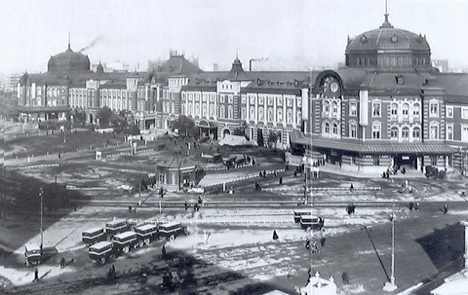
The original brick Tokyo Station (Marunouchi Building) in 1914 (Wikipedia)
When I tramped through the different places, it was impossible not to see change going on all around. Old buildings disappeared, new ones replaced. It was as if a war was being fought in the streets. A building boom, had been waged in the streets around the residents, with concrete pillars and walls enclosed around them. The buildings were objects of compassion and heartfelt pride in the inmost soles of the prime instigators -- architects, building contractors, and local government officials. A play on Winston Churchill’s wartime speech: ‘Never was so much damage done on so many, by so few. They bestowed the ugly new buildings with all the foundation and permanency, across the country. Such people had even focused their attention on the famous Tokyo Station. Not just on the station, but its history and what it meant to the area, and to Japan. Plans had been drawn up to demolish the iconic station building -- all in the name of money and profit. The plans were to demolish the station and replace it with a multi-complex. The Tokyo Station stood on prime land, near the downtown Ginza commercial district. There was no profit in history. In 1983, construction on the new Narita Shinkansen Line, found itself on the shelf. This was in part becasue of a series of protests from farmers, who refused to sell their land for the project. In my eyes, each newly errected skyscraper, widened the distance between Japan's past and presen, that bit further. The train platforms at Tokyo Station in the Chiyoda area of Tokyo, dated back to 1914. In that year, around 553,000 used the train service. The station building stretched some 335-meters. The Tokyo Station Marunouchi Building opened at a time of rebuilding. When it was opened, Tokyo Station became a showcase for the nation's ever-expanding rail system. It survived the Great Kanto Earthquake, in 1923, and close to being firebombed and completely demolished, in the closing months of the Pacific War. In more recent times, the old Tokyo Station's days had been numbered. Already, building contractors were glorified at the prospect of replacing it, with a new massive multi-complex box-like concrete structure. No doubt, with a few trees added for good measure. Good sense won out, for the present. The Tokyo Station building had got a reprieve, the local harangue had been heard, at least for the next couple of decades. The Marunouchi side of the station had undergone renovation, in 2009. This was not far from where Japanese Prime Minister, Osachi Hamaguchi, was shot, in 1930. A metal plaque marked the attempted assassination. It was not the fist time at the Tokyo Station a politician fell victim to an ultra-rightist attack. Some nine-years earlier, Takashi Hara was stabbed to death in front of the South wing of the station. At the time, Hara had just arrived on a train for Kyoto. In the year of the murder (1921), around five-million passengers used the station. Today, it was the main intercity rail terminal station, in Tokyo. In terms of the number of commuters, it was the busiest station in the country. It served the Shinkansen (bullet train) high-speed lines, in addition to a host of Tokyo Metro and regional commuter lines.
Done
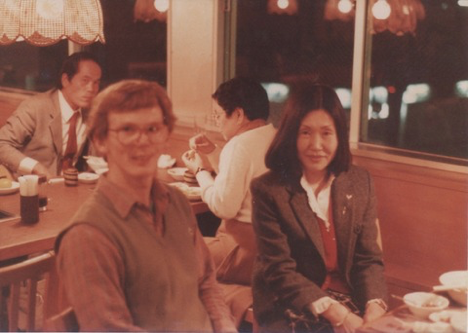
With a friend, Sabina, at a Korean restaurant in Ginza, in 1984
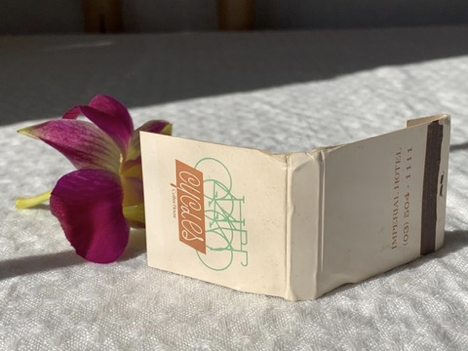
Imperial Hotel ‘Cycles Cafe’ matchbox, 1980s
Which was the most important, to shake hands with the future, or wave good-bye to the past? Frank Lloyd Wright designed the old Imperial Hotel, which once stood across from Hibiya Park, in Tokyo. As for sweet memories, I used to be a regular Sunday morning customer at 'Cycles', a gourmet cafe on the ground floor of the hotel's annex building.The current hotel annex building had replaced Wright’s architectural wonder, in 1967; the year the James Bond film, 'You Only Live Twice' hit the big screne. Once the buffee breakfast was finished, I used to sit and read the morning newspaper, and drink bottomless cups of coffee until it came out of my ears. My sweetest memory of the lot, were the Sundays I met my Korean friend, Sabina Kim, at the cafe. Among my little treasures, was a tiny book of Imperial Hotel 'Cycles' matches. A strange little thing to hold onto for so many years, for I never smoked in my life. In those days, many Japanese did. The cafe in question had long been replaced by a number of gourmet cafes and restaurants, some of which I sampled to try the delicious local and international cuisine. In addition to the book of matches, I still treasured my memories from those days. Ironically, the Wright-designed Imperial Hotel, officially opened on the 1 September, 1923, the same day the Great Kanto Earthquake struck, but survived with minimal damage. A telegram to Wright from entrepreneur, Ōkura Kihachirō, after the earthquake stated: “Hotel stands undamaged as a monument of your genius hundreds of homeless provided by perfectly maintained service congratulations”. Wright had left Japan, in 1922, more than a year before the opening of the hotel. The hotel was the most famous of his works, in Japan. Much of the hotel was destroyed by incendiary bombs in the closing months of the Pacific War. Wright learned of the damage to the hotel, but chose not to return to Japan to oversee repairs. The hotel was occupied by the Occupation Forces, up until it was returned to the rightful owners, in 1952. Time and events had taken a toll on the hotel's foundations, and its days were numbered. The plan for a new high-rise structure was being batted about. The (Second) Imperial Hotel building, finally closed its doors to business, in 1967. Soon afterwards, the wracking ball went to work on the hotel building. Much of the old hotel and the courtyard entrance, had been dismantled and relocated to the Meiji-Mura Museum, near Nagoya. The current (Third) Imperial Imperial Hotel that replaced the old one (in 1968), was not worth penning in my notebook. On the road, I passed a countless number of other buildings, no less apparent than the current Imperial Hotel. The damage was done, the past was the past, and ‘let sleeping dogs lay’, as the idiomatic term advised. There was no space for structural works of art these days in Japanese cities and towns. The mindset was for buildings to be more suitable to the needs of the time. It was not important that buildings be a part of a city's history and culture, and a thing to be proud of in the future. There was no need any more for Pyramids, or Taj Mahals, or Château Frontenacs, or Casa Milà, or whatever.
Done
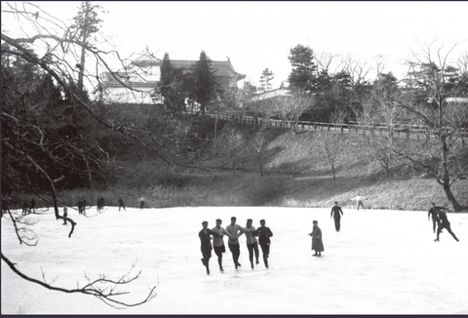
Daini high school students skate on Goshikinuma Pond, 1924 (Tohoku University Archives)
Not only did these imposing iconic buildings stood out for all to see, but they blended superbly and complimentary to their areas, they were part of the history, the environment, the culture, and of course, the future. Long gone were the days of great and beautiful buildings, if not architects, like, Frank Lloyd Wright. A short walk from the castle grounds took me, unexpectedly, to the Goshikinuma Pond. Goshikinuma Pond meant, ‘Five-colored Ponds or Marshes’. This pleasant spot was located in Kita-Shiobara Village in Yama in Fukushima. Even with a little l sign, and sculpture, it was easy to miss the pond. Thankfully, I kept my eyes open. Sendai wsa said to be the place where figure skating was born, in Japan. During the Meiji period, a German missionary called, Georg Würfel (1880-1936), was credited for the introduction of figure skating, to Japan. He taught figure skating to local residents, including his students at Daini High School, in 1909. There were other larger and more famous ponds called Goshikinuma in Fukushima. Goshikinuma Pond, of figure skating fame, was once surrounded by a grove of trees, in the 1900s. Today, the pond still froze over in winter, but because of safety hazards, iceskating was prohibited. In addition to his missionary work, Würfel taught German at a theological school in Koishikawa in Tokyo, for a couple of years. He taught at other schools in Tokyo, including the famous Waseda University, before moving to Sendai, in 1908. Needless to say, the rest was history. Würfel lived in Sendai for close to three-decades, until an untimely death, in 1936. He had worked in Japan through the Meiji and Taishō periods, and was one of several native foreign teachers, in Japan during that time. One of the more noted was Irish-Greek author, Patrick Lafcadio Hearn (1850-1905), who had arrived in Japan years earlier than Würfel, as a newspaper correspondent. Like Würfel, however, Hearn did not hang around for long, and was on the move soon after his arrival. After advice of an Englishman friend, Japanologist and Professor Basil Hall Chamberlain, Hearn became a teacher. In his day, Hearn came to love, marry, and raise a family. He also settled comfortably into Japanese ways, where he gained inspiration for his writing.. Hearn was known in Japan by his Japanese name, Koizumi Yakumo. Hearn's acquaintances, Chamberlain, played a key role in the earliest translations of haiku into English. Haiku was a short, highly structured form of traditional Japanese poetry. Among a diverse range of interests, Chamberlain was best remembered in the literary world for his one-volume encyclopedia -- ‘Things Japanese’ -- published in 1890. One thing foreigners during the Meiji period, in Japan, had in common, was that they were likely the first contacted workers. Fgure skating had come along way since the German, Georg Würfel, first brought it to Sendai. Japanese figure skating champions, Yuzuru Hanyu and Shizuka Arakawa, were born in Sendai, where their illustrious careers started. Another sport was baseball. An American English teacher called Horace Wilson, was accredited with introducing baseball to Japan, in 1872.
Done
The first baseball teams in Amcerica, began to appear around 20-years earlier. The first baseball team in Japan -- the Shimbashi Athletic Club -- was started in 1878. However, it took longer for the sport to catch on, and for other teams and clubs to be established -- Yokohama Country & Athletic Club, in 1868; Keio and Waseda Universities, in 1903. A few days ago, I learned from the NHK TV news that Sendai Ikuei High School reached the finals of this summers national baseball championships at the famous Koshien, a baseball stadium near Kobe, that hosted the games since 1924, when it opened. Sendai blitzed Waseda from Tokyo, 7-0 in the semi-final. The news also spoke of the nuclear reactor in Sendai to be restarted. When I opened the door of my place in Tokyo, the only thing on my mind was to turn on the TV and watch the national high school baseball finals -- Sendai Ikuei faced Tōkaidai Sagami from Kanagawa. Tōkaidai had got off to a good start, and led 2-0 by the first innings. Tōkaidai Sagami went on to win, 10-6. This was the 97th championship since it began in 1915. The 61st Summer National High School Baseball Tournament, in 1979, at the historic Koshien Stadium in Kobe, was the first game that I ever watched, not only on television, but in my life. At that time, I lived in Tobunirima in Saitama, not long after I came to Japan. The final, was between Minoshima High School and Seiryo High School, from Wakayama and Ishikawa, respectively. It was a nail-biting game, which went well beyond the allotted time. Minoshima went on to win 4-3. A number of changes came out of this 18-innings event. Today, high school baseball games did not stretch beyond 15-innings. Should the score be tied, it was rescheduled for another day. That said, I did not care much for television programs. Thanks to a friend, who lived nearby, I was able to watch English Premier League games, with a cool beer. in hand
Done
What happened in Japan and the world on this day????