Irishman Walking (Stage 20 Chapter 2) is about my walking the main and coastal roads of Japan. Summer 2017.
22 Aug, 2017: The first beach I came to, some distance past Horonai, would have been a good spot to have pitched the tent for the night. Most of the beaches I had camped on, usually were. It was now very dark, and I felt tired. Thankfully, the bus stop hut that I stopped at, had a light above its entrance -- aluminum and glass sliding doors. The hut looked as inviting as any to stop the night at. My head told me it would not be the last time a bus stop hut would double as a bedroom for the night. They were great on a rainy or snowy night. When morning did finally show its face, I was well rested and ready for the road. For much of the evening, traffic along the road, Route 238, had abated to only one vehicle, every five-minutes, or so. There was the odd trip in the night to point Percy at a tree. My tinkle reminded me that I needed to replenish my water bottles, better sooner than later. For want of entertainment last night, I tried to tune my iPad into the BBC. As was often the case, I could not connect the WiFI to the Internet. Countless flies of various kinds, on some kamikaze mission, crash dived into the outside light, at the entrance. The ground was covered with tiny corpses. Unfortunately, my company for the evening was one fortunate fly, trapped inside the bus stop hut. How long, the poor bugger would remain alive, I had not the foggiest. If the spiders in the hut did not trap it, the fly repeatedly dove into the glass door, in some mad effort to rejoin its buddies in the war outside. At times, it buzzed around the hut's interior, as if to search for another way out. Then, suddenly, it would hurl itself into the glass nearest the light outside. Sometimes, the fly would drop onto the dirty concrete floor, motionless. Then, after it had nearly killed itself, it would stagger about the floor in every direction, only for the process to began all over again. “Mmm! What a life!” I mumbled to myself. "Surely there was more to life than the antics of an insect", I thought as I sprawled out on the bench. In human terms, the only mad comparison I could think of was a suicide bomber, in the Middle East, people learned about in newspapers and on television. Surely, the flies did not plan to kill themselves. Right? There were about one-million species of flies, of which less then 10-percent had been properly researched and documented. Two large spiders made oppisite corners in the hut their homes, still hard at work on their webs. Last night, when I first entered the hut, I was greeted with a face full of one of the webs. Everything now needed to be rolled up and packed away before I could hit the road proper. My humble breakfast was quickly prepared -- nuts and dried fruit, and the last of a mini sized Sinkers bar, washed down with a few mouthfuls of water from my army hip-flask. "Mmm!" If only I had brought my Capt. Stag gas burner with me, I thought. It was one of a number of odds and ends that I had left it behind in Tokyo, in an effort to reduce the weight in my backpack. It would have been nice if I had boiled water for a cup of tea or coffee in the morning. The gas burner was useful along the road when I stopped to rest. So, I regretted that I did not bring it with me.
Done
To locate a good spot to light an open fire was not always easy. It did not take me long to pack the gear away. Before I hit the road, I decided to write a couple of plain postcards, to friends. Just as I jotted down the last lines on a postcard, it began to drizzle. A small touristy sign pointed in the direction of Gome Shima, a tiny hump of land that poked out of the Sea of Okhotsk. It was not until sometime later that I was able to put right my translation on the island’s name. If I was not mistaken, the word ‘gome’ was the Japanese word for ‘rubbish’. Soon the island was well behind me, as I made my way across the Toinai-bashi. The drizzle continued to fall. A cyclist, his bike loaded up with camp gear, shot past. We both waved to one another. The miserable weather did not seem to bother him, like it did me. The sound of rain had a gentle effect on the old brain, but out in it was another story. What I did not want was rain-laden winds. All that was in my head at the present, was to keep an eye out for a bus stop hut, to stop awhile. What I needed to do was to tape up the soles of my feet. Fortunately, it was not long until a hut popped into view. Unlike a lot of places I tramped along, this segment of the road had a fair number of bus stop huts. On the road under the elements all day long was not for the faint hearted. When I set on the bench, and removed my sandals and socks, I saw that I still had the medical tape on my feet from yesterday. Thankfully, all appeared well -- no early signw of blisters. In away, it was pointless to remove the tape, and added a little more on top, for what it was worth. A glance out the window of the hut, told me that the drizzle had stopped. The sky did its best to brighten up. All the same, there was still some heavy cloud cover, so anything could happen. Life on the road looked good, at least as I closed in on the homeward stretch of my mission. It was only a matter of time, before everything was done and polished. Strangely, was not feel overly happy about it all soon to end. Life on the road had become a part of my life, since July 2009 -- nine-years of mental and physical struggle. It felt like I was about to lose something that had become important to me. To rub shoulders with strangers -- memorable times with beautiful people. A little earlier a road sign told me that I was nearer to Esashi than I had thought, some 37-kilometers away. It was a good days walk, if I pushed myself. There was just one wee problem. I was in no hurry. Everything in life came to an end soon enough anyway. Up ahead, a white van sat parked at the side of the road. The driver of the van, a white haired fellow, perhaps in his 60s, stood by a fence, his elbows on it. He seemed so preoccupied with a large field, that he did not notice me. There were many dairy farms in this region of Hokkaidō. In my country, Ireland, about 5-percent of the work force was involved in agriculture, and crops and pasture occupied around 70-percent of the land. Because of the climate and soil, and the small size of the holdings, in Ireland, the land was best suited to livestock farming. Less than four-percent of the labor force worked in argriculture, in Japan.
Done
Farm signpost names photos???
All in all, cultivable land was short, as were its industrial minerals and natural resourses. In Japan, less than 25-percent of the land had been made cultivable, in 100-years. Only 20-percent of the available land in Japan, was cultivated. Most of the farms, in Japan, or more than 55-percent of the arable land, was used for the production of rice. This made rice the main yield, followd by barley and wheat, among other cereals. All the same, most of the country's wheat, barley, and soya beans were imported. On an added note, the growing or rice, like many things that made their way to Japan, was indebted to Chinese and Korean influences. Some of the farms in Hokkaidō had quaint, and many had artistic signposts with their names on them. Often the signpost caused me to stop a moment to take some snapshots. Like Ireland through the years, Japan augmented its food source from the sea, with one-percent of the labor force employed in the fishing industry. The Japanese loved their fish, and most of the animal protein came from seafood, which included harvesteed seaweed. The Japanese had been involved in whaling for hundreds of years, and on a modern scale since the 1890s, which included outside Japanese territorial waters. When I got nearer to the man, he turned his attention away from the field and stood, and looked at the van, this time with his hands on his hips. “Mmm!” A penny for your thoughts, I mumbled to myself, as I passed him. Still, the man did not seem to notice or hear me. Then suddenly, as if the heavens had opened up, he called out to me in a loud voice. “Hey! Where you from? Amelika?" So, I turned my head and looked back, and replied, with a smile: “Yes! Amelika.” The man’s face appeared expressionless, his hands remained firmly planted to his hips. Another road sign told me that I was less than 30-kilometers from Esashi. The road took me past the uneventful little town and farmland regions of Fureppu and Otchube, part of the Esashi District. Another road sign pointed straight for Central Esashi and Wakkanai. The sign also pointed left along a minor road, Route 1023, for Utanobori. Utanobori was granted town status in 2004, and became suburb of Esashi, in 2006. Today, the town had a population of more that 2,300. The original Ainu name for Utanobori was, 'Uta-nupuri', which meant ‘mortar shaped mountain'. At long last, I arrived at the town of Otchube where, thankfully, a Seicomart, stood as if the convenience store awaited my arrival. The name Otchube evolved from the Ainu word, ‘o-cis-un-pe’, for ‘wavy river’. Needless to say, I made right for the store. It did not take me long to gobble down a dish of cool noodles that I bought at the store. A small apple pie, that I also picked up, soon headed in the same direction; washed down with a cup of coffee. This was made possible by a thermos flask, which such stores always had at the ready. Lunch was rounded off with a cool can of Sapporo, which, in a way, made life on the road all the more worth while. The nimbus clouds, to use the ancient Latin word, were gone. With no sign of rain, the sun made itself felt, each time appeared from behind one of the now fluffy clouds.
Done
A large Honda motorbike pulled off the road and stopped in the carpark of the store. Printed on the side of a gas tank I passed, were the words -- ‘Beyond the Stratosphere’. Often times, when a large motorbike sped past, my throughs drifted back to my own motorbike, in Tokyo. Another large motorbike pulled over and stopped by the side of the road. When I drew near, to my pleasant surprise, the rider handed me a sports drink. The time could not have been better. He handed me the PET-bottle gift, without a word. The unexpected encounter had startled me a little. All sorts of things happened on the road, but you never knew what or when until it happened. Just as sudden as the man held out his hand and the bottle for me, I reached out my hand, almost automatically. “Wow! Thank you!” Without uttering a word, the rider turned his motorbike back onto the road, and as quickly as his appearance had been, he sped off like there was no tomorrow. As I was headed in the same northernly direction as the rider, I wondered if I would see him again. In 1985, I made a trip around this great northern island on my bicycle, but I could hardly remember anything about it. One thing I do recall, about that time was that the whaling ships were unable to leave their ports. Anti-whaling groups, like, Greenpeace, and opposition from foreign governments for the protection of endangered species, such as, the population of the Southern Hemisphere minke whale, had long been a headache for the Japanese government. The soft drink was not as cold as the ones just bought from a vending machine or stores. Still, I was glad for it, and the bottle was half empted, even before the motorbike had vanished from view. "Mmm!" The rider may have taken it from his own supplies, I thought, as I drank the rest of it. My supply of water was low, and wondered how long it would be to the next store. Here in Hokkaidō one could tramp for hours, and not see a vending machine. The Japanese never failed to amase me with unexpected gestures of kindness. All that I could do, after stuffing the empty PET-bottle into the backpack, was to get my arse into gear, in the hope I would find water soon. A number of small towns dotted about the farmland regions. Towns like Yamausu and Tokushibetsu popped up, here and there, then they immediately fall away, and out of sight. Often, a town had namesake bridge, over a winding river (e.g., Otcharabe-gawa), which I had to cross to enter or leave them. In the Autumn season, salmon could be seen swimming up the Otcharabe-gawa, which ran through the Esashi. There was also a fish cultivating farm on the river. The river passed through Esashi District of Hokkaidō, along Route 238 on its way into the sea. Yamausu Fishing Port, was also famous for its pink salmon. The 44-kilometer long Tokushibetsu-gawa, drew many visitors to enjoy Canadian-style canoeing, and salmon and trout fishing, at designated locations along the river. Many of the places I passed on the road were not even villages, but a few houses and buildings. At times, the machinery scattered about them told me they belonged to a farm related industry. There was no better way to install discipline in a person than a long distance walk.
Done
A failure to learn from the trials and tribulations on the road had a screw missing. As I was on the home-run leg, felt in no hurry to get anywhere quickly. A road sign for tourists, I was near a Michi-no-Eki, a roadside station called Marine Island Okashima, just five-kilometers away. The design of the main building of the roadside station resembled a ship, moored by the Okhotsk Sea shoreline. More than enough calories had been burned off, so this was a good spot to wrap things up for the day. Besides, I needed to replenish a few supplies, and fill my water bottles, therefore, the roadside stations were indispensable. The Michi-no-Eki system was first launched in the mid-1990s, today they could be found in every prefecture throughout Japan. The last number of kilometers led me past Yamausu Town and then Tokushibetsu Fishing Port. Any one of the places, including one of the riverbanks that had past, appeared good places to make camp for the night. Like everywhere, the town of Okashima came and went, as did the tiny Tokushibetsu-bashi, a bridge that spanned the fast flowing Tokushibetsu-gawa, on its way to the sea. Decades earlier, a large number of salmon (around 12,000), died in the river. The primary cause of the death was a toxic substances that seeped from the Motokura Metal Mine, in 1961. Another 20,000 salmon died in the following year. Today, the Tokushibetsu-gawa was noted for its eel farms. Eel farming first began in the Fukugawa area of Tokyo, in 1879. Many visitors stopped by to swim in the sea, fish, to gather clams on the shore, and to enjoy the river in a Canadian-style canoe. Some 50-meters from the beach, I set down to pen a few things into my tattered notebook. A couple of kilometers along the road, I made another stop, this time at what looked like an venture park for children. It had a large wooden structure, with a series of ropes and a slide. However, unlike the many vistors to the roadside station, the park appeaered devoid of anyone, especially children. Perhaps not enough research had gone into the plans to build the venture park project. What happened to all the expected children? Suddenly, at the northern section of the park, a young boy, about eight-years old, showed up on his bicycle. A baseball cap, too big for his head, was hung from his back. Perhaps the cap had belonged to an older brother. “Konichiwa!” He said, as he passed me by. I replied in kind, with a smile. Far off in the distance, I could just about hear the sound of motorbike engines being raved up. No doubt, a gang of young bōsōzoku were out on their rounds on their customized motorbikes. “Mmm!” Momentarily, I wondered if they had once been polite little boys, like the child that had just peddled away. The bōsōzoku were mainly made up with young gangs of delinquent youths, who had little between their ears. Nelson Mandela once said that education was the most powerful weapon for changing the world. If only the young delinquents would leave their bikes and return to their books. With dwindling numbers, the bōsōzoku were fast becoming a dying bread. In recent times, the few that I saw in Tokyo, rode small 50-cc scooters, as opposed to the larger customized motorbikes their predecessors.
Done
They could still be heard them before seen. Unlike the junk the bōsōzoku rode, I had long been a lover of large motorbikes, particularly the low American-style motorbikes. The road led me past Hiyoriyama-jinja, a small shrine around 600-meters on foot from Yamausu (Tokushibestu) Fishing Port. Okajima-inari-jinja was home to the kami of agriculture, fertility, industry, and prosperity, sake, success, tea, and the fox. It was said that Inari descended from heaven on the back of a white fox. The kami was also the patron of a host of professions -- blacksmiths, merchants, swordsmiths, and warriors, etc. Inari Ōkami was one of the main Shinto kami. More than a third of the Shinto shrines and a number of modern corporations (e.g., Shiseido), in Japan, revered the kami Inari. The state of the neglected shrine told me that it could do with some of the prosperity itself. The area had many foxes. One cunning fox had stolen a 500-milliliter carton of milk that I had just bought. After a while, the road led me past the Hamanasu Koryu-hiroba Free Camping Ground. For a moment I considered stopping the night, but pushed on instead. There were a number of free campsites in Japan, especially in Hokkaidō. On weekends and the peak summer season, it might be a good idea to make reservations first. The road led me over the 250-meter long Horobetsu-bashi, a bridge about two-kilometers north of the campground. The bridge spanned the Kitami-Horobetsu-gawa, a river that flowed through the fertile Esashi region to the sea. The coastline was a breeding ground for a variety of wild birds. One was the 'osprey', a bird of pray, called 'misago' in Japanese.
Done
23 Aug, 2017: As hoped, my tent was pitched on a rich sandy beach, at a place called Marine Island Okashima. This was near a cold water tap, which I knew would come in handy. The front of the tent faced a calm Okhotsk Sea, where I hoped to take a dip. Unfortunately for me, the faucet did not work very well. The water trickled from the tap, then suddenly gushed out. Therefore, it was not easy to wash clothes. After a while, the washing was done and hung to dry. In the early part of the evening, I set about building a campfire. At first, my intention was to boil water for tea or coffee, but then I decided to go the whole hog and prepare a pasta dish. This was soon done, and turned out to be damn good, if I may say so myself. Life on the road was a hungry one. I felt the hunger more than at other times. If my maps were to be believed, I was less that 10-kilometers from Esashi Town. The town was located in its namesake district, in the sub-prefecture of Sōya since 1869. It was also a reminder that I was nearer to the conclusion of my misssion. Not long after the end of the Pacific War, Esashi was granted town status, in 1947. Later, in 2006 the towns of Utanobori and Esashi merged, to expand the population of the district to about 17,000. According to the September, 2016 census, Esashi had an estimated population of 8,578. The residents of the region enjoyed a humid subtropical climate, thanks to the tsushima-kairyu -- warm ocean currents. During the winter months, Esashi region experienced less snow than other parts of Hokkaidō. Many of the place-names in Hokkaidō, Esashi came from an Ainu word, ‘Esaushi’, which meant ‘cape’. Hokkaidō was an island of capes -- Kamoiwakka, Nosappu, Shirakami, and Sōya, to name a few. The mose important cape to me, Cape Sōya. At first I thought it might be a good idea to stop the evening in Esashi, at a business hotel. The town turned out to be a local kind of place, my hope was quickly extinguished. A rich sandy beach was much better than any hotel room, with beds that had other peoples bed bugs. The gear was soon dismantled, rolled up, and put away. My washing was not very dry, because of the damp evening air. The rising sun and warm morning breeze, encouraged me to hang the damp clothes and gear up to dry. There was the hurry. A humble breakfast included dried fruit, and a piece of chocolate. Breakfast was said to be the most important meal of the day, to prepare for the day ahead. At least I felt the positive effects afterwards. With the gear properly packed away, and the old teeth brushed, it was time to get back on the road, where life really started. There was a planned stop at Esashi, where I hoped to pick up some supplies. A little earlier, a local had told me that shops and restaurants were few and far between. Like I penned earlier, I regretted that my gas burner back in Tokyo. What the hell, the damage was done, and that was that. “Mmm! Everybody made mistakes. Right?” I mumbled to myself, as I tried to focus my mind more on the road ahead. After a short distance, I stopped at a Michi-no-Eke, a roadside station, to see what was on the cafe's menu.
Done
At the cafe I treated myself to something more substantial than the usual convenience store lunches that I had become used to. A plate of tonkatsu teshoku, a deep fried pork dish, with rice, pickles, and a bowl of miso for good measure. The food was soon placed on the table in front of me. Needless to say, my lunch was washed down with cool can of a local beer -- Abashiro White Ale. In no time at all, the adrenaline rushed through my body, and I felt ready for any challenge that heavens cared to toss my way. However, I did not really need to feel that way, for I was already I was well ahead of my schedule, and did not have to push myself to make distance. Esashi Town was nearer than I had cared it to be. As this was the final leg of my mission, with 99-percent of it done and polished, there was absolutely no need for me to hurry. My flight at Wakkanai Airport to Hanada was booked for Saturday, 2 September, in 10-day time. A phone call from my daughter Anna, informed that her mother would spend some time at the teacher’s hospital in the Ochanomizu part of Tokyo. At first I imagined it was noting serious, like an operation, on a life threatening matter.
There was something said about the possibility of an amputation. This was a serious matter for anyone, particularly for a member of the female gender. Kikuyo an I had remained friends since our divorce years earlier. After Anna ended the call, I placed a call to my ex-wive at the family home in Tokyo, but there was no answer. Not very much later, my cellphone rang. It was from Kikuyo-san. She gave me a rundown on family events and her expected time in the hospital. As she would be undergo a number of tests, it was not necessary for me to return to Tokyo, at least immediately. Before we hung up, I told her that I would stop by and see her at the hospital or at home, the moment I returned. I did not tell Kikuyo-san that I would not be for 10-days. It was important for her to remaim positive. She made some mention of my Aunt Nellie and cousin Roseanne, who visited Tokyo in the late-1990s. They stayed with us at our home in Adachi-ku in Tokyo. My wife Kikuyo and daugter nine year old daugher Anna accompanied them on a Shinkansen journey to Kyoto. The visit had left us all with fond memories. At that time, my aunt had an artificial leg, caused by diabetic issues. My aunt was definitely the most positive-minded woman whom I had ever known. Her positive outlook on life impressed me, which enriched my views on things. Her life had been far from smooth, which I would not go into here. By the time my aunt finally did take her last breath, a decade later, her other leg had been amputated, below the knee. Both were the only close relatives who bothered their arses to make the long journey out to the Land of the Rising Sun to visit us. “Mmm!” Was that why I considered Roseanne my favorite cousin and Nellie my favorite aunt, now gone, but not forgotten, to use the idiom. Replenished and a quick glance over my maps, before I left the restaurant, told me that the town of Hamatonbetsu was the next big stop after Esashi. A friend told me on the phone, there were no shops between the two towns.
Photo of Aunt Nellie???
Done
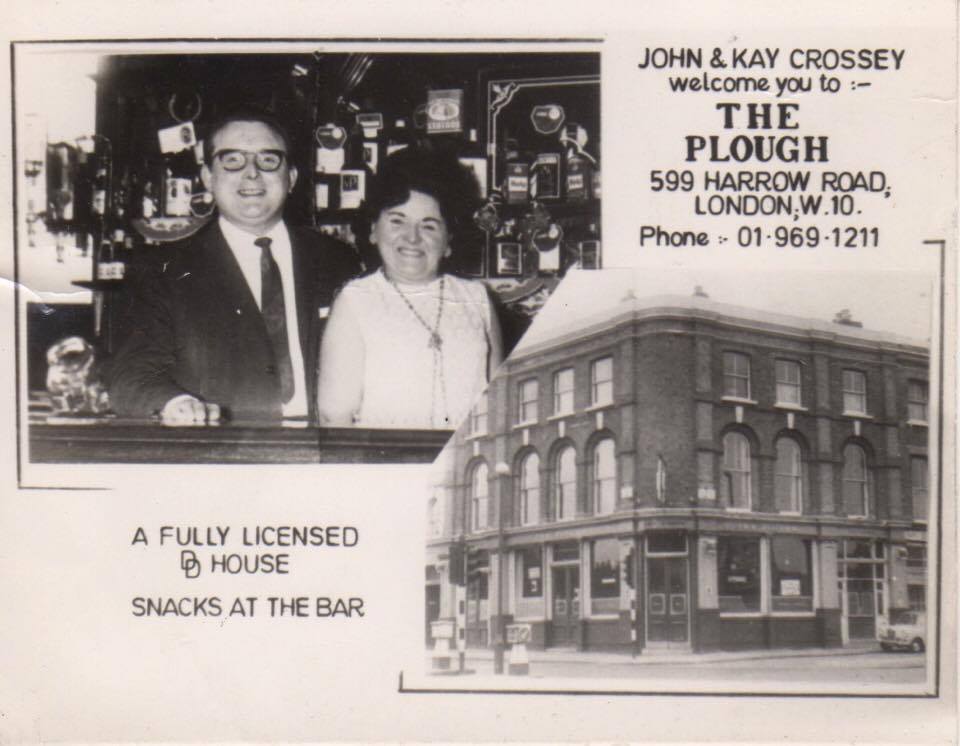
Therefore, I should pick up what I needed when I reached Esashi. Back on the road, a sign told me that Central Esashi was eight-kilometers away, an easy one and a half hour tramp. The road led me past Shimohorobetsu, and then across an attractive steel girder bridge, called Horobetsu-bashi. The bridge spanned the Kitamihorobetsu-gawa. Shimohorobetsu was part of Esashi, and like so many places, it once had its own local train station. Years ago, I lived in a public house called 'The Plough' across from St. John's Parish Church. The pub was located on the corner of the Harrow Road and Ladbroke Grove, in London. The famous Harrow Road skirted the equally famous Kensil Green Cemetary, a place of rest for many noted and not so noted people. My father managed the pub from 1969 to 1971, when we moved to greener pastures on the outskirts of London. In those days, when I went to my school (St. Edmund's R.C. Secondary School), I often walked down Ladbroke Grove, over a rusty old girder-bridge that crossed the canal. Whenever I spotted such a bridge, my mind shot back to my London days. On a recent visit to the Swinging City, not that I lived in London in the 60s, I was happy to see how attractive the bridges were, including the girder-bridge. For me, girder-bridges were the most attractive of the lot. Like many pubs and buildings, the Plough had long been demolished. The route that the Harrow Road followed had remained unaltered since ancient times. Ladbroke Grove itself was named after a nineteenth-century landowner and developer, called James Weller-Ladbroke. It ran north to south, from the Harrow Road to Holland Park Avenue. Weller-Ladbroke developed a namesake estate, in the 1840s, originally a rural area on the western edges of London. Construction at the southern end of Holland Park Avenue began, in the 1830s. The development, however, did not fully reach the Harrow Road, until the 1870s. An English artist and illustrator, called Hablot Knight Browne (1815-1882), who used the pen-name ‘Phiz’, lived for eight-years at No. 99, from 1872. His illustrations appeared in a number of Charles Dickens’ novels. In my early-20s, for some reason, when I first settle in Tokyo, I used to tell people that I majored Dickens at university. This was a white lie, as I had not even seen the inside of a university at that time. In time, a road sign pointed left along Route 12, a minor road that led to Utanobori. A cool southwesterly wind blew in from the coast, and was most welcomed indeed. A second minor road, this time Route 1069, took me nearer to Esashi. There seemed little point to stay on Route 238 for Hamatonbetsu, as some locals told me that shops, if any, were few and far between. The road that I needed to take, was not for another 32-kilometers. It surprised me that the main drag, Route 238, did not have more shops and restaurants along it. It was a popular coastal road, first opened in 1953 as a second-class National Highway.
It was upgraded to a General National Route, in 1965. One good thing about getting off the main drag, was to stop to ponder and photograph things of interest, mostly the sscenery.
Done
The road led me across the Chidori-bashi and the slow marauding Keinnai-gawa the bridge spanned. It was an attractive river, as rivers went, I felt, as I headed over the bridge. By now, my mind had been made up, not to push on any further. What was the point of hurrying? I felt, as I entered the southern outskirts of Esashi. It would not hurt any to stop and rest, so soon after my previous campsite on the beach. Cape Sōya, my goal, was not so far away. When I got there, I could camp for a day or two, but not for too long, for the boredom. I still recalled when I was stranded there four-days, in 2009, because of heavy rain. Therefore, I knew the place well enough. Tomorrow would be time enough to make my final push. Along the way there were a number of parks that had wooden benches and picnic areas. When the sun went down, I hoped to pitch my tent in one of them. This was finally done at a park called Miharashidai, which meant: ‘lookout’ or ‘observation platform’. The name meant sense, as much of it could only be reached by steep steeps. There were some private houses, dotted about here and there. Experience taught me to distance my presence as far away as possible, from the occupants. As I looked for a spot to pitch the tent, the popular and long sasting BBC television series of the 1950s, ‘Dixon of Dock Green’ popped into my head. The series focused on the daily routine of a fictional London police station, with the understanding Police Constable George Dixon, played by Jack Warner. A sole elderly man was walked his dog, but he did not pass through the park grounds. The lower segment of the park was nearer to the main drag, Route 1069. There, an attractive looking fountain shot water about three-meters up into the air. What I needed to do was to pay a visit to the 'jacks', to use the Elizabethan slang for toilet. Thankfully, there was a public toilet, which I hoped to make use. When I did pay a visit to the WC, I was happy to learn that it was clean and well maintained. There was a car parked at the toilet building, so I decided to wait for the driver to be on his way. On the upper segment of the park, near where I pitched the tent, there was a hardcourt, but no tennis players. As far as I could make out, there appeared to be another segment of the park on the far side of the road. All in all, the park appeared to be well maintained, orderly, with a smell of freshly cut grass, as if thrown in for good measure. On the downside, many of the wooden benches were home to a fair amount of bird shite.
Done
24 Aug, 2017: The rain bucketed down through the night and early hours. So sleep was very much a stop-start affair. Even after 09:30, I still waited for the rain to let up. Away in the distance the sound of the deep resonant sound of thunder added to the mornings entertainment. Often nature provided the background music, like the climax of a play about to unfold. “Mmm!” Momentarily, I wondered if the thunder had already passed, and that things were about to improve. Wishful thinking! A week earlier, a friend in Tokyo had forewarned me about heavy rain in this northern region of Hokkaido. The prediction had proven accurate, particularly over Thursday and Friday. Like a fool, I had forgotten my umbrella in Oarai. My mind had been preoccupied with my gear and the ferry crossing. A study of my maps told me that my next big stop would be at a town called Hamatonbetsu. It was a small town with a population of nearly 4,000, and steady decline over the years. As with many locations in Hokkaido, the local economy leant towords dairy farming and crab, salmon, and scallop farms. Hamatonbetsu was noted for its freshwater wetlands area home to many migratory birds, particularly swans on their winter journey from Siberia. That was around 30-kilometers from my current location, Miharashidai Park. There were a number of parks in Hokkaido with the same name. The rain continued to lash down on top of the tent, with no indication it would let-up. The road, Route 1069, would join up again with the main drag, Route 238. One good thing, the minor road followed the coastline. Further along, the road headed inland, northwest for about 30-kilometers, before it rejoined the coast. In my notebook, I refered to this segment of the road -- my ‘homeward stretch’ -- a part of reality that I did not feel ready for. What bothered me for the moment, however, was what to do about this rain? Farmers loved the rain, which equated to profit for them. For me, life on the road in the rain, was a kind of poison, a violation of my wild soul. The rain made the the remaining distance seem longer and heavier. If only a Shinto god, Raijin, the daity of rain and storms, could make a few changes -- this final stage have a far-awayness about it. That was how the previous spring, summer, autumn, and winter stages had felt. On my way out of Esashi I made a wee stop at a Seicomart to pick up a few thingsm which included a bottle of red wine. Earlier on the road, a local man told me that there were no more shops until I got to Hamatonbetsu. Needless to say, I was in no hurry to reach the town. By the time I hit the road again, the rain bucketed down like there was no tomorrow. After a while, it was downgraded to a drizzle. No thanks to the elements, life on the road remained miserably uncomfortable. For a while, I was unsure whether I should rejoin the main road, Route 238, or not. That was until I stopped a police car to ask. Actually, I was the last person in the world who would stop a policeman or woman for information. More often than not, it was their nature to stop me. When I lived in Nishiarai, the police regularly stopped me for questioning.
Done
They had done it so often that I decided to relocate to a new address. Like in many countries, unregulated occurrencesn of racial discrimination was an habitual part of life in Japan. In recent times Japan had experienced a record influx of foreign residents and tourists. In a recent survey (2016) commissioned by the Ministry of Justice, it was found that 40-percent of foreign residents in Japan had experienced housing discrimination, myself included. It had been reported that some 60-percent of the Japan Property Management Association was reluctant to accept foreigners. Concern over communication was cited as a main reason, but that was another story for another time. An aging population had forced the hand of the local governments to booster the labor force. In recent years, foreign workers, and residents, in Japan increased. Currently, one in 10 young people in the country came from overseas, particularly, from China and South Korea. (A recent census (2018) showed that 97.8-percent of the population were of Japanese origin). The police car slowed down and stopped. The policeman at the wheel looked at me, as if to wonder if something was wrong. At first, the police car drove a good 25-meters past me, before it suddenly stopped at the side of the road. A middle-aged fellow got out off the car, and made sure his uniform was straight with both hands. We met about halfway. The rain had begun to make itself felt, again. Thankfully, the policeman was polite, and gladly pointed out the correct way for me to take. With no questions asked, our meeting did not take more than a few minutes. Soon I was headed off in the right direction, and the policeman hurried back to the car. He seemed happy to be behind the steering wheel again, for by now the rain really bucketed down. As I made my way along the road, in the rain, it interested me to note that the same police car suddenly drove out from some side-streets. When I thought about it, I felt that the policeman had, in a roundabout kind of way, followed me. Perhaps he wanted to make sure I was headed in the correct direction. It was often not easy to get out of cities, for a lack of signposts, or in this case Esashi Town. Not long after I did get out of the town, I made a short stop at a bus stop hut, to jot down a few things. It was near impossible to write in the rain, for fear of ruining my already tattered notebook. A touristy road sign that I passed earlier pointed to a place called: ‘Senjoiwa’. Like much of the Hokkaido coastline, the Senjoiwa region was a very scenic spot, particularly on a good day. One such spot included the Usutaibe Senjoiwa, a rocky seashore along the cape, which had remained uncunged from prehistoric times. This rocky seashore was located near Esashi, and became part of North Okhotsk Dogen Prefectural Natural Park, in 1964. The rocks reminded me a wee bit of the Giant's Causeway in Ireland, with it's interlocking basalt stone columns, a natural wonder, the result of ancient volcanic eruptions. Esashi was also famous for its location for its namesake crab festival, and the production of harvested King Crab. Hokkaido had the most hot springs in the country, many located in the Esashi region.
Done
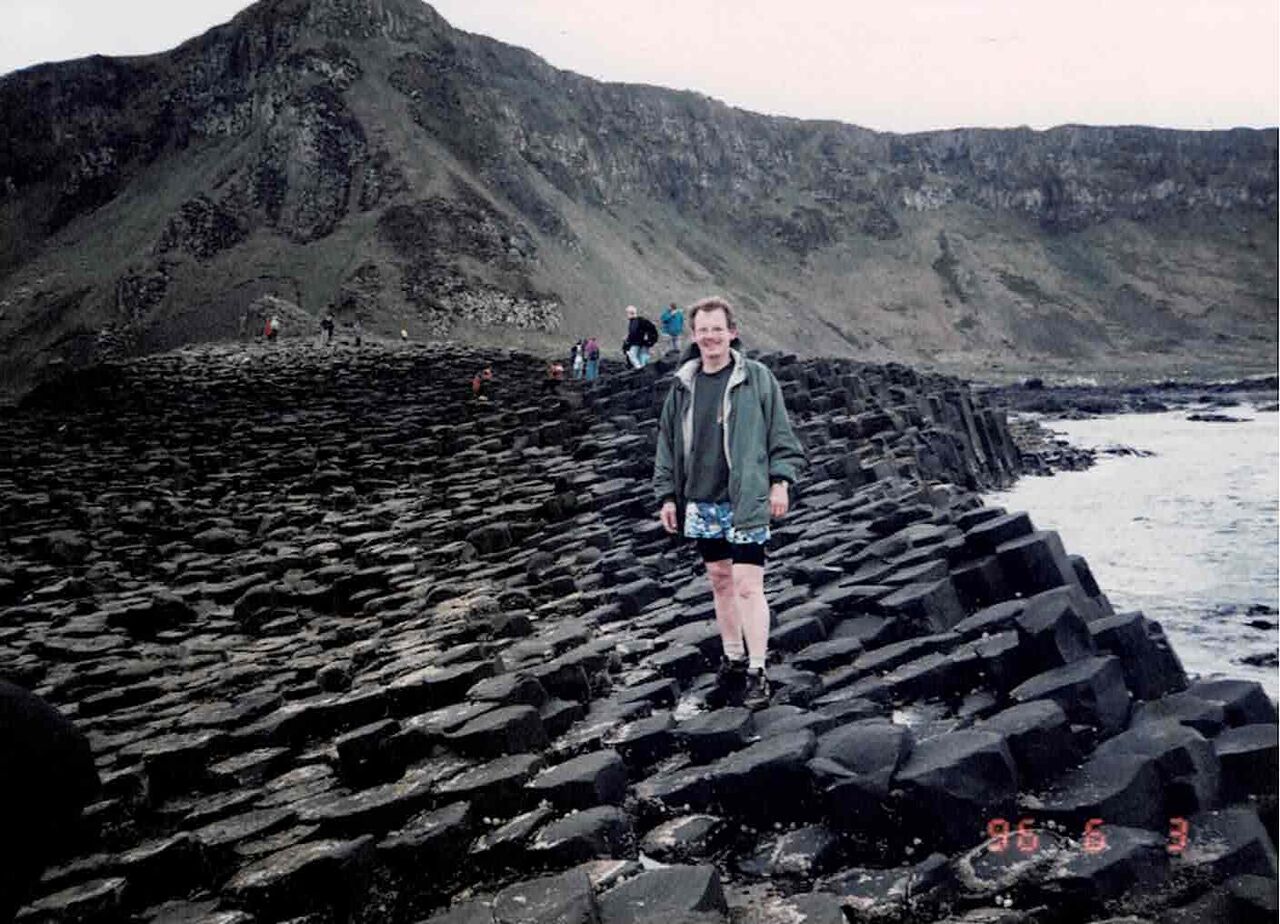
A visit to the Giant's Causeway, in the 90s
Done
26 Aug, 3017: Camp was made about three-kilometers from the town of Asajino, less than 50-kilometers from my final goal, Cape Sōya. The patch of ground I pitched the tent on was nice and dry. Thanks to a couple of large stone monuments and a two-meter high incline, the tent was also protected from the wind. Asajino, a little short of 1,100-kilometers from Tokyo, on the outskirts of Sarufutsu Town. During the Pacific War, Korean POWs built an airfield in Asajino. The POW camp was located near village of Sarufutsu. Approximately 80 POWs died during the construction, from abuse and malnutrition. Fortunately for the allied forces, the war ended before the airfield could be completed. Any trace of the airfield site had just about vanished. In recent times, the village had planned to erect a monument to the Korean POWs who died. Rightwing nationalist objections and threats, however, poured cold water on any such plans. Today, Wakkanai Airport serviced the area with regular flights. Apart from the time I dragged my weary body from the tent in the early hours, sleep had turned out to be relatively peaceful. The morning air proved chilly. The tent was not exactly comfortable. At one point I put on what clothes, clean and dirty, to keep warm. Thankfully, the dirty clothes not wet from sweat or dampness. When I finally awoke in the morning, it was not to the sound of the traffic or the birds that chirped away in the trees, nor even to the morning sun that shown into my eyes. Rather, the distant sound of thunder told me that I needed to get everything ready for the road, even if I was in no great hurry. Even though it was 09:20 sharp, rather late on previous occausions to hit the road, for once the time seemed on my side. My washing was quickly retrieved. Yesterday evening, I hung it over a rope, tied to two trees, behind the monuments. Not two-minutes later, the rain started to fall. The thunder rumbled away for a good while, after the rain had stopped. Regardless of the distance left, to my goal, and the uncertainty of the weather, I could not linger any longer. A final push awaited me. But not until I ate a humble breakfast first — two bread rolls, a banana, and some dried fruit and nuts. The ground was wet, so I did not bother to build a fire for a cup of tea or coffee. Everytime I thought about a campfire, I thought about my gas burner back in Tokyo. A glance at the monuments told me that othing was dry. A few snapshots might be a good idea, before I hit the road proper. The design of one of the marble slabs interested me. By now the heavy clouds had moved south in the direction of Tokyo. Still, I would hate to gamble on what might follow later on. The morning's weather seemed colder than usual. Not very long after my notebook was put away, a strong wind kicked up, soon followed by a sudden downpour. The tent had faired better in the night than previously. The place I had picked to pitch the tent last night, was better sheltered, and I took special measures to peg it down well. Fortunately, the snapshots of the monuments and surroundings, were taken before the rain fell. All that I could do for the present was to settle down to my humble breakfast, and hope that the change in the weather was a change for the better.
Done
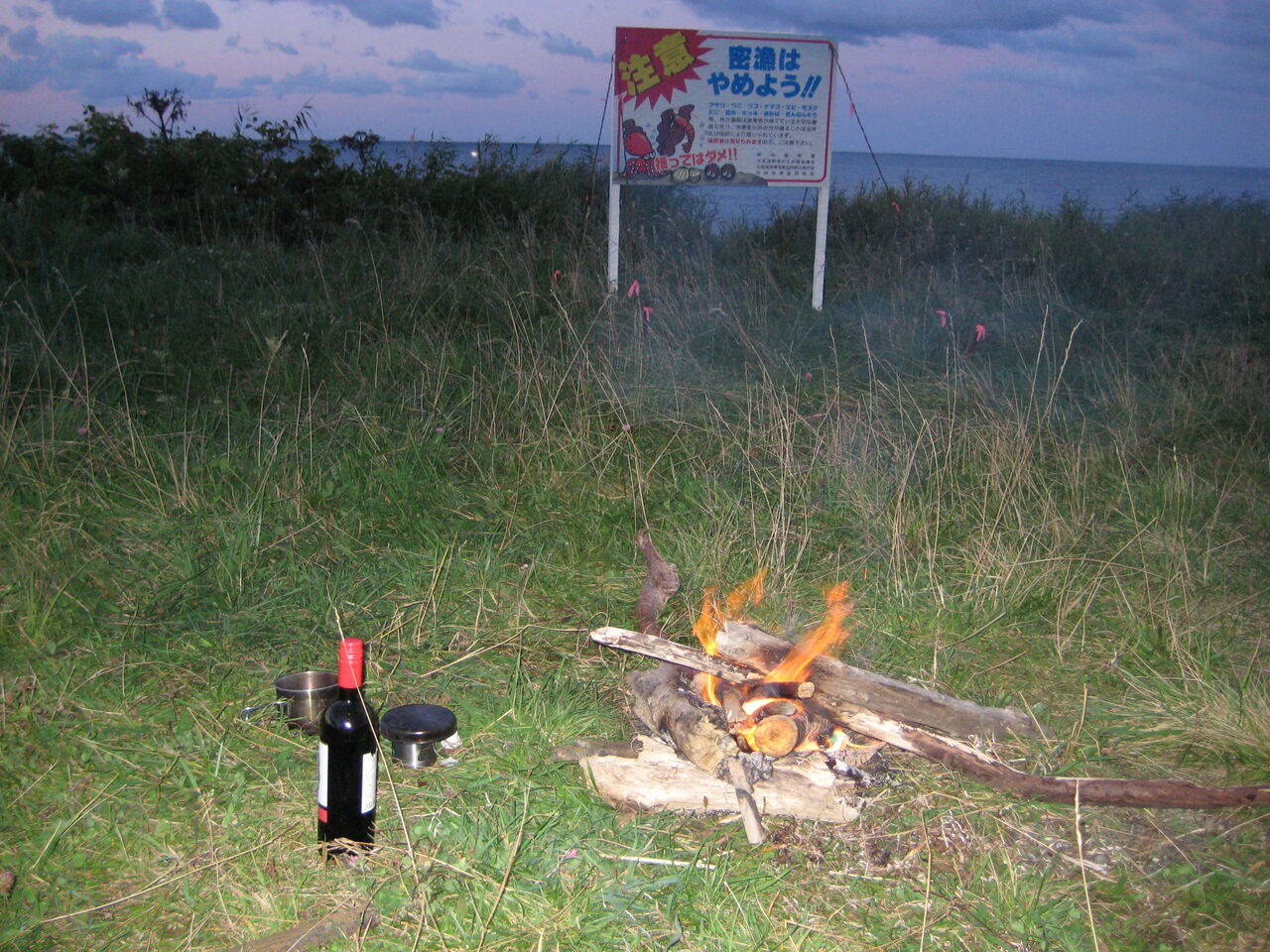
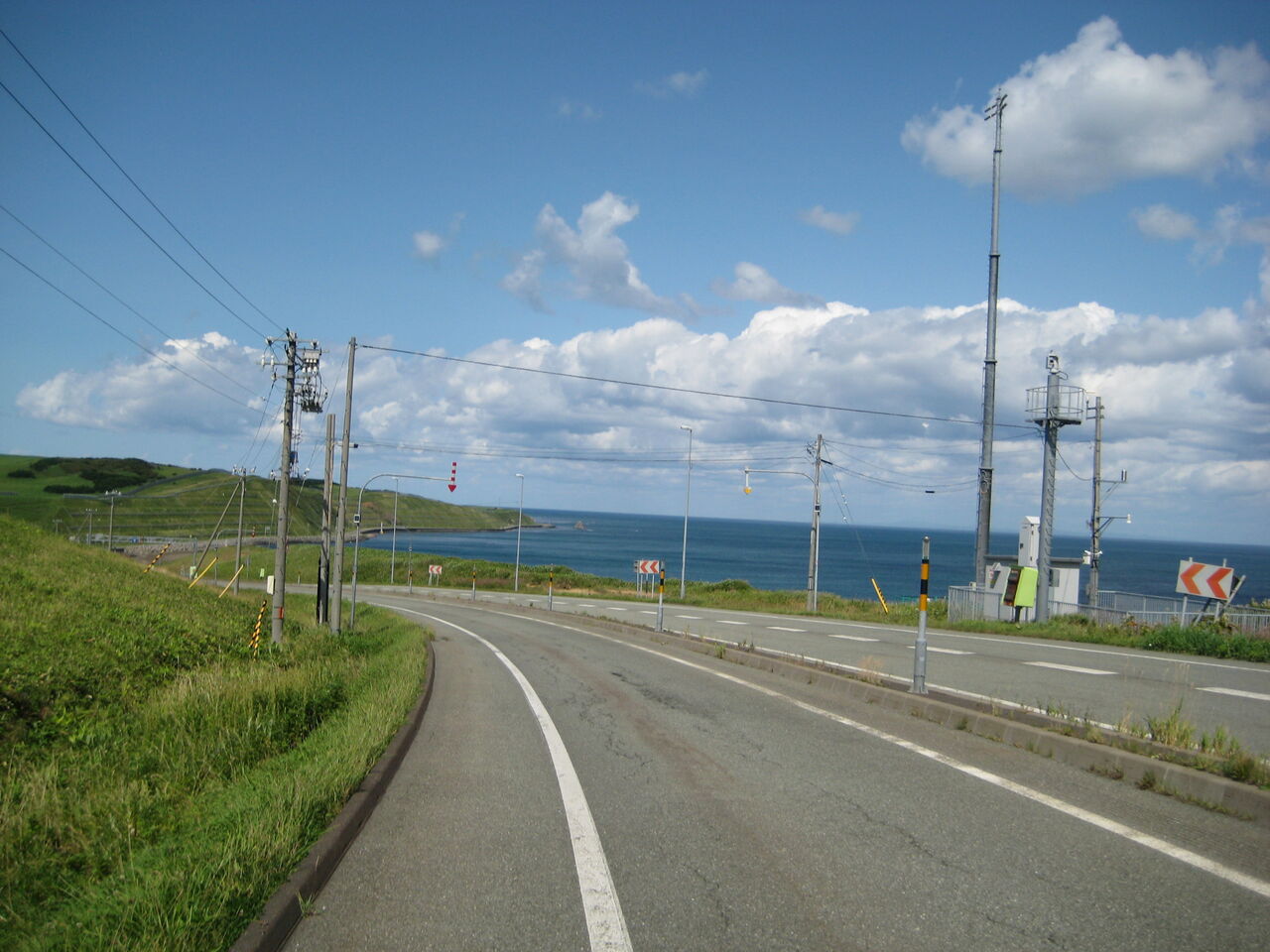
The sound of the oncoming traffic was heard shooting past up on the main drag. What I would not give for a hot cup of strong tea, with milk. Last night I had felt the same about a cup or two of red wine. A British pathologist called, Matthew Baillie (1761-1823),once claimed that tea and wine, as 'caused human destruction'. What bottered me for the moment was how to dismantle and pack away the wet gear smoothly. There was another spurt of rain at noon, as I set off along the road. The rain fell so suddenly, I needed to drap the outer tent fabric to shelter under, backpack and all. Experience had taught me to keep the tent fabric, at the ready. The rain lasted about five-minutes, still everywhere around was saturated. Soon I would pass through Asajino in Sarufutsu Village, the northernmost village on Japan. By area, it was also the largest village in Hokkaido. Sarufutsu was just 20-kilometers away, and would be my stop for the evening. Sarufutsu was part of a vast area, located on the Tonbetsu Plain. A minority of the land made up farmland, most of it given over to forestry. Nearly 70-percent of Japan was forestland. If only the same could be said about my own country. (Or a lot of places in the world, for that matter). The national forests made up more than 50-percent of the total forestlands of Hokkaido. This saddened me a wee bit, since Hokkaido was about the same size as Ireland. One dark spot in Irish history, had to do with forests. Up until the sixteenth-century, Ireland was thickly forested with alder, ash, blackthorne, hazel, holly, and willow. the forests had been profitable for the landlords who striped the windswept Emerald Isle of its trees. Today, in the northern part of the island, in particular, rough grazing and permanent pastures, took up about 37- and 49-percent of the land, respectively. The main arable parts of Ulster, were in the lowlands of a freshwater lake, Lough Neagh. It was the largest lake in Ireland, responsible for over 40-percent of the water to six of the nine counties of Ulster. Many areas of the world had been covered by broad-leaved hardwood trees, only to be exploited by man. The hardwoods proved important for construction and furniture industries. The deciduous forests were cleared to make way for farmland and the growth of towns, with timber for fuel. Little of the natural forests survived. The dominate species of hardwood trees in Asia, and in western Europe, were beech, chestnut, lime, and oak. Japan was one of the main areas in the world that was naturally covered by deciduous forestland. Today, needle-leaved evergreens covered the higher latitudes in the Northern Hemisphere. On an economic front, Sarufutsu was noted for its dairy produces and seafood -- scallops. Unlike my fellow compatriots, I loathed shellfish. There was also a growing tourist industry -- moterbikers in the warm summer months. The region was also home to Mount Horoshiri, lakes, and swamps -- Kimoma, Mokeuni, and Poro swamplands -- part of the North Okhotsk Prefectural Natural Park. Their names came from the Ainu language, which meant -- ‘a swamp in a mountain’, ‘large’, and : ‘a swamp with dead trees’, respectively.
Done
Poro Swamp was a brackish-water lake, popular amongst anglers, and was chosen as one of 500 Important Wetlands, in Japan. Whilst, Mokeuni Swamp was a freshwater lake, and part of Asajino Wetland. The population of Sarufutsu Village was less that 3,000. One thing I would remember about Hokkaido was the abundance of nature. Many in the romantic movement -- Blake, Keats, Shelley, Southey, Wordsworth, and others -- believed that poetry grew from nature. Many artists, however, hated the color green. Green was a color that was synonymous with Ireland -- the Emrild Isles -- 40-shades of green, and so on. "Mmm!" I thought art had no colors nor boundries. In the art world, green was considered “as one of the insoluble problems of painting” (Paul Johnson, ‘The Birth of the Modern’). One of my favorite artists, Joseph Mallord William Turner (1775-1851), was one who did not care for green. He once confided to one of his counterparts. James Baker Pyne (1800-1870), that 'he wished he could do without trees'. This was probably why Turner used yellow for his palm trees. All the same, he prefered to be outside and one with nature, to sketch -- imagination did not work for him. He found the greens in his paint boxes, to be inadequate -- unsatisfactory for naturalistic purposes. When I was younger, I used to tell anybody that green was my favorite color. Even now, it was the first color than came to mind, when one of my students asked me what was my favorite color. Then again, I was not quite sure which shade of green. The only green thing about me were my eyes, and I could not explain the exact shade for the life of me. "Mmm!" For some reason, Johnny Cash's 40-Shades of Green popped into my head. Like poetry, music, and songs, Turner believed that paint and the paintbrush spoke an objective and descriptive language, which told the truth about nature. Since I started out on the final stage of my mission in Hokkido, many cyclists, and bikers, passed by. Many of them were loaded up with camp gear. There were a good number of lone cyclists, too. Most, however, seemed part of a large group, clad in their club colors. The first bike club was called ‘Bicycle Touring Club’, founded in England, in 1878. Later it was renamed ‘Cyclists Touring Club’, a name that stuck until quite recently, 2009, the year my mission on foot, began. Ths 1880s was known as the ‘age of the bicycle’, when cycling clubs flourished. Automobiles had not yet been marketed in any great numbers. At that time, most people walked, or traveled on wagons drawn by horses. The first bicycles made their appearance in Japan, around the late 1860s. The first Japanese cycling organization,‘Tokyo Wheel Association’, was established in Japan, in 1908. Needless to say, the rest was history. The birth of the bike gave people the chance to get away from the usual well-trodden routes. Most of the cyclist I saw along the road seemed of college age. Some, however, appeared to be in the twilight of their years. As for motorbike riders, it was less easy to place an age category, since many wore full-face helmets. There were a good number of beautiful large machines, of mixed sorts.
Done
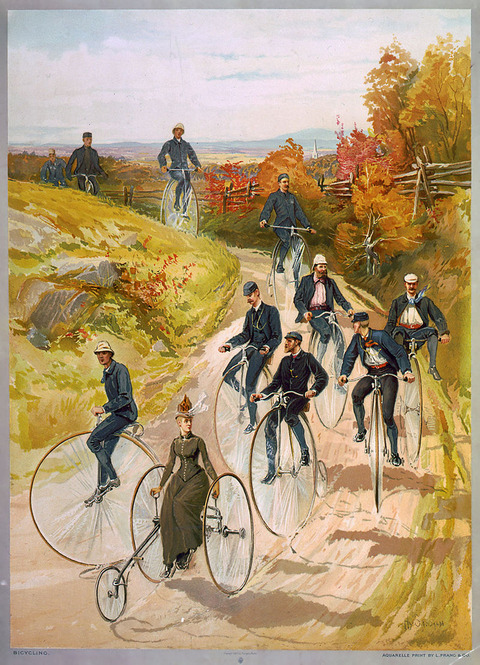
Touring the countryside, 1887 (Wikipedia)
Done
The Harley-Davidson bikers, in particularly, tended to be in Harley groups of their own kind. It did not surprise me any to notice a number of small Honda Cubs — 50cc to 110cc — shoot along the road, loaded up with camp gear. The small Honda bikers traveled alone, or in small groups. The Honda was a sturdy little bike, long used by the Japanese postal service. The sun fought hard through the clouds to make itself felt. A steady northernly wind proved pleasant company on a lonely road. The last of my pens, a blue one, was lost. So, I used a red one. In time, the red played tricks on the old eyes. Not to bring enough pens with me, marked another of my mistakes on the road. There was nothing to hang about for in Asajino. The road led me across a long bridge, Shinasajino-bashi, and near where I thought was a good place to pitch the tent for the night. The equally long Shinigorikawa-bashi popped up soon after I left the Shinasajino-bashi behind me. The second bridge, was also a good place to camp for the night. There was no shortage of water, and all that I needed was to build a campfire to boil it. "Why not? Three was no hurry." I mumbled to myself. For some reason, I decided to push on. By now, the sun ruled supreme, high up in the sky. The wind did its best to keep the sun at bay. Three large motorbikes shot across the Shinasajino-bashi. Another bike followed, some 500-meters behind. How was it possible to enjoy the surroundings, unless you made the time? "Mmm!" Surely bikers needed to slow down to smell the flowers. I thought. Even on foot, it was easy to miss things if you were not careful. There had been times when I stopped along the road, to take my usual copious notes on the surroundings, then subconsciously I would start off again, like a headless chicken. Time was all that I required. Was that too much to ask? A lack of time, was a main enemy. The roads were expensive to maintain -- cracked surfaces, drains, gullies, sewers, potholes, and accidents. Geographical changes over the years, destroyed old land areas where once modern roads ran. New land areas and roads, bridges, and tunnels appeared. For wildlife -- survival or extinction -- was often beyond their power. Many roads I had cycled on years ago, no longer existed -- fallen into the sea, abanded, reclaimed by nature. Anumber of times I had camped near an abandoned tunnel that I once cycled through. In time, another long bridge, the Shinsarufutsu-bashi popped up. Near the bridge was a good spot to camp for the evening. Often rivers were not easy to get near, for undergrowth. There were a number of bridges and rivers to be crossed, before I reached my goal, Cape Sōya. A minor road, Route 584, headed to Central Sarufutsu, but I prefered to stick to the main drag, Route 238. A sign told me of a Michi-no-Eki, 7.5-kilometers along the road, where I hoped to get something to eat. A long the road, I passed a number of fabulous places to camp. At one attractive bridge, called Fujimi-bashi, across its namesake river, I was momentarily tempted to pitch the tent for the evening. Another bridge, the Shinfujimi-bashi, acorss the winding Sarufutsu-gawa, soon came into view.
Done
Majestically, Lake Poro set in the background, a paradise on earth. Two giant windmills, with blades that rotated like gods arms, demanded to be included in my snapshots. As I got nearer to the windmills, I noticed the words, NEG MICON printed on them. NEG MICON was a Danish wind turbine manufacturer, which merged with another Dutch company, Vestas, in 2004. Vestas specialised in renewable energy, and the merger made it the largest manufacturer of wind turbines in the world. It had serviced wind turbines, since 1979. When I got to the giant windmills, a middle-aged cyclist turned off the road and stopped. In the course of our short chat, I learned that he was on his way to Abashiri, a coastal city further north. Abashiri ws part of Abashiri Quasi-National Park, and was home to an old prison, now a musuam, built during the Meiji period. The city drew countless visiters to it in wintertime, to look at the drift ice on the Sea of Okhotsk. The Hokkaido Museum of Northern Peoples, focused on the Ainu culture, and other peoples that once inhabited Hokkaido and surrouding islands. All that is known of these ancient peoples came from unearthed burial grounds, and remains of their tools and weapons. The man's bicycle was not loaded up with camp gear, which I commented on with interest. He told me that he stopped at business hotels along the way. The man worked as a teacher at a high school near Tokyo. Like others before him, he was surprised when I told him that I was on foot, and gave him a quick rundown on my mission around Japan. When we parted, it saddened me when I realized we had had failed to exchange email addresses. It would have been nice to have kept in touch, and learn how his trip panned out. After a while, I stood on the outskirts of Ashino township, part of the area of Sarufutsu, 80-percent of which was forestland. Sarufutsu was also the largest village in Hokkaido, with a population of just under 3,000. It was also Japan's most northern village. My plan was to continue along the road for some seven-kilometers. This was on the advice of my friend, Yumiko-san, who lived in Tokyo, who told me by phone that I would come to a Michi-no-Eki. This was not exactly news, as I already knew of the roadside station. Apart from public toilets, the facilities, if any, tended to differ from one another in pros and cons. My friend told me that it might be a good place to stop awhile -- to cleanup and eat something -- even pitch the tent for the night. There were a few clothes to wash, so a wee stop was not a bad idea, as time was on my side. After a while, a Seicomart popped into view. The convenience store might prove handy, for I was hungry and needed to replenish my hip-flask with water. I could not have gone two-kilometers in Ashino when I came to what looked like the roadside station that my friend had mentioned. The Sarufutsu Parking Shelter was located under a giant concrete overhang across the road, Route 238. On the road, it was important to keep your wits about you, for I had almost tramped past the damn place. In the three-hours I spent at the place, mainly to wash some clothes, no more than a few drivers pulled off the road to use the public toilets.
Done
In a way, it was good that the place was devoid of people, as I was able to have a good soupy scrub down, without a care in the world. There was nothing better than to change into clean clothes. This did not take long to do, and soon I worked on my dirty clothes under the cold faucet. This did not take long. My only hope, as I set down with a pen and open notebook, was for my clothes to dry quickly. My original plan, was to push on and make camp at a suitable spot when the sun went down. Usually I had no problem to dry the clothes outside. However, my current location lacked a good breeze. Thankfully, the public toilet facilities were clean and spacious, and with a drinking fountain. There were four small monitors that showed the traffic at different locations along the main road. Though, I was unsure of the necessity of the monitors located near the toilets. One thing I appreciated was the sort background music -- a soothing sound. The soft mucic was not quite as soothing as the sound of birds, or the rustling of branches in a breeze. As with the lights, the music in the toilets was stopped automatically after a short time. It would only start up again when someone entered. The music stopped when I stretched out on an exercise bench to rest awhile. All in all, I was glad that I stopped at the Michi-no-Eki, alone with my own thoughts. After only a couple of moments on the bench, the sound of a car pulled in and stopped. The engine also stopped. This caused me to sit up. The driver did not get out car. After a short while, the engine started up and the car drove away. It was not easy to take a nap. My mind turned to food. My dinner was two small bananas and donuts, with a few dried nuts for good measure. Each time I readied food, my gas burner back in Tokyo came to mind. A hot cup of tea or coffee would have added nicely to my humble dinner. According to the monitors, this segment of the road was not busy. Apart from an odd cyclist, there were no motorbikes, with or without camp gear. This segment of road appeared lack shops and restaurants. As I was in no hurry, I decided to stop the night. Therefore, I was prepared to hang about at other roadside stations I came to. Most Michi-no-Eki had at least one restaurant. My friend in Tokyo told me that Cape Sōya was just 30-kilometers away, or less than a day on the road. There was also a campground, just 110-meters south of the roadside station.
Done
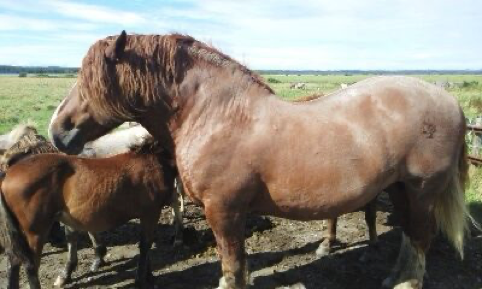
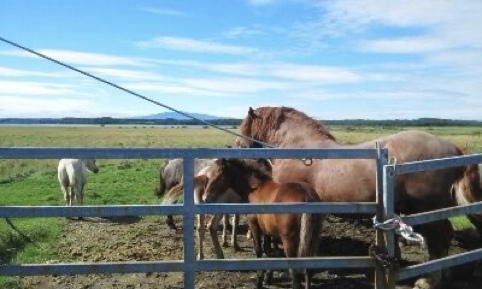
27 Aug, 2017: Sleep at the Sarufutsu Parking Shuttle was a series of starts and stops. After 02:00AM people paid visits to the public toilets in dribs and drabs. If that was not enough, the cleaning lady arrived at 04:00AM. The whooshing sound of the vacuum engine, and the clickety-clack sound of it pulled across the tiled floor, made any further sleep impossible. At least I was able to get some level of rest, before the cleaner arrived. No sooner had the door been opened, I was met with the foulest of smells. By now I was wide awake, and felt in no mood to pen anything down in my notebook. The cleaner finished her chores within an hour and soon drove away. Perhaps she was on her way to another public toilet along the road. The smell still linger in the air, so I was in no mood to try and get back to sleep. Besides, I was not very tired and the sun would soon be up. The cleaner seemed friendly. When she left she said to me: “Yukkuri shite kudasai!”, which meant, ‘Take your time!’. It surprised me a little that my eyes suddenly felt heavy. So, I lay down again on the bench, for a short 30-minute nap. When I did open my eyes again and sit up, a glance at my cellphone clock told me it had gone 08:00 AM. As I was in no immediate hurry to be anywhere soon, I lazily performed my morning routines -- washed my face, brushed my teeth, and gathered up my washing and gear. The night before, I ate the last of my bananas. So, breakfast was what I had left of some dried fruit and nuts. In time, the road took me to the Hamaonishibetsu district. There was no shortage of open fields full of beautiful cows that looked healthy. Hamatonbetsu was only a small town near the northern tip of Hokkaido. The town had an estimated population of under 4, 000. The local economy lent towards dairy farming, and crab, salmon, and scallop farms. Hamatonbetsu's claim to fame was its world-famous wetlands and freshwater lake -- Lake Kutcharo -- two interconnected freshwater lakes. The lakes were home to thousands of migratory birds, particularly swans from northern Siberia, and the white-tailed eagle. The white-tailed eagles settled for much of the year on large bodies of open water - freshwater lakes and saltwater shorelines. The lakes and wetlands became a Ramsar site, in 1989. Compared to other lakes in the world, the lakes were quite short and shallow. Lake Baikal, in southern Siberia, for example, was beieved to be the world's deepest lake (Max. depth: 1,642-meters). It was also the world's oldest lake, about 25-million years. Behind Lake Baikai in both age and depth, was Lake Tanganyika, in western Africa, was about 10-million-years-old, with a maximum depth of 1,470-meters, respectively. It was also the longest freshwater lake in the world, at over 670-meters. There were a number of rough grassy fields, not used to pasture sheep or cattle, but horses to leisurely graze on. The fields did not belong to some Japanese horse breeding farm, for thoroughbred horses to run loose kick up a bit of sweat. Hokkiado bred some of the finest racehorses in the world. On the contrary, the different kinds of horses in them appeared to be in their their twilight years.
Done
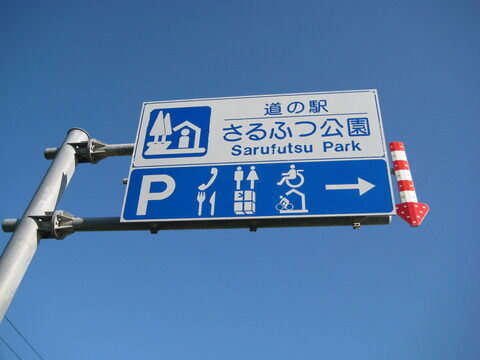
Done
Surely not much could go wrong with curry. When the curry arrived, however, I could not locate any beef. As before, the taste was not so bad. The sun still rolled supreme overhead. In a good light, I set off to take a few photos, which turned out to be rather enjoyable. One was off a memorial monument to victims of the SS Indigirka, a ship that foundered in coastal waters, about 80-years ago. First launched in 1919, the steamship's short history on the highwaves, was anything but colorful. In its 20-year lifespan, the ship went through no less than five name chages, and different ownership , which included the Soviet Union, from 1938-39, when it sunk. During that time, the Indigirka was one of a fleet of steamships to transport prisoners across the Sea of Okhotsk. Its cargo hold was said to hold around 1,500 prisioners. The prisoners were mainly used for construction (e.g., roads) and mining (e.g., gold). On the Indigirka's final journey, she ran aground near Sarufutsu, in torrential weather conditions. When the ship capsized, many of prisoners were held in the cargo hold, unable to escape. As a result, more than 700 prisoners died, for which the captain of the ship was executed.
Done