Irishman Walking (Stage 13 Chapter 1) is about my walking the main and coastal roads of Japan. Spring 2014.
*
Dear Friends and Readers:
Irishman Walking was about my walking the main and coastal roads of Japan, in a series of spring, summer, autumn, and winter stages. It took me eight-years to complete my mission. This spring-stage, Stage 13, began on 13-14 March, 2014 at Maisaka, via Hamamatsu City, in Shizuoka prefecture, in southeastern Honshu. It was also where the previous stage officially ended. The Japanese archipelago consisted of 6,852 islands, with 430 of them inhabited. An island was defined as being land with more than 100-meters in circumference. The five main islands, from north to south, were Hokkaido, Honshu, Shikoku, Kyushu, and Okinawa. Honshu was often referred to as the Japanese mainland. After about 20-days on the road, and the trials and tribulations that went with it, the stage was finaly concluded on 4 April, 2014, at Odawara City in Kanagawa prefecture, along the Pacific coastline of the main island of Honshu, the largest of Japan’s mainland islands. Odawara City, an historic castle town, much of Odawara Castle was destroyed by an earthquake, in 1703, but was quickly rebuilt. In the first years of the Meiji period, the castle tenshu (keep), among other buildings, were finally dismantled and sold, in 1870. What remained was severely damaged by the Great Kantō earthquake, in 1923. The castle ground was proclaimed a National Historic Site, in 1938. The castle keep was rebuilt again in ferro-concrete, in 1960. The plan was based on early drawings (and models) that dated to the Edo period. The castle’s three main gates were restored in the years that followed. Most ‘new’ castles were concrete reconstructions, with modern interiors, which often housed a museum and shops for visitors to spend money at. All in all, Odawara proved a good place to wrap up this stage of my mission, for it should be easy to return to this coming summer to restart the next stage.
Be happy, keep smiling!
Yours sincerely
Michael Denis Crossey
From Hamamatsu City in Shizuoka to Odawara City in Kanagawa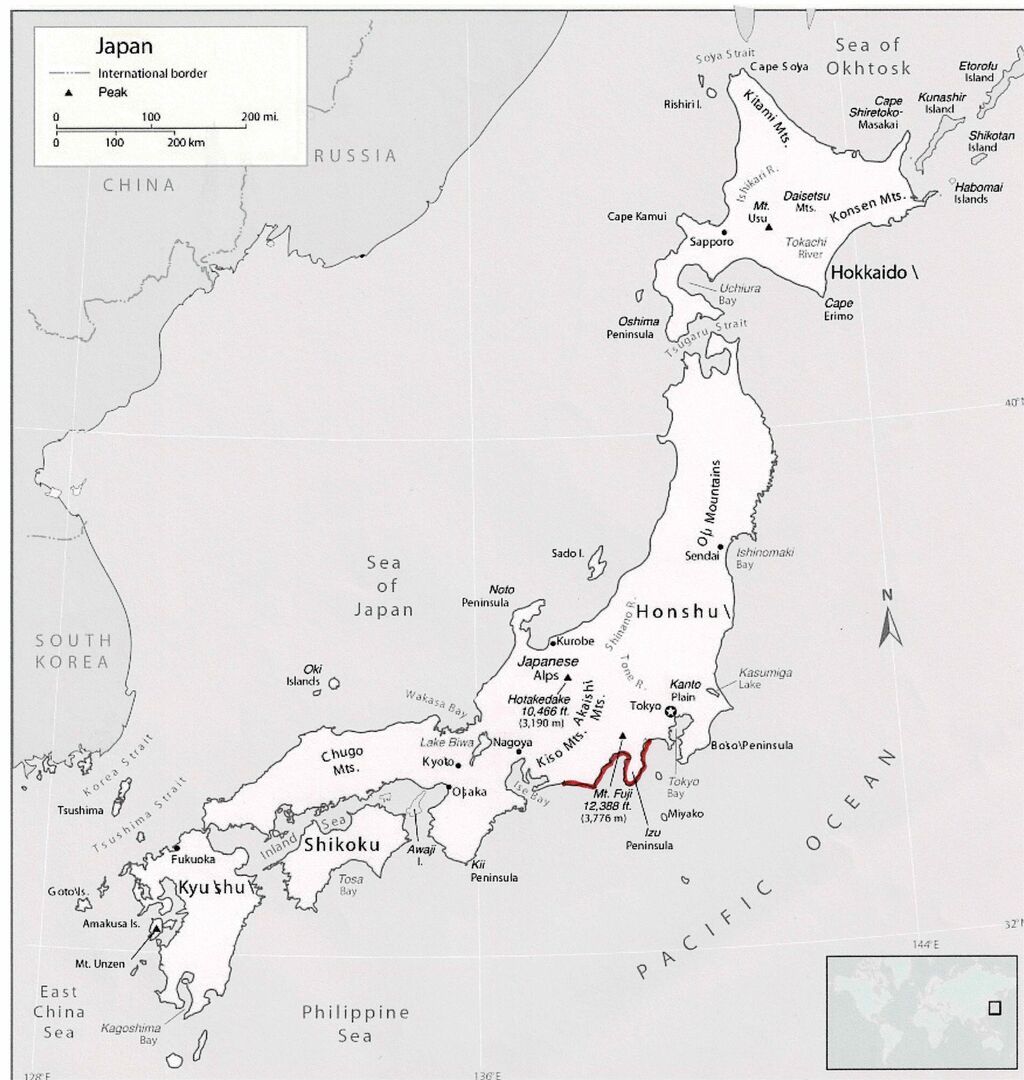
*
13-14 Mar, 2014: The evening coach for Hamamatsu pulled away from the bus stop at 11:14 PM. A strange time, I thought, as I shifted my butt to lean against the curtain covered window. “Mmm!” Maybe the clock at the front of the coach, above the driver’s head, was a minute out. The coach was half full, and most of the other passengers set by themselves. Less fortunate, a story of my life, a young Japanese fellow occupied the seat next to mine. If the noise was anything to go by many of the other passengers were soon fast asleep. The young man next to me was no also out for the count. The Japanese could fall asleep just about anywhere and at anytime. This was one of the reasons why I envied the Japanese. On the move just like this, I could not sleep. There were a couple of rest stops along the Tōmei Expressway made before the coach finally reached Hamamatsu City, and where it stopped not 300-meters from the main train station. Hamamatsu Station served the Keihin–Tōhoku, Yamanote, and Tokyo Monorail Haneda Airport Lines. Hamamatsu was granted city status on 1 July, 1911. Today, the city of Hamamatsu had a population of more than 800,000 inhabitants, and which had risen steadily since the 1940 censes. The Imperial Japanese Army Hamamatsu Air Base, and Flight School, were opened, in 1926 and in 1933, respectively. So it was not surprising that much of the city was destroyed by American bombs during the Pacific War, in June 1945. Hamamatsu was designated as a core city by the central government, on April Fool’s Day, 1996. For the most part, Hamamatsu was an industrial city, particularly noted for the production of motorbikes and musical instruments, as well as, fabrics. Much of the industry was hard hit by the downward turn of the economy, in the 1990s, from which it had not recovered. Still, Suzuki and Yamaha Corporation headquarters were located in Hamamatsu. The city was also located along the coastline of Honshu, Japan's main island, and where I soon planned to make my way along. It was a nice city, built on the southern side of a mountain range and the Mikatahara Plateau and the Pacific Ocean well within view, not far from the Tenryu River and Lake Hamana. The Nakatajima Sand Dunes, which I hoped to pass-by in due course, was a noted breeding ground for loggerhead turtles. The park was home to the reconstructed sixteenth-century Hamamatsu Castle, which stood majestically, on a hill. The castle and park drew countless visitors in springtime each year, mainly to view the cherry blossoms in full bloom, not to mention lookout over the mighty Pacific Ocean. Originally Ieyasu Tokugawa resided in the castle for around 17-years, from 1571 until 1588. His reign also marked the start of the Edo period. Today visitors can enjoy a visit to the small museum inside side the castle, home to pieces of armor and other relics of the period, among other items of interest of the times. Not far from the castle, visitors could also stroll through a large park, with a Japanese garden, a pond, and a ceremonial teahouse. Hamamatsu had a humid subtropical climate year round, with an average temperature of around 14°C for this time of the year, which was not so bad.
The time on the clock was 05:30 AM, and still dark when I stepped down from the coach, where I waited a short while for my backpack to be dug out from the storage compartment at the lower part of the vehicle. No one, including the coach driver seemed to know where the Toyoko Inn was located, but I was advised to head across to the train station area, where my chances of finding it would be better. As things turned out, the business hotel was not very far past the station. Thanks to the large bright colored telltale sign, usually displayed at the top of Toyoko Inn buildings. Therefore, the hotel was easy to find. My plan was to leave the backpack at the hotel and then take the train back to a place called Maisaka, where I had previously wrapped Stage 12 up at last summer. Magoori Station was close to the old Tōkaidō highway, just south of the Shin River. The train station was opened in late-1888. That was the year that a massive eruption changed the shape of Mount Bandai, located on the outskirts of Kitashiobara Village and the towns of Inawashiro and Bandai, in Yama-Gun, Fukushima prefecture. The eruption left countless kilometers of forest and farmland a wasteland, with the disappearance of many villages under landslides. New lakes were formed and river diverted. Urabandai or Bandai-kōgen, as the lake district was known, had long been a popular tourist destination. Originally the mountain was called 'Iwahashi-yama", or “a rock ladder to the sky”, in English, or 'Aizu Bandai' and 'Aizu Fuji' by many locals. Mount Bandai was certified as a geopark, in 2011, as well as being one of the most famous mountains, in Japan. A photograph of the mountain soon after the eruption, was the first news photograph published in the Yomiuri Shimbun at the time. It was also the first major disaster that the newly formed Japanese Red Cross faced, when it carried out relief efforts. Like much of the Meiji period, 1888 was also a year of progress that saw the opening of a good number of important of railway stations across the country. However, the station was renamed, Maisaka Station, a few months later, and had connected Hamamatsu since it was opened, in 1909. Maisaka Station was only two stops from Hamamatsu, but one hell of a distance between each of the stations. So in away, I regretted wrapping the previous stage, Stage 12, of my mission up there. The damage was done, and there was no point in complaining, for I had other more important things on my mind. When I stepped down from the train at Maisaka, someone I stopped to ask directions with outside the station told me that it was a good 10-kilometers from Hamamatsu. Of course, I felt in no great hurry to return there, for the checkin time at the hotel would not be until three o’clock. The Maisaka area had been settled since the Jomon period, as early as 5,000-years ago. In more recent times, Jomon remains had been unearthed within the town perimeters. The period was also the beginning of an early agriculturalist population that came to settle in on place for longer periods. The period was rich in tools and jewelry formed out of bone, shell, and antlers, as well as, from stone.
Maisaka has been a thriving fishing town along the Pacific coastline in Shizuoka prefecture. The town was particularly noted for its eel farming. The area continues to draw many visitors, and was still popular with fishermen and clam-diggers. Had this been better circumstances, the beach there would have made a great place to camp. Misaka was finally merged into Hamamatsu City, on 1 July, 2005, where I was headed. Soon after arriving in Misaka, I was back on the road retracing my steps on foot, along the route the coach had taken, was on part of the old Tōkaidō Road. Old only by its name, for the countless new house and tall buildings I passed along the way. At times the Tōkaidō ran parallel to Route 1, on which I had cycled on decades earlier. This time, however, my plan was to avoid Route 1 on this stage of my mission. Now was not the time to spend thinking about the past. It was not easy to reflect on the old Tōkaidō, and other early highways in Japan for that matter, without thinking of the form of art called, ukiyo-e. The famous ukiyo-e artist, Ando Hiroshige was born in October, 1797, and was considered the last great ukiyo-e artist ever. He worked under the name, Utagawa Hiroshige. Among his wide range of genre categories, Hiroshige was perhaps best known for his popular horizontal-format landscape series, enticed: ‘The Fifty-three Stations of the Tōkaidō’. Maisaka was one of the places depicted in ukiyo-e woodblock print as Maisaka-juku, the 30th station entitled ‘Maisaka-juku’ in Hiroshige’s ukiyo-e landscape series. For many contemporary thinkers, Hiroshige's death in 1858, marked the rapid decline in the ukiyo-e genre. A void somewhat filled by the influence of westernization through the Meiji period. The Tōkaidō road, or ‘eastern sea route,’ was in its day the most important of the five major main roads that dated to the Edo period. The Tōkaidō Road connected Kyoto to Edo. In those early days, the main method of getting about was by foot. “Mmm!” If only we could all return to those slow moving days, when tomorrow would have to wait, and when the future would take care of itself. Nissaka-shuku was located in what was now part of Kakegawa City in Shizuoka prefecture. Heavy rain fell for much of the day in Tokyo, but now throughout Shizuoka prefecture, the weather could not be better for tramping along the road with a backpack firmly strapped in place. Even at a snails pace on this beautiful clear spring morning, I found myself back in Hamamatsu by 09:00 AM, and where I would soon set off on this stage of my mission. My early return to Hamamatsu was not so much a problem, or as far as having some time to kill went. Checkin time at the hotel was not until three o’clock. The lack of sleep on the coach from Tokyo was not, as yet, making itself felt. Then when I turned onto a little side road, a shortcut that led to Hamamatsu train station building complex, I spotted a Starbucks coffee shop, which I headed straight towards. The station building was completed in 1981, and was home to the ‘MayOne Shopping Centre. The stop by at Starbucks for a while, not only allowed me the chance to jot down some lines in my notebook, but also a place to rest awhile.
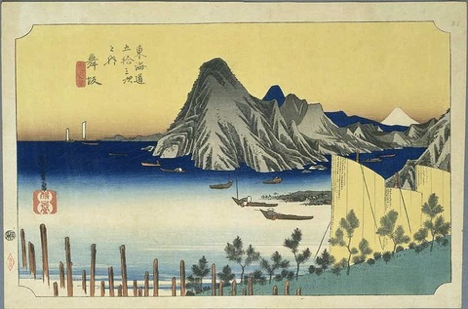
Maisaka-juku, a woodblock print by ukiyo-e master, Hiroshige Utagawa (1797-1858) (Wikipedia)
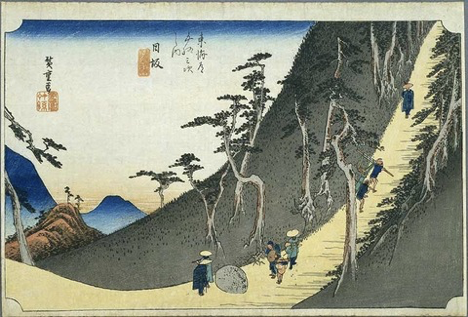
Nissaka-shuku was the twenty-fifth station on the Tōkaidō, a woodblock print by Hiroshige (Wikipedia)
Fortunately, unlike other Starbucks I had popped into, especially in Tokyo, this outlet was not very busy. Then again, it was still some hours to go until lunchtime. Hamamatsu City was not as busy as Japanese cities were, I felt, still it seemed to be home to so many business hotels. First opened on 1 September, 1888, Hamamatsu Station these days served the Tōkaidō Main Line and the Tōkaidō Shinkansen Line, operated by the Central Japan Railway Company. Shin-Hamamatsu Station, just three-minutes away, was the terminus station for the local Enshū Railway Line. The word ‘shin’ means ‘new’ in Japanese, however, it could be argued that Shin-Hamamatsu Station had existed since 1 September, 1927, although it was called Asahimachi Station at that time. It its day, the station was one of the most modern buildings in the city in its day, only to be destroyed by American bombs during closing weeks of the Pacific War, on 29 July, 1945. Of course, after the war, the station building was rebuilt in 1953, and was renamed, Shin-Hamamatsu. In a similar vain, the Shinkansen, or Bullet Train, started operations on 1 October, 1964. As I set in the Starbucks thoughts of current affairs in Japan and other places ran through my head. The recent crash of Malaysian Airlines, the rebuff of the STEP research program, and so forth. Actually, I had hoped to pickup a copy of the Japan Times, of some other Japanese English language newspaper at a convenience store. Not a single store that I popped into on my way to the Starbucks had single issue, or according to some of the staff sold any. When I called in at the hotel earlier to drop off my backpack, had a copy on the newspaper rack in the lobby, either. This surprised me a little, for I saw a good number of foreigners here and there about the city. Likewise, I was not the only foreigner to stop at the coffee shop, so I thought it should be easy to get a newspaper that I could read. With the Tokyo Olympic Games taking place in the near future, in education local governments were busy revamping English conversation lessons at schools. Another plan was to get as many volunteers as possible to help out during the Olympics. “Mmm!” No doubt this all had something to do with internationalizing the young people’s minds, like the swipe of some magic wand. This was also the end of the famous train, Akebono, from Ueno to the northern part of the country. Akebono was a luxury sleeper-train that had served the route for close to 45-years, from 1970. The route fell victim to changing times and a drop in the numbers of passengers. Therefore, it was only inevitable that the train would make its final run, out of Ueno on the evening of 14 March. At Crimea in Ukraine there was talk of a reformation to join Russia. Around 60-percent of the inhabitants saw themselves as Russian. The Russian leader, Putin, threatened military intervention should the violence continue. Japan got another gold medal in the Sochi Para-Olympic Games, whilst another Japanese athlete went crashing out doing his best. That was life, a microcosm of the world, with its ups and downs, of success and failure, with happiness and sadness, and there was not much one could do about it, other than to do their best.
15 Mar, 2014: This was another beautiful spring sunny morning to awaken up to enjoy. The NHK morning news made mention of narrowing down the search for the lost airliner and passengers. Surely it was only a matter of time before something turned up. In this day and age, why not? It was impossible to imagine that something so large as an airplane could simple vanish and not be found. Downstairs in the breakfast area, in the lobby, it was not easy to find a free table. Anther chap ahead of me, was waiting when I came out of the elevator. “Mmm!” Who was worse off, I momentarily thought to myself, the salarymen stuffing their faces in a hurry, before heading off to their jobs, or me, in no great rush? Of course, I had not least care, for the world was a stage and everyone played their part. My part was to accomplish my mission as smoothly as possible. Whenever I got back to my room, I set about getting all the gear together and ready for the road. A glance at the maps told me that I needed to get my arse onto Route 150, bound for Ryuyo, Osuka, Daito, Hamaoka, and beyond. If the weather held, which I felt it would, then there was no reason that this should not be a good day, kilometer-wise. One thing that I needed to do before hitting the road was to tap up the soles of my feet. Even my12-kilometer long dander about Hamamatsu left me with the early signs of blisters about to form. Like I penned earlier, Hamamatsu was loaded with interesting touristy spots, so the dander about the city was a worthwhile little venture. When I was walking about the city, I remembered the young fellow whom I set on the coach from Tokyo telling me that Hamamatsu was particular famous for the pianos produced there. The YAMAHA piano factory tour in the Kakegawa area of the city, was a case in point. YAMAHA was one of the most famous musical instrument companies in Japan, if not the world. Visitors were able see the craftsmen work the traditional techniques of making pianos, crafts passed down over the years, since 1900. The guided tours were available on Mondays, Wednesdays, and Fridays, but reservations were necessary. The city was also famous for: The Hamamatsu International Piano Competition held every three-years. However, there seemed to be a 30-year age limit for the competitors. Not that I could say it kind of tossed cold water on any Mozart-level dreams that I had in me. That said, the competition was started in 1991, to mark the 80th-anniversary of the founding of Hamamatsu City, on 1 July, 1911. After leaving the hotel and setting off along the road, it soon became clear to me that it was not easy to find even Routes 1, let along Route 150, which I needed to get onto. A stop was made at a small koban, to ask one of the many policeman there for some directions. This proved to be a waste of time. The Japanese police were lost to explain anything, without a roadmap to help them. Without going into any great detail over a set of grubby books of maps, all that I wanted was to be pointed in the right direction, and simply sent on my way. “Mmm!” Was that asking too much? At least, it seemed easy enough to me.
One of the police physically pointed with his forefinger in the right direction, or at the corner I should make a turn. "Go straight and turn right just before the park, you can’t miss it." Such was the kind of simple English that I had from time to time drummed into the heads of my students during the classroom lessons on directions. In the end, I left the koban none the wiser. On the road, it was important to be prepared for all situations, ’to keep a stiff upper lip,’ if I may use that 1915 American invention. At long last I got my first glimpse of the sea from a bridge over the Tenryugawa. the point also marked the start of a tollroad. On the far side of the river, six giant windmills slowly turned their great blades, with bellicose-like noises. “Mmm!” Surely the windmill needed more than the gentle sea breeze that blew in from the coast? I thought to myself. Even the cool breeze gradually to ebbed away. The sun shown down brilliantly from a cloudless March sky. Still on the bridge, a tiny sign told me that I was now entering into Iwata City. Like whenever I came across such signs on previous occasions, there was nothing around that looked like a city. The tollroad had ended almost as soon as it had begun, and made it the shortest, 100-meters long, that I had ever heard of. Not far away I saw a little driving range and miniature golf course, both of which were situational on either side of the road, Route 150. Another road sign I passed pointed in the direction of Ryuyo Coastal Park, some three-meters across the bypass. I heard that visitors often stopped the night on the beach, or in the park, or at the local camping site, so as to view the New Years sunrise. At such times, they were offered free sweet sake to drink for the occasion. One good place to watch the sunrise, and where sake was also offered to visitors, was on top of Ryuyo Fuji, the highest point in the park. Unfortunately for me, this was not that time of the year. There were no further sightings of the sea for one hell of a time and distance. Another sign told me that I was 0.4-kilometers from Ryuyo Insect Nature Observation Park across the Tenryu River that made its way through Iwata. There were enough insects on this stretch of the road that led be past shrubs and farmland, not to mention a mountain range far off in the distance. Clearly much of the area was a place for golf lovers, with various signs here and there that advertised one golf club or another. Playing golf in Japan was not a pastime, for the poor. Another sign that posted to the right, told me that the ‘Pacific Coast Cycling Route’ lay just 2.4-kilometers away. “Mmm!” If only I had my bicycle with me now. There was a bicycle song that I sang as a child growing up in Belfast, donkeys years ago. The song "Daisy Bell” was first penned by British songwriter, Frank Dean (1857-1922) under the pen name Harry Dacre. "Daisy, Daisy / Give me your answer, do. / I'm half crazy / all for the love of you…” The song ended with the words: "a bicycle built for two” and was a popular hit in its day, in London music halls and worldwide. Building bicycles had become a big business in Japan since the late-1800s. There were believed to have been as my as 10,000 registered bicycles in Japan, in 1890. The number multiplied nearly six-times by 1901, and had grown to 400,000 registered bicycles, by 1912.
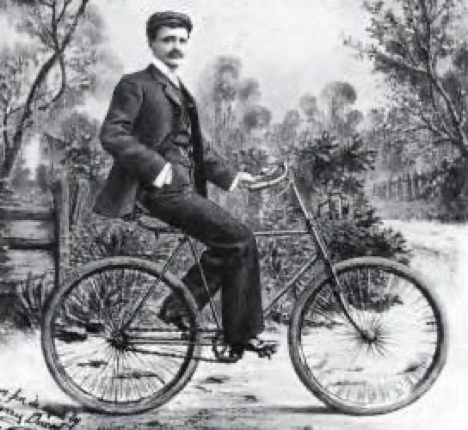
Harry Dacre with bicycle, about 1890s (Wikipedia)
There was also a large poster nearby that advertised wedding ceremonies, a most expensive business in many countries in more ways than one. In fact, weddings and funerals were the most expensive ceremonies to date. Regardless of any customs and traditions, both ceremonies played on the old emotions of the people involved. Hence a good chance to cheat and swindle anyone out of their hard earned money. In Japan, with its aging society rising and the falling birthrates, surely cheaper marriage and funeral costs would prove a winner or money earner. Somebody said that 'marriages were made in heaven', or something along those lines. Hovever, they were not happening in Japan in current times, to the extent they should. In fact, they had seen a sharp decline. The Land of the Rising Sun had long struggled to overcome a demographic challenge of older peple and fewer babies - more pensions and expensive medical care - made things look bleak. Other signs that I passed along the way took my mind away from such things as marriages and deaths. The signs made mention of the danger of tsunamis and posted in the direction of raised places to dash towards, for safety. Thanks to the weather, if not myself, progress along the road was good and steady, without any telltale sign of blisters or muscle pain. This was nothing like that time last winter when I pushed myself to cover a good 40-kilometers. Still, it was good enough to warrant a stop at a FamilyMart convenience store in the village of Toyohama, for a nice cool can of Kirin beer. The coastline where Toyohama was situated was also popular for surfing and crowded on weekends. Like many places in Japan, the village was merged into Fukude-cho Town, on 31 March, 1955. Fukude-cho and a host of other tiny locations merged to form Iwata City, on April Fool’s Day, 2005. The Fukude local economy was mainly based on agriculture, such as, hothouse melons, green tea, not to mention, commercial fishing. Before leaving my place in Tokyo, I included among my gear a little booklet written by a fellow called, L. J. Link, an expat who had lived and worked in Japan for many years. “Mmm!” Someone like myself, I guess. The booklet contained a collection of short articles on things Link found interesting about Japan. The articles were light reading and interesting, even if I already held similar views from my own experience, over the years. One article I read in particular, for example, entitled: ’Is there a Chopstick Complex?’ dealt with the way Japanese people always seemed impressed at the skillful way in which foreigners used chopsticks, and would comment to that effect. “Hashi jozu ni tsukatte-imassu ne!” (Oh, you use the chopsticks so well!). The proper use of chopsticks was, no doubt, a bit of a sacrilege, in Japan. However, I could not help wonder what the Japanese would have said if they noticed that the wooden pegs I used for keeping the cool breeze from coming in under the tent, were in fact chopsticks. Somewhere along the road, I lost some of my tent pegs through carelessness. In time, I came to a ¥100-Yen store, where I stopped for a wee look-see. There I did not care very much for the weak-looking tent pegs, which came in packets of six. Instead, I settled on a packet of wooden chopsticks. Ten chopsticks to a packet, it seemed bitter value.
16 Mar, 2014: After some writing and reading, I eventually fell into a well deserved slumber and awoke the following morning at 07:30, to the sound of the traffic rushing along the road nearby. This was about the start of the morning rush-hour. It was seldom easy to drift off to sleep again, and by 08:00 AM I was outside the tent dismantling the camping gear and putting everything together for packing away. Like the morning before, the sun rose slowly up into the cloudless sky, and I knew that this was going to be another good day for tramping the roads. The brisk wind that blew in from the sea made decamping a little difficult, but gradually all went well. Not very far down the road, Route 150, I made a stop at a 7-Eleven convenience store, mainly to use the toilet and give a quick wash to a pair of socks and underwear I wore yesterday. Surprisingly, I did not sweat so much and so I decided to continue wearing the same T-shirt. The washing was soon taken care of, and after hanging the things over a fence to dry, I went back into the store to pickup a 500-milliliter carton of milk. There was nothing like a wee bit of energy to start the morning. The milk would work just fine with the muesli that I packed along with my gear for such times. One of the many good things about the convenience stores was the hot water they always had at the ready. It saved the trouble when I felt like a cup of tea or coffee, which I also brought along with me. Soon I was sitting outside on the ground next to my washing, tucking into my humble breakfast, with a hot cup of tea for good measure. By the time I decided to hit the road again, a nice fresh morning breeze had worked its magic and quickly dried my things, and which had already been retrieved from the fence and put away. Yesterday, not long before I made camp for the evening, I passed a couple of used car garages, which were run by a group of fellows from South American, but I was not sure which country. There was a Brazilian flag on the window of a hair salon nearby, next to a store that sold surfing gear. Rightly or wrongly. I did not need to stretch the old mind any to conclude that the salon was run by one of their wives, who more than likely was a Japanese. The South America continent had some of the best locations in the world for surfing. No doubt the some of the fellows I had just passed were keen surfers, too. Some of the greatest football players ever to grace this planet came from that part of the Southern Hemisphere. Some distance further along the road, I passed another garage, where I noted a small number of South American looking fellows, busy at work on some used cars. Not more than 300-meters further on along the road, I came to a closed down kitty-park, with a host of various contraptions and apparatus built of wood and ropes. They were especially made for small children to climb over and have fun on. There was also a name sign, but it was in Portuguese, which I could not make sense of for the life of me. A tiny football pitch set next to the little park, with its little goals complete with nets. Needless to say, everything had become overgrown with grass and brambles. Sadly, like so many places that I had passed along the way, it was a victim of the lingering recession.
For some reason I stopped a short while to look over the things, and could not help imagining that some handsome Brazilian fellow had come along one day, met, and married a nice looking Japanese girl. Perhaps the girl came from a wealthy family, for noting was cheap, nor free in Japan. The day before, a good number of Harley Davidsons roared past me along the road, with the riders all decked out in shiny leather. Often when there was a female among the group, she tended to be on the rear seat. What happened to the, ’Mrs-One-In-A-Million’ article that I read about in one of the books I brought me? The article gave light to changing times in Japan. Early signs of the female gender, how they had begun to pull themselves out from under the feet of the male dominated corporate world into top executive positions. Of course, this was still a man’s world, since most of anything appeared under their control. Even if women were making their mark here and there, in various areas. The females riding on the backs of their boyfriend’s motorbikes, seemed to me, rather subservient. In a way, it was kind of like placing their life in the hands of another. The Harleys in Japan, tended to be fitted out with all the attachments and gear, like, carrier cases, at the back, wind screens and chrome protection bars at the front, and so forth. Often the large motorbikes were a bit over the top with fittings. Personally, I preferred to see the complete shape of the motorbikes, rather than hide them under a load of colorful side-boxes for carrying god knows what. My Yamaha Dragster that awaited me back in Tokyo, did have a wind screen and appropriate chrome protection bars at the front, but there was not a single side-box attached. At least, my Dragster looked like what I wanted it to look like, a motorbike. It was just as convenient for me to tie the gear to the upright bar at the rear when I went on a camping trip. Another interesting little article I read in the tent last night, before hitting the sack proper, entitled: ‘The Psychological Value of a Car’, highlighted the fact that the Japanese were not so practical when it came to cars For example, the cost to purchase, the mandatory inspections, parking costs, tolls, gasoline, oil, repairs, ad insurance costs, and so on. Even before thinking about getting a car, there had to be proof of a place to park it, like, at or near your home. In other words, life without a car might be a lot more commonsensical. My progress along the road was slower than I had hoped. Still, there was no big hurry, for Tokyo was within reach, and I was well ahead of my deadline, 12 April. Who knows, I might even cross into Tokyo on April Fool’s Day. This all equated to the high cost of having the honor of being a proud owner of a car. Even when the car was parked for most of the week, its owner still drove it down the road to a local carwash. Japanese kept their cars nearly spotless. To own a new car in Japan was a like a new family member, it was of great psychological value. Cars that sustained a dint or scratch, was damage the owner’s soul. Needless to say, I was somewhat heart broken for my Dragster, brand new at the time, slid from under me one icy winter day some years back, and scratched and dinted parts of its chrome fittings.
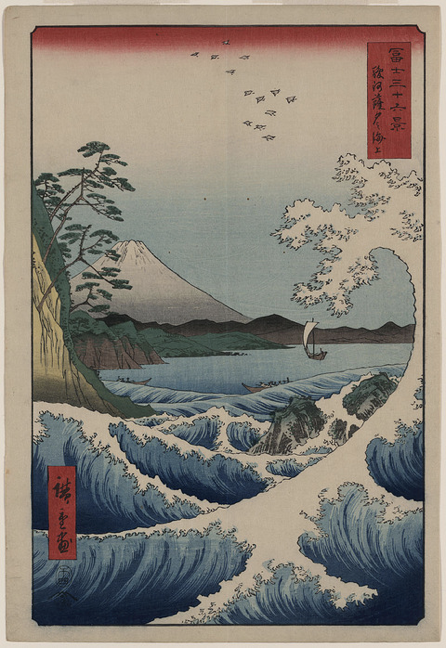
‘The sea off Satta in Suruga’, a woodblock print by Hiroshige (Wikipedia)
17 Mar, 2014: The morning felt warmer than the previous mornings, more like summer than early spring. There was no sign of the usual fresh morning breeze either. Out on the Suruga-wan, some fishermen in tiny boats were busy applying their trade on the calm water. “Mmm!” Momentarily, I wondered what sort of fish they hoped to land? Almost as quickly as the fishermen had grabbed my attention, I stopped thinking about them, and turned to my own work dismantling, rolling up, and putting away the camping gear. The road awaited me! Still, I was happy that I had stopped the evening on the beach. Suruga-wan was located at the center of Shizuoka prefecture, and was one of the deepest bays in Japan, some 2,500-meters below sea level at its deepest point. Much of the water in the bay came from melted snow that flowed into the bay from Mount Fuji. The bay was home to around 1,000 freshwater fish, including rear deep sea creatures, such as, the coelacanth. The coelacanth was believed to have become extinct around 66-million-years ago. Today it was referred to as a living fossil. Because of conservation, fishing of endangered species had been banned in the area. It was impossible to observe living coelacanth in the local waters. At the Numazu Deep Sea Aquarium & Coelacanth Museum, located at the bay, visitors were able to learn about the coelacanth, among other rare sea creatures. Suruga was one of the ancient provinces of Japan, established under the ancient Taiho Code around the start of the Nara period. The kanji that made up the name, Suruga, meant ‘fast flowing current or river’, in English. On the road yesterday, the only time I saw the sea was when I crossed over the long bridge. Today, I had a funny feeling that the sea and myself would be friends again, and see a lot of one another, or so I hoped. The time was also near when I would get my butt off Route 150, which was an end to a long friendship of sorts. All that I needed to do was to keep an eye open and get smoothly, onto Route 135. The road should lead me to Shizuoka City, hopefully by tomorrow. It was a thriving city in such areas as agriculture, fisheries, etc, it had a population of more than 690,000 inhabitants. Because of its location, Shizuoka was said to be the sunniest of the major cities in the country. The Suruga Bay, into which many major rivers emptied into, was not only Japan’s deepest bay, but it was also one of the most polluted in the country. To paraphrase from Wikipedia, since the post-war industrial boom of Japan, the bay suffered from severe industrial pollution — equivalent to the daily sewage of Tokyo at the time. The sulphur-laden sludge was so thick that it threatened to block the harbor, requiring dredging that severely damaged the marine life. Despite protests by local citizens and fishermen for government action, surveys on sea life continued to show intense PCB and PBDE contamination. “Mmm!” It interested me to wonder if Utagawa Hiroshige would have put so much time into producing such detailed woodblock prints, had he known of the pollution in the rivers, lakes, and bays? The state of the bay was so infamous at one time, that it featured in the 1971 Japanese film Godzilla vs. Hedorah. ‘Hedorah’ meant: mud, sludge, or chemical ooze, in English.
The city was located in the central part of the prefecture, along the Taiheiyō Belt, between the Minami Alps and Suruga Bay. It had a humid subtropical climate, where snow rarely fell, and was noted for mild weather, particularly like the present time, in the month of March. “Mmm!” If only I could say the same about the precipitation. The blisters in my feet had not troubled me much, or thanks to the supply of medical tape. With something missing, like, no milk, at times I found myself start off along the road in the morning without my humble breakfast of muesli, inside me. This was not a good idea, for it was not long before the effects would be felt, like, in the form of moodiness. Along the road, I made a stop at a 7-Eleven convenience store to pick up a 500-milIliter carton of milk, not to mention, some hot water to drop a teabag into. By now, the sun could really be felt on my face and arms, when I set down outside the store to eat. A sign, a little across from a ENEOS gas station, pointed to the right, for ‘Sagara Beach 0 km’. “Mmm!” That was the first time I had come across a sign with zero kilometers on it, I thought to myself. Of course, the thought also crossed my mind about the about previous hot summers when I swam in the sea. In no time at all, I felt replenished with eating, and was back on my feet and heading in the direction of Shizuoka. The maps told me that I would pass through, what I took to be meaningless little towns of Haibara, Yoshida, Oigawa, and Yaizu. Today Yaizu was a small city and had a population of about 140,000 inhabitants. The population had steadily risen since the 1960 census. A port city, its economy was based on agriculture, food processing, and commercial fishing, especially tuna, mackerel, and bonito. The city was also home to a large Sapporo Brewery factory, Shizuoka University of Welfare, Shizuhama Air Base, which had existed at that location since December, 1944. During the Pacific War, the Yaizu fishing industry crewmen and the fishing fleet were requisitioned into the Imperial Japanese Navy, in 1941. Just 10 fishing boots survived the war. Thanks to the beautiful coastline, so far my long tramp along the road had had turned out to be rather pleasant. At times, the course I followed led me along a cycling path, but there seemed not to be a cyclist in sight, nor anyone for that matter. This was Monday, so I guessed the Japanese were hard at work. Like the weekend drivers, not a single Harley roared past, which kind of told me that many of the owners of the motorbikes were weekend riders. Japan was not only a male dominated country, like many other countries, no doubt, it was also a car country, like the most notable of the lot, America. The roads remained busy with traffic. This made it all the more important to get my arse away from all the pollution and noise, and chance I got. It was good to get onto the cycling path, which from time to time skirted along the coastline. Below on a beach, I could see the tiny figures of men and women digging and raking about along the tideline for seaweed. What kind of seaweed they were digging for, I had not the foggiest. Another variety, called Kombu, was gathered mostly off the coast of Hokkaido, in northern Japan.
Komba was also a main component used in dashi broth, essential in most Japanese dishes. This included onigiri, and salads, with vegetables, and as a topping on rice. One of the most common and milder types of seaweed consumed in Japan was called Wakame, it was harvested from February to June, from the Nihon Kai. Wakame was commonly used for salads, pickled vegetables, and miso soups. Mekabu, from the same plant as wakame, just above the root, had a rather slimy texture, a sweet type of seaweed. Mekabu could be served either dry or fresh, shredded or whole, and was often preferred with dressings, vinegars, and soy sauces, with soups, noodles, add salads, as well as, topping for rice, and so forth. Kanten was an agent extracted from seaweed, and was used for making custards, puddings, and wagashi, a traditional type of sweet, popularized in Japan since the Edo period. Hijiki was a type of seaweed gathered up from the rocky coastlines. It is commonly used in stews and ochazuke, as well as in salads. The seaweed called, nori, was one of my favorites, especially when I have a Japanese-style breakfast at my place in Tokyo. One of the oldest descriptions of nori, dated as far back as the eighth-century. To paraphrase from Wikipedia, the word ‘nori’ first appeared in an English-language publication in C. P. Thunberg's ‘Trav’, that was published in 1796. The Japanese nori industry declined in the years after the Pacific War. At the time, the country was in bad need of all kinds of food, especially food that could be domestically produce. Today, nori was perhaps the most common variety of all seaweed enjoyed in Japanese cuisine, especially sushi. In some ways the popularity of nori was due to the efforts of British phycologist, Kathleen Mary Drew-Baker, who was known for her research on the edible seaweed. Japanese scientists applied her research findings to a series of artificial methods, which resulted in rescuing the nori industry. Drew-Baker was hailed as the "Mother of the Sea” and a state was erected in her honor. She was still revered as the savior of the nori industry, in Japan. The fisherman’s town of Naruto, located in the northern part of Tokushima prefecture in Shizuoka, had long been noted for its marine products, especially, Naruto wakame seaweed, grown in the violent current ridden waters off the Naruto Strait. There were organized harvesting tours, in February through March, each year. These days, seaweed could be bought in just about any developed country, especially at Asian supermarkets. All in all, seaweed was a popular and healthy food that was rich in essential minerals and dietary fibers. I can still recall my grandmother telling me it would do me good, the times she gave me a piece of dulse, a kind of seaweed we used to get in Belfast donkeys years ago. In fact, I do not think I had eaten it again since that time, but I still recall that it was very salty and, like chewing gum, it took a long time to chew. The dulse was mainly grown along the Atlantic and Pacific Ocean coastlines. The first record of this species of seaweed was harvested by Christian monks on the island of Iona off the coast of Scotland, around 1,400-years ago. But that was another story for another time.
As I had just noted, both males and females, young and elderly, were hard at work down by the tideline along the Shikoku coastline. One elderly woman poked about with her walking stick among the debris washed up on the sand. The odd time, she would bend further over and pick some tiny item up and place it in a plastic white shopping bag she carried. Momentarily, the thought of digging about in the backpack for my cellphone and take a snapshot, but just pushed on instead. For sometime along the road, I could not get the elderly woman on the beach out of my head, and wondered what kind of stuff she searched for among the washed up debris. It was easy to imagine the sort treasures that lay hidden among the things washed up on the shore. The sea and the beaches had been in peoples blood for thousands of years. Down through history, if not in a number of classic literary tales, it was the things found on the beach that meant life or death for someone marooned on an isolated island somewhere. Beach-combing did not just imply retired people strolling down the length of some beach for kilometers, picking up shells along the coast. A past-time that was just one of the pleasantries of their retirement. These days, some amateur diggers even went armed with their metal detectors. The bending and stooping of beachcombers had existed for donkeys years. It even appeared in the February, 1881, issue of 'Chamber’s Journal of Popular Literature, Science, and Arts', a weekly magazine of the era: "Beachcomber is a word of American coinage. Primarily, it is applied to a long wave rolling in from the ocean, and from this it has come to be applied to those whose occupation it is to pick up, as pirates and wreckers, whatever these long waves wash into them." The word appeared even earlier than that, in American novelist Herman Melville’s 1847 narrative, 'Omoo', believed to have been based on the author's recollections and experiences in the South Pacific seas. The storyline touched on some Europeans who combed the beaches for any valuables washed up by the tides. The earliest beachcombers, of sorts, were believed to have been sea-faring lot -- castaways, convicts, deserters, sailors, and whalers, like Melville -- whose circumstances forced them to drifted to and from the islands of the South Pacific for survival. In away, they had been swept ashore by the waves. According to my reading, Melville himself had deserted from a whaling ship in the later half of 1842. The first recorded beachcombers were shipwrecked, off the Papau islands, in 1783, and where they savaged along the beaches for several months. Thankfully for them, the inhabitants of the islands were friendly and supplied the castaways with food. A group of missionaries that had landed on Tongatapu Island, in March, 1797. It was on this main island in the Polynesian archipelago, where the missionaries saw the beachcombers as little more than a “base and wicked characters” tattooed and naked savages. The era of early beachcombers stranded on the Pacific Islands, was believed to have lasted for several decades.
Most people, I should have thought, never completely found what it was thea y looked for in life. What was the main thing enlightened people sought? Happiness? At least, I hoped that I would not go to my grave after a life that was unfulfilled. I knew that I would be a bit more contented and happy if this damn scorching sun would let up, a bit. Almost daily, since starting off the mornings, my T-shirt would soon be saturated in sweat. However, this time sweat was literally dripping off me. The sun had not long sunk into a bright orange colored horizon when I finally decided to make camp. This was at a pleasant riverbank a little short of the city of Yaizu. Normally, after pitching the tent, I liked to take a short nap. This time however, I decided to dig out one of the books I had carried in the backpack with me and begin to read. Yaizu was a city in central Shizuoka prefecture, with a population of almost 140,000 inhabitants. The population appeared to have grown steadily since the 1960 census. Clearly it was an interesting little city with lots of places to see. Yaizu City was a center of commercial fishing and fish processing industries, such as, bonito flakes, called katsuobushi, in Japanese. The city was also noted for its shiokara, a salted squid; tsukudani, a kind of preserved seaweed in soy-sauce; and kamaboko, a fish paste loaf. The area was also noted for its agriculture, such as, the growing of melons, tangerines, and tomatoes, and plants for the production of green tea. The writer, Patrick Lafcadio Hearn and his family liked to visit Yaizu every summer, from 1897. Hearn was also a keen swimmer, so they rented rooms above a fish shop near Yaizu Beach. The shop was owned by a friendly fellow called, Otokichi Yamaguchi. “Mmm!” I momentarily imagined them sipping green tea from the local area, in the evening, at least that was what I had, the odd time, done, in the absence of something stronger to drink. Around that time, Hearn supported his family by working as a journalist for the English-language newspaper, Kobe Chronicle. Hearn got a teaching job at the Tokyo Imperial College, in 1896, where he remained until 1903. He later took up a position at Waseda University, also in Tokyo, which he held until his death in 1904. The region was hard hit during the Pacific War year. For example, the Yaizu fishing boats and their crew, were requisitioned by the Imperial Japanese Navy, and a only a few of its boats survived by the end of the war. Two famous companies had factories in the city. For example, the Hasegawa Corporation, the producers of toy plastic model kits. Among the many scale models that the company turned out over the yers, was a scale model of the famous Japanese Imperial Navy battleship, Yamato, first released in June, 1962. Perhaps more interesting to me was to learn that Yaizu was were one of the Sapporo Brewery Ltd factories was located. After about 20-minutes and a few pages later, I heard heavy footsteps on the grass close by. A man’s voice called out. On poking my head out through the tent flaps, and readjusting the headlamp downwards, I could make out a middle-aged man holding a small plastic shopping bag. “For you!” The man said in Japanese, smiling, as he stooped down and placed the bag on the grass beside me.
The bag was open and inside I could see two small cans, but I was not sure what they were until the kind man turned and walked away. The shopping bag contained two small cans of happoshu, a beer-like drink. In recent years, happoshu had become a rather popular drink amongst people at large, in this recession strapped country. The plastic shopping bag also contained two tiny paper bags, one with aji-furai, a deep-fried fish. The other one had a small portion of fried chicken, and a few pickles. Needless to say, I could not be more over the moon about my unexpected windfall, of sorts, from the kind stranger, for I was rather hungry at the time. Of course, before the man left, I thanked him profusely from the bottom of my heart. On the open road, kindness from a stranger in whatever form, was a many splendored thing. I was sure to give him a quick rundown on my mission, what I was doing and where I was headed, and so forth. There were a couple of comments made about the weather, and how I had been fortunate with it so far. Before the man left me to head back home, he told me that though the sky was clear and bright, rain was expected. As he spoke he pointed in the direction of a large bright light not far away, and told me that should it begin to rain, there was a shelter over there. Needless to say, I thanked him again and soon the man was gone. His comments on the weather had caused me to think of the old phrase: ‘Red sky at night, sailors' delight, red sky in the morning, sailors' warning’. Even if the evening sky appeared clear, it certainly was not red. Later on, when I reflected on the welcomed wee encounter with the man, I had been reading a book when I read his footsteps close to the tent. The book was a series of articles on things the writer found surprising about Japan, or his time in the country. Of course, I was in complete agreement with some of the things that he discovered about the Japanese. In a way, my encounter in question, could very much have fitted nicely into the writers series of short articles, like, the out of the blue moments of kindness from complete strangers. Of course, not all of the Japanese people were so kind, and like in any country, I guess, there where its meatheads and racists. On an added note, back in Tokyo, I was not a lover of the smell of cooked fish, nor the sight, let alone the taste, of fish and chicken skin. However, life on the road proper, the animal instinct in me seemed to takeover. Some hours earlier, I had made a stop at an Indian restaurant I saw along the road, and where I treated myself to a chicken curry. All the same, the calories were soon burned off, just like the kilometers fell away with every step I took along the road. Therefore, I had lost count of the number of times I had gone to sleep feeling hungry, if not thirsty, too. This time however, rather than hit the road in the morning on an empty stomach, I made sure that some of the stuff was set aside for breakfast tomorrow. Even just the thought of something to eat, gave me a feeling of confidence, for the long road ahead. After I had opened the first of the two cans of hopposhu, and nibbled on a tiny piece of the deep-fried fish, I could not help thinking about the kind stranger. “Mmm!” I wondered if he was a happy man, or had found what he was looking for in life.
18 Mar, 2014: The sound of a light aircraft passing overhead woke me up. Even the sky seemed busy, for the airplanes flew over one every minute. There were red suns under the wings. “Mmm!” Perhaps they were young Air Self-defense Force pilots in training, I thought. And no doubt it was only a matter of time before they flew something bigger. A fair number of elderly people passed the tent. The look of them told me that they were out for their daily morning walk. “Mmm!” Did keeping fit equate to a longer life? More likely a healthy mind and body helped one lived life to the fullest, better. A few of the elderly people stopped to chat with me. There were the same old questions that I had bee asked hundreds of times before. For example, ‘Where are you from?’ ‘Where did you begin the trip from?’ Where are you headed?’ ‘Home far do you walk in a day?’, and so on. One of the elderly people told me that there was a public toilet just along the path, if I wanted to wash, which I was happy to learn. Just as I was rolling up and putting away the last of the camping gear, another elderly fellow stopped in his tracks. “Good morning! Did you sleep well?” He said. In deed I had slept rather well, and replied in the affirmative.”Very comfortable! Not cold at all!” Just before he took his leave, I asked him if he could tell me the name of the river, near where I spent the night. “Tochiyamagawa.” He replied, and pointed in the direction, where I had told him that I was headed. “Yaizu Shiti!” Then, turning and pointing in the opposite direction, he told me that over there was where he lived. “Just two-kilometers away!” To which I replied that there was nothing better than a nice brisk walk in the morning, even before breakfast. “Yes, very nice!” He nodded in agreement. Before I turned to leave and let me get back to my task at hand, he insisted on writing the name of the river in kanji, which I was happy to let him do for me. Then, with a little wave of the hand and nod of the head, he turned a walked away in the direction of his home. A second-class river, Tochiyamagawa ran for only 37-kilometers, and passed through the cities of Yaizu, Fujieda, as well as Shizuoka, were I was headed. In earlier times, heavy rainfall had taken its toil on the river, causing its embankment to collapse and flood the area. The predicted rain fell at around 11:30. The rain was so heavy at times that I found myself ducking for shelter wherever I could. Not long after midday, lunchtime, stopped by at a Coco’s family restaurant for a bite to eat. If I was not mistaken, the first Coco's opened in Tokyo in Showa 53, or 1978, about a year before I first landed i Japan. After ordering a plate of spaghetti bolognese, I set about jotting down a few things into my notebook before I forgot. The spaghetti bolognese was the cheapest on the menu, at ¥680 Yen, and turned out to be a very good choice, even if I was not overly hungry, Some years ago I spent hours catching up on my writing, at family restaurants, not to mention tank up on bottomless cups of coffee. There was no letup in the rain, which continued to bucket down, even when I left the restaurant. Once back on the road, there were a few moments when the rain slackened for a spell, before coming down again, big time, if not with greater force.
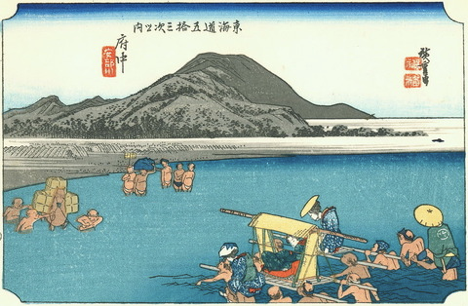
Crossing the Abegawa, a woodblock print by Hiroshige (Wikipedia)
The rain no longer seemed to bother me, for I was already by they time fairly drenched through. It was at the big bridges, like, Minami-Abekawa Bridge that spanned the Abegawa when I really felt the rain from all directions, even in an upwards direction, as it bounded off from asphalt with gusto. Like many of the river and wetland regions in Japan, the Abegawa had its fair share of typhoons, earthquakes, and flooding, and all the damage that resulted from them. The city by and its surroundings was not noted for any military significance, thus spared any extensive American bombing raids during the Pacific War. The city was badly damaged after a firebombing raid, on 19 June, 1945. There were a lot of civilian casualties, including the deaths of 23 American airmen, following the collision of two B-29s over the city. A book called, ‘The Blackened Canteen’ (2008), written by Jerry Yellin, documented the story. Yellin was himself a P-51 fighter pilot, and fought in the Pacific Ocean theater of the war. Route 150 connected onto the Shizuoka By-Pass, which led me over the long Minami-Abekawa Bridge and the river of the same name. The bridge was opened in Showa 45, or 1970. The Prime Minister at the time was, Eisaku Satō, who was then well into his fifth year in office, in 1970. Just months prior to becoming PM, he had been responsible for organizing the successful Tokyo Olympics, in 1964. Prime Minister from 1964 until 1972, Satō held the longest uninterrupted period in Office, in Japanese history. During Satō’s time in Office, Expo ‘70 in Osaka had just begun, in March, 1970. Amongst the countless futuristic attractions on display, that year, was the first-ever introduction of IMAX film, and all the necessary high-resolution and superior sound systems necessary for large screen viewing. The Japanese must have felt they had just stepped into the future. Things had certainly come along way since the early days when Vitascope caught the attention of Japanese people. Or when two Lumière brother’s cinematograph first appeared, in Japan, in 1897. Another popular highlight at Expo ’70, was the moon rock that was featured at the ‘United States’ pavilion. The ‘rock’ was a kind of souvenir from the moon, thanks to the Apollo 12’s successful mission, 1969. Expo ’70 also featured the first mobile phones, and needless to say, the rest was history. “Mmm!” How I still recalled the times during my childhood days in Belfast when I sometimes got long striped stick of traditional rock candy from a relative, during the summer holidays. The rock candies were commonly named after the place of origin, like, Blackpool in England, or Bray, Strandhill, or Bangor on the island of Ireland. Being the young boy I was, the rock candy certainly did not last long. Still, they were welcomed gift all the same. Other big news at the time, which occurred about two-weeks after the opening of Expo ’70. This time it involved the armed hijacking of Japan Airlines Flight 351, with 129 hostages, including crew members. Successful in the eyes of some, the hijackers finally landed in Pyongyang, where they were granted asylum by the North Korean Government.
The hijackers were members of the Japanese Communist League-Red Army Faction, a predecessor of the Japanese Red Army. The whole incident at the time was referred to in Japan as the Yodogō Haijakku Jiken. The Abekawa ran for 53.3-kilometers from the Akaishi Mountains, it passed through Shizuoka on its way to Suruga Bay and the Pacific Ocean. The mountainous region was known for its many hot springs, not to mention, the Abe Great Waterfalls, said to be one of the most beautiful in the country. Abekawa was one to the most famous fireworks festival in Shizuoka. The festival was held on the banks of the river in August every summer, and drew many thousands of visitors. The festival was first held in Showa 28 (1953). To paraphrase Wikipedia, the Shōgun Ieyasu Tokugawa had carried out extensive construction on the river and formed the present route of the lower course of the river. Abekawamochi, a mocha rice cake dusted with kinako, a soybean flour had been a local speciality of this area since the Edo period, if not earlier. The river had long been the main water supply for the city. “Mmm!” The many times that I had slept well, camped near rivers or under bridges to avoid the rain. It was more than important to know what potential dangers might arise and how to avoid them when necessary, especially when it rained. The rain was still pouring down when I tramped into Shizuoka City Center. The time was a little after five o’clock. Often in large cities, the hotels where located around the main train stations, but for the life of me, I could not seem to see one. Finally, I came to one hotel, but the ¥7,800 Yen for a single room, without breakfast, was too expensive for my liking. Then I came to a tourist information office and popped inside to see what I might find. The front desk was manned by a middle-aged woman, who looked like she was about to have a fit, or panic at the sight of me. To the women I must have looked like a rag and bone man, the rain dripping off my well worn clothes, as I entered the establishment. Of course, anyone out in such miserable weather all day long, day in and day out, would not have been a sight for sore eyes. “Sorry, no English! Please follow me!” Before I had a chance to utter a word, or undo the backpack straps, she ushered me out the same door I had just entered. She then pointed in the direction of the train station and said: “North entrance! Station! Tourist office! There speak good English! Can help you! Sorry here cannot help! Follow me!” And with that she led me to the other tourist office, just a few meters from the northern entrance of the station. Then after a few words in Japanese, to an attractive young woman behind the counter, she turned and headed back out into the rain and through the rush-hour crowds. The place was a little busy, but soon after dropping the backpack against a wall and waited in line. With the kind assistance of the young girl, after a number of phone calls to various hotels, the hotel that I finally settled on, was called Hotel Abant Inn (now called Smile Hotel, Shizuoka), just five-minutes walk from the station, the price came to ¥5,800 Yen, for a single room, which included breakfast.
19 Mar, 2014: A cloudy morning, but at least the rain had passed by, for now anyway. When I left the hotel to take a dander about the city, I spotted some bicycles near the entrance, clearly set aside for guests. So, I retraced my steps back into the lobby, and after signing a little slip of paper and returned it to the hotel clerk, who handed me a key with tag numbered “4” I was on my way. “Mmm!” This was good, I thought, for my plan was to rest my feet. I had read somewhere that the park was a good place from where to view Mount Fuji, which I hoped to pass by in the not too distant future. A lover of the bicycle, I had owned a fair number of them over the years, the bike was unquestionably one of the greatest inventions ever. Even at my leisurely pace, everything seemed so near. My little journey of sorts, led me to Sumpu Castle Park, not 10-minutes on foot from the main train station. This historical public area was located in the Shizuoka City Center. On the orders of the daimyō, work started on the construction of Sumpu Castle, the ‘Castle of the Floating Isle’, in 1607. Sumpu Castle was also referred to as Fuchū-jō, and as Shizuoka-jō. In fact, Sumpu was the former name of Shizuoka. During his time, Ieyasu Tokugawa, the big wig who united Japan, had spent a good portion of his life at the castle. This included being held hostage, by the Imagawa clan in his youthful days. All the same, he must have had a soft spot for the location of the castle, the splendid view of Mount Fuji, as he came to spend his final years there. Not long after his dearth, the seven-story donjon or tower, and its five-level roof, was just about destroyed by fire, in 1635. The castle was again destroyed after a series of powerful earthquakes that hit the region in late-December, 1854. The Great Ansei Tōkai earthquake, as it came to be known, had a magnitude of 8.4. The epicenter was not far from the mouth of the Arakawa River. Early records from that time indicated 6,641 deaths inside the city limits, with 2,759 others injured. A good part of the city was destroyed by fire. As a result, many people were forced to stay in rural inns. The aftershocks were said to have continued for 20-days (Wikipedia). The castle grounds became the property of Shizuoka City, from 1889 onwards. In away, it was fortunate that the Sumpu Castle survived to the extent it did. Currently, just twelve originally built castles survived the turbulent times that marked much of Japanese history. The castles had survived for centuries undamaged. Unfortunately, Sumpu Castle was not one of the twelve castles that had been built during the Tokugawa period, if not earlier. These fascinating castles, with their unique and original features, were located across the country, and each of which gave its visitors a valuable look into the the country's past. Most of the Japanese castles were dismantled or demolished during the Meiji period, in 1873. The plan of that period was to modernize the country, which dispensed with traditions and cultural values. Japan now embraced westernization and implemented a series of reformations throughout the country. With the new and modern national army, the castle system was regarded as old fashioned, or useless to Japan's military ambitions.
The same might be said about the many old stone castles that still dotted Europe. Today at the Sumpu Castle grounds, the place where the tower had once stood was now an excavation site. In its day, the donjon was the largest tower, in Japan. Needless to say, I stopped and took some snapshots of the castle and the bronze stature of Ieyasu at the castle keep. Just as the statue implied, the big man loved falconry. So many of the castles in Japan, Sumpu Castle gradually fell into decline over the years. To paraphrase from the official Sumpu Castle Park Website: during the Meiji period, the Honmaru moat was filled in for use by the 34th Infantry Regiment, and Sannomaru was used as a public space for government officers and schools. After the Pacific War, both the Honmaru and the Ninomaru were turned into a park for local citizens' rest and relaxation. The park was famous for its hundreds of cherry trees that bloomed in springtime, it also had many vivid azaleas that bloomed in May. Furthermore, the Higashi Gomon, Hitsujisaru Yagura, and Tatsumi Yagura were remodeled using traditional woodworking techniques. Inside, visitors were able to stop and take a look at pictures and materials on the reconstruction efforts. They could also view a number of excavated materials uncovered at various sites within the castle grounds. Most, if not all, Japanese cities were home to one or more famous temples and shrines. Many of them contained famous cultural assets and gardens, and so forth. Tokugawa Ieyasu, the first shōgun of the Tokugawa shogunate, ruled and united Japan after the Battle of Sekigahara, in 1600. Ieyasu was said to have been interested in literature. He was also believed to have studied under the guidance of a Buddhist priest of the small Keyoin Temple, called Chitan-shonin. The temple was not far from shōgun’s grandmother’s grave. The graves of his wive and daughter, were also located nearby. There were a number of old statues worth looking at. One of them was Kannon, the Buddhist goddess of mercy. To paraphrase the words of Michelangelo: ‘The more the marble wasted, the more the statue grew’. Today, this serene little temple ground was surrounded by a number of ugly looking box-like buildings. Other temples within the city limits were home to the graves of a number of notable people. For example, Saigo no Tsubone, the mother of the second Tokugawa shōgun, Tokugawa Hidetada, was interned at Hodeiin Temple, formally known as Ryūsen-ji, in Shizuoka City. To paraphrase Wikipedia: Lady Saigō was said to have influenced Ieyasu's philosophies, his choice of allies, and policies as he rose to power during the late Sengoku period, thus, she had an indirect effect on the organization and composition of the Tokugawa shogunate. Although less is known of her than some other figures of the era, she is generally regarded as the "power behind the throne", and her life has been compared to a “Cinderella story" of feudal Japan. A large mausoleum in honor of Lady Saigō was built to house her remains at Hōdai-in, 1938. The mausoleum’s tall five-tier stupa that marked the grave was toppled during the Great Shizuoka Fire, on 15 January, 1940.
Although the stupa survived, evidence of damage was plainly visible. For those interested, the grave of Katagiri Katsumoto (1556-1615) could be found at Seiganji Temple. Katsumoto was a Japanese daimyō during the Azuchi–Momoyama and early-Edo periods. In his youth, he was one of the Seven Spears, the mounted bodyguards for Hideyoshi Toyotomi, during the Battle of Shizugatake, in 1583. It was one of the battles that marked the start of the Tokugawa shogunate. Katsumoto was promoted to the rank of daimyō for his courage in the battle. As for Seiganji Temple, it was rebuilt on the orders of Minamoto no Yoritomo (1147-1199), after it had been destroyed by fire. He was also the first shōgun of the Kamakura shōgunate from 1192 until his death, in 1199. The temple was also home to around some 500 eighteenth-country statues, monuments to early priests. Nearby, a Japanese apricot tree, said to have been planted by Ieyasu Tokugawa. As a child, Ieyasu had been held as a hostage at the temple. “Mmm!” What was it that made many of the temples so famous? I wondered. Surely it was not solely because the remains of various noted figures were inshrined at them. Perhaps not! Ryuge-ji Temple, for example, boasted the oldest style of landscape gardening found anywhere in Japan, and also contained the grave of Japanese author and literary critic, Takayama Rinjirō (1871-1902) (pen-name Chogyū Takayama). At one point in his life, Chogyū and novelist, Natsume Sōseki, were selected by the Ministry of Education, to study in Europe, in 1900. Perhaps Chogyū became more religious in the final years of his life, as much of what he produced was mainly on religious philosophy. During his life, Chogyū influenced Japanese literature in a wide genre of areas. He published novels, works on art history, and Buddhist philosophy. Much of his work bordered along the lines of romanticism and mysticism, with a touch of nationalism thrown in for good measure. This was in the wake of First Sino-Japanese War (1894-5), and the Triple Intervention (April, 1895), when France, Germany, and Russia had a say in the wording of the Treaty of Shimonoseki, which ended the First Sino-Japanese War. Russia had the most to gain from the Triple Intervention, and was at that time trying to increase her influence in the Far East. The intervention was one of the causes of the Russo-Japanese War (1904-5), almost 10-years later. The outcome of the war was a complete Japanese military victory over the Russians, which in turn surprised other world powers. During his final year, Chogyū lived and wrote in a house near Kamakura. It was believed that the sea air would be good for his already deteriorating health. His funeral rites were conducted at the Ryuge-ji Temple. Baiinzenji Temple was of the Myoshin-ji School of the Rinzai Buddhism sect, it was established during the Ashikaga Period (1336-1573), which made it one of the oldest holy places in Shizuoka, if not Japan. The temple also contained the grave of Shimizu Jirocho (1820-1893), and his wife, including graves of some of his cohosts. Jirocho was born in Shizuoka, was adopted by his uncle, Jirohachi Yamamoto, a rice merchant.
Besides being involved in a number of questionable activities in his day, it maybe incorrect to imply that he was a gangster (yakuza). Jirocho’s real name was, Chogoro Yamamoto, in his day he was considered the Robin Hood of his day, for helping the weak against the strong, in the Meiji period, from 1868. “Mmm!” I wonder if he was familiar with the Code of Hammurabi: “the strong shall not oppress the weak”? A bronze statue of Jirocho was believed to be the only one in the country. There was also a museum nearby that was dedicated to him. The Japanese 1957 film, ‘Ninkyō Shimizu-minato’, the ’Port of Honor’ in English. The film was directed by Sadatsugu Matsuda, and portrayed a loosely based plot on the legend of Jirocho, and portrayed him as Japan’s most famous gangster and folk hero. No less than 16 films had been released between 1911 and 1940, which dealt with the life and exploits of this, so-called, criminal-cum nice guy figure. Last, but not least, the first shōgun, Ieyasu Tokugawa’s original place of rest was located at a Shinto shrine called, Kunō-zan Tōshō-gū Jinja, located at the summit of the 216-meter high Mount Kunō that overlooked Suruga Bay in Shizuoka. The temple was said to have prospered during the Kamakura period (1185–1333). This was around the time of the eminent Buddhist monk, Enni Ben'en, introduced the cultivation of green tea in the region and the introduction of udon noodles to Japan. The rest became history. Later, on the orders of the third-shōgun, Iemitsu, Ieyasu’s remains were relocated to Nikkō Tōshō-gū. Ieyasu’s spirit was still honored at both shrines, since a part of his spirit still resided on Mount Kunō. Among the treasures on display at the museum at the shrine, was Tokugawa Ieyasu’s armor and eyeglasses, and a clock given to the shogun by a representative of the Spanish king, Philip II, in 1611. Kunō-zan Tōshō-gū Jinja was believed to date as far back as the Nara period (710-794). This made it the oldest and one of the most famous of the Shinto Tōshō-gū shrines, in the country. The Nikkō Tōshō-gū was one a number of UNESCO World Heritage Site Shrines and Temples in Nikkō, and which housed many important national and cultural treasures. The shrine included the famous gilded Yomeimon Gate, the main sanctuary set among a cluster of cedars. Local village life during the Nara period was predominately agricultural, which included a Shintoistic worship to both ancestral and natural spirits, or kami. It goes without saying, on a good day, Mount Kunō offered a specular view out over Suruga Bay. Japan certainly loved its festivals, called matsuri in Japanese. However, it was unknown just how many were held in the country for one traditional festive occasion or another, each year. The number was said to be somewhere between 100,000 to 300,000. Like so many other shrines and temples in Japan, there were two festivals held at the Kunō-zan Tōshō-gū Jinja. One was held in late-winter and the other in the middle of spring each year, on 17-18 February, and 17 April, respectively. Although the winter matsuri was deemed the main festival of the two, the one held in springtime drew more visitors.