Road Notes Around Japan

Irishman Walking (Stage 20 Chapter 3) Summer 2017

56439087_2291153687790871_6976789749440708608_n

Irishman Walking (Stage 20 Chapter 3) is about my walking the main and coastal roads of Japan. Summer 2017.


28 Aug, 2017: In the morning I was in no mood to do much of anything, other than to take my time to up camp and hit the road. My washed clothes lay strewn about the warm ground to dry. Sleep too, had not been easy. The late hours was spent listening to a Liverpool-Arsenal game on the BBC. By halftime, Liverpool were 2-0 ahead, then the WiFi died. As I was in no great hurry, I was able to recharge some batteries. Later, I learned that Liverpool thrashed Arsenal 4-0. The win left Liverpool second in the English Premier League, behind Chelsea. I had followed Liverpool ever since I first moved to London to go to school, in 1969. My first school friend at the time, was a Reds van. Needless to say, I swore when the WiFi died. A call from a friend, told me that a room had been secured for me at an hotel, just two-kilometers from my current location. The cost was a just under ¥6,000 yen. This was not bad, as two meals were included. I also learned of the possibility of rain in the morning. To have booked an extra day at the hotel might not have been a bad idea. Then again, a fat lot of good that would do, for the weather was said to be unstable. Before I left the roadside stop behind me, I decided to pay my third visit to the restaurant. It was not good to judge anything from photos, particularly food. This time I decided on a katsukarē dish, rice topped with beef cutlet and curry. The dish placed in front of me was not what I ordered, but hayashi, a hashed beef stew on rice. Often hayashi included some chopped onions and mushrooms, and a thick tomato or red wine sauce. Both katsukarē and hayashi were popular dishes, in Japan. Stew had been around since ancient times, and first documented in Japan in the Jōmon period (6,000–300 BC). There were many types of stew, each with their own particular history, hayashi among them. The earliest evidence of hayashi was found in Japan. A common explanation was that the name, ’hayashi’, came from the English phrase, ‘hashed beef’. Another view was that hayashi originated from a yōshoku (Western-style food) restaurant in the Ginza district of Tokyo, after the Pacific War. One frequent patron at the restaurant, at that time, was a Yomiuri Giants baseball player called, Shigeru Chiba. Chiba was said to have influenced the creation of a new curry dish, katsukarē, dubbed, 'Chiba-san's curry'. The hayashi placed on the table in front of me appeared to have a meat-based source, without any meat or vegetables. My  night in the tent proved comfortable, but chilly in the early-hours. The tent was pitched a short distance from the public toilets, which I felt to be a good idea. This was mainly in an effort to escape the force of a wind, which had kicked up expectedly. Thankfully, the night remained calm, and I slept well, even if the tent was a little chilly. All the same, the air outside was a lot nippier than inside the tent. So, I did not bother to head to the toilet when the need called. Instead, a paper cup solved the problem, which I then tossed outside, at arms length, into the cold morning air. This act of sorts, was repeated thrice in the course of the night. 


Done


Back on the main drag again, I made a wee stop at the corner of a minor road, Route 138, partly to see where it was headed. A sign told me that the road was bound for a place called, Onishibetsu. The second reason I stopped was to use a Seicomart, a convenience store nearby. Thanks to a thermos flask at the store, I was able to sit down outside for a while and enjoy my first coffee in a good while. Not 50-meters from where I set, stood a brown building, built around 20-years ago. This was the Sarufutsu Marine Inn, where I had a reservation. It was a rather dull building, situationed on the side of the Okhotsk Sea. Checkin time was not until 15:00, so I had a bit of time to kill. So, it was it was good that there was no rain. Much depended on the state of the place -- cleanliness of the room, quality of the food -- to extend my stay, if possible. The room (#201) that I was assigned had a tatami-mat floor. There was a time in the not too distant past when such floors were common. In recent times, however, I had grown accustomed to shinny wood paneled floors, particularly at business hotels. One good thing about my tent, was that I never needed to consider such things. In addition, around 95-percent of the time, most nights in the tent usually proved quite comfortable, to say the least. As I had some time to kill, I treated myself to a cool 500-milIliter can of Sapporo ‘Extra Brew’ lager, as printed on it. The theologian, Martin Luther, was reputed to have said: 'If you don’t have beer, you have nothing to drink'. That said, my own beer turned out to be a wee bit too sweet for me to fully enjoy.


Done 


29 Aug, 2017:  The rain bucketed down, when I climbed out of bed. That was not all that had come down. The NHK news babbled on about a North Koran missile. Apparently, the missile passed over Japanese waters between the main islands of Honshu and Hokkaido, before it crashed into the Pacific, a distance of some 1,180-kilometers. A road sign told me that Cape Sōya was just 29-kilometers away. Of course, Wakkanai was further at 60-kilometers, but I had no intention to visit there. The rain stopped, and I hoped it would stay that way. A cyclist shot past, headed in my direction, the cap. He did not wave nor stop to chat. A few seconds later, a large motorbike sped past, in the other direction. The rider waved, which I returned. There was no need for him to stop. There were a number of small tents, dotted along the coastline. The tents were not the kind that campers used, but norrow for fishermen to sit under, to stay dry if it rained. It had rained for awhile in the early-hours. A short stop was made to take some snapshots. From the appearance of the fishermen, I would say that some of them were retired. It was said that everyday was a Sunday for retired people, but I was not so sure in the current state of events -- the cost of living and rising prices. Further along the road, Route 238, I passed other tents of various colors and sizes. The occupants did not seem to be around. My plan was to reach Chiraibetsu, an unevent little township, some 15-kilometers away, or half the distance to my goal. Both the road and pavement had quickly dried up from the rain. A second large motorbike passed by, headed in the opposite direction. Like the previous rider, I was greeted with a wave, which I happily returned. On this final stage of my mission, a good number of cyclists and bikers passed by, as I made my way along the road, flanked by large open pastoral fields. Conversely, I was unsure why I had not seen many coaches, loaded up with tourists. It was hard to see why this was. The most northern point in Japan drew many trekkers year round, for its natural beauty, an abundance in wildlife, and its hot springs. It was bordered by two seas -- the Nihon Kai and the Sea of Okhotsk Sea, noted for the drift ice in winter. In the course of time, tents popped up here and there along the seashore. Some of them had fishing rods fixed to the ground that pointed high out over the foamy surf. Regardless of the many technological improvements through the years, the idea of the fishing rod dated back to ancient times. Why the art of fishing failed to make an impression on me was another story, which I will not go into here. The main thing on my mind, however, was the hot weather. Earlier, this morning’s weather forecast news on the box, spoke of sunshine. The road headed past a small fishing port, Chiraibetsu Fishing Pork. Altogether, the islands of Japan boasted more than 2,000 fishing ports. Only the Shinto gods knew just how many I had tramped past along the coastline, on my way around the country. In time, a young man I bumped into, accompanied with his two-year old son, told me that a bear had been spotted in the vicinity, but had not seen one himself.


Done


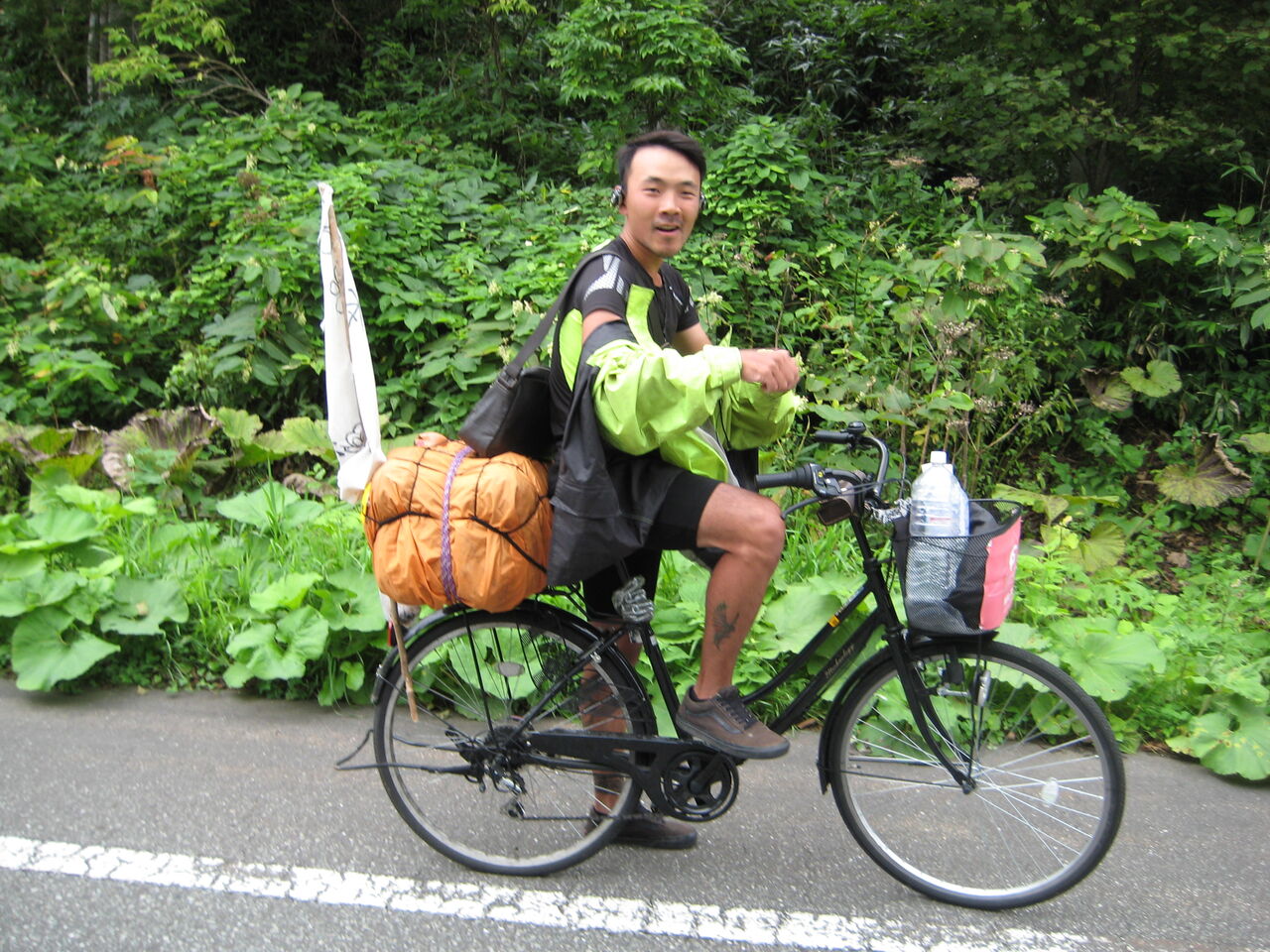
He also told me that he was the local policeman, and pointed to the direction of a recently built building, the lower part of which was a koban, or police box. The young man was not in uniform, so I surmised that this was a sort of day off for him. “Be careful!” He said to me, as I headed off along the road. After about 12-kilometers, the road rose at a sharp angle upwards for a kilometer. A tiny sign along the road, told me that I was about to enter Mineoka Township, and where the road started to head downwards. It was also at this point along the road when I realized that this was turely the homeward stretch, the last leg of my mission. "Sōya Misaki, here I come.” I shouted at the top of my voice. The road continued for some distance through a low mountain pass. When I headed on the downward stretch of the road, I caught sight of a cyclist slowly peddle his way upward. It was easy to see that the bike was loaded up with gear, as it swayed from side to side. For a moment I thought that he was about to take a tumble. There had been a number of times when I had fallen of my bicycle, and on one occasion had boke my collarbone. Even on foot, there had been the odd time I took a tumble, which  I put down as part of life on the road. Regardless, I had an elemeent of admiration for the young man. He drew nearer, then stopped and dismounted. Perhaps the heat from the sun or the steep road, or both, had gotten the better of him, for he appeared exhausted. My encounters with people along the road, usually proved reason enough to stop and rest. The cyclist greeted me with a warm smile. “Konichiwa!” I said, with a smile. “Sorry, but I don’t speak Japanese. But, Hello there.” He introduced himself as Wenhan Yu, from Taipei. In the course of our chat, I learned that Wenhan had just graduated from university, and like many young people, he wanted to travel a bit, before he knuckled down to a career. We chatted more about life on the road, than about ourselves. The best way to see the world, he added, was to do it as cheaply as possible. To cut costs, Wenhan told me that that was why he chose to use a mamachari, an inexpensive bike with a limited set of gears. “Why not?” I said in agreement. I told him that I had had a similar adventure, around Japan on a bike. Unlike Wenhan, things had been in reverse -- worked, traveled, studied. Wenhan had a pleasant laugh, which lifted my own sprits. Before we headed off in our oppisite directons, snapshots were taken, and contact addresses exchanged. In away, my travels had never really ended, and even life itself was one big journey.


Done 

IMG_0817


Wenhan Yu, alone cyclist

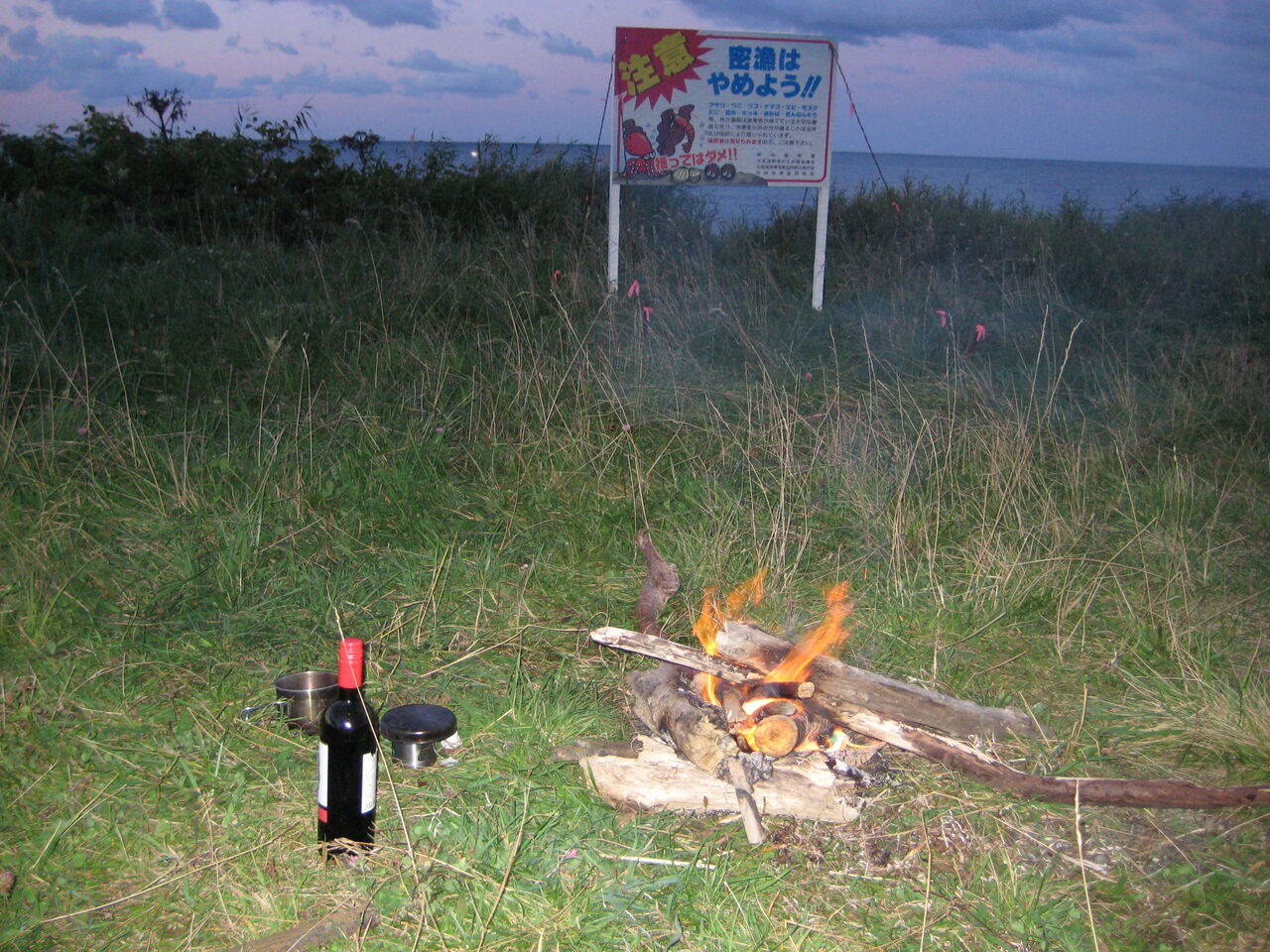
30 Aug, 2017: Yesterday, the tent was pitchd on a raised piece of ground, beside a brown sandy beach, along the Okhotsk shoreline. A road sign told me that the distance to Sōya Misaki was exactly nine-kilometers away. This was less than two hours tramp, or nearer than I hoped. It was not always easy to find a suitable spot to spend the night, when on a steep mountain pass, for the dense growth of shrubs, and whatnot else. Even my campfire to boil water for tea, proved more difficult than usual. At first, I had thought of coffee, but  could not find the coffee filters. It seemed that I had inadvertently left filters at one of the places I had stopped at along the road. Unfortunately, the words 'lost' and 'misplaced' were frequent occurrences on the road. There were more important things on my mind, as I tossed a piece of wood on to the campfire. By now the fire burned well. Nothing fascinated me more than a beautiful clear evening sky -- home to more stars than the earth was to grains of sand. In away, I envied the ecademics that were well-rounded about all that stuff out there. If anyting, the star was what I knew least about, their formation, planets, galaxies, and whatever else made up the Milky Way. Back down to earth, some 50 giant windmills stood far off in the hills to my left. All the blades appeared frozen. The cost of a single wind turbine was not for the faint hearted to even think about. A large turbine on a wind farm could cost anything from 20- to 40-million yen. The jury was still out, if it was money well spent. Back to the present, the road headed at a downward slant, as if to go right into the sea. In the distance below, another cyclist popped into view. He struggled up the steep slope towards me. His efforts reminded me of the young Taiwanese man I had chatted with yesterday. This time, however, the cyclist rode, what to me looked like, an expensive touring bike. The cyclist seemed determined to reach the top, so he did not stop, nor wave. About four-kilometers from my goal, Cape Sōya, I made a stop to read an historical sign. It had quite a bit of information after the title, so I set down nearby to pen some notes. The Toyoiwa unearthing was designated as historical heritage sites. The sites were located 3.4-kilometers from the northern most point, Cape Sōya. All 10 of the Toyoiwa sites dated back to the Jōmon to Satsumon periods, and were excavated, in 1985. The Jōmon period dated from about 14000 to 300 BC. The people lived in small settlements, mainly on the islands of Honshu and Kyushu. They lived in sunken pit dwellings, usually near rivers and along the seashore, where seafood, particularly shellfish, was a major food source. At the start of the Jōmon period, the Japanese archipelago was still linked to Asia -- via Kyushu and the Korea peninsula -- from where many early settlers entered the Land of the Rising Sun. The earliest pottery in Japan was said to have been made around the start of the Jōmon period. The people produced earthenware figurines and distinctive cord-patterned vessels; and lacquerware, as well as, jewelry and tools made from antler, bone, shell, and stone. 

Done 

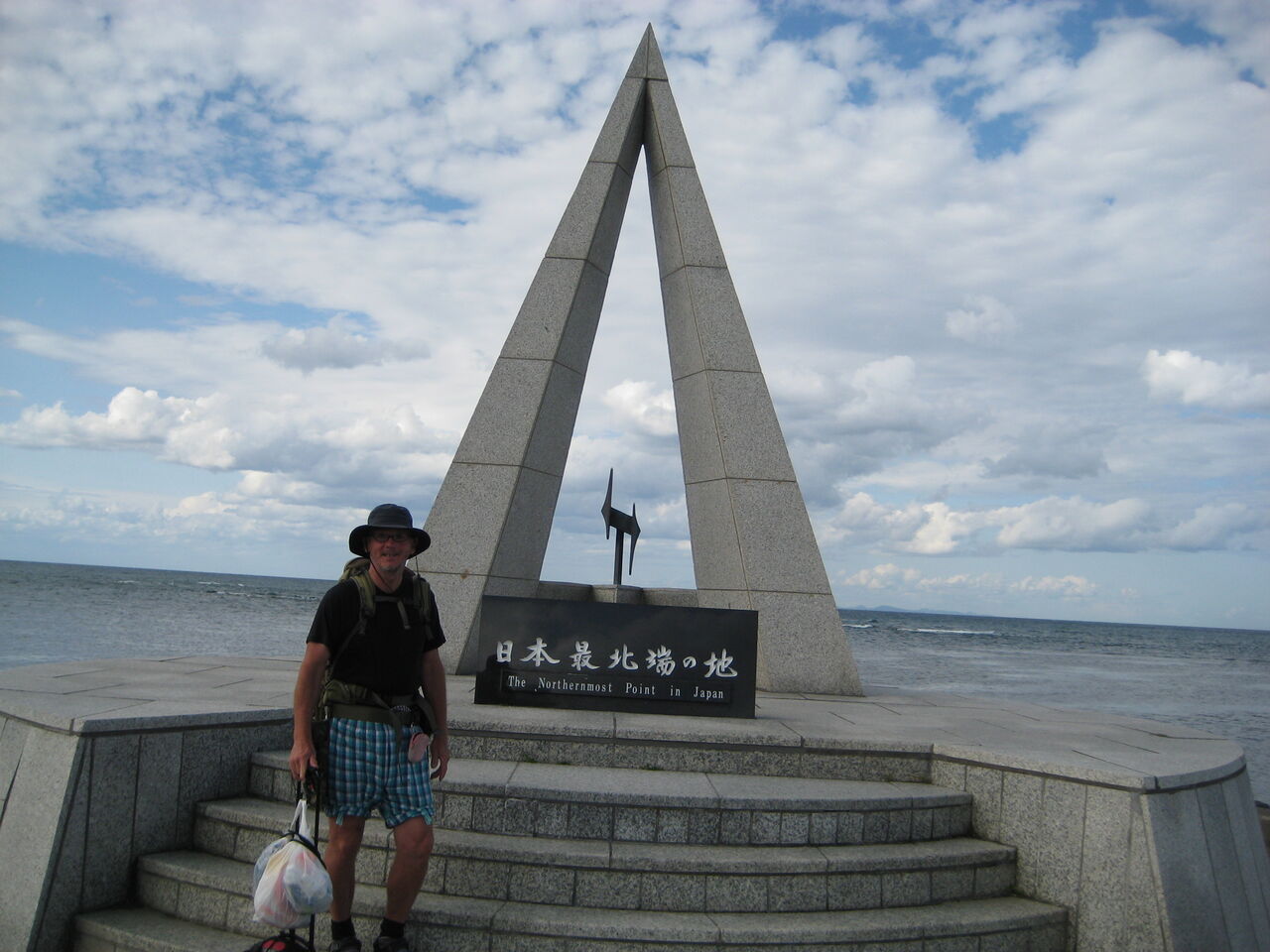
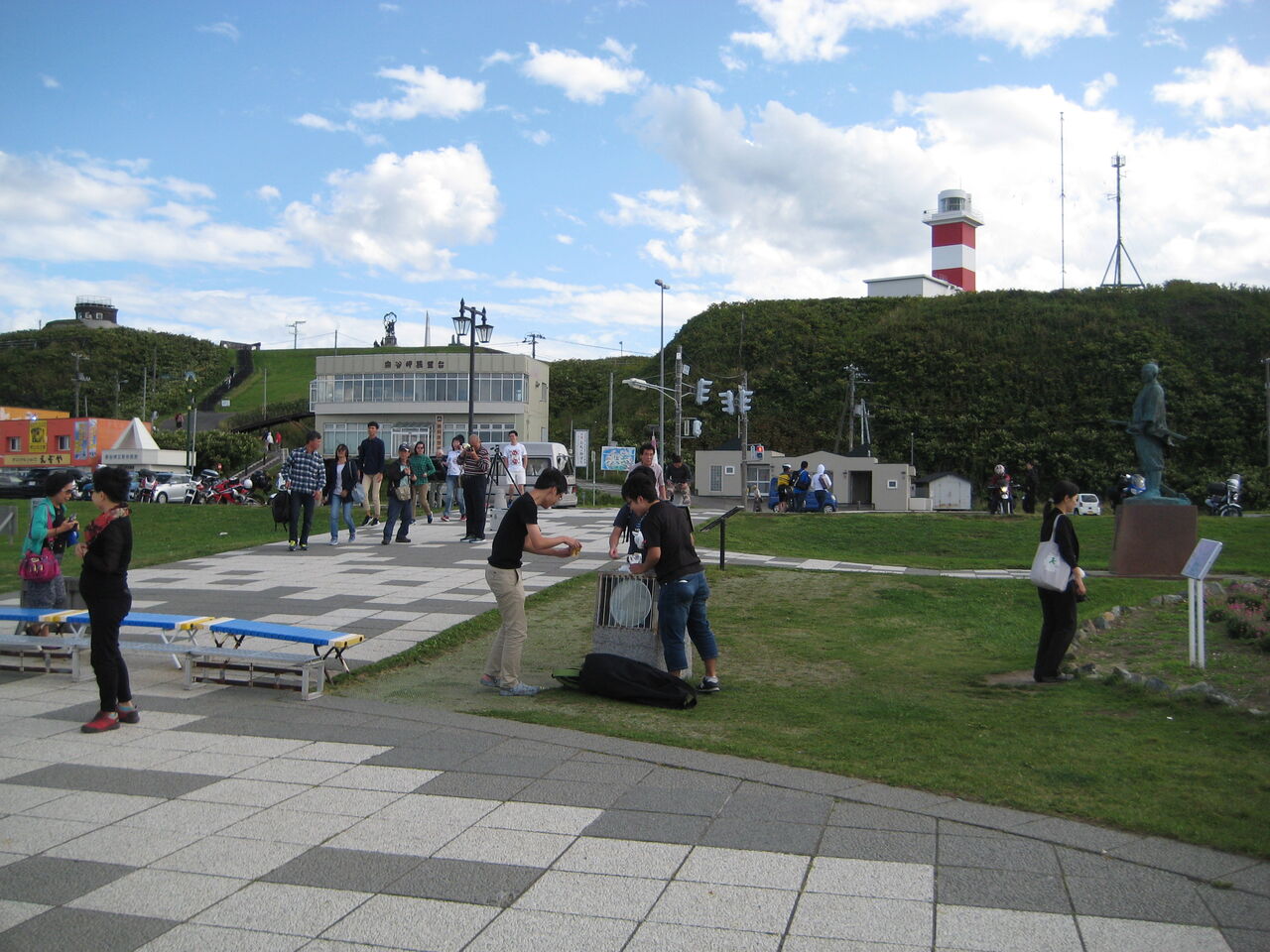
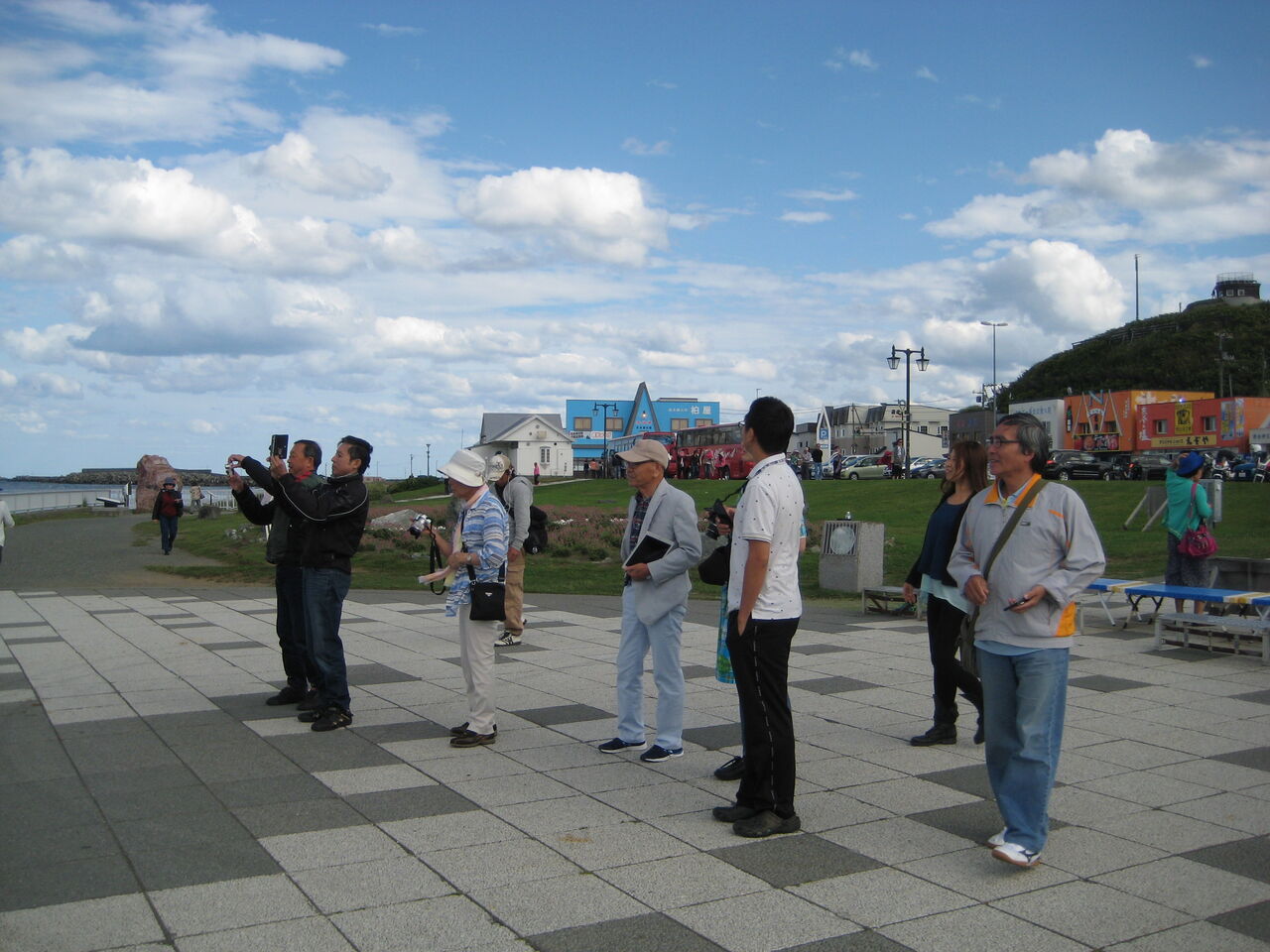
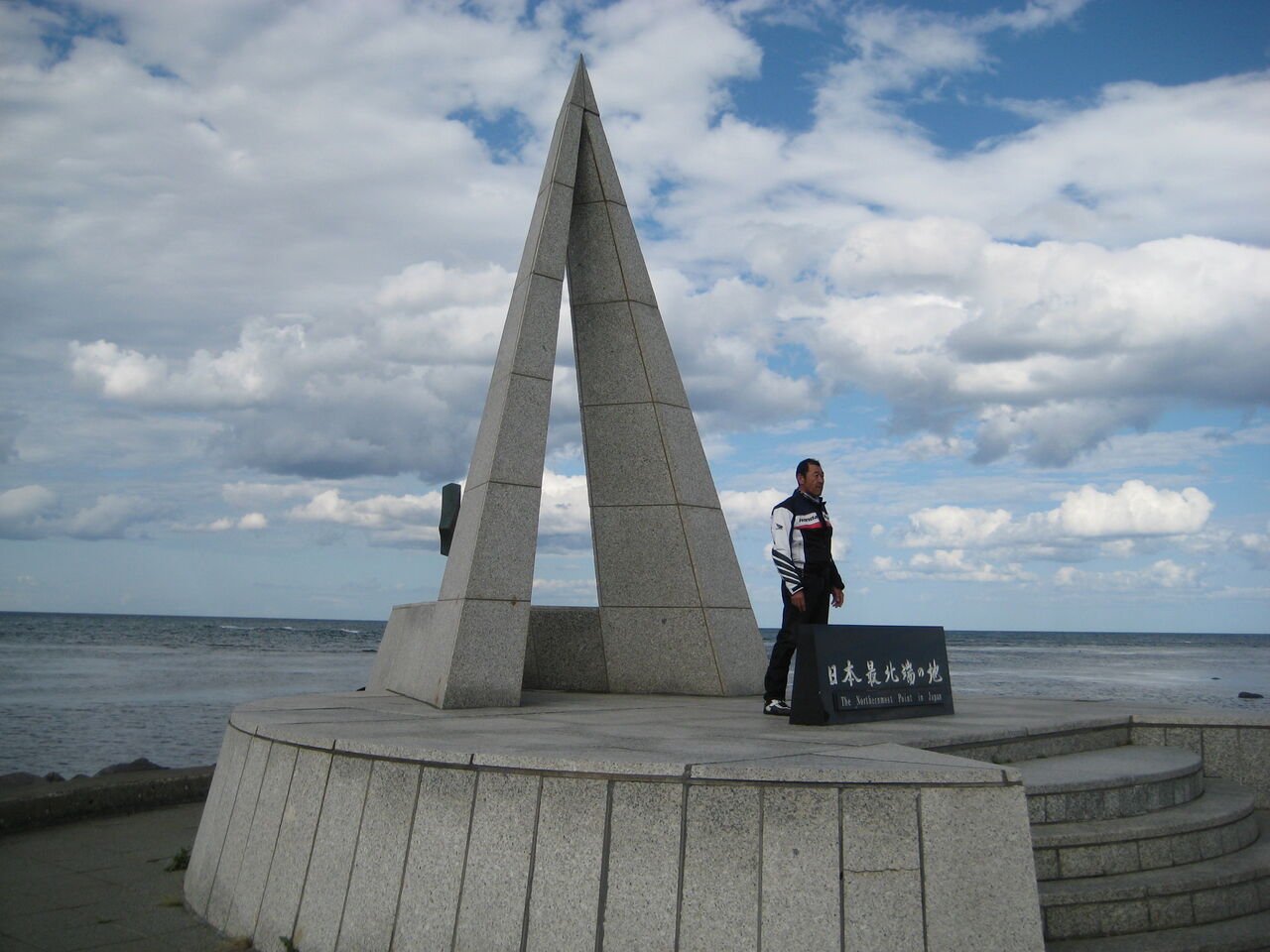
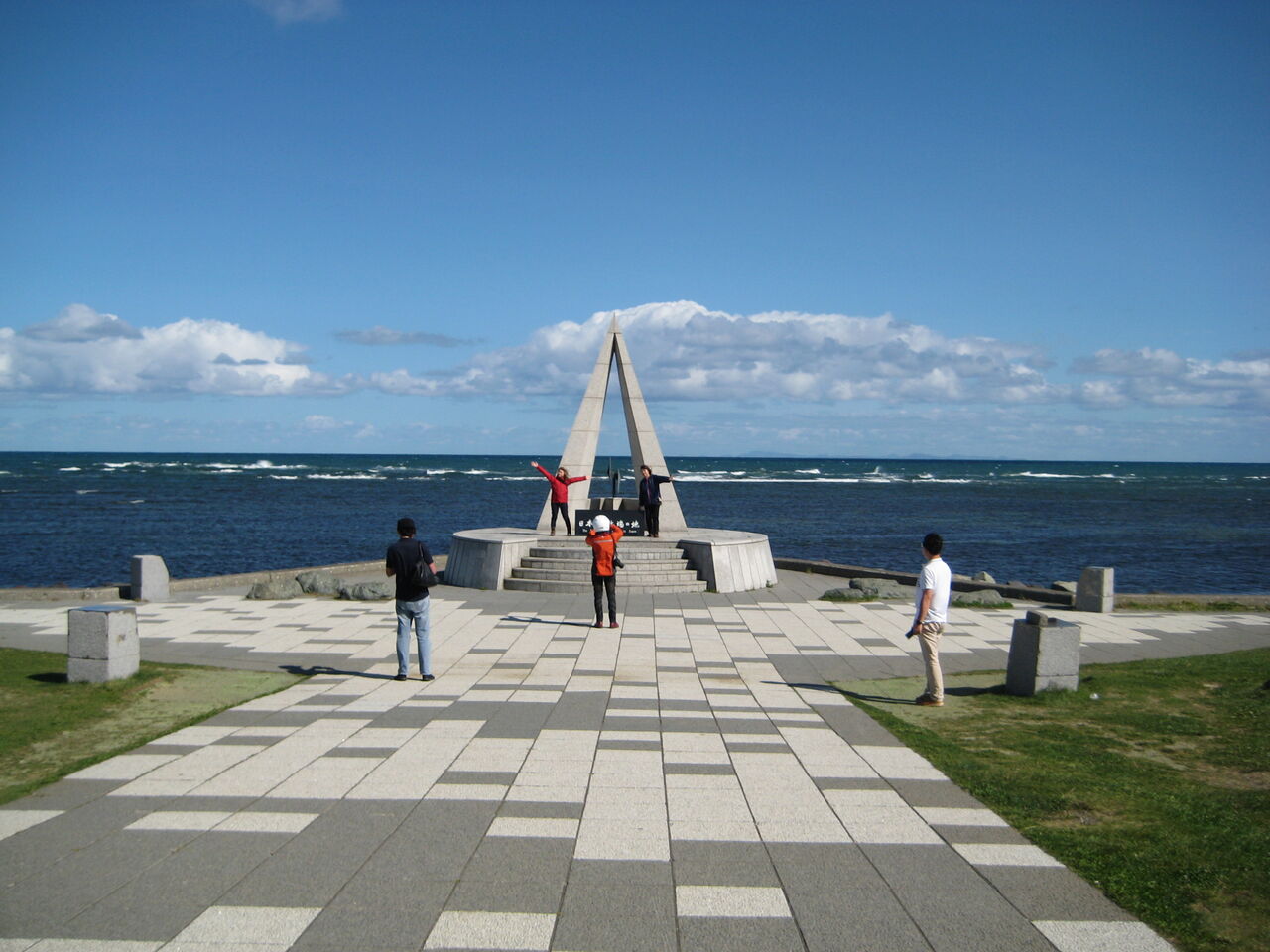
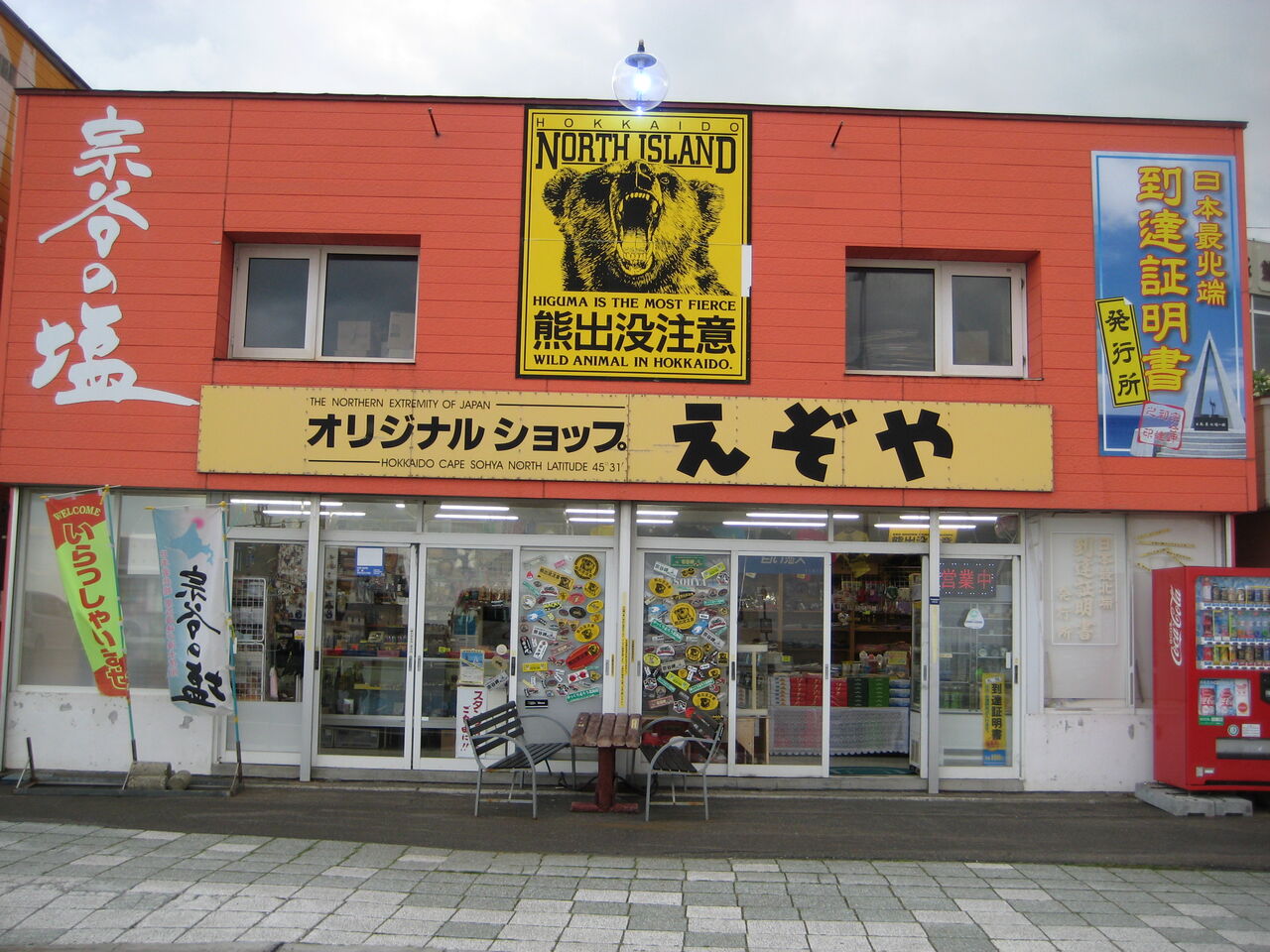
Bronze and iron metallurgy also made an apparance around that time. Wet rice farming was introduced to Japan from Korea and China, in the later half of the Jōmon period. Although some horticulture was practiced in the Jōmon period, it was primarily a hunter-gather culture. The Jōmon period was followed by the Satsumon period, which dated from about 700 to 1200 AD, in the northern regions of Honshu and the southern regions of Hokkaido. Some of the findings uncovered from several sites, dated to the  Jōmon  period. The Satsumon people shared similarities with other ancient ethnic groups -- Ainu and Emishi -- iron tools, place names, archeology, agriculture. The Satsumon people grew a wide range of cereals -- barley, wheat, millet, and perhaps even rice, a diet staple in the country today. Hunting-gathering, and the use of horses, and fishing, remained important activities during the Satsumon period. A small road sign told me that I was now entering into Sōya Misaki Township -- the last leg of my mission. The time had gone one-thirty in the afternoon when I tramped into Cape Sōya proper. The cape was home to a good number of famous, and not so famous, monuments. The most photographed monument in Hokkaido, if not the country, marked Japan's northernmost point. The monument was constructed in 1968, it was moved 20-meters closer to the sea twenty-years later, in 1988. On a clear day, Karafuto Island (now known as Sakhalin Oblast, Russia) could be seen from the monument. The northernmost point in Japan was a popular destination for national and international tourists. And, just as I had done in the summer of 2009, the monument was a common start-point to set off from on a tour the country. In addition, 'Commemorative Certificates' were available from the souvenir shop at Cape Soya to mark the arrival. One monument that caught my eye when I started my my mission in 2009, was dedicated to an American submarine, USS Wahoo (SS234), sunk in 1943. That was around the time with the Pacific War began to change in the Allies favor. Already following the Battle of Midway in early-June, 1942, and the Guadalcanal campaign a few months later, Japan’s capacity to replace its losses were greatly limited. Some 80 crew members lost their life. From the monument: “Eighty Americans sleep in the Sōya Strait 12 miles northeast of here.” Up until that fatal day, the Wahoo was the most successful submarine in the US Navy, in tonnage sung. Again from the monument: “Many Japanese sleep in the Sea of Japan from Wahoo attacks.” The exact location of the Wahoo was found by a dive team from an investment firm, in 2006. This monument was erected by the members of the Japanese Attack Group and relatives of Americans had served on the Wahoo. From the monument: “Old enemies met as brothers to ensure that our countries will have lasting peace and war will never again destroy the friendship we enjoy today. —  George E. Logue.” By chance, I came upon an interesting American television series, ‘The Silent Service’ (1957-8) on the Internet (YouTube).

Done 

The programs were produced and narrated by Rear Admiral Thomas Michael Dykers (1905-1975). During the Pacific War, Dykers had been a submarine commander, and knew of the Wahoo. One of the episodes (#13) was dedicated to the USS Wahoo and her crew, and was refered to in other episodes. As I drew nearer to the spot were all the tourist coaches stopped, two muscular young cyclists stood near the public toilets. One was making repairs to his bicycle, when I stopped to chat to them. They told me that they were on a clockwise journey around Hokkaido. They asked me the usual Who-What-Why-When-Where-How questions. They were the sort of quetsions I had been asked on countless occasions before. Some of the people I met wanted to know everyting -- where I came from, who I was, what I did -- every circumstance of my life. Some how, this time, the questions seemed a wee bit different. The cyclist seemed confused, when I pointed to a spot a few metters along the road. “You see, that’s where it all started for me, on a rainy day in July, 2009.” Still, they did not seem to understand what I meant. For all I knew, they may have thought that they had bumped into the village idiot. It would have been nice to have shared the moment with someone I knew and understood where I was coming from, or had a handle on my mission. There was nothing better than to be understood, especially by someone you loved. There had been no one to meet me, and even though I had planned it that way, I felt lonely. Already I had begun to think about what to do next. “Over there at that monument was where my walk around Japan will end.” I told them. “Just a few more steps to go.” The two cyclists appeared a wee bit impressed. They finally understood me, or so I felt at the time. It was hard to read a Japanese face, in a country where facial expressions could be so misleading. For all I knew they might even have wondered why I bothered my arse to share such a personal thing with to strangers. At the time, I felt mentally tired, and in little mood to go into great details. I even, momentarily, felt sorry for myself. Why should they care? We had just bumped into each other. Besides, they had other things to think about -- fix the bike, head off along the road to accomplish their own goal, and so forth. In away, I envied them. To be sure, life on the road had been for me another world, away from the humdrum of city life and unsmiling faces. Oh sure, it was a hard life, really. Somewhere between the sun and a hot road one day, then drenched by rain, or frozen in snow, the next. Life on the road in the summertime, was a series of in and out of the sun, to duck under a shade somewhere to escape the heat, for a whille. They were about to start out on a new adventure, an experience that would unfold before them. My own excitement had since petered out somewhere along the road. Not a single feeling of genuine enthusiasm remained, nor a sense of accomplishment. This was unlike the time when I reached Cape Sata Misaki, on the southern tip of Ōsumi Peninsula, on the island of Kyūshū. I still remembered the lighthouse at Cape Sata, which stood since 1871.  

Done 

A decade when many western-style lighthouses were built, in Japan. It was designed by a Scotsman, Richard Henry Brunton (1841-1901), who was said to be the ‘Father of Japanese lighthouses’. At the time, the British government felt obligated to make the waters and harbors of Japan safe for shipping. Juring his time in Japan, Brunton was responsible for no less than 26 western-style lighthouses, most of them were still in operation today. The lighthouses were refered to as, his children. He also initiated a system of lighthouse keepers, modeled on its success in Scotland. In addition, Brunton was responsible for the first detailed maps of Yokohama -- the sewage system, street pavments, and gas lights, and a telegraph system, and the first iron bridge. Brunton also helped found the first School of Civil Engineering, in Japan. Incidentally, the lighthouse at Sata was where the travel writer, Alan Booth, ended his own mission. Booth started his mission from Cape Sōya, in 1977, as I had done about three-decades later, in 2009. He travelled mainly along the small backroads from top to bottom, Cape Sada, whereas I stuck to the main and costal roads around the intire country. Booth's travelogue, ‘The Roads to Sata’, was first published in 1985, which I came across secondhand, more the 20-years later. In away, his book kickstarted me on my own mission, on foot around the Land of the Rising Sun. This was done on a series of spring, summer, autumn, and winter stages, from 2009 to 2017. Such was my enthusiasm, each time a stage ended, I could not wait for the next one to begin. Life on the road was like a drug, it opened up my eyes, and gave me something to live for. In the interim, I never suffered despondency, or self-doubt. Pessimism was a word that was not in my dictionary. This was perhaps because, I was one of the most restless men to inhabit the planet. A child of a broken family, with little to hang about for, and with two itchy feet, the road seemed as good a home as any. My school-life had been a hotchpotch of institutions — two primary schools and five secondary schools, in Belfast and London. And, various three colleges in as many American states. My school days included two universities, in Belfast and in London, both of which I finally graduated from. In the years I spent in Tokyo, I moved no less than 12 times to news addresses, such was the restlessness in me. One of the first things I did when I arrived in Japan for the first time, was to climb Mt. Fuji, Japan's tallest mountain. Mt. Fuji, the most photograpthed peak in Japan, was also an object of Shinto worship since ancient times. It became a World Cultural Heritage site, in 2013. I climbed Mt. Fuji more for a sense of movement it give me, than the joy to reach the summit. Not long after the climb, I bought a bike and cycled around Japan, again for the same reasons -- movement. I moved from one place to another since as long as I could remember. Often this was more out of need, than by choice. Like the proverb, I believed that the grass was greener on the other side of the fence. Back to the present, the only thing on my mind at the moment was to replenish my hip-flask with water.  

Done 


IMG_0883

IMG_0878

IMG_0877

Done

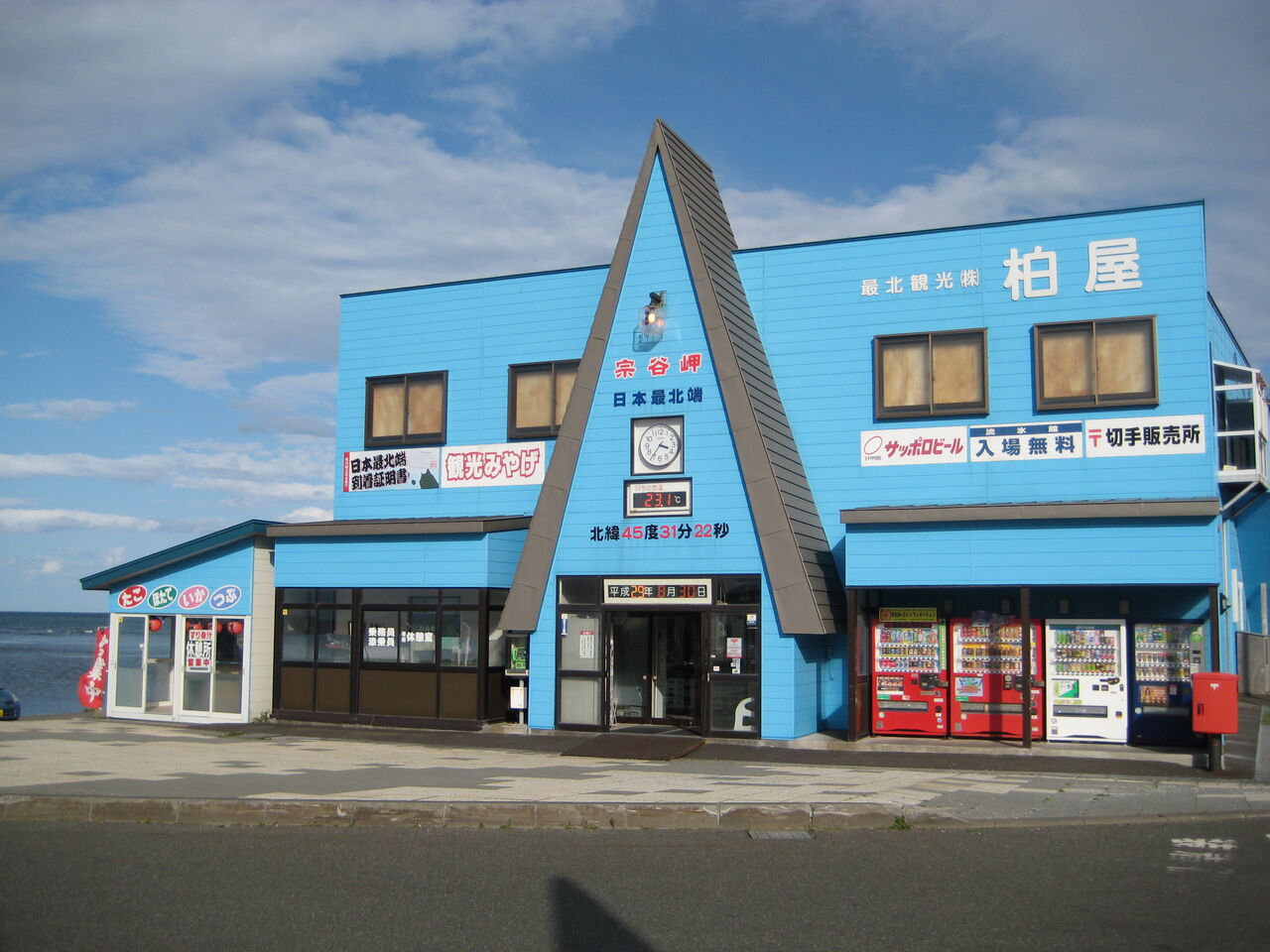
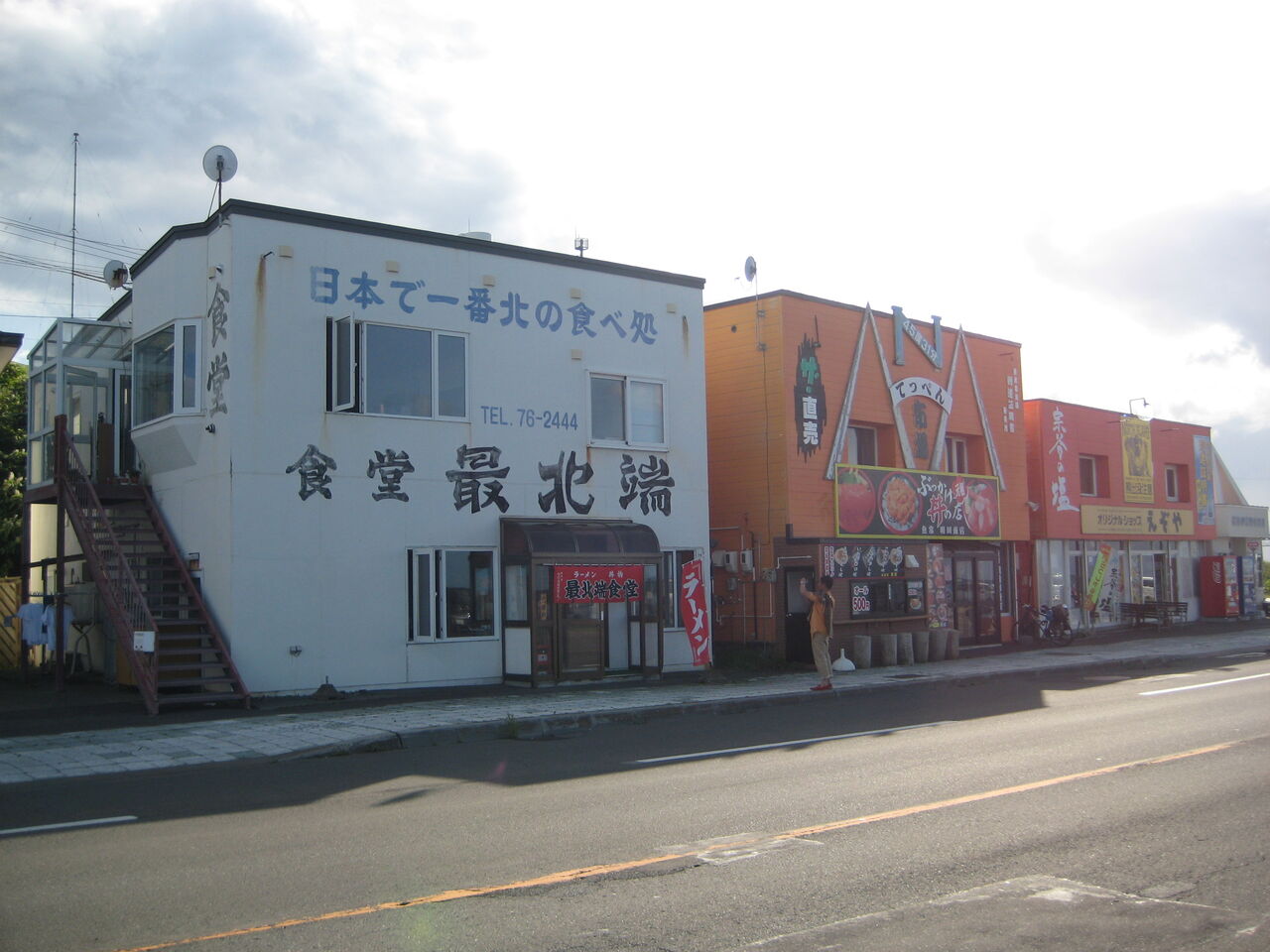
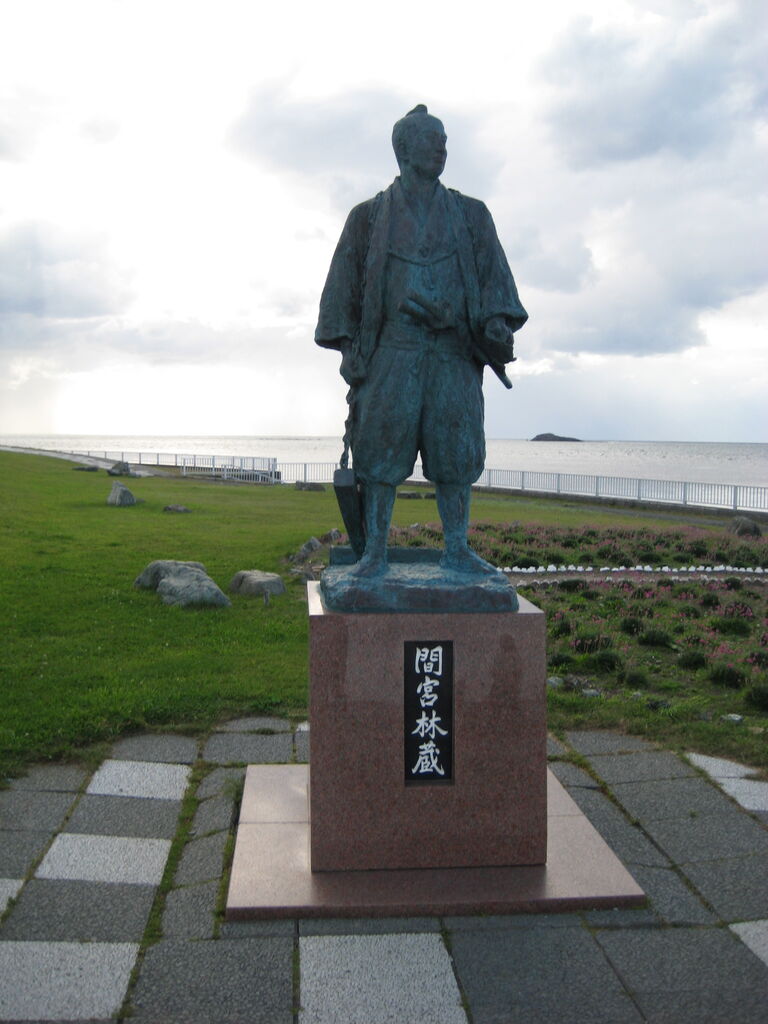
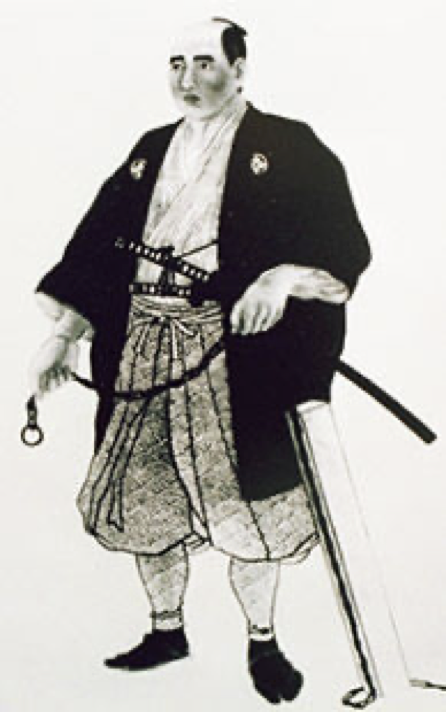
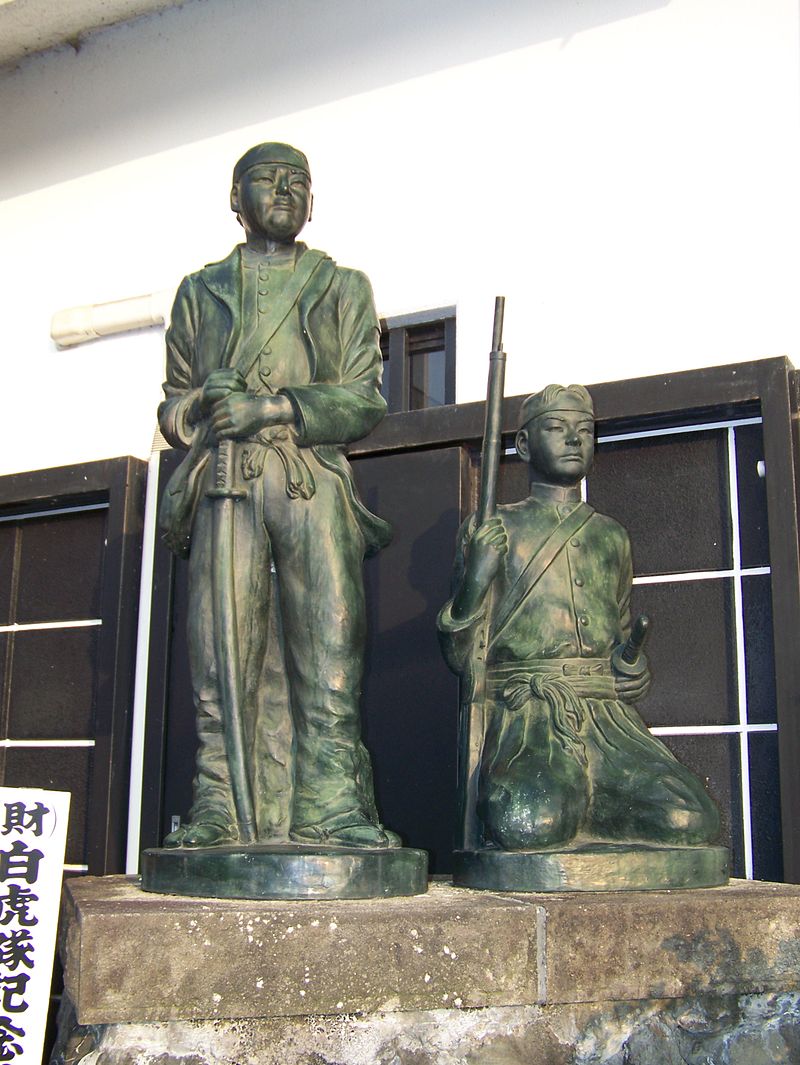
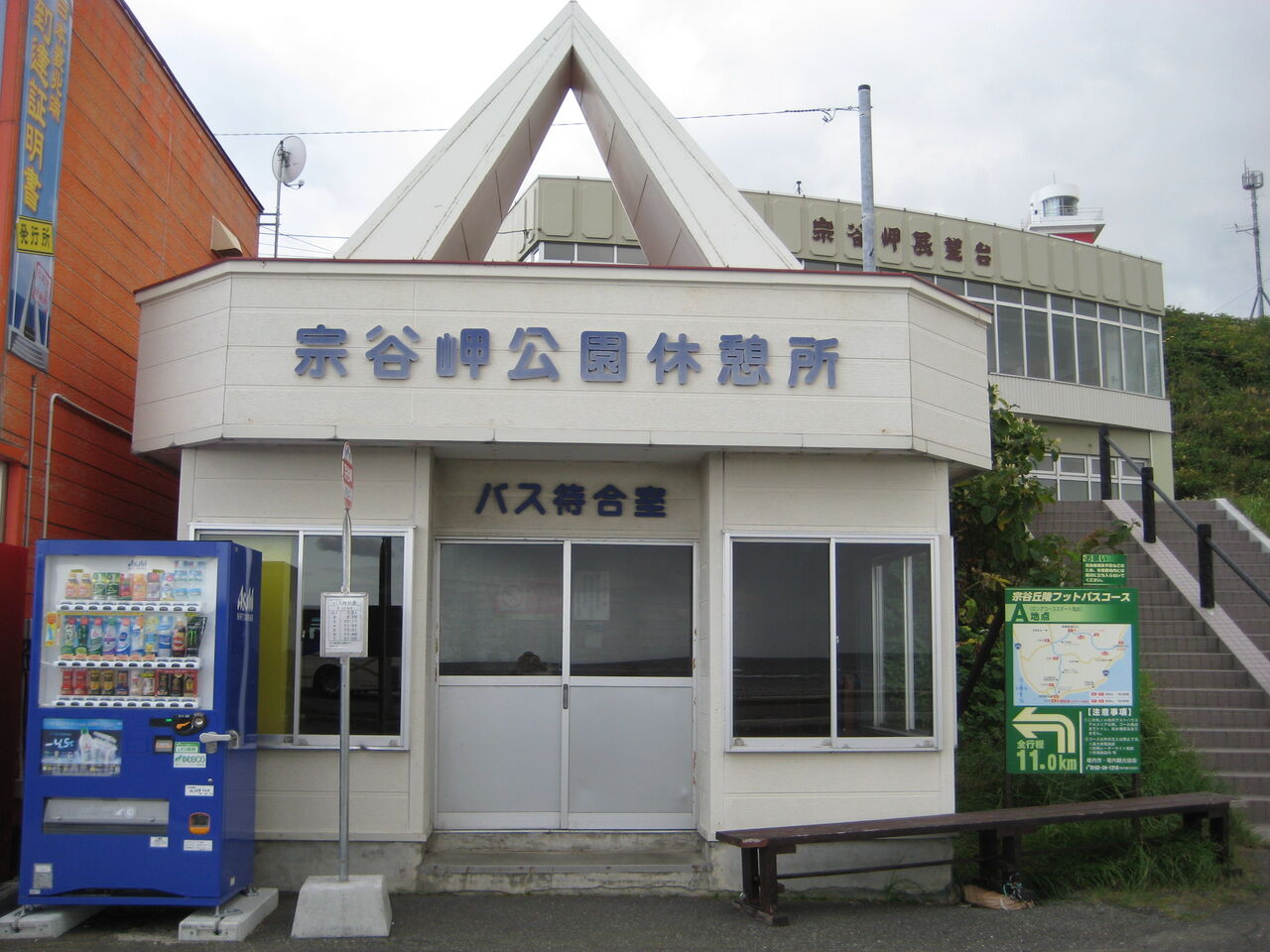
Then I needed to get something to eat. There seemed no better place than to stop by at the establishment, I ate at nine-years earlier. At that time, a typhoon held me up for four-days of bordom, so I was glad to stop by at the restaurant a number of times. If it was not the nice sunny weather playing tricks on my old mind, a coat of paint worked wonders. There had been some changes done to the exterior and interior of the restaurant, since I last ate there. The other buildings, too. Many of the facade shopfronts appeared cleaner than before. A large bus stop hut, some meters away, would have come in handy, had it been there nine-years earlier. Most of the building-facades had an image of the monument that marked the northernmost tip of Japan. Back in the day, it amazed me how my tent had stood up well as it had done to the strong wind and relentless rainfall. Success in life had many meanings for many people -- get married, raise children, a happy family, build a nice home, yearly holidays, all helped by a well-paid job. Many others were literally tied to their jobs, in the hope that things would turnout for the better. In life, people could not see into the future, foresee how things panned out. Like everybody, people hoped for the best. Yet, how strange life really was -- gave with one hand, and took way with the other, whilst time ticked by in spite of it. Now, when I looked back, I felt curious about how pleasant life in the open, day in and day out, regardlless of the elements and hardships, had been. On the road, I felt full of life, whilst now, at the end of my mission, I felt lost. This may have been the reason why I did not care to hang about the northern most point of Japan longer than I needed to. What I did need to do was to check the bus schedule, on the buses to Wakkanai Airport, about a 30-minute ride. There was a statue, which I stopped to look at, dedicated to an early traveler. It was the Statue of Rinzō Mamiya, who explored Japan's northern reaches. He was accredited with the discovery of Mayiya Strait, in 1809. Recent times had been less kind to the explorer. In popular culture Mamiya was represented as one of the two villains -- a chief henchman, and a master of disguise, in murder. The villians appeared in the manga series, 'Shin Kozure Okami'. Although Mamiya was thought to have been childless, however, recent documents (2022), stated that he had been related to an Ainu woman, who gave birth to a girl. A heavy downpour, fell around four-fifteen in the later afternoon. So, I hurried across the road to get some clothes, scattered about the grass to dry, which I had washed earlier. Feelings were so complex, as were any feelings of achievement, now absent from my mind. Perhaps things might have been different had someone I was close to, been near to share the moment with. Nine-years earlier, when the typhoon passed over, I felt like a child about to embark on a big adventure.


Done
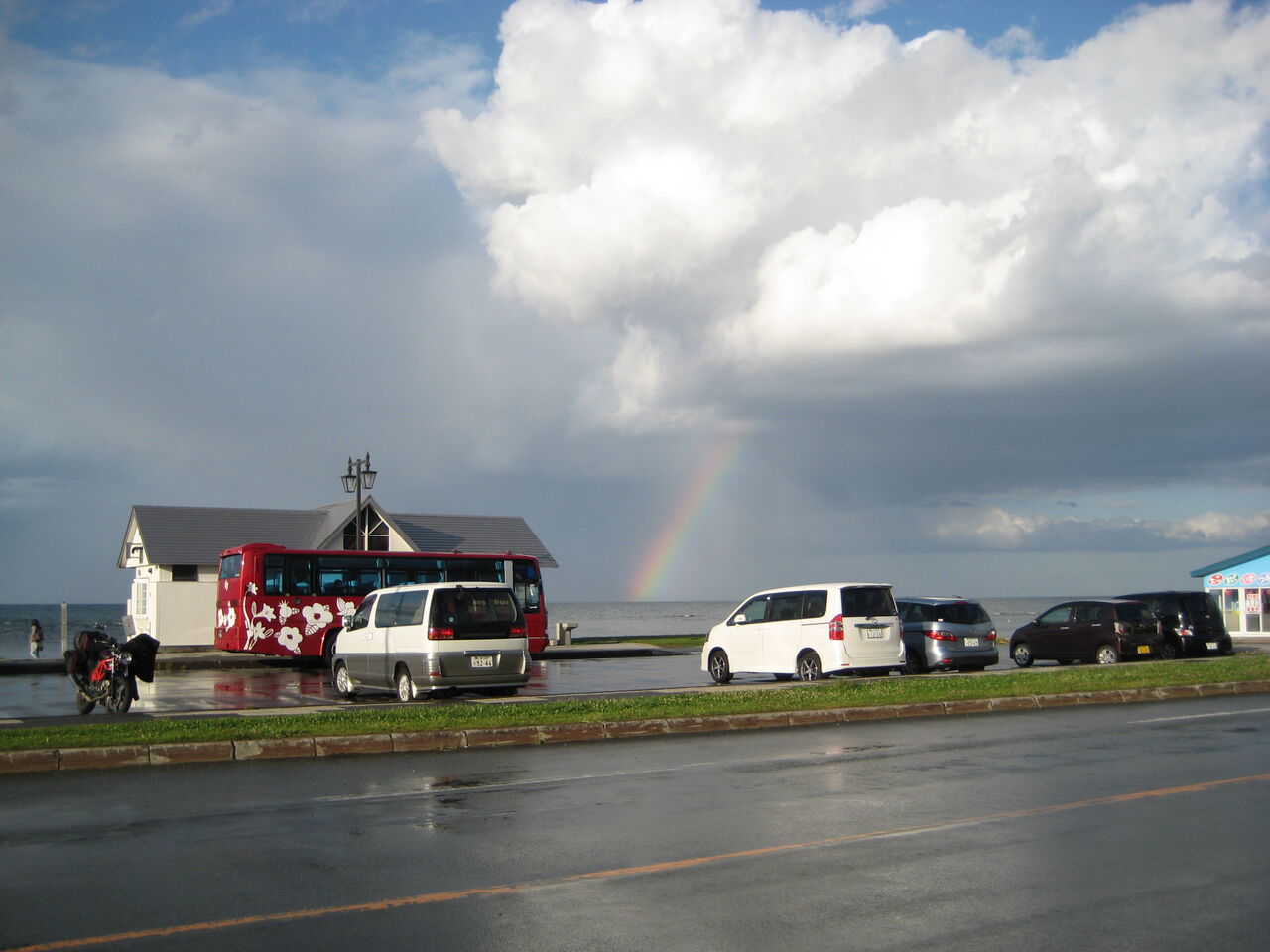

IMG_0885

A rainbow after the sudden downpour
 
31 Aug, 2017: Any hope that I had for company, to ease the loneliness, was soon dashed by a sudden heavy downpour. My plans to camp behind the signpost and tourist map were also dashed by the rain. So, I hurried across the road to shelter inside the large bus stop hut. Another foreigner had also ducked into the hut to escape the rain. In the course of our time at the hut, he told me that he was from Russia. He and his family lived on the island of Sakhalin. Like many Russians I had seen, he was a big strong fellow. Unlike many Russians these days, I felt, his English was not very good. That said, my Russian ability and knowledge of the country, was fairly close to zero. "Mmm!" Didn't a Soviet diplomat, called Molotov a cocktail named after him? The Molotov cocktail was a simple mass-produced weapon used in many countries, during times of unrest -- the northern regions of the island of Ireland, among them. The incendiaries were used during the Troubles, a conflict that lasted about 30-years, from 1969 to 1998, when the Belfast Agreement for peace was signed in that year. All in all, it was one of a number of dark periods in Irish history, which led to more than 3,500 killings. Vyacheslav M. Molotov (1890-1986) was of Bolshevik stock and a strong backer of Stalin's policies, right up until his death. Every decade in history produced a certain treacherous individual, with an unruptured rottenness in the blood. They and their conspirators, enforced policies of evil that enslaved the people, aimed at some grandeur scheme. Our chat was kept simple, with careful listening. The man told me that he had visited Japan on many occasions over the years, and mentioned the places he remembered most. He was an interesting and friendly fellow, and was sorry that the downpour ended so soon. A light rain continued to fall on and off for some hours. By now, I had already decided to stop the night at Cape Sōya. There were a number of pensions in the area. One in particular that caught eye nine-years earlier, some 300-meters along the road from where I now stood, was called 'Tom Sōya' -- needless to say, a name coined from a famous character in a famous noval. In my youthful days, for some reason, I was more drawn to Huckleberry Finn, not that I knew much about the storyline at the time. Although Mark Twine penned Finn the main character, in a later picaresque novel, somehow a pension or inn called 'Cape Finn' did not quite seem to fit my current situation. The Sawyer and Finn books sat on a bookshelf at my place in Tokyo, still unread. I recalled when I first saw the pension years earlier, its name brought a smile to my face. And, when I stopped to take a couple of snapshots of the establishment, I thought to stop there on my next visit. At long last, the chance to stop a night or two, had finally presented itself. A friend in Tokyo, kindly booked a couple of nights for me at the Tom Soya Pension. After the pension, my plan was to camp a night or two nearer to the famous most northern monument. This was in a half-hearted effort to try and re-live the time when my mission had begun. My plans, however, did not quite workout as I had hoped.

Done 

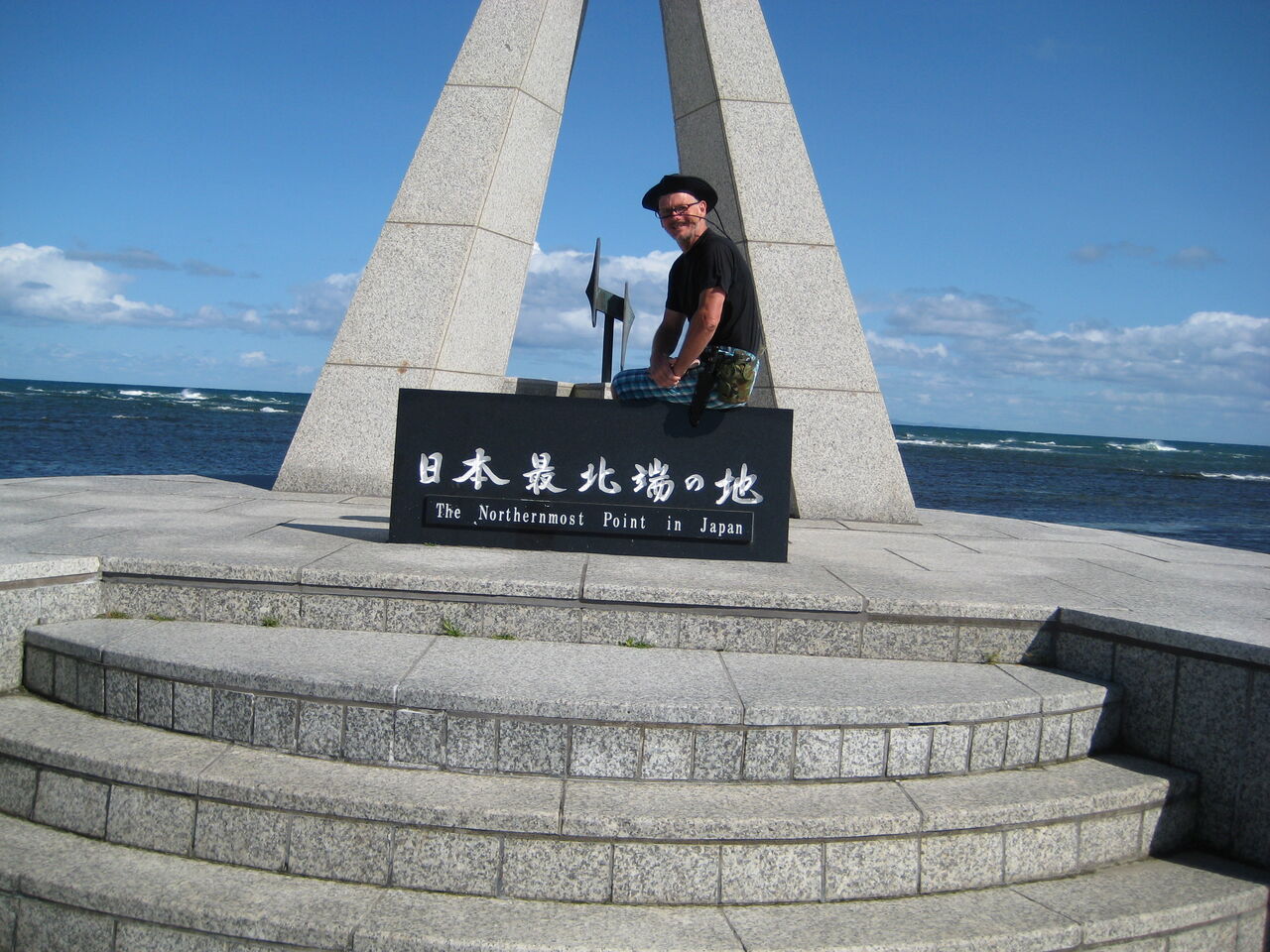
The pension did not have a WiFi service, so I was disappointed, for I had hoped to surf the Internet at the time. I needed to check up on a few things in my road-notes. As this was not to be, I decided to cancel my second day at the pension. In addition to the Internet problem, I had grown concerned about getting to Wakkanai Airport on time for a flight back to Tokyo. Information on the times for local buses, seemed just about impossible to find. The local buses did not stop at the airport, but instead headed for the main train station, in Wakkanai City. The bus times did not always coincide with flight times. The arrival and departure times seemed to work out well. Earlier, when I chatted to the man from Russia, he advised me to get the bus into the city, and then an airport bus from there. Therefore, to go all the way into Wakkanai first, seemed a bit out of the way for me. The local bus for the city passed quite near to the airport. Therefore, it was easy enough to get off at the nearest bus stop and walk. The distance would not be more than a couple of kilometers, I felt. The last time that I tramped past the airport, was nine-years earlier, when I started off on my mission from Cape Sōya. It was easy to see the airport from the main drag, Route 238. My new plan was to head off along the road early in the morning and camp close to the airport. There was a Seicomart, a convenience store, a long the road, which would come in handy, in more ways than one. The pension, Tom Sōya, where  I stopped the night, was clean, and comfortable, and I slept well. When I left the breakfast area, I noticed that the pension had a public bath. Had I known about the bath, I most certainly would have used it, for only two other guests had stopped at the pension. According to my friend, who had reserved a room for me, the other pensions were fully booked. It would have been nice to have relaxed in the hot bath, without the presence of naked male bodies around. If only the people who ran the pension had told me about the public bath when checked in. All the same, the private bath in my room, served just as well. Another night at the place, however, was out of the question. The bill, ¥6,880 Yen, was soon paid, and I hit the road. A stop was made at the famous monument for my last snapshots. An elderly man was at the monument when I arrived, so I asked him if he would take my photo next to it. At first the man was unsure which button to press, so I showed him, and the photos were soon taken. We chatted for a little while, and I happily answered the usual gauntlet of Who-What-Why-When-Where-How questions, about my life on the road. Among my answers was my need to get to the airport. Only the Shinto gods knew the number of times I had answered such questions. My mind was now set on the road for the airport, on foot. It was a good way to round off my mission, proper. Still, I was not completely sure how best to achieve this. In this beautiful, yet somewhat mad world -- crime and terrorism -- I was not even sure if it was possible to enter the airport on foot. "Mmm!" A part of me thought that should a local bus come along, it might be better to use it. 

Done 

The weather could not have been better for a walk. A steady wind kicked up, and hoped it would be at my back. As things turned out, it did not bother me much, like the old Irish saying:

May the road rise up to meet you. 
May the wind always be at your back. 
May the sun shine warm upon your face, 
And rains fall soft upon your fields.

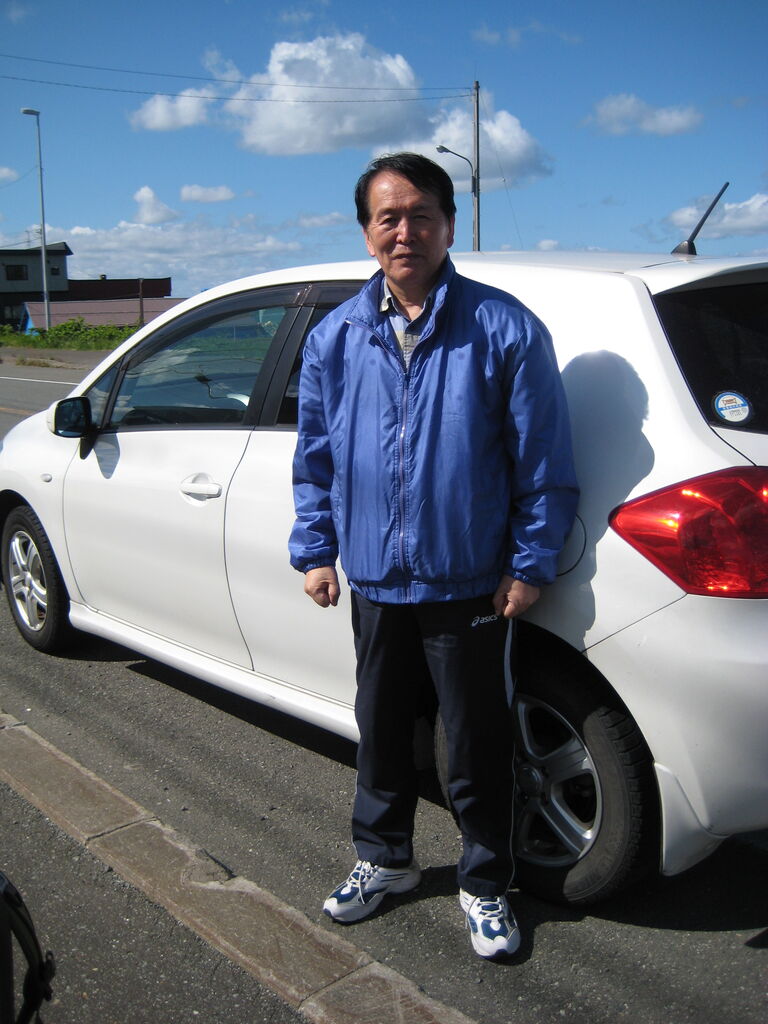
In the course of our wee chat, I told Mr. Shirado that I was on my way to the airport. He offered to drive me there in his car. Already my mission was accomplished, and there was no reason why I should not accept the kind offer. A drive to the airport in comfort, and good company, was as fitting away as any, to make a start for Tokyo. As if the Shito gods had watched over me, the ride to the airport was an unexpected spot of luck, which I happily accepted. However, I was not keen on camping too close to Wakkanai Airport, so it was decided that I be dropped off at the convenience store, about 13-kilometers from my destination. Wakkanai Airport, the northernmost airport in Japan, was opened for commuter flights, in 1959. It was some 12-kilometers from downtown Wakkanai, a city with a population of more than 30,000. Through the Pacific War years, Wakkanai harbor was used as a base for submarines, and sub-repairs or renovation. For much of the war, it fell well beyond the reach of American bombers. Mr. Shirado was a pleasant, gentle 70-year old man, recently retired. He had worked as a public servant, in Fukushima, where he now lived. For some in retirement, every day was like a Sunday. To help escape boredom, he had long wanted to set off in his car and visit the parts of Japan that he had always wanted to see. Rather than stop the evening at hotels or inns, he told me that he mostly slept in his car. I asked him if it was cold in the evening? He replied that he was pleasantly warm and comfortable. In away, I felt the same about by tent, which I prefered to any hotel bed. Life on the road could often be lonely. I felt that there was an expression of loneliness, 
or a slight tragic look on Mr. Shirado's face that managed to insinuate a recent death in the family. Had someone close to him died? 
His eyes did not smile. For some reason, I did not ask about his family, or if he was married. There were, of course, times in life when things turned out miserably horrible. There was no room or time for empathy or sympathy on the road. You needed to keep your wits alive, for fear of ending up a statistic. What I did know was a long-distance tramp was a great way to burn off stress. "Mmm!" I was unsure if the same could be said about driving. 
Done


IMG_0890

IMG_0871


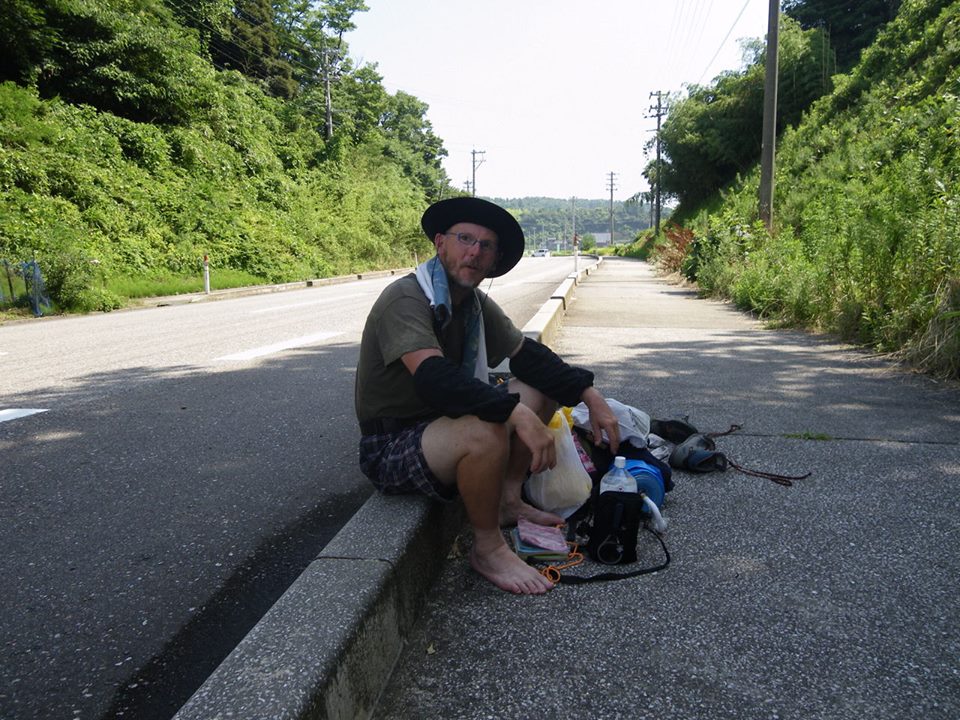
There was something about him, which I did not see and never would see. Yet somewhere there was a gentle kindness about the man's character. In the course of our time together, I told Mr. Shirado that I sometimes stopped at business hotels, mainly in large cities, but preferred to sleep in my tent than any hotel. In away, our situations were quite similar -- washed in public toilets, liked the outdoors, and so forth. Our time together was only too short. It did not take long to reach the carpark of the store. With a beep of the horn and a wave, the car was gone. For a while, I thought about the pleasent wee encounter. With his help, I was now within easy reach of the airport. It was not often one could hope to meet such kind people, along the road, which was just about imposible in cities. It came about when I asked a man, a stranger, to take a snapshot of me in front of that famous northern monument. The incounter resulted in a lift to the airport -- 'The luck of the Irish', as the phrase put it. The Tomiisogyoko was not just a fishing port, but a very beautiful spot on the Sea of Okhotsk. The Tomiisogyoko was not just a fishing port, but a very beautiful spot on the Sea of Okhotsk. The port was known for its wide range of fish landed there -- pink salmon, trout, and squid, etc. My home country, Ireland, was famous for salmon and sea trout fishing. Each year, the fishing season opened in January to May, and closed at the end of September, depending on the location. Sea trout fishing continued on some of the rivers, until mid-October. In recent times, conservation measures were introduced to many rivers, lakes, and estuaries, to ensure fish stocks continued in abundance. By now, a steady wind kicked up, and scattered any thoughts I had to pitch the tent. I even wondered if it was better to move nearer to the airport. The move would make things easier, if it was not too hard to find a spot off the road to spend the night. The tiny bus stop hut, were I currently set, was a good place to escape the sun for a while, but only that. The interior was not overly inviting -- an absence of chairs, or a bench to take a wee nap on.  Even if it had a bench, the hut was too narrow to fully stretch-out. All the same, it served well enough to stop and sort out my gear, and pen a few things in my notebook. Among my note were were a few lines on the three yellow plastic Kirin beer crates, instead of chairs. The crates were spaced a part, so I thought if I moved them closer together, I might be able to organize something worthwhile. There was a wood factory next door, where I grabbed a broken plank of wood, which solved the bench problem nicely. The wind seemed in no hurry to let up, so the hut served its purpose to kill time. Later, after a couple of hours on the road, I decided to make camp for the night. This was done on a raised ground in front of a small Shinto shrine, called Tomiiso-jinja, just off the main drag, Route 238. More importantly, as a committed atheist, a convenience store as also not far away. Shintoism, the ancient national faith, had a countless number of deities, thought to be around eight-million. Shintoism was a way to reconnect with nature, hence, it was sometimes refered to as 'nature religion' -- a spiritual power within nature.


Done 

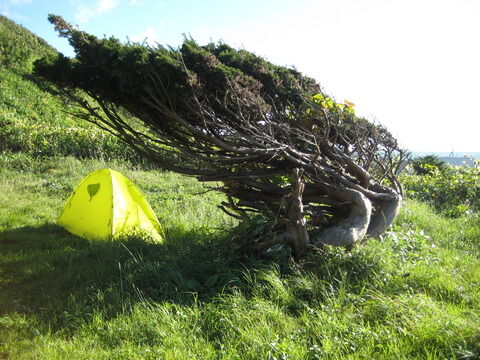
In his novel (St Mawr, 1925), D. H. Lawrance wrote: 'the landscape' lived its life in a world run by the gods, a world man did not exist. "The landscape lived, and lived as the world of the gods, unsullied and unconcerned. The great circling landscape lived its own life, sumptuous and undaring. Man did not exist for it.". Shintoism had once been revived for the manifestation of xenophobia, by the rulers in eighteenth-century Japan. Much of the world that I was acquainted with was less than squeaky clean -- “clothed in the priestly robes of religious cosmogony” (Paul Hohnson, 'The Birth of a Nation'). The Shinto priest, Hirata, a disciple of Moto-or, saw Japan as the birthplace of the gods, ancient ancestors of the clans. In the absence of a clear ethical or moral code, Shinto fundamentalism formed a philosophy in an aggressive militaristic light -- well documented in the first half of the 1930s. It was a world created my man. Similar tendencies festered in a nother of countries long before then -- nineteenth-century Europe was an age of racism. Then a demographic revolution swept across the globe, and continued to the present time. Johann Gottleib Fichte (1762-1814) held the view that the Germans were nature's chosen people, thus needless to learn from the outside. Conversely, to help keep evil in check, Germany should teach its natural civilized ways to the outside world. The meaning of life for academics like Fichte, influenced by Machiavellianism -- to carry out the work of God, to awaken the people to struggle for supremacy and assimilation of other nations -- for survivsl, profit, prosperity, and so forth. Such theories (e.g., Fichte, Hegel, among others), clouded in military metaphors, were strikingly similar to those held by the Japanese, in later years — a totalitarian state, like the German Reich — to rule over by hereditary divine right. Even though Hegel did not believe in a master-race, per se, he opposed to German philosopher, Immanuel Kant’s ‘perpetual peace’ — rulers of states had no right to arbitrate over other states. For Hegel, life followed a predetermined course that could not be prevented from happening. The torii gate at Tomiiso-jinja,  near where I camped, was no so old, erected on  Showa 59 (1984); a local jinja. In a blog about the shrine, visitors were warned not to tramp on deer droppings. Deer pellet-shaped droppings were similar to rabbit droppings, which tended to be a little larger. All in all, I spent a comfortable night without any problem. A grim bent and twisted pinetree, with a grayish bark, was my guardian for the night. Its air of permanence, the old-growth pine shielded the tent nicely, from a wind that blew in from the sea. The wind could be so powerful in these parts that they could blow a person into isolation. The tree had undoubtedly, felt the power of the winds through the years. The tent faced out over the Okhotsk coastline, a magnificent view. "Mmm!" If I cut the grass, the view could be greatly inhanced, I momentarily thought. It was a splendid spot to spend the final night in Hokkaido -- the last day of my mission. The store nearby made it easy to pick up a few things. The weather was too warm for anything fresh to last for long. 


Done
 92065375-s
(By Michael Denis c)


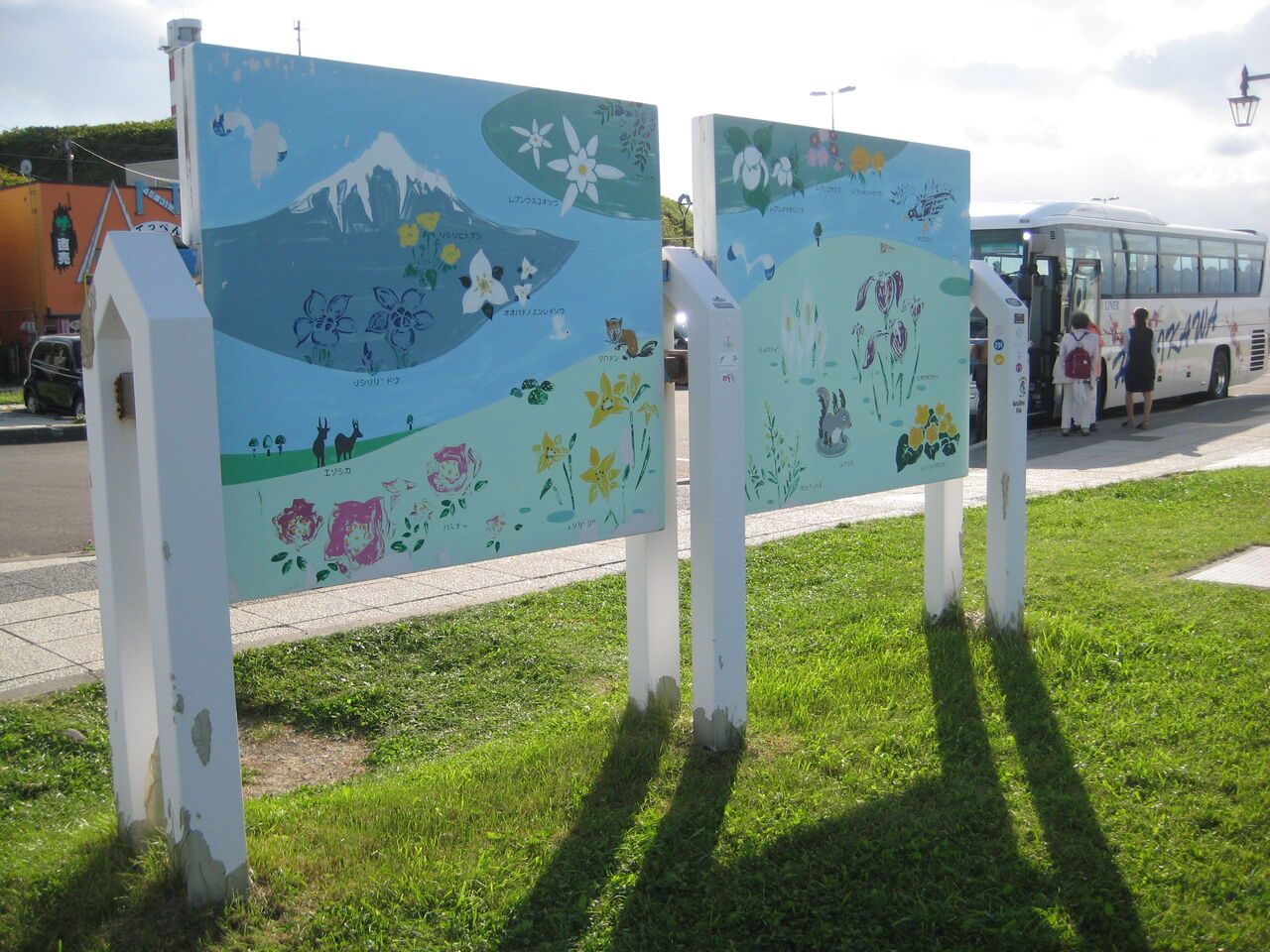
The area around the tent seemed devoid of mosquitoes. All the sae,  a coil of katori-senko was placed at the ready, just in case. Thankfully, as the evening wore on, I did not need to strike a match. For lunch, I picked up a deep fried pork sandwich, which killed any old hunger pangs. In itme, I would make another stop at the store, to pick up someting for the evening. For the present, however, I did not want to think about food. High overhead, the sun focused its powers on the tent. Thanks to a cool breeze, the heat was tolerable. The absence of mosquitos was one thing, but the absence of birds seemed a wee bit strange. Apart from the sound of my breathing, the sound of insects was the only indicator of life. The odd insect paid me a visit to my tent. On a warm summer evening, it was a bit of a ritual for me to leave the tent flap open. Rituals were not always practical, yet they were just as old as humans were on earth. They were believed to be a means to foster a sence of community. Still, I was not so sure I cared much about getting too close to the insect world. particularly mosquitos and ants. Animals, if not insects, had rituals, believed to be a form of bonding, like birds of a feather, flocked together. Like, 'symbols of the curious debasing malevolence that was in the spririt of the place,' to use D. H. Lawrance's words. Lawrance had pack-rats that came down from the hills, on his mind when he wrote his short novel, 'St Mawr', published in 1925. The Shinto shrines had their fair share of rituals, symbolic of Japan, the most group oriented developed country in the world. The Japanese flocked to shrines and temples, where they turned to unseen deities to help quell some hidden fire that raged in the inner sanctuaries of their hearts. They visited shrines and temples over the New Year holidays, to pay respect to the local kami, and prayed for things important to themselves -- pass an examination, good fortune, and so forth. During my time at the shrine, I thought about something important to me, the ins and outs of my mission -- life on the road, weather conditions, and people I met along the way, and more. Unlike now, there were few visitors to Cape Soya when I started my mission. The rain was so heavy, few toursits stepped down from the coaches that stopped near by. Then, after only a few quick snapshots, it was back onto the coaches to continue on their journey. Back to the present, a vast number of visitors appeared happy to hang around the monument for group photos, and enjoy the moment. The weather could not have been better to travel. The visitors scurried about, which made it impossible to simply pitch my tent. I had hoped spend my final night on the same grassy turf, behind two touristy signs, as I had done, in 2009. The public toilet building was only about 200-meters away. For a moment, I stopped to look at the grassy spot. The visitors moved past me in all directions. It took me nine-years of long hours, out under the elements, to complete my mission. My mission had aged me in more ways than one. It was damn hard, it had worn me down mentally and physically. At times, along the road, I wondered just what on earth had I gotten myself into? 

Done


IMG_0876 


Why had I bothered? The funny thing was, I was unsure what I had exactly got or gained out of my mission. It was said that an old dog could not be taught new tricks. There was something positive about life on the road, but what? I was unsure if it had made me a better man, hopefully not worse. In the best sence, a day on the road was a kind of intoxication that had possessed my spirit, while it lasted. The time I spent outdoors had pulled me away from irritation and tension of my life, the friction of life in the city, and all its strict rules had vanished. The road had provided me with an aim, something to occupy my life. This was not like a brick in a wall, but the wall itself, an inner strength. The coastal road was easy to accommodate -- places to eat, drink, and sleep, and the biggest bathtub in the world to wach in -- the Pacific Ocean. One thing I may have gained on the road, if nothing, was a more thoughtful and considerate attitude towards other people. My humble tramp around Japan was done and dusted, and soon to be left behind me, forever. All that I wanted to focus on now, at the close of the day was to look at the last sun of the month sink into the horizon, and to imagine that it too wanted to sleep. The world was heavily dependent on the sun, a star of stars. In a book, I once read that the weather represented a state of the atmosphere, a place at a given time. When the summer weather was not quite the way I wanted them to be, was a pain in the butt. Only too often, the heat emitted off the road was hotter than the sun, which did its best to cook me alive.


Dome


1 Sep, 2017: Slept quite well, apart from the early morning cold. It seems that I had underestimated the northern Hokkaido weather. Foolishly, I had failed to pack a bed cover when I left Tokyo. Like the gas burner, I felt a cover an unnecessary weight, and how I regreted it now. Still, the damage was done to put things right on this stage. In away, I felt depressed. A mood swing was part of the trials and tribulations of life on the road, as was any expenses incurred -- food, acomodation, and outdoor gear, particularly footwear. In one of D. H. Lawrance's novels I read that a shoe had only two excuses for existence -- perfect comfort or perfect appearance. On the road, appearance was less important than comfort and cost. The time and cost it took to return to where a previous stage ended, came at a fair penny, particularly if it involved the cost of an air ticket. A journey by rail in Japan was not exactly cheep. Japan had long been closed (for 265-years) to foreign visitors, hence tourism, as such, did not exist. It was only when Japan opened up to the outside world (in 1853), and a railway system was buildt in the Meiji Restoration, was tourism made possible. The first railway line, in Japan, ran from Tokyo to Yokohama, in 1872, whilst the first low-cost passenger journeys by rail, in Europe, became possible, around the 1830s. Becasuse of economic, political, and social issues in the 1800s, Ireland did not enjoy the pogress of the Industrial Revolution. The first commuter railway in Ireland, however, began in 1834, and ran from Dublin to the coastal town of Kingstown (now called Dún Laoghaire). In the course of the following years, the railway was extended from Dublin to Cork, and to Belfast and Galway. The trains stopped at some of the smaller towns and villages along the way. Progress, however, often did not apply to the poor, who had to rely on their feet to take them just about everywhere. The first step was the hardest, as the saying went. Then, of course, I was off, away into the distance, silently assertive and self-satisfied. All in all. I  prefered the outdoors when I could be more or less alone in it. To tramp the road was a much pleasent way of travelling, particularly on a nice warm day. My mission around Japan, on foot, was not exactly an original venture. During the eighteenth-century, long-distance walking had become a fashionable activity among the literary middle-classes. The historical archives had many recorded examples of ventures on foot. The English poet, Samuel Coleridge, had ruined his shoes when he walked almost 500-kilometers on a tour of Scotland. Compatriots of Coleridge, William Wordsworth and his sister Dorothy, once accopanied him on a long walk as far as Stirling, where he branched off by himself. In the case of Dorothy, she regularly liked to walk from her home in Penrith to visit friends near the historic market town of Halifax in West Yorkshire. A walk from Penrith through the Yorkshire Dales to Halifax was more than 200-kilometers. Other poets and essayists -- Keats, Southey, De Quincey, Hazlitt -- were keen long-distance walkers. Perhaps the most celebrated walker of the eighteenth century, was a man called Foster Powell (1734-1793).


Done

Powell was said to be the first true exponent of long-distance travel, on foot. His fondness for walking, was firmly established from a wager he made, in 1764. At that time, he covered a distance of over 80-kilometers, along the Bath Road, in Summerset, in seven-hours. Another of Powell's successful ventures, on foot, was from York to London and back, a jourey that took almost 645-kilometers, in 1773. All in all, his long walks gained an element of fame for him, and at times crowds of people flocked to see him. There was a host of noted long-distance walkers around that time -- George Wilson (1766-1839), nickname, ‘The Blackheath Pedestrian’; and Captain Robert Barclay-Allardyce (1779-1854), the 'father of pedestrianism' -- a competitive form of walking. They were followed by Emma Sharp (1832-1920), the first woman to successfully emulate Barclay's times and distances on the roads, in 1864. Many artists of the period like to trek the highways and byways for inspiration. Today's weather could not have been better for tramping the road, Route 238.  Across the way, a road sign told me that Abashiri and Sōya Misaki was 310- and 16-kilometers away, respectively. From time time to time, motorbikes and cyclists passed in both directions. Some of the motorbike riders had tiny cameras fixed to their helmets. A short stop was made to look at a monument with what I thought to have a long name -- 'The National Monument Mekuma Mizunara Colony' -- a colony for plants. The monument had been designated a cultural asset, by Wakkanai City, in 1968. Mekuma (or spelt Meguma), was an Ainu word. ’Me’ meant ‘bumps in the land’, and ‘kuma’, ‘ridge’ or ‘rod’. ‘Mekuma’, was also the name of an eight-kilometer stretch of beach, located between Koetoi and the mouth of the Masuhoro-gawa. The mountainside was ornamented with Ezo spruce and Sakhalin fir trees, a natural windbreak. A row of Mizunara trees seperated the highway, Route 238, from the mountainside and the sea. Mizunara was refered to as Mongolian oak, a white, broad-leaved oak. The cooler Hokkaido climate was ideal for the Mizunara to grow up to 30-meters tall, with trunks of 1.5-meters in girth. Widely known outside Japan for the production of whiskey barrels, its wood was sought after for luxury furniture. During the Jōmon period, the wood had been used as a food preserver, in the cold winter months. The food was eaten in mountain villages, up until recent times. The first book on shiitake cultivation in Japan, was published by Japanese horticulturist, Satō Chūryō,  in 1796. Mizunara logs had been used for the cultivation of shiitake mushrooms, since the twenty-century. Traditional medicine used shitake for medicinal purposes. The shiitake mushroom became popular, and today was cultivated throughout the world. Ezo spruce, found in cold, humid rain forests, was a large evergreen tree with needle-like leaves. The spruce grew as high as 50-meters, a trunk that had a diameter of up to two-meters in girth. The Ezo spruce was commonly grown in parks and private gardens, but mainly it was used for timber, particularly for the production of paper. 


Done

Unknown-13


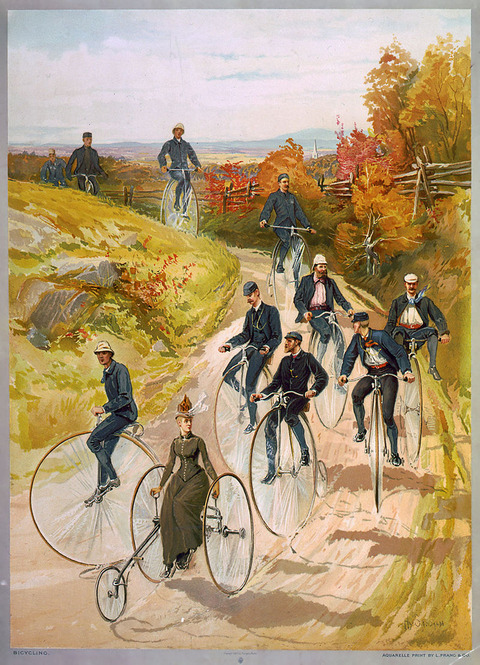
An 1836 illustration of a "Walking Wager" (Wikipedia

Unknown-4


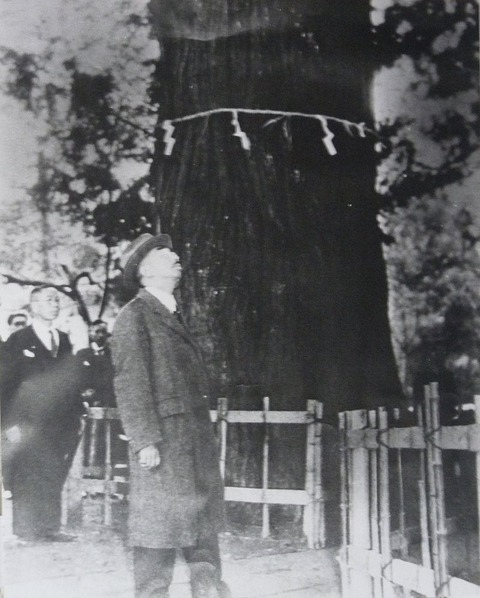
Emperor Hirohito gazes up at the giant Kayano Osugi (54.8-meters tall), in 1947 (Wikipedia) 


It was also used as the main body of the Ainu five-string instrument, tonkori, thought to have orignated in Sakhalin, a Russian island north of Hokkaido. The tonkori became nearly extinct, in the 1970s, but, like the Ainu language, the instrument was revived, in recent times. Historically, 'Ezo' was a Japanese name that referred to the lands to the north -- Hokkaido, Sakhalin, the Kuril Islands. It was renamed 'Hokkaido', in the early-Meiji period (1869) -- a time of military reform and industrial growth. After their defeat in the Boshin War (or Civil War), many Tokugawa shogunate forces resettled in Hokkaido, where they attempted to establish a breakaway republic. National forces, loyal to the Emperor, put a stop to such plans, with victory in the Battle of Hakodate, in 1869. Often, strong northwesterlies blew directly in over the Sōya Strait. Only a few species of trees flourished under such harsh conditions. Many countries boasted a colony of ancient trees of one species or another, Japan was no different. The Great Kayano Cedar, was one of four ancient cedars along a path to Sugawara Shrine in Ishikawa. It stood about 45-meters high, with a maximum 12.6-meter girth, the cedar was thought to be around 2,300-years old. Old-growth trees once thrived in abundance. Today, however, old-groth trees -- Kayano Osugi and Houkisug, thought to be around 2000-years old -- were mostly found on mountainside forests, or on shrine grounds. Japanese mountainsides were home to a wind range of tree species -- cypress, elm, fir, and conifer, like the Japanese hemlock, a species native to the islands, particularly, Kyūshū, Honshū, and Shikoku. During the Tokugawa period, the felling of these trees became prohibited. Later, in the Meiji Restoration, cryptomeria trees were cut down to grow plants for the production of  green tea. The Jōmon Sugi was believed to be the oldest individual tree, in Japan. Even though its exact age of the tree was unclear, it was believed to be between 2,170 to 7,200-years old. The tree stood on Miyanoura-dake, the highest peak on Yakushima, at 1,934-meters. The island was designated a World Heritage Site, in 1993. The Jōmon Sugi grew to about 25-meters, with girths up to 16.5-meters. It was the largest among the cryptomeria trees on the island. There were two routes to the tree -- the Arakawa Trail and the Kusugawa Hiking Path -- however, access was restricted. Another road sign told me that I needed to get my arse off Route 238, and turn left onto a miner road, Route 121 for the airport. The road led to Numakawa and Keihoku five-kilometers away. Along Route 121, I passed a narrow sign sign that pointed right for Wakkanai Megasolas Power Station. After only a couple of kilometers along the road, I then turned left onto Route 1059 that will take me directly to where I needed to go, toilets, restaurant, and the airport. Just as I turner left onto Route 121, there was a kind of biker rest-stop. The Red Baron Bikers Station Wakkanai, a rest stop area, seemed to have accommodation and places to pitch tents. A young man was busy watering a large flower bed, in full bloom. 


Done


Water was the most important physical source to man. If one tried to live without it, it would be an exceptionally short life. Water was important for for the life of just about everything -- industry and agriculture, medicine -- the things we needed to live. About 97-percent of the water made up the seas and oceans. Most of the water, according to what I read, came from the Earth’s interior. What was more, my own water bottles, needed to be topped up. The young man did not appear to notice my approach, but quickly looked up at the sound of my voice. “Is it possible for me to stop the night here?” “No! Sorry! Bikers only!”  To which I replied: “Oh! I see!” Baring a bicycle, or even my motorbike in Tokyo, I hated all other vihicles. As a rule, I prefered to walk practically everywhere. After being told that the place was for bikers, I was tempted to to add that the remaining wheels on my trolly made it as much a vehicle than any motorbike, but I did not bother. What was the point? The Japanese were sticklers for rules. It was a waste of time trying to be a comical smart ass with a Japanese person, hard at work, or so I thought to myself at the time. Similarly, I did not bother to ask him if I could have some of the water that he abundantly used on the flower bushes. However, I did ask if they had a restaurant at the place, where I might get something to eat. There were a number of other related buildings, but I was not sure what they were used for. The hostal appeared to be well maintained. “No! Sorry!” “Well, how about a convenience store, nearby?” I asked and pointed along the two roads. “Yes but, quite a distance.”  When I thought back at the start of my mission, I recalled a convenience store, on the outskirts of Wakkanai City. Whether the store was still there or not, it was not worth the journey, too far. Besides, I would need to return to the airport. "Surely the airport shop, or restaurant, was open. Right?" I knew that the passenger area at the airport was by no means large. To arrive at the right times, was important at local airports in more ways than one. “Wakkanai Airport!” Not sure! It’s also quite a distance.” This time the man replied in Japanese, and with some concern. Time was on my side, so the distance did not bother me any.  “No problem!” I said, with a faint smile. Needless to say, I did not tell him that I had walked just about everywhere already. "I've a flight back to Tokyo, early tomorrow.” Then I thanked the young man and headed back onto the road, and turned in the direction of the airport. The uneventful encounter with the man proved food for thought. Surely businesses needed to be nondiscriminatory if they had any chance of survival. Right? Apart from a couple of riders clad in their bikers gear, the Red Baron Bikers Station Wakkanai, seemed devoid of clientele. After a while, I tramped into the passenger area at the airport, about 24-hours too early. With the help of a kind ANA ground staff member, a mature woman, I was able to take care of  my flight-necessities. After that, I headed to the public toilets for a quick wash, and don what few clean clothes I had left in my backpack. 

Done 

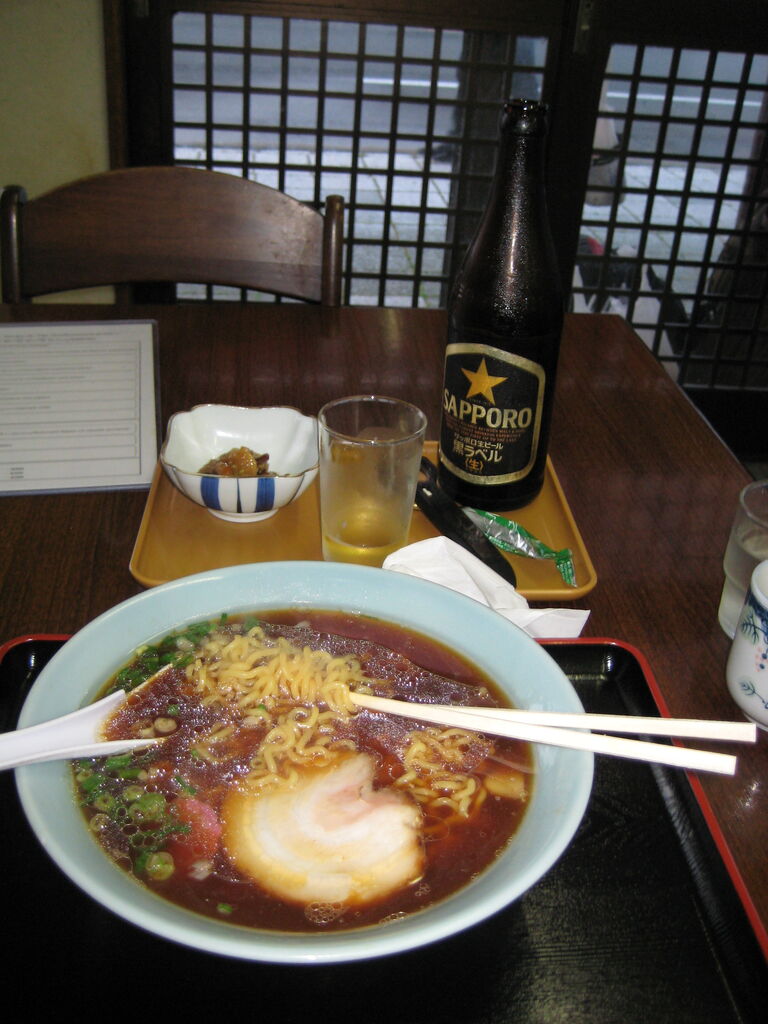
The clothes would need to do me until I got back to Tokyo, tomorrow. The trip to the toilets did not take long. Soon I found myself at a restaurant table, on the second-floor, suitably called, ‘Airport Restaurant’, where I ordered a bowl of soy-based ramen, and a plate of french-fries. A strange assortment of food, washed down by two large mugs of Sapporo lager. Such was the extent of my wee private celebration that marked the end of my mission. It was also as good a time as any to reflect a little about the future. When at the table, a new plan had just entered my head -- coast to coast tramp, the route to be decided. However, I could not see myself embark on a new mission anytime soon. And, for the present, I had other matters on my mind. The airport was scheduled to close its doors for the evening. This included the surrounding area. My mind was refocused on the road, this time in the direction of Sōyafureai National Park, a short distance away. At the park I hoped camp for the night.


2 Sep, 2017: Needless to say, it felt so good to sit on the floor for awhile, under a hot shower. Unfortunately, I did not have a stitch of clean clothes to put on after I washed. All the same, I felt fresh and clean. If only I could have said the same about my sleep in the night. The night air proved to be cold and damp. The plastic shopping bags, spread out on the ground under my body, for added warmth, did little good. During the early hours, things had become so unbearable, that I considered a move to the main building. Somehow I managed to nod off to sleep in the end. When I did open my eyes a couple of hours later, it was to a brightening sky. The tent was saturated with morning dew, in no hurry to dry. At about that time, Sir Walter Scott's narrative poem, ‘The Lady of the Lake’ (1810), popped into my head:

Like the dew on the mountain, 
like the foam on the river, 
like the bubble on the fountain, 
thou art gone, and forever. 

This was the sort of 
topographical features the Earth was home to — mountains, rivers, seas, hills, valleys, and so forth. They interfered with the movement of the air-currents, at least in the Northern Hemisphere, and made the weather so unpredictable. The predictiona of the weather, for certain locations, had come a long way since I was a boy growing up in Belfast. Still, the weather forcasts could, at times, be way off base. Yet, somehow the weather did not seem to matter anymore, in the way that each stage of my mission had begun with the first step, whather it rained or not. Now, my mission had finished. There was a time when I wanted it to end, for the pain and hardship remained fixed in my mind. In time, the mystic of life on the road, had become a kind of drug, unable to shake off, which I consumed for self-indulgent reasons. The drug released a fire in my limbs, and opened the undiscoverd doors to life. The outdoors gave me fresh air, and took me away from the rules and modernity of the concrete jungle. It took me to places where I felt free to do as and when I liked. It had, in fact, crystallized a hate in my heart for citylife, a life that I was soon to return to. In Tokyo, where I lived, the air was not fresh, and even stale in places. I had grown to dislike the cold interier of my apartment -- rooms so artificially lit, a stuffiness in the atmosphere. Since nothing lasted forever, the effects of life outdoors, would through time, wear off.

Done

As Scott’s poem implied, the end of my mission was definitely a goodbye to the many damp mornings, hills, mountains, valleys, and forests that I had come to along the road, in all kinds of weather. In away. my life outdoors
 was a goodbye to a different world, with its rivers and bridges, long and short, which I had tramped crossed on many occasions. It was a goodbye to the fountains and waterfalls, where I momentarily stopped, to admire and photograph. The end of my mission marked a goodbye to all of the long and short tunnels, old and new, which popped up from nowhere, along the way. Even the monsterly long tunnels were forever notched in my mind. It was also goodbye to the major, and minor roads, particularly those along the coastline. It was along such roads where I met my old friend, the sea, again, which kept me company for hours on end. My mission would not have been possible, had it not been for the many kind people I met along the way. Sadly, their names had long fallen by the wayside, but memories of the times remained warm in my heart. Undoubtedly. many of the memories will be cherished right up until my last breath. How I loathed Tokyo and the relentlessness of pressure, disillusionment, and hostility within. In cities, people spoke in vague and confused sentences, if they spoke at all, and where nothing of worth was remembered. And, where unwanted occurances never really went away, but lingered, only to return in some other form. There was a mysterious endurance about citylife, where the doors to victory, success, and prestige opened only to a few. My loathing for citylife was just days away from being apart of my life, again. How was I to coup with that? Each time I returned to Tokyo, at the end of a stage in my mission, it was always with a curious reluctance. In Tokyo, I lived the usual life of a city dweller -- not short of money, enjoyed good sanitation, nutrition, and healthcare, and so forth. The rest of my time, however, I half yearned to be part of another world -- travel from place to place, like, an itinerant trader. To return to places I once knew to, long long ago. To travel back in time to those places that had come and gone, too soon. To rub shoulders once more with the people that had made me feel at home. To daydream was part of my nature. The outdoors had given me a backpack full of victories, more than I could ever have hoped for. My continous preoccupation with, and opposition to, cities and citylife, was a mix of paradoxes, contradictions, and ambiguities, and feelings with lots of jagged edges. Feelings were a more complex business to sort out. Any concentration on feelings and the place they played in my hatred for large cities, Tokyo in particular, would only distort the story of the final days of my mission. As to life on the road, I felt indebted overwhelmingly to my mission -- around Japan on foot, and hugged the coastline as best I could. The numerous spring, summer, autumn, and winter stages, from 2009 to 2017, would continue to hunt my thoughts for years to come. My journey around this island nation, the land of the rising sun was home to a relatively stable society, undisturbed by the outside, was for me, a thing of the past.

Done

Thanks to the people I mat, and life on the road at large, had made me a more rounded man than when I began. 
The experiences, difficilities, and hardships presented at every turn. were for my readers to imagine and ponder upon for themselves.Many of whom, I surmised, had a shared experience of long distance walking, and therefore were well aware of the trials and tribulations of life on the road. 


Done

What happened in Japan and the world on this day????

IMG_0884

IMG_0882

IMG_0881

IMG_0880

IMG_0879


IMG_0886 


Unknown-12


Rinzō Mamiya (1775-1844) (Wikipedia) 


IMG_0875

IMG_0874

IMG_0873


IMG_0889

 IMG_0887
 

Irishman Walking (Stage 20 Chapter 2) Summer 2017

56439087_2291153687790871_6976789749440708608_n

Irishman Walking (Stage 20 Chapter 2) is about my walking the main and coastal roads of Japan. Summer 2017.


22 Aug, 2017: The first beach I came to, some distance past Horonai, would have been a good spot to have pitched the tent for the night. Most of the beaches I had camped on, usually were. It was now very dark, and I felt tired. Thankfully, the bus stop hut that I stopped at, had a light above its entrance -- aluminum and glass sliding doors. The hut looked as inviting as any to stop the night at. My head told me it would not be the last time a bus stop hut would double as a bedroom for the night. They were great on a rainy or snowy night. When morning did finally show its face, I was well rested and ready for the road. For much of the evening, traffic along the road, Route 238, had abated to only one vehicle, every five-minutes, or so. There was the odd trip in the night to point Percy at a tree. My tinkle reminded me that I needed to replenish my water bottles, better sooner than later. For want of entertainment last night, I tried to tune my iPad into the BBC. As was often the case, I could not connect the WiFI to the Internet. Countless flies of various kinds, on some kamikaze mission, crash dived into the outside light, at the entrance. The ground was covered with tiny corpses. Unfortunately, my company for the evening was one fortunate fly, trapped inside the bus stop hut. How long, the poor bugger would remain alive, I had not the foggiest. If the spiders in the hut did not trap it, the fly repeatedly dove into the glass door, in some mad effort to rejoin its buddies in the war outside. At times, it buzzed around the hut's interior, as if to search for another way out. Then, suddenly, it would hurl itself into the glass nearest the light outside. Sometimes, the fly would drop onto the dirty concrete floor, motionless. Then, after it had nearly killed itself, it would stagger about the floor in every direction, only for the process to began all over again. “Mmm! What a life!” I mumbled to myself. "Surely there was more to life than the antics of an insect", I thought as I sprawled out on the bench. In human terms, the only mad comparison I could think of was a suicide bomber, in the Middle East, people learned about in newspapers and on television. Surely, the flies did not plan to kill themselves. Right? There were about one-million species of flies, of which less then 10-percent had been properly researched and documented. Two large spiders made oppisite corners in the hut their homes, still hard at work on their webs. Last night, when I first entered the hut, I was greeted with a face full of one of the webs. Everything now needed to be rolled up and packed away before I could hit the road proper. My humble breakfast was quickly prepared -- nuts and dried fruit, and the last of a mini sized Sinkers bar, washed down with a few mouthfuls of water from my army hip-flask. "Mmm!" If only I had brought my Capt. Stag gas burner with me, I thought. It was one of a number of odds and ends that I had left it behind in Tokyo, in an effort to reduce the weight in my backpack. It would have been nice if I had boiled water for a cup of tea or coffee in the morning. The gas burner was useful along the road when I stopped to rest. So, I regretted that I did not bring it with me.


Done 


To locate a good spot to light an open fire was not always easy. It did not take me long to pack the gear away. Before I hit the road, I decided to write a couple of plain postcards, to friends. Just as I jotted down the last lines on a postcard, it began to drizzle. A small touristy sign pointed in the direction of Gome Shima, a tiny hump of land that poked out of the Sea of Okhotsk. It was not until sometime later that I was able to put right my translation on the island’s name. If I was not mistaken, the word ‘gome’ was the Japanese word for ‘rubbish’. Soon the island was well behind me, as I made my way across the Toinai-bashi. The drizzle continued to fall. A cyclist, his bike loaded up with camp gear, shot past. We both waved to one another. The miserable weather did not seem to bother him, like it did me. The sound of rain had a gentle effect on the old brain, but out in it was another story. What I did not want was rain-laden winds. All that was in my head at the present, was to keep an eye out for a bus stop hut, to stop awhile. What I needed to do was to tape up the soles of my feet. Fortunately, it was not long until a hut popped into view. Unlike a lot of places I tramped along, this segment of the road had a fair number of bus stop huts. On the road under the elements all day long was not for the faint hearted. When I set on the bench, and removed my sandals and socks, I saw that I still had the medical tape on my feet from yesterday. Thankfully, all appeared well -- no early signw of blisters. In away, it was pointless to remove the tape, and added a little more on top, for what it was worth. A glance out the window of the hut, told me that the drizzle had stopped. The sky did its best to brighten up. All the same, there was still some heavy cloud cover, so anything could happen. Life on the road looked good, at least as I closed in on the homeward stretch of my mission. It was only a matter of time, before everything was done and polished. Strangely, was not feel overly happy about it all soon to end. Life on the road had become a part of my life, since July 2009 -- nine-years of mental and physical struggle. It felt like I was about to lose something that had become important to me. To rub shoulders with strangers -- memorable times with beautiful people. A little earlier a road sign told me that I was nearer to Esashi than I had thought, some 37-kilometers away. It was a good days walk, if I pushed myself. There was just one wee problem. I was in no hurry. Everything in life came to an end soon enough anyway. Up ahead, a white van sat parked at the side of the road. The driver of the van, a white haired fellow, perhaps in his 60s, stood by a fence, his elbows on it. He seemed so preoccupied with a large field, that he did not notice me. There were many dairy farms in this region of Hokkaidō. In my country, Ireland, about 5-percent of the work force was involved in agriculture, and crops and pasture occupied around 70-percent of the land. Because of the climate and soil, and the small size of the holdings, in Ireland, the land was best suited to livestock farming. Less than four-percent of the labor force worked in argriculture, in Japan.


Done 


Farm signpost names photos???


All in all, cultivable land was short, as were its industrial minerals and natural resourses. In Japan, less than 25-percent of the land had been made cultivable, in 100-years. Only 20-percent of the available land in Japan, was cultivated. Most of the farms, in Japan, or more than 55-percent of the arable land, was used for the production of rice. This made rice the main yield, followd by barley and wheat, among other cereals. All the same, most of the country's wheat, barley, and soya beans were imported. On an added note, the growing or rice, like many things that made their way to Japan, was indebted to Chinese and Korean influences. Some of the farms in Hokkaidō had quaint, and many had artistic signposts with their names on them. Often the signpost caused me to stop a moment to take some snapshots. Like Ireland through the years, Japan augmented its food source from the sea, with one-percent of the labor force employed in the fishing industry. The Japanese loved their fish, and most of the animal protein came from seafood, which included harvesteed seaweed. The Japanese had been involved in whaling for hundreds of years, and on a modern scale since the 1890s, which included outside Japanese territorial waters. When I got nearer to the man, he turned his attention away from the field and stood, and looked at the van, this time with his hands on his hips. “Mmm!” A penny for your thoughts, I mumbled to myself, as I passed  him. Still, the man did not seem to notice or hear me. Then suddenly, as if the heavens had opened up, he called out to me in a loud voice. “Hey! Where you from? Amelika?" So, I turned my head and looked back, and replied, with a smile: “Yes! Amelika.” The man’s face appeared expressionless, his hands remained firmly planted to his hips. Another road sign told me that I was less than 30-kilometers from Esashi. The road took me past the uneventful little town and farmland regions of Fureppu and Otchube, part of the Esashi District. Another road sign pointed straight for Central Esashi and Wakkanai. The sign also pointed left along a minor road, Route 1023, for Utanobori.  Utanobori was granted town status in 2004, and became suburb of Esashi, in 2006. Today, the town had a population of more that 2,300. The original Ainu name for Utanobori was, 'Uta-nupuri', which meant ‘mortar shaped mountain'. At long last, I arrived at the town of Otchube where, thankfully, a Seicomart, stood as if the convenience store awaited my arrival. The name Otchube evolved from the Ainu word, ‘o-cis-un-pe’, for ‘wavy river’. Needless to say, I made right for the store. It did not take me long to gobble down a dish of cool noodles that I bought at the store. A small apple pie, that I also picked up, soon headed in the same direction; washed down with a cup of coffee. This was made possible by a thermos flask, which such stores always had at the ready. Lunch was rounded off with a cool can of Sapporo, which, in a way, made life on the road all the more worth while. The nimbus clouds, to use the ancient Latin word, were gone. With no sign of rain, the sun made itself felt, each time appeared from behind one of the now fluffy clouds.


Done 


A large Honda motorbike pulled off the road and stopped in the carpark of the store. Printed on the side of a gas tank I passed, were the words -- ‘Beyond the Stratosphere’. Often times, when a large motorbike sped past, my throughs drifted back to my own motorbike, in Tokyo. Another large motorbike pulled over and stopped by the side of the road. When I drew near, to my pleasant surprise, the rider handed me a sports drink. The time could not have been better. He handed me the PET-bottle gift, without a word. The unexpected encounter had startled me a little. All sorts of things happened on the road, but you never knew what or when until it happened. Just as sudden as the man held out his hand and the bottle for me, I reached out my hand, almost automatically. “Wow! Thank you!” Without uttering a word, the rider turned his motorbike back onto the road, and as quickly as his appearance had been, he sped off like there was no tomorrow. As I was headed in the same northernly direction as the rider, I wondered if I would see him again. In 1985,  I made a trip around this great northern island on my bicycle, but I could hardly remember anything about it. One thing I do recall, about that time was that the whaling ships were unable to leave their ports. Anti-whaling groups, like, Greenpeace, and opposition from foreign governments for the protection of endangered species, such as, the population of the Southern Hemisphere minke whale, had long been a headache for the Japanese government. The soft drink was not as cold as the ones just bought from a vending machine or stores. Still, I was glad for it, and the bottle was half empted, even before the motorbike had vanished from view. "Mmm!" The rider may have taken it from his own supplies, I thought, as I drank the rest of it. My supply of water was low, and wondered how long it would be to the next store. Here in Hokkaidō one could tramp for hours, and not see a vending machine. The Japanese never failed to amase me with unexpected gestures of kindness. All that I could do, after stuffing the empty PET-bottle into the backpack, was to get my arse into gear, in the hope I would find water soon. A number of small towns dotted about the farmland regions. Towns like Yamausu and Tokushibetsu popped up, here and there, then they immediately fall away, and out of sight. Often, a town had namesake bridge, over a winding river (e.g., Otcharabe-gawa), which I had to cross to enter or leave them. In the Autumn season, salmon could be seen swimming up the Otcharabe-gawa, which ran through the Esashi. There was also a fish cultivating farm on the river. The river passed through Esashi District of Hokkaidō, along Route 238 on its way into the sea. Yamausu Fishing Port, was also famous for its pink salmon. The 44-kilometer long Tokushibetsu-gawa, drew many visitors to enjoy Canadian-style canoeing, and salmon and trout fishing, at designated locations along the river. Many of the places I passed on the road were not even villages, but a few houses and buildings. At times, the machinery scattered about them told me they belonged to a farm related industry. There was no better way to install discipline in a person than a long distance walk. 


Done 


A failure to learn from the trials and tribulations on the road had a screw missing. As I was on the home-run leg, felt in no hurry to get anywhere quickly. A road sign for tourists, I was near a Michi-no-Eki, a roadside station called Marine Island Okashima, just five-kilometers away. The design of the main building of the roadside station resembled a ship, moored by the Okhotsk Sea shoreline. More than enough calories had been burned off, so this was a good spot to wrap things up for the day. Besides, I needed to replenish a few supplies, and fill my water bottles, therefore, the roadside stations were indispensable. The Michi-no-Eki system was first launched in the mid-1990s, today they could be found in every prefecture throughout Japan. The last number of kilometers led me past Yamausu Town and then Tokushibetsu Fishing Port. Any one of the places, including one of the riverbanks that had past, appeared good places to make camp for the night. Like everywhere, the town of Okashima came and went, as did the tiny Tokushibetsu-bashi, a bridge that spanned the fast flowing Tokushibetsu-gawa, on its way to the sea. Decades earlier, a large number of salmon (around 12,000), died in the river. The primary cause of the death was a toxic substances that seeped from the Motokura Metal Mine, in 1961. Another 20,000 salmon died in the following year. Today, the Tokushibetsu-gawa was noted for its eel farms. Eel farming first began in the Fukugawa area of Tokyo, in 1879. Many visitors stopped by to swim in the sea, fish, to gather clams on the shore, and to enjoy the river in a Canadian-style canoe. Some 50-meters from the beach, I set down to pen a few things into my tattered notebook. A couple of kilometers along the road, I made another stop, this time at what looked like an venture park for children. It had a large wooden structure, with a series of ropes and a slide. However, unlike the many vistors to the roadside station, the park appeaered devoid of anyone, especially children. Perhaps not enough research had gone into the plans to build the venture park project. What happened to all the expected children? Suddenly, at the northern section of the park, a young boy, about eight-years old, showed up on his bicycle. A baseball cap, too big for his head, was hung from his back. Perhaps the cap had belonged to an older brother. “Konichiwa!” He said, as he passed me by. I replied in kind, with a smile. Far off in the distance, I could just about hear the sound of motorbike engines being raved up. No doubt, a gang of young bōsōzoku were out on their rounds on their customized motorbikes. “Mmm!” Momentarily, I wondered if they had once been polite little boys, like the child that had just peddled away. The bōsōzoku were mainly made up with young gangs of delinquent youths, who had little between their ears. Nelson Mandela once said that education was the most powerful weapon for changing the world. If only the young delinquents would leave their bikes and return to their books. With dwindling numbers, the bōsōzoku were fast becoming a dying bread. In recent times, the few that I saw in Tokyo, rode small 50-cc scooters, as opposed to the larger customized motorbikes their predecessors. 


Done 


They could still be heard them before seen. Unlike the junk the bōsōzoku rode, I had long been a lover of large motorbikes, particularly the low American-style motorbikes. The road led me past Hiyoriyama-jinja, a small shrine around 600-meters on foot from Yamausu (Tokushibestu) Fishing Port. Okajima-inari-jinja was home to the kami of agriculture, fertility, industry, and prosperity, sake, success, tea, and the fox.  It was said that Inari descended from heaven on the back of a white fox. The kami was also the patron of a host of professions -- blacksmiths, merchants, swordsmiths, and warriors, etc. Inari Ōkami was one of the main Shinto kami. More than a third of the Shinto shrines and a number of modern corporations (e.g., Shiseido), in Japan, revered the kami Inari. The state of the neglected shrine told me that it could do with some of the prosperity itself. The area had many foxes. One cunning fox had stolen a 500-milliliter carton of milk that I had just bought. After a while, the road led me past the Hamanasu Koryu-hiroba Free Camping Ground. For a moment I considered stopping the night, but pushed on instead. There were a number of free campsites in Japan, especially in Hokkaidō. On weekends and the peak summer season, it might be a good idea to make reservations first. The road led me over the 250-meter long Horobetsu-bashi, a bridge about two-kilometers north of the campground. The bridge spanned the Kitami-Horobetsu-gawa, a river that flowed through the fertile Esashi region to the sea. The coastline was a breeding ground for a variety of wild birds. One was the 'osprey', a bird of pray, called 'misago' in Japanese.


Done 


23 Aug, 2017: As hoped, my tent was pitched on a rich sandy beach, at a place called Marine Island Okashima. This was near a cold water tap, which I knew would come in handy. The front of the tent faced a calm Okhotsk Sea, where I hoped to take a dip. Unfortunately for me, the faucet did not work very well. The water trickled from the tap, then suddenly gushed out. Therefore, it was not easy to wash clothes. After a while, the washing was done and hung to dry. In the early part of the evening, I set about building a campfire. At first, my intention was to boil water for tea or coffee, but then I decided to go the whole hog and prepare a pasta dish. This was soon done, and turned out to be damn good, if I may say so myself. Life on the road was a hungry one. I felt the hunger more than at other times. If my maps were to be believed, I was less that 10-kilometers from Esashi Town. The town was located in its namesake district, in the sub-prefecture of Sōya since 1869. It was also a reminder that I was nearer to the conclusion of my misssion. Not long after the end of the Pacific War, Esashi was granted town status, in 1947. Later, in 2006 the towns of Utanobori and Esashi merged, to expand the population  of the district to about 17,000. According to the September, 2016 census, Esashi had an estimated population of 8,578. The residents of the region enjoyed a humid subtropical climate, thanks to the tsushima-kairyu -- warm ocean currents. During the winter months, Esashi region experienced less snow than other parts of Hokkaidō. Many of the place-names in Hokkaidō, Esashi came from an Ainu word, ‘Esaushi’, which meant ‘cape’. Hokkaidō was an island of capes -- Kamoiwakka, Nosappu, Shirakami, and Sōya, to name a few. The mose important cape to me, Cape Sōya. At first I thought it might be a good idea to stop the evening in Esashi, at a business hotel. The town turned out to be a local kind of place, my hope was quickly extinguished. A rich sandy beach was much better than any hotel room, with beds that had other peoples bed bugs. The gear was soon dismantled, rolled up, and put away. My washing was not very dry, because of the damp evening air. The rising sun and warm morning breeze, encouraged me to hang the damp clothes and gear up to dry. There was the hurry. A humble breakfast included dried fruit, and a piece of chocolate. Breakfast was said to be the most important meal of the day, to prepare for the day ahead. At least I felt the positive effects afterwards. With the gear properly packed away, and the old teeth brushed, it was time to get back on the road, where life really started. There was a planned stop at Esashi, where I hoped to pick up some supplies. A little earlier, a local had told me that shops and restaurants were few and far between. Like I penned earlier, I regretted that my gas burner back in Tokyo. What the hell, the damage was done, and that was that. “Mmm! Everybody made mistakes. Right?” I mumbled to myself, as I tried to focus my mind more on the road ahead. After a short distance, I stopped at a Michi-no-Eke, a roadside station, to see what was on the cafe's menu.


Done 


At the cafe I treated myself to something more substantial than the usual convenience store lunches that I had become used to. A plate of tonkatsu teshoku, a deep fried pork dish, with rice, pickles, and a bowl of miso for good measure. The food was soon placed on the table in front of me. Needless to say, my lunch was washed down with cool can of a local beer -- Abashiro White Ale. In no time at all, the adrenaline rushed through my body, and I felt ready for any challenge that heavens cared to toss my way. However, I did not really need to feel that way, for I was already I was well ahead of my schedule, and did not have to push myself to make distance. Esashi Town was nearer than I had cared it to be. As this was the final leg of my mission, with 99-percent of it done and polished, there was absolutely no need for me to hurry. My flight at Wakkanai Airport to Hanada was booked for Saturday, 2 September, in 10-day time. A phone call from my daughter Anna, informed that her mother would spend some time at the teacher’s hospital in the Ochanomizu part of Tokyo. At first I imagined it was noting serious, like an operation, on a life threatening matter. 

There was something said about the possibility of an amputation. This was a serious matter for anyone, particularly for a member of the female gender. Kikuyo an I had remained friends since our divorce years earlier. After Anna ended the call, I placed a call to my ex-wive at the family home in Tokyo, but there was no answer. Not very much later, my cellphone rang. It was from Kikuyo-san. She gave me a rundown on family events and her expected time in the hospital. As she would be undergo a number of tests, it was not necessary for me to return to Tokyo, at least immediately. Before we hung up, I told her that I would stop by and see her at the hospital or at home, the moment I returned. I did not tell Kikuyo-san that I would not be for 10-days. It was important for her to remaim positive. She made some mention of my Aunt Nellie and cousin Roseanne, who visited Tokyo in the late-1990s. They stayed with us at our home in Adachi-ku in Tokyo. My wife Kikuyo and daugter nine year old daugher Anna accompanied them on a Shinkansen journey to Kyoto. The visit had left us all with fond memories. At that time, my aunt had an artificial leg, caused by diabetic issues. My aunt was definitely the most positive-minded woman whom I had ever known. Her positive outlook on life impressed me, which enriched my views on things. Her life had been far from smooth, which I would not go into here. By the time my aunt finally did take her last breath, a decade later, her other leg had been amputated, below the knee. Both were the only close relatives who bothered their arses to make the long journey out to the Land of the Rising Sun to visit us. “Mmm!” Was that why I considered Roseanne my favorite cousin and Nellie my favorite aunt, now gone, but not forgotten, to use the idiom. Replenished and a quick glance over my maps, before I left the restaurant, told me that the town of Hamatonbetsu was the next big stop after Esashi. A friend told me on the phone, there were no shops between the two towns. 


Photo of Aunt Nellie???


Done 


19433880_1410939038960676_2095465528_n


Therefore, I should pick up what I needed when I reached Esashi. Back on the road, a sign told me that Central Esashi was eight-kilometers away, an easy one and a half hour tramp. The road led me past Shimohorobetsu, and then across an attractive steel girder bridge, called Horobetsu-bashi. The bridge spanned the Kitamihorobetsu-gawa. Shimohorobetsu was part of Esashi, and like so many places, it once had its own local train station. Years ago, I lived in a public house called 'The Plough' across from St. John's Parish Church. The pub was located on the corner of the Harrow Road and Ladbroke Grove, in London. The famous Harrow Road skirted the equally famous Kensil Green Cemetary, a place of rest for many noted and not so noted people. My father managed the pub from 1969 to 1971, when we moved to greener pastures on the outskirts of London. In those days, when I went to my school (St. Edmund's R.C. Secondary School), I often walked down Ladbroke Grove, over a rusty old girder-bridge that crossed the canal. Whenever I spotted such a bridge, my mind shot back to my London days. On a recent visit to the Swinging City, not that I lived in London in the 60s, I was happy to see how attractive the bridges were, including the girder-bridge. For me, girder-bridges were the most attractive of the lot. Like many pubs and buildings, the Plough had long been demolished. The route that the Harrow Road followed had remained unaltered since ancient times. Ladbroke Grove itself was named after a nineteenth-century landowner and developer, called James Weller-Ladbroke. It ran north to south, from the Harrow Road to Holland Park Avenue. Weller-Ladbroke developed a namesake estate, in the 1840s, originally a rural area on the western edges of London. Construction at the southern end of Holland Park Avenue began, in the 1830s. The development, however, did not fully reach the Harrow Road, until the 1870s. An English artist and illustrator, called Hablot Knight Browne (1815-1882), who used the pen-name ‘Phiz’,  lived for eight-years at No. 99, from 1872. His illustrations appeared in a number of Charles Dickens’ novels. In my early-20s, for some reason, when I first settle in Tokyo, I used to tell people that I majored Dickens at university. This was a white lie, as I had not even seen the inside of a university at that time. In time, a road sign pointed left along Route 12, a minor road that led to Utanobori. A cool southwesterly wind blew in from the coast, and was most welcomed indeed. A second minor road, this time Route 1069, took me nearer to Esashi. There seemed little point to stay on Route 238 for Hamatonbetsu, as some locals told me that shops, if any, were few and far between. The road that I needed to take, was not for another 32-kilometers. It surprised me that the main drag, Route 238, did not have more shops and restaurants along it. It was a popular coastal road, first opened in 1953 as a second-class National Highway. 

It was upgraded to a General National Route, in 1965. One good thing about getting off the main drag, was to stop to ponder and photograph things of interest, mostly the sscenery. 


Done


The road led me across the Chidori-bashi and the slow marauding Keinnai-gawa the bridge spanned. It was an attractive river, as rivers went, I felt, as I headed over the bridge. By now, my mind had been made up, not to push on any further. What was the point of hurrying? I felt, as I entered the southern outskirts of Esashi. It would not hurt any to stop and rest, so soon after my previous campsite on the beach. Cape Sōya, my goal, was not so far away. When I got there, I could camp for a day or two, but not for too long, for the boredom. I still recalled when I was stranded there four-days, in 2009, because of heavy rain. Therefore, I knew the place well enough. Tomorrow would be time enough to make my final push. Along the way there were a number of parks that had wooden benches and picnic areas. When the sun went down, I hoped to pitch my tent in one of them. This was finally done at a park called Miharashidai, which meant: ‘lookout’ or ‘observation platform’. The name meant sense, as much of it could only be reached by steep steeps. There were some private houses, dotted about here and there. Experience taught me to distance my presence as far away as possible, from the occupants. As I looked for a spot to pitch the tent, the popular and long sasting BBC television series of the 1950s, ‘Dixon of Dock Green’ popped into my head. The series focused on the daily routine of a fictional London police station, with the understanding Police Constable George Dixon, played by Jack Warner. A sole elderly man was walked his dog, but he did not pass through the park grounds. The lower segment of the park was nearer to the main drag, Route 1069. There, an attractive looking fountain shot water about three-meters up into the air. What I needed to do was to pay a visit to the 'jacks', to use the Elizabethan slang for toilet. Thankfully, there was a public toilet, which I hoped to make use. When I did pay a visit to the WC, I was happy to learn that it was clean and well maintained. There was a car parked at the toilet building, so I decided to wait for the driver to be on his way. On the upper segment of the park, near where I pitched the tent, there was a hardcourt, but no tennis players. As far as I could make out, there appeared to be another segment of the park on the far side of the road. All in all, the park appeared to be well maintained, orderly, with a smell of freshly cut grass, as if thrown in for good measure. On the downside, many of the wooden benches were home to a fair amount of bird shite.


Done 


24 Aug, 2017: The rain bucketed down through the night and early hours. So sleep was very much a stop-start affair. Even after 09:30, I still waited for the rain to let up. Away in the distance the sound of the deep resonant sound of thunder added to the mornings entertainment. Often nature provided the background music, like the climax of a play about to unfold. “Mmm!” Momentarily, I wondered if the thunder had already passed, and that things were about to improve. Wishful thinking! A week earlier, a friend in Tokyo had forewarned me about heavy rain in this northern region of Hokkaido. The prediction had proven accurate, particularly over Thursday and Friday. Like a fool, I had forgotten my umbrella in Oarai. My mind had been preoccupied with my gear and the ferry crossing. A study of my maps told me that my next big stop would be at a town called Hamatonbetsu. It was a small town with a population of nearly 4,000, and steady decline over the years. As with many locations in Hokkaido, the local economy leant towords dairy farming and crab, salmon, and scallop farms. Hamatonbetsu was noted for its freshwater wetlands area home to many migratory birds, particularly swans on their winter journey from Siberia. That was around 30-kilometers from my current location, Miharashidai Park. There were a number of parks in Hokkaido with the same name. The rain continued to lash down on top of the tent, with no indication it would let-up. The road, Route 1069, would join up again with the main drag, Route 238. One good thing, the minor road followed the coastline. Further along, the road headed inland, northwest for about 30-kilometers, before it rejoined the coast. In my notebook, I refered to this segment of the road -- my ‘homeward stretch’ -- a part of reality that I did not feel ready for. What bothered me for the moment, however, was what to do about this rain? Farmers loved the rain, which equated to profit for them. For me, life on the road in the rain, was a kind of poison, a violation of my wild soul. The rain made the the remaining distance seem longer and heavier. If only a Shinto god, Raijin, the daity of rain and storms, could make a few changes -- this final stage have a far-awayness about it. That was how the previous spring, summer, autumn, and winter stages had felt. On my way out of Esashi I made a wee stop at a Seicomart to pick up a few thingsm which included a bottle of red wine. Earlier on the road, a local man told me that there were no more shops until I got to Hamatonbetsu. Needless to say, I was in no hurry to reach the town. By the time I hit the road again, the rain bucketed down like there was no tomorrow. After a while, it was downgraded to a drizzle. No thanks to the elements, life on the road remained miserably uncomfortable. For a while, I was unsure whether I should rejoin the main road, Route 238, or not. That was until I stopped a police car to ask. Actually, I was the last person in the world who would stop a policeman or woman for information. More often than not, it was their nature to stop me. When I lived in Nishiarai, the police regularly stopped me for questioning. 


Done


They had done it so often that I decided to relocate to a new address. Like in many countries, unregulated occurrencesn of racial discrimination was an habitual part of life in Japan. In recent times Japan had experienced a record influx of foreign residents and tourists. In a recent survey (2016) commissioned by the Ministry of Justice, it was found that 40-percent of foreign residents in Japan had experienced housing discrimination, myself included. It had been reported that some 60-percent of the Japan Property Management Association was reluctant to accept foreigners. Concern over communication was cited as a main reason, but that was another story for another time. An aging population had forced the hand of the local governments to booster the labor force. In recent years, foreign workers, and residents, in Japan increased. Currently, one in 10 young people in the country came from overseas, particularly, from China and South Korea. (A recent census (2018) showed that 97.8-percent of the population were of Japanese origin). The police car slowed down and stopped. The policeman at the wheel looked at me, as if to wonder if something was wrong. At first, the police car drove a good 25-meters past me, before it suddenly stopped at the side of the road. A middle-aged fellow got out off the car, and made sure his uniform was straight with both hands. We met about halfway. The rain had begun to make itself felt, again. Thankfully, the policeman was polite, and gladly pointed out the correct way for me to take. With no questions asked, our meeting did not take more than a few minutes. Soon I was headed off in the right direction, and the policeman hurried back to the car. He seemed happy to be behind the steering wheel again, for by now the rain really bucketed down. As I made my way along the road, in the rain, it interested me to note that the same police car suddenly drove out from some side-streets. When I thought about it, I felt that the policeman had, in a roundabout kind of way, followed me. Perhaps he wanted to make sure I was headed in the correct direction. It was often not easy to get out of cities, for a lack of signposts, or in this case Esashi Town. Not long after I did get out of the town, I made a short stop at a bus stop hut, to jot down a few things. It was near impossible to write in the rain, for fear of ruining my already tattered notebook. A touristy road sign that I passed earlier pointed to a place called: ‘Senjoiwa’. Like much of the Hokkaido coastline, the Senjoiwa region was a very scenic spot, particularly on a good day. One such spot included the Usutaibe Senjoiwa, a rocky seashore along the cape, which had remained uncunged from prehistoric times. This rocky seashore was located near Esashi, and became part of North Okhotsk Dogen Prefectural Natural Park, in 1964. The rocks reminded me a wee bit of the Giant's Causeway in Ireland, with it's interlocking basalt stone columns, a natural wonder, the result of ancient volcanic eruptions. Esashi was also famous for its location for its namesake crab festival, and the production of harvested King Crab. Hokkaido had the most hot springs in the country, many located in the Esashi region. 


Done 


316470015_531249912051535_2487511923873245087_n


A visit to 
the Giant's Causeway, in the 90s

Done 

There was a large free campsite called, Usutaibe Campsite, with well maintained facilities — toilets, kitchen, and parking lot, among other things. I had not tramped 200-meters, when the thought to stop at a shrine, to jot down a few things, again entered my head. At the bus stop hut, I had also hoped to take a nap. A glance through the window, however, told me that the rain had stopped. For all I knew, this may have been a sign that the Shinto gods had taken pity on me. Much depended on what early Japanese myths and legends one researched. The Shinto deity of rain -- ‘Okami-no-kami’ -- mentioned in the Kojiki, the oldest historical chronicle in the country. The deity had a different name -- ‘Kuraokami’ -- in the Nihon Shoki, the second oldest chronicle in Japanese history. Okami-no-kami, also known as Kuraokami, was a legendary Japanese dragon and Shinto deity of rain and snow. The road led me thought various townships and regions. Misakicho came and went. It would not have surprised me any to pass over a neighbering bridge, or river, that had the same name. What I did know was, the places continued to pop up and fall away. The next area along the way was probably Toimaki, about four-kilometers north from Esashi Town. The rain started to fall heavily again, which caused me to duck into another bus stop hut for a while. Thankfully the bus stop was nearby, where I would remain for a spell. Whenever such places popped up along the road, Route 238, most of them seemed relatively well maintained. Needless to say, the huts were perfect places to escape the heavy rain for a while. They were also good to take a nap in, which I now decided to do. One thing I could not stop kicking myself for, was that I left my gas burner at my place in Tokyo. This ran counter to my infatuation with order. There was nothing better than to do what you wanted to do when you wanted to do, like boil water for a cup of tea. To turn my attention to immediate things, to occupy my mind with those little things of the moment, the trivial present. What I was able to do was to spread the wee tent to dry, and take stock of my gear. Back on the road again, I passed a road sign that pointed to Central Toimaki, a good 1,061-kilometers from Central Tokyo. Soon I would pass over a barely noticeable little bridge, Toimaki-bashi, and river with the same name. A touristy sign that pointed to the right, read: ‘Lat. 45° N, International Memorial Plaza’. For the life of me, I failed to understand the significance to state the latitude of the place. After sometime, I finally left Toimaki, and entered into Menashidomari. Previously, both Toimaki and Menashidomari had their own train stations. A decline in the population and businesses, added to their closure. In recent years, Menashidomari was the location of an archaeological site, where artifacts of the Okhotsk culture (600-1000 AD) had been uncovered. The Okhotsk people were hunter and gatherers. The museum was dedicated to the history of the Esashi and the Okhotsk Sea coastline, where they fished. Today, many artifacts from the site could be seen at the Okhotsk Museum Esashi, opened in 1999.

Done 

The Okhotsk people were related to the Jōmon people, the ancestors of the Ainu culture. The rain had been stopped for some time. Out on the horizon, the sky showed signs of clearing. It also brought a positive feeling to me, like something good awaited me. What I needed was something nutritiously healthy in my stomach. If I stopped at the first bus stop hut that popped up, I could check what food I had left among my gear. The road and the surrounding area showed some signs of drying up. However, this did not last long. The drizzle started to fall. When I got to Kamuimi, it began to drizzle. At the town, I decided to make camp for the night. I had just hung a few bits of washing when the rain started to fall. A steady wind started to blew in from the coastline. This caused me to double check that the tent had firmly been pegged down.

Done 

25 Aug, 2017:  If there was anything that I would remember Kamuimisaki about,  it was not for its beauty. My tramp in the rain yesterday was hard enough, but to pitch a tent in heavy rain was another matter. The tent had not long been pitched, when a strong wind suddenly kicked up. So, I decided to double check things about the tent, sucured with an army rope, firmly pigged down, for good measure. Thankfully, the rain held off when I fixed the tent in place. At the time, I had hoped the rain clouds would pass over. Wishful thinking! No sooner had the wind abated, when the rain began to fall, again. At first, only drizzle, but things soon changed for the worst. A mistake on my part, was that I had camped on a concrete floor, under a high concrete roof. This was at a picnic area, with a number of concrete tables and stools. It was impossible to use tent-pegs. The high roof proved a waste of space, as the rain came in from all angles. Therefore, I kept an eye open for poodles forming. Somehow I eventually fell asleep. However, it was not many hours later when I realized that water had seeped in under the tent. It took a good while to map things up with what cloths I had available. My efforts soon proved a waste of time. The concrete floor soon became inundated in water. If it had not been for the wee mat in the tent, I would have woke up socked. All the same, I did not escape without damp clothes. The only thing I could do was to up camp and relocate to another spot nearby. This was not accomplished so easily. In the end, the second spot proved just as bad as the first. All in all, things could have turned out worse. The tent did its job well enough. Still, a fat lot of good that did me, since the floor got covered in rainwater. The evening air was warm, so I was still able to nod off to sleep. The early morning, was spent in a seated position on the wet floor of the tent, with folded arms and head bent over my raised knees. The time to hit the road, could not have come soon enough. The wet gear was soon dismantled, rolled up, and stashed away. By 05:00 AM I was back on the road, headed in the direction of Hamatonbetsu Town, accompanied by rain. The road took me through the Toyohama region, andovre Miyuki-bashi, just 65-meters in length. Things appeared to looki up, or that was until I came to the first monster tunnel popped up. The Kitaohotsuku Tunnel ran for 1,205-meters. On the road I kept an eye open for a bus stop hut, where I hoped to duck into to check up on things and even take a badly needed nap. Needless to say, I had not slept very well last night. Unfortunately, the bus stop huts that I had passed along the road were damp and dirty. So, I pushed onwards, regardless of the rain. After a while, I decided to stop awhile at one hut that appeared to be not as damp as the others. The the mountain mist began to clear, however, more importantly, the rain had stopped. Japan was not short of rocky or volcanic ash peaked mountainns. A warm northerly wind that kicked up earlier, had worked wonders on the road and the surroundings. Soon, my camp gear, and some clothes, lay spaced out at the side of the road, to dry.

Done  

Momentarily this morning, I heard the sound of Taiko drums in the distance. The poetic bom-bom-bom sound did not last long, which saddened me a little. The sound of the drums blended nicely with the mysteriousness mountain mist that settled in over the trees. Like the shamisen, the Taiko drum had played a central role in Japanese folklore, and like the tree of life, it had a mythological origin. The actual origin of the drum was unclear, though early records suggested the drums entered Japan via China and Korea, around the sixth-century, in the Kofun period (300-538 AD). An image of the Taiko drum was refered to in the Nihon Shoki, the early chronicles of Japanese history. A Shinto deity called, Ame-no-Uzume-no-Mikoto, was said to have danced on top of an empty sake barrel. According to modern hitorians, this may have symbolized the mythological creation of the famous instrument and the taiko music that accompanied it. Later on, the clouds high up in the sky began to part. This told me that it was only a matter of time before the sun worked its magic, again. That said, the rain seemed not to give up without a fight. It fell in spits and spouts. At times, a sudden downpour caused me to gather up the gear and duck in somewhere for shelter. A road sign told me that Monbetsu was now 123-kilometers behind me. Another sign told me that Esashi was 23-kilometers ahead of me. In the distance, five giant windmills stood supreme. This was the first time in a good while that I saw windmills. Printed on their sides, I could makeout the names -- Eurus Energy on the first, and Tomon on the second, however I could not make out the names on the other three. Eurus was currently the largest wind power developer in Japan. The calm Okhotsk Sea was on my right. A steady wind blew in from the north, under a blue sky. Along the road I passed another road sign that pointed straight ahead for Central Hamatonbetsu. Nakatonbetsu was a small town along a minor road, Route 586. According to the 2016 census, Nakatonbetsu had a population of 1,776. The town  boosted the northernmost cave in Japan -- Nakatonbetsu Calcareous Cave. Entrance to the cave was free, however, it was closed in winter months. In the case of winter, Hokkaido was also home to the largest number of ski slops, in the country. (*The largest painting in the world was completed by children of Nakatonbetsu Shogaku, a primary school in Nakatonbetsu, in 2020). The road headed across the long Tonbetsu-bashi and the Toyokanbetsu-gawa, a river that flowed under the bridge. The region had its fair share of rivers. My empty stomach umbled at the thought of food, with each step I took. Thankfully, the town of Hamatonbetsu was just two-kilometers further along the road. I surmised the town to have restaurants, and so, I kept my eyes open. In time, I passed over the long Hamatonbetsu-bashi and the broad river it spanned. Often, towns and cities were were not far from their namesake bridges. High up in the sky, the sun ruled supreme, as well as, much of everything under it. The steady wind, thankfully, made sure it did not cook me alive. 

Done 

All in all, the weather in the Sarufutsu area remained warm and sunny, which I could not complain. After all, it could have been worse A lazy stop was made at a Seicomart, to pick up something to eat. Soon, I was back on the road again, headed in the direction of Asajino. 

Asajino???

During the Pacific War, Asajino had been picked as a site for an airfield. In Koishi, not far from Asajino, the coal industry thrived, until the 1970s. A decline of the coal industry, however, saw many people move away in search of work. Two children went past me. The boy on foot, whilst the girl cycled slowly beside him, on the pavement. They returned my smile. Back in busy Tokyo, people seldom smiled at strangers. The wee boy was clad in a football kit, so I asked him what team he liked. “Barcelona!” He replied, with gusto. I did not bother to tell the boy that I had a soft spot in my heart for Liverpool. My painful feet carried me over the Kutchato-bashi and namesake river. Shortly, I would take my leave of Hamatonbetsu. All the same, I had a feeling that I would pass this way again. A large touristy sign told me that it was 91-kilometers to Wakkanai, and 60-kilometers to Cape Sōya, about two-days away. It was also the first indication of just how near I was to my goal. The sign also told me that Sarufutsu was 25-kilometers further along the road. After a little while, another sign pointed right for Benija Natural Flower Garden, also in Hamatonbetsu, just one-kilometer distance away. The garden might have been a nice place to camp the night. It turned out to be a wild flower garden, forest, grassland, and wetland, in the town, on the southeastern outskirts of Wakkanai City. The region was home to a brackish water lake -- Lake Kutcharo --  part of the North Okhotsk Prefectural Natural Park. The lake had been designated a Ramsar Convention Wetland, in 1989, and deemed one of the most Important Wetlands in Japan. It was not a deep lake, with a maximum water depth of just 2.5-meters. Beniya was said to have been the name of a farmer, who cultivated Chrysanthemum and Tanacetum, in the region. The flower garden boosted more than 100-types of wild plants, among them Japanese Rose and Japanese Iris Ensata. Needless to say, the abundance of flowers in full bloom were very popular, and the garden also drew many birdwatchers to it each year. The garden had an observation tower, and admission and parking, was free. Many visiters prefered to use the train, serviced by the Esanuka Line. This was not a railway line, as the name might imply, but rather a village road some 16-kilometers long, that ran through Sarufutsu Village. Perhaps along ta stool along the scenic bypass was more for the romantics. Japan had many bypasses, and may even have got the idea from Britain. Bypasses became a common feature of the British infrastructure, in the 1960s. The bypass came long before the motor car. For example, the Marylebone Road in London, which ran between Islington and Paddington and Islington, was the first bypass, built in 1756. A small side road called, Beniyasen Ave, lay off to my right, where I made a short stop to take a few snapshots of an interesting sign.

Done

The sign made mention of recent bear sightings. “Mmm! Now, that’s interesting!” I mumbled under my breath, as I turned and headed back onto the road. The sun did its best to burn my face. The main drag took me past farmland after farmland, which caused me to reflect momentarily back to my own county, Ireland. In time, the road branched off at Route 710, headed in the direction of Nitachinai and Toyotomi in the Teshio district, just south of Wakkanai. According to the  2016 census, Toyotomi had a population of 4,054. Unlike much of the country, the Toyotomi area was rich in natural resources, such as, petroleum, coal, and peat, etc. The name 'Toyotomi', meant: ‘abundant’ or ‘rich’, and was noted for its onsen, or hot-springs. Therefore, on the economic front, the region prospered in farming, fisheries, forestry, mining, and tourism.

Done


26 Aug, 3017: Camp was made about three-kilometers from the town of Asajino, less than 50-kilometers from my final goal, Cape Sōya. The patch of ground I pitched the tent on was nice and dry. Thanks to a couple of large stone monuments and a two-meter high incline, the tent was also protected from the wind. Asajino, a little short of 1,100-kilometers from Tokyo, on the outskirts of Sarufutsu Town. During the Pacific War, Korean POWs built an airfield in Asajino. The POW camp was located near village of Sarufutsu. Approximately 80 POWs died during the construction, from abuse and malnutrition. Fortunately for the allied forces, the war ended before the airfield could be completed. Any trace of the airfield site had just about vanished. In recent times, the village had planned to erect a monument to the Korean POWs who died. Rightwing nationalist objections and threats, however, poured cold water on any such plans. Today, Wakkanai Airport serviced the area with regular flights. Apart from the time I dragged my weary body from the tent in the early hours, sleep had turned out to be relatively peaceful. The morning air proved chilly. The tent was not exactly comfortable. At one point I put on what clothes, clean and dirty, to keep warm. Thankfully, the dirty clothes not wet from sweat or dampness. When I finally awoke in the morning, it was not to the sound of the traffic or the birds that chirped away in the trees, nor even to the morning sun that shown into my eyes. Rather, the distant sound of thunder told me that I needed to get everything ready for the road, even if I was in no great hurry. Even though it was 09:20 sharp, rather late on previous occausions to hit the road, for once the time seemed on my side. My washing was quickly retrieved. Yesterday evening, I hung it over a rope, tied to two trees, behind the monuments. Not two-minutes later, the rain started to fall. The thunder rumbled away for a good while, after the rain had stopped. Regardless of the distance left, to my goal, and the uncertainty of the weather, I could not linger any longer. A final push awaited me. But not until I ate a humble breakfast first — two bread rolls, a banana, and some dried fruit and nuts. The ground was wet, so I did not bother to build a fire for a cup of tea or coffee. Everytime I thought about a campfire, I thought about my gas burner back in Tokyo. A glance at the monuments told me that othing was dry. A few snapshots might be a good idea, before I hit the road proper. The design of one of the marble slabs interested me. By now the heavy clouds had moved south in the direction of Tokyo. Still, I would hate to gamble on what might follow later on. The morning's weather seemed colder than usual. Not very long after my notebook was put away, a strong wind kicked up, soon followed by a sudden downpour. The tent had faired better in the night than previously. The place I had picked to pitch the tent last night, was better sheltered, and I took special measures to peg it down well. Fortunately, the snapshots of the monuments and surroundings, were taken before the rain fell. All that I could do for the present was to settle down to my humble breakfast, and hope that the change in the weather was a change for the better.


Done


IMG_0827

IMG_0832


The sound of the oncoming traffic was heard shooting past up on the main drag. What I would not give for a hot cup of strong tea, with milk. Last night I had felt the same about a cup or two of red wine. A British pathologist called, Matthew Baillie (1761-1823),once claimed that tea and wine, as 'caused human destruction'. What bottered me for the moment was how to dismantle and pack away the wet gear smoothly. There was another spurt of rain at noon, as I set off along the road. The rain fell so suddenly, I needed to drap the outer tent fabric to shelter under, backpack and all. Experience had taught me to keep the tent fabric, at the ready. The rain lasted about five-minutes, still everywhere around was saturated. Soon I would pass through Asajino in Sarufutsu Village, the northernmost village on Japan. By area, it was also the largest village in Hokkaido. Sarufutsu  was just 20-kilometers away, and would be my stop for the evening. Sarufutsu was part of a vast area, located on the Tonbetsu Plain. A minority of the land made up farmland, most of it given over to forestry. Nearly 70-percent of Japan was forestland. If only the same could be said about my own country. (Or a lot of places in the world, for that matter). The national forests made up more than 50-percent of the total forestlands of Hokkaido. This saddened me a wee bit, since Hokkaido was about the same size as Ireland. One dark spot in Irish history, had to do with forests. Up until the sixteenth-century, Ireland was thickly forested with alder, ash, blackthorne, hazel, holly, and willow. the forests had been profitable for the landlords who striped the windswept Emerald Isle of its trees. Today, in the northern part of the island, in particular, rough grazing and permanent pastures, took up about 37- and 49-percent of the land, respectively. The main arable parts of Ulster, were in the lowlands of a freshwater lake, Lough Neagh. It was the largest lake in Ireland, responsible for over 40-percent of the water to six of the nine counties of Ulster. Many areas of the world had been covered by broad-leaved hardwood trees, only to be exploited by man. The hardwoods proved important for construction and furniture industries. The deciduous forests were cleared to make way for farmland and the growth of towns, with timber for fuel. Little of the natural forests survived. The dominate species of hardwood trees in Asia, and in western Europe, were beech, chestnut, lime, and oak. Japan was one of the main areas in the world that was naturally covered by deciduous forestland. Today, needle-leaved evergreens covered the higher latitudes in the Northern Hemisphere. On an economic front, Sarufutsu was noted for its dairy produces and seafood -- scallops. Unlike my fellow compatriots, I loathed shellfish. There was also a growing tourist industry -- moterbikers in the warm summer months. The region was also home to Mount Horoshiri, lakes, and swamps -- Kimoma, Mokeuni, and Poro swamplands -- part of the North Okhotsk Prefectural Natural Park. Their names came from the Ainu language, which meant -- ‘a swamp in a mountain’, ‘large’, and : ‘a swamp with dead trees’, respectively.

Done

Poro Swamp was a brackish-water lake, popular amongst anglers, and was chosen as one of 500 Important Wetlands, in Japan. Whilst, Mokeuni Swamp was a freshwater lake, and part of Asajino Wetland. The population of Sarufutsu Village was less that 3,000. One thing I would remember about Hokkaido was the abundance of nature. Many in the romantic movement -- Blake, Keats, Shelley, Southey, Wordsworth, and others -- believed that poetry grew from nature. Many artists, however, hated the color green. Green was a color that was synonymous with Ireland -- the Emrild Isles -- 40-shades of green, and so on. "Mmm!" I thought art had no colors nor boundries. In the art world, green was considered “as one of the insoluble problems of painting” (Paul Johnson, ‘The Birth of the Modern’). One of my favorite artists, Joseph Mallord William Turner (1775-1851), was one who did not care for green. He once confided to one of his counterparts. James Baker Pyne (1800-1870), that 'he wished he could do without trees'. This was probably why Turner used yellow for his palm trees. All the same, he prefered to be outside and one with nature, to sketch -- imagination did not work for him. He found the greens in his paint boxes, to be inadequate -- unsatisfactory for naturalistic purposes. When I was younger, I used to tell anybody that green was my favorite color. Even now, it was the first color than came to mind, when one of my students asked me what was my favorite color. Then again, I was not quite sure which shade of green. The only green thing about me were my eyes, and I could not explain the exact shade for the life of me. "Mmm!" For some reason, Johnny Cash's 40-Shades of Green popped into my head. Like poetry, music, and songs, Turner believed that paint and the paintbrush spoke an objective and descriptive language, which told the truth about nature. Since I started out on the final stage of my mission in Hokkido, many cyclists, and bikers, passed by. Many of them were loaded up with camp gear. There were a good number of lone cyclists, too. Most, however, seemed part of a large group, clad in their club colors. The first bike club was called ‘Bicycle Touring Club’, founded in England, in 1878. Later it was renamed ‘Cyclists Touring Club’,  a name that stuck until quite recently, 2009, the year my mission on foot, began. Ths 1880s was known as the ‘age of the bicycle’, when cycling clubs flourished. Automobiles had not yet been marketed in any great numbers. At that time, most people walked, or traveled on wagons drawn by horses. The first bicycles made their appearance in Japan, around the late 1860s. The first Japanese cycling organization,‘Tokyo Wheel Association’, was established in Japan, in 1908. Needless to say, the rest was history. The birth of the bike gave people the chance to get away from the usual well-trodden routes. Most of the cyclist I saw along the road seemed of college age. Some, however, appeared to be in the twilight of their years. As for motorbike riders, it was less easy to place an age category, since many wore full-face helmets. There were a good number of beautiful large machines, of mixed sorts.

Done


800px-Bicycling-ca1887-bigwheelers


Touring the countryside, 1887 (Wikipedia)


Done

The Harley-Davidson bikers, in particularly, tended to be in Harley groups of their own kind. It did not surprise me any to notice a number of small Honda Cubs — 50cc to 110cc — shoot along the road, loaded up with camp gear. The small Honda bikers traveled alone, or in small groups. The Honda was a sturdy little bike, long used by the Japanese postal service. The sun fought hard through the clouds to make itself felt. A steady northernly wind proved pleasant company on a lonely road. The last of my pens, a blue one, was lost. So, I used a red one. In time, the red played tricks on the old eyes. Not to bring enough pens with me, marked another of my mistakes on the road. There was nothing to hang about for in Asajino. The road led me across a long bridge, Shinasajino-bashi, and near where I thought was a good place to pitch the tent for the night. The equally long Shinigorikawa-bashi popped up soon after I left the Shinasajino-bashi behind me. The second bridge, was also a good place to camp for the night. There was no shortage of water, and all that I needed was to build a campfire to boil it. "Why not? Three was no hurry." I mumbled to myself. For some reason, I decided to push on. By now, the sun ruled supreme, high up in the sky. The wind did its best to keep the sun at bay. Three large motorbikes shot across the Shinasajino-bashi. Another bike followed, some 500-meters behind. How was it possible to enjoy the surroundings, unless you made the time? "Mmm!" Surely bikers needed to slow down to smell the flowers. I thought. Even on foot, it was easy to miss things if you were not careful. There had been times when I stopped along the road, to take my usual copious notes on the surroundings, then subconsciously I would start off again, like a headless chicken. Time was all that I required. Was that too much to ask? A lack of time, was a main enemy. The roads were expensive to maintain -- cracked surfaces, drains, gullies, sewers, potholes, and accidents. Geographical changes over the years, destroyed old land areas where once modern roads ran. New land areas and roads, bridges, and tunnels appeared. For wildlife -- survival or extinction -- was often beyond their power. Many roads I had cycled on years ago, no longer existed -- fallen into the sea, abanded, reclaimed by nature. Anumber of times I had camped near an abandoned tunnel that I once cycled through. In time, another long bridge, the Shinsarufutsu-bashi popped up. Near the bridge was a good spot to camp for the evening. Often rivers were not easy to get near, for undergrowth. There were a number of bridges and rivers to be crossed, before I reached my goal, Cape Sōya. A minor road, Route 584, headed to Central Sarufutsu, but I prefered to stick to the main drag, Route 238. A sign told me of a Michi-no-Eki, 7.5-kilometers along the road, where I hoped to get something to eat. A long the road, I passed a number of fabulous places to camp. At one attractive bridge, called Fujimi-bashi, across its namesake river, I was momentarily tempted to pitch the tent for the evening. Another bridge, the Shinfujimi-bashi, acorss the winding Sarufutsu-gawa, soon came into view.

Done

Majestically, Lake Poro set in the background, a paradise on earth. Two giant windmills, with blades that rotated like gods arms, demanded to be included in my snapshots. As I got nearer to the windmills, I noticed the words, NEG MICON printed on them. NEG MICON was a Danish wind turbine manufacturer, which merged with another Dutch company, Vestas, in 2004. Vestas specialised in renewable energy, and the merger made it the largest manufacturer of wind turbines in the world. It had serviced wind turbines, since 1979. When I got to the giant windmills, a middle-aged cyclist turned off the road and stopped. In the course of our short chat, I learned that he was on his way to Abashiri, a coastal city further north. Abashiri ws part of Abashiri Quasi-National Park, and was home to an old prison, now a musuam, built during the Meiji period. The city drew countless visiters to it in wintertime, to look at the drift ice on the Sea of Okhotsk. The Hokkaido Museum of Northern Peoples, focused on the Ainu culture, and other peoples that once inhabited Hokkaido and surrouding islands. All that is known of these ancient peoples came from unearthed burial grounds, and remains of their tools and weapons. The man's bicycle was not loaded up with camp gear, which I commented on with interest. He told me that he stopped at business hotels along the way. The man worked as a teacher at a high school near Tokyo. Like others before him, he was surprised when I told him that I was on foot, and gave him a quick rundown on my mission around Japan. When we parted, it saddened me when I realized we had had failed to exchange email addresses. It would have been nice to have kept in touch, and learn how his trip panned out. After a while, I stood on the outskirts of Ashino township, part of the area of Sarufutsu, 80-percent of which was forestland. Sarufutsu was also the largest village in Hokkaido, with a population of just under 3,000. It was also Japan's most northern village. My plan was to continue along the road for some seven-kilometers. This was on the advice of my friend, Yumiko-san, who lived in Tokyo, who told me by phone that I would come to a Michi-no-Eki. This was not exactly news, as I already knew of the roadside station. Apart from public toilets, the facilities, if any, tended to differ from one another in pros and cons. My friend told me that it might be a good place to stop awhile -- to cleanup and eat something -- even pitch the tent for the night. There were a few clothes to wash, so a wee stop was not a bad idea, as time was on my side. After a while, a Seicomart popped into view. The convenience store might prove handy, for I was hungry and needed to replenish my hip-flask with water. I could not have gone two-kilometers in Ashino when I came to what looked like the roadside station that my friend had mentioned. The Sarufutsu Parking Shelter was located under a giant concrete overhang across the road, Route 238. On the road, it was important to keep  your wits about you, for I had almost tramped past the damn place. In the three-hours I spent at the place, mainly to wash some clothes, no more than a few drivers pulled off the road to use the public toilets.

Done

In a way, it was good that the place was devoid of people, as I was able to have a good soupy scrub down, without a care in the world.  There was nothing better than to change into clean clothes. This did not take long to do, and soon I worked on my dirty clothes under the cold faucet. This did not take long. My only hope, as I set down with a pen and open notebook, was for my clothes to dry quickly. My original plan, was to push on and make camp at a suitable spot when the sun went down. Usually I had no problem to dry the clothes outside. However, my current location lacked a good breeze. Thankfully, the public toilet facilities were clean and spacious, and with a drinking fountain. There were four small monitors that showed the traffic at different locations along the main road. Though, I was unsure of the necessity of the monitors located near the toilets. One thing I appreciated was the sort background music -- a soothing sound. The soft mucic was not quite as soothing as the sound of birds, or the rustling of branches in a breeze. As with the lights, the music in the toilets was stopped automatically after a short time. It would only start up again when someone entered. The music stopped when I stretched out on an exercise bench to rest awhile. All in all, I was glad that I stopped at the Michi-no-Eki, alone with my own thoughts. After only a couple of moments on the bench, the sound of a car pulled in and stopped. The engine also stopped. This caused me to sit up. The driver did not get out car. After a short while, the engine started up and the car drove away. It was not easy to take a nap. My mind turned to food. My dinner was two small bananas and donuts, with a few dried nuts for good measure. Each time I readied food, my gas burner back in Tokyo came to mind. A hot cup of tea or coffee would have added nicely to my humble dinner. According to the monitors, this segment of the road was not busy. Apart from an odd cyclist, there were no motorbikes, with or without camp gear. This segment of road appeared lack shops and restaurants. As I was in no hurry, I decided to stop the night. Therefore, I was prepared to hang about at other roadside stations I came to. Most Michi-no-Eki had at least one restaurant. My friend in Tokyo told me that Cape Sōya was just 30-kilometers away, or less than a day on the road. There was also a campground, just 110-meters south of the roadside station.


Done 


27 Aug, 2017: Sleep at the Sarufutsu Parking Shuttle was a series of starts and stops. After 02:00AM people paid visits to the public toilets in dribs and drabs. If that was not enough, the cleaning lady arrived at 04:00AM. The whooshing sound of the vacuum engine, and the clickety-clack sound of it pulled across the tiled floor, made any further sleep impossible. At least I was able to get some level of rest, before the cleaner arrived. No sooner had the door been opened, I was met with the foulest of smells. By now I was wide awake, and felt in no mood to pen anything down in my notebook. The cleaner finished her chores within an hour and soon drove away. Perhaps she was on her way to another public toilet along the road. The smell still linger in the air, so I was in no mood to try and get back to sleep. Besides, I was not very tired and the sun would soon be up. The cleaner seemed friendly. When she left she said to me: “Yukkuri shite kudasai!”, which meant, ‘Take your time!’. It surprised me a little that my eyes suddenly felt heavy. So, I lay down again on the bench, for a short 30-minute nap. When I did open my eyes again and sit up, a glance at my cellphone clock told me it had gone 08:00 AM. As I was in no immediate hurry to be anywhere soon, I lazily performed my morning routines -- washed my face, brushed my teeth, and gathered up my washing and gear. The night before, I ate the last of my bananas. So, breakfast was what I had left of some dried fruit and nuts. In time, the road took me to the Hamaonishibetsu district. There was no shortage of open fields full of beautiful cows that looked healthy. Hamatonbetsu was only a small town near the northern tip of Hokkaido. The town had an estimated population of under 4, 000. The local economy lent towards dairy farming, and crab, salmon, and scallop farms. Hamatonbetsu's claim to fame was its world-famous wetlands and freshwater lake -- Lake Kutcharo -- two  interconnected freshwater lakes. The lakes were home to thousands of migratory birds, particularly swans from northern Siberia, and the white-tailed eagle. The white-tailed eagles settled for much of the year on large bodies of open water - freshwater lakes and saltwater shorelines. The lakes and wetlands became a Ramsar site, in 1989. Compared to other lakes in the world, the lakes were quite short and shallow. Lake Baikal, in southern Siberia, for example, was beieved to be the world's deepest lake (Max. depth: 1,642-meters). It was also the world's oldest lake, about 25-million years. Behind Lake Baikai in both age and depth, was Lake Tanganyika, in western Africa, was about 10-million-years-old, with a maximum depth of 1,470-meters, respectively. It was also the longest freshwater lake in the world, at over 670-meters. There were a number of rough grassy fields, not used to pasture sheep or cattle, but horses to leisurely graze on. The fields did not belong to some Japanese horse breeding farm, for thoroughbred horses to run loose kick up a bit of sweat. Hokkiado bred some of the finest racehorses in the world. On the contrary, the different kinds of horses in them appeared to be in their their twilight years.

Done 

 Unknown-3

1d9ae7b7-s


There was little need for the grazing to be controlled -- like in parts of America, where rainfall was unreliable -- so as to make the best use of the grasslands. One plan I had, was to eat at a large restaurant, apart of a bikers' resthouse. The plan fell through, which was a pity, for the menu seemed very inviting. This had something to do with bad timing, as I arrived at the roadside stop a little before opening time, so I hung around. When the time came for the place to open, nothing happened. "Mmm!" Something was wrong, I thought. I was the only form of life about. Earlier on the phone, a friend had recommended the place to me. Therefore, I phoned my friend back to explain things. She kindly checked the restaurant up, via the Internet, for me. To cut to the chase, it was closed on Sundays. Establishments that catered to bikers were usually seasonal -- closed during the winter months. As it was late-summer,  should imagine bikers rode the roads at anytime throughout the week. They were like other tourists in that they spent their hard earned money on food and board, and gasoline, etc. Therefore, one might imagine that such establishments -- places of rest with shops, restaurants, and toilets -- remained open seven-days a week, particularly in the summer months. Surly this was not asking too much. Now that I was better informed, though no means happier, got back on the road again. It did not take long for the old hunger pangs to pay a visit. Fortunately, I had tramped only about three-kilometers, when a sign popped into view, which told me that 'Sarufutsu Park Michi-no-Eki', a roadside station was near at hand. The roadside station website told me that it was built on the corner of a public farm off Route 238, along the Okhotsk coastline. Visiters were able to sample the local cuisine, particularly scallops, and take in the nature. What caught my eye the most, however, was a large restaurant, which I immediately headed for. After a quick lookover the menu, I decided on ‘shogayaki’, a fried pork and rice dish, with some pickles and a small bowl of miso soup. All in all, this turned out to be a bad choice. The pork turned out to be mostly a lump of fat. When I cooked at my place in Tokyo, I preferred to seperate the fat from the meat. Although the taste was not so bad, I left the restaurant dissatisfied, and just as hungry as when I entered. Another thing on my mind was whether to stop the night at the roadside stop, or push on.  Sōya Misaki, my goal, was less that 30-kilometers away. Sarufutsu was a vast area with a minority of the land was under cultivation. Like I had penned earlier, Sarufutsu was famous for its dairy products and shellfish, particularly scallops. Fortunately or unfortunately, shellfish was a food I never acquired a taste for. Cooked or raw scallops contained calories, potassium, protein, and whatnot else. In recent times in Japan, large numbers of ancient fossils, a type of scallop among them, had become exposed by the elements. The tent was soon pitched, in a well maintained Sarufutsu Park. The staff appeared friendly, even if the quality of the food was questionable. Hunger had long got the better of me, so I ordered a beef curry dish.

Done

Surely not much could go wrong with curry. When the curry arrived, however, I could not locate any beef. As before, the taste was not so bad. The sun still rolled supreme overhead. In a good light, I set off to take a few photos, which turned out to be rather enjoyable.
One was off a memorial monument to victims of the SS Indigirka, a ship that foundered in coastal waters, about 80-years ago. First launched in 1919, the steamship's short history on the highwaves, was anything but colorful. In its 20-year lifespan, the ship went through no less than five name chages, and different ownership , which included the Soviet Union, from 1938-39, when it sunk. During that time, the Indigirka was one of a fleet of steamships to transport prisoners across the Sea of Okhotsk. Its cargo hold was said to hold around 1,500 prisioners. The prisoners were mainly used for construction (e.g., roads) and mining (e.g., gold). On the Indigirka's final journey, she ran aground near Sarufutsu, in torrential weather conditions. When the ship capsized, many of prisoners were held in the cargo hold, unable to escape. As a result, more than 700 prisoners died, for which the captain of the ship was executed.

Done


Unknown-1

Unknown

Unknown-1

IMG_0775

Irishman Walking (Stage 17 Chapter 3) Summer 2015

56439087_2291153687790871_6976789749440708608_n


Irishman Walking (Stage 17 Chapter 3) is about my walking the main and coastal roads of Japan. Summer 2015.


11 Aug, 2015: Camp was made at around seven o’clock in the evening, right next to Kazuma JR Station. This was not two-kilometers past the Naruse Ohashi and the two rivers the bridge spanned. Kazuma JR was a small station, opened to the public in 1929, and serviced the Senseki Line, in Miyaki, much of it along the coast. Much of the line took a battering by the 2011 Tohoku earthquake and tsunami, and was only fully returned to service in May, about three-months ago. The train line was completed in 1928, less than a year before the Wall Street Crash, in 1929. The Great Depression, an economic crises that affected most of Europe, particularly Germany, with repercussions across the world. Though the country's economy shrank to around eight-percent, the depression did not affect Japan, like it did in other countries. This may have been in part true becasue of the person in charge of the money. The Finance Minister during the depreesion years was a man called, Korekiyo Takahashi. Takahashi was involved in a number of controversial, but successful financial policies --  he did away with the gold standard, devalued the Yen, and reduced interest rates, among other things. The policies proved especially effective in textiles and light industries -- industrial production doubled, through the 1930s, and by 1933 the econom was on the up. In the 1930s, however, the climate in Japan drifted more towards nationalism -- a greater military influence in the government. According to Ben Bernanke, chairman of the United States Federal Reserve from 2006 to 2014, commented favorabaly on Takahashi's efforts, for "brilliantly rescued Japan from the Great Depression". Conversley,  Masaaki Shirakawa, who served as Bank of Japan governor from 2008 to 2013, saw Takahashi's policies as a "bitter experience", and "the bank's biggest mistake in its 100-year history". Even if the jury on the country's hisotry was still out, Takahsshi paid the altomate price for his believes he was assassinated by a group of disgrumpled military officers, in 1936. “Mmm!” There could not be a more local looking train station than Kazuma, I thought to myself, as I set about erecting the tent. By now, the sky was heavily covered in clouds, and ideal for tramping along the road, as long as it did to rain. It was the sound of the first train of the day that I woke up to, in the morning. My ears were also wide open to the beautiful sound of the birds that chirped away like mad. If only I knew what the birds communcated about, high up in the trees. If only alarm clocks sounded like the birds. It was the kind of morning call any positively minded human would be happy to get awake to, without complaint. I read some time ago, that birds with the least color, or prettiest of plumage, sang the sweetest. The sound of the birds never failed to give me a new lease of life feeling. What mattered now, was to up camp and hit the road, just the rain started to fall. The new hand-trolley proved a gift from heaven. Life on the road seemed easier for it. 


Done


The morning sky indicated that rain was expected, it certainly took its time, as things turned out. The clouds appeared to get lower with the passing of time. Thankfully, the morning air remained warm and comfortable, with a gentle, but unsteady breeze. The weather, I hoped, would continue this way, even if a feeling lingered in me that it would not. Made a stop at a Lawson, at a place called Higashimatsushima. At the store I picked up something that might do me good for breakfast, if not for life on the road -- a  large banana and a 500-milIliter carton of milk. The milk went down well, together with the last of the muesli, which I brought with me from Tokyo. A good thing about stopping a convenience stores was the hot water in the thermos flasks, they kept at the ready. Such stores were even better if they had a place to sit-down at, too. Most of them, however, did not seem to have any such luxury. A cup of hot tea, or coffee, was a good way to round the morning off with. A place to sit, also allowed me the chance to pen a few things down in my notebook. Just about every part of Japan had some ancient history to write about. Higashimatsushima in Miyagi Prefecture was no different, first settled during the Jōmon period. The area on which the city now stood was part of the ancient Mutsu Province, in todays Tōhoku region -- Aomori, Fukushima, Iwate, and Miyagi, and a  host of municipalities. Like many modern cities, after the merging of towns and villages, the modern city of Higashimatsushima was established on April Fool’s Day, 2005. Today, the city had a population of around 39,000, a bit of a drop from earlier figures. The population grew steadily since 1970, but had declined this last few years. In addition to tourism, Higashimatsushima was traditionally a center for commercial fishing, particularly the cultivation of oysters. The Japan Air Self Defense Force Base, was located nearby. 
Higashamatsushima was severely damaged by the Tōhoku earthquake and tsunami, in 2011. After some hours of tramping along the road, under a heavy and depressive sky, it was time for me to get my arse off Route 45, with the four-wheeled hand-trolley in tow, and onto Route 398. The new road would take me closer to my old friend the sea, or in this case, the mighty Pacific. Needless to say, I hoped the road would not be as difficult, or as busy, as Route 45 had been, which was now well behind me. The first signpost of the day told me that I would soon pass Saint Juan Bautista Park and Ishinomori Manga Museum, which sadly, I had not the slightest intention of stopping. Saint Juan Bautista was also the name of a Japanese galleon, which made a couple of voyages to Eurupe, between 1613 and 1620. It was hoped that the voyages would help to open up Japan to the outside world --  A group of Franciscan missionaries were among the passingers on the return journey, in the hope of establishing a religious order, in Japan. In addition, around 50 specialists in silver-refining, and mining were also invited. This was to help develop the mines in the 
Tōhoku
 region (e.g., Sendai). The plans failed, and a long period of isolation ensued upon the galleon's return to Japan. The galleon was built for shōgun by the English pilot William Adams.

Done


This Tokugawa period of isolation was called 'Sakoku', or 'locked country', and lasted for 214-years, from 1603 to 1868, when the Meiji period began. 
A Japanese replica (1993) of the seventeenth-century galleon, San Juan Bautista, dislayed at a theme park in Ishinomaki, in Miyagi, not far from it was originally built, in 1613. The giant lumber used for the galleon's masks, came from British Columbia in Canada. As with much of the region, however, the San Juan Bautista sustained structural damage in the powerful earthquake and tsunami, in 2011. The dury, therefore, was still out as to what to do with the galleon  -- reconstitution or dismantle it? Ishinomaki's economy had long been connected with the sea -- commercial fishing, such as, the cultivation of oysters. The nearby town of Ayukawa, a town in Oshika, was once a main bases for whaling ships. The town of Ogatsu, long famous for the production of inkstones, held an annual scallop matsui, or festival, every summer. Today, Ishinomaki had a population of around 140,000, which had beenon the decline, since 1980. Manga was not only a massive moneymaking enterprise in Japan, but had left a wide mark on many countries, too. Ishinomori Manga Museum, also called Ishinomaki Mangattan Museum, was opened in 2001. This was to commemorate the works of the Japanese manga artist and author, Shotaro Ishinomori, who was born in Ishinomaki. Like any able child, I enjoyed art-class, at school. Not that I had any natural aptitude for drawing and painting, compared to a lot of kids, whose works I had admired over the years. My first ever encounter with a comic, which I joyfully read again and again, was 'Orr Wullie'. Although I could not recall the time or what I was up to, or even the exact year for that matter, I do remember that it was a miserably wet day. Drizzle was a common part of life in Belfast, a small city with few umbrellas. I had been walking along out street at the time, and something on the pavement up ahead of me, caught my attention. As I hurried nearer, in case another kid might get to it before me, I saw that it was the back-half of a tattered comic book. To cut to the chase, I quickly picked it up and ran home. That was what kids did, they stood or ran in the street, or squatted at their doorsteps. And, when I did not run, it was my habit to walk swiftly in the street. Always hurry and scurry, looking for someting, but never finding it. There was no doubt about it, the youth always seemed to be going somewhere, and never coming from anywhere. If you wanted to succeed in life, you had to leave and go away. I think most of us knew what it was like to be corner boy, destined to become one of a band of tramps, huddled over some fire together to keep warm. Those childhood days were tempered with recurrences of simple joys, and at a time when the future would just have to wait until it came. The remains of the comic book was a great find, which occured in the early-1960s, and I think the great man, JFK, was still alive at the time. Whether or not someone had lost the comic, or thoughtlessly discarded it, did not matter one way or another, for I was happy at my unexpected find. 

Done


For the most part, people, mainly Chatolics, were poor in my part of west Belfast, so finding anything of value or interest, was rare to say the least. At the time, I remembered how unsure I had felt when I entered the house, the comic stuffed up under my pullover for good measure. I was worried my grandparents, who raised my sister Anna and me, would think I stole the comic. Or whether I should tell them about my lucky find, at all. Had I told them, they might have said that some boy may have dropped it, and was looking for it. Shyness had always held me back, so I harbored a fear that they would tell me to take it back to where I found it. Other than an old Bible, I could not recall a single book on the shelves in our house. The streets in Belfast were so close-knit, everyone knew what everybody was up to, and if they did not, they would soon find out. In spite of this, I remembered that I said noting to no one. In those days kids could not afford to buy anything, let alone on such luxuries as comics. Kids were aquatinted with comics, they came across the odd one from somebody somewhere. As far as I understood the youth culture on our street, none of us bought one. Even the bigger boys, spent what few coppers they had on a loose fag, or two. Back in the day, people, regardless of age, bought cigarettes in ones and twos. The local shops sold cigarettes in packets of five, ten, and twenty. Smoking was a cool thing to do. Why not? All the film stars and artists did it. That said, I never smoked a fag in my life. The luxary of pocket money was unheard of, and if I got any money, it was barely enough to get me into the pictures. The odd newspaper comic stripe, did come my way, but seldom complete. As far as I understood things, most people could not afford to buy newspapers. Therefore, it had long remained a mystery to me how we came across newspapers at all? Newspaper cuttings hung on the back of toilet doors. The toilets were located outdoors, usually in a far corner of tiny yards. So, blocked up toilets were common on our street. For Orr Wullie was a popular Scottish comic that first appeared in The Sunday Post, in Dundee in Scotland, in 1936. Not that I ever read any of the comicstrips. There were no Orr Wullies among the newspaper clippings that hung on our toilet door. I still recall the upturned bucket, Orr Wullie set on. The comicstrips were first created by the Scottish editor Robert Duncan Low and English cartoonist Dudley D. Watkins. Like most kids on the street, we were more familiar with the Beano and the Dandy. If my research was not barking up the wrong tree, the Beano was the longest running British children's comic magazine in history, whilst the Dandy, the world's third-longest running comic. The Japanese, regardless of their age, loved their manga. In recent times, the manga or comic book industry had made similar inroads in Europe and beyond. To quote from the New International Version of the BIble (1 Corinthians 13:11): “When I was a child, I talked like a child, I thought like a child, I reasoned like a child. When I became a man, I put the ways of childhood behind me.” That was how I thought about comics.


Done 


Unknown-16


‘Orr Wullie’ (Natural Library of Scotland)


Unknown-1


Commodore Matthew C. Perry on a USA postage, 1953 issue (Wikipedia)


Nothing lasted forever, particularly 'time', or Father Time, to use the personification term; or what the presence of the 'Grim Reaper' implied, each time he appeared to collect his victom's soul. Therefore, I preferred to give what free time I had to reading good books, not comics. The Tokugawa government's policy of isolation, ‘Sakoku’, came to an end, in 1853. Even if it was helped along by Commodore Matthew Calbraith Perry, (and the presence of his Black Ships), which forced the country to open its doors to outside trade. The weather continued to hold nicely, no rain, not overly hot, and a welcominng breeze graced my body. “Onagawa here I come!” I mumbled to myself, afher I passed a signpost. This segment of road, bound for Onagawa, was called the Cobalt Line. Onagawa was first established as a village, in 1889, and granted town status, in 1956. This was part of the new municipalities system, enacted at the beginninng of the Meiji period. For reason or another, a lot of the villages, towns, and cities, had been elevated to their status, on an April Fool’s Day. Onagawa was enclosed by a deep harbor that not only proved important commercially, but also militarily. The port became a target for American air raids, and had several ships sunk, in the closing days of the Pacific War. The port was, incidentally, bombed on the same day the second atom bomb (‘Fat Man’) exploded over Nagasaki. A memorial was unveiled in the town, in 1989, for a Canadian pilot, called Robert Hampton Gray, who died during one of the raids. Today, the town had a population of around 6,000, but on the decline, since 1970. Economy, commercial fishing -- coho salmon, pacific saury, including the cultivation of oysters. The kanji used in the name of the 'pacific saury fiah', meant: 'autumn knife fish'. The shape of the fish was said to resembl a katana, a traditional Japanese sword. The Onagawa Nuclear Power Plant, once a major source of income for the town, has remained offline since the 2011 earthquake. Onagawa JR Station fell within Onagawa Town, located on rugged Sanriku Coastline, and the the Kitakami Mountain range that extended some 250-kilometers to the west. Japan was a country of national parks. Much of the town bordered along the Sanriku Fukkō National Park, created in 2013. Onagawa boasted a humid subtropical climate. With its mild summers, it was a great season for hikers. Presently, dark clouds sailed slowly across the sky, and appeared to nest, momentarily, on the tops of the mountains. The deep water port, home to many fishing boats, played a key role in Onagawa's local commercial fishing industry. The port was housed the Onagawa Nuclear Power Plant, the most hastily constructed nuclear power plant, in the world. Fortunately, the plant escaped damage from a powerful earthquake, in 2005. However, the plant was shut down for about a year, as a result. Onagawa Nuclear Power Plant was shutdown a second time after the 2011 Tōhoku earthquake and tsunami. Requests were made by the plant owners, Tohoku Electric Power Co., Inc., to restart the plant, in 2013. 

Done 

The Japanese Nuclear Regulatory Agency, however, pushed for newly required safety measures to be implemented, before any decision could be made. 
In the 2011 desaster, the Onagawa area, was one of the most heavily damaged oceanfront locations, in the Tōhoku region. The tsunami reached as high as 15-meters in places; with many evacuation sites inundated. Around 70-percent of the buildings in the town were distroyed, this included the train station and the tracks.

Done 


12 Aug, 2015: Camp was made in Sawada Town on the coasline. It was a silent enough spot to pitch the tent at, just off a not overly busy road, Route 398. The odd local train shuttled along the tracks, that ran between the road and the shore. The clouds were heavier than on previous days, which caused me some concern. My thoughts were well justified. Not long after the tent had been securely pegged down, the rain came down like there was no tomorrow. The rain did not let up until the early hours. When I got off the mat, it stopped altogether. A well tented, was an art in itself. If not, all hell could break loose, and no one but myself to blame. It was easy to be sloppy, if you were not careful. That was part of the trials and tribulations of life on the road, all day long, On a number of occasions, the tent had to be erected on a concrete surface, not for the faint hearted on a windy or rainy day. To cut to the chase, it did not take long for puddles to form here and there, and in no time at all, the water to began seep in under the tent. Once the tent's interier got wet, it became just about usuless. If it had not been for the mat I lay on, I would have been soaked. By the time I did realize what had happened, much of my gear was inundated with rainwater. Thankfully, the clothes that I wore, where dry. A satiated tent was a bummer to get dry. After some hours later, the rain had finally stopped, and then I was able to make an effort at putting thing right. This segment of the road, Route 398, was devoid of shops, restaurants, and people. The only sign of life came in the form of passing cars, but not so many. There were a good number of birds high up in the trees. The road could be a lonely place at times, if it was not for the pleasant sound of the birds for company. A road sign told me that I was heading towards Ishinomaki. Hopefully I could pick up something for breakfast there. The region was part of ancient Mutsu Province, once controled by the powerful Date clan. For years, Ishinomaki prospered as a major port and transshipment center from northern regions to Edo (Tokyo). Ishinomaki was granted town status, in 1889. It became a city on April 1, 1933. This was a time Japan freed itself from the Great Depression, when other countries still felt the affects. Today, Ishinomaki had a population of around 150,000, on the declin, since 1970. The city was known for manga lovers, of whom I was not among them. It was also home to the Ishinomori Manga Museum, opened in 2001, and dedicated to the work of Japanese manga artist and author, Shotaro Ishinomori, who came from there. The window-like eyes of this rather strange looking museum building, looked out over the Pacific, and the majestic Tashirojima, an island, about 11-kilometers in perimeter in size. The islanders were merely elderly, and an untold number of feral cats that had been there for donkey’s years. The feral cat population outnumber humans 6 to 1, which did not bother visitors to the island one bit. "Mmm!" I wondered why there were no pet dogs on the island? The human population dwindled from 1,000-residents, in 1950, to fewer than 100-residents, today. 

Done

The island’s last school, Tashiro Elementary School, closed its doors for the last time, in 1989. The two villages on the island, Oodomari and Nitoda, were said to be ‘threatened’, and refered to as ‘terminal villages’. Tashirojima and a neighboring island, Oshika, merged with Ishinomaki City, on April Fool’s Day, 2005. The livelihood on the island was geared toward the sea -- fishing and ospitality. Fixed-net fishing became popular during the early-Meiji period. For many years, silkworms were raised to produce silk for textiles. Rodents were natural predators of silkworms. The cats, therefore, were kept mainly to keep the rodent (mice) population down, and lesson any damage to the silk. There were around 10 cat shrines in Miyagi, and many more cat-shaped stone monuments. There is a small cat shrine located in the middle of the island, called Neko-jinja. There was a story that in the past, rocks were being collected, by the fishermen for their fixed-nets. One of the rocks fell and killed a cat. The death of the cat affected the fishermen so much, that its body was enshirined around the same location where Neko-jinja stood. Today, Miyagi had more shrines and monuments to this small carnivorous mammal, than any other prefecture in the country A Fuji television series (2006), directed by Terebi Asahi, had been shot on the island. The theme focused on a droopy-eyed cat, one of the many cats. A BBC television program series (2012), called: ‘Pets, — Wild at Heart’, featured the feral cats on Tashirojima. This was followed by a documentary (2015), entitled: ‘Cat Heaven Island’. It focussed on human life on the island, past and present, which included the cats. Thanks to media interest, photo contests and exhibitions about cats, had become popular events on the island. A large number of tour-groups visited Tashirojim,  just to see the cats. The hospitality on the island forcused on lodging (B&B) and tourism. The hospitality on the island forcused on lodging (B&B) and tourism. Tashirojima was known as ‘Manga Island’, for its strong connection with Shotaro Ishinomori. The lodges were also manga-themed based, hence The Hyokkori Hyōtan Tashirojima Marathon --  six and 10-kilometers long -- was held on the island, in 2007. In Shintoism, cats harbored good luck, or wealth and good fortune. Although much of Tashirojima was extensively damaged by the earthquake and tsunami, in 2011, the feral cat population survived relatively unscathed. The cat population fled further inland to escape the advancing water. Through time, fishermen developed a fondness for the cats and would observe the cats closely, to interpret their actions as predictions on the weather and fish patterns. Something told me that I was going to go to sleep hungry this evening. A glance over my maps this morning, told me to expect a long tunnel. Each time a long tunnel popped into view, I was reminded of the monster tunnels I faced south of Otaru in Hokkaido, in 2009. Back then, the long tunnels popped up one after another. At time, the maps could be so deceiving. 

Done


After a while, I came to Wakenami Tunnel, opened to the public, in 2006, it was just 
462-meters long. “Mmm!” Surely this was not the tunnel in the map? Or so I thought, as I headed entered, the hand-trolley pulled carefully behind me. It certainly was the same road, Route 398. The tunnel was located in the township of Ogatsu-cho, part of Ishinomaki. It was not the monster tunnel that I had expcted, but a series of tunnels close together. Almost immediately, I entered a second tunnel, Mizuwake Tunnel, only 186-meter long, and opened in Heisei 15 (2003). "Mmm!" Surely the other tunnels were nearby, I though, as I set down a moment to jot down a few lines into my notebook. "Where were the hell where they? The road curved this way and that way, for some distance, but  I could see nothing in the form of a tunnel up ahead of me. After a good distance along the winding road, which by now slanted upwards and downwards, I arrived at a place called Ogatsu, a Michi-no-Eki, or roadside rest stop area. Like the other Michi-no-Ekis, it had its restaurants, shops, and public toilets, regional-tourist information. There were more than 1,000 Michi-no-Eki-like reststops located throughout Japan. Ogatsu was one of a group of small towns located in Miyagi, that were absorbed into Ishinomaki City, in 2005. Ogatsu had historically manufactured ink-stones, a stone mortar for grinding and holding ink. The inkstone was intoduced into Japan from China, and dated back for thousands of years. Later, the inkstone was not only produced in stone, but also from bronze, clay, iron, and porcelain. The tool still played an important part for artists, and others, in calligraphy and painting. 
Also, a scallop festival was held in the town every autumn. Today, Ishinomaki City had a population over 141,000. It's residents enjoyed a humid climate with mild summers. The highest average temperature was in August, like the present, at around 24.2°C. It certainly seemed a lot hotter pulling a four-wheeled hand-trolley behind me. And, undoubtedly even hotter with a heavy backpack. I stopped a while, to rest and make a cup or two of coffee. Also, to take stock of my location on the map. According to a
touristy map nearby, the monster tunnel, still lay up ahead of me. 
When would I come to the tunnel? was another question. As I waited for the water to boil, I began to feel tired. It was not easy to stay focused on things. This was my first stop in four-hours of tramping. The last number of kilometers had slowed to a crawl. I rea somewhere that slower walkers showed signs of aging, faster than those who walked fast. This was the twilight of my years, so I was no spring chicken, even at the best of times. The thought of a nap, crossed my tired mind. If only I felt contented, or proud of myself for a job well done. Life in the open was unaccompanied with problems. The times when I had fucked up somewhere a long the road -- had not tramped as far as I had hoped, misread the maps, taken a wrong turning, lost bits of the gear. Even the times I had neglected eating, and covered long distances on a near empty stomach. Life on the road was not for the faint hearted. Only after eating, did I feel, if not see, a change over my body.

Done 


Thanks to the rest and replenishing the old body, I at last found myself at the mouth of the monster tunnel. Thankfully, the Kamaya Tunnel, was not as long as the maps implied. Opened in 1986, the t
unnel was 995-meters in length, so not quite a 'monster tunnel'. According to a couple of tales, the Kamaya Tunnel was said to be hunted. The ghost of a woman was believed to hunt the tunnel. At times, a hand was said to touch the windscreen of a passing car. In another tale, a red car, it was noted, moved slowly in front of some of the cars, only to suddenly vanish in front of them. That said, I did not notice anything spooky appear in front of me, as I tramped through the tunnel, with the trolley close behind me. The Kamaya Tunnel stood between Okawa East School and the old town of Ogatsu, at a raised point, called Kamaya Toge. The word 'toge' refered to a mountain pass, or a winding narrow road. More than 80-percent of Japan was mountainous. Kamaya Toge was a mountain pass where many locals sought escape, during the Tōhoku earthquake and tsunam, in 2011. Unforetunately, 70 out of 108 students and nine staff members, perished when they sought safety on the Shinkitakamiohashi Bridge, nearby. The bridge over the broad Kitakami-gawa, had become engulfed in the flooding waters. On a lighter note, after I left the tunnel, I was happy to see that the road, Route 398, started to head downwards. It led me across the Kitakami River, where I took a sharp right, towards the towns of Minamisanriku and Kitakami. By now, the sun had long gone down, and darkness was fast falling.


Done 


13 Aug, 2015: Not two or three-kilometers after l left the Kitakami-gawa, behind me yesterday, my tired mind and body told me to stop and make camp. It was dark by the time the tent was finally pitched. On the shoreline, not 200-meters away, two fishermen stood on a recently constructed quayside, to applied their honorable trade. From inside the tent, the wizzing-sound of the casted lines out over the water, could be heard. The sound, I remembered, resembled that of a bullwhip, wizzing through the air. Regardless, I felt too tired to care, and it was not long before I drifted off to sleep. My eyes opened around 04:30AM. It was never easy for a hungry man to just dilly-dally about and do nothing. Food, and water, was foremost in my mind. A look at my maps last night, did not exactly leave me feeling optimistic. I had a funny feeling that I would not come to a shop or restaurant anytime soon. This was Obon, a time when many places were closed for the holidays. Signs of the country's long recession, caused me to wonder how any of the businesses in the area, survived at all. By 06:00 AM, I was back on the road, again. The road seemed lonely and devoid of traffic. It was just as well I headed off when I did, for not much later, the sky darked and the rain suddenly began to bucket down. After about an hour of tramping along the road, in the rain, I made a stop at a building site. The site was no different to the many I had passed along the road yesterday. My aim was to shelter from the heavy rain, for a while. Tap water to drink, and replenish the water-bottles, would have been ideal. If not, the traping some rain, was just as good. The tasks were soon accomplished. In no time at all the water was boiled, and the coffee ready. For what it was worth, a cup of hot coffee or tea for breakfast, was better than nothing. Not long after getting arse back on the road, the building site left behind me, I came to the first tunnel of the day. My mind had a habit of going off in tangents, a common occurrence of life on the road. This was particularly true, as far as my love of modern history was concerned. Getting water was at times easier said than done. Thankfully, the time had long gone in Japan, when getting water to drink, was truly problematic. The more fortunate households, in the Tokugawa period, got water from fixed pumps. Much of the water in the Meiji period, was fetched from shallow wells and springs. In some instances, the water was piped through wooded pipes. In Victorian London, the main water supply was the River Thames, which over 230 sewers emptied into. Such unsatisfactory arrangements served a similar purpose, in Japan. The less foretunate among the Japanese got their suply of water from nearby rivers or steams. The rivers were often polluted and had to be boiled before drinking. The first modern piped-water system was setup in Yokohama, in 1887. In more recent times, Tokyo had faced a chronic water shortage, in the early-1960s. The supply of water in many households, had to be rationed, during the 1964 Tokyo Olympic Games. Hence, the city earned the nicename, ‘Tokyo Desert’.

Done

Lake Miyagase, in the picturesque district of Aiko in Kanagawa, was the main source of drinking water for the Greater Tokyo and Yokohama areas. The lake was a purposely built dam, completed in the millennium. Back to the present, the 465-meter long Shirahama Tunnel (1992), where I stood, was located in a place called Jusan-hama in the township of Kitakami in Ishinomaki. There used to be a thriving fishing port, as well as, a popular beach called, Shirahama, famous for its white sand. In fact, the kanji in its name meant: ‘white beech’. Land erosion, however, had narrowed the beach area. A sole survivor was a gasoline station, but severally damaged by the Tōhoku earthquake and tsunami. (The beach was reopened to the public, in 2018, and the nearby Shitahama Beach Park, in 2019). The land used for the park was where a small village, with around 200 people, had previously stood. The village had been completely destroyed with the loss of life. There were a number of beaches in Japan, that had the same name, Shirahama. Not long after passing through the Shirahama Tunnel, the rain finally stopped. Soon after that, I made a stop a long the road to jot down some notes, before I forgot. No sooner had I set down by the side of the road, pencil and notebook in hand, the rain started up again. "Mmm! This was not good." I mumbled to myself. Earlier at a building site, I made a stop to wash clothes. I had hoped to hang them out, for the warm breeze to work its magic on. Near where the Kitakami-gawa joined the mighty Pacific, I spotted a scenic spot to pitch the tent for the night. It would given me the chance to splash about in the sea. Becasue of the dismal weather, however, I was in no mood to do either. Later, a road sign pointed right, for Shirahama. The second tunnel of the day popped into view. The Jusan-hama Tunnel (1995), ran for only 537-meters. Therefore, I was soon back out in the rain. The only good thing about very long tunnels was to escape the rain for a while. A glance up at the sky, told me that the heavy rain had not plan to letup anytime soon. Another stop was made at the northern mouth of the Jusan-hama Tunnel. There I decided to make my third cup of coffee in an hour. Coffee or not, I still had to continue along the road, in the rain. There was no point in bitching about the rain. The different weather conditions was what my mission was all about, if it was about anything. The Jusan-hama Tunnel  tunnel was a good dry place to stop at for a while. Thankfully, the breeze was not very strong, like the entrances of tunnels often were. It was not damp, nor busy with traffic, like so many other tunnels I had passed through, the sort that I needed get through and leave behind me, as quickly as possible. If only the rain would stop, or lighten a bit so that I might enjoy the final days on this stage, Stage 17, of my mission. At long last, the first restaurant, since I left Route 45, two-days before came into view. It was a ramen joint, called ‘Tsunomiya Daishizenjyuku’ in the village of Tsunomiya. It had a strange name, part of which meant: ‘big nature school’.

Done

The building was donated by a NPO volunteer group, JAPAN TEAM OF YOUNG HUMAN POWER (JHP). 
There was a photo of Japanese actor, Shōhei Hino, who had stopped by at the place. Hino played General Hideki Tojo, in the film 'Emperor', in 2012. The only thing that I knew about the actor was the popular television traveling program, ‘Nippon Judan Kokoro-tabi’. The couple who ran the restaurant were very friendly, with a sort of kindness that softened the hardship of life on the road.

Done


14 Aug, 2015: The rain really did a job on me yesterday. The state of the sky this morning, looked like I was in for another drenching. The rain had not let up thought the night, before it finnaly stopped some minutes earlier, at 05:00 AM. Thankfully, the camp gear was folded up and stuffed away, when the sky opened up, and the rain fell with gusto. Last night, camp was made near a 7-Eleven along the road, on Route 45. It was in the evening, when I rejoined the road after making a detour along a minor road. The camp site was under a large roof, part of an old  fish factory, closed for the Obon holidays. Therefore, I felt that I would not be disturbed by any workers. It proved a good place to hang the gear and clothes to dry. Although I was aware that the police could show up unexpectedly, and charge me for trespassing, I still drifted off into a comfortable sleep. All the same, life on the road was about taking chances. Perhaps the same could be said about life at large. The way I saw it, the rain was going to be a start-stop affair, and there was nothing I could do about it. At times the rain was heavy, at times light, and at times even nothing at all. Then it would start to fall all over again. By the time I decided to hit the, at 07:30 AM, it started to fall, again, with gusto. The first sign post of the day, not long after hitting the road, read: "End. Past Tsunami Inundation Section". This was not the first time that I was reminded of the dangers of the region, and no doubt it would not be the last. It was nice the road ran beside the railway tracks, again. The tracks kind of told me that this stage of my mission was nearly ended. The easiest way was to return to Tokyo by train. The train passed through Sendai, where I planned to make a stop for a while. It seemed a little strange that no trains passed by, as I made my way along the road. At least I had not heard any, during times with the tracks disappeared from view. It was not until some kilometers along the road that the reason became clear. Two sections of a railway bridge had vanished, the handiwork of the Tōhoku earthquake and tsunami. “Mmm!” That was three-years ago, I thought, as I looked up at where the trains once shuttled past. Much of the coastline was under redevelopment, but the railways, at least for the moment, appeared neglected. Something told me that any plans to return to Tokyo by train, were dashed. What I needed to find out where I might get a local bus to Sendai City. The trains out of the city were running. A glance over my maps told me that I should be able to get a bus from Kesennuma City in Miyagi; where the Ōkawa River flowed into Kesennuma Bay. The area was also home to Mount Ōmori, some 711.9-meters high. If all went well, Kesennuma would officially mark the end of this stage of my mission, Stage 17. Kesennuma, was a port city, which bordered two bays -- Hirota and Kesennuma, which touched the Pacific. Kesennuma had a humid subtropical climate, its highest temperature on average was in August, at around 23.3°C. Kesennuma was also located on part of ancient Mutsu Province and had been settled since the Jōmon period, around 1000 BCE. Kesennuma became a town, in 1889, the same year the Japanese emperor proclaimed the Meiji constitution. The town was granted city status, in 1953. Today, Kesennuma had a population of around 61,000, in decline since 1990. Much of the regions economy relied on commercial fishing and associated industries, as well as, tourism. What I did know was that memorial services took place for the victims of the earthquake and tsunami were held throughout the country, including Kesennuma. My brain worked overtime at the thought of how easy it was to return to Kesennuma, this winter, for Stage 18 of my mission.


Done


Unknown-18


Rikuzen-Koizumi Station after the 2011 earthquake and tsunami

(Wikipedia)


15 Aug, 2015: Camp was made a bit early at four o’clock. This was at a place called Rikuzen-Koizami, about 20-kilometers from Kesennuma. Actually, Rikuzen-Koizumi was located in Hiraga, which fell within Kesennuma  City boundaries. The Rikuzen-Koizumi train station was completely destroyed by the earthquake and tsunami, in 2011. A number of stations along the line were severely damaged, or destroyed. The train services were replaced by a provisional rapid bus service, along the narrow road that replaced the tracks. Therefore, any traffic jams that hampered the roads, during Obon, was not an issue. An eye out for a post office was easier said than done. Because of the disaster, many businesses in the Tōhoku region were closed, or shutdown for good. The spot where I decided to pitch the tent proved to be a good choice. A local family invited me to their home to use the hot shower. Such a luxury had not been enjoyed in a good while, and had nearly forgotten what a soapy scrub-down felt like. The prefab houses were supposed to be temporary shelters for the victims, left homeless after the natural disaster. A good number of the people continued to live on the site. They kept for the most part to themselves, so I was unable to talk to them. Thousands of people lived in similar sites dotted about the region, if not further afield. Even four-years after the disaster, many people were still confronted with the problems in rebuilding their lives. In Kesennuma, around 9,500 homes were destroyed, with more than 1,000 lives lost. There were a couple of businessmen I met, from Tokyo and Yokohama, told me that their company was instrumental in the recovery. They also told me that they were in the city to attend a thank you party, orgnized by local people. They invited me to join them at the party, but as I was pressed for time, I declined the kind offer. I needed to hit the sack as soon as possible, for I was exhausted and needed to be up extra early, at sunrise. The site was run by a delightfully friendly fellow, who introduced himself as, Mr. Takahashi. He and his wife, oversaw the running of the site. A JR bus left Kesennuma City at four-fifty-six in the afteroon. If all went well, I should reach Sendai by five-twenty-seven. According to the bus timetable, I had to make a couple of changes first. The bus retraced much of the journey that I had trampled. From the windows, I was given a glimpse of some of the places where I camped along the way. Thankfully, the road, Route 45, appeared devoid of the Obon traffic. This surprised me a bit, for I still recalled the traffic jams I had tramped past. After a while, the bus turned off the main drag. It was a pleasant surprise, seated on a bus that sped along the Kesennuma Line, with its narrow train tunnels. At times, it amused me to observe the bus driver navigate carefully, though not exactly slowly, through the dark narrow tunnels. Obon was a time of many travelers and bus roads. Therefore, I was a little worried if the bus would arrive on time, for me to change buses for Sendai. Fortunately, there were no problems.

Done 


16 Aug, 2015: Camp was made on a rich grassy-green patch, along the banks of the 45-kilometers long Hirose-gawa. The river flowed by Atago Green and through the center of Sendai. The source of Hirose-gawa was the 650-meter high Sekiyama-toge, a pass deep in the Ōu Mountain Range. The  Ōu Mountain Range was the longest in Japan. It stretched some 500-kilometers south from the Natsudomari Peninsula, in Aomori, to the Mount Nasu volcanoes, in Kantō. Mount Nasu was located in the Nikkō National Park, with Sanbonyari Peak, its highest major peak, at 1916.9-meters. Atago Green  was home to Atago Shrine, with a winding staircase that led through a forested greenery. The shrine was built on a large hill, with a panoramic view over the city of Sendai. The shrine was built around 1591. The shrine was home to the Shinto deity of fire, Kagutsuchi. Kagutsuchi was a favorable god to have on hand, in a country with a long history of structures made from wood and paper. The main shrine was designated a tangible cultural asset, in Sendai. According to a nearby sign, this was a designated disaster refuge area. It seemed a strange, to me, a disaster prevention center set next to a river. There was not much I could do before heading back to Tokyo. There were a number of postcards to sort out, and get off to a number of family, friends, and acquaintances. A dander about the city and do a bit of window shopping, was a good way to kill some time. This included keeping an eye open for a postoffice. The Sendai JR Station complex, with its many shops and food outlets, might be a good place to start from. So, I headed in that direction. Along the way, I stumbled upon a ¥100 Yen shop, where I ducked into to buy a T-shirt and a pair of socks. The clothes from such places were great for the road, easy to wash and quickly to dry. Sendai JR Station bordered Aoba-ku and Miyagino-ku, wards in Sendai. It was a major station for the Akita and Tōhoku bullet trains, as well as, the Senzan, Senseki, and Tōhoku lines. The station was opened in 1887, in the nineteenth-year of the Meiji government. In that year, Tōkyō Denkō (Tokyo Electric Lighting) introduced an electric lighting system. to the public. At that time, the Imperial Palace, in Tokyo, switched to electric lighting. This made it the first electric power company, to supply electricity, in Japan. Like other countries in Europe at that time, Japan was keen to make a transition to electric lighting. The first electric street lighting appeared in relatively well-to-do areas, like status symbols. The very first electric street lamps appeared in Ginza in Tokyo, in 1882, in Kyoto, in 1883, and in Osaka, in 1886. As the first electric street lamps were being installed in other parts of the country, Hirobumi Itō, became the first Prime Minister, in Japan. His four times in office, made Itō one of the longest PMs in the country’s history. Itō played a main part in creating the first modern constitution, in 1868, which defined Japan as a modern nation, capable of playing an equal part among  the other powers. Unfortunately, the PM was assassinated by a Korean nationalist, in 1909.

Done  


Unknown-17


Azuma Bridge, and note the street lamps in this woodblock print (1887), by Inoue Yasuji (1864-1889) (Wikipedia)


A ride on the Sendai Sightseeing City Loop Bus to Aoba Castle, seemed a good idea. An interesting bus service, affectively known as ‘the Loople Sendai’. Thanks to a one-way bus pass, visitors were able to use the buses in any direction, at a leisurely pace, as often as they liked. The bus routes covered many tourist attractions. One attraction I stopped at, was the Zuihoden Mausoleum, where the remains of Date Masamune and his heirs, were housed. Unfortunately, most of the original monuments at the mausoleum were destroyed by American bombs, in 1945. Like much in the city during the postwar years, the mausoleum, and monuments, were subsequently rebuilt, in the original style. The bus made a short stop at Sendai City Museum, the site of Sendai (Aoba) Castle, Botanical Gardens, Museum of National History, Miyagi Museum of Art, and other places of interest. It was not always easy to find the damn bus stops. When I did at last arrive at one, a hell of a long queue op people waited for a bus to arrive. Needless to say, I was not able to get a seat when I climbed a board the bus, and stood packed shoulder to shoulder, as far as the castle. It was just as we that I did not have a full backpack with me. The roads that the driver skillfully maneuvered along, were busy with traffic. The bus moved at such a slow speed, it would have been better had I saved the money and walked. Unlike the heavy rain the day before, the weather was perfect for walking. When the bus did finally pull up and stop at the castle, I felt disappointed. There was nothing what looked like a castle in any shape and sizeeen. The Aoba Castle grounds were well planned and led out. The castle had been built on Mount Aoba, hence its name. During the Kamakura period (1185-1333), Aoba Castle acted as a fortified residence of a branch of the Shimazu clan. After the Battle of Sekigahara (1601), and a visit by Ieyasu Tokugawa, the area was renamed, Sendai. The castle fell to the Date clan, and Masamune Date (1567-1636), became the first daimyo, or feudal lord, of the Sendai Domain. Around that time, reconstruction was carried out on the castle.


Done 


Work on the castle was finally completed, in 1637, by Date’s son, Tadamune Date (1600-1658). After the surrender of Senda, Aoba Castle fell into the hands of the new Meiji government. Work to dismantle the castle was carried out, in the 1870s. Much of what remained of the castle was destroyed by fire, in 1882. Two of the few original structures of the castle remained-- the Wakiyagura tower and the Omotemon Gate -- were designated as National Treasures, in 1931. The castle grounds became a military base for the Imperial Japanese Army. That was up until American bombers destroyed what remained off the castle, in the final weeks of the Pacific War. The America occupied the castle grounds, before it was finally returned, in 1957. Soon afterwards, work began on repairing the surrounding area. A number of quality trees survived the war years, whilst others had since been planted. “Mmm!” The trees caused me momentarily to wonder if this was why Sendai got its nickname? -- ‘The City of Trees’ -- a pleasant spot to stroll about in. More recently, Aoba Castle and its surrounding grounds, efforts were made to beefi up the Aoba Castle grouds to appeal more to tourists. The site was designated a a national historical site, in 2003. The castle was deemed one of the 100 fine castles of Japan, in 2006. According to a touristy pamphlet that I read at breakfast: Sendai (Aoba) Castle Guidance Facility was opened in 2006, to teach visitors about the original structure of the castle. After a lazy stroll about the castle grounds, next was to pay a visit to the near by Sendai City Museum. The museum had stood on the site of the San-no-Maru enclosure, since 1961. It was home to a host of interesting cultural assets. Many of the artifacts on display were lnked with the Date clan. Why not? After all, the Date clan was responsible for building Sendai Castle, if not putting Sendai on the map. Another tourist pamphlet told me that the museum building was designated by the Japanese architect, Toyo Ito, and was awarded the World Architecture Award. It was designated the best building in East Asia, in 2002. The museum building was multi purpose -- gallery, and studio for various venues, and so forth. The building did not cause me to pause in awe, not even for a second. I found design of the building similar to discarded trash by the roadside. On countless occasuaions,  -- unwanted furniture dumped down hillsides -- the handy work of mindless fools, who had more than likely stopped their vahicles along the roadside in the dead of night. Like discarded items were blots on the landscape, ugly buildings, too, just seemed to pop up everywhere. This was not the first time that I had jotted something down in my notebook about ugly buildings. The tall buildings stood in many towns and cities, and in isolated areas along the roads. Architects were enamored with their building designs. This had something to do with the 'Modern Movement' school of architecture. Formost among the players in this field were Dankmar Adter, Louis Sullivan, and Frank Lloyd Wright. It was such people that brought the skyscraper to the world.

Done

Towering modern structures of reinforced-concrete, their recurring theme of  glass and steel, and with walls that could be discribed as "a veneer of masonry hung on a steel fraim." (Readers Digest Library of Modern Knowledge). One of Wright's many achievements was the world's very first reinforced-concrete structure -- Unity Church in Oak Park in Chicago, in 1906 -- the same year of the Great San Francisco earthquake. Modern architects overlooked or justified any shortcomings, which at another context and time, would have been deplorable. They defended their buildings, nor ever referred to anything wrong or misleading about them. Most architects were impelled by a desire to get their ideas off the drawing boards and creat a reality. In a worst-case scenario, the so-called expected 'big earthquake' could occur right under Tokyo. Should that happen, thousands would undoubtedly die, and buildings completely leveled. The economic damage would be unmeasurable. Would the new buildings going up truely withstand such a massive earthquake? How many architects had been arrested for fake earthquake-resistance data, for their buildings the designed? On the road, I was at times lost for words, about some of the buildings I tramped past. Tall buildings darkened the appearance of towns and cities. I would have surmised that the state of the Japanese economy curbed the building boom. In away, the towns and cities had become dumping grounds of ugly building. The local authorities seemed to be asleep -- devoid of planning schemes that avoided piecemeal building. Many of the cities and towns had delightful and quient little spots dotted about here and there, with delightful building strudtures. In Tokyo, the Imperial Palace area and the old British Embassy nearby, were great places to take a stroll around on a nice sunny day. Not a kilometer away, a quick glance about the roads and side streets revealed a clustered hotchpotch of ugly buildings. They were eyesores that appeared so out of place. Cercumstances had allowed me to live and work in a number of foreign cities with beautiful old buildings. Even with my smattering of knowledge on city planning, I considered Tokyo an ugly city. Many cities in Japan boasted the largest number of tall buildings, on the smallest possible plot of land. For skyscrapers in Japan, the sky was truely the limit -- for structures far beyond the principle of rational toleration - without order, logic, or elegance. In other words, Japan had turned its back on the past. Old atractive cities, like, Otaru in Hokkaido, were few and far between. Tramping the road, had allowed me to make a stop in Otaru for a few days, during Stage 1 of my mission, in summer 2009. That time in Otaru was now a happy memory, thanks to a friend, Riko-san, who was kind enough to accompany me there for a while. Many of the Japanese towns and cities that I had passed through, since my visit to Otaru, symbolized an amalgamation of confused and disjointed vulgarity, buildings devoid of taste or genius. "I could not express my astonishment more." I mumbled to myself, as I penned this into my notebook.

Otaru photo???

Done 


Unknown-16


The original brick Tokyo Station (Marunouchi Building) in 1914 (Wikipedia)


When I tramped through the different places, it was impossible not to see change going on all around. Old buildings disappeared, new ones replaced. It was as if a war was being fought in the streets. A building boom, had been waged in the streets around the residents, with concrete pillars and walls enclosed around them. The buildings were objects of compassion and heartfelt pride in the inmost soles of the prime instigators -- architects, building contractors, and local government officials. A play on Winston Churchill’s wartime speech: ‘Never was so much damage done on so many, by so few. They bestowed the ugly new buildings with all the foundation and permanency, across the country. Such people had even focused their attention on the famous Tokyo Station. Not just on the station, but its history and what it meant to the area, and to Japan. Plans had been drawn up to demolish the iconic station building -- all in the name of money and profit. The plans were to demolish the station and replace it with a multi-complex. The Tokyo Station stood on prime land, near the downtown Ginza commercial district. There was no profit in history. In 1983, construction on the new Narita Shinkansen Line, found itself on the shelf. This was in part becasue of a series of protests from farmers, who refused to sell their land for the project. In my eyes, each newly errected skyscraper, widened the distance between Japan's past and presen, that bit further. The train platforms at Tokyo Station in the Chiyoda area of Tokyo, dated back to 1914. In that year, around 553,000 used the train service. The station building stretched some 335-meters. The Tokyo Station Marunouchi Building opened at a time of rebuilding. When it was opened, Tokyo Station became a showcase for the nation's ever-expanding rail system. It survived the Great Kanto Earthquake, in 1923, and close to being firebombed and completely demolished, in the closing months of the Pacific War. In more recent times, the old Tokyo Station's days had been numbered. Already, building contractors were glorified at the prospect of replacing it, with a new massive multi-complex box-like concrete structure. No doubt, with a few trees added for good measure. Good sense won out, for the present. The Tokyo Station building had got a reprieve, the local harangue had been heard, at least for the next couple of decades. The Marunouchi side of the station had undergone renovation, in 2009. This was not far from where Japanese Prime Minister, Osachi Hamaguchi, was shot, in 1930. A metal plaque marked the attempted assassination. It was not the fist time at the Tokyo Station a politician fell victim to an ultra-rightist attack. Some nine-years earlier, Takashi Hara was stabbed to death in front of the South wing of the station. At the time, Hara had just arrived on a train for Kyoto. In the year of the murder (1921), around five-million passengers used the station. Today, it was the main intercity rail terminal station, in Tokyo. In terms of the number of commuters, it was the busiest station in the country. It served the Shinkansen (bullet train) high-speed lines, in addition to a host of Tokyo Metro and regional commuter lines.

Done 


Unknown-15


With a friend, Sabina, at a Korean restaurant in Ginza, in 1984


Unknown-14


Imperial Hotel ‘Cycles Cafe’ matchbox, 1980s


Which was the most important, to shake hands with the future, or wave good-bye to the past? Frank Lloyd Wright designed the old Imperial Hotel, which once stood across from Hibiya Park, in Tokyo. As for sweet memories, I used to be a regular Sunday morning customer at 'Cycles', a gourmet cafe on the ground floor of the hotel's annex building.The current hotel annex building had replaced Wright’s architectural wonder, in 1967; the year the James Bond film, 'You Only Live Twice' hit the big screne. Once the buffee breakfast was finished, I used to sit and read the morning newspaper, and drink bottomless cups of coffee until it came out of my ears. My sweetest memory of the lot, were the Sundays I met my Korean friend, Sabina Kim, at the cafe. Among my little treasures, was a tiny book of Imperial Hotel 'Cycles' matches. A strange little thing to hold onto for so many years, for I never smoked in my life. In those days, many Japanese did. The cafe in question had long been replaced by a number of gourmet cafes and restaurants, some of which I sampled to try the delicious local and international cuisine. In addition to the book of matches, I still treasured my memories from those days. Ironically, the Wright-designed Imperial Hotel, officially opened on the 1 September, 1923, the same day the Great Kanto Earthquake struck, but survived with minimal damage. A telegram to Wright from entrepreneur, Ōkura Kihachirō, after the earthquake stated: “Hotel stands undamaged as a monument of your genius hundreds of homeless provided by perfectly maintained service congratulations”. Wright had left Japan, in 1922, more than a year before the opening of the hotel. The hotel was the most famous of his works, in Japan. Much of the hotel was destroyed  by incendiary bombs in the closing months of the Pacific War. Wright learned of the damage to the hotel, but chose not to return to Japan to oversee repairs. The hotel was occupied by the Occupation Forces, up until it was returned to the rightful owners, in 1952. Time and events had taken a toll on the hotel's foundations, and its days were numbered. The plan for a new high-rise structure was being batted about. The (Second) Imperial Hotel building, finally closed its doors to business, in 1967. Soon afterwards, the wracking ball went to work on the hotel building. Much of the old hotel and the courtyard entrance, had been dismantled and relocated to the Meiji-Mura Museum, near Nagoya. The current (Third) Imperial Imperial Hotel that replaced the old one (in 1968), was not worth penning in my notebook. On the road, I passed a countless number of other buildings, no less apparent than the current Imperial Hotel. The damage was done, the past was the past, and ‘let sleeping dogs lay’, as the idiomatic term advised. There was no space for structural works of art these days in Japanese cities and towns. The mindset was for buildings to be more suitable to the needs of the time. It was not important that buildings be a part of a city's history and culture, and a thing to be proud of in the future. There was no need any more for Pyramids, or Taj Mahals, or Château Frontenacs, or Casa Milà, or whatever.

Done


Unknown-13


Daini high school students skate on Goshikinuma Pond, 1924 (Tohoku University Archives)


Not only did these imposing iconic buildings stood out for all to see, but they blended superbly and complimentary to their areas, they were part of the history, the environment, the culture, and of course, the future. Long gone were the  days of great and beautiful buildings, if not architects, like, Frank Lloyd Wright. A short walk from the castle grounds took me, unexpectedly, to the Goshikinuma Pond. Goshikinuma Pond meant, ‘Five-colored Ponds or Marshes’. This pleasant spot was located in Kita-Shiobara Village in Yama in Fukushima. Even with a little l sign, and sculpture, it was easy to miss the pond. Thankfully, I kept my eyes open. Sendai wsa said to be the place where figure skating was born, in Japan. During the Meiji period, a German missionary called, Georg Würfel (1880-1936), was credited for the introduction of figure skating, to Japan. He taught figure skating to local residents, including his students at Daini High School, in 1909. There were other larger and more famous ponds called Goshikinuma in Fukushima. Goshikinuma Pond, of figure skating fame, was once surrounded by a grove of trees, in the 1900s. Today, the pond still froze over in winter, but because of safety hazards, iceskating was prohibited. In addition to his missionary work, Würfel taught German at a theological school in Koishikawa in Tokyo, for a couple of years. He taught at other schools in Tokyo, including the famous Waseda University, before moving to Sendai, in 1908. Needless to say, the rest was history. Würfel lived in Sendai for close to three-decades, until an untimely death, in 1936. He had worked in Japan through the Meiji and Taishō periods, and was one of several native foreign teachers, in Japan during that time. One of the more noted was Irish-Greek author, Patrick Lafcadio Hearn (1850-1905), who had arrived in Japan years earlier than Würfel, as a newspaper correspondent. Like Würfel, however, Hearn did not hang around for long, and was on the move soon after his arrival. After advice of an Englishman friend, Japanologist and Professor Basil Hall Chamberlain, Hearn became a teacher. In his day, Hearn came to love, marry, and raise a family. He also settled comfortably into Japanese ways, where he gained inspiration for his writing.. Hearn was known in Japan by his Japanese name, Koizumi Yakumo. Hearn's acquaintances, Chamberlain, played a key role in the earliest translations of haiku into English. Haiku was a short, highly structured form of traditional Japanese poetry. Among a diverse range of interests,  Chamberlain was best remembered in the literary world for his one-volume encyclopedia -- ‘Things Japanese’ -- published in 1890. One thing foreigners during the Meiji period, in Japan, had in common, was that they were likely the first contacted workers. Fgure skating had come along way since the German, Georg Würfel, first brought it to Sendai. Japanese figure skating champions, Yuzuru Hanyu and Shizuka Arakawa, were born in Sendai, where their illustrious careers started. Another sport was baseball. An American English teacher called Horace Wilson, was accredited with introducing baseball to Japan, in 1872.

Done

The first baseball teams in Amcerica, began to appear around 20-years earlier. The first baseball team in Japan --  the Shimbashi Athletic Club -- was started in 1878. However, it took longer for the sport to catch on, and for other teams and clubs to be established -- Yokohama Country & Athletic Club, in 1868; Keio  and Waseda Universities, in 1903. A few days ago, I learned from the NHK TV news that Sendai Ikuei High School reached the finals of this summers national baseball championships at the famous Koshien, a baseball stadium near Kobe, that hosted the games since 1924, when it opened. Sendai blitzed Waseda from Tokyo, 7-0 in the semi-final. The news also spoke of the nuclear reactor in Sendai to be restarted. When I opened the door of my place in Tokyo, the only thing on my mind was to turn on the TV and watch the national high school baseball finals -- Sendai Ikuei faced Tōkaidai Sagami from Kanagawa. Tōkaidai had got off to a good start, and led 2-0 by the first innings. Tōkaidai Sagami went on to win, 10-6. This was the 97th championship since it began in 1915. The 61st Summer National High School Baseball Tournament, in 1979, at the historic Koshien Stadium in Kobe, was the first game that I ever watched, not only on television, but in my life. At that time, I lived in Tobunirima in Saitama, not long after I came to Japan. The final, was between Minoshima High School and Seiryo High School, from Wakayama and Ishikawa, respectively. It was a nail-biting game, which went well beyond the allotted time. Minoshima went on to win 4-3. A number of changes came out of this 18-innings event. Today, high school baseball games did not stretch beyond 15-innings. Should the score be tied, it was rescheduled for another day. That said, I did not care much for television programs. Thanks to a friend, who lived nearby, I was able to watch English Premier League games, with a cool beer. in hand  


Done


What happened in Japan and the world on this day???? 
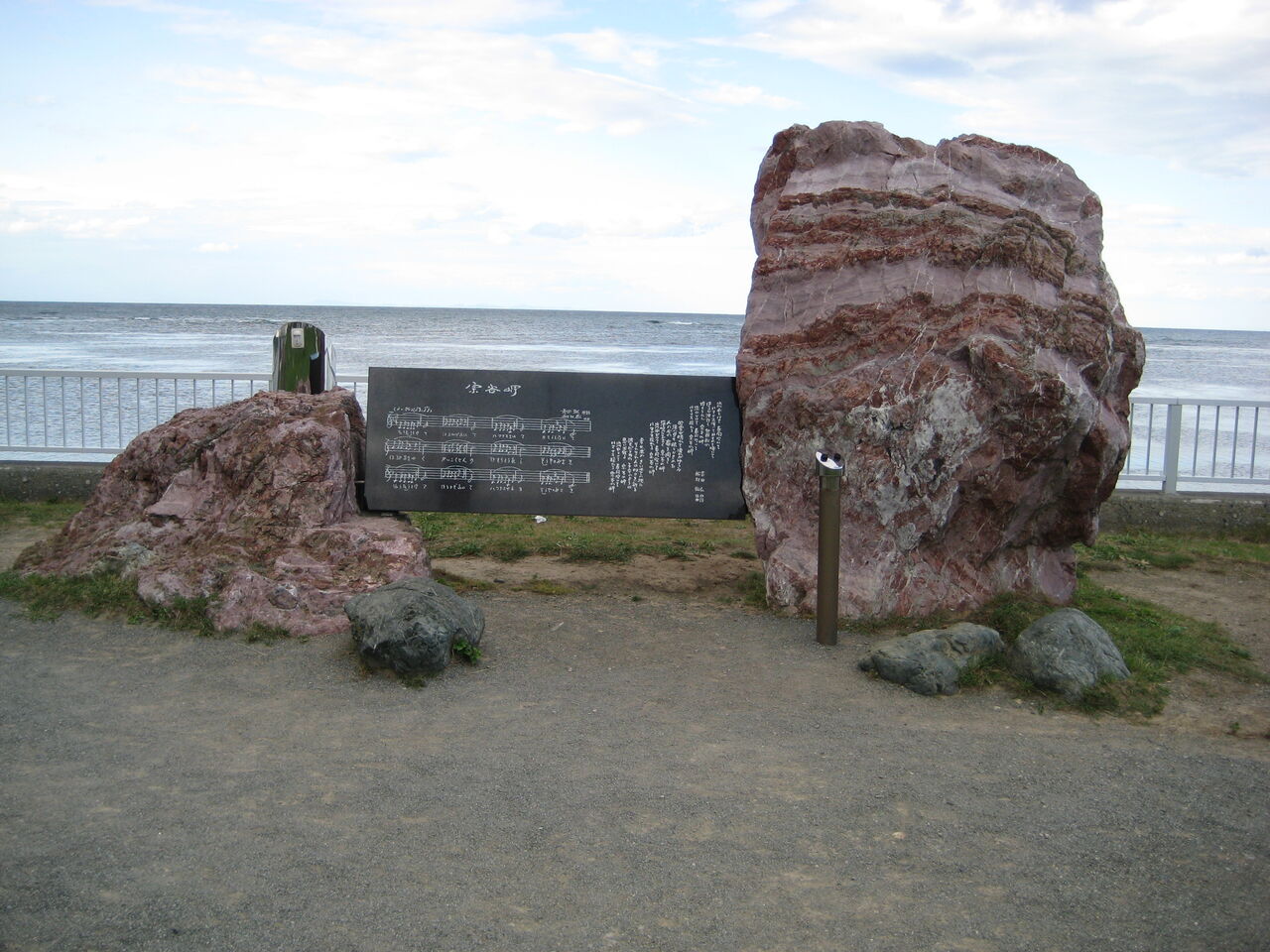
Irishman Walking (Stage 17 Chapter 2) Summer 2015.

56439087_2291153687790871_6976789749440708608_n

Irishman Walking (Stage 17 Chapter 2) is about my walking the main and coastal roads of Japan. Summer 2015.


2 Aug, 2015: Work duties had kept my friend busy for a good while, and it was not until close to midnight when we finally met. Therefore, I had plantey of time to get to the Higashiyama Grand Hotel, where my friend had booked a double room. The hotel was tucked a wee bit out of the way, especially on foot. The hotel was so far in the sticks that even my WiFi failed to work. In the absence of the BBC news, I turned on the television set to see what was on. It was the usual lighthearted boring programing. If it had not been for an international football game -- Japan verses North Korea, women's teams , I wold gone fallen asleep. As it turned out, North Korea were simply superb, with a 4-2 win. The time had gone midnight when my friend's car drove into the hotel carpark. About that time, an interesting bilingual documentary was about to begin. We were both too tired to watch anything. There were a few weary words of welcome, and an agreement to leave our plans until tomorrow. Formost on our minds was to call it a day, and hit the sack. After a hearty breakfast my friend drove me to a number of touristy places, which included the Fukushima Museum. It was my second visit to the musuem, but that was a good eight-years ago. So I could not remember anything about it. What I did learn was that a moving pathway had been installed since then. The pathway was installed to assist visitors to the top of Iimoriyama, at a hefty price. Although, Iimoriyama was not far from Aizuwakamatsu, it was still a good drive for my friend, to set up our meeting, so I was more than grateful. The elderly, in particular, could now reach the top of the mountain, without much of an effort. Being in the prime of my life, I found Iimoriyama to be more a hill than a mountain. A the top, visitors payed their respects to the 19 young samurai, referred to as 'Byakkotai'. In English, the Byakkotai were referred to as, ‘the White Tiger Unit’, a force of few hundred young warriors of the Aizu Domain. The samurai warriors attempted to reestablish the traditional society they knew. This was called 'Sakoku' -- a government policy of near total isolation, from foreigner interference and influence. It was a period when foreigners could not enter Japan, nor Japanese leave the country, on penalty of death. Needless to say, their hopes and desires were dashed. Some chose to commit seppuku, a ritual suicide, rather than surrender to the new Meiji forces. Any plans for victory must have appeared a forlorn hope to the young samurai. The through themselves gallantly into the task at hand, and fought bravely in the Boshin War, 1868-9. What could one say about such young men? Being part of the Byakkotai, went beyond any boyish love of adventure. Where they truly receptive of a revolution? Was it impossible them to steer an alternative course? Rather than to stand and fight, and to give their lives for the Tokugawa shogunate. The persuasiveness of their cause, and optimism, to turn the clocks back, must have been unbelievebly strong. To take on the better equipped and modern Meiji government forces, was definitely not for the faint-hearted. Many myths expressed the belief in an honourable death, and many samurai even welcomed and sought it in battle. One example of this were the young Kamikaze pilots who saw themselves as modern day samurai.


Done

800px-Byakko-tai_statues


Statue of Byakkotai warriors at Iimori Hill, Aizu-Wakamatsu in Fukushima (Wikipedia) 


Unknown-12


Victory, as it emerged, was not the outcome the Tokugawa government, nor the confident young samurai, had hoped for. What the Meiji government needed to do was to take swift action to restore order, and get the country out of its economic slump. Gradually, the cogs of trade and industry began to move. The following years brought drastic change to the political system. It was a time that placed importance on the working classes, particularly the merchant-class, noted for their enterprise. During the early-years of the Meiji Emancipation, however, violence continued sporadically here and there. Still, the old ways of life were never the same. The ancient rights and dreams of conquest, among the old samurai society, were shattered and dead. It was a call not to dwell on the past, but pay more attention to the future. The principle and conviction at the time, was to welcome and accept new enterprise. The young warriors, who had fought vigorously for those ideals, must have anticipated the consequence of capture. The leaders, who commanded their obedience, had fallen dead around them. Those that survived the wounds in battle, found their hopes blighted. Some lived long enough to see any return to the good old days dispelled, and their previous victories turned to dust. The Byakkotai were teenagers. The Tokugawa shogunate, therefore, could not be looked back on in terms of  nostalgia, a yearning for the chivalry of the samarai. Those who survived the battle, paid a heavy price for their defeat -- unemployed, poverity, emancipated on the verge of starvation and disease, politically powerless, and alienated from the new ambitious society. This was what confronted them. In short, the doctrine of the ‘good old days’ had been turned on its head. In the course of time, any incongruous alliance with the Tokugawa shogunate past, became less. There was little choice, but to accept the new political order. There was no where for the young warriors to turn, but to climb over the barrier of their past that obstructed them -- come in out of the cold. The time had come to accept the new Meiji government and to assimilate into a new way of life that had been met with an enthusastic response from the common people. In the first 10-years of the nineteenth-century, trade with the outside world increased considerably in Japan, and more rapidly than it had in previous decades. A little below the Byakkotai graves stood the Aizu Sazaedo Temple, located in the Oaza Yahata area of Aizuwakamatsu. Its old wooden building was three-storied, 16.5-meter high, with a hexagonal Buddhist pagoda, built using early Japanese woodworking  techniques. The official name of the temple was ‘Entsu Sansodo’, which literally meant, ’three full turns’. This was in reference to its winding staircase. The spiral-staircase led visitors past some 33-Kannon statues. The building, with its unique double helix-shaped staircase, was built in 1796. Therefore, it was no surprise this unique temple was designated an Important Cultural Property. To an interested layman like myself, it was of a somewhat unusual design, more like a set of stairs incased in an outer shell. Then again, what the hell did I know about Japanese architecture?


Done

What I did know was that I would more than likely come to regret not forking out the ¥400 Yen entrance fee, and look about the place better. It was believed to be the oldest wooden structure in Japan. When I visited eight-years ago,  it cost ¥800 Yen to enter, which at the time surprised me. Now the entrance fee was half that, which I still found was a bit on the steep side. It was not an overly large building, with lots of things to offer its visitors. What interested me more, was our visit to the Fukushima Museum, opened to the public in 1986. The Fukushima Kenritsu Hakubutsukan, to use its full name, was situated in the old Aizu-Wakamatsu Castle grounds, now a large park. It saddened me a little that nothing of the original Aizu-Wakamatsu Castle remained. When the castle was first built in 1384, it was called Kurokawa Castle. Up until 1868,  was the main Tokugawa administrative and military headquarters of the Aizu and Tōhoku regions. That was before castle was demolished by the new Meiji government, six-years later, in 1874. The tenshu, the castle's main tower, was rebuilt using concrete, in 1965. There was a museum inside, and an observation gallery that offered visitors a panoramic view of the city. An old tea room, called Rinkaku, had also been restored. It was designated an Important Cultural Property by the local Aizu governemnt. This was not the first visit to the museum. The previous time was on my Dragster, eight-years earlier. For the life of me, I could not recall anything about that time. People visited museums for different reasons all year round. For me, I simply wanted to learn something about the local culture and history, and the many local crafts the region was noted for. After all, that was the mission of a museum, to highligh the natural history and culture of the prefecture. Hopefully, in the company of my good frind, I will not forget what I learn, so easily this time. Long gone were the youthful days, when I saw visits to museums only in terms of fun. Fukushima was a large prefecture, divided into three main area -- Hamahori, Nakachori, and Aizu. It was also home to the Ōu Mountain Range and the Abukuma Highlands, with  Mount Ōtakine its hightest peak. Stretching some 500-kilometers north to south, made the Ōu Mountains the longest range in Japan. Together, the mountains played a great part in the different climates in the prefecture. Over the years, Fukushima barely had its fair share of natural and manmade disasters. Unfortunately, the damage casused by the 2011 Tōhoku earthquake and tsunami, forced me to take a lengthy detour inland on my own narrow road to the deep north. The coastline and surrounding areas of the nuclear reactors remained closed to the average Joe Pulic. Of course, that was neither here nor there, for nothing was going to prevent me from accomplishing my mission.

Done 


Unknown-11


The original tenshu of Aizuwakamatsu Castle, 1868 (Wikipedia)


3 Aug, 2015: We left the Higashiyama Grand Hotel, a good hour before checkout time, to give us a wee bit more time out and about together. This was our final day in Aizuwakamatsu, or when I would soon be back on the road proper. The interior of the car felt like an oven, just as uncomfortable as tramping under the sun all day long. According to the NHK news, the weather woould hover around 36°C. What little time we had left together, before I headed back to Koriyama, to restart my mission, where I left off, we decided to go to Aizu-Wakamatsu Castle. For some reason the castle was also known as, Tsuruga-jo Castle. Like before, I could not recall anything about my last visit there, eight-years earlier. “Mmm!” I momentarily wondered if this had something to do with getting older, or a mental condition that I should be more concerned about? At the castle, a pamphlet in English was pressed into my hand, along with the two tickets, which came to ¥1,020 Yen. Two highlighted sentences on the pamplet caught my eye: “A roof of Tsuruga-jo Castle is the only red roof in Japan,” and “The inside of the castle tower is a museum.” The castle dated back to 1384. Since that time, a number of notable historical, encluding mythological, figures had held positions of one level or another. Unfortunately for the castle, its rulers had placed their money on the wrong horse in the civil war, historically refered to in school textbooks as the Boshin War. That was when the Meiji Imperial Army defeated the Tokugawa Shogunate regime in a series of battles. The Tsuruga-jo Castle was finally demolished, in 1874. Today, there were only 12 extant feudal period castle keeps, in Japan. Just over double of that number (25) of castle grounds still had structures that dated to tte 1600s -- buildings, stone walls, gates, moats, etc. Most of the castles, however, that visitors took photographs of today, were mainly concrete replicas of what once was. Some of them were precise replicas of the original plans, built with the same original methods. Others were little more than tourist traps. Many of the concrete replicas had been poorly planned -- keeps that were out-of-scale, and walls that did not exist in the original structures. This seemed quite a stepdown from the 171 castles that existed, during the Tokugawa period, 1600-1868. The Land of the Rising Sun was once boasted more then 3,200 castles, including forifications, in the Sengoku period, 1467-1600. "In 1870 the Meiji government ordered that all remnants of Japan’s feudal past be demolished including castles, tower fortifications, samurai quarters, and armouries. Over the next four years, in their fervour to forget their feudal past and embrace a new fresh modern nation, the Japanese demolished all but 19 main castle keeps. Many hundreds of stone walls and moats surrounding castle baileys however remained, as they proved far too difficult to demolish. Many of these became public parks, private residences, or had government buildings built within them. All but only a few moats were filled in to make way for roads and public buildings. Quite a few castle grounds soon served as new locations for Japan’s new modern military forces, with their gardens levelled, trees felled, and moats filled in to provide parade grounds for the new western style military drills." (nisshinkankobudo.wordpress.com).

Done
 

The location of the old Aizu-Wakamatsu Castle was declared a National Historical Site, in 1934. The 1930s, one of the godforsaken blackest times in Japanese history, a time when rightwing fundamentalists ran the roost. The onslaught of the Pacific War, claimed countless casualties and brought despair to the Japanese people. My friend and I spent a good hour and a half looking about the castle inclosure, created in part by the financial support of local citizens, in 1965. “Mmm!” When the time at last came to head back over to the train station, I could not help wonder why I had forgotten just about everything I had seen on my previous visit. Perhaps I really was getting old, or the years were creeping up on me without noticing it. Surely everyone remembered visits to museums and tourist spots. Another thing that bothered me, were my books, for I could not remember most of what I read for the life of me. This was especially the case with the books I read at university, let alone the topics debated about them. At one time I even wondered what was the point of going to university in the first place? Alas, time waited for no one, and after a nostalgic few days with my good friend, we parted, and headed off in our opposite directions.


Done


4 Aug, 2015: Slept well, as usual. The mornings, as was often the case, came too quickly for my liking. The NHK news reported no letup in the sweltering heat. This was not the worst of it. I left my maps and a book inadvertently, in my friend’s car. The moment I reached Koriyama City, I headed for map section at the nearest bookshop. The plan for this morning, after leaving the Toyoko Inn, was to head for the Showa dori, segment of road along Route 4. In Tokyo, I knew Route 4 better by its name, the Nikko Kaido. Over time, nothing lasted forever, including roads, let alone their names. All the same, it was good idea for me to stick closely to Route 4. The road gradually drew nearer to the southern part of Sendai, where I was headed. There I hoped to get my arse onto Route 6. By then, I should be able to get a better idea of what roads I needed. Communication with another friend, Sean, opened up the possibility of meeting up for awhile, perhaps somewhere along Route 4. This would need to be before the Obon holidays. At Obon time, just about everywhere in Japan was crowded with merrymakers, not to mention the roads with traffic. Sean was an Australian friend of mine, who had, to use the idiom, 'married into money'. Among his manu interests, he had setup his own Website, that included the word -- backpackers -- in its name. My friend told me that he wanted to get some photos and make a short video of me tramping along the road, with my backpack. There was talk of the possibility to camp awhile together. That said, I had a feeling that our meeting would not materialize. My friend was a busy man, and things always seemed to pop up for him to take care of. Sean was the sort of guy who had a mind that changed like the wind. That was his character, and there was nothing I could do about it one way or another. My big problem now was the relentless sun, which beat down on top of me like there was no tomorrow. Any shade to shelter under, seemed to be few and far between. As a result, the thoughts of laying down in a cool isolated spot for a nap, plagued me no end, for a good while. Thankfully, the kilometers fell away like dominoes. This was along a dusty hot asphalt road, with only passing vehicles for company. Another thing that occupied my mide, was keeping an eye open for drinking water, or 'akua' in Japanese. Needless to say, akua was the most important of drinks, for animal life and nature, even if it was tasteless. So hot was the weather that people forked out their hard earned money for bottles of water than usual, at shops or vending machines. The farmers, too, were surely pissed off with the stifling hot days of summer. On the road again, I found myself at Nihonmatsu-jo, the site of a castle located in the Kakunai area of Nihonmatsu City in Fukushima. The castle was ruled by Mitsushige Niwa, the first feudal daimyō of the Nihonmatsu Domain, in 1643. Like many castles during the Meiji Restoration, the Nihonmatsu-jo was dismantled -- the grounds transformed into a park (now the Kasumigajō kōen), in 1872. The park landscape was noted for its nature and seasonal beauty, and a National Historic Site, since 2007.

Done 


Around April, the castle grounds were ‘embellished with some 1,700 cherry blossom trees in full bloom -- like a snow in spring. An abundance of pink and while petals was said to resemble a cloud, hence the castles’s nickname, ‘Castle in the Mist’. “Mmm!” A castle in the mist, was a sight to behold, even if only for a brief moment. In addition, countless visitors flocked to the park to enjoy the country's largest chrysanthemum doll festival, in autumn. Visitors were also able to view Japanese sculptor, Kentaro Hashimoto’s iconic statures, erected in 1996, of the young Byakkotai warriors, of the Boshin War. They were members a a grounp called the: 'White Tiger Brigade’, which numbered around 300 young samurai, aged between 12 to 17-years old. A tragic story that involved ritual suicide that had long become immortalized in Japanese folklore. Today, many Japanese nostalgically saw the period as the golden age of their country's past. They saw the young samurai’s actions in terms of courage and dignity, held them in great esteem. For whatever the reasons, many Japanese were proud of their own family’s ’samurai' background. “Mmm!” For a moment, wondered if the way the samurai were protrayed on the big screen, or in television dramas, had something to do with it? In away, their suicides removed any responsibility they had for the military catastrophe. The park was open 24-hours a day. Therefore, had the time been right, it would have been an excellent spot to pitch the tent for the night. Adachigahara Furusato-mura was a kind of theme park located in Nihonmatsu City. It was not far from the Abukuma River, which wound its way northwards around the park. The park was home to Adachigahara Furusato-mura Village -- a traditional Japanese village -- that give visitors a glimps into the past. It was part of a large open-air theme park, of the same name. In Japanese folklore the area was home of 'Onibaba', a female demon that lived in the mountain, and feasted on humans. There were a series of Onibaba stories, including a 1964 Japanese psychological horror film, directed by Kaneto Shindo. The film-plot was based on an old Buddhist fable, set during the feudal period (1400-1600). The two female protagonists in the story survived by murdering wandering soldiers, returning home from the bloody battle field. Their armor was removed from their dead bodies and sold to a dealer in secondhand goods.


Done 


5 Aug, 2015: Camp was finally made at a place called, Chieko-no-Sato, a touristy rest stop area, with a public toilet and places to eat and shop. There was a 24-hour convenience store, located in Adachi in Nihonmatsum, and which I expected to pay a visit to. Thankfully, sleep came quicker than usual that even the wine went untouched. A glance at my maps told me that I should reach Sendai in four-days time. The hot weather could could wear down the devil if given the chance. For the average Joe Public, the possibility of heatstroke was always a main concern. Fukushima City drew nearer with each step that I took. If all went well, I may be able to stop the night at a business hotel there. What I needed was to escape this damn weather for a while, however, any such plans were soon quashed. All the hotels around the train station area were full, and this was not even a weekend when I expected them to be. My membership card at the Toyoko Inn proved useless at cutting a few corners. The schools were still out for the summer holidays period. To make matters worse, Obon was fast approaching. It had been a slow lazy day on the road, but I still felt tired, no thanks to the stifling sun. The sun had not finished with me yet. There were still a few more hours of sunshine left. What was the point in bitching about it? All that I could do now was to stop by at any hotel I saw on my way out of the city to see if they had a room. What I needed was a wee bit of  the luck of the Irish. At one of the many convenience stores I passed along the way, I stopped and chatted with a young fellow. He told me that his name was Masahiro, and that he was hitch-hiking form Tokyo to the Sendai. In away, I envied Masahiro-san, for having the balls to do it. In ths 70s and 80s, hitch-hiking for me was like a food, something that had to be done. In my advancing years, I still recalled a good few fund memories of my hitch-hiking days in Japan. Thoughts of a number of the people I I met all those years ago, still burned like an eternal flame in my heart. Once during the New Year holidays in 1980, I hitch-hiked from Tokyo to Kobe with a girlfrind at the time, Toshiko. Out journey to Kobe inclued a series of local buses and trains, thrown in for good measure. In Kobe, we stopped at her younger sister's home. The sister's husband was a muscular Japanese man, who was a keen rugby player. They were a nice and homely couple. It was also the first and last time I drank Japanese sake, or rice wine. The jusband and myself mush have polished off three bottles of the stuff that night. Needless to say, I could not remembered much about that time, other than I was as sick as a dog. When I first met Toshi-san, to use her nickname, she worked at Keio Hospital in Tokyo, as a nurse. Back then, I taught English conversation lessons to doctors and nurses at Keio, and at the Cancer Certer in Tsukiji, also in Tokyo. Toshi-san hasd been one of my students, before we started to fall for eachother. As we drew closer, we planned a number of daytrips together -- the Fuji-Hakone-Izu National Park. I recall that another nurse, from the same hospital, came with us to Hakone. There was a bit of drizzle that day, and thanfully we had umbrellas. There was the time when we stood on the deck of a sightseeing ship on Lake Ashi, umbrellas in head, and had our photo taken. Unfortunately for the life of me, I could not remember the name of the other nurse. Sadly, the time came for us to head off in our different directions in life. From time to time, Toshi-san pops in to my mind, and  each time I wonder what she was up to these days.


Done


Unknown-10


Toshi-san and yours truly, in Kobe, New Year, 1980


6 Aug, 2015: After my failure to find a hotel for the night, camp was finallymade on a piece of ground just off the main drag, Route 4. The tent was pitched on the banks of a river, called Matsukawa. A pitched battle, called Matsukawa-no-Tatakai, was fought on the banks of the river, in 1600. One of the most interesting historcial Japanese figures, was a local daimyō, called Masamune Data. Date, a one-eyed ruler, whose army invaded the Fukushima region, on learning of the victory of his leader, Ieyasu Tokugawa. Following the Battle of Sekigahara (1600), Ieyasu became the first shōgun of the Tokugawa Shogunate. The Tokugawa shogunate ruled Japan for around 250-years, until 1868, the beginning of the Meiji period. In the course of his rule, Ieyasu outlawed and persecuted Christianity. Masamune on the other hand, sympathized with foreign traders and Christian missionaries in the region. He also worked to open up relations with Christian envoys in Rome. He sent expeditions to a number of countries -- Mexico, Philippines, Spain, and Rome. More recently, Masamune was portrayed in a number of Japanese period dramas, and by Japanese actor, Ken Watanabe, in the popular NHK televeion series Dokuganryū Masamune, in 1987. The Matsukawa flowed from Mount Azumayama, eastwards through the residential area of Fukushima. At Fukushima, the river joined the Abukuma-gawa, a river that made its way through Shinobu-ga-oka Sogo Undo Koen, a large athletic park. The Fukushima Hanabi Taikai, a fireworks festival, was held at the park every July. This year, 2015, was the thirty-seventh anniversary of the festival. The 234-kilometer long Abukuma-gawa was the second longest river in Tōhoku. It was also the sixth longest river in the country. The 234-kilometer long Abukuma-gawa was the second longest river in Tōhoku. The river flowed into the Pacific. I liked to camp near rivers, and usually found them peaceful places. Of course, I needed to be aware of the dangers -- sudden floods, slippery banks, etc. The sound of moving water could be very southing. That said, sleep did not come as easy as I had hoped. This had nothing to do with the noise from the passing traffic, for I slept well even in the worst of conditions. Rather, I had a feeling that I caught a cold. Much of the night was spent searching for tissues to blow a continuously runny nose with. It never bothered me during my childhood days, for just about every boy on our street, used their sleves. Was it possible to catch a cold in such hot weather? Contrary to popular belief, or so I had just read, the common cold was just as easily cought in the summertime, as in winter. Rhinovirus was main reason for the common cold, regardless of the season. According to my research, the virus infection in the nose seemed to proliferate more in temperatures of 33–35°C. The traffic along the road was never ending, that I could not think of a busier and more dangerous road since I left Tokyo. This was all the more annoying in the day, when I needed to find some shade to escape the stiffling sun for a while. There were times when the traffice prevented me from crossing the road, to be in the shade.

Done

In unforgiving weather conditions, part of my mind was taken up with how best to avoid the sun. Another part reminded  me that I had a tight schedule to stick to, and that stopping to rest was out of the question. Besides, much of the road was devoid of quality trees, or places to seek shelter under for a while under. The Shinto shrines that were home to tall quality trees, and shade in abundance, however, they appeared few and far between. Many Shinto shrines were known for their centries old sacred forests, or other ‘yorishiro’ -- trees, rocks, waterfalls, mountains,  -- natural object that attracted spirits or kami. In Shinto terminology, kami were found in nature, a physical space on Earth, called ‘shintai’. Back to the present, my head felt roasted and preoccupied about finding some air-conditioned spot to kill time at for a spell. If only I could find a shade to lay down and take a nap under, or wait for the sun to sink a bit deeper in the sky.


Done


7 Aug, 2015:  When I crossed the border into Miyagi Prefecture, about 10-kilometers south of Shiroishi, I had a feeling of relieve to have left Fukushima behind me. It gave me a sence of progress on the road. The people in Fukushima were kind to me, so a part of me felt sad. They had cheerful smiling faces. Their kindness was a thing that I seldom experienced in Tokyo. The time was by no means late, but the sun had really worked hard on me. So much so that I found myself stopping at just about every convenience store I came to. This was mainly to enjoy the cool air-conditioned interior, for a spell. Only God knew how many lollypops I must have ate in a crazy effort to cool my body down. The problem with drinking cool sports drinks was that they were gone in minutes. Camp was made at the top of a steep flight of stone steps, which led to an isolated Shinto shrine. After pitching the tent and tossing the gear into it, I continued my way further upwards. The path led me through brush and brambles, past unkept trees, and around large rocks. After a short distance, I stopped at the little shrine. There was no sign of a freshwater tap. There seemed little need to pull the rope at the haiden -- the hall of worship -- to awaken the Shinto diety and ask for help. Traditionally, tugging on the rope to ring the bell was to ward off unwanted spirits, or to purify the surrounding space for the kami arrive. A strange act for any atheist, I clapped my hands together a few times, like the Japanese did when they paid respect at shrines. “Mmm!” What sort of stuff did the Japanese pray for? I momentarily wondered. Many were anxious for something good to happen for someone, if not for themselves. Others prayed to distance themselves from something dreadful. The power of prayer was not to be scorned or laughed at. Religious literature awakened intellectually aware minds, particularly those who felt wronged in someway. Thanks to a strict Roman Catholic upbring, religion of any donomination or spiritual conviction, was well beyond my own intellectual capacity. All the same, it seeemed strange that there was no Shinto literature per se, such as, the Koran and the Bible. Faith in a god, or gods, was perhaps the most powerful of all emotions known to man. These days, however, the hold that religion, or sects, had on their followers, was less firm than previously. Most anything that lent towards religion, or supernatural ways, was not the kind of thing that I needed on the road. Any Irishman who was true to himself, harbored an inferno of emotions. The last time that I seriously attended mass -- dipped my fingers in holy water, knelt at an alter, or sat my arse down on a shinny church pew -- was as a young child growing up in Belfast. Since that time, I cannot think of any personal identification with religion or the church. There were more pressing issues on my mind, and spiritualism was not among them. Morning came soon, and once again, I was more than ready for the road ahead. An orange sun rose from the eastern horizon, and graced the road, Route 4, that I would shortly follow. Unlike previous days, a broad shade fanned out over the righthand side of the road. “Mmm!” If only the shade from the trees and bushes could accompany me as far as Sendai, or so the thought crossed my mind.

Done

Just as I contemplated the best way to deal with the sun or the heat, I caught sight of a tall slim Caucasian man up ahead. The man appeared to be waiting for me to draw nearer. His truck was parked by the side of the road. “Ah! A gaijin!” I said with a smile, as I got closer. “Ha! Yes! I’m from New Zealand.” The man introduced himself as John. And told me that he had seen me tramping along the road, when he past, back down the road. "So, I decided to stop and say hello". John added. In the course of our chat, John handed me a 250-gram bar of chocolate -- Whittaker’s Almond Gold Milk Chocolate. “Don’t worry, it’s real quality chocolate, so it won’t melt so easily". Of course, I was happy to get the wee out of the blue gift, regardless of its quality, for kindness was a many-splendored thing. Perhaps John knew something that I was not sure of, or what melting had to do with quality. When I was given the chocolate, I did not have the slightest of appetites -- no thanks to the stifling weather. Still, I knew that I needed to eat more than my usual morning rationing of muesli. The chocolate treat would more than do the trick. Before heading off down the road, we exchanged the necessary contact information. It was be nice to keep in touch, and look John up, when I next passed through Gumma Prefecture, where he lived with his family. “Why not!” I replied to his kind offer. “It might be nice to make the trip through Gumma on my motorbike”. By now, the sun was really worked its evil on both of use. It was time to get a move on. “A nice cool beer might have been better than a bar of chocolate.” I jokingly commented, as we turned to take our leave. “Yes, a cool beer! Nice!” He replied with a smile, as we shook hands and parted company. Further along the road, I made a stop under a shade to boil water for a cup of tea. As I waited for the water to boil, I took out the business card John had given me earlier. ‘Tracking vehicle diagnosis a quantum leap forward’ was printed on the face of the card. “Mmm!” What did that mean? I did not have the foggiest what John did for a living.


Done 


8 Aug, 2015: Just like yesterday evening, camp was set up near a small out of the way Shinto shrine. Likewise, it was not until I dealt with another steep set of stone steps first. The traffic along Route 4, about 50-meters below, sped past like there was no tomorrow. "Mmm!" This segment of the road, I thought, was the busiest national highway, in Japan. The noise from the passing vehicles did not let up for much of the night. From time to time, I got a glimpse of the distant lights of a Shinkansen train, in both directions. Each time a bullet-train passed, to use the colloquial name, the ground where I lay, vibrated a wee bit. From time to time, there was the cracking of twigs and ruffling of branches, which caused me to imagine a wild animal was on the move. A part from a few birds, I could not see any animals. Most of the birds were in the warmth of their nests, high up in the trees. Not a daring feral cat would chance its luck to get at them. The nights entertainment, came from the sound of the cicadas. Needless to say, sleep did not come as quickly as I would have liked. This may have been the result of a lazy day on the road. An eye open for a shelter from the relentless sun, took precedence over distance. When I did decided to call it a day and pitch the tent, I was far from exhausted. When morning came, I was happy to see that the sky was overcast, providing it was not a sign of rain. An overcast sky was perfect for being out in the open all day. Along the road, not far from Kitashirakawa JR Station, I made a stop at a 7-Eleven to pickup a spots drink. One good thing about stopping outside such places was that it gave me a good chance to look over my maps and get an idea of things. My initial plan was to get my arse onto Route 6, which was not so far away. Plans were not incased in concrete, at least as far as being on the road was concerned. After going over the maps, I decided to stick to my current route to Sendai. This was a good day to be on the road -- good weather, no rain under a cloudy sky -- pregress was good. The clouds were like friends, to turn to for shelter. At around one-o’clock, however, the sun made every effort to rule the sky. Its rays penetrated every gap in the clouds. At times it looked as if the clouds would win the battle above, but for how long that would be, was another story. Part of me did not care one way or another, so long as the rain held off. This last couple of days a good number of long distance cyclists passed me by, in both directions. One young fellow whom I chatted to yesterday, for the best part of an hour, told me that he was on a cycling trip from Canada, where he lived. He told me that his name was Mizael, and that he was currretly studying in South Korea. As school out for the summer holidays, he decided to pay a visit to a neighboring country to look around. Before Mizael boarded the ferry at Pusan, he told me that he invested in a secondhand road-bike. He told me that he arrived in Fukuoka on a ferry, from Pusan; and from there he proposed to cycle to Sendai. When we met, I had not long entered a large Co-op supermarket that sold a wide range of stuff, which I did not need. On the road, I needed to be frugal in all things, and keep what I did buy down to the lowest yen.

Done

After getting what I wanted -- a cool watermelon and yoghurt -- and set down on a bench close to a rear exit. 
Mizeal sauntered over, with what looked like a package of suchi, and set down on the bench, about two-meters away. In the course of our chat, I learnt that he had suffered for sometime from a lack of appetite. This he put down to the relentless heat. Thankfully, Mizeal was cleaver enough to know that he needed to eat something. In this case, a little sushi, and ice cream for dessert. Interesting as or char was, it had little to do with life on the open road. We spoke, lightheartedly, about politics, of all things, and views on an independent Quebec. Mizeal was from Quebec, and though I visited Canada a couple of times, he was much better versed on the 'La Belle Province', than me. For some reason our talk turned to the American businessman-cum television personality, Donald Trump. 
Trump had just entered the race for the White House. We could not stop ourselves from bursting into bouts of laugher about the madness of the world. This caused a number of the other customers to glance our direction. From my point of view, I felt that someone like Trump was just what the American politics needed, kind of shake things up a bit. We both agreed that Trump did not have a hope in hell in the election, when the big day came. No one would be more surprised that Trump, should he find himself in the Oval Office. Surely tossing his hat in the presidential election ring, was some kind of costly window dressing for his own business ventures. Unlike the others the presidency race, Trump seemed less
 ambiguous, he kind of spoke directly to people's faces. That was how Trump appeared to me. Despite the fine talk, I liked to read between the lines of what the politicians rambled on about. Trump, I felt, was a no nonsence sort of guy, who did not seem to care how man bridges got gurned down behind him. His words resonated an enthusiasm that left people feeling hopeful. One thing was clear, Mizeal-san and me agreed that Trump was the most interesting runner in the race. Many in the American senate and congress were elegant speakers. All the same, it looked like Hillary Clinton, was well on her way to the White House. Being a socialist at heart, however, I preferred Bernie Sanders, however, American was not ready for the likes of a leftist like him at the moment. Like Trump, Sanders had no chance. What was the point of wasting your nomination on no-hopers? When the delegates spoke to their supporters, it was often with sharp wit and suave inventive language. They used an aggressive language, often contrived by the delegates and speechwriters. They were acutely aware of the powor of their words. They knew that the right sort of words enlivened their listeners, amid scenes of intense enthusiasm. 
They used live music, often with ticker-tape and colorful lighting, and balloons. A few guest speakers were invited for good effect. Every single one of them played to the television cameras and reporters. They did their utmost to take the edge off their opponents arguments -- to thin their ranks, and break their strengte -- through one slander, or another. The debates included a few well chosen and well timed phrases, to excite an emotional counter-response.

Done

The delegates had an ability to deliberately stoke the emotions and awe their audiences. 
They spoke lyrically in support of what views it was they wanted to get across. This was achieved in the light of one campaign slogan, or another. For Sanders -- ‘A FUTURE TO BELIEVE IN’, whilst  for Trump -- “MAKE AMERICA GREAT AGAIN” . Trump stood out the most. He not only liked to be the center of attention, he was the center of attention. Trump enjoyed the fame and adulation that the White House brought with it. It was hard to believe that the successful candidate swore an oath prior to entering the Execution Office: 'I Michael Denis Crossey do solemnly swear (or affirm) that I will faithfully execute the Office of President of the United States, and will to the best of my Ability, preserve, protect and defend the Constitution of the United States.' Alas, this was not the time for Mizeal and me to waste our energy on political matters, for time waited for no man. We agreed that we could have spent more time chatting, for I enjoyed the humor. The time had arrived to head off in our separate directions along the road, Route 4. Mizeal planned to head south on his bike for Tokyo, and yours truly on foot northwards towards Sendai. Just before hitting the road, we exchanged our contact addresses, and a few snapshops were taken. My parting words to Mizeal were to let me know what he did with his bike when he got to Tokyo. Earlier, he told me that he planned to dispose of the bike, before flying back to South Korea, but was not sure how. He had even offered to leave it for me at an approprate location, but I declined the kind offer. Besides, I already owned a good road-bike. When the time, and weather, allowed, I loved to cycle off on the odd camping trip somewhere. All the same, I wondered if the young man was destined to become one of the confused memories of so many fine people I met along the way.

Done


9 Aug, 2015: A gentle pitter-patter on the sides of the tent told me it was a good idea to up camp before the rain really bucketed down. Thankfully the rain had not fall in any big way. Still, the going along the road was smooth, thanks to the heavy cloud cover. A main concern this morning was getting my arse onto Route 45, a turning that I almost missed. It was so easy to take a wrong turning, let along the right one. The old mind ofen headed off on meaningless tangents -- about past, present, and future things. To add to the problem, the roads ofte seemed not to have been built for people on foot. Even taking a left or a right turn, was a task in itself. Getting onto the right road often involved taking the long way around, or crossing over a busy road. Just as I was standing at a traffic light to cross the road, Route 45, which I was at last able to get onto, my focus caught a window display of an outdoor shop. Through the shop window, my eyes fell on two small four-wheeled trolleys. “Mmm! Now, that was what I needed.” I mombled to myself. The light changed and I headed across the road and into the store, for a look about. The four-wheeled trolley that I liked most, had a camouflage or military-like pattern on its basket. The trolley was by no means as tough and sturdy as the military might use. The cost was a bit on the steep side -- ¥16,000 Yen. Still, the sead had been planted. So, the trolley that I decided on, was a family outing kind of job. The sort families might use to cart their gear on, from the car to the beach or campsite. It cost ¥10,000 Yen, which was not exactly cheap neither. The new trolley, I felt, would do the trick, for life on the road. At least it would take the weight off my back and knees, or so I hoped. It was not long after I had left the store, the four-wheeled hand trolley in tow, the backpack and water bottles in it, that I realized what a fool I had been. It was the sort of thing I should have bought before, particularly at the start of my mission at Soyamisaki in Hokkaido, in 2009. My body would have been better for it. And, I could have carried more gear, with less concerns about food and water. The new trolley was like a new friend, a sheer delight. That said, I needed to be careful not to forget that I owned a trolley, for fear of leaving it behind on the road somewhere. The gear on the trolley felt so light, I hardly knew it was there. "Mmm!" How better life on the road might have been, I thougth, if I had had a four-wheeled hand trolley earlier. The sun did its best to reflect its deadly at me. Thankfully, the clouds were plentiful enough to keep things in check. At times, long distance cyclists, their bikes loaded up with gear, passed me by. For much of today, however, I saw just few tourist coaches on the road. Many people continued to avoid the Tōhoku region. The hotels were fully booked, a good sign for the local economy. The sun continued to beat down on me, like there was no tomorrow. How this could be, for the abundance of clouds in the sky, I did not have the foggiest idea. Thankfully, a hearty appetite returned, a sign that I was keeping on top of things. Up the road, my eyes fell on a ramen restaurant, and where I ordered a bowl of miso-ramen, for lunch.

Done 

10 Aug, 2015: After only a few kilometers up the road I came to a Family Mart, next to a neglected local park.
This was at a place called Shiogama. It was as good a spot as any to camp for the night. It did not take me long to pitch the tent. A look about the park told me that the tsunami that hit the Tōhoku region three-years earlier, had left a calling card here, too. Shiogama, a city in Miyagi Prefecture, had a population of more than 52,000. The population had been on the decline since 1990. Commercial fishing -- tuna, and fish processing -- was a big part of the local economy. The city was also famous for its sushi -- the highest density of sushi restaurants, in the country. It did not surprise me to learn that August was the city's hotest month in the year, at around 24.6°C. The next month, September, was the wettest, so I guess I was just as fortunate not to be out under the elements at that time. The kanji that made up the name, Shiogama, meant ‘salt furnace’. The production of salt from seawater, in July, was a local Shinto ritual. This morning, not long after getting up, a pleasant elderly fellow, on a brisk morning walk, stopped to chat. He told me that the tsunami had greatly damaged to the area. The water, he said, was only one-meter high, but high enough to leave its mark. “This used to be a beautiful park”, he continued, “but just the trees and tall bushes survived.” It was easy to see that the flowers were gone, replaced all around by various species of weeds. The man added that the park was popular, and was created around 30-years ago. So, it was a great loss to the local township. After an hour or so on the road, I came to the first tunnel of the day. However, the Sukadaichi Tunnel was soon followed by a second, the Sukadaini Tunnel. Thankfully, both of the tunnels came with little side tunnels, for pedestrians and cyclist to use safely. The area or space between the two tunnels was not a bad place to make camp at, had the time been right. However, it was much too early to even think of such a thing. Had the time been right, the quality trees offered a perfect spot to stop and relax under. The moonlit sparkling waters of Matsushima Bay, would have been a sight to behold, on a clear evening. All the more so with a cup of red wine. A little after I had pasted Ruzen-Hamada JR Station, another tunnel came in to view. Though there was no side tunnel for pedestrians and cyclists to use, the Hamada Tunnel did have a good wide pavement. However, just before making my way through the tunnel, I made a stop in at a local post office, only to discover that it had no ATM machine. It was the old face to face and filling out of forms kind of thing, which I should add did not take very long. The postoffice was a friendly little place, and with the withdrawal stashed away, I was back out the door, and on my way again. Back on the road, I soon noticed that the weather no longer seemed hot. I had not noticed the sky clouding over. Now, a fresh easterly breeze blew in across the coastline. A signpost at the roadside told me know that I was past the tsunami inundation section. Acording to a second sign post along the road, I had just entered the Matsushima Township.
 

Done 
 

The local economy was largely based around tourism, commercial fishing, and farming. Located on the picturesque Matsushima Bay, Matsushima Town had a population of around 13,500, a decline since the 1990 census. It was also home to the Buddhist temples, Entsū-in, Zuigan-ji, Godaidō, and Kanrantei, a Momoyama-style Japanese teahouse. Entsū-in, founded in 1647, was popular for its gardens -- a Japanese rock garden, a Western baroque-style rose garden, and a moss garden and pond. The rock garden symbolized heaven and earth, whilst the rose garden was believed to be inspired by Date's connection with Christians. He was also known for his refined aesthetic tastes. The temple inclosure was noted for Japanese cedars and Japanese maple trees. Entsū-in was home to a mausoleum where Date Masamune's grandson, Mitsumune, was enshrined. He was just 19-years old when he died. Date Masamune was a powerful daimyō in the Tōhoku region, during the Azuchi–Momoyama Period (1568-1600). It was a period of political unification. Becasuse of his progressive nature, Masamune was believed to be the founder of the modern-day city of Sendai. Entsū-in was also the frst temple on the Sanriku 33 Kannon pilgrimage route. Zuigan-ji was founded in 828, during the Heian period (794-1185). It was a period when Japan's influence from China was on the decline, and when its one national culure grew. It also included the rise of the warrior class, who patronised the temple. On the orders of Date Masamune, work was started to rebuild Zuigan-ji, in 1604. Work on the main building (Hōjō), was completed in 1609. The Date clan worshipped at the temple until the Meiji Restoration. The lumber used for the work, came from Mount Kumano in Kii Provance, in todays Wakayama, Mei, and Nara Prefectures. The Kii Mountain Range, located on the Kii Peninsula, was also known for its sacred sites and pilgrimage routes. The work was carried out by skilled workmen from Kii Province and Kyoto. The haiku poet Matsuo Bashō wrote about the temples' golden wall interior. Due to its protected location, Zuigan-ji  escaped much of the damage of the Tōhoku earthquake and tsunami, in 2011. Kanrantei was a Japanese tea house, of the Tokugawa perioddesigThe teahouse and a number of the fusuma panels had been designated as prefectural and cultural properties. It was the only building from Date's mansion complex in Matsushima to survive. Matsushima was a pleasant town in northeastern Honshu, and had a humid subtropical climate. Its coastline was particularly noted for the natural beauty, which included about 260 little islands that dotted Matsushima Bay. Incidentally, the word ‘Matsu’ meant ‘pine’, and many of the islands were forested with pine trees. A number of picturesque hiking trails, for example, crisscrossed the pine forest on Fukuura-jima Island. The poet Matsuo Bashō (1644-94) was captivated by Matsushima’s scenic beautiful. Bashō referred to the beauty in his famous travel diary -- ‘Oku no Hosomichi’ or 'Narrow Road to the Interior'.

Done

Bashō was perhaps the most famous poet of the Tokugawa period, and wrote extensively on his travels. As for myself, I happily quoted bits from Bashō's writings in my own road-notes -- “The temple bell stops but I still hear the sound coming out of the flowers.” The cost seemed to be of little concern -- about 130 master craftsmen worked on the rebuilding; the materials used were of the highest quality; and, the five-years it took to rebuild the temple, must have cost a pretty penny. Today, the main building, and other parts of the temple, was designated a national treasure. More recently, the structure underwent a major six-year renovation, completed in 2016. Today, visiters can enjoy the temple's decorative rooms, sliding doors and alcoves -- embellished in gold leaf, and many paintings of floating celelias beings, peacocks, red and white camellias, and pine trees. First founded in 807, the Godaidō Temple, set on an islet that overlooked Matsushima Bay. Partly hidden by a cluster of trees, the temple was located on the islet since the ninth-century, and got its name from the five Buddhas of wisdom, enshrined within. The deities were displayed to the public every 33-years. The last time was in 2006. A series of curved vermillion bridges led to the temple inclosure. The temple exterior was decorated by small carvings, symbolic of the twelve animals of the lunar calendar. Because of its location, Godaidō did not suffer major damage by the Tōhoku earthquake and tsunami, in 2011. Thankfully, the public toilet also survived the tsunami, and was a good place for me to get my washing done, and dried quickly in the hot sun. I was able to sit a while in the shade, and boil water for cup of coffee, tasted good. The traffic along the road had slowed to a crawl. “Mmm!” The movement of the vahicles caused me to wonder if there had been an accident. Hopefully not! No doubt I would find out in the not too distant future. Work was being carried out on the tiny harbor. There was not a fishing boat in sight. There were so many tiny fishing harbors dotted around the country. With my washing dry, and neatly folded away in my brand new four-wheeled hand trolley, I made my way back up onto the road. The first tunnel of the day I came to was Matsushima Tunnel. It was a short tunnel, at just 125-meter long, it was opened in 1988. The road ran through the Matsushima National Park. A large touristy-like map at an entrances to the park, told me that I was still within the Matsushima Bay area. "Mmm! Good!" I mumbled to myself, as it was nice to know exactly were I was. Across the bay set Oku-Matsushima, an island with rich sandy beaches, with many great places to pitch the tent for the night. The island’s coastline was chosen as one of the top hundred beaches, in the country. The Land of the Rising Sun was not short of beautiful coastlines, great places to stop to ponder over for a while. The islands that poked out of Matsushima Bay drew countless tourists throughout the year. The view was said to be one of the three best picturesque scenic sites, in Japan. There was a host of water activities to do throughout the year -- swimming, wind-surfing, and drag-net fishing, and so forth.

Done 

For keen hiking, there was the Oku-Matsushima Trail, which started at the Selco Home Aomina Visitor Center. Segments of the hiking trail were believed to date back as far as prehistoric times. Back in those days, the only way for getting about from village to village, was on foot. The route took me though the Satohama Historical Park, and then past the Satohama Shell Mound. The mound dated back to the Jomon period (14,000-300 BC), and one of the largest archaeological sites of its kind, in Japan. At Inagasaki Park and on top of Otakamori, visitors enjoyed a 360-degree view over Oku-Matsushima’s landscape. It was one of the four panoramic views of Matsushima. This route also allowed visitors to sample the delicious seafood and the local hospitality. A chain of small islands added to the beautiful landscape -- Karatojima, Sabusawajima, Katsurashima, Nionjima, Nonoshima, Omorijima, and Hojima -- many with beautiful sandy beaches. The water that surrounded the islands was said to be as calm as a lake. The ferry bound for Shiogama sailed past the islands. The Shiogama Port was only slightly damaged by the Tōhoku earthquake and tsunami, in 2011, however, three people in Matsushima died. It was believed the chain of islands protected the area from greater damage. The local economy was largely based around commercial fishing -- oyster, swordfish, and tuna. Shiogama City also boasted of the highest density of sushi restaurants, in the country. The Urato Islands, a group of five small islands, four of which weere inhabited -- Katsurashima, Nonoshima, Sabusawajima, and Hojima. Katsurashima boasted the popular Katsurashima Beach on one side, and the 61-meter high Mount Tsumori, the highest point in the Urato Islands. The island had been inhabited since the Jomon period. Today, Katsurashima was the most populated of the Urato Islands. Nonoshima, in particulaer was famous for its mysterious caves and camellia tunnel. A part of the island was closed to visitors, because of reconstruction after the earthquake and tsunami. Visitors were also discouraged from visiting the islands when the rapeseed were in bloom in springtime, in order to protect the plants from contamination. Sabusawajima was especially noted in other countries for its oysters -- America and Europe. The island thrived as a port island during the Tokugawa period, and was also the birthplace of Tsudayu and Sahei Watanabe, the first Japanese to travel overseas. There was a monument on the island dedicated to the first western-style warship built in Japan --  the Kaisemaru. The ship was built on the orders of the Date clan, in 1856, and in the final years of the Tokugawa period. The Treaty of Shimoda was signed in Febuary, 1855, the first treaty betwee the Russian Empire and the Tokugawa Shogunate; and the Kanagawa Treaty with America, a year earlier. The treaties effectively brought an end to Japan's 220-year isolation policy -- 'sakoku'. It was also a period of catastrophic earthquakes in Edo (Tokyo), in 1854, in 1855, and in 1858, collectively refered to as the Ansei great earthquakes. It was also a time of a major cholera outbreak that left more than 100,000 people dead.

Done

Hojima was the smallest of the Urato Islands, and fewest residents. 
Its natural beauty, was the islands main attraction. The first kanji in the name, ‘Ho(u)’, meant 'treasure' -- a mythological bird called ‘Houou’. A houou was a mythological Chinese phoenix. The kanji also meant, 'beacon fire', seen from a great distance. It was said that the Date clan used the island to hide portions of their wealth, perhaps to buy weaponry.  Nearly 40 other shell mounds were uncovered on a number of the Urato islands. In more recent times, a shell mound that dated back to the Jomon period, called the Katsurashima Kai-zuka, was unearthed on the island. The shell mound was designated a national heretage site, in 1969. The island was noted for a number of matsuri, including a popular summer firework festival was held in August, every year. The main industry was built around fisheries -- the production of seaweed and oysters. A kind of white fish, called Shira-uo in Japanese, was caught at nighttime, under the light of flames. A fishing fire, as it was termed, also signaled the coming of spring. All in all, the islands dotted about the bay were formed of sedimentary rocks and had become eroded by the elements and waves. Many of the islands were named by locals, because of their unusual shapes. The tiny islet Niojima, for example, resembled the statue of a deity, called Nio Guardian: a statue that stood at the entrance of many Buddhist temples, in Japan. Likewise, Futagojima, two tiny islands close together, resembled the shapes of a whale and a turtle. The hand of nature may be noted on the island of Kabutojima, shaped like a samurai helmet. In English, the name refered to a type of helmet used by ancient Japanese warriors. Senganjima was said to have been Masamune Date’s favorite islet, where he was said to have viewed the moon. In Japanese this was called, ‘Otsukimi’, a popular activity in Japan, on the night of the full-moon, around mid-September. The name, 'Osukimi' refered to celebrating the harvest moonl, an old Japanese custom. The custom, introduced from China, and mainly enjoyed by aristocrats during the Heian period. The islet’s name meant ‘a thousand coin island’. For myself, I preferred to think of islands for their natural beauty; a thing to be enjoyed at any particular time, day, or season; not to tack the islands to some manmade nickname. There was also the Kanrantei, built during the sixteenth-century, which the Date clan used as a guesthouse. This gorgeous building was originally located in Kyoto, then ruled over by the feudal lord of Fushima Castle, Toyotomi Hideyoshi. The building was later dismantled and moved to its current location. At that time, Date Masamune ruled Mutsu Province (today's Tohoku region). The relocation of Kanrantei was overseen by Masamune’s son, Tatamune, during the Azuchi-Momoyama Period  (1568-1600). The period was credited after two main castles -- Azuchi Castle, in Shiga and Momoyama (also Fushimi)) Castle, in Kyoto. It was a time of political unification, which led to the beginning of the Tokugaya shogunate (1603-1868).

Done 

Momoyama Castle was dismantled, in 1623, and parts of it were used on other castles, and several temples, in Kyoto -- Yōgen-in, Genkō-an, and Hōsen-in, among others. Hōsen-in boasted a blood-stained ceiling, previously the floor of a corridor at Momoyama Castle, where the daimyo Torii Mototada, and his followers, were believed to have committed  seppuku, or Japanese ritual suicide. The tomb of Emperor Meiji was constructed on the original castle site, in 1912. That was, incendentily, about three and a half months after the disastrous maiden voyage of the RMS Titanic. One of the passingers to survive, was a man called Masabumi Hosono, the only Japanese among the passingers. Hosono lived his life under the cloud of a false accusation that he had gotten aboard a lifeboat disquised as a woman. Back in Japan, he was condemned as a coward by the newspapers, and at one time even lost his job. He was seen as having betrayed spirit of the samurai through self-sacrifice. The current Fushimi Castle that visitors took their snapshots of today -- a concrete replica of the original design -- built in 1964. According to my research, about 20 provinces provided between 20-30,000 craftsmen and labors for the construction of the castle. The castle was originally intended as the location for Toyotomi Hideyoshi's peace talks with Chinese diplomats, to end to the Seven-Year War in Korea. An earthquake, however, destroyed the castle just two-years after its completion (Wikipedia). The Matsushima Museum stood next to the old Kanrantei. Visitors to the museum were able to look at early writings, paintings, tools, armor, among many other exhibits, which dated back to feudal times. The Kenrantei was designated an important cultural heritage asset, in Miyagi, in 1953. A good distance up the road, another touristy looking signpost pointed to a number of places of interest -- Oku-matsushima Jomon Village, Mount Otakamori, Sagakei Pleasure Boat, and Oku-matsushima Park, 14.2-kilometers,  13.7-kilometers, 12-kilometers, and 11-kilometers away, respectively. The northeastern coastline of Miyagi, was home to natural parks, hot springs, and oysters. The area also boasted one of the largest prehistorical sites, in the country. The Oku-matsushima Jomon Village gave visitors a glimpse back to the first civilization, in Japan. An ancient people of hunter and gatherers, who mainly survived on wild plants chestnuts, acorns, and food from the sea. This part of Japan’s ancient past dated around 12,000 to 300 BC, before the advancement of settlements and agriculture. The Jomon Village Museum stood, on the banks of the picturesque Matsushima Bay, offered information on a wide array of artifacts -- bones of wild boar, deer, and different species of birds. Several shell mounds had also been unearthed in the area. Once I read in a book that burial mounds were associated with fairies and mythical heros. In Japan, the word was 'Yōsei', 
synonymous with the word 'fairy' in Irish folklore. In addition to their mischivioius harmless pramks, the yōsei, it was said, possessed the power to resurrect the dead. God forbid, that was the kind of people I did not want to hang around with.

Done

Ireland, the country of my birth, had its own fair share of faries and mythical heros -- 
Cú chulainn, Dagda, and Lugh, among others. Cú chulainn was an Irish mythological demigod who single-handedly defended the Kingdom of Ulster, with his magical powers. Dagda was a one of the leaders of a mythological Irish race, who was believed to be able to slay nine of the enemy at one stroke with his club. Another prominent god in Irish mythology, was called Lugh. Lugh won battles through the use of magical owers, which he passed on to his son, Cú chulainn. Lugh also possessed the powers to bring his comrades back to life. Many fishing hooks, tools made from stone and whale bone, and a large array of pottery, were displayed at the Jomon Village Museum. The Jomon period was particularly known for the pottery-making craftmanship, with intricate patterns. To help people connect with the pas, the Oku-matsushima Jomon Village hosted various events and culture classes, throughout the year. Visitors learned how to build a fire, make pots, and create jewelry by grinding stones, just as the Jomon people had done a millennia ago. The shell mound was designated an important cultural site, in 2000. Mount Otakamori, located on Miyatojima in the Higashimatsuhima part of Miyagi, was a not overly elevated mountain, at just  105.8-meters high. Although technically an island, Miyatojima was more like a peninsula than an island. The Island jutted out between two bays -- Ishinomaki and Matsushima. A panoramic view from the peak of Mount Otakamori, a 20-minute hike, over the bays, was simply splendid. Oku-matsushima Park, on the eastern side of Matsushima, was referred to as the land of whispering winds and blue seas. The park overlooked the largest of the islands in Matsushima Bay, Miyato Island, and its beautiful Nobiru coastline. The area was a paradise for poets and painters, as well as, for the common Joe Public, out on a weekend getaway. The Oku-Matsushima hiking trail started from the Selco Home Aomina Visitor Center. The start-point dated back to Jomon times. The relatively mild climate in the region and calm waters in the bay, enticed visitors all year round for wind-surfing, and various forms of fishing. Matsushima Bay was a fertile fishing ground that provided an abundance of seafood. The cultivation of  oysters, shipped allover the country, was a big part of the local economy. The sun had almost gone down behind a steep hill, carpeted by trees and shrubbery. Further along the road, Route 45, I came to a road sign that pointed in the direction of Oku-Matsushima and Nobiru, on Route 60. The road that I was on made a sharp left for Ishinomaki and Kesennuma. The road led me across the Naruse Ohashi that spanned two rivers, the Yoshida-gawa and Naruse-gawa. Many riverside scenic spots had thier attractions, in this case, the Narusegawa River Canoe Race. The road went past the site of Nobiru-chikuko, a port project built in the early-Meiji period in Momoo-gun, present-day Higashi-Matsushima City. The old port faced onto Sendai Bay, also refered to as Ishimaki Bay. 

Done

The construction of the port, included the infrastructure -- new roads, railways, and canals.
 By the time the the Nobiru-chikuko was opened to shipping, was it was the first modern port in Japan. Not long after the port was in use, a strong typhoon hit the Tōhoku region, and severely damaged the jetty. More recently, the old port-site was designated a civil engineering award, by the Japan Society of Civil Engineering. The old port site also earned the nickname, ‘Phantom Port’. "Mmm!" This was as good a time as any to think about keeping an eye out for a good place to camp. The port area was a good place to make camp, providing of course, one understood the dangers of being too close to the waters edge. Should push come to shove, an escape route was a many splendid thing to have nearby. 


Done

Irishman Walking (Stage 17 Chapter 1) Summer 2015

56439087_2291153687790871_6976789749440708608_n

Irishman Walking (Stage 17 Chapter 1) is about my walking the main and coastal roads of Japan. Summer 2015.

*


Dear Friends and Readers:


Irishman Walking was about my walking the main and coastal roads of Japan, in a series of spring, summer, autumn, and winter stages. It took me eight-years to complete my mission. This summer-stage, Stage 17, began on 27 July, 2015, at Mito City (via Takahagi), in Ibaragi prefecture, on the eastern coastline of Honshu. It was also where the previous stage officially ended. The Japanese archipelago consisted of 6,852 islands, with 430 of them inhabited. An island was defined as being land with more than 100-meters in circumference. The five main islands, from north to south, were Hokkaido, Honshu, Shikoku, Kyushu, and Okinawa. Honshu was often referred to as the Japanese mainland. After 20-days on the road, and the trials and tribulations that went with it, the stage was finally concluded on 16 August, 2015, at Sendai City, nicknamed the ‘City of Trees’. This was because it was said to be one of Japan's greenest cities, for the abundance of plants and trees. This was not a recent idea, rather dated to the Tokugawa period, when residents were encouraged to plant trees in their gardens, or ‘yashikirin’ , household forests. It also proved a useful source for wood, to make everyday materials. Sendai was located in Miyagi prefecture along the northeastern Pacific coastline of Honshu, the largest of Japan’s mainland islands. Sendai was not only the capital city of the prefecture, but it was also its largest. Around 20-percent of the earthquakes in the world tended to occur in Japan. As with much of Japan, the Sendai region had its fair share of natural disasters, earthquakes among them. The 1978 Miyagi earthquake, for example, had a magnitude of 7.7, had caused number of landslides and widespread damage to the infrastructure around Sendai, on 12 June, 1978. Only one death was reported. The 2005 Miyagi earthquake, with a magnitude of 7.2, also caused considerable damage, and a number of deaths, after the collapse of a swimming pool roof, on 16 August, 2005. Much of the long Tōhoku coastline and beyond, was decimated by a massive earthquake, in 2011 Tōhoku earthquake, with a magnitude 9.1. It was said to have been the most powerful earthquake ever recorded, in Japan. According to the records, it was also the fourth most powerful in the world. It was a disaster that left thousands dead, and contributed to the Fukushima Daiichi nuclear disaster that followed. The Sendai region had been inhabited for around 20,000-years. Sendai was said to have be founded by the daimyo at the time, Masamune Date, in 1600. Date had been given permission, by Tokugawa Ieyasu, the first Shogun, to have a castle built. The location was an ideal location for trade, and a town soon grew up around the castle. On an added note, the grid plan roads in present-day Sendai City center were based upon Date’s plans (Wikipedia). The first railway line to that connected Sendai with Tokyo, was opened in 1887. Needless to say, the line greatly reduced the travel-time. People were able to make the journey within only a day, which was considered revolutionary at the time. Furthermore, Sendai University, founded in 1907,  was not only the first school of higher eduction in the region, but was the first in Japan to admit students of the female gender, in 1913. An Imperial Japanese Army division, locally recruited troops, was stationed in Sendai, during the Pacific War, and participated in the Battle of Guadalcanal, among other bloody encounters. Needless to say, the city was targeted by American bombers in the closing weeks of the war, 10 July, 1945. The historic city center was leveled as a result, including the loss of almost 12,000 inhabitants. After the war, the American occupying forces operated two camps in and near the city, Camp Sendai and Camp Schimmelpfennig. Sendai was also home to the largest festival in Japan, ‘the Tanabata Matsuri’, held every summer. Also known as ‘the Star Festival’, and believed to have been introduced into Japan by the Empress Kōken, in 755. According to legend, the empress had a lasting love affair with a Buddhist monk called, Dōkyō. The Tanabata celebrated the meeting and subsequent love of two deities, where were separated by fate. The empress was the sixth of eight females to rule Japan. When she died in 770, her lover fell from grace and was banished from the capital Nara. “Mmm!” ‘Love was a Many Splendored Thing’, to coin the title of one of my favorite films. After all, it was better to have loved and lost, than never to have loved at all. Food for though! Back to the present, I was glad to have wrapped this stage of my mission up in Sendai City. Not only was it an interesting place with a lot to do and see, but it would be easy to return to this coming to continue on my mission around Japan on foot.


Be happy, keep smiling! 


Yours sincerely


Michael Denis Crossey


*
 

From Mito City in Ibaragi to Sendai City in Miyagi

163400543_1061735940978683_1928232892411645971_n


*


21 Jul, 2015: Prior to getting my gear together for this stage, Stage 17, of my mission, a massive earthquake hit Nepal and left more than 7,000 people dead. In recent years, the British have experienced about 20 to 30 earthquakes per year, with an intensity above 2. Many more smaller earthquakes were recorded by the British Geological Survey. An earthquake in Kent in England registered 4.2 on the rector scale. When I lived in London for seven-years, I never felt a single tremmer. In other news, the Takasakiyama Zoo in Oita in Kyushu, apologized for naming one of its newly born monkeys, Charlotte, after the British royal baby. According to the zoo, the name Charlotte got the most votes. The Takasakiyama Natural Zoological Garden was a unique kind of place, located on the 628-meter high Mount Takasaki. In 1953, the zoo started feeding a group of wild monkeys. This monkey-feeding activity attracted more visitors to it, than to the mountain itself. Prior to this, the Oita City Mayor, Tamotsu Ueda, had made an unsuccessful attempt to intice the monkey population in the area. His plan was to entice the monkeys with apples. A hora-gai, a horn made from a conch shell, was blown to attract the monkeys. The attempt to control the monkeys was financed out of his own pocket. A hora-gai was often common among the Yamabushi mountain monk's gear, in Yamanashi. Later, another attempt was made to intice the monkeys, by a  Buddhist priest called Onishi, from the Manjuji Temple. This time he used sweet potatoes to intice them, which proved successful. Soon, the monkeys began to visit the area more frequently. The monkeys in the region were first recorded, in 1698, and were known to harass local farmers. By 1964, the monkeys numbers increased. In time, different groups of monkey formed. In June 2002, one of the groups left the protected zoological area, never to return. The big news in Japan focused on a change in the constitution, so as to send armed forces abroad to fight abroad. This would be the first time in 70-years. The move was welcomed by Washington. America had been instrumental in drawing up the pacifist Article 9 of Japan’s postwar constitution. Japan had long been the target of unprecedented international pressure for a more active role in world affairs. Needless to say, antiwar protests were planned to counter any change in the law.

Done 


10915bca


Takasakiyama Park (Wikipedia)


22 Jul, 2015: This coming Monday, 27 July, was officially set for the start on this stage of my mission. This was at a time when I had just recovered from an alien illness, which kept me in my futon for seven-days. On my mind at the time was a pressing need for a spot of exercise, so as to get back into shape, before I left Tokyo proper. Looking over my maps at the time, I decided to take a short cycling trip for a few days as far as Kamakura and back. Cycling was as good away as any for beefing up the old muscles. Rather than load up any camping gear this time, I decided to book myself into a Toyoko Inn in Fujisawa for a couple of days. My plan was to cycle as closely as possible to the kyu-Tōkaidō, which was easier said than done. There was just about nothing left of the old Tōkaidō, the main road now being, Routes 1 and 2 (and Route 3), which I cycled along on an earlier cycling trip to Fukuoka in Kyushu, many years ago. These days, the Tōkaidō was so built up, over, and around, it was hard to believe that any of the old road survived at all. The land between Tokyo and Yokohama made up the country’s most intensely developed industrial zone. To paraphrase the words of Keio University founder, Yukichi Fukuzawa years earlier: ‘All that Japan had to be proud of was the scenery.’ “Mmm!” What scenery? Fukuzawa must be turning with anger in his grave. Busy roads were no places to pause for superficial attention. No matter how much I had planned for the various stages of my mission, circumstances often dictated how things went, or turned out. Thankfully there was nothing magical about getting the old mind and body ready for the road. So, I hoped this short cycling venture would help to do just that. There were two things I never got used on the busy roads -- the fumes and the speeding vehicles. This fumes were most noticeable at times of traffic jams. A traffic jam was a microcosm of the real world, not easy to escape, a thing that needed to be dealt with. It did not have to be rush-hour for veciles to get slowed down on the roads, even for cyclists. There were a few things that came to mind -- accidents, roadworks, weather conditions, blisters, muscile fatique, etc., etc., really could put a few dints in my plans. Any unwanted occurrences proved sobering to say the least. Not a day passed not see a reckless driver speeding madly along the road, or weaving in and out of the traffic. What was the point of hurrying? Life was short as it was. Often at times along the road, the scenery was blocked out on all sides by hideous buildings. Trees planted and cultivated by man, ornamented the buildings along the sides of the road. The hand of man had left its mark in all directions. As I was cycling, there was no need to be in any great hast, a thing I was guilty of in my younger days. Besides, I was still recovering from a misterious illness. With the sun beating down on top of me, a lazy paddle along the Tōkaidō, Route 1, was good enough for me in the hight of summer.

Done 


Besides the cycling trip to get the body and mind ready for walking the road again shortly, there was another reason. My plan was to pay an unexpected visit to a certain cafe for lunch, and to see my friend, Mayu-san, who ran the place. Mayu's attractive smiling face never failed to work wonders on my emotions. The lack of scenery, which I touched on earlier, did not prevent me from taking in other places of interest along the way. Many of the houses I passed, had attractive Japanese-style gardens with admirably arranged plants, trees, and rocks, and so forth. It was hard not to pause momentarily, to take some snapshot. On the odd occuasion, providing the weather was favorable, I liked to sit down for a while to enjoy the environment. The good thing about cycling, I roughly knew when I would arrive at a certain place, in this case Yokohama, where I was headed. How many Japanese knew that it was at a local summer festival in Yokohama, the female gender were first carried the mikoshi, the sacred and heavy religious palanquin? Juring the Japanese festival, the mikosh was believed to hold a Shinto deity on a journey between the main shrine to a temperory one.

Done 

23 July, 2015: The headlines in the morning Japan Times offered a little food for thought: ‘Govt reveals map, photographs of China’s ‘structures in E. China Sea.' No doubt the Japanese government hoped to deter China from unilaterally developing gas fields in the region. In other headlines: ‘Japan greets over 9 mil. visitors in 1st half of year’, and ‘Toshiba sued in U.S. over stock price plunge on scandal’. The scandal in question had to do with accounting irregularities that involved top management, over a series of years. Whenever I thought about it, I could not recall a year in Japan that was free from white-collar scandals of one kind or another. Then again, white-collar crime, or any crime for that matter, was synonymous the world over. Thankfully, the rain that I expected to fall did not materialize, which suited me just dandy as  made my way along the road, Route 32. The road led in the direction of the famous Daibutsu, a gaint bronze statue of Buddha, some 13.35-meter tall from its base. Like Mount Fuji, the Daibutsu was considered a Japanese icon. An outdoor statue, in the grounds of the Kōtoku-in, a Buddhist temple, about a 10-minute walk from Hase Station, the third-stop on the Enoden Line, from Kamakura. On a visit to Japan in 1892, Rudyard Kipling saw the Daibutsu as 'a Japanese idol at Kamakura'. The Daibutsu was more famous than the temple itself, it took about 10-years to complete. It was originally made of wood, in 1243. Damage casued by storms and earthquakes over the years, however, led to the construction of the bronze statue we see today. Now, the visitors waited paitently in the drizzle to get their snapshots of the statue of Amitābha -- the Buddha of Limitless Light -- just one of a number of phrases of the statue, in the different touristy broachers. It represented the main deity of the Buddhist Sect Jodo, which in English meant Pure Land. It was hard to keep the broachers dry in the rain, as I jotted down my notes. The statue was commonly referred to by local people as the Kamakura Daibutsu, and was designated a National Treasure. A notice at the entrance to the [Kōtoku-in] grounds read: "Stranger, whosoever thou art and whatsoever be thy creed, when thou enterest this sanctuary remember thou treadest upon ground hallowed by the worship of ages. This is the Temple of Buddha and the gate of the eternal, and should therefore be entered with reverence.” The 1923 Great Kanto earthquake badly damaged the base or the statue, but it was repaired in 1925. Repair to the statue’s neck was carried out in 1960–61, and included work to strengthen it against earthquakes. Further restoration and preservation work was planned. When I reached the Daibsu, a light drizzle began to fall. The rain remained light that the other visiters appeared not to use an umbrella. Likewise, I saw no reason to open the one I had borrowed at the hotel. "Mmm!" For some reason, I wondered if famous visitors to the Kamakura Daibutsu, worried about the weather? The British journalist, writer, and poet, among other talents, Rudyard Kipling, who visited Japan twice, in 1889 and again in 1892. No other British literary figure than Kipling, fully documented his life in Japan in the late-Meiji period. His newspaper despatches from Japan were seen by the noted Japanologist, Basil Han Chamberlain, as: "the most graphic ever penned by a globetrotter". 


Done


1e4075d1


One of the earliest photographs of the Great Buddha, by Italian-British photographer, Felice Beato (1867) (Wikipedia)

There were a good number of Chinese and European tourists, not to mention a few Americans, or Canadians, if my ears were not decieving me. And of course, an Irishman! Yours truly! I mumbled to myself as I looked about me. Everytime I found myself in Kamakura, it was hard not recall earlier visits to the place together with old friends, sadly gone from my life. A day-trip to Kamakura Daibutsu was a favored pastime for foreign residents of Yokohama, at least since the late-nineteenth-century, if not before. The Daibutsu drew Japanese visitors to it all year round. But where the hell were they today? The official Webpage reminded visitors on a number of rules: “Refrain from eating and drinking in front of the Great Buddha and near the pedestal. In addition, please refrain from eating while walking as this can inconvenience other temple visitors. Please take any trash with you when you leave. Wheelchair users should, as far as possible, be accompanied by a helper, as some areas on the temple grounds are difficult for wheelchair users on their own. There was a wheelchair-accessible unisex restroom facility, on the grounds. Visitors with pets may enter the grounds only if their pet is in a pet cage or carrier. Except for service dogs, no dogs on leashes may be walked on the grounds.” In adddition: "Smoking was not permitted anywhere within the temple grounds. When taking photos on the grounds for commercial use, please obtain the temple’s permission beforehand. Download the application from the website, fill out and sign the form, and submit it to the temple office. Visitors were free to take photos for personal use as they wish. But we ask all visitors to refrain from flying drones in the precincts and using selfie sticks in the interior of the statue. There were no professional photographers on duty, at the temple. The templeʼs cycle parking lot is for bicycles and mopeds only. The temple assumes no responsibility for theft, minor accidents or other incidents in this parking lot.” Besides the different and overpriced souvenir shops, I could not see very many Japanese tourists at all. This last number of years there had been an active drive to promote domestic tourism, as a good way to get them to see and learn more about their own country. Each summer different prefectures in Japan made efforts to hold cultural festivities, though mainly for your people, or students. The festive events covered various interests, with a Japanese leaning. The events ranged from arts, calligraphy, crafts, creative writing, Japanese poetry, the board game Go, music, natural science, tea ceremony, theater, and so forth. Another was Ogura Hyakunin Isshu, a traditional card game, enjoyable especially amongst children. The game was attributed to the scholar, Fujiwara no Nobuzane (1162-1241), in the late-Heian and early-Kamakura periods. Before I cycled back to the hotel in Fujisawa where I was stopping, I bought the tiniest model of a Kamakura Daibutsu that I could find, from a shop in the temple grounds. My plan was to give it to my friend, Mayu-san tomorrow, when I stopped by at her cafe in the Ōfuna part of Kanagawa. It was just a wee gift to mark the occausion, and hope that she would not forget me.

Done


Unknown-3


Poem Card No.1 (Wikipedia)
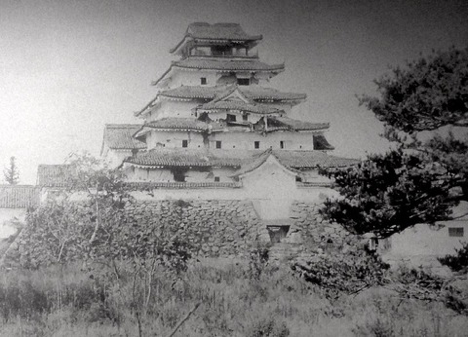
24-25 Jul, 2015: One good thing about stopping at the business hotel was that I could sit and read an English language newspaper in comfort. 
In this case, a morning issue of the Japan Times, which I read over breakfast, and take my thoughts away from the road for a while. At times I wondered about the level of intelligence needed to make a choice headline? The headlines in this mornings paper were: ‘Jan-June trade deficit down 77-percent from last year’, ‘Yui enters ISS after Soyuz launches docks successfully’, ‘One-stop tax desks lure tourists to localities’, and, ‘TPP talks near deal on rice quota under 100,000 tons’. This was the final day of my wee cycling trip to Kamakura and back to my place in Tokyo. There was no hurry to return to Tokyo, so I intended to peddle slowly, and try to enjoy the remainder of the roundtrip. My mind had a habit of working overtime, so I would have to make a greater effort to stay focussed. Of course, I looked forward to my stop at my friend's cafe in  Ōfuna, the next town. Sadly, both of us were not as close as we once where. Our phone calls and emails, were now few and far between. How her many emails used to cheer me up no end. There were two things in life that were said to be certain -- taxes and death. Noting lasted forever. Everything came to an end. Almost a year had passed when Mayu-san ended the relationship. The reasons for which  I still could not understand. Behind the smiling faces it was hard to gauge the mind of a Japanese woman, or any female for that matter. I worried that my friend may misinterpret my out of the blue stop off at her cafe. Another part of me hoped that she would be happy to see me again, regardless of circumstances. Such was her character. For me, I looked forward to seeing her beautiful smile again, if only for a short while. There was one problem, my friend’s place in time for lunchtime. Checkout time at the hotel in Fujisawa was at 10:00 AM sharp. Nothing beat the solitude of a warm and comfortable night in a well pitched tent. I liked to enjoy my stop at a hotel to enjoy to the fullest, not just a hot bath and a comfortable bed, but to think about things that I needed to do that may have slipped my mind. The clock was barely gone 11:00 AM when I dismounted the bike outside the cafe, which had just opened for business. After securing the bike, I opened the door and entered. Just as I had thought, Mayu-san welcomed me with a delightful smile. Apart of me felt sadm as I knew that this would be the last time I would see her, as I had no reason to come this way again. The truth was, I would ever see her again after today. There was no reason for me to visit this part of the country again. A pleasant pedestrian and cycling path followed for a fair distance along the Kashiogawa. If only I had known of the path a couple of days earlier, for it would have made Ōfuna easier to get to. For the most part, the roads back to my place in Tokyo proved uneventful. In a word, boring. There had been a heavy downpour in the afternoon, when I crossed the border into Yokohama. Unfortunately, a bout of depression lingered for much of the journey back to Tokyo. The sort of feeling that something dear was lost.

Done


Ōfuna had a train station since 1888, long before it was absorbed into Kamakura City, in 1948. Today, Ōfuna was a busy built-up area, so I was glad to have left the place behind me. The region was not short of beautiful spots, such as, the Ōfuna Kannonji area, particularly at cherry blossom time. The temple was by no means as old or had the history that most others. A Buddhist temple, the Ōfuna Kannonji, was home to a 25-meter tall concrete statue of Bodhisattva Kannon, the Goddess of Mercy. The outbreak of the Pacific War halted work on the statue. When it was finally completed in 1960, and contained a museum and shrine. 'The Ōfuna Kannon incorporated stones from ground zero of Hiroshima and Nagasaki to commemorate those who died in the explosions of the atomic bombs. A fire originating from the atomic fires of Hiroshima burned at a mushroom-formed statue' (Wikipedia).


Done


26 Jul, 2015: Jul, 2015: The first thing I wanted to do when I got back at my place in Tokyo, was to email my friend in Ōfuna to thank her for her kindness. She had even treated me to the sandwich lunchtime set special at her café. Mayu-san never failed to surprise me in one pleasent way or another. In another email, I learned that she did not mention my unexpected visit at the cafe, to her mother, whom she lived with in Yokohama. In away, this saddened me a little. It kind of hammered home that our relationship had truly ended. The only thing I wanted to do now was to think about and get ready for the next stage of my mission. I could not wait to get started on the road again, on foot. Tramping the roads again would burn off the stress that my short cycling trip to Kamakura had failed to do. All the same, I was physically and mentally ready. All that I needed to do was to return to northern Ibaraki, where the summer stage, Stage 17, of my mission would soon start. Tomorrow I planned to get the morning train from Nishiarai, near where I lived, and make a change at Kitasenju, only a few stations away. From there, I planned to take a Joban Line train as far as Mito City in Ibaraki. During the previous stage in spring, Stage 16, I had already passed through Mito. In the closing days of the Pacific War, students at a school in Mito had boycotted their classes. This was to force their military-minded principle to resign. "Mmm!" Weren't all of the school princples at that time military-minded? For better or for worse, Japanese schools across the country had come along way since those days. These days teachers in Japaneses schools, if not in schools in many countries, where prohibited from using physical punishment. When I looked back over the years, I was among the last bunch of boys to get the cane for misbehaving. That was when I attended secondary school in London, the early-1970s. Actually, about 99-percent of my schoollife in Belfast, and in London, involved one form of discipline or another. Looking back, the happiest part about my schooldays was when I quit school a couple of weeks before graduation day. That was a time I never looked back on with any regrets. Incendently, the word 'boycott' came from an Englishman called, Charles Cunningham Boycott (1832-1897). After his retirement from the British Army, Captain Boycott worked as a land agent in County Mayo in Ireland. He became so disliked by the local people, that they refused to harvest the crops, and to have anything to do with him. This was at a time when agriculture was the main means of survival in Ireland. The shops in the nearby town also withdrew their service to him. This was not only a campaign of isolation by the local community, but an act of resistance against the evictions that were to take place on the estate. Hence, a new word -- boycott -- found a new home in the English language dictionaries. Back to the present, the old bouts of stress and anxiety had returned. This was noting new for me. It occured each time I checked and rechecked the gear in preparation for life on the road.

Done 


Stress was part of life, like normal human reactions to a problem. People needed to manage their stress and anxiety, to succeed in something. This was important to following plans and reaching goals. Too much stress, like to much of anything, could lead to whole host of other problems -- fear of something, lack of sleep, bad eating habits, and so on. To combat such things, I needed to enhance self-discipline, self-control, and my mental and physcal health. After all, physical exercise was as good away as any to reduce stress. That said, I was not sure tramping 30 to 35-kilometers under the elements all day long, was the same as physical exercise or a workout. Exercise was any bodily activity or workout that maintained physical fitness and overall health. The amount of endorphins, or stress defeating chemicals that my aging body produced after hours on the road, was open to debate. The kind of stress that I suffered from, tended to pop up out of the blue, unexpectedly. This was especially true at camp in the evenings, when I went over my maps, and saw with my very eyes that I had not done as well as I had first thought. Like the bad workman and his tools story, the weather was a good thing to blame a poor performance on. Doing so, however, did not lesson the problem any.

Done


27 Jul, 2015: The night passed as well as could be expected, in a comfortable futon. A hot shower was followed by a hearty breakfast of porridge, yoghurt, and tea. Now I could not be more ready for the train ride to Mito, and then to Takahagi. Unfortunately, things did not turn out as smooth as that. The train arrived a little late, which was quite unusual in a country that prided itself on good time keeping. According to the schedule, the trained that stopped at Platform 1 at Kitasenju at 10:01 was not the train that should have pulled in at this time. Therefore, not realizing this at the time, I found myself on the wrong train. Thankfully, I soon relized the mistake, and got off at the following stop, where I waited for the correct train to arrive. The mess-up was partly my own fault for not reading the destination on the sides of the train carriages properly. Somehow, in my haste to get the right train for Mito, I left behind a cool bottle of water that I had taken from my backpack, to quench my thirst. Things were not off to a good start. There was no sign of the bottle anywhere about the platform when I retraced my steps. The bottle was unopened, so perheps another passenger nearby, must have picked it up. After all, this mornings weather was a hotter than usual. "Mmm"" Something told me that this was not going to be a good day, or so the thought ran through my head. The Mito region had greatly prospered since it was first inhabited in 400 AD. Today, Mito was a large city, and the capital  of Ibaraki, with a population of around 271,000. The city had long thrived on tourism, and boasted the Kairaku-en gardens and many local museums and art galleries. Why not? The mission of a museum, if not a city, was to transmit culture and promote learning, especially to children. Among the many attractions, was the 100-meter tall metal tower, Art Tower Mito, opened in 1990. A date that marked Mito's 100th aniversary as a city. The cultural plaza complex next to the tower, housed a concert hall, a gallery for contemporary art, and a theater; for a wide variety of local and foreign events, concerts, dramatic productions, and art exhibitions. At the close of the Pacific War, more than three-quarters of the city took a pounding in an air raid, in the closing days of the war. Mito was severely damaged again, by the 2011 Tōhoku earthquake and tsunami, which cost some lives and many homes completely destroyed. Unlike my previous visit to Mito, I had no plans of hanging about the city for verylong. Mito City was about 10-kilometers from the Pacific. My plan was to follow along, or near the ocean for much of my journey. Takahagi, where I was headed, was a city located at the northeastern part of Ibaraki. It was previously called, Matsuoka, but was renamed, Takahagi, in 1937. “Mmm!” What was wrong with keeping the old name? I thought. Takahagi was granted town status on April Fool’s Day, in 1889, and city status in 1954. Today, Takahagi City had a population of over 29,000, a decline since 1990. Many locals worked in areas, such as, agriculture, commercial fisheries, food processing, and light manufacturing. 


Done

In yesteryear, Takahagi local economy was fueled by the Jōban coal fields, which had pettered out by the 1960s. Takahagi also boasted a rich white sandy beach, a great place to pitch the tent for the night. It was not easy to put a positive spin on the train journey mess-up this morning.When I did finally reach Takahagi, it was a good 25-minutes later than I had hoped. Still, I had to stay positive, and look on the brighter side of life. “Mmm!” I momently wondered if positive people lived longer than nagative-minded people? The damage was done, and I was where I wanted to be. Other regrets would just have to wait. A book that I pulled from the shelf before I left Tokyo, was titled: ‘A book of Nonsense’. I quickly learned that is was a load of nonsense or crap. For want of a word, a dead-weight. It surprised me that the book included the works of Lewis Carrol, Edward Lear, William Brightly Rands, among others, all specialists of literary nonsense. There were just too many books at my place in Tokyo, a fair number of them remained to be read. Before hitting the road, I was already halfway through reading ‘A Road to Freedom’ by the one and only Nelson Mandela. It was a book that I found hard to put down. However, it was much too cumbersome to cart about with me on the road. To continue with it would just have to wait until I got back to Tokyo. So I decided quickly on the 'nonsense' book, which I felt was lighter in both weight and content. How true the old saying was: ‘Never judge a book by its cover’. 


Done


28 Jul, 2015: Slept rather well to the rolling sound of the Pacific waves. The tent was pitched at an uneventful place called Isohara, previously called, Kitanakago, on the northeastern tip of Ibaraki, where it touched Fukushima and the coast. Today, Isohara had a population of around 13,000 inhabitants. The old Tanagura highway, also known as the ‘Road of Salt’, was once a main commercial route during the Tokugawa period. However, the coal mined at the Jōban Coal Field, was transported on water, which seemed appropriate for the long coastline and fine ports in the region. All in all, the coal industry in Japan had played an important part of the country’s modernization. A coal reliant Industrial Revolution was already up and running in Britain. It was the matrix of the modern world -- in the eyes of popular historian, Paul John Johnson -- formed around 1815 to 1830. Coal remained important to the local economy through the Meiji and Showa periods, until 1976 when the mining finally ceased. The city's flag and seal depicted the joining of the  Kuroshio and Oyashio currents, warm and cool, respectively. Becasue of the nutrient-rich currents, the fishing in the area was abundant. The Izura coastline, not far from the Otsu fishing port, was noted for its scenic beauty, and boasted seven beaches. The region was famous for its red hexagonal buildings, tea houses, called ‘Kanran-tei’, as well as being a good spot to view the coastle scenery. The six-sided building, or ‘Rokkaku-dō’, in Japanese, was designed in the Meiji period, by a Japanese scholar, called Tenshin Okakura. Okakura was a forerunner, if not saviour, of 'Ninonga', an artform that used traditional Japanese techniques. This was to counter the influence that modern Western art, had on Japan at the time. In other words, traditional Japanese art, was threatened of being replaced by Western-style paintings, known as 'Yōga' in Japanese. In an earlier book, ‘The Awakening of Japan’(1904), he wrote that: 'the glory of the West was the humiliation of Asia countries'. Okakura was, however, mainly remembered for his ‘The Book of Tea’, which was published in English, in 1906. Like Nihonga, Okakura's book attempted to show how the drinking of tea -- its purity and harmony, etc., was a part of Japan's social order and cultural heritage. The  Japanese scholar and artist's work influenced one of my favorite thinkers, the American poet and critic, Ezra Pound. “Mmm!” If only I had taken a book on his poems with me on this stage of my mission, or so the thought momentarily hit me. Regardless, I was stuck with the book on nonounce, whather I liked it or not. For what it was worth, the book was now my tent-friend in the evenings. Before I left my place in Tokyo, I almost brought Mandela’s ‘The Long Walk to Freedom’, which I had not yet finished. However, experience told me that I really needed to consider the weight I carried on my back, so the big man's big book was left behind until my return. The early morning sky became low and heavy that I felt rain to be imminent. Taking no chances, I hit the road early. A tiny road marker along Route 6 told me that I was a good 174-kilometers away from Tokyo. As I emerged from the Hirakata Tunnel, all 60-meters of it, the first signs of the sun momentarily broke through the heavy cloud covering. All the same, I felt glad that the heavy clouds kept the sun from having its way with me. Whenever I cycled to Kamakura a few days ago, the sun had had a field day with me. In a word, it burned me to a crisp. Therefore, thoughts of how best to protect myself from the sun, never left me.

‘There was an old man from Corfu,
Who never  knew what he should do;
So he rushed up and down,
Till the sun made him brown,

That bewildered Old Man of Corfu.' 

 Done

From my maps, I knew that I needed to get my arse onto Route 49, which would lead me away from the coastline, and for quite a while. Apart from a few glimpses of the Pacific in the distance, it turned out to be a boring and uneventful day. The earthquake and tsunami that struck three-years ago, had really hit the area. Progress along the road was good. This had more to do with an early start this morning, than to any super power on my part. Like the previous mornings, the sun rose with its extraordinary brilliance. And like before, it not only cook me alive, but never failed to wear me down. Thoughts of rapping things up earlier than usual, never left me. The path led invitingly down to a river. It was around four-thirty in the day, and the tent was pitched on the banks of a narrow river called, Mawatari-gawa. My maps told me that I was now close to the town of Jyoban Shimo-Funao, part of Iwaki City in Fukushima. Usually, I did my best to make camp at a spot that drew the least suspicion or attention. This was not always easy to achieve in Japan, even if the country was not exactly overpopulated. Like many locations up and down the coast, Jyoban Shimo-Funao was severely damaged by the  2011 Tōhoku earthquake and tsunami. Iwaki was the second largest city in the Tōhoku region, and the tenth largest in Japan. The city had a population of around 345,000, but on the decline since the millennium. In yesteryear, the Jōban Coal Field was the largest coalfield in Honshu, and the nearest to Tokyo. Industry and agriculture were important to the local economy, the included the manufacturing of chemicals, machinery, and wood based products. The name ‘Iwaki’ meant ‘rocky castle’ in English. Like many cities in Japan, Iwaki had a long history, which stretched back as far as the Nara period, if not further. Later, in the early-Tokugawa period, work began on Wakitaira Castle, in 1603, and took 12-years to complete. Wakitaira Castle (also known as Ryūgajō), had a number of rulers during that period. At the Battle of Iwakitaira, the castle was razed to the ground, so as it would not fall into the hands of the new Meiji government forces. Later, much of the castle grounds and inner moat was filled-in. This was to make way for the new Taira train station, which was opened to the pubic, in 1897. Today, only a small portion of the castle moats and its ramparts remained. Sections of the Mito Railway Line opened from 1889 to 1905. The train line was built mainly for the haulage of coal, and was nationalized a year later, in 1906. In 1910, the line was redeveloped for double-tracking -- to carry more traffic, more smoothly, in both directions. The railway was also the forerunner of the current Jōban Line. Iwaki was the birthplace of the Japanese Admiral, Takeo Takagi, who commanded navel forces during the Pacific War. It was not sure how Takagi died during the Battle of Saipan -- committed suicide or in an attempt to escape in a submarine. Although Takagi remains were never recovered, he was posthumously promoted to full admiral. Much of Iwaki was damaged in the earthquake and tsunami the hit the Tohoku region, with many lives were lost and missing. Even overflowing riverbanks and flooding, was a frightful occurrence. The Natsui River was one of a number of great rivers that flowed through Fukushima and Iwaki, to the Pacific.

Done

Tourism was a growing industry to the economy -- hot springs. Iwaki was home to one of the oldest Japanese hot springs in the country, the Iwate Yumoto Onsen, that dated back to the Nara period (710-794 AD). The "hot springs at Iwaki [were] developed with borehole drilling in the Jōban Coal Fields in the Meiji period” (Wikipedia). The Spa Resort Hawaiians (previously named Joban Hawaiian Center) opened in 1966, was the first theme park in Japan. The resort drew around 1.5-million visitors every year. Long before it was developed as for tourism, natural hot spring water seeped into the coal mines. Later, the issue became the main theme in the 2006 Japanese film, ‘Hura Girls’, directed by Lee Sang-il. The summertime had a special significance, in Japan, particularly in the case of festivals. In summer, Iwaki was a city of festivals. On example was the Taira Tanabata Matsuri, a three-day festival held in early-August, each year. The dates were based on the old lunar colander. Many of the stalls sold festive feasts and attractions -- scooping up gold fish, from large water-filled containers. The attraction called kingyo-sukui, was in Japanese. Visitors also had the chance to write their wishes, or dreams, on colorful little stripes of paper, called tanzaku. Another festival called, the Onahama Hanabe Matsuri, was a combination of fireworks and music. Each yeaer, a large fireworks display, skillfully synchronized to music, was held at Onahama Port. It was said to be one of the best festivals of its kind in Japan. The night sky background, over the Aquamarine Park, greatly added to the awe. The Iwaki Odori, a major summer festival, was held in front of Iwaki JR Station, usually on the first Sunday in August, each year. The festival was an anual dancing event, with 15,000 to 20,000 participants. The Iwaki Odori continued to grow in size each year. It was held for the first time, in 1981, to commemorate the founding of Iwate City, with a population of more than 340,000. It was the largest city in Fukushima, and the tenth largest in Japan. Another anual festival was the Jangara Matsuri, held on 6 August. The festival was made up with groups of dancers, with well coordinated performances to the sound of  kane bells and taiko drums. The performances were dedicated to the recent natural disaster in the Tohoku region. When possible, it may include paying a visit to the homes of families who lost someone in the disaster. The most interesting and attractive and interesting matsuri, I felt, was the Natsui River Lantern Matsuri. Almost a 100-years old, the festival involved thousands of floating lanterns drifting down the Natsui-gawa to the sea. The lanterns symbolized the spirits of loved ones passing onto the other world. Originally, the festival was held to commemorate the accidental drownings of children. It also usually marked the end of the Obon holidays. In the mid-1980s, I watched a different lantern festival with a gilfriend, Arimi-san, from Fukuoka. At the time, we were on wee a cycling trip to Kanagawa for a few days. Arimi was on holiday from her studies at Tsuda College in Tokyo. Sadly, I could not remember the name of the lantern festival. It might have been the famous Kaga-Yuzen Toro Nagahi Matsuri in Ishikawa, in Kanazawa.
Done 

Photo of Arimi Kanamori???

The festival name literally meant, 'flowing lanterns',said to have existed since the summer of 1583. A three-day festival in late-August, which marked the end of Obon, a time when the spirits returned to the after world. 
Each year, more than a thousand colorful candle-lit paper lanterns floated down the Asano-gawa towards the sea. The floating festival took place just before another, the Hyakumangoku Matsuri, the largest festival in Kanazawa. There were actually a good number of paper lantern festivals across Japan. The festivals were often referred to as festivals of recovery from unfortunate events. The Asakusa Toro Nagashi was first held on the Sumida-gawa in Tokyo, in 1946. It was to commemorate lives lost during the American fire-bombings on Tokyo, and other cities, in the war. It also included lives lost during the Great Kanto Earthquake, in 1923. Larger floating paper lantern festivals were held in Hiroshima. 
"Mmm!" When the tent was pitched, I wondered if I would sleep well tonight, for the busy road, Route 6, was less than a 100-meters away. I also thought about tomorrow, and hoped that all would go well. Or that I would be able to make a left on the road as planned, and get onto Route 49. Then again, I was well used to things not turning out smoothly, according to plans.


Done

29 Jul, 2015: By late evening the clouds made a hasty departure revealing the sort of sky that lifted emotions to new levels. The change made me feel good, after being on a long, hot, and monotonous segment of road for much of the day. Like the clouds, the traffic on the road became fewer, with the odd car or truck speeding along every few minutes. The warmth from the morning sun gradually replaced the cool and gentle breeze that blew into the open tent through the night. This told me that it was time to dismantle the gear before I broke into a sweat. After a short spell of tramping along the road, Route 6, I decided to stop by at Mos Burger to try one of their morning breakfast specials. Surprisingly, the food was not so bad. At least it set me on the right foot, to hit the road proper. My mind was preoccupied with looking out for Route 49, which would take me further inland. Leaving the coastline was like leaving an old friend. This unwanted detour was the result of the Fukushima Daiichi nuclear disaster a few years back. Since 1967, when the nuclear power plant began to operate, it was plagued by a series of problems -- violation of building regulations, malfunction of the condenser and the cooling pumps, etc. Following flooding of a backup generator of Reactor 1, in 1991, future safety recommendations were made, in 2000 and again in 2008, but were ignored. Located on an active seismic zone, Japan was prone to earthquakes on a daily basis. At long last, I reached Route 49, thankfully without too much difficulty. The scorching sun still found away to get at me, or such were the stifling hot days of summer. Today, however, turned out to be one of the hottest days so far. Therefore, it did not surprise me that I appeared to be the only person outside. These days every house, car, and truck had air-conditioners, which the Japanese loved. The best I could do was to duck under a shade somewhere, or into a store, just to cool doen for a short while. That said, many of the shops and stores seemed to have disappeared, or few and far between. Something told me that this was going to be a tough day. As expected, I soon felt thirsty. With my water bottles nearly empty, however,  it was not long until I found myself popping coins into a vending machine. Up until the present, I had done my best to avoid such machines. There seemed nothing better than pouring a cool drink down the old gullet, particularly a nice cool beer. On the downside of quenching my thirst with beer, however, it would not be long when I felt thirsty, again. What I needed to do was to replenish my water bottles as soon as possible. After some time, I arrived at an interesting looking ramen restaurant, run by an elderly woman. The place had some tables and chairs outside, and soon I set down at one, under a cool shade. A bowl of shio ramen ws soon ordered, and a cool bottle of beer for good measure. As the woman took my order, I happily told her that there was nothing better than an energized body to achieve something. I was not sure what or how she thought, but she came to my table a few times to see if I was all right. 

Done

A few times she replaced the cool wet flannel, which I used to wipe the sweat from my neck and forehead, as well as presented me with a tiny bowl of cool pickles for me to enjoy with the ramen. “Energy, energy!” She said with a smiling face, and placed a small bowl of pickles on the table. It was the first time that I had pickles with ramen. Of course I did not care one way or another, and was happy to have something tasty inside me. On the whole, the people I had met along he road since I left Tokyo, were kind to me. When I did finish eating, I felt a wee bit tired, and toyed with the idea of stopping for a nap at some point along the road. Another part of my brain told me that I was far from beaten and to push on. Thanks to my stop at the restaurant, I soon felt the energy building up inside me. The thoughts of a nap, was the result of being longer than I should have at the restaurant. Now I wanted to kick up some dust. Earlier, the women at the restaurant had said something about a long tunnel, up the road. After a while, I found myself standing at an iron nameplate at the mouth of the tunnel. The Iwaki Mizuishi Tunnel, opened in August, 2005, ran for an ungodly length of 1,385-meters. The tunnel was named after the 735.2-meter high Mizuishi-yama, that was home to a large park of the same name. In the 1950s there used to be a golf course, and an area for horses to graze. It was possible to reach the summit of mountain by car. At New Year time, many people visited an old Buddhist temple, near the summit. The Jofukuji Temple was one of 36 other temples listed on the pilgrimage map in the Tōhoku region. The woman also kindly told me about a convenience store along the road. She added that I would do well to load up on necessities, as there were not other shops for a good distance. What I really needed most, was water. Foolishly, I had forgotten to refill my water bottle at the restaurant. As things turned out, there were two convenience stores. The 7-Eleven and a Lawson, were located quite close to one another. The time was a little after five o’clock, so I decided to make camp early, close to the stores. The tent was soon erected, but with much difficulty. This included a tumble into a ditch at the side of the road. A fall made all the more forceful by the heavy backpack. Thankfully I was not injured. All the same, the fall was all the more troublesome as the ditch was full of thick, slimy muck, with a foul smell. My fall from grace, of sorts, happened close to the Goudo area of Miwa Town. Other than my fall, it was an uneventful little place. The town of Miwa had a population of nearly 3,700. The local athorities were currently drawing up plans to entice interested parties to relocate to the township, or even to setup second homes there. All that I could do was to focus on tomorrow, and get what information I could about the road ahead of me.

Done 


94e30754


My old karate-friend, Vincent (left), and yours truly sporting a smile, around 1979


30  Jul, 2015: Slept well enough, even if it was not until midnight, later compared to previous nights. The sun rose from behind a cluster of trees, as I set about dismantling and rolling up the camping gear. When everything was in order, I retraced my steps about 500-meters to one of the convenience stores. There I picked up a carton of milk for the muesli that I brought from my place in Tokyo. Nothing was better than a hot bowl of porridge for breakfast, which I was more than familier with since childhood. Muesli was the next best thing, and which I first got to know in my teenage days. I think it was a Dutch friend called, Vincent Van Dorp, who first introduced me to it, during my London days, in the 1970s. Back then, Vincent was studying health related coarse at a collage in London, so he was more infromed on what to eat than I was. It was also through my friend that I learned about the benefits of eating brown rice and soybean sprouts. In away, it was funny how little things allowed me to recall people I once knew. "Mmm!" What are you up to these days, my old friend? Before hitting the road proper, again, I asked a young male staff member if there were other stores along the road, where I was headed. “Not before Koriyama.” He replied, with his smiling face. The smile on my face soon disappeared when a directional-distance road sign reminded me that Koriyama was 50-kilometers away. In other words, a good one and a half days on foot. Thankfully, the heavily clouds kept the sun rays off me. Life on the road was made all the more tolerable by a cool breeze that blew in over the road. In time, I came to another tunnel, the Iwaki Miwa Tunnel, which thankfully, at 743-meters, was not overly long. Along the way I stopped again, this time at a bus stop hut, where I to boiled water for a cup of coffee. The water was poured carefully, not to spill any. I did not have the fogiest when I could next replenish the bottles. Across the road, a stocky woman, in her 40s, was hard at work pushing a small motor-powered rake. The women did not appear to notice me looking at her, as she worked away like there was no tomorrow. “Mmm!” I momentarily wondered what the woman’s husband was doing? Then again, it was nice to own a piece of land to work on. The bus stop hut was dirty or neglected -- gits and pieces of rubbish and cigarette butts scattered about the floor. Who was at fault? -- The local government? The local residents? The bus companies? The sharing of responsibility for the upkeep of the bus stop huts, was a many splendid thing. In recent times, fewer people used the local buses to commute. These days, just about everybody had access to cars or vans. Most commuters in Japan prefered trains, to buses. Soon the water for my coffee was ready. Before I left Tokyo, I made sure I brought enough coffee and filters, and tea. That said, it was not unusal for me not to forget something --  a corkscrew, or whatever. In this case, I foolishly forgot to bring a cup. Thankfully, I kept the empty plastic-bottle, of the sports drink I picked up at a store earlier. A cup was soon fashioned out of it, with the aid of my trusty knife. In a matter of moments, the hot coffee was ready and welcomed.

Done 

On average the Japanese, per-person, drank around 10-cups of coffee a week. 
For whatever the reason, they drank most of the coffee on Saturdays, Sundays, and Mondays. When I got back onto the road, Route 49, the distant sound of a bell told me that it was twelve-noon. About 30-minutes later, a small brown van pulled up just ahead of me, and stopped. Its rear lights flashed on and off like a Christmas tree. As I drew nearer to the van, a young Middle-Eastern looking man leant over the passenger seat, to speak to me through the window. “Where are you going? Can I give you a lift?” It was the last thing on my mind that a foreigner would stop his car to offer me a lift. Still, it was not the first time that a fellow foreigner had offered me a lift, but few and far between. So I thanked the young man for the unexpected kindness, but explained that I needed to walk. This included a quick rundown on my mission, and how I avoided all forms of transportation, other than on foot. He told me that he had just passed me by, and then made a U-turn. He wished me luck, and with a nod, a smile, and a wave, he drove off. For a while, my mind was occupied with the kindness from strangers. It would have been nice to have chatted to the young man more, for I had many questions to ask. The road remained busy with traffic, and I knew that it was not safe to stop for too long. At last, I came to spot in the road when it crossed Route 349. A directional road sign pointed left for Yamatsuri and right for Ono, which led towards the Ban-Etsu Expressway. The cities of Koriyama and Aizuwakamatsu, home to Tsuruga Castle with its distinctive red-tiled roofs, lay straight ahead, along Route 49. Fukushima Airport also lay in the same direction, but I could not give a shite about such things just now. This segment of road was called, 'Abukuma Kogen Road'. A little further along the road, a touristy sign post pointed in the direction of Abukuma Limestone Cave, 27-kilometers away. “Mmm!” Kuma was also the Japanese word for bear, which kind of sent a shiver down my back. Abukuma Limestone Cave was located in the Tamura area of Fukushima. It was not far from the smaller Irimizu Limestone Cave, discovered in 1927, and designated as a Natural Treasure, in 1934. The caves must be interesting places to visit, especially at the hight of summer. The temperature inside Abukuma-do, was around, 15°C. For a country as modern as Japan, it surprised me to learn that Abukuma Limestone Cave was discovered, in recent times (1969), and opened to the public about four-years later, in 1973. Originally the cave was called Kamayama Shonyu-do. In that year, it was designated a natural heritage site, of the town. A touristy sign also pointed to Licca Castle, and to Jupeerland, 19- and 9.3-kilometers, respectively. Licca Castle was a fairytale castle located in Ono in Fukushima. Opened in 1993, it was the sort of place one expected to come across at a theme park. It was designed in the image of a European-style castle, to showcase Japanese fashion dolls, called Licca-chan dolls, hence its name. The castle was also an open factory, where visitors were able to see how the dolls were manufactured. The Licca-chan dolls were especially popular amongst young Japanese girls.

Done  


There was also a museum that displayed limited editions of the dolls, and hands on activities for vistors to enjoy, amongst other things. Jupialand Hirata was located at the base of Mt. Yomogida-dake in Fukushima. A large parkland area, home to a wide variety of flowers -- hydrangea, lilies, and others. The region had a lush landscape, with gentle mountain slopes and many farms. Mount Yomogida was a symbol of Hirata Village. The Hirata roadside station offered a wide variety of locally cultivated fresh vegetables at resonable prices. The locally grown vegeables were used in the making of various foods -- ice-cream, shortbread, curry, etc. The  stifling hot weather this last number of days seemed to have broken at last. One moment the sky was blue, sunny, and hot. Then suddenly there was heavy cloud cover. Therefore, I had a funny feeling that the dice were heavily loaded in favor of rain. After awhile, a cool breeze blew across the road. This was soon followed by a heavy downpour, which lasted for the best part of two-hours. Then, the sky cleared up, and the road became dry and dusty, and hot once more. Of course, I did not mind if the sky being clouded over, but the rain was sure to follow. The rain fell so suddenly, that everything got soaked, including my nerves.


Done 


Photos of landslides???
 

31 Jul, 2015: The night passed comfortably, in my little one-man tent. How else could it have gone, under a scorching hot sun all day long? The Japanese weather was blunt and to the point. Each year, somebody fell victom it the weather, in one form or another -- earthquakes, tsunames, typhoons, floodings, mud and landslides, or countless cases of heatstroke, like at the present time. Today, Friday, 31 July, was the hottest day since I left Tokyo. It was essential to keep your wits about you, especially when out in the open. God knows how many plastic bottles of sports drinks or water I must have drunk. Not to forget a 500-milIliter cool can of Kirin beer. If it had not been for the sweat, or the pores in my skin, the sports drinks would be coming out of my ears. At long last, my tired legs carried me into Koriyama City, just 21-kilometers from where I had camped last night. The time had just gone four-fifteen. Since leaving Tokyo, finding a place were my WiFi worked properly, was not for the faint hearted. I could not recall the last time I listened to the BBC, or checked the emails. Whenever I did get a signal, it was too faint to be any good. Finding a hotel to stop the night, now occupied my mind. Thankfully, I was able to get a single room at the Dormy Inn. The hotel was about half a kilometer from the Toyoko Inn. My membership card at the Toyoko Inn hotel chain proved useless. Being Friday, it did not surprise me that it was fully booked. My stop at the Dormy Inn cost a more. That said, 'beggars can't be choosers', as the proverb put it. The NHK weather news reported that the hot weather will continue for some time. A cold mass flow will blow in, gaining strength as it moved. This meant rain in the form of thunder clouds, was expected. Unfortunately. I was too tired to comprehend, which part of the country was expected to have rain.

Done


1 Aug, 2015: Apart from a bit of tossing and turning, I nodded off into another world reasonably well. There was the odd time when I itched one part of my body or another. It was hard to imagine that there were lice in the bed -- clean bed sheets, regularly changed. I read in a book a few years ago that a main difference between the bed in your home and the bed at a hotel, was that the first contained your lice, and the later contained other peoples' lice. Whatever the cause, I could not stop myself from itching. A fair portion of the evening was spent emailing a friend who lived and worked in Kitakata, not far from Aizuwakamatsu in Fukushima. The Aizu region was said to be where the 'akabeko', a traditional toy originated from. The word 'aka' meant 'red', and 'beko' was the local Aizu dialect for 'cow'. Today the akabeko toy was a popular souvenir tht countless numbers of visiters to Aizu liked to buy. According to legend, this mythical red-cow, was based on an actual cow that lived in Japan in the nineth-cenutry. Around that time, the cow was used as a work-anamal in the construction of Enzō-ji, a Buddhist temple in Yanaizu in Fukushima. When the temple was completed, the akabeko gave itself to Buddha, and was immediately turned into stone. Another version of the tale claims that the akabeko refused to leave the temple environment when the construction work was finished, and became a permanent fixture about the grounds. Granted city status, in 1954, today Kitakata had a population of around 47,000 -- in decline since 1960. In 1882, a large number of peasants in Shiokawa in Fukushima once marched on the nearby Kitakata Police Station to protest against the oppression by the prefectural government. This became known as 'the Kitakata Incident', and was the first public demonstration for Human Rights in the Tohoku area, if not in the country. Today, Kitakata was noted for its lacquerware and sake brewing. “The city has over 2,600 kura storehouses which are now typically used as sake breweries, living quarters and workshops” (Wikipedia). The city was also well known for its own distinctive ramen -- 'Kitakata ramen' -- characterized by its unique thicker than usual varieties of noodles. The ramen was believed to have originated from a noodle shop in Kitakata, called 'Genraiken', in 1927. The old city boundaries, was home to the highest number of ramen restaurants, in Japan. As I was walking, my friends place was a bit out of my way. Thereofore, it was decided that we meet up somewhere along the way. This I was happy to leave to my friend, who not only had a car, but knew the area much better than I did. However, our meeting, I later learned, was accomplished with some difficulty. The month of August was in the peak season, when hotels did a thriving business. This was also the weekend, which added to the difficulty. It was decided not to meet up at my current hotel, the Dormy Inn. When a place was agreed, all that I needed to do was to see about how to get there. At Koriyama JR Station I bought a return ticket, which workouted some ¥400 Yen cheaper than two, one-way tickets. Our meeting would last until Monday, when I needed to return to Koriyama, to continue with my mission, on foot again.

Done 


When that time came, I needed to get my butt onto a different road, Route 4 that headed further north. Such thoughs could wait until the time came. Back to the present, I looked forward to seeing my friend again, as a lot of water had passed under the bridge since we last met. Unfortunately, because of work, we would not meet until the evening, and so it was decided that I should eat dinner alone. At such times, the Japanese often said, ‘Shoganai!’, which meant, 'It could not be helped. Again I tuned into the weather conditions across the country on the NHK news. Areas in Gifu Prefecture, reached record highs of 39.9°C. The seasonal temperature in August, on average, was around 35°C. Many people had come down with symptoms of heatstroke, some died, others remained unconscious. The stifling hot summer weather was expected to continue for sometime. It was expected to hover around 36°C in Fukushimam, where my friend lived, and 35°C in Tokyo. The news advised people to drink lots of water to help prevent heatstroke. Heavy rain was expected to fall in other areas, with a possibility of landslides. Rain clouds were expected to develop in wider areas and people should be careful of swollen rivers. The times when it did rain, it did its best to dampen what enthusiasm I had left in me.


Done

ギャラリー
  • Irishman Walking (Stage 20 Chapter 1) Summer 2017
  • Irishman Walking (Stage 20 Chapter 1) Summer 2017
  • Irishman Walking (Stage 20 Chapter 1) Summer 2017
  • Irishman Walking (Stage 20 Chapter 1) Summer 2017
  • Irishman Walking (Stage 20 Chapter 1) Summer 2017
  • Irishman Walking (Stage 20 Chapter 1) Summer 2017
  • Irishman Walking (Stage 20 Chapter 1) Summer 2017
  • Irishman Walking (Stage 20 Chapter 1) Summer 2017
  • Irishman Walking (Stage 20 Chapter 1) Summer 2017